
 Recruit
Employer of Record (EOR) in the Bahamas
-
 Drew Donnelly
- Published
- July 21, 2026
RemotePeople’s employer of record in Bahamas lets you hire employees in Bahamas without local setup requirements. We handle National Insurance Board contributions of 5.9% to 6.65% on earnings capped at B$38,484 annually, monthly submission by the 15th, and statutory leave entitlements.
Hire in Bahamas — book a free 30-minute demo
No sales call required. Free 30-minute expert call if you want one.
Tell us about your company
So we can match you with a specialist who knows your market — and unlock volume pricing tiers.
* All fields are required.
Where and when are you hiring?
Tell us the geography and timing and we'll quote each country line by line, with onboarding timelines.
* All fields are required.
Help us beat your current setup
We'll benchmark your current deal and send a line-by-line proposal in 24 hours — showing exactly where we cut cost, time, or risk. After you submit, you can book a call to walk through it together.
* All fields are required.
Thanks! Your proposal is on its way.
Expect a tailored, line-by-line proposal in your inbox within 24 hours. In the meantime…
Want to walk through it together?
Book a free 30-minute call with one of our specialists. We'll explain every line, answer your questions, and tailor the proposal further if you need.
No obligation. Pick a time that works for you.








- Hire in Bahamas — book a free 30-minute demo
- Tell us about your company
- Where and when are you hiring?
- Help us beat your current setup
- Thanks! Your proposal is on its way.
- How an Employer of Record Works in The Bahamas
- Employment Laws and Regulations in The Bahamas
- Work Permits and Visas in The Bahamas
- Payroll, Taxes, and Social Security in The Bahamas
- Cost of Hiring Through an EOR in The Bahamas
- Benefits of Using an EOR in The Bahamas
- Termination and Offboarding in The Bahamas
- EOR vs. Other Hiring Models in The Bahamas
- Public Holidays in The Bahamas
- How to Get Started with an EOR in The Bahamas
- Where companies hiring in the Bahamas expand next
- Frequently Asked Questions
- Related EOR Destinations

Start hiring in Bahamas
Let RemotePeople handle payroll, compliance, and HR admin worldwide so you can focus on building your team.

The Bahamas offers a unique combination of zero personal income tax, English common law, and a US-dollar-pegged currency that makes payroll and budgeting straightforward for North American employers. The country’s financial services sector, tourism economy, and stable regulatory environment have built a workforce familiar with international business standards. For companies looking to hire employees in The Bahamas, the main compliance task is navigating the Employment Act 2001, registering with the National Insurance Board (NIB), and handling work permits for non-Bahamian hires.
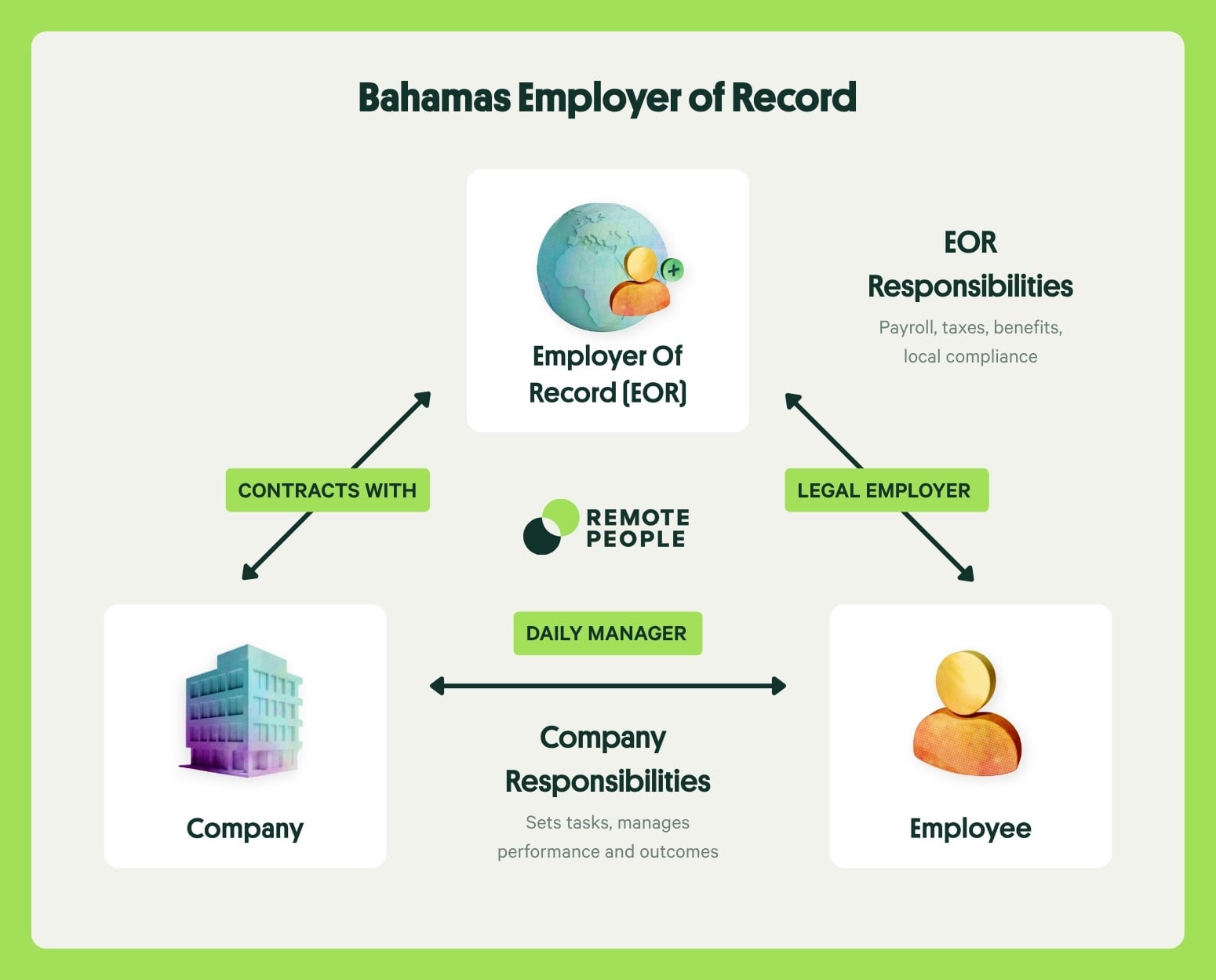
An employer of record in The Bahamas removes the need to incorporate a local company while keeping every hire fully compliant with Bahamian labour law. The EOR acts as the legal employer on paper, managing employment contracts, NIB registration, payroll, statutory benefits, and work permit sponsorship. You keep full operational control over the employee’s work, performance, and day-to-day management.
How an Employer of Record Works in The Bahamas
What Is an EOR?
Who Uses an EOR in The Bahamas?
Companies typically use an EOR in The Bahamas to test the market before committing to a full entity, to hire a small team of 1 to 15 people without the overhead of incorporation, or to onboard a single high-value hire in days rather than the months entity setup would take. The model is especially useful for international businesses hiring remote workers in financial services, technology, and customer support roles that are common in the Nassau and Freeport workforce. For any company expanding into The Bahamas, an EOR removes the legal, banking, and HR barriers to a quick start.
Typical Onboarding Timeline
The onboarding process typically takes 1 to 2 weeks for Bahamian nationals:
- First, sign the EOR service agreement and share the employee’s details (1–2 days).
- Second, the EOR drafts a compliant employment contract in English and sends it for signature (2–3 days).
- Third, NIB registration and bank account setup happen in parallel (2–5 days).
- Fourth, payroll configuration and benefits enrollment are finalized (1–2 days).
- Fifth, the employee officially starts work and receives their first paycheck on the next monthly payroll cycle.
If the hire is a non-Bahamian national requiring a work permit, add 8 to 12 weeks for long-term permit processing or 7 to 10 business days for a short-term permit. An expedited processing option is available for an additional $400 fee, with decisions within 14 calendar days.
Hire in The Bahamas
Partner with RemotePeople to hire employees in The Bahamas quickly and compliantly. We handle NIB registration, Employment Act compliance, payroll, and work permits so you can focus on growing your team.
Employment Laws and Regulations in The Bahamas
Employment Contracts
The Employment Act 2001 (Bahamas.gov.bs) governs every employment relationship in the country, administered by the Department of Labour. Written contracts are standard practice and required for fixed-term arrangements, although the Act recognises oral agreements for indefinite contracts. The Act, cited as Chapter 321A of the Statute Law of The Bahamas, contains 53 sections covering hours of work, leave, notice periods, redundancy pay, and grounds for summary dismissal.
Employment contracts must cover job title, compensation, working hours, leave entitlements, notice periods, and termination conditions. Fixed-term contracts are allowed for specific projects or tasks, while indefinite contracts are the default for ongoing roles. All contracts must be written in English, the official language of business and government.
Working Hours and Overtime
The standard workweek in The Bahamas is 40 hours, typically distributed as 8 hours per day over 5 days (Employment Act 2001, Part II §8). In industrial, construction, manufacturing, transshipment, and essential services, daily hours can extend up to 12 hours under section 8(3). Overtime beyond 40 hours per week or 8 hours per day is paid at 1.5 times the regular hourly rate.
Work performed on public holidays or on an employee’s scheduled day off is paid at double the regular rate under section 10(a). Every employee is entitled to at least 48 hours of rest in each 7-day period, with no fewer than 24 of those hours taken consecutively as a “day off.” Supervisory and managerial positions are excluded from the standard hours cap under section 8(4).
The Bahamas overtime and premium pay rates · Per Employment Act 2001 |
|||
Hour Type |
Rate Multiplier |
Weekly or Daily Cap |
Notes |
|---|---|---|---|
Standard hours |
1.0× (regular rate) |
40 hrs/week, 8 hrs/day |
Set under section 8(1) after 1 February 2003. Covers non-managerial staff. |
Overtime (weekday, beyond standard) |
1.5× |
No statutory weekly cap for non-industrial roles |
Payable under section 10(b) for any work beyond 8 hrs/day or 40 hrs/week. |
Work on public holiday |
2.0× |
Double time for all hours worked |
Section 10(a) rate. Applies to any gazetted public holiday. |
Work on weekly day off |
2.0× |
Double time for all hours worked |
Section 10(a) rate. Employees are guaranteed 48 hours of rest per 7-day period. |
Industrial, construction, essential services |
Regular until 12 hrs/day, then 1.5× |
Up to 12 hrs/day |
Section 8(3) exception for manufacturing, transshipment, and law enforcement. |
Tipped tourism and hospitality staff |
Regular rate (except 2nd day off) |
Per section 10 proviso |
Overtime paid at regular rate except work on the second day off in any week, which pays 2.0×. |
Minimum Wage
The national minimum wage in The Bahamas is $6.50 per hour, equivalent to $260 per week for a 40-hour schedule, set under the Minimum Wages Act and effective since January 2023. The rate applies uniformly across all islands and sectors with no regional variations. Public sector workers receive a slightly higher minimum of $260 per week, which in practice matches the private sector rate on a 40-hour basis.
For current thresholds and sector-specific guidance, see the Bahamas minimum wage page.
Probation Period
The Employment Act 2001 does not establish a statutory probation period in The Bahamas. In practice, most employers include a 3 to 6 month probationary clause in the written contract, and collective agreements may extend probation up to 12 months. During probation, an employer may terminate employment with shorter notice, although NIB contributions apply from the very first day of work regardless of probationary status.
For a deeper breakdown of probationary rules and typical contract clauses, see the Bahamas probation period page.
Leave Entitlements
Bahamian law provides a baseline set of leave entitlements under the Employment Act 2001, covering paid annual leave, sick leave, and maternity leave. Leave accrues only after qualifying service thresholds, and paternity leave is not part of the statutory framework.
Annual Leave
Employees in The Bahamas are entitled to 2 weeks of paid annual leave after completing 12 months of continuous service, rising to 3 weeks after 7 years of service (Employment Act 2001, Part VII). After 6 months but before the first anniversary, employees accrue at least 1 week of paid leave. Unused leave generally must be taken in the same year and does not carry over unless the employer agrees.
Sick Leave
Paid sick leave amounts to 1 week (7 days) per year after 6 months of continuous service, funded entirely by the employer at 100% of wages. A medical certificate is required from the second day of absence onward; the first day does not require documentation. Unused sick days cannot be carried forward into the next leave year. After the employer’s 7-day paid obligation is exhausted, employees may claim NIB sickness benefit for longer absences.
Maternity Leave
Female employees are entitled to 12 weeks of paid maternity leave after completing 12 months of service with the same employer. The leave must include at least 1 week before the expected date of delivery and at least 8 weeks after the birth. Pay during maternity leave is shared: NIB pays a maternity benefit of up to 66.67% of average insurable wages, and the employer tops up the difference so the employee receives their full salary (NIB Benefits). Employees cannot be dismissed because of pregnancy.
Paternity Leave
Paid paternity leave is not mandated under the Employment Act 2001. Fathers are entitled to take up to 1 week of unpaid family leave around the birth of a child, provided they have completed at least 6 months of service. Some employers offer paid paternity leave voluntarily as part of a benefits package, but it is not a statutory entitlement.
Other Statutory Leave
- Bereavement (family) leave: up to 1 week unpaid on the death of a spouse, parent, or child, after 6 months of service.
- Public holiday leave: 11 paid public holidays per year (see the public holidays table).
- Jury duty leave: paid time off to attend jury service, with pay recovered from the court.
Leave Entitlements Summary
Bahamas’s labour code codifies every statutory leave type employers must grant, from annual leave to maternity, sick, and other protected absences (Employment Act 2001). The table below summarises each statutory leave category with duration and eligibility so payroll and HR can plan accruals and cover without missing a mandatory entitlement.
The Bahamas statutory leave entitlements · Per Employment Act 2001 |
||
Leave Type |
Duration |
Eligibility & Notes |
|---|---|---|
Annual Leave |
2–3 weeks/year |
2 weeks after 12 months of service; 3 weeks after 7 years. 1 week accrues between 6 and 12 months. Paid by employer. |
Sick Leave |
1 week/year |
7 days fully paid by the employer after 6 months of service. Medical certificate required from day 2. |
Maternity Leave |
12 weeks |
Eligible after 12 months with the same employer. Min 1 week prenatal, 8 weeks postnatal. NIB pays up to 66.67% and employer tops up. |
Paternity Leave |
1 week (unpaid) |
Unpaid family leave after 6 months of service. Not a statutory paid entitlement. |
Family/Bereavement Leave |
1 week (unpaid) |
On death of spouse, parent, or child. Available after 6 months of service. |
Public Holidays |
11 days/year |
Paid time off on 11 national public holidays. Work on a public holiday paid at 2× regular rate. |
Jury Duty Leave |
As required |
Paid leave to serve on a jury. Employer recovers pay from the court. |
Source: Employment Act 2001 and NIB Bahamas |
||
Statutory Employee Benefits
The core mandatory benefit in The Bahamas is enrollment in the National Insurance Board scheme, funded by a combined 11.30% contribution (6.65% employer plus 4.65% employee) on wages up to the insurable ceiling of $810 per week. NIB benefits include sickness, maternity, invalidity, retirement, survivors, industrial (workplace injury), and funeral benefits, which together form the social safety net for Bahamian workers (NIB Benefits).
Unlike many other jurisdictions, The Bahamas does not mandate employer-provided health insurance, pension contributions beyond NIB, meal or transportation allowances, or housing benefits. Most employers voluntarily offer private health insurance, group life cover, and supplementary retirement plans to remain competitive in the local labour market. For a complete breakdown of statutory and common voluntary benefits, see the Bahamas employee benefits page.
Recent Regulatory Updates (2026)
The most significant recent change to Bahamian employment costs is the NIB contribution rate increase that took effect on July 1, 2024, raising the employer rate from 5.9% to 6.65% and the employee rate from 3.9% to 4.65%. This was the first rate increase in over a decade and was paired with an expansion of the insurable wage ceiling to $810 per week (NIB Contributions).
On July 1, 2026, the insurable wage ceiling will rise again, from $810 to $830 per week, as part of the two-year adjustment cycle established by the NIB Act. The contribution percentages remain at 6.65% employer and 4.65% employee for standard employment. Beyond NIB, the Employment Act 2001 has not undergone structural amendments in the past 18 months, and the minimum wage has remained at $6.50 per hour since January 2023, though government statements have indicated further review is under consideration.
Work Permits and Visas in The Bahamas
Work Permit Requirements
Who Needs a Work Permit
Every non-Bahamian who wishes to be employed in The Bahamas must hold a valid work permit issued by the Department of Immigration. There are no bilateral exemptions: citizens of the United States, Canada, the United Kingdom, and CARICOM member states all require a work permit to take up paid employment. Spouses of Bahamian citizens may apply for a certificate of permanent residence with a right to work as an alternative to a standard work permit.
Eligibility and Required Documents
Applications are employer-driven: the prospective Bahamian employer (or the EOR acting as employer) submits the application on behalf of the foreign national. Required documents include a valid passport with at least 6 months remaining validity, a police clearance certificate from the country of residence, medical examination results, proof of qualifications, a signed employment contract, and the relevant government fees. Advertised local recruitment efforts may be required to demonstrate no qualified Bahamian was available for the role.
Processing Time and Validity
Long-term work permits typically take 8 to 12 weeks to process, depending on the complexity of the role and the volume of applications at the Department of Immigration. Short-term work permits (1 to 90 days) are processed within 7 to 10 business days. An expedited processing option is available for both permit types for an additional fee of $400, with decisions issued within 14 calendar days of filing. Standard long-term permits are valid for up to 1 year and tied to a specific employer and role.
Renewal Process
Work permit holders must file a renewal application with the Department of Immigration before the current permit expires, ideally 30 to 60 days in advance. Renewal requires an updated employment contract, proof of continued need for the role, and payment of the applicable annual fee, which ranges from $1,500 to over $10,000 depending on the job category. The employee may continue working during renewal processing, provided the application was filed on time and no adverse notice has been issued.
Common Visa Types for Foreign Workers
Foreign nationals typically need a work permit or employment-authorised visa to take up a job in Bahamas (Bahamas Department of Immigration Fee Scale). The table below summarises the most common visa categories employers use when relocating international hires, along with typical eligibility requirements and permit durations.
The Bahamas work visa types for foreign workers · 2026 |
||||
Visa Type |
Duration |
Best For |
Leads to APT? |
Processing |
|---|---|---|---|---|
Short-term work permit |
1–90 days |
Project work, training, site visits, short assignments |
No |
7–10 business days |
Long-term (annual) work permit |
Up to 1 year, renewable |
Full-time foreign hires under EOR or local entity sponsorship |
Yes, after 10+ years continuous residence |
8–12 weeks standard, 14 days with $400 expedited option |
BEATS (Bahamas Extended Access Travel Stay) |
Up to 3 years (1 year initial + 2 year extension) |
Remote workers employed by foreign companies; not for local employment |
No |
Typically 5–10 business days after online application |
Economic permanent residence |
Indefinite |
Investors, retirees, and high-net-worth individuals (minimum $750,000 property investment) |
Yes, grants right to work and reside |
Typically 3–6 months |
Spousal permit |
Tied to spouse\u2019s status |
Spouses of Bahamian citizens seeking the right to work |
Yes, leads to permanent residence after 5 years |
Typically 4–8 weeks |
For a full walkthrough of each category and the document pack required, see the Bahamas work visa and permit page.
How an EOR Handles Work Permits
An EOR acts as the official employer of record on the work permit application, handling the Department of Immigration paperwork, proof-of-advertising, and fee payments on your behalf. The employee provides their personal documents (passport, police clearance, qualifications, medical exam results), while the EOR manages the rest of the process. For a non-Bahamian hire, work permit sponsorship typically extends the standard 1 to 2 week onboarding timeline by an additional 8 to 12 weeks, or by roughly 2 weeks if the expedited processing option is used.
Payroll, Taxes, and Social Security in The Bahamas
Employer Contributions
Employers hiring in Bahamas owe mandatory contributions on top of gross salary, funding social security, health, pensions, and other statutory schemes (NIB Contributions). The table below lists the employer-side contribution rates so you can calculate the true all-in cost of each hire.
The Bahamas employer social security contributions · 2026 rates |
||
Contribution |
Rate |
Notes |
|---|---|---|
National Insurance (NIB) |
6.65% |
Covers pension, sickness, maternity, invalidity, survivors, and industrial (workplace injury) benefits. Applied to wages up to the insurable ceiling of $810/week. |
Total |
6.65% |
Combined employer obligation per employee (single NIB contribution covers all statutory social security branches). |
Source: NIB Contributions and PwC Bahamas Tax Summary |
||
Employers in The Bahamas pay a single mandatory social security contribution: 6.65% of gross wages to the National Insurance Board, up to the weekly insurable ceiling of $810 (approximately $3,510 per month). There is no separate workers’ compensation insurance, unemployment fund, or pension scheme; the NIB contribution funds all statutory social insurance branches (NIB Contributions). This gives The Bahamas one of the lowest employer burden rates in the Caribbean region.
For complete payroll and tax compliance guidance, see the Bahamas payroll and tax page.
Employee Contributions
Alongside income tax, employees in Bahamas pay statutory payroll deductions that fund social security, health cover, and other state schemes (NIB Contributions). The table below summarises the employee-side contribution rates payroll must withhold from gross pay each month.
The Bahamas employee payroll deductions · 2026 monthly withholdings |
||
Deduction |
Rate |
Notes |
|---|---|---|
National Insurance (NIB) |
4.65% |
Employee share of the combined NIB contribution; deducted from gross wages up to the insurable ceiling of $810/week. |
Personal Income Tax |
0.00% |
The Bahamas does not levy personal income tax on wages, salaries, or other earned income. |
Total |
4.65% |
Combined monthly deduction from gross salary, capped at the insurable wage ceiling. |
Source: NIB Contributions and PwC Bahamas Personal Income Tax |
||
Employees in The Bahamas have 4.65% of their gross wages deducted for NIB contributions, and nothing is withheld for income tax because the country does not levy a personal income tax on employment earnings. This means a $2,500 monthly gross salary translates into roughly $2,384 in take-home pay, putting net pay close to 95% of gross.
Income Tax
Personal income tax in Bahamas is levied on a progressive basis, with the rate rising as taxable income crosses statutory thresholds (PwC Bahamas Personal Income Tax). The table below sets out the current income-tax brackets that apply to resident employees so you can model net-of-tax compensation before making an offer.
The Bahamas income tax brackets · 2026 |
|
Annual Taxable Income (USD) |
Tax Calculation |
|---|---|
$0 and above |
0% (no personal income tax in The Bahamas) |
The Bahamas has no personal income tax. Employment earnings, investment income, capital gains, and dividends are all untaxed at the individual level, a policy that has been in place for decades and that applies equally to Bahamian citizens, permanent residents, and non-residents working on a valid permit. The main indirect tax is Value Added Tax (VAT) at a standard rate of 10%, which affects consumer prices but is not withheld through payroll.
For employers, this means payroll administration is simpler than in income-tax jurisdictions: the EOR only calculates NIB contributions on each pay run, with no tax brackets, tax-free thresholds, or end-of-year reconciliation to manage.
Payroll Cycle
Payroll in The Bahamas typically runs on a monthly or bi-weekly cycle, with bank transfer the standard payment method. The Bahamian dollar is pegged to the US dollar at a 1:1 rate, so gross and net pay can be quoted and paid in either currency without exchange-rate risk. Employers must issue pay slips showing gross wages, NIB deduction, and net pay.
NIB contributions are remitted monthly and must reach the Board by the 15th day of the month following the month they accrued. Late payments trigger penalties and interest. The EOR handles filing and remittance on every pay run, so you receive a single monthly invoice covering salary, NIB, and the EOR fee.
13th Month Salary and Bonus Pay
The Bahamas does not mandate a 13th month salary, Christmas bonus, or profit-sharing payment. The Employment Act 2001 is silent on year-end bonuses, and there is no statutory obligation to pay gratuities of any kind. In practice, many Bahamian employers choose to pay a discretionary Christmas bonus equal to one week or one month of salary as a retention tool, particularly in financial services and tourism, but this remains voluntary and at the employer’s discretion.
For EOR arrangements, any bonus, commission, or discretionary payment can be added to the monthly payroll run as agreed in the employment contract, with the EOR applying NIB contributions on the additional amount up to the weekly insurable ceiling.
Cost of Hiring Through an EOR in The Bahamas
EOR Service Fees
EOR service fees in The Bahamas typically range from $300 to $600 per employee per month. This flat USD fee covers payroll processing, NIB registration and monthly remittance, statutory leave tracking, employment contract drafting, ongoing HR support, and termination handling if needed. Work permit sponsorship for non-Bahamian hires is usually billed separately, either as a fixed-fee add-on or a pass-through of government charges.
Total Employment Cost Breakdown
The all-in cost of employing someone in Bahamas goes well beyond gross salary. The table below walks through a realistic cost build-up for a typical hire, layering mandatory employer social contributions, statutory benefits, and payroll taxes on top of base pay so finance teams can budget accurately before an offer goes out.
The Bahamas employer cost example · $1,200/month gross · 2026 |
||
Employer Cost |
Amount (USD) |
% of Gross |
|---|---|---|
Gross Salary |
$1,200.00 |
100.00% |
NIB Contribution (6.65%) |
$79.80 |
6.65% |
EOR Service Fee |
$400.00 |
33.33% |
Total Employer Cost |
$1,679.80 |
139.98% |
Source: NIB Contributions and RemotePeople |
||
The total monthly cost to employ one person through an EOR in The Bahamas is approximately $1,680 for a $1,200 gross salary, roughly 40% above gross compensation. This total includes the 6.65% NIB contribution and the EOR service fee. Because the Bahamian dollar is pegged 1:1 to the US dollar, all amounts in this article are shown in USD and are identical to local currency values.
Setting up a local entity in The Bahamas costs $10,000 to $25,000 upfront for incorporation, legal fees, and business licence, plus $6,000 to $12,000 per year in ongoing maintenance. For teams of 1 to 15 employees, the EOR model is almost always more cost-effective than entity registration.
Ready to hire in The Bahamas? Get started with RemotePeople; we handle employment contracts, NIB compliance, payroll, and full Bahamas compliance. No local entity needed.
Benefits of Using an EOR in The Bahamas
An EOR accelerates your time to hire from the 3 to 6 months required for entity incorporation, business licence, and NIB registration down to 1 to 2 weeks for a straightforward Bahamian hire. The up-front legal, accounting, and licensing costs of forming a local company (typically $10,000 to $25,000) are replaced by a predictable monthly fee of $300 to $600 per employee. For companies testing the Bahamian market or hiring a single regional lead, this is the fastest and lowest-risk way to begin.
Compliance with the Employment Act 2001 and the National Insurance Act requires accurate weekly wage reporting, monthly NIB remittance by the 15th, statutory leave tracking, and severance calculations that differ for managerial and non-managerial staff. An EOR handles all of these obligations, reducing exposure to NIB penalties, Department of Labour disputes, and wrongful-termination claims. The EOR also sponsors work permits for non-Bahamian hires and manages the renewal cycle, which is especially valuable given that work permit administration is one of the main friction points for foreign employers in The Bahamas.
The EOR model provides local expertise without a long-term structural commitment. Your provider understands Nassau and Freeport labour market norms, the severance thresholds under the Employment Act, and the practical steps for engaging with the Department of Immigration. You gain the speed, compliance assurance, and cost efficiency of a local employer without the fixed overhead of maintaining a Bahamian entity, and you can scale your team up or down as business needs change.
Termination and Offboarding in The Bahamas
Notice Periods
Notice periods under the Employment Act 2001 depend on length of service and the nature of the role (Employment Act 2001, Part VII §29). Non-managerial employees with less than 6 months of service have no statutory notice entitlement. Those with 6 to 12 months of service receive 1 week of notice. From 12 months onward, non-managerial staff are entitled to 2 weeks of notice. Employees in managerial or supervisory positions receive 1 month’s notice regardless of tenure.
Employers may elect to pay in lieu of notice, providing the employee with their full regular wages for the applicable notice period rather than requiring them to work through it. Notice must be given in writing and state the reason where applicable. Employees who resign also owe notice to their employer: 2 weeks’ notice where the period of employment is between 1 and 2 years, and 4 weeks’ notice where employment is 2 years or more, unless the employer has breached the contract.
The Bahamas statutory notice periods by position level · Per Employment Act 2001 |
|||
Position Level |
Notice Period |
During Probation |
Notes |
|---|---|---|---|
Non-managerial, under 6 months |
No statutory notice |
Not covered by statute |
Act is silent; probation is contractual and typically 3–6 months. |
Non-managerial, 6 to 12 months |
1 week |
Contractual terms apply |
Section 29(1)(a). Employer may pay in lieu of working notice. |
Non-managerial, 12 months or more |
2 weeks |
Not applicable past probation |
Section 29(1)(b). Minimum notice regardless of tenure beyond 12 months. |
Supervisory or managerial position |
1 month |
Contractual terms apply |
Section 29(1)(c). Applies regardless of length of service. |
Employee resignation (12–24 months tenure) |
2 weeks |
Contractual terms apply |
Section 29(2)(a). Owed by the employee to the employer. |
Employee resignation (24+ months tenure) |
4 weeks |
Contractual terms apply |
Section 29(2)(b). Owed by the employee to the employer. |
Severance Pay
Calculation Method
Severance pay is required on termination for redundancy or any reason other than serious misconduct, and is calculated by reference to length of service. Non-managerial employees are entitled to 2 weeks of basic pay per year of service, capped at 24 weeks (12 years of service). Managerial and supervisory employees receive 1 month of basic pay per year of service, capped at 48 weeks. Basic pay means the regular wage rate, excluding overtime, bonuses, and allowances.
Caps and Exceptions
Severance is not owed when termination is for serious misconduct documented in accordance with the Employment Act’s summary dismissal grounds, nor during a contractually valid probationary period with proper notice. Fixed-term contracts that run to their natural end do not trigger severance; early termination of a fixed-term contract without cause may trigger damages equal to the remaining contract value. The maximum severance payout under the standard formula is 24 weeks for non-managerial staff and 48 weeks for managers.
The Bahamas severance pay schedule by years of service · Per Employment Act 2001 |
|||
Years of Service |
Severance Amount |
Base Salary |
Notes |
|---|---|---|---|
Less than 1 year |
None |
Not applicable |
Section 26(1) sets a minimum of 1 year continuous service for redundancy pay. |
1 to 12 years (non-managerial) |
2 weeks\u2019 basic pay per year of service |
Regular wage, excluding overtime, bonuses, and allowances |
Section 26(2)(a). Plus 2 weeks\u2019 notice or pay in lieu on top. |
12+ years (non-managerial) |
Capped at 24 weeks\u2019 basic pay |
Regular wage, excluding overtime, bonuses, and allowances |
Section 26(2)(a). Statutory ceiling for weekly-paid staff. |
1 to 12 years (supervisory or managerial) |
1 month\u2019s basic pay per year of service |
Regular monthly wage, excluding overtime, bonuses, and allowances |
Section 26(2)(b). Plus 1 month\u2019s notice or pay in lieu on top. |
12+ years (supervisory or managerial) |
Capped at 48 weeks\u2019 basic pay |
Regular monthly wage, excluding overtime, bonuses, and allowances |
Section 26(2)(b). Statutory ceiling for managerial staff. |
Dismissal for serious misconduct |
None |
Not applicable |
Summary dismissal under Part VIII. Grounds include theft, fraud, and gross negligence. |
Grounds for Termination
The Employment Act 2001 distinguishes between summary dismissal for serious misconduct (which does not require notice or severance), termination for cause with notice and severance for documented performance or conduct issues, and termination by redundancy where severance is owed. Grounds for summary dismissal are listed in the Act and include theft, fraud, willful disobedience, and gross negligence.
Certain employees receive enhanced protection. Pregnant employees cannot be dismissed because of their pregnancy, and employees on approved sick leave or maternity leave cannot be terminated during that leave. Union representatives and members are protected from dismissal based on union activity under the Industrial Relations Act.
EOR vs. Other Hiring Models in The Bahamas
EOR vs. Setting Up a Local Entity
Choosing between an Employer of Record and setting up your own legal entity in Bahamas comes down to timeline, upfront cost, ongoing administrative burden, and how quickly you can scale up or wind down. The table below lays out both paths side by side across setup time, cost, compliance risk, and flexibility so you can match the right model to the size and duration of your Bahamas hiring plan.
The Bahamas EOR vs local entity comparison · Setup time, cost, risk and best-fit |
||
Comparison |
Employer of Record |
Own Entity |
|---|---|---|
Setup time |
1–2 weeks |
3–6 months |
Upfront cost |
$0 |
$10,000–$25,000 |
Ongoing cost |
$300–$600/employee/month |
$6,000–$12,000/year maintenance |
Local partner required |
No (EOR is the local entity) |
No (but requires legal, accounting, HR setup) |
Social insurance registration |
Handled by EOR |
You manage it |
Payroll & tax filing |
Handled by EOR |
You manage it (or outsource) |
Best for team size |
1–15 employees |
15+ employees |
Scale down / exit |
Easy, no entity to unwind |
Costly, legal dissolution required |
Government contracts |
Not eligible |
Eligible (requires local entity) |
Source: RemotePeople and PwC Bahamas |
||
The EOR model is the fastest and lowest-cost way into the Bahamian market for companies hiring a single employee or a small remote team. You sidestep the incorporation process, the business licence application, NIB employer registration, and the ongoing maintenance of a local company. For teams of 1 to 15 people, the EOR monthly fee is nearly always cheaper than entity overhead.
A local entity becomes financially justified once you have roughly 15 or more employees in The Bahamas, where the annual maintenance cost of $6,000 to $12,000 is spread across a larger workforce. An own entity also opens access to Bahamian government contracts, provides direct control over HR policies and office infrastructure, and can be useful for financial-services operators seeking local licensing.
The choice comes down to team size, speed of entry, and long-term commitment. For rapid low-risk hiring with full compliance, an EOR is the standard path. For established operations planning long-term investment in The Bahamas, entity setup provides greater control and cost efficiency at scale.
EOR vs. Hiring Independent Contractors
Classifying a Bahamas-based worker as an independent contractor rather than an employee can expose you to back-taxes, unpaid social contributions, and reclassification penalties if the working relationship looks like employment in practice. The table below contrasts EOR employment with contractor engagement across legal relationship, tax and benefits treatment, IP ownership, and misclassification risk so you can pick the right model role by role.
The Bahamas EOR vs independent contractors · Compliance, cost, and risk |
||
Comparison |
EOR (Full-Time Employee) |
Independent Contractor |
|---|---|---|
Legal relationship |
Employee of the EOR |
Self-employed, no employment relationship |
Compliance risk |
Low, EOR ensures Employment Act compliance |
Higher, misclassification risk if the relationship resembles employment |
Payroll & tax |
EOR handles NIB deductions and remittance |
Contractor invoices you and pays self-employed NIB (10.3%) |
Benefits & leave |
Statutory leave, sick pay, NIB coverage |
No entitlement to employee benefits |
IP protection |
Stronger, employment contract assigns IP by default |
Weaker, requires explicit IP assignment clause |
Termination |
Subject to Employment Act notice and severance |
Contract can be ended per agreement terms |
Best for |
Long-term, core team roles |
Short-term projects, specialized tasks |
Cost structure |
Salary + NIB + EOR fee |
Contractor fee (typically higher gross, lower total cost) |
Source: RemotePeople and Employment Act 2001 |
||
Hiring through an EOR provides legal certainty and full compliance with the Employment Act 2001, while engaging independent contractors is only appropriate in some cases such as short-term project work, specialized consulting, and roles with genuine autonomy over work methods and schedule. Bahamian labour authorities and courts look at the substance of the working relationship rather than the label on the contract, and a relationship that resembles full employment in practice can be reclassified.
Misclassification (treating a de facto employee as an independent contractor) can trigger back NIB contributions, penalties, and retroactive entitlement to severance, leave, and sickness benefits. The financial exposure is real: several years of unpaid contributions plus accrued interest, combined with potential Department of Labour disputes, can easily exceed the savings from avoiding the employer relationship in the first place.
For ongoing team members, core business functions, and roles requiring direction and supervision, an EOR employee is the compliant choice. For genuinely independent project-based engagements, RemotePeople also offers a dedicated Bahamas contractor management solution that handles compliant contractor payments, contracts, and classification risk.
EOR vs. PEO (Professional Employer Organization)
EORs and PEOs both simplify international hiring, but only an EOR becomes the legal employer of record in Bahamas — a critical distinction when you don’t have a local entity of your own. The table below maps the practical differences across legal employer status, entity requirement, liability allocation, and scope of coverage.
The Bahamas EOR vs PEO comparison · Legal employer, liability, and setup |
||
Comparison |
Employer of Record (EOR) |
PEO |
|---|---|---|
Legal employer |
EOR is the legal employer |
You remain the legal employer (co-employment) |
Local entity required |
No, the EOR is the local entity |
Yes, you must have your own entity in The Bahamas |
Best for |
Companies without a local entity |
Companies that already have a local entity |
Compliance liability |
EOR assumes compliance responsibility |
Shared liability between you and the PEO |
Setup time |
1–2 weeks |
Depends on your entity setup (weeks to months) |
Control over HR policies |
EOR manages within local law framework |
More direct control, PEO advises |
Typical use case |
Market entry, small remote teams, testing new markets |
Established local operations needing HR outsourcing |
Source: RemotePeople and PwC Bahamas |
||
The fundamental difference is entity ownership: an EOR is the legal employer and provides the local entity, while a PEO operates as a co-employer and requires you to already have a Bahamian company. The Bahamas does not have a formal statutory PEO framework, so international providers in the country operate almost exclusively under the EOR model rather than as true co-employers.
An EOR is the right choice for companies entering The Bahamas without existing local infrastructure that need to hire employees within weeks rather than months. If you already own a Bahamian entity and simply want to outsource payroll processing, NIB administration, or HR support, a service provider can take that work on under a straightforward administrative services agreement. That arrangement is closer to outsourcing than to a true PEO.
For most foreign companies weighing these options, the decision is simple: without a Bahamian company in place, the EOR is the path to employment within 1 to 2 weeks. With an existing local entity, a payroll or HR service provider can handle ongoing administration without the legal complexity of co-employment.
Public Holidays in The Bahamas
Bahamas observes a defined set of official public holidays on which most private-sector employers must give staff a paid day off (Bahamas.gov.bs Public Holidays). The table below lists the statutory holidays employers need to build into payroll calendars and leave planning for the year, along with the date rule for each.
The Bahamas public holidays · 2026 calendar year |
||
Date |
Holiday |
Type |
|---|---|---|
January 1 | New Year’s Day | Fixed |
January 12 | Majority Rule Day (observed) | Fixed (obs.) |
April 3 | Good Friday | Movable |
April 6 | Easter Monday | Movable |
May 25 | Whit Monday | Movable |
June 5 | Labour Day | Movable |
July 10 | Independence Day | Fixed |
August 3 | Emancipation Day | Movable |
October 12 | National Heroes Day | Movable |
December 25 | Christmas Day | Fixed |
December 28 | Boxing Day (observed) | Fixed (obs.) |
Source: Bahamas.gov.bs Public Holidays and timeanddate.com |
||
The Bahamas observes 11 paid public holidays in 2026. When a fixed holiday falls on a weekend, the government typically declares an observed day on the following Monday, which is treated as the official paid holiday for payroll and leave purposes. Employees required to work on a public holiday are entitled to double the regular daily wage in addition to standard compensation.
How to Get Started with an EOR in The Bahamas
Launching your Bahamian team through an EOR follows a straightforward sequence:
- First, define the role, responsibilities, and total compensation package in US dollars (which are accepted at par with Bahamian dollars).
- Second, select an EOR provider with established operations in The Bahamas, such as RemotePeople, and confirm the service scope, work permit support, and fee structure.
- Third, the EOR drafts a compliant employment contract under the Employment Act 2001 and shares it for your review and the employee’s signature.
- Fourth, NIB registration, bank account setup, and payroll configuration are completed by the EOR in parallel.
- Fifth, the new employee begins work within 1 to 2 weeks of contract signature, with the EOR managing all ongoing payroll, NIB remittance, and compliance.
Ready to build your team in The Bahamas? Contact RemotePeople for a free consultation on hiring costs, timelines, and compliance.
Where companies hiring in the Bahamas expand next
Employers with operations in the Bahamas often extend across the Caribbean and nearby US-adjacent markets. Most teams start with a team in Trinidad and Tobago — CARICOM mobility and shared Caribbean business practices. Operations in Barbados typically follows, with aligned CARICOM employment frameworks. The Dominican Republic is a natural addition for CARICOM-wide workforce portability, and hiring in Jamaica completes the regional picture with shared Caribbean labor and trade norms.
Frequently Asked Questions
EOR service fees in The Bahamas typically range from $300 to $600 per employee per month as a flat USD amount. Beyond this fee, you pay the employee's gross salary plus the 6.65% employer NIB contribution (capped at $810/week of insurable wages). For a $1,200/month gross salary, total monthly employer cost including the EOR fee is approximately $1,680, or about 40% above gross. This is one of the lowest employer burdens in the Caribbean.
An EOR is an employment model, so it does not directly support contractor engagements. However, RemotePeople offers a dedicated Bahamas contractor management solution that handles compliant contractor payments, contracts, and classification risk under Bahamian labour law. This keeps contractor relationships distinct from full employment and reduces the risk of reclassification by the Department of Labour or NIB.
The employment contract assigns intellectual property created during the course of employment to the client company (you), not the EOR. The EOR makes sure the contract includes proper IP assignment language so all work products, inventions, and creative output flow directly to your business. You should confirm with the EOR that the IP clause covers all deliverables and is enforceable under Bahamian common law.
Standard onboarding takes 1 to 2 weeks from contract signature to the employee's first day for Bahamian nationals. If the hire is a non-Bahamian requiring a work permit, the process extends to 9 to 14 weeks for standard long-term permits, or around 3 to 4 weeks if the $400 expedited processing option is used. Short-term permits (1 to 90 days) are issued within 7 to 10 business days.
Bahamian employers must enroll every worker in the National Insurance Board scheme (6.65% employer contribution), provide 2 to 3 weeks of paid annual leave (depending on tenure), 1 week of paid sick leave per year after 6 months of service, 12 weeks of paid maternity leave after 12 months of service, and observe the 11 national public holidays. For a detailed breakdown of each benefit, visit the Bahamas employee benefits page.
The national minimum wage in The Bahamas is $6.50 per hour, equivalent to $260 per week for a 40-hour workweek, effective since January 2023 under the Minimum Wages Act. The rate applies uniformly across all islands and sectors. For the latest updates, see the Bahamas minimum wage page.
No. The Bahamas does not levy a personal income tax on wages, salaries, capital gains, dividends, or any other form of personal income. The only statutory payroll deduction is the 4.65% employee National Insurance contribution, capped at the weekly insurable wage ceiling of $810. Indirect taxes such as VAT (10% standard rate) exist but are not collected through payroll.
No. An employer of record acts as the legal employer and local entity on your behalf, removing the need to incorporate a Bahamian company. The EOR handles NIB registration, payroll, statutory leave tracking, and Department of Immigration filings for any work permits. This lets you hire and manage employees in The Bahamas without the administrative, legal, or financial overhead of forming a local entity. Contact RemotePeople to get started.
Employer of Record in
Employer of Record in
Employer of Record in
Employer of Record in
Employer of Record in
Employer of Record in
Employer of Record in
Saint Vincent and the Grenadines
Employer of Record in




