
 Recruit
Employer of Record (EOR) in the Dominican Republic
-
 Drew Donnelly
- Published
- July 21, 2026
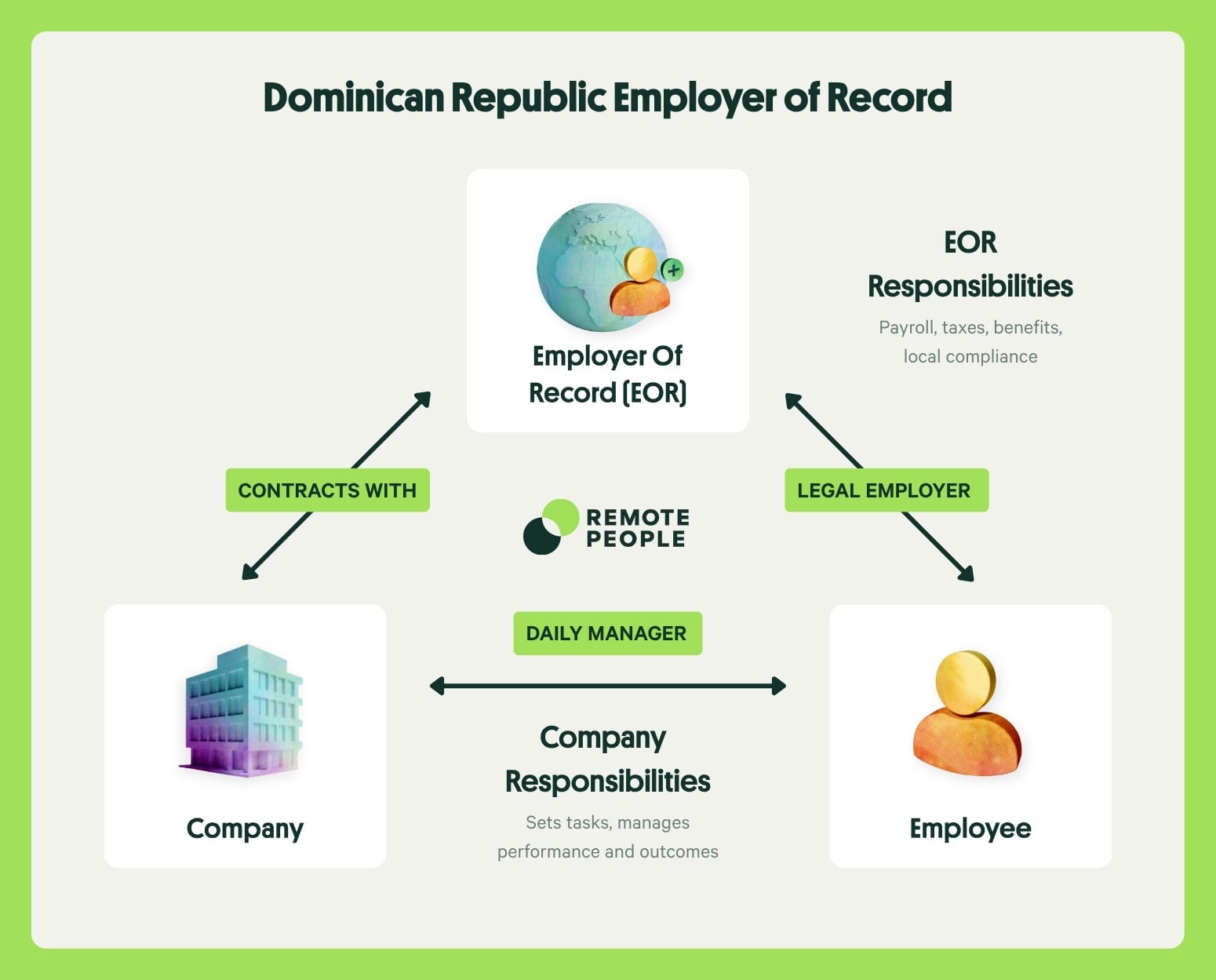
An Employer of Record (EOR) in the Dominican Republic is a locally registered entity that hires employees on your behalf, managing DGT labor contracts, TSS social security, ARS health insurance, AFP pension contributions, and Código de Trabajo compliance. A Dominican Republic EOR lets you hire workers in two weeks—no RNC business registration required.
Hire in Dominican Republic — book a free 30-minute demo
No sales call required. Free 30-minute expert call if you want one.
Tell us about your company
So we can match you with a specialist who knows your market — and unlock volume pricing tiers.
* All fields are required.
Where and when are you hiring?
Tell us the geography and timing and we'll quote each country line by line, with onboarding timelines.
* All fields are required.
Help us beat your current setup
We'll benchmark your current deal and send a line-by-line proposal in 24 hours — showing exactly where we cut cost, time, or risk. After you submit, you can book a call to walk through it together.
* All fields are required.
Thanks! Your proposal is on its way.
Expect a tailored, line-by-line proposal in your inbox within 24 hours. In the meantime…
Want to walk through it together?
Book a free 30-minute call with one of our specialists. We'll explain every line, answer your questions, and tailor the proposal further if you need.
No obligation. Pick a time that works for you.








- Hire in Dominican Republic — book a free 30-minute demo
- Tell us about your company
- Where and when are you hiring?
- Help us beat your current setup
- Thanks! Your proposal is on its way.
- How an Employer of Record Works in the Dominican Republic
- Employment Laws and Regulations in the Dominican Republic
- Work Permits and Visas in the Dominican Republic
- Payroll, Taxes, and Social Security in the Dominican Republic
- Cost of Hiring Through an EOR in the Dominican Republic
- Benefits of Using an EOR in the Dominican Republic
- Termination and Offboarding in the Dominican Republic
- EOR vs. Other Hiring Models in the Dominican Republic
- Public Holidays in the Dominican Republic
- How to Get Started with an EOR in the Dominican Republic
- Where companies hiring in the Dominican Republic expand next
- Frequently Asked Questions
- Related EOR Destinations

Start hiring in Dominican Republic
Let RemotePeople handle payroll, compliance, and HR admin worldwide so you can focus on building your team.

The Dominican Republic is the largest economy in the Caribbean and a top nearshore hiring market for North American technology, BPO, manufacturing, and tourism employers. Hiring directly in the country means working through the Código de Trabajo (Ley 16-92), registering with the Tesorería de la Seguridad Social (TSS) for AFP pension, SFS health, and labour-risk contributions, withholding ISR income tax for the Dirección General de Impuestos Internos (DGII), and routing any foreign hires through the Dirección General de Migración. An employer of record in the Dominican Republic absorbs every one of those obligations as the legal employer of your staff, so you can hire, pay, and manage a team without incorporating a local entity.
This guide explains how an employer of record in the Dominican Republic works, what the Labour Code requires in 2026, what hiring through an EOR actually costs, and how the model compares with setting up your own SRL, hiring contractors, or using a PEO. Every figure is verified against the Código de Trabajo, the 2026 TSS contribution schedules published by the social security treasury, and the ISR brackets confirmed in the PwC Worldwide Tax Summaries.
How an Employer of Record Works in the Dominican Republic
What Is an EOR?
Who Uses an EOR in the Dominican Republic?
An employer of record in the Dominican Republic is typically used by companies that want a compliant hire without committing to a full entity setup. Common situations include nearshore software and customer-support teams hiring developers in Santo Domingo and Santiago, US and Canadian employers building bilingual call-centre operations, manufacturers extending free-zone operations into Dominican territory, and tourism or hospitality groups bringing expatriate management into Punta Cana or Bávaro.
The model also fits any business hiring between one and twenty employees in the country, where incorporating a Sociedad de Responsabilidad Limitada (SRL) would be slower and more expensive than the EOR fee for the first twelve to twenty-four months. Companies that want to test the Dominican market before committing to a permanent presence routinely start with an EOR and only incorporate once headcount or contract requirements demand it.
Typical Onboarding Timeline
Most EOR providers can onboard a Dominican employee within one to two weeks if no work permit is required. The stages are sequential but short:
- First, sign the EOR service agreement and share the employee’s details, proposed salary, role, and start date (1-2 days).
- Second, the EOR drafts a compliant Código de Trabajo contract in Spanish and sends it for employer and employee signature (2-3 days).
- Third, TSS registration, RNC employer setup, AFP and ARS enrollment, and bank account collection run in parallel (3-5 days).
- Fourth, payroll is configured, statutory benefits are enrolled, and the employee is onboarded into your systems (1-2 days).
- Fifth, the employee begins work on the agreed start date.
Timelines extend when a residence permit is required (add 6-10 weeks for MIREX and Migración processing), when academic credentials need apostille legalisation, or when the role requires a regulated professional licence such as medical, legal, or engineering certification.
Hire in the Dominican Republic
A skilled bilingual workforce, a nearshore time zone aligned with US business hours, competitive labour costs, and a stable Caribbean economy make the Dominican Republic a top hiring destination for technology, BPO, and manufacturing teams.
We handle employment contracts, payroll, ISR withholding, and TSS compliance, plus full Código de Trabajo coverage.
No local entity needed. Your Dominican team can start in days.
Employment Laws and Regulations in the Dominican Republic
Employment Contracts
Employment relationships in the Dominican Republic are governed by the Código de Trabajo (Ley 16-92), in force since 1992 and administered by the Ministerio de Trabajo. Contracts can be indefinite, fixed-term, or for a specific task, but Dominican law strongly favours the indefinite contract: fixed-term agreements are only valid where the nature of the work objectively justifies a time limit, and any contract that does not meet that test is treated as indefinite by default. Written contracts are recommended for evidentiary purposes, although purely verbal contracts remain legally valid.
Every contract must specify the job title, wage, place of work, hours, and probation period if any. The working language for employment documentation is Spanish, and the standard practice is for the EOR to issue a Spanish-language master with an English translation for the foreign client’s records.
Working Hours and Overtime
The standard workweek under Article 147 of the Código de Trabajo is 44 hours, typically spread across five and a half days, with a maximum of 8 hours per day. Article 149 requires at least 36 consecutive rest hours per week, normally taken from Saturday afternoon through Monday morning. Night shifts (9 pm to 7 am) are capped at 8 hours and earn a 15% premium over daytime pay.
Overtime above 44 hours per week is paid at a 35% premium over the regular hourly rate, and any work beyond 68 hours in a week is paid at a 100% premium under Article 203. Sunday and public-holiday work performed beyond the normal weekly limit attracts a 100% premium. Executives, managers, and employees in positions of trust as defined in Article 200 are excluded from the overtime regime.
The table below summarises the legal framework for working hours and premium pay under the Dominican Código de Trabajo.
Dominican Republic overtime and premium pay rates · Per Código de Trabajo (Ley 16-92) | |||
Work Scenario | Hours or Context | Pay Rate | Legal Reference |
|---|---|---|---|
Standard workweek | Up to 44 hours per week | 100% base rate | Art 147, Art 149 |
Overtime (tier 1) | Hours 45 to 68 per week | 135% (base plus 35%) | Art 203 |
Overtime (tier 2) | Above 68 hours per week | 200% (base plus 100%) | Art 203 |
Night work | Between 9:00 pm and 7:00 am | 115% (base plus 15%) | Art 204 |
Rest day or public holiday work | Beyond the weekly hours limit | 200% (base plus 100%) | Art 203, Law 139-97 |
Source: Ministerio de Trabajo and Código de Trabajo (Ley 16-92) | |||
Minimum Wage
The Dominican Republic uses a tiered minimum-wage structure for the non-sectorized private sector, with rates indexed to the size of the employer rather than the job category. Effective 1 February 2026, monthly minimum wages were set at DOP 29,988 (about $496) for large companies, DOP 27,489.60 (about $455) for medium employers, DOP 18,421.20 (about $305) for small employers, and DOP 16,993.20 (about $281) for micro enterprises, following a two-phase 20% increase agreed by the Comité Nacional de Salarios in early 2025 (WageIndicator Dominican Republic). Sectoral wages apply in free zones, hotels, agriculture, security, and construction, with separate scales published by Comité Nacional de Salarios resolutions. All USD figures throughout this guide use an April 2026 reference rate of $1 = DOP 60.43.
Probation Period
Probation in the Dominican Republic is short and tightly regulated. Article 80 of the Código de Trabajo treats the first three months of an indefinite contract as the trial period, during which either party may terminate without notice or severance. After the three-month threshold, the employee acquires full Code protection and any termination must follow the just-cause, notice, and severance rules. Our Dominican Republic probation guide walks through the calculation rules and edge cases in detail.
Leave Entitlements
The Código de Trabajo sets statutory minimums for annual leave, sick leave, maternity leave, and a short list of family-event leave categories. Most entitlements accrue with continuous service, and many collective bargaining agreements in regulated sectors improve on the floor set by the Code.
Annual Leave
Article 177 of the Código de Trabajo grants fourteen working days of paid annual leave after one year of continuous service, rising to eighteen working days after five years. Leave must be taken within the year following accrual, and unused leave is paid out in cash on termination. Employers cannot replace leave with pay during ongoing employment except in exceptional circumstances authorised by the Ministerio de Trabajo.
Sick Leave
The Código de Trabajo does not impose a specific paid sick-leave allowance on the employer beyond the rules of the Sistema Dominicano de Seguridad Social. Under the SFS health branch, employees who are unable to work due to non-occupational illness receive a daily allowance of 60% of base contributable salary from the fourth day of absence, paid by the SFS scheme for up to 26 weeks per illness episode. The employer covers the first three days at full pay. A licensed physician’s certificate must be filed with the employer and the ARS within 48 hours.
Maternity Leave
Pregnant employees are entitled to fourteen weeks of paid maternity leave under Article 236 of the Código de Trabajo: 7 weeks before the expected date of delivery and 7 weeks after birth. Pay is funded by the SFS maternity allowance at 100% of contributable salary, subject to the SFS ceiling of 10 minimum wages. Mothers cannot be dismissed during pregnancy or for the six months following return to work without prior authorisation from the Ministerio de Trabajo. Nursing mothers are entitled to three 20-minute breastfeeding breaks per day during the first year after birth.
Paternity Leave
Fathers receive 2 paid days of leave following the birth of a child, granted under the family-event provisions of Article 54 of the Código de Trabajo. Some collective bargaining agreements and large employers extend paternity leave to 5 or 7 days, but this is voluntary rather than statutory.
Other Statutory Leave
Article 54 of the Code provides short paid family-event leave for marriage of the employee (5 days), death of a spouse, parent, or child (3 days), and other specified life events. Religious public holidays carry their own paid rest entitlement and are listed in the holidays table further down this guide.
Dominican Republic statutory leave entitlements · Per Código de Trabajo Ley 16-92 | ||
Leave Type | Duration | Eligibility & Notes |
|---|---|---|
Annual leave | 14 working days (rising to 18 after 5 years) | Article 177. Accrues after 1 year of continuous service. Paid by employer at full salary. |
Sick leave | Up to 26 weeks | Employer pays first 3 days at full salary. SFS pays 60% of contributable salary from day 4, capped at 10 minimum wages. |
Maternity leave | 14 weeks | Article 236. 7 weeks prenatal + 7 weeks postnatal at 100% salary, paid by SFS. Dismissal protection during pregnancy and 6 months after return. |
Paternity leave | 2 days | Article 54. Paid by employer at full salary on birth of a child. |
Marriage leave | 5 days | Article 54. Paid family-event leave for marriage of the employee. |
Bereavement leave | 3 days | For death of spouse, parent, child, or sibling. Paid by employer. |
Public holidays | 12 days in 2026 | Set by national decree. Work performed on a holiday earns a 100% premium when above the weekly hours limit. |
Statutory Employee Benefits
The Dominican Republic’s statutory benefit package is built around the Sistema Dominicano de Seguridad Social created by Law 87-01, which combines a pension branch (AFP), a family health branch (SFS), and a labour-risks branch (SRL) into a single contributory scheme administered by the Tesorería de la Seguridad Social. Every formal employee in the country is automatically enrolled in all three branches from the first day of work, with contributions split between employer and employee as detailed in the payroll section of this guide.
On top of TSS coverage, the Código de Trabajo guarantees a mandatory Christmas salary (salario de Navidad) equal to one-twelfth of the wages earned during the calendar year, payable no later than 20 December under Article 219. Profit sharing is also mandatory under Article 223, requiring most employers to distribute 10% of net profits among employees subject to a per-employee cap of 45 days of salary for staff with under three years of service and 60 days for longer-tenured employees. Detailed benefit categories and market practice for supplementary perks are summarised in our Dominican Republic employee benefits guide.
Recent Regulatory Updates (2026)
The most significant recent change is the two-phase 20% minimum-wage increase agreed by the Comité Nacional de Salarios in February 2025. The first 12% phase took effect on 1 April 2025 and the remaining 8% phase on 1 February 2026, lifting the large-employer monthly floor to DOP 29,988 (WageIndicator). The Código de Trabajo itself has not been substantially amended, although bills to recognise remote work, harmonise paternity leave, and modernise severance have been under congressional review since 2024.
On the tax side, the DGII confirmed the 2026 ISR brackets through Aviso 01-2026, leaving the exemption threshold at DOP 416,220 of annual taxable income and keeping the top marginal rate at 25% on income above DOP 867,123 (PwC Worldwide Tax Summaries). Employers should also note that the Banco Central’s currency regulations require all payroll to be denominated and paid in Dominican pesos, even where the employment contract is signed with a foreign client and the underlying compensation is benchmarked in USD.
Work Permits and Visas in the Dominican Republic
Work Permit Requirements
Who Needs a Work Permit
Every foreign national who is not a Dominican citizen or permanent resident needs immigration authorisation to take up paid employment in the country. Citizens of the United States, Canada, the European Union, and most Latin American countries can enter visa-free or with a tourist card for up to 30 to 60 days, but tourist status does not authorise work. To take up an employment contract, the foreign hire needs a residence-for-work visa (Visado de Residencia con fines laborales) issued by MIREX, followed by a residence permit (Carnet de Residencia) issued by the Dirección General de Migración after arrival.
Eligibility and Required Documents
Under General Migration Law 285-04 and its implementing Decree 631-11, the employer must show that the position is being filled by a qualified foreign professional, and the foreign worker must hold credentials matching the role. The standard dossier includes a valid passport with at least one year of remaining validity, a signed Dominican employment contract, apostilled diplomas and professional certificates, an apostilled criminal-record extract from the home country, a recent medical certificate, passport photos, and proof of payment of the application fees at MIREX and Migración.
Processing Time and Validity
MIREX typically issues the residence visa within 4 to 8 weeks of receiving a complete consular dossier, after which the worker enters the country and applies for the residence card at Migración in Santo Domingo within 30 days. Residence permits are issued for one year initially and renewed annually for the duration of the employment contract. The worker is also required to register with the Junta Central Electoral to receive a Cédula de Identidad y Electoral (national ID), which is needed to open a Dominican bank account and enroll with TSS.
Renewal Process
Renewals must be filed at least 60 days before the residence permit expires, with an updated employment contract, renewed medical certificate, and proof of continued enrollment in TSS. Foreign employees can usually continue working during the renewal review provided the application was filed on time. More detail on the end-to-end process is covered in our DR work visa guide.
Common Visa Types for Foreign Workers
Most foreign hires in the Dominican Republic move through one of five main immigration categories. The residence-for-work visa is by far the most common for permanent hires, while business visas and short-stay tourist cards are used for scoping trips, training, and project visits. Investors and senior executives bringing capital into the country can also use the investor residence track under Law 171-07.
Dominican Republic work visa and permit types for foreign workers · 2026 | ||||
Visa or Permit | Issuing Authority | Who It Is For | Typical Duration | Work Rights |
|---|---|---|---|---|
NM1 Business Visa for Employment | MIREX consulate abroad | Foreign hire sponsored by a Dominican employer | Up to 1 year, renewable | Permits employment with the sponsoring employer |
RS Residence for Work Visa | MIREX with DGM registration | Employees on multi year assignments in country | 1 year initial, renewable | Entry visa that leads to a Carnet de Residencia |
Carnet de Residencia residence card | Dirección General de Migración | Foreign workers already on an NM1 or RS visa | 1 year renewable, then multi year renewals | Required after 90 days of residence based work |
RS Investor Visa under Law 171-07 | MIREX | Foreign investors and qualifying retirees | 1 year, convertible to permanent residency | Work rights limited to the investor own business |
NS or NM Business Visa | MIREX consulate abroad | Short business trips, meetings, and training | 60 days single entry or 1 year multi entry | No employment permitted under this visa class |
How an EOR Handles Work Permits
An employer of record in the Dominican Republic can sponsor the residence visa directly because it is already registered with the DGII, holds an RNC, and has an active TSS employer account. The EOR prepares the employer letter, files the supporting documentation with MIREX, coordinates the apostille and translation steps, and submits the post-arrival residence permit application to Migración on the employee’s behalf. The employee is responsible for providing a valid passport, apostilled diplomas, the home-country police record, and the medical certificate.
Because the residence visa process adds 6 to 10 weeks to the timeline outlined in section 1.4, onboarding for a foreign hire through an EOR typically lands at 8 to 12 weeks from contract signature rather than the 1 to 2 weeks required for a Dominican national. The EOR also handles the annual renewal cycle and the Junta Central Electoral cédula registration without you having to set up a local subsidiary.
Payroll, Taxes, and Social Security in the Dominican Republic
Employer Contributions
Employers in the Dominican Republic pay a combined statutory burden of approximately 16.39% of gross salary across the four social-security and training branches: AFP pension, SFS family health, SRL labour-risks insurance, and the INFOTEP technical training tax. Each branch has its own contribution ceiling expressed as a multiple of the national minimum wage, so high-salary employees are capped on the AFP and SFS lines but pay full rate on INFOTEP.
Dominican Republic employer payroll contributions · 2026 rates | ||
Contribution | Rate | Notes |
|---|---|---|
AFP pension fund | 7.10% | Funds the AFP individual pension account. Contributable wage capped at 20 minimum wages. |
SFS family health insurance | 7.09% | Funds family health coverage through the chosen ARS. Contributable wage capped at 10 minimum wages. |
SRL labour-risks insurance | 1.20% | Funds occupational accident and illness coverage. Contributable wage capped at 4 minimum wages. |
INFOTEP technical training tax | 1.00% | Payroll tax funding the national vocational training institute. Applies to total monthly payroll. |
Total employer burden | 16.39% | Remitted via TSS by the third working day of the month following payroll. |
Employee Contributions
Employees in the Dominican Republic contribute a combined 5.91% of gross pay to the social security scheme before income tax is calculated. The 2.87% AFP pension and 3.04% SFS health deductions are both withheld from gross salary at source by the employer and remitted to TSS together with the employer share. Income tax (ISR) is then computed on the post-contribution figure using the progressive bracket structure described in section 4.3.
Dominican Republic employee payroll deductions · 2026 monthly withholdings | ||
Deduction | Rate | Notes |
|---|---|---|
AFP pension fund | 2.87% | Mirrors the employer pension contribution. Capped at 20 minimum wages of contributable salary. |
SFS family health insurance | 3.04% | Funds the employee’s family health coverage. Capped at 10 minimum wages of contributable salary. |
ISR income tax | 0% – 25% | Progressive, applied to monthly net taxable income after social security deductions (see H3 4.3). |
Total employee deductions (excl. ISR) | 5.91% | 2.87% AFP + 3.04% SFS, before ISR withholding. |
Income Tax
The Impuesto Sobre la Renta (ISR) is a progressive monthly withholding tax on employment income, with rates running from 0% on the lowest band up to 25% on the top band. Social security contributions are deductible before ISR is computed, so the effective rate on a typical mid-level salary is lower than the headline bracket suggests. The DGII confirmed the 2026 brackets in Aviso 01-2026 with no change from the 2025 thresholds.
Dominican Republic income tax (ISR) brackets · 2026 | |
Annual Taxable Income (USD) | Tax Calculation |
|---|---|
Up to $6,888 | 0% |
$6,888 to $10,332 | 15% on the portion above $6,888 |
$10,332 to $14,349 | $517 plus 20% on the portion above $10,332 |
Above $14,349 | $1,320 plus 25% on the portion above $14,349 |
Thresholds are converted from Dominican pesos at the April 2026 reference rate of $1 = DOP 60.43. The underlying annual ISR bands in DOP are 416,220, 624,329, and 867,123, with fixed-amount adjustments of DOP 31,216 and DOP 79,776 at the second and third break points. Non-residents are taxed at a flat 27% on Dominican-source income under Article 297 of the Tax Code.
Payroll Cycle
Payroll in the Dominican Republic is run monthly, fortnightly, or weekly depending on collective agreement and industry practice, with monthly being the dominant cycle for office and professional staff. Wages are paid in Dominican pesos by bank transfer to the employee’s local account, and the Banco Central restricts cash payments above the minimum wage. Employers must issue a detailed pay slip showing gross pay, every contribution line, ISR withheld, and net pay.
TSS contributions for both employer and employee are remitted by the third working day of the month following payroll through the Sistema Único de Información y Recaudo (SUIR Plus) portal. ISR is withheld monthly and reported to DGII through the IR-3 declaration, with annual reconciliation due in March of the following year.
13th Month Salary and Bonus Pay
The Dominican Republic has a mandatory 13th month payment, known as the salario de Navidad, codified in Article 219 of the Código de Trabajo, known as the salario de Navidad. The Christmas salary is calculated as one-twelfth of the total wages earned during the calendar year, paid no later than 20 December, and capped at the equivalent of one month’s salary for the purpose of the calculation. The salario de Navidad is exempt from ISR and from social security contributions, which makes it one of the more efficient compensation lines in the Dominican payroll. In addition to the 13th month, Article 223 requires most private employers to distribute 10% of net profits to employees as a profit-sharing bonus (participación de los beneficios), subject to per-employee caps based on length of service.
Cost of Hiring Through an EOR in the Dominican Republic
EOR Service Fees
Employer of record services in the Dominican Republic typically cost between $300 and $600 per employee per month, quoted as a flat fee in USD. The fee covers the employment contract, monthly payroll, TSS and DGII remittance, pay slip production, benefits administration, compliance updates, and HR support. Provider pricing depends on the complexity of the role, whether a residence visa is required, and the size of the payroll.
Total Employment Cost Breakdown
The table below illustrates the total employer cost for a mid-level Dominican hire on a $1,200 gross monthly salary (about DOP 72,500). All amounts are shown in USD at the April 2026 reference rate.
Dominican Republic employer cost example · $1,200/month gross · 2026 | ||
Employer Cost | Amount (USD) | % of Gross |
|---|---|---|
Gross monthly salary | $1,200.00 | 100.0% |
AFP pension (7.10%) | $85.20 | 7.1% |
SFS family health (7.09%) | $85.08 | 7.1% |
SRL labour risks (1.20%) | $14.40 | 1.2% |
INFOTEP training tax (1.00%) | $12.00 | 1.0% |
EOR service fee (flat) | $400.00 | 33.3% |
Total employer cost | $1,796.68 | 149.7% |
On a $1,200 gross salary, the 16.39% statutory employer burden adds $196.68 in TSS and INFOTEP contributions, and the EOR service fee adds another $400. Total employer cost comes to $1,796.68, which is about 49.7% above gross pay. Salario de Navidad and profit sharing add roughly another 8% to 10% on an annualised basis depending on company profitability. All USD amounts are approximate conversions at $1 = DOP 60.43 (April 2026 rate). Actual contributions are calculated and remitted in Dominican pesos.
Ready to hire in the Dominican Republic? Get started with RemotePeople and we handle employment contracts, TSS registration, ISR withholding, and full Código de Trabajo compliance. No local entity required.
Benefits of Using an EOR in the Dominican Republic
The strongest reason companies choose an employer of record in the Dominican Republic is speed to market. Setting up an SRL in Santo Domingo typically takes six to ten weeks once you include name reservation, notarised statutes, capital deposit, RNC registration with DGII, and TSS employer enrollment. An EOR skips all of that: a compliant hire is live within one to two weeks, which matters when a project, client contract, or nearshore launch is already running.
Compliance is the second reason. The Código de Trabajo is detailed, severance under Article 80 is generous and litigated, the Christmas salary deadline is unforgiving, and the SUIR Plus reporting cycle catches foreign employers off guard. A specialist EOR absorbs that risk by tracking regulatory updates from the Ministerio de Trabajo and the DGII, filing on time, and indemnifying the client against mistakes in its own payroll runs. For companies running a single Dominican hire without a dedicated in-country HR manager, the EOR fee is often cheaper than the first fine for a late TSS remittance.
Beyond speed and compliance, an EOR offers predictable monthly costs in USD, ready-made access to TSS-administered statutory benefits, the ability to scale up or down without dissolving an entity, and local expertise on Spanish-language contracts, collective bargaining agreements in regulated sectors, and the day-to-day customs that shape how Dominican workplaces actually run. Those advantages compound over the first year and explain why nearshore tech employers, BPO operators, and US manufacturers increasingly default to the EOR model when extending their workforce into the Caribbean.
Termination and Offboarding in the Dominican Republic
Notice Periods
Statutory notice periods in the Dominican Republic are set by Article 76 of the Código de Trabajo and depend on length of service. Employees with three to six months of service are entitled to seven days of notice, employees with six to twelve months to fourteen days, and employees with more than one year of service to twenty-eight days. Notice can be waived by payment in lieu equal to the wages the employee would have earned during the notice period, and either party may serve notice when the contract is terminated without cause.
Dominican Republic statutory notice periods by length of service · Per Código de Trabajo (Ley 16-92) | |||
Length of Service | Statutory Notice | Pay in Lieu | Legal Reference |
|---|---|---|---|
Less than 3 months | No notice required | Not applicable | Art 76 |
3 to 6 months | 7 days | Permitted at equivalent wages | Art 76 |
6 to 12 months | 14 days | Permitted at equivalent wages | Art 76 |
1 year or more | 28 days | Permitted at equivalent wages | Art 76 |
Source: Ministerio de Trabajo and Código de Trabajo (Ley 16-92) | |||
Severance Pay
The Código de Trabajo sets a sliding severance schedule based on continuous length of service. The daily wage used in every severance calculation is the employee monthly salary divided by 23.83, as defined in Article 192.
Dominican Republic severance pay schedule by years of service · Per Código de Trabajo (Ley 16-92) | |||
Length of Service | Days of Wages Owed | Formula | Example at $1,200 per month |
|---|---|---|---|
3 to 6 months | 6 days | 6 times the daily wage | $302.14 |
6 to 12 months | 13 days | 13 times the daily wage | $654.64 |
1 to 5 years | 21 days per year of service | 21 times years of service times daily wage | $3,172.47 at 3 years |
5 years or more | 23 days per year of service | 23 times years of service times daily wage | $11,582.04 at 10 years |
Source: Ministerio de Trabajo and Código de Trabajo (Ley 16-92) | |||
Calculation Method
Severance pay (auxilio de cesantía) is owed to any employee dismissed without just cause after at least three months of continuous service, under Article 80 of the Código de Trabajo. The formula scales with tenure: 6 days of salary per year for service between three and six months, 13 days per year for six to twelve months, 21 days per year for one to five years, and 23 days per year for service beyond five years. The calculation base is the average daily wage over the twelve months preceding termination, including bonuses and overtime.
Caps and Exceptions
There is no statutory ceiling on total severance, and Dominican labour courts apply the Article 80 formula strictly. Just-cause dismissals (faltas graves listed in Article 88) excuse the employer from severance, but the burden of proof rests with the employer and a Ministerio de Trabajo conciliation hearing is required before termination becomes effective. Fixed-term contracts terminated early without just cause owe the wages the employee would have earned through the end of the term. Employees dismissed during pregnancy, maternity leave, or the six months following return to work require prior authorisation from the Ministerio de Trabajo, and unauthorised dismissal triggers reinstatement plus back wages.
Grounds for Termination
The Code distinguishes between dismissal without cause (desahucio), dismissal for just cause (despido), termination by mutual agreement (mutuo consentimiento), and termination by operation of law (fin del contrato). Desahucio requires notice and severance under Articles 75 and 80. Despido is reserved for serious misconduct listed in Article 88 and excuses both notice and severance, but it must be filed with the labour court within 48 hours of the dismissal decision and proved at trial. Protected categories include pregnant workers, employees on maternity leave, union representatives, and employees who have filed a labour complaint against the employer in the past six months.
EOR vs. Other Hiring Models in the Dominican Republic
EOR vs. Setting Up a Local Entity
Choosing between an Employer of Record and setting up your own legal entity in Dominican Republic comes down to timeline, upfront cost, ongoing administrative burden, and how quickly you can scale up or wind down. The table below lays out both paths side by side across setup time, cost, compliance risk, and flexibility so you can match the right model to the size and duration of your Dominican Republic hiring plan.
Dominican Republic EOR vs local entity comparison · Setup time, cost, risk and best-fit | ||
Comparison | Employer of Record | Own Entity |
|---|---|---|
Setup time | 1-2 weeks | 6-10 weeks |
Upfront cost | $0 | $3,000-$8,000 (notary, RNC, capital deposit, legal) |
Ongoing cost | $300-$600/employee/month | $8,000-$18,000/year maintenance (accounting, tax, TSS) |
Local partner required | No (EOR is the local entity) | No, but a Dominican-resident agent is recommended |
Social insurance registration | Handled by EOR | You manage TSS and SUIR Plus filings |
Payroll & tax filing | Handled by EOR | You manage it (or outsource) |
Best for team size | 1-20 employees | 20+ employees |
Scale down / exit | Easy (no entity to unwind) | Costly (legal dissolution required) |
Government contracts | Not eligible | Eligible (requires local entity) |
For a team of one to twenty employees, the EOR is typically the cheaper and faster option in the Dominican Republic. The $3,000 to $8,000 in incorporation costs plus annual accounting, ProSoli, and TSS filings for an SRL will usually exceed the EOR fee until headcount grows past 20. The EOR model also avoids the six-to-ten-week incorporation window, which is the single biggest barrier to hiring quickly.
An own-entity structure makes sense once you need to bid on Dominican government tenders (which require a locally incorporated supplier), once your team exceeds 20 employees, or once you are building physical infrastructure such as a manufacturing plant in a free-trade zone, a hotel in Punta Cana, or a retail network in Santo Domingo. At that scale the fixed annual overhead of an SRL is amortised across many hires, and the control over HR policy outweighs the flexibility of the EOR.
The cleanest decision rule is to start with an EOR for the first year or two, validate demand, and only incorporate once you have a clear line of sight to 20+ hires or a contract that legally requires local registration in the Dominican Republic.
EOR vs. Hiring Independent Contractors
Classifying a Dominican Republic-based worker as an independent contractor rather than an employee can expose you to back-taxes, unpaid social contributions, and reclassification penalties if the working relationship looks like employment in practice. The table below contrasts EOR employment with contractor engagement across legal relationship, tax and benefits treatment, IP ownership, and misclassification risk so you can pick the right model role by role.
Dominican Republic EOR vs independent contractors · Compliance, cost, and risk | ||
Comparison | EOR (Full-Time Employee) | Independent Contractor |
|---|---|---|
Legal relationship | Employee of the EOR | Self-employed, no employment relationship |
Compliance risk | Low (EOR ensures Código de Trabajo compliance) | Higher if the relationship resembles employment |
Payroll & tax | EOR handles withholding, TSS, and ISR | Contractor invoices you; they self-manage tax and social contributions |
Benefits & leave | Statutory benefits, paid leave, TSS coverage | No entitlement to employee benefits |
IP protection | Stronger (employment contract assigns IP by default) | Weaker (requires explicit IP assignment clause) |
Termination | Subject to Código de Trabajo notice and severance rules | Contract can be ended per agreement terms |
Best for | Long-term, core team roles | Short-term projects, specialised tasks |
Cost structure | Salary + employer contributions + EOR fee | Contractor fee (typically higher gross, lower total cost) |
Independent contractors can be the right choice for short-term, specialised, or project-based work where the individual has genuine autonomy over how and when they deliver. Typical examples include a freelance Spanish-English translator completing a discrete assignment, a consulting architect on a three-month feasibility study, or a creative professional producing specific deliverables for a marketing campaign.
Hiring independent contractors is only appropriate in some cases because the Ministerio de Trabajo and the DGII apply a substance-over-form test. If a contractor works set hours, uses company equipment, reports to a manager, and is integrated into a team, the relationship can be re-characterised as employment under the principles of primacía de la realidad recognised by Dominican labour courts. Consequences include back-dated TSS contributions, ISR and INFOTEP arrears, late-payment penalties, and an obligation to pay accrued leave, salario de Navidad, and severance as if the person had been an employee from day one.
RemotePeople also runs a contractor management solution for the Dominican Republic that handles compliant contractor agreements, local payment rails in Dominican pesos or USD, and classification risk review, so you can use contractors where they fit without absorbing the compliance exposure yourself.
EOR vs. PEO (Professional Employer Organization)
EORs and PEOs both simplify international hiring, but only an EOR becomes the legal employer of record in Dominican Republic — a critical distinction when you don’t have a local entity of your own. The table below maps the practical differences across legal employer status, entity requirement, liability allocation, and scope of coverage.
Dominican Republic EOR vs PEO comparison · Legal employer, liability, and setup | ||
Comparison | Employer of Record (EOR) | PEO |
|---|---|---|
Legal employer | EOR is the legal employer | You remain the legal employer (co-employment) |
Local entity required | No (EOR is the local entity) | Yes (you must have your own entity in the Dominican Republic) |
Best for | Companies without a local entity | Companies that already have a local entity |
Compliance liability | EOR assumes compliance responsibility | Shared liability between you and the PEO |
Setup time | 1-2 weeks | Depends on your entity setup (weeks to months) |
Control over HR policies | EOR manages within Código de Trabajo framework | More direct control, PEO advises |
Typical use case | Market entry, small remote teams, testing new markets | Established local operations needing HR outsourcing |
The key difference is the legal employer. Under the EOR model, the EOR is the sole legal employer and absorbs full compliance liability. Under a PEO arrangement, your own Dominican entity remains the employer of record and the PEO acts as an HR outsourcing partner that advises on contracts, runs payroll on your behalf, and handles TSS filings, while liability is shared under a co-employment structure.
The Dominican Republic does not have a formal PEO regulatory framework in the way that the United States does. Companies typically buy the functional equivalent as outsourced payroll and HR services from local accounting firms once they already have an SRL in place. For a company without a Dominican entity, the EOR route is the only option that avoids incorporation, because a PEO cannot act as the legal employer in place of a non-resident company.
Choose the EOR if you have no entity and need to hire quickly. Choose PEO-style outsourcing once you have incorporated, have at least 20 employees, and want to offload the administrative layer while retaining direct control over HR policy and liability.
Public Holidays in the Dominican Republic
Dominican Republic observes a defined set of official public holidays on which most private-sector employers must give staff a paid day off (timeanddate.com Dominican Republic 2026). The table below lists the statutory holidays employers need to build into payroll calendars and leave planning for the year, along with the date rule for each.
Dominican Republic public holidays · 2026 calendar year | ||
Date | Holiday | Type |
|---|---|---|
1 January (Thu) | New Year’s Day | Public holiday |
5 January (Mon) | Three Kings Day (observed) | Public holiday |
21 January (Wed) | Our Lady of Altagracia | Public holiday |
26 January (Mon) | Duarte Day | Public holiday |
27 February (Fri) | Independence Day | Public holiday |
3 April (Fri) | Good Friday | Public holiday |
4 May (Mon) | Labour Day (observed) | Public holiday |
4 June (Thu) | Corpus Christi | Public holiday |
16 August (Sun) | Restoration Day | Public holiday |
24 September (Thu) | Our Lady of Las Mercedes | Public holiday |
9 November (Mon) | Constitution Day (observed) | Public holiday |
25 December (Fri) | Christmas Day | Public holiday |
The Dominican Republic observes 12 public holidays in 2026. Under Law 139-97, several holidays falling on a Tuesday, Wednesday, Thursday, or Friday are moved to the closest Monday to create a long weekend, with the exception of New Year’s Day, Our Lady of Altagracia, Independence Day, Restoration Day, and Christmas Day, which always fall on their fixed calendar date. Work performed on a public holiday earns a 100% premium when it falls beyond the weekly hours limit, and employers must build these days into payroll schedules and TSS reporting.
How to Get Started with an EOR in the Dominican Republic
Hiring your first Dominican employee through an employer of record is a short, predictable process:
- First, share the role details, proposed salary in Dominican pesos or USD, start date, and whether the candidate is a local national or a foreign hire.
- Second, sign the EOR service agreement and receive a compliance-checked employment contract under the Código de Trabajo, ready for the employee to sign in Spanish.
- Third, the EOR registers the employee with TSS and DGII, configures payroll in DOP, and enrolls statutory benefits including AFP, SFS, and SRL coverage.
- Fourth, payroll goes live and the employee starts work on the agreed date, with monthly pay, contributions, and ISR withholding handled automatically.
- Fifth, the EOR manages ongoing compliance, TSS reporting through SUIR Plus, residence permit renewals, and offboarding if and when the employee leaves.
Contact RemotePeople to hire employees in the Dominican Republic through our employer of record, and we will have your team member onboarded within 1-2 weeks. See our pricing page for transparent monthly fees with no hidden setup costs.
Where companies hiring in the Dominican Republic expand next
Employers with operations in the Dominican Republic often extend across the Caribbean and nearby US-adjacent markets. Teams frequently add hiring in Trinidad and Tobago for CARICOM-wide workforce portability; an EOR partner in Barbados often follows for shared Caribbean labor and trade norms; Jamaica is a common next step, offering CARICOM mobility and shared Caribbean business practices; and a team in the Bahamas rounds out the regional footprint with aligned CARICOM employment frameworks.
Frequently Asked Questions
EOR services in the Dominican Republic typically cost between $300 and $600 per employee per month, quoted as a flat USD fee. On top of the EOR fee you also pay the 16.39% statutory employer contributions to TSS (AFP, SFS, SRL) and INFOTEP, plus the mandatory salario de Navidad. The exact EOR fee depends on the provider, the complexity of the role, and whether a residence visa is required.
Most EOR providers onboard a Dominican national in 1 to 2 weeks. Foreign hires requiring a residence visa from MIREX and Migración add another 6 to 10 weeks, for a total of 8 to 12 weeks from contract signature.
Yes. The EOR is a Dominican-registered employer that signs the Código de Trabajo contract, pays TSS and ISR, and files all statutory declarations through SUIR Plus and the DGII portal. The arrangement is recognised under Ley 16-92 and is widely used by nearshore technology employers, BPO operators, and US manufacturers operating in the Dominican Republic.
The employment contract assigns IP to the client company (you), not the EOR. The EOR makes sure the contract has proper IP assignment language so all intellectual property flows directly to your business, consistent with the protections provided under Dominican Law 65-00 on Copyright.
Contractors work for short-term, specialised, or genuinely autonomous engagements, but misclassification is a real risk if the working arrangement looks like employment under the Dominican primacía de la realidad doctrine. RemotePeople also offers a contractor management solution that handles compliant agreements, local payments, and classification review, so you can use contractors where they fit without the compliance exposure.
For the non-sectorized private sector, monthly minimum wages effective 1 February 2026 are DOP 29,988 (about $496) for large companies, DOP 27,489.60 (about $455) for medium employers, DOP 18,421.20 (about $305) for small employers, and DOP 16,993.20 (about $281) for micro enterprises. Free-zone and sectoral minimums are set separately by the Comité Nacional de Salarios.
Yes. Article 219 of the Código de Trabajo makes the salario de Navidad mandatory: one-twelfth of the wages earned during the calendar year, paid no later than 20 December, exempt from ISR and social security contributions. Most employers also pay a profit-sharing bonus under Article 223, capped at 45 to 60 days of salary depending on length of service.
The EOR handles notice, severance calculation, TSS deregistration, and final-pay processing in line with the Código de Trabajo. Statutory notice runs from 7 to 28 days depending on length of service, and severance under Article 80 is calculated at 6, 13, 21, or 23 days of salary per year of service depending on tenure. The EOR also manages the Ministerio de Trabajo conciliation hearing if the dismissal is contested.
Employer of Record in
Employer of Record in
Employer of Record in
Employer of Record in
Employer of Record in
Employer of Record in
Employer of Record in
Employer of Record in




