Employ
 Recruit
Employer of Record (EOR) in Cameroon
-
 Drew Donnelly
- Published
- May 28, 2026
Hire employees in Cameroon without setting up a local entity. Remote People handles employment contracts, CNPS registration, payroll, tax withholding, and full Cameroon compliance, so you can build your Cameroon team in days, not months.

Hiring in Cameroon at a glance
CFA Franc (XAF)
French / English
~$65/mo
Monthly
7%
18 days
6 months
1 month
Not mandatory
40 hrs/wk








- Cameroon Services
- Start hiring in Cameroon
- How an Employer of Record Works in Cameroon
- Employment Laws and Regulations in Cameroon
- Work Permits and Visas in Cameroon
- Payroll, Taxes, and Social Security in Cameroon
- Cost of Hiring Through an EOR in Cameroon
- Benefits of Using an EOR in Cameroon
- Termination and Offboarding in Cameroon
- EOR vs. Other Hiring Models in Cameroon
- Public Holidays in Cameroon
- How to Get Started with an EOR in Cameroon
- Where companies hiring in Cameroon expand next
- Frequently Asked Questions
- Related EOR Destinations

Start hiring in Cameroon
Let Remote People handle payroll, compliance, and HR admin worldwide so you can focus on building your team.

How an Employer of Record Works in Cameroon
What Is an EOR?
An employer of record is a licensed third-party company that hires workers on your behalf and becomes their legal employer in Cameroon. You manage the employee’s role, responsibilities, and performance, while the EOR takes on legal, payroll, and regulatory obligations under Cameroon’s Labour Code (Law No. 92/007). This structure lets foreign companies hire in Cameroon without incorporating a local subsidiary, opening a CNPS account, or registering with the Direction Générale des Impôts.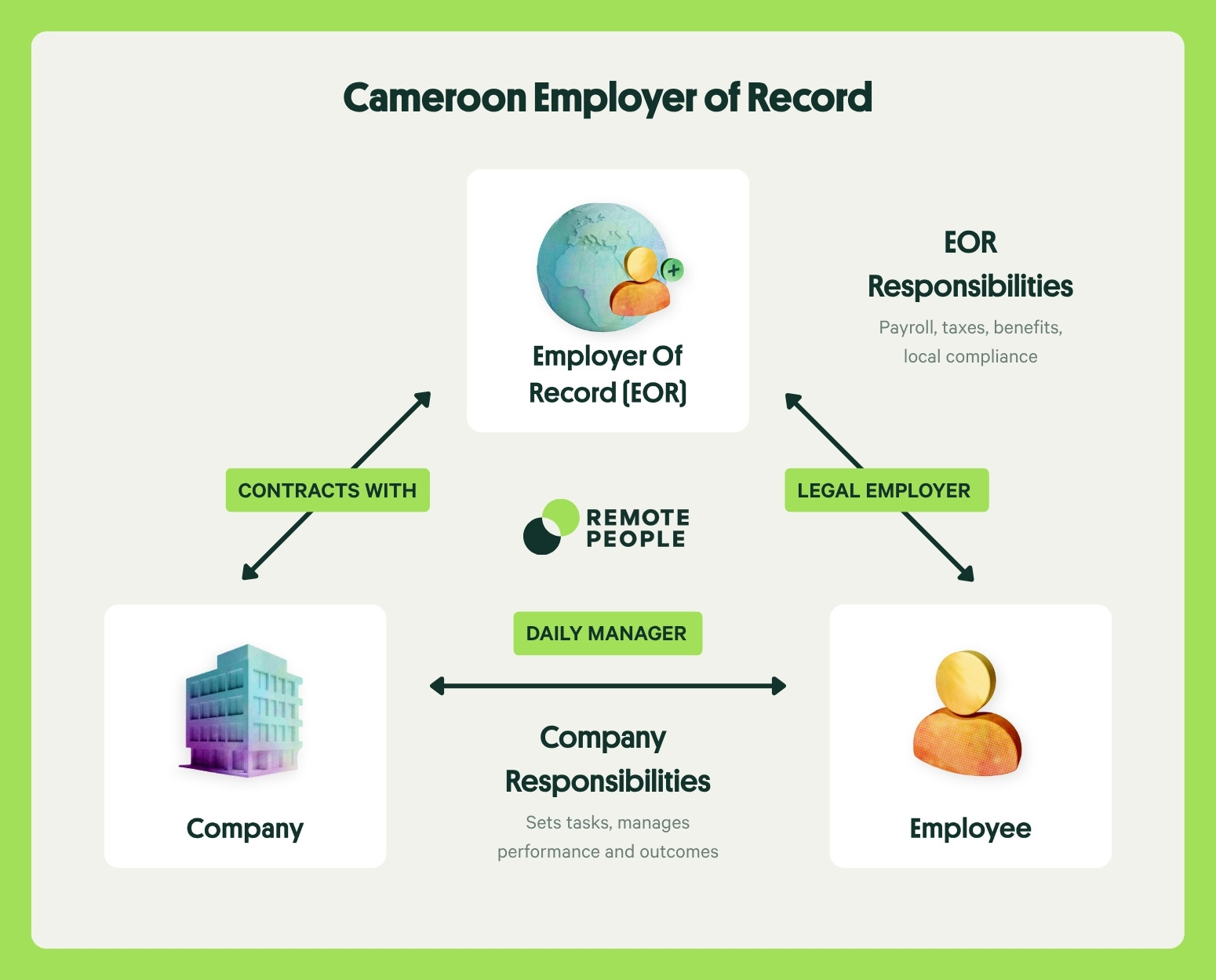
What Does an EOR Handle?
The EOR drafts a compliant bilingual employment contract, runs monthly payroll in XAF, withholds personal income tax (IRPP) plus the 10% Council Additional Tax, and remits CNPS contributions for pensions, family allowances, and occupational risk. It also files the Credit Foncier housing fund contribution and the National Employment Fund (FNE) levy. Your Cameroonian employee receives a proper pay slip each month, and the EOR keeps the statutory employee register required by the Ministry of Labour.
Beyond payroll, the EOR manages leave accrual under the Labour Code’s 1.5 days per month rule, tracks sick leave medical certificates, processes maternity and family leave, and enrolls the employee in the public CNPS healthcare scheme. When an expatriate is involved, the EOR coordinates work permits through the Ministry of Employment and Vocational Training and handles the residence permit application with the Délégation Générale à la Sûreté Nationale.
The EOR also handles end-of-contract formalities. If an employee leaves, the EOR calculates the severance due under the Labour Code’s tenure-based formula, issues the final pay slip, deregisters the employee with CNPS, and provides the statutory certificate of employment. This removes the most common compliance trap for foreign employers, which is mishandling termination paperwork under Cameroonian law.
Who Uses an EOR in Cameroon?
Any company that wants to place a small team on the ground in Cameroon without the cost and lead time of setting up a local entity is a candidate for an EOR. The typical use cases include testing Cameroon as a growth market before committing to incorporation, hiring one to fifteen employees where a subsidiary does not make financial sense, bringing on a country manager or regional sales lead, and retaining a Cameroonian citizen who would otherwise leave a remote role because of contractor classification risk. Organizations expanding into CEMAC also use an EOR in Cameroon as a staging point for regional hires, since Cameroon is the largest economy in the bloc.
Typical Onboarding Timeline
Most EOR providers can onboard a Cameroonian citizen within one to two weeks. Expatriate hires take longer because the work permit must clear the Ministry of Employment and Vocational Training before the employee can legally start.
- First, sign the EOR service agreement and provide employee details, salary, and job description. This takes 1 to 2 business days.
- Second, the EOR drafts a compliant employment contract in French or English (both are official languages under the Constitution) and sends it to the employee for signature. This takes 2 to 3 business days.
- Third, the EOR registers the employee with CNPS and the tax authority and sets up the payroll file. Registration takes 3 to 7 business days depending on whether Douala, Yaoundé, or a regional CNPS office is involved.
- Fourth, payroll is configured, the CNPS number is issued, and the employee begins work with their first full month of coverage.
- Fifth, for expatriates, the work permit application is filed in parallel. Expect an additional 3 to 6 weeks before the permit is issued, followed by 1 to 3 weeks for the visa and residence permit.
Hire in Cameroon
Cameroon offers competitive wages, bilingual French and English talent, and a 15.45% employer cost burden that beats most West African peers, making it a smart entry point to the CEMAC region.
We handle employment contracts, payroll, tax withholding, and full Cameroon compliance.
No local entity needed. Your team can start in days.
Employment Laws and Regulations in Cameroon
Employment in Cameroon is governed by the Labour Code, Law No. 92/007 of 14 August 1992, together with its implementing decrees, the collective bargaining agreements that apply to specific sectors, and the Social Insurance Code administered by CNPS. The Ministry of Labour and Social Security (MINTSS) is the primary regulator, and the Ministry of Employment and Vocational Training (MINEFOP) handles work permit authorizations for expatriates.
Employment Contracts
Every employment relationship in Cameroon must be documented in a written contract when the duration exceeds three months or when the employee is required to live away from their usual place of residence. The contract must specify the parties, job title, workplace, basic salary, working hours, probationary period, and duration. Contracts may be drafted in either French or English because the Constitution of Cameroon recognizes both as official languages. Fixed-term contracts are capped at two years with one renewal allowed, and indefinite-term contracts are the default form of employment for open-ended roles.
Working Hours and Overtime
The standard workweek in Cameroon is 40 hours for non-agricultural workers, typically arranged as 8 hours per day across 5 days, per Section 80 of the Labour Code. Agricultural work has a higher annual cap of 2,400 hours. Any work above the weekly ceiling counts as overtime and is capped at 20 additional hours per week.
Overtime is compensated at a premium based on the hour band. The first 8 overtime hours each week are paid at 120% of the regular hourly rate, the next 8 hours at 130%, and the final 4 hours (hours 17 to 20) at 140%. Sunday work, night work, and work performed on public holidays attract a 140% premium, with public holiday work in some collective agreements reaching 200%.
Cameroon sets the standard workweek at 40 hours under Section 80 of Labour Code Law No. 92/007, with a daily cap of 8 hours in most sectors. Overtime beyond that threshold is regulated by ministerial decree and pays a tiered surcharge that climbs with the hour count, plus fixed premiums for night, Sunday, and public holiday work. Collective bargaining agreements may set higher rates, but never lower than the statutory floor.
Cameroon overtime and premium pay rates · Per Labour Code Law No. 92/007 | |||
Hour Type | Rate Multiplier | Weekly or Daily Cap | Notes |
|---|---|---|---|
Standard workweek | 100% base hourly wage | 40 hours per week, 8 hours per day | Applies to all non-agricultural sectors; agriculture uses a 2,400-hour annual ceiling |
Overtime tier 1 (first 8 extra hours) | 120% (20 percent premium) | Hours 41 to 48 | Applies to daytime overtime on regular working days |
Overtime tier 2 (next 8 extra hours) | 130% (30 percent premium) | Hours 49 to 56 | Applies once tier 1 hours are exhausted within the same week |
Overtime tier 3 (beyond 16 extra hours) | 140% (40 percent premium) | Hours 57 to 60, capped at 20 overtime hours per week | Requires labour inspector authorization for continued use |
Sunday work | 140% (40 percent premium) | Full shift rate | Applies when employees are required to work on the weekly rest day |
Night work (22h00 to 05h00) | 150% (50 percent premium) | Full shift rate | Applies to hours worked between 10 p.m. and 5 a.m. regardless of overall weekly total |
Public holiday work | 200% (100 percent premium) | Full shift rate | Applies to the 12 statutory public holidays; higher still if combined with night hours |
Minimum Wage
The minimum wage in Cameroon is XAF 43,969 per month, which is approximately $78 at the April 2026 exchange rate. The current level was set by Decree No. 2024/0168/PM of 23 February 2024, which raised the previous floor by roughly 5%. The rate, known as the Salaire Minimum Interprofessionnel Garanti (SMIG), applies to all non-agricultural workers. Sector-specific collective agreements frequently set higher floors, particularly in banking, telecommunications, oil and gas, and the port sector.
Probation Period
The probation period in Cameroon is capped at six months for standard workers, including any renewal, and up to eight months for employees in managerial categories. The probation clause must be in writing and signed before the employment contract takes effect. Either party may terminate the contract during probation without notice and without severance, provided written notice is given on the day of termination. After probation ends, full statutory protections apply.
Leave Entitlements
Cameroonian employees accrue paid leave at the rate of 1.5 working days per month of continuous service, which produces a minimum of 18 working days per year after twelve months of employment. The Labour Code and its collective agreements expand this entitlement for seniority, mothers with children, and young workers. The sections below summarize each statutory leave category, followed by a comparison table.
Annual Leave
Employees accrue 1.5 working days of paid leave per month of actual service under Section 89 of the Labour Code, producing 18 working days after a full year. Seniority adds 2 extra days every five years of continuous service with the same employer. Mothers are entitled to 2 extra days per child under the age of six, and young workers under 18 accrue 2.5 days per month of service. Annual leave must be taken within the reference year and is paid at the employee’s full salary, including fixed allowances.
Sick Leave
Employees unable to work because of illness must provide a medical certificate issued by an approved practitioner. Short-term sick leave up to six months is paid by the employer at full salary for the first period, with the exact duration and rate often set by collective agreement. CNPS steps in for long-term illness and disability benefits under the pension and invalidity branch. An employer may suspend the contract for prolonged illness but cannot terminate on that ground until the statutory waiting period has elapsed.
Maternity Leave
Female employees are entitled to 14 weeks of maternity leave, with 4 weeks taken before the expected delivery date and 10 weeks taken after, per Section 84 of the Labour Code. The leave is fully paid and funded by the employer, and it may be extended by an additional 6 weeks on medical grounds. During maternity leave and the 15-month period after returning, the employer cannot terminate the employee except in narrowly defined cases of serious misconduct.
Paternity Leave
Cameroonian labour law does not create a dedicated paternity leave entitlement. Instead, new fathers can use the special family leave allowance provided for events directly concerning the household, which gives up to 10 days of paid leave per year for births, marriages, deaths, and similar events. Many private-sector collective agreements add 1 to 3 days of specific paternity leave, and most EORs follow the higher standard for recruitment reasons.
Other Statutory Leave
Beyond annual, sick, and maternity leave, Cameroonian workers are entitled to several additional statutory categories:
- Special family leave of up to 10 days per year, paid, for births, marriages, bereavements, and similar events.
- Education and training leave, granted in agreement with the employer when the course benefits the role.
- Paid public holidays, covering the 11 days listed in the public holidays section below.
- Trade union leave for worker representatives attending official training sessions.
Cameroon statutory leave entitlements · Per Labour Code Law No. 92/007 | ||
Leave Type | Duration | Eligibility & Notes |
|---|---|---|
Annual leave | 1.5 days/month (18 days/year) | Full pay; +2 days per 5 years of seniority; mothers get +2 days per child under 6 |
Young worker leave | 2.5 days/month (30 days/year) | Applies to workers under 18 years of age |
Sick leave | Up to 6 months | Employer-paid for short-term absence; CNPS covers long-term disability |
Maternity leave | 14 weeks (4 pre + 10 post) | Full pay, employer funded; extendable by 6 weeks on medical grounds |
Paternity leave | Covered under family leave | No statutory paternity entitlement; use family leave allowance |
Special family leave | Up to 10 days/year | Paid leave for births, marriages, deaths, and similar events |
Public holidays | 11 days in 2026 | Paid; work on a public holiday attracts a premium rate |
Education leave | By agreement | Granted for training directly relevant to the employee’s role |
Source: Cameroon Labour Code 92/007 and PwC Cameroon Tax Summary | ||
Statutory Employee Benefits
Employees in Cameroon are entitled to a package of mandatory benefits funded primarily through CNPS. Every employer must register new hires with CNPS within 8 days of the start date and pay monthly contributions that cover three benefit branches: old-age pension, family allowances, and occupational risk. Workers receive healthcare access through the public CNPS scheme, and many employers add a private health insurance because public hospital coverage is limited. Retirement benefits activate at age 60 with at least 180 months of contributions, according to the CNPS pension rules.
In addition to CNPS, employers pay a 1.5% housing fund contribution (Crédit Foncier du Cameroun) and a 1% National Employment Fund (Fonds National de l’Emploi, or FNE) levy. Employees contribute 1% to the housing fund from their own salary. Most white-collar collective agreements require transport and housing allowances on top of base pay, particularly in Douala and Yaoundé where the cost of living is higher. The contribution rate details are broken down in the payroll section below.
Recent Regulatory Updates (2026)
The biggest payroll change of the last three years was the CNPS reform that raised the wage ceiling for social security contributions from XAF 300,000 to XAF 750,000 per month and increased the employee pension rate to 4.2%. The updated CNPS rates and ceiling, which has increased take-home deductions for higher earners but also expanded future pension benefits.
The 2025 Finance Law also revised some personal income tax provisions, including flat rates on income from stocks and shares between 15% and 16.5%. The progressive scale for salaries remains unchanged for 2026. The minimum wage was last updated by Decree No. 2024/0168/PM of 23 February 2024, which moved the SMIG from XAF 41,875 to XAF 43,969 per month. No further minimum wage decree has been issued as of April 2026.
Work Permits and Visas in Cameroon
Every non-Cameroonian national who wants to take up paid employment in Cameroon needs a work visa and permit before they can lawfully start work. The process involves three parallel tracks: the labour authorization from the Ministry of Employment and Vocational Training, the entry visa from a Cameroonian embassy abroad, and the residence permit issued after arrival by the Délégation Générale à la Sûreté Nationale. The EOR coordinates all three.
Work Permit Requirements
Who Needs a Work Permit
All foreign nationals require a work permit regardless of their country of origin. Citizens of CEMAC member states (Central African Republic, Chad, Republic of the Congo, Equatorial Guinea, Gabon, and Cameroon itself) benefit from freedom of movement agreements, but they still need a work authorization to take paid employment. Cameroonian law gives preference to local candidates, so the employer must document the recruitment effort before hiring a foreigner in a role that a qualified Cameroonian could fill.
Eligibility and Required Documents
The employer (or the EOR acting on behalf of the client) files the work permit dossier with MINEFOP. Required documents typically include the signed employment contract, a copy of the employee’s passport, certified copies of academic and professional qualifications, a recent medical certificate, a criminal record extract, a CV, and the employer’s trade register excerpt. All supporting documents must be translated into French or English by a certified translator if they originate from another jurisdiction.
Processing Time and Validity
The labour authorization itself is normally processed in 3 to 6 weeks at MINEFOP, provided the file is complete. The initial work permit is issued for 2 years and is tied to the specific employer and position that sponsored the application. Including the consular visa step and the residence permit application after arrival, the full process from job offer to legal start date typically runs 2 to 4 months. Delays usually come from missing documents, apostille requirements, or sector-specific scrutiny in regulated industries.
Renewal Process
Work permits must be renewed before expiry, and renewal applications should be submitted at least 60 days in advance. The renewal dossier is similar to the initial application and requires an updated medical certificate, criminal record extract, and proof that the employee has been compliant with tax and CNPS obligations during the previous term. Employees may continue to work while the renewal is in progress if the application was filed before the original permit expired.
Common Visa Types for Foreign Workers
Cameroon operates a permit-led immigration model. The Ministry of Employment and Vocational Training (MINEFOP) must approve the work permit before the Ministry of External Relations (MINREX) issues the entry visa through a Cameroonian embassy abroad, and the Délégation Générale à la Sûreté Nationale (DGSN) handles the residence permit once the employee arrives. The table below summarizes the main visa and permit routes, including indicative processing windows confirmed on Remote People’s Cameroon work visa guide.
Cameroon work visa types for foreign workers · 2026 | ||||
Visa Type | Duration | Best For | Leads to APT? | Processing |
|---|---|---|---|---|
Work Permit (MINEFOP Labour Authorization) | 1 year, renewable up to 3 years | Mandatory labour approval before any foreign national can lawfully work; tied to one specific employer and role | Discretionary | 3 to 6 weeks |
Long-Stay Work Visa | 1 year initial, renewable | Principal visa for stays above 90 days, covering full-time employees, long-term consultants, and intra-company transferees | Discretionary | 1 to 3 weeks |
Short-Stay Work Visa | Up to 6 months | Time-limited project assignments and short-duration roles; still requires a MINEFOP authorization before issue | No | 1 to 2 weeks |
Residence Permit (Carte de Séjour) | 2 years, renewable | Issued by DGSN after arrival for foreign workers on an approved long-stay work visa who intend to live in Cameroon for their contract term | Yes | 4 to 8 weeks |
CEMAC Regional Authorization | Aligned with employment contract | Citizens of Central African Republic, Chad, Republic of the Congo, Equatorial Guinea, and Gabon; still subject to MINEFOP work authorization | Regional | 2 to 4 weeks |
How an EOR Handles Work Permits
An EOR acts as the local sponsor for the work permit because it is the legal employer of the expatriate in Cameroon. The EOR files the MINEFOP dossier, coordinates with the consular post abroad, and handles the residence permit after arrival. The expatriate supplies the personal documents (passport, medical, criminal record) and attends the biometric appointment at the DGSN. Because the EOR is the employer on record, the permit is tied to the EOR’s name rather than the client’s foreign entity, which matters on exit and on permit renewals.
Using an EOR also extends the onboarding timeline shown earlier. A Cameroonian citizen can start within 1 to 2 weeks, but an expatriate hire should plan for 2 to 4 months from offer to first day. Clients hiring for immediate-start roles usually prioritize Cameroonian candidates and use the EOR’s contractor management solution as a bridge for expatriates already in-country under another status.
Payroll, Taxes, and Social Security in Cameroon
A full overview of payroll tax in Cameroon is published separately; this section summarises the core rates, ceilings, and filing rules that govern monthly compliance for EOR payroll.
Employer Contributions
Employers in Cameroon pay a combined statutory burden of approximately 15.45% of gross salary for a low-occupational-risk white-collar hire, split across CNPS pension, family allowances, occupational risk, the Crédit Foncier housing fund, and the FNE employment fund. Pension and family allowances are capped at a CNPS salary ceiling, while occupational risk and the housing fund apply to the full gross salary. Higher-risk sectors such as construction or mining face occupational risk rates of up to 5% instead of the 1.75% used for offices.
Cameroon employer social security contributions · 2026 rates | ||
Contribution | Rate | Notes |
|---|---|---|
CNPS family allowances | 7.00% | General scheme rate; capped at XAF 750,000/month |
CNPS old-age pension | 4.20% | Employer share; capped at XAF 750,000/month |
CNPS occupational risk | 1.75% | Group A (low-risk office work); rises to 2.5% Group B and 5% Group C |
Crédit Foncier housing fund | 1.50% | Employer share; applies to full gross salary |
National Employment Fund (FNE) | 1.00% | Funds vocational training and employment programs |
Total employer burden | 15.45% | Low-risk white-collar baseline; higher for risk groups B and C |
Source: CNPS Employer Obligations and PwC Cameroon Other Taxes | ||
Employee Contributions
Employees pay a combined 5.2% of gross salary toward CNPS pension and the Crédit Foncier housing fund, on top of the progressive personal income tax described in the next section. The pension contribution is capped at the XAF 750,000 ceiling, while the housing fund applies to the full salary.
Cameroon employee payroll deductions · 2026 monthly withholdings | ||
Deduction | Rate | Notes |
|---|---|---|
CNPS old-age pension | 4.20% | Capped at XAF 750,000/month (approx. $1,334) |
Crédit Foncier housing fund | 1.00% | Applies to full gross salary |
Personal income tax (IRPP) | 11% to 38.5% | Progressive; see income tax brackets below |
Council Additional Tax (CAC) | 10% of IRPP | Surcharge applied to the calculated personal income tax |
CRTV audiovisual tax | XAF 750 to 13,000/month | Fixed-scale levy based on salary band |
Total social contribution floor | 5.20% | Before IRPP, CAC, and CRTV |
Source: PwC Cameroon Individual Tax and CNPS Insured Rates | ||
Income Tax
Cameroon’s personal income tax (Impôt sur le Revenu des Personnes Physiques, or IRPP) is calculated on a progressive scale with four brackets, applied to net taxable income after a 30% standard deduction for professional expenses and after subtracting CNPS and housing fund contributions. The calculated IRPP is then increased by a 10% Council Additional Tax (Centimes Additionnels Communaux), which funds local government. The table below shows the annual brackets converted to USD at the April 2026 exchange rate.
Cameroon income tax brackets · 2026 | |
Annual Taxable Income (USD) | Tax Calculation |
|---|---|
$0 to $3,560 | 11% of taxable income |
$3,561 to $5,340 | 16.5% of the amount above $3,560, plus $391 |
$5,341 to $8,900 | 27.5% of the amount above $5,340, plus $685 |
Over $8,900 | 38.5% of the amount above $8,900, plus $1,664 |
On top of the IRPP and the 10% CAC surcharge, employees are also subject to the CRTV audiovisual tax, which is a fixed monthly levy scaled to salary. It runs from XAF 750 for the lowest band up to XAF 13,000 for salaries above XAF 1 million per month. All USD amounts in the bracket table are approximate conversions at $1 = 562 XAF (April 2026 rate).
Payroll Cycle
Cameroonian payroll runs on a monthly cycle, with salaries paid in XAF by bank transfer or mobile money into an account held in the employee’s name. Pay slips must be issued in French or English and must show gross pay, each line item deduction, and net pay. Personal income tax and CNPS contributions must be filed and paid by the 15th of the month following the pay period. Annual tax declarations are due by 15 March of the following year. Employers who fail to remit CNPS on time face penalty interest and, in severe cases, criminal liability under the Social Insurance Code.
13th Month Salary and Bonus Pay
Cameroon does not impose a statutory 13th month salary on private-sector employers. The Labour Code is silent on the matter, and no decree mandates an annual bonus in the way seen in Francophone countries like Senegal. However, many large employers in banking, telecommunications, oil and gas, and the public enterprise sector pay a customary 13th month or end-of-year bonus, and some collective bargaining agreements make it contractually binding within the signatory industries. When a 13th month is paid voluntarily, it is subject to the same income tax and CNPS treatment as regular salary.
Cost of Hiring Through an EOR in Cameroon
EOR Service Fees
EOR service fees in Cameroon typically run $300 to $600 per employee per month for a standard white-collar role. The fee covers employment contract drafting, monthly payroll, CNPS and tax filings, pay slip issuance, leave tracking, insurance administration, and compliance monitoring. Work permit sponsorship for expatriates may attract additional one-off fees of $500 to $1,500 to cover the MINEFOP dossier and residence permit handling.
Total Employment Cost Breakdown
The table below shows the total monthly cost of hiring an employee on a gross salary of $1,200 per month through an EOR in Cameroon. All figures are in USD and based on the Group A occupational risk rate used for office-based white-collar roles.
Cameroon employer cost example · $1,200/month gross · 2026 | ||
Employer Cost | Amount (USD) | % of Gross |
|---|---|---|
Gross salary | $1,200.00 | 100.00% |
CNPS family allowances | $84.00 | 7.00% |
CNPS old-age pension | $50.40 | 4.20% |
CNPS occupational risk (Group A) | $21.00 | 1.75% |
Crédit Foncier housing fund | $18.00 | 1.50% |
National Employment Fund (FNE) | $12.00 | 1.00% |
EOR service fee (est.) | $400.00 | 33.33% |
Total monthly cost | $1,785.40 | 148.78% |
Source: CNPS Employer Obligations and PwC Cameroon Other Taxes | ||
The statutory employer burden on a $1,200 gross salary is $185.40, or 15.45% above gross. Adding a typical $400 EOR service fee takes the total to $1,785.40 per month, which is 48.78% above the gross salary. Higher-risk sectors face occupational risk rates of 2.5% or 5% instead of 1.75%, which adds up to $39 per month at the $1,200 level. All USD amounts are approximate conversions at $1 = 562 XAF (April 2026 rate).
Ready to hire in Cameroon? Contact our team for a full cost quote. Remote People handles employment contracts, CNPS registration, payroll, tax withholding, and full Cameroon compliance. No local entity needed.
Benefits of Using an EOR in Cameroon
The single biggest reason to use an EOR in Cameroon is speed. Incorporating a Cameroonian subsidiary usually takes 3 to 6 months and involves the Agence de Promotion des Investissements, the trade register, the tax office, and CNPS registration. An EOR can onboard a Cameroonian citizen in 1 to 2 weeks because the legal entity already exists. For companies that want to pilot the market or hire a single regional lead, that time saving is decisive.
Compliance risk is the second reason. Cameroon’s Labour Code is detailed and enforceable, and foreign employers who try to handle payroll informally often run into trouble with CNPS or the tax authority. An EOR carries that compliance responsibility on its own books, which means the client is insulated from CNPS assessments, back tax claims, and labour court judgments that come from paperwork errors. Termination, in particular, is an area where the EOR’s local expertise pays off, because wrongful dismissal claims in Cameroon can result in significant severance awards.
Cost efficiency also matters for smaller teams. Running a Cameroonian subsidiary carries fixed costs (office, accountant, auditor, secretariat) that can exceed $20,000 per year even without any employees. An EOR replaces that fixed cost with a per-employee fee, so the total cost scales cleanly with headcount. Finally, the employee experience is often better under an EOR. The employee receives a proper Cameroonian contract, CNPS benefits, pay slips in their own currency, and access to the public healthcare scheme, which is hard to match when paying a remote worker as a contractor from abroad.
Termination and Offboarding in Cameroon
Notice Periods
The Labour Code sets statutory minimum notice periods based on the employee’s category and length of service. Standard workers are entitled to 30 days of notice during the first year of service, 60 days between 1 and 5 years, and 90 days after 5 years. Managerial and supervisory staff receive longer notice: 30 days during the first year, 90 days between 1 and 5 years, and 120 days after 5 years. Notice must be given in writing, and either party may pay in lieu of serving out the notice period.
Notice periods for open-ended contracts in Cameroon are set by Section 34 of Labour Code Law No. 92/007 and the implementing ministerial order on occupational categories. The duration climbs with both the worker’s occupational category (I through XII) and their seniority in the enterprise, and may be extended by collective bargaining agreements but never reduced below the statutory floor. Pay in lieu of notice is permitted when either party chooses to shorten the notice period.
Cameroon statutory notice periods by position level · Per Labour Code Law No. 92/007 | |||
Position Level | Notice Period | During Probation | Notes |
|---|---|---|---|
Category I to VI workers, under 1 year of service | 15 days | None required | Applies to unskilled and semi-skilled workers in the first year of employment |
Category I to VI workers, 1 to 5 years of service | 1 month | Not applicable | Most common bracket for operational and support roles |
Category I to VI workers, over 5 years of service | 2 months | Not applicable | Applies to long-tenured workers in Categories I to VI |
Category VII to IX staff, under 1 year | 1 month | None required | Applies to supervisors, technicians, and qualified employees |
Category VII to IX staff, 1 to 5 years | 2 months | Not applicable | Applies to mid-tenure supervisory and technical roles |
Category VII to IX staff, over 5 years | 3 months | Not applicable | Applies to long-tenured supervisors and technicians |
Category X to XII staff, under 1 year | 1 month | None required | Applies to senior managers, engineers, and executives |
Category X to XII staff, 1 to 5 years | 3 months | Not applicable | Applies to mid-tenure senior management |
Category X to XII staff, over 5 years | 4 months | Not applicable | Maximum statutory notice period under Cameroon labour law |
Severance Pay
Calculation Method
Severance pay is mandatory for employees dismissed for any reason other than serious misconduct, provided they have completed at least 2 years of continuous service. The formula is tiered based on tenure: 20% of the average monthly salary per year of service for the first 5 years, 25% per year for years 6 through 10, 30% per year for years 11 through 15, 35% per year for years 16 through 20, and 40% per year beyond 20 years of service. Fractional years of 6 months or more count as a full year.
Caps and Exceptions
Severance is not payable in cases of serious misconduct (faute lourde) that meets the threshold defined by case law and collective agreement, such as theft, gross insubordination, or violence. Fixed-term contracts that reach their natural expiry date do not attract severance, and employees dismissed during the probation period are also ineligible. The average monthly salary used in the formula includes base pay plus fixed allowances but excludes occasional bonuses. Collective agreements may set higher severance rates than the Labour Code minimum, and the EOR applies whichever is more favourable to the employee.
Severance pay in Cameroon follows the schedule in Section 37 of Labour Code Law No. 92/007. It is owed to employees on open-ended contracts who have completed at least two full years of service and whose employment is terminated for reasons other than gross misconduct. The formula multiplies the employee’s average monthly salary from the last 12 months by a percentage that rises across five-year tenure bands, then sums the bands to produce the total payout.
Cameroon severance pay schedule by years of service · Per Labour Code Law No. 92/007 | |||
Years of Service | Severance Amount | Base Salary | Notes |
|---|---|---|---|
Under 2 years | Not eligible | Not applicable | No statutory severance; minimum eligibility threshold is 2 completed years of service |
3 years (worked example) | 0.60 of average monthly salary (3 × 20%) | Average gross monthly salary over last 12 months | All 3 years fall within the 20 percent band for years 1 to 5 |
5 years (worked example) | 1.00 of average monthly salary (5 × 20%) | Average gross monthly salary over last 12 months | Full use of the 20 percent band; ceiling before moving to the 25 percent band |
10 years (worked example) | 2.25 of average monthly salary (5 × 20% + 5 × 25%) | Average gross monthly salary over last 12 months | First 5 years at 20 percent, years 6 to 10 at 25 percent |
15 years (worked example) | 3.75 of average monthly salary (5 × 20% + 5 × 25% + 5 × 30%) | Average gross monthly salary over last 12 months | Years 11 to 15 earn the 30 percent band on top of earlier bands |
20 years (worked example) | 5.50 of average monthly salary (5 × 20% + 5 × 25% + 5 × 30% + 5 × 35%) | Average gross monthly salary over last 12 months | Years 16 to 20 earn the 35 percent band; beyond year 20 the marginal rate rises to 40 percent |
Grounds for Termination
An employer may terminate an indefinite-term contract for economic reasons or for a personal reason linked to the employee’s conduct or capability. Both categories require written notice, a statement of the reasons in the termination letter, and, for economic dismissals, consultation with employee representatives and notification to the labour inspectorate. Dismissal for serious misconduct must be preceded by an internal disciplinary hearing where the employee has the right to present a defence. Protected categories, including pregnant employees, those on maternity leave, and worker representatives, enjoy additional protection and cannot be dismissed except in narrowly defined cases approved by the labour inspectorate.
EOR vs. Other Hiring Models in Cameroon
EOR vs. Setting Up a Local Entity
Choosing between an Employer of Record and setting up your own legal entity in Cameroon comes down to timeline, upfront cost, ongoing administrative burden, and how quickly you can scale up or wind down. The table below lays out both paths side by side across setup time, cost, compliance risk, and flexibility so you can match the right model to the size and duration of your Cameroon hiring plan.
Cameroon EOR vs local entity comparison · Setup time, cost, risk and best-fit | ||
Comparison | Employer of Record | Own Entity |
|---|---|---|
Setup time | 1 to 2 weeks | 3 to 6 months |
Upfront cost | $0 | $5,000 to $15,000 |
Ongoing cost | $300 to $600 per employee per month | $15,000 to $30,000 per year maintenance |
Local partner required | No (EOR is the local entity) | Not legally required, often useful for market knowledge |
Social insurance registration | Handled by EOR | You manage it |
Payroll and tax filing | Handled by EOR | You manage it (or outsource) |
Best for team size | 1 to 15 employees | 15+ employees |
Scale down or exit | Easy, no entity to unwind | Costly, legal dissolution required |
Government contracts | Not eligible | Eligible (requires local entity) |
Setting up a Cameroonian subsidiary makes sense when the projected headcount is large enough to absorb the fixed costs and when the business model requires a local entity (for example, bidding on public contracts or holding a regulated licence). For everyone else, the EOR route is materially faster and cheaper.
The break-even point is usually around 15 to 20 employees. Below that, the EOR’s per-employee fee is lower than the fixed overhead of running a subsidiary. Above it, the subsidiary economics start to make sense, and many companies transition from an EOR to their own entity once they hit that threshold. The EOR handover can usually be completed in 2 to 3 months.
Another factor is risk tolerance. Setting up an entity exposes the parent company to full local liability, including any historical CNPS or tax assessment against the subsidiary. The EOR model caps that risk because the EOR is the employer of record and carries the compliance obligation. For companies testing Cameroon for the first time, that insulation is valuable.
EOR vs. Hiring Independent Contractors
Classifying a Cameroon-based worker as an independent contractor rather than an employee can expose you to back-taxes, unpaid social contributions, and reclassification penalties if the working relationship looks like employment in practice. The table below contrasts EOR employment with contractor engagement across legal relationship, tax and benefits treatment, IP ownership, and misclassification risk so you can pick the right model role by role.
Cameroon EOR vs independent contractors · Compliance, cost, and risk | ||
Comparison | EOR (Full-Time Employee) | Independent Contractor |
|---|---|---|
Legal relationship | Employee of the EOR | Self-employed, no employment relationship |
Compliance risk | Low, EOR ensures local labour law compliance | Higher, misclassification risk if the relationship resembles employment |
Payroll and tax | EOR handles withholding, CNPS, and filings | Contractor invoices you; they handle their own taxes |
Benefits and leave | Statutory benefits, paid leave, CNPS coverage | No entitlement to employee benefits |
IP protection | Stronger, employment contract assigns IP by default | Weaker, requires explicit IP assignment clause |
Termination | Subject to local notice periods and severance | Contract can be ended per agreement terms |
Best for | Long-term, core team roles | Short-term projects, specialized tasks |
Cost structure | Salary + employer contributions + EOR fee | Contractor fee (typically higher gross, lower total cost) |
Source: Cameroon Labour Code 92/007 and PwC Cameroon Tax Summary | ||
Hiring independent contractors in Cameroon is only appropriate in some cases, such as short-term project work, specialized consulting, or roles where the worker has genuine autonomy over how and when they deliver. For long-term or full-time roles, contractor classification is the wrong tool because Cameroonian labour courts can reclassify the relationship as employment if the worker is economically dependent on one client, reports to that client’s management, and follows company processes.
The consequences of misclassification in Cameroon are concrete. The client may owe back CNPS contributions, back-dated IRPP and CAC, penalty interest on both, plus severance if the worker was dismissed without following the Labour Code procedure. The labour inspectorate can also open an enforcement action independently of the worker’s own claim.
For roles that truly are project-based, the cleanest option is to use a contractor management solution rather than a direct invoice arrangement. Remote People’s contractor hiring solution handles compliant contractor agreements, payments, and classification reviews for Cameroonian and CEMAC freelancers, which keeps the flexibility of a contractor relationship while managing the misclassification risk.
EOR vs. PEO (Professional Employer Organization)
EORs and PEOs both simplify international hiring, but only an EOR becomes the legal employer of record in Cameroon — a critical distinction when you don’t have a local entity of your own. The table below maps the practical differences across legal employer status, entity requirement, liability allocation, and scope of coverage.
Cameroon EOR vs PEO comparison · Legal employer, liability, and setup | ||
Comparison | Employer of Record (EOR) | PEO |
|---|---|---|
Legal employer | EOR is the legal employer | You remain the legal employer (co-employment) |
Local entity required | No, the EOR is the local entity | Yes, you must have your own entity in Cameroon |
Best for | Companies without a local entity | Companies that already have a local entity |
Compliance liability | EOR assumes compliance responsibility | Shared liability between you and the PEO |
Setup time | 1 to 2 weeks | Depends on your entity setup (weeks to months) |
Control over HR policies | EOR manages within local law framework | More direct control, PEO advises |
Typical use case | Market entry, small remote teams, testing new markets | Established local operations needing HR outsourcing |
Source: PwC Cameroon Tax Summary and CNPS Social Insurance | ||
Cameroon does not have a formal PEO regulatory framework comparable to the US co-employment model. The concept exists in practice because large domestic HR firms offer payroll and administration outsourcing services to companies that already have a Cameroonian entity, but the legal employer remains the client company. This is the key distinction: an EOR replaces the need for a local entity, while a PEO complements one.
For foreign companies without a Cameroonian subsidiary, the EOR route is the only practical option because a PEO assumes you already have a company in-country. Once a client has incorporated and grown past the EOR break-even point, moving to a PEO-style payroll outsourcing arrangement can make sense because it lowers the per-employee overhead while keeping the entity active for tendering and regulatory purposes.
Compliance liability is the other major difference. Under an EOR, the provider is on the hook for CNPS, tax, and Labour Code compliance. Under a PEO arrangement, the client company remains on the hook and the PEO only advises and executes, which means the client must still have internal capacity to review the local advice.
Public Holidays in Cameroon
Cameroon observes a defined set of official public holidays on which most private-sector employers must give staff a paid day off (TimeAndDate Cameroon Holidays 2026). The table below lists the statutory holidays employers need to build into payroll calendars and leave planning for the year, along with the date rule for each.
Cameroon public holidays · 2026 calendar year | ||
Date | Holiday | Type |
|---|---|---|
1 January | New Year’s Day | National |
11 February | Youth Day | National |
20 March | Eid al-Fitr (end of Ramadan) | Religious (Islamic) |
3 April | Good Friday | Religious (Christian) |
1 May | Labour Day | National |
14 May | Ascension Day | Religious (Christian) |
20 May | National Day (Unification) | National |
27 May | Eid al-Adha (Feast of Sacrifice) | Religious (Islamic) |
15 August | Assumption Day | Religious (Christian) |
26 August | Mawlid (Prophet’s Birthday) | Religious (Islamic) |
25 December | Christmas Day | Religious (Christian) |
Cameroon observes 11 paid public holidays in 2026, split between national days, Christian, and Islamic religious holidays. Islamic dates depend on lunar sighting and may shift by one or two days. Work performed on a public holiday attracts a premium, and payroll for the holiday month must reflect the paid day whether or not the employee worked.
How to Get Started with an EOR in Cameroon
- First, define the role, gross salary, and projected start date for your Cameroonian hire and share the brief with the EOR provider.
- Second, receive and review the full cost quote, including statutory contributions, the EOR service fee, and any work permit costs for expatriates.
- Third, sign the EOR service agreement and send the employee’s personal details, identification documents, and qualifications.
- Fourth, the EOR drafts the employment contract, sends it for signature, registers the employee with CNPS and the tax authority, and sets up payroll.
- Fifth, the employee begins work. You manage their day-to-day output while the EOR handles monthly payroll, filings, leave tracking, and ongoing compliance.
Ready to get started? Remote People operates as your employer of record across Cameroon and the wider CEMAC region, with local payroll, CNPS filings, and a dedicated account team that knows the Labour Code. Check our pricing for a transparent per-employee fee and launch your Cameroon team in days.
Where companies hiring in Cameroon expand next
Companies building West African operations commonly expand across the ECOWAS bloc and neighboring Francophone and Anglophone markets. Teams frequently add a team in Nigeria for aligned West African hiring norms; operations in France often follows for established French-language business ties; Ivory Coast is a common next step, offering the Francophone talent corridor; and hiring in Gabon rounds out the regional footprint with shared Central African workforce dynamics.
Frequently Asked Questions
Beyond the statutory employer contributions (around 15.45% of gross salary for low-risk office roles), you will pay an EOR service fee of $300 to $600 per employee per month. The exact amount depends on your provider, the complexity of the role, and whether work permit support is needed for an expatriate.
A Cameroonian citizen can be fully onboarded in 1 to 2 weeks from the moment the EOR service agreement is signed. Expatriate hires take longer because the work permit and residence permit must be processed through MINEFOP and the DGSN, which typically adds 2 to 4 months.
No. Cameroon has no statutory 13th month requirement under the Labour Code. Many large private-sector employers pay a customary end-of-year bonus, and some collective bargaining agreements make it contractually binding, but it is not a legal obligation for all employers.
The employment contract assigns IP to the client company (you), not the EOR. The EOR ensures that the contract includes proper IP assignment language so that all work product, inventions, and copyrightable material flow directly to your business from the moment the employee starts work.
You can, but only for genuine short-term or project-based work where the worker is truly independent. For long-term or full-time roles, the misclassification risk is real: the labour court can reclassify the relationship as employment and impose back CNPS contributions, back taxes, and severance. Remote People's contractor management solution handles compliant contractor payments, written agreements, and classification reviews, which is a safer path than direct invoicing.
The minimum wage in Cameroon is XAF 43,969 per month, or approximately $78 at the April 2026 exchange rate. It was last updated by Decree No. 2024/0168/PM in February 2024. Sector-specific collective agreements often set higher floors, particularly in banking, telecommunications, and the oil and gas industry.
Cameroonian labour law requires written notice (30 to 120 days depending on tenure and category) and severance pay on a tiered scale (20% to 40% of monthly salary per year of service). The EOR calculates the severance, issues the termination letter in line with the Labour Code, and handles the final pay slip and CNPS deregistration. The client approves the decision and provides the underlying reason.
Yes. The EOR is the legal employer, so it sponsors the work permit application with the Ministry of Employment and Vocational Training and coordinates the visa and residence permit steps. The expatriate provides personal documents (passport, medical certificate, criminal record) and attends biometric appointments. The full work permit process usually runs 2 to 4 months.
Employer of Record in
Employer of Record in
Employer of Record in
Employer of Record in
Employer of Record in
Employer of Record in
Employer of Record in
Employer of Record in