Recruit
Employer of Record in Saint Vincent and the Grenadines
-
 Drew Donnelly
- Published
- September 13, 2026
RemotePeople’s employer of record in Saint Vincent and the Grenadines lets you hire employees in Saint Vincent and the Grenadines with full NIS compliance. We handle National Insurance Services contributions, employment injury benefits, and statutory leave administration.
Hire in Saint Vincent and the Grenadines — book a free 30-minute demo
Tell us what you need. You'll get a tailored, transparent proposal within 24 hours, plus a free call to walk through it.
Tell us about your company
So we can match you with a specialist who knows your market — and unlock volume pricing tiers.
* All fields are required.
Where and when are you hiring?
Tell us the geography and timing and we'll quote each country line by line, with onboarding timelines.
* All fields are required.
Help us beat your current setup
We'll benchmark your current deal and send a line-by-line proposal in 24 hours — showing exactly where we cut cost, time, or risk. After you submit, you can book a call to walk through it together.
* All fields are required.
Thanks! Your proposal is on its way.
Expect a tailored, line-by-line proposal in your inbox within 24 hours. In the meantime…
Want to walk through it together?
Book a free 30-minute call with one of our specialists. We'll explain every line, answer your questions, and tailor the proposal further if you need.
No obligation. Pick a time that works for you.








- Hire in Saint Vincent and the Grenadines — book a free 30-minute demo
- Tell us about your company
- Where and when are you hiring?
- Help us beat your current setup
- Thanks! Your proposal is on its way.
- How an Employer of Record Works in Saint Vincent and the Grenadines
- Hire in Saint Vincent and the Grenadines
- Employment Laws and Worker Rights in Saint Vincent and the Grenadines
- Work Permits and Visas in Saint Vincent and the Grenadines
- Payroll, Income Tax, and Social Security in Saint Vincent and the Grenadines
- Cost of Hiring an Employee in Saint Vincent and the Grenadines
- Employee Benefits and Compensation in Saint Vincent and the Grenadines
- Termination, Notice, and Severance in Saint Vincent and the Grenadines
- EOR vs. Other Hiring Options in Saint Vincent and the Grenadines
- Public Holidays and Working Days in Saint Vincent and the Grenadines
- How to Get Started With an EOR in Saint Vincent and the Grenadines
- Where companies hiring in Saint Vincent and the Grenadines expand next
- Frequently Asked Questions
- Related EOR Destinations

Start hiring in Saint Vincent and the Grenadines
Let RemotePeople handle payroll, compliance, and HR admin worldwide so you can focus on building your team.

Saint Vincent and the Grenadines is a compact, English-speaking economy anchored by offshore financial services, citizenship-by-investment advisory, tourism, and a growing remote-services sector. For foreign companies that want a Vincentian hire without the months of work that come with registering a local company, an employer of record is the fastest route to a compliant payroll. This guide walks through how an EOR works in Saint Vincent and the Grenadines in 2026, covering employment law, work permits, payroll tax, National Insurance Services contributions, cost of hiring, termination rules, and the common alternatives.
How an Employer of Record Works in Saint Vincent and the Grenadines
An employer of record becomes the legal employer of your Saint Vincent and the Grenadines hires while you keep full day-to-day control of their work, output, and priorities. RemotePeople holds the local employment contract, runs payroll through the Inland Revenue Department and the National Insurance Services, and handles every statutory filing the law requires. Your team operates as if they were on your own payroll, just without the entity, the bank account, and the months of registration paperwork.
Hiring directly in SVG means incorporating a company with the Commerce and Intellectual Property Office, registering with the Inland Revenue Department for a Tax Identification Number, enrolling with the National Insurance Services, and opening a local bank account that accepts Eastern Caribbean dollar payroll runs. That setup typically takes three to six months and costs several thousand US dollars before the first salary is even paid. An EOR removes that entire stack.
Companies pick this route when they want one or two specialists in Saint Vincent, when they are testing the Caribbean market, or when their candidate is already on the island and they have no time to spin up a local subsidiary. The model is especially common for technology, offshore finance, citizenship-by-investment advisory, hospitality management, and remote-first international firms that want a Vincentian presence without the overhead.
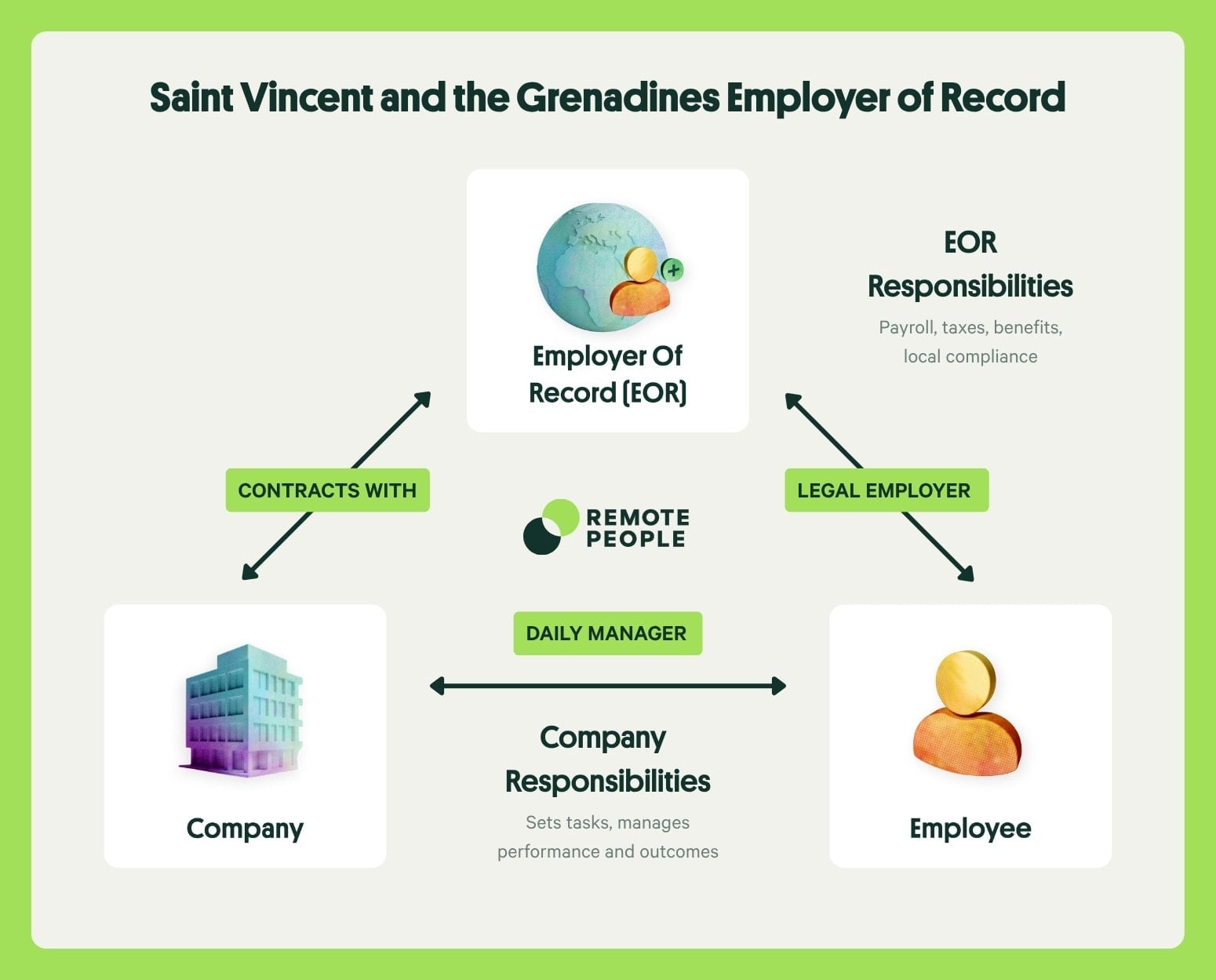
If you’d like to learn more about how Employer of Record (EOR) services work, read our What Is an Employer of Record (EOR)? guide for a complete overview of the model, its benefits, and when to use it.
If you’re comparing providers, our Best Employer of Record (EOR) Providers guide reviews the leading platforms to help you choose the right solution for your business.
1.2 Who Hires Through an EOR in Saint Vincent and the Grenadines
Foreign companies use an EOR in SVG for three common reasons. The first is converting an existing contractor into a full employee without losing them, often because the contractor relationship has drifted into employee territory and the misclassification risk is no longer worth carrying. The second is hiring a single specialist, such as a Caribbean compliance officer, an offshore banking relationship manager, or a tourism general manager, without taking on the cost and time of incorporating. The third is testing the market before deciding whether to commit to a local subsidiary, which can take six months or longer to register.
The model also works for citizenship-by-investment firms placing local representatives in Kingstown, for hotel groups running operations in the Grenadines, and for international development organisations that need a Vincentian programme officer on a compliant local contract.
Hire in Saint Vincent and the Grenadines
Saint Vincent and the Grenadines offers a unique combination of an English-speaking, common-law workforce, a small but growing offshore financial services sector, and a stable regional economy backed by the Eastern Caribbean Currency Union.
With an employer of record, you can onboard a Vincentian employee in days instead of months, while offloading PAYE income tax, National Insurance Services contributions, and compliance with the Protection of Employment Act 2003 to a local expert.
RemotePeople handles the contract, payroll, statutory filings, and ongoing HR support so your team can focus on the work.
Employment Laws and Worker Rights in Saint Vincent and the Grenadines
Saint Vincent and the Grenadines’ employment framework rests on a compact set of statutes that are actively enforced by the Department of Labour within the Ministry of National Mobilisation. The core statute is the Protection of Employment Act 2003, Act No. 20 of 2003, which sets out probation, notice periods, severance, redundancy, and unfair dismissal protections. Hours, overtime, minimum wages, leave, and maternity entitlements sit under the Wages Councils Act and the Wages Regulations, most recently amended in February 2024 and gazetted effective 1 March 2024. Together they form the floor that every Vincentian employer, foreign or local, must respect.
The Department of Labour enforces both frameworks through its Labour Commissioner and an inspectorate based in Kingstown. Disputes that cannot be resolved at the Commissioner level go to the Ministerial hearing stage and then, where necessary, to the High Court of Saint Vincent and the Grenadines.
2.1 Employment Contracts
Every employee in Saint Vincent and the Grenadines should have a written statement of terms covering the employer name, the employee name, the job title, the start date, the rate of pay, the pay period, working hours, rest days, leave entitlement, the probation clause, and the notice required to terminate. The Protection of Employment Act 2003 treats written terms as the benchmark against which the Labour Commissioner measures disputes, and the absence of a written contract almost always works against the employer.
Indefinite-term contracts are the default and the most common form. Fixed-term contracts are permitted for specific projects or seasonal work, but successive renewals can be treated by the Department of Labour as a continuous contract, which then carries full notice and severance rights. Oral contracts are technically valid for short engagements, but the evidentiary gap creates a serious risk the moment a dispute arises, so written contracts are the only safe option.
2.2 Working Hours and Overtime
The standard workweek in Saint Vincent and the Grenadines is 40 hours across five days, with at least one statutory rest day each week. Work beyond the 40-hour threshold is overtime and must be paid at one-and-a-half times the regular hourly rate during the week, with double time for hours worked on a Sunday or a public holiday. Saturday rates vary by sector and are usually set in the contract or a collective agreement, with many industries paying time-and-a-half until a mid-afternoon cut-off and double time thereafter.
| Saint Vincent and the Grenadines Overtime and Premium Pay 2026 (Wages Regulations 2024) | When worked | |
|---|---|---|
Weekday overtime (beyond 40 hours/week) | 1.5x regular hourly rate | Time-and-a-half |
Saturday (sector-dependent) | 1.5x or 2.0x | Set by contract or collective agreement |
Sunday | 2.0x regular hourly rate | Double time |
Public holiday | 2.0x regular hourly rate | Double time, on top of regular daily pay |
Night shift | 1.25x – 1.5x typical | Set by contract or collective agreement |
There is no statutory cap on weekly overtime hours for adults, but the Labour Commissioner can intervene where excessive hours threaten worker safety. Youth workers are subject to tighter limits under the Wages Regulations, with night work restricted for anyone under 18.
2.3 Probation Period
Probation in Saint Vincent and the Grenadines is set in the contract and capped by the Protection of Employment Act 2003 at an initial maximum of six months. An extension is permitted once, and the extension cannot exceed the length of the original probation period. During probation either party can terminate without statutory notice, provided the contract is explicit on the point, and the employee is paid for the period actually worked. No severance is owed during or at the end of a properly managed probation period.
The market norm is three months for most roles, with six months reserved for senior or technical positions. Any probation beyond six months is outside the statutory framework and the Department of Labour treats the employee as confirmed for notice and severance purposes.
2.4 Annual Leave
Paid annual leave in Saint Vincent and the Grenadines is two weeks, or 10 working days, per year after the employee completes 12 months of continuous service. Leave accrues pro-rata during the first year and is paid at the regular daily wage rate. The Wages Regulations allow employers to schedule leave by mutual agreement, and most private-sector contracts treat unused leave as use-it-or-lose-it within the year, subject to any contractual carry-over clause.
Some sectors and collective agreements provide three weeks of annual leave for employees with longer service, particularly in banking, offshore finance, and the larger hotel groups, but that is a market practice rather than a statutory floor. On termination, any accrued but untaken leave must be paid out in cash, calculated at the employee’s most recent regular rate.
2.5 Maternity, Paternity, Sick, and Other Leave
Maternity leave in Saint Vincent and the Grenadines runs to 13 weeks of paid leave, split before and after the expected date of confinement according to medical need. Job protection runs through the entire maternity period and dismissal during pregnancy or maternity leave is expressly prohibited. The employer is responsible for payment during the leave in most cases, with a National Insurance Services maternity benefit paid at 65 percent of average insurable weekly earnings for up to 13 weeks for women who meet the contribution test of at least 20 weekly contributions in the 30 weeks before confinement. NIS also pays a one-off Maternity Grant of EC$660 per live birth.
Paternity leave was introduced as a statutory entitlement in the 2024 Wages Regulations reform at one week paid, for male employees with at least one year of continuous service who meet the qualifying relationship test. Paid sick leave is capped at 14 days per year under the Wages Regulations, payable at the regular daily rate, with a medical certificate required for absences beyond two or three consecutive days depending on the sector. Bereavement leave, study leave, and family responsibility leave are not statutory and are handled through the contract or company policy.
2.6 Statutory Employee Benefits
The mandatory benefits floor in SVG is set by the National Insurance Services. Every employed person between 16 and the statutory pensionable age must be enrolled in NIS from the first day of employment, with contributions split between employer and employee on insurable earnings up to the monthly ceiling. The scheme funds age benefit (pension), invalidity benefit, survivor’s benefit, maternity benefit, maternity grant, sickness benefit, employment injury benefit, funeral grant, and unemployment benefit under the 2024 pension reform architecture.
Beyond NIS, Vincentian employers competing for skilled talent commonly offer private health insurance, a December bonus equivalent to a portion of monthly salary, group life cover, and a transport or fuel allowance. None of these are required by law, but they are standard in the salary package for roles in Kingstown’s financial services sector and the larger tourism operators in the Grenadines.
Work Permits and Visas in Saint Vincent and the Grenadines
Foreign nationals who want to work in Saint Vincent and the Grenadines need a work permit issued by the Ministry of National Mobilisation in consultation with the Office of the Prime Minister. Citizens of CARICOM member states benefit from the CARICOM Single Market and Economy (CSME) framework, which allows skilled nationals with the right certificate to live and work in SVG without a traditional work permit.
The work permit application is filed by the employer, not the employee. RemotePeople files the application as the legal employer of record, attaches the supporting documents, and tracks the file through to issue. Processing typically runs four to six weeks from a complete submission, longer if the Department of Labour wants the role advertised locally first or if documents need clarification.
3.1 Standard Work Permit
A standard work permit in Saint Vincent and the Grenadines is usually granted for the duration of the employment contract up to 12 months at a time, and is renewable. The employer files the application through the Office of the Prime Minister with the employment contract, the candidate’s CV and qualifications, a copy of the passport bio-data page, passport-sized photographs, a police certificate from the country of origin, a medical certificate, and the employer’s business registration documents. Fees vary by duration of the permit and by applicant category, with most foreign nationals paying between EC$675 and EC$945 for a 6 to 12 month permit, roughly $250 to $350 USD at the Eastern Caribbean dollar peg.
| Saint Vincent and the Grenadines Work Permits and Visas 2026 | Permit type | ||
|---|---|---|---|
Temporary work permit | 3 – 12 months, renewable | EC$675 – EC$945 (~$250 – $350 USD) | Most foreign hires |
Seasonal work permit | 3 – 6 months | Lower-tier fee | Agriculture and tourism |
Long-term/indefinite permit | Multi-year | Higher fee on application | Senior long-term placements |
CSME Skilled National Certificate | Indefinite (provisional 6 months) | No work permit fee | CARICOM nationals with approved skills |
Spouse/dependent residence | Aligned with principal permit | Set fee per applicant | Family members of permit holders |
Sources: Office of the Prime Minister, SVG; SVG Ministry of Foreign Affairs – CSME Brochure; SVG Consulate – Non-Nationals. USD figures use $1 = EC$2.70. | |||
The Department of Labour wants to see that the role could not reasonably be filled by a Vincentian national. For senior, technical, or shortage-skill roles the test is usually satisfied with a short justification letter and proof of a local advertisement. For more junior roles the bar is higher and the application is more likely to be refused or returned for additional evidence.
3.2 CSME Skilled National Certificate
CARICOM nationals with a recognised university degree, an associate degree, or other approved skill category can apply for a CSME Skilled National Certificate, which removes the need for a traditional work permit. A certificate issued by another CARICOM state grants an initial six-month provisional right to work in SVG pending an upgrade through the Ministry of National Security. Once the Vincentian certificate is issued, the holder has an indefinite right to work in the country. Approved CSME categories include university graduates, artisans, media workers, sportspersons, nurses, teachers, domestic workers, and a growing list of service and digital professions.
For Caribbean hires this is the cleaner route and it cuts both cost and processing time compared to the standard work permit.
3.3 Residence Permits
Work permit holders who plan to live in Saint Vincent and the Grenadines for more than six months apply for a residence permit through the Immigration Department in addition to the work permit. The two are issued separately and both must be in place before the employee can be paid as a tax-resident worker. Spouses and dependent children apply for dependent residence permits in parallel with the principal applicant.
Payroll, Income Tax, and Social Security in Saint Vincent and the Grenadines
Saint Vincent and the Grenadines runs a Pay-As-You-Earn system administered by the Inland Revenue Department. The employer withholds income tax and the employee’s NIS share from each pay cycle, then remits both to the relevant authority by the 15th of the following month for PAYE and within 7 days for NIS. PAYE is filed on the IRD’s standard monthly remittance and reconciled at year-end through the annual return. Late filings attract penalties and interest under the Income Tax Act Chapter 435.
All Vincentian payroll is run in Eastern Caribbean Dollars (XCD), the regional currency pegged to the US dollar at $1 USD = EC$2.70 since 1976. The peg removes day-to-day FX risk on the EC dollar leg, but the conversion still matters when you fund payroll from a non-USD account.
4.1 Employer Payroll Contributions
Employers in Saint Vincent and the Grenadines pay a single statutory contribution into the National Insurance Services at 7.5 percent of the employee’s insurable earnings in 2026, rising to 8.0 percent from 1 January 2027 under the ongoing NIS pension reform. Insurable earnings are capped at EC$5,200 per month, or about $1,926 USD per month, under the ceiling that took effect on 1 June 2024. There is no separate payroll tax, no national health insurance levy, and no employer training tax.
| Saint Vincent and the Grenadines Employer Payroll Contributions 2026 (National Insurance Act) | Contribution | |
|---|---|---|
National Insurance Services (employer share) | 7.5% | EC$5,200/month (~$1,926 USD) |
Total employer contribution | 7.5% | – |
Sources: National Insurance Services – Contribution Rates; NIS 2024 Pension Reform. USD figures use $1 = EC$2.70. | ||
Under the phased NIS reform schedule, the total employer + employee contribution moved from 11 percent before June 2024 to 12 percent on 1 June 2024, 13 percent on 1 January 2025, 14 percent on 1 January 2026, and will reach 15 percent on 1 January 2027. Employers should build the phased increase into forward salary budgets when setting multi-year hiring plans.
4.2 Employee Payroll Deductions
The employee’s share of NIS in 2026 is 6.5 percent of insurable earnings, withheld at source by the employer. PAYE income tax is also withheld monthly against the bracket schedule the Inland Revenue Department applies at year-end.
| Saint Vincent and the Grenadines Employee Payroll Deductions 2026 (National Insurance Act; Income Tax Act Chapter 435) | Deduction | |
|---|---|---|
National Insurance Services (employee share) | 6.5% | EC$5,200/month (~$1,926 USD) |
PAYE Income Tax | 0% – 28% (see brackets) | – |
Total employee contribution | 6.5% + PAYE | – |
Sources: National Insurance Services – Contribution Rates; Inland Revenue Department – Taxes. USD figures use $1 = EC$2.70. | ||
4.3 Income Tax Brackets
Saint Vincent and the Grenadines operates a progressive personal income tax with three positive bands above a tax-free personal allowance. The first EC$25,000 of annual chargeable income (about $9,259 USD) is covered by the standard personal allowance and taxed at zero. Income above that threshold is taxed at 10, 20, and 28 percent across the next three bands, following the rate reductions that took effect in January 2023 and the threshold increase that took effect in January 2024. The schedule is set by the Income Tax Act Chapter 435 and administered by the Inland Revenue Department.
| Saint Vincent and the Grenadines Personal Income Tax Brackets 2026 (Income Tax Act Chapter 435) | Annual chargeable income | |
|---|---|---|
Up to EC$25,000 (personal allowance) | Up to $9,259 | 0% |
EC$25,001 – EC$30,000 | $9,260 – $11,111 | 10% |
EC$30,001 – EC$35,000 | $11,112 – $12,963 | 20% |
Above EC$35,000 | Above $12,963 | 28% |
Sources: Inland Revenue Department – Taxes; Ministry of Finance – PAYE Tax Table; KPMG – SVG Tax Rate Cuts 2025. USD figures use $1 = EC$2.70. | ||
4.4 Pay Frequency, VAT, and Filings
Saint Vincent and the Grenadines applies Value Added Tax at a standard rate of 15 percent to most goods and services, which is not a payroll cost but is relevant to any local supplier invoices the employer pays. Salaried staff in Saint Vincent and the Grenadines are paid monthly, with hourly and daily-rated workers paid weekly or fortnightly depending on the sector. PAYE is filed monthly through the Inland Revenue Department by the 15th of the following month, and NIS contributions are filed and paid to NIS within 7 days of the pay period end. Annual personal income tax returns are due by 31 March of the following year.
Cost of Hiring an Employee in Saint Vincent and the Grenadines
The full employer cost of an employee in Saint Vincent and the Grenadines is the gross salary plus 7.5 percent in NIS contributions (capped at EC$5,200 of insurable earnings per month in 2026), plus the EOR fee. There is no separate payroll tax, no national health levy, and no employer training contribution, which keeps SVG one of the lighter-cost payroll jurisdictions in the Eastern Caribbean. For a $40,000 USD annual salary, the total cost works out to approximately $48,921 USD per year, or about 22.3 percent above gross.
| Saint Vincent and the Grenadines Annual Cost Example 2026: $40,000 USD Gross Salary | Employer Cost | |
|---|---|---|
Gross salary | – | $40,000 |
NIS contribution (employer share, capped) | 7.5% on EC$5,200/month | $1,733 |
RemotePeople EOR fee (est.) | $599/month | $7,188 |
Total annual employer cost | – | $48,921 |
Sources: National Insurance Services – Contribution Rates; RemotePeople pricing. NIS employer share calculated on the EC$5,200/month insurable ceiling (12 × EC$5,200 × 7.5% ÷ 2.70). USD figures use $1 = EC$2.70. | ||
5.1 What Drives the Cost in Saint Vincent and the Grenadines
Three things move the number on the invoice. The first is the gross salary itself, which for skilled professionals in Kingstown ranges from about $14,000 to $45,000 USD per year depending on role, with senior specialists in offshore finance, tourism management, and regulated professions reaching higher. The second is the 7.5 percent employer NIS charge, which is capped on the insurable earnings base of EC$5,200 per month, so the marginal cost flattens at roughly $1,733 USD per year per employee in 2026 and rises to around $1,849 USD in 2027 when the rate moves to 8 percent. The third is the EOR service fee, which RemotePeople charges as a flat monthly amount per employee, typically between $300 and $600 per month depending on volume and complexity. See RemotePeople pricing for the current rate.
Setting up your own subsidiary instead of using an EOR adds incorporation fees with the Commerce and Intellectual Property Office, an annual return filing, accounting and audit costs, a registered office, a Vincentian bank account, and a local company secretary. The all-in cost of running your own entity is usually well above the EOR fee for the first one or two employees, and only starts to break even at five hires or more.
5.2 Ready to Hire in Saint Vincent and the Grenadines?
RemotePeople can have your first SVG employee on payroll within 7 to 14 days of receiving signed contracts, with no entity setup, no Kingstown office lease, and no need to learn the Inland Revenue Department portal. Talk to our team to get a quote and a draft SVG employment contract on the same day.
Employee Benefits and Compensation in Saint Vincent and the Grenadines
Statutory benefits in SVG are anchored by the National Insurance Services and a handful of leave entitlements under the Wages Regulations and the Protection of Employment Act 2003. The compensation package on top of that is shaped by market practice, sector, and the talent you are competing for. For a fuller view of what local employers offer, see our guide to employee benefits in Saint Vincent and the Grenadines and to average salaries in Saint Vincent and the Grenadines.
6.1 Mandatory Benefits
Every employer in Saint Vincent and the Grenadines must enrol new staff with the National Insurance Services from the first day of employment and pay contributions at the statutory rate every month. The scheme provides nine headline benefits funded from those contributions: age benefit (pension), invalidity benefit, survivor’s benefit, maternity benefit, maternity grant, sickness benefit, employment injury benefit, funeral grant, and unemployment benefit. Eligibility for each benefit depends on the employee’s contribution record, which is why correct registration on day one matters.
Workers also have a statutory right to paid annual leave of 10 working days after 12 months of service, 13 weeks of paid maternity leave, one week of paid paternity leave after 12 months of service, up to 14 days of paid sick leave per year, 13 paid public holidays, and statutory notice and severance under the Protection of Employment Act 2003. The general minimum wage is EC$1,000 per month or EC$50 per day, with higher sector-specific rates for hotel chefs, hotel reception staff, agricultural drivers, and hazardous agricultural work, under the Wages Regulations gazetted on 29 February 2024.
6.2 Common Supplementary Benefits
Beyond the statutory floor, Vincentian employers competing for skilled talent typically offer private health insurance, a December bonus or year-end performance bonus, group life insurance, and an annual transport or fuel allowance for staff who are not within walking distance of the workplace. Hospitality and financial services roles often add a meal allowance or staff meal, and senior managers in international firms often get an education allowance for dependents enrolled in private schools.
For roles that involve travel between the islands of the Grenadines or to the US and UK, employers also cover passport renewal fees, a small per diem on travel days, and the cost of any vaccinations required for fieldwork. None of these are required by law, but skipping them puts a Vincentian offer below the local market for experienced professionals.
6.3 Holiday Pay and 13th Month
There is no statutory 13th-month payment in Saint Vincent and the Grenadines, and the market practice is less uniform than in some Eastern Caribbean neighbours. A December bonus equivalent to one or two weeks of basic salary is common in the banking, professional services, and larger hotel employers, but it remains a discretionary benefit unless the contract or collective agreement says otherwise. Holiday pay for work performed on a public holiday is double time under the Wages Regulations, on top of the regular monthly salary.
Termination, Notice, and Severance in Saint Vincent and the Grenadines
Termination in Saint Vincent and the Grenadines is governed by the Protection of Employment Act 2003, which sets out the rules on notice, severance, redundancy, and unfair dismissal. The Act applies to most employees and is enforced by the Labour Commissioner within the Department of Labour. Foreign employers are bound by it from the first day of employment regardless of where the contract is signed.
7.1 Notice Periods
Notice periods in Saint Vincent and the Grenadines scale with length of continuous service under the Protection of Employment Act 2003. Employees with less than one year of service are entitled to 15 days of written notice. Employees with one to five years of service receive 30 days. Employees with five to ten years get 60 days. Employees with ten or more years of service are entitled to 75 days of written notice. Employers can pay in lieu of notice where the contract or circumstances make a worked notice period impractical, calculated at the employee’s regular wage rate.
| Saint Vincent and the Grenadines Notice Periods 2026 (Protection of Employment Act 2003) | Length of continuous service |
|---|---|
Less than 1 year | 15 days written notice |
1 – 5 years | 30 days written notice |
5 – 10 years | 60 days written notice |
10+ years | 75 days written notice |
Summary dismissal for serious misconduct | No notice required |
Sources: SVG Department of Labour – Legislation; Protection of Employment Act 2003 (Act No. 20 of 2003). | |
Probation periods, where included in the contract, allow either party to terminate without the statutory notice provided the contract states this clearly and the period is within the six-month statutory cap. Summary dismissal for serious misconduct does not require notice, but the Labour Commissioner can review the dismissal and order compensation if the conduct did not justify summary action.
7.2 Severance and Redundancy Pay
Severance pay in Saint Vincent and the Grenadines is owed where the employee has completed at least two years of continuous service and the termination is by redundancy, prolonged illness of six months or more that is unlikely to improve, unfair dismissal, or another qualifying ground under the Protection of Employment Act 2003. The formula scales with tenure: two weeks of pay for each completed year of service from two to ten years, three weeks for each year from 11 to 25 years, and four weeks for each year above 25 years.
| Saint Vincent and the Grenadines Severance Pay 2026 (Protection of Employment Act 2003) | Years of continuous service | |
|---|---|---|
Less than 2 years | No statutory severance | Notice only |
2 – 10 years | 2 weeks per year | 7 years = 14 weeks |
11 – 25 years | 3 weeks per year (first 10 yrs at 2 weeks) | 15 years = 20 + 15 = 35 weeks |
26+ years | 4 weeks per year (first 10 at 2 wks, next 15 at 3 wks) | 30 years = 20 + 45 + 20 = 85 weeks |
Sources: SVG Department of Labour – Legislation; SVG Department of Labour – FAQ; Protection of Employment Act 2003 (Act No. 20 of 2003). | ||
Severance is paid as a lump sum. Where the employer cannot pay the full amount at once, the employee and employer can agree a reasonable instalment schedule, but the debt cannot be offset against other claims. Disciplinary dismissal for misconduct removes the severance entitlement, with a narrow exception for employees with five or more years of service that the Labour Commissioner can apply in limited cases.
7.3 Unfair Dismissal
A dismissal in Saint Vincent and the Grenadines is considered unfair if it is not based on a valid reason connected to the employee’s capacity, conduct, or the operational requirements of the business, or if the employer fails to follow a fair procedure. Employees who believe they were unfairly dismissed can raise a complaint with the Labour Commissioner, who has the power to conciliate and, where the dispute is not resolved, refer the matter up to a Ministerial hearing or the High Court.
Common reinstatement grounds include dismissal during maternity leave, dismissal linked to trade union membership, and dismissal that breaches the express terms of a written contract. Compensation for unfair dismissal is calculated case-by-case and is in addition to any statutory notice or severance payment.
EOR vs. Other Hiring Options in Saint Vincent and the Grenadines
Foreign companies hiring in Saint Vincent and the Grenadines usually choose between four routes: an employer of record, a local subsidiary, an independent contractor agreement, or a Professional Employer Organisation arrangement that requires an existing entity. Each one trades off speed, cost, control, and compliance risk in a different way. The right choice depends on how many people you plan to hire, how long you plan to operate in SVG, and how much administrative weight you can absorb in-house.
8.1 EOR vs. Setting Up a Local Entity
Setting up an SVG subsidiary takes three to six months, costs several thousand US dollars in legal and registration fees, and locks you into ongoing compliance obligations including annual returns to the Commerce and Intellectual Property Office, audited financial statements where required, and a registered office. An EOR removes all of that for the cost of a flat monthly fee per employee.
| EOR vs. Local Entity in Saint Vincent and the Grenadines 2026 | Comparison | |
|---|---|---|
Setup time | 7–14 days | 3–6 months |
Setup cost | Zero | $3,000–$8,000 USD |
Ongoing admin | Outsourced | Annual return, audit, secretary |
Payroll and tax | Handled by EOR | In-house or local provider |
Best for | 1–10 employees, market test | 10+ employees, long-term presence |
The break-even point in SVG usually arrives at five to ten employees. Below that headcount, the EOR model is faster, cheaper, and far less risky than running your own entity. Above it, the fixed costs of a subsidiary start to make sense and the in-house finance and HR resources become easier to justify.
For a market test of 12 to 18 months with one or two hires, the EOR is the dominant choice. For a permanent regional office with a finance team and a local CEO, an SVG subsidiary is usually the right answer. Many of our clients use the EOR for the first year and then transition to a subsidiary once headcount and revenue justify the overhead.
8.2 EOR vs. Independent Contractors
A contractor relationship in Saint Vincent and the Grenadines is governed by the contract between the parties, not by the Protection of Employment Act 2003 or the Wages Regulations, which means none of the statutory leave, notice, or severance protections apply. That sounds attractive on paper but it carries a misclassification risk that the Inland Revenue Department and the Department of Labour both look at, particularly where the worker serves a single client, follows the client’s hours, and uses the client’s equipment.
| EOR vs. Contractor in Saint Vincent and the Grenadines 2026 (Protection of Employment Act 2003) | Comparison | |
|---|---|---|
Employment law coverage | Full Protection of Employment Act coverage | Contract law only |
National Insurance | Mandatory, both sides contribute | Self-pays as self-employed |
Tax withholding | PAYE handled by EOR | Contractor files and pays directly |
Misclassification risk | None | Significant if relationship is exclusive |
Best for | Long-term, integrated roles | Project-based, multi-client work |
Contractor arrangements in SVG are only appropriate in some cases, such as a short, scoped project with clearly defined deliverables, a true freelancer with multiple clients of their own, or a specialist hired for a single piece of work. Where the worker reports to your management, follows your hours, uses your equipment, and serves only your company, the relationship looks like employment and the Department of Labour can reclassify it. If your role is genuinely contractor in nature, RemotePeople also offers a contractor management solution that handles compliant onboarding, contracts, and payments without the misclassification exposure.
8.3 EOR vs. PEO
A Professional Employer Organisation works as a co-employer with your own SVG entity, sharing the HR and payroll burden but not removing the need for incorporation. An EOR replaces the need for an entity altogether, which is the key distinction for foreign companies that have not yet incorporated in Saint Vincent and the Grenadines.
| EOR vs. PEO in Saint Vincent and the Grenadines 2026 (SVG employment law framework) | Comparison | |
|---|---|---|
Local entity required | No | Yes |
Legal employer | EOR | Client (co-employed with PEO) |
Compliance liability | Sits with EOR | Shared with client |
Best for | No entity, wants speed | Has entity, wants HR support |
For most foreign companies in SVG, the PEO model is the wrong answer because it does not solve the entity problem. The EOR is the cleaner route when you want speed, full compliance coverage, and no setup work. The PEO becomes interesting only after you already have a Vincentian subsidiary and want to outsource the HR function rather than the legal employer status.
Public Holidays and Working Days in Saint Vincent and the Grenadines
Saint Vincent and the Grenadines observes 13 public holidays in 2026, confirmed by the Office of the Prime Minister. Employees do not work on these days and are paid as if they had worked. Work performed on a public holiday attracts double time on top of the regular daily pay. The full schedule for 2026 is below.
| Saint Vincent and the Grenadines Public Holidays 2026 | Date | |
|---|---|---|
1 January | Thursday | New Year’s Day |
14 March | Saturday | National Heroes’ Day |
3 April | Friday | Good Friday |
6 April | Monday | Easter Monday |
1 May | Friday | National Workers’ Day |
21 May | Thursday | Spiritual Baptist Liberation Day |
25 May | Monday | Whit Monday |
6 July | Monday | Carnival Monday (Vincy Mas) |
7 July | Tuesday | Carnival Tuesday |
1 August | Saturday | Emancipation Day |
27 October | Tuesday | Independence Day |
25 December | Friday | Christmas Day |
26 December | Saturday | Boxing Day |
Vincy Mas, the carnival that runs through late June and early July, is the country’s largest cultural event. Many private businesses in Kingstown extend their closure around Carnival Monday and Tuesday, and most foreign employers running an SVG payroll plan accordingly. Where a holiday falls on a weekend, the Labour Department guidance generally allows the employer to observe it on the closest working day under the contract or collective agreement.
9.1 Annual Leave Days in Saint Vincent and the Grenadines
The statutory minimum paid annual leave for an employee with 12 months of continuous service is 10 working days. Combined with the 13 public holidays, a typical Vincentian employee has around 23 days of paid time off in a normal year, before any sick leave or contractual extras.
| Saint Vincent and the Grenadines Statutory Leave Entitlements 2026 (Wages Regulations 2024; Protection of Employment Act 2003) | Leave type | |
|---|---|---|
Annual leave (after 1 year service) | 10 working days | Yes, full pay |
Sick leave | Up to 14 days/year | Yes, full pay from employer |
Maternity leave | 13 weeks | Full pay from employer; 65% NIS benefit top-up if qualifying |
Maternity grant (NIS) | EC$660 lump sum per live birth | NIS-paid |
Paternity leave (1+ year service) | 1 week | Yes, full pay |
Public holidays | 13 days/year | Yes, full pay |
Sources: SVG Department of Labour – Legislation; National Insurance Services – Maternity Benefit; Wages Regulations (gazetted 29 February 2024). | ||
How to Get Started With an EOR in Saint Vincent and the Grenadines
Getting your first hire onto a Vincentian payroll through RemotePeople is a structured process that runs from a discovery call to the first salary credit in about 7 to 14 days, faster if the candidate already has a residence permit and a Tax Identification Number on file.
First, we scope the role with you on a 30-minute call to confirm the salary, the start date, the benefits package, and any work permit requirements. Second, we draft a compliant SVG employment contract under the Protection of Employment Act 2003 and the Wages Regulations, send it for your review, and then for the candidate’s signature. Third, we register the employee with the National Insurance Services and the Inland Revenue Department, set up the PAYE deduction schedule, and file any work permit application if the candidate is a non-CARICOM national. Fourth, we run the first monthly payroll cycle, withhold PAYE and the employee NIS share, remit both to the relevant authorities, and issue a Vincentian payslip in Eastern Caribbean Dollars. Fifth, we send you a single consolidated invoice in your preferred currency that covers gross salary, employer contributions, and our service fee.
After that, you focus on the work and we keep the compliance machine running in the background. If you need to add a second hire, change a salary, run a bonus cycle, or terminate a role, the same RemotePeople account manager handles it without any additional setup. Get started today and we will have a draft contract on your desk within 24 hours.
Where companies hiring in Saint Vincent and the Grenadines expand next
Employers with operations in Saint Vincent and the Grenadines often extend across the Caribbean and nearby US-adjacent markets. After building a team in Saint Vincent and the Grenadines, employers often look to a team in the Bahamas for aligned CARICOM employment frameworks, then operations in Trinidad and Tobago for CARICOM-wide workforce portability. The Dominican Republic follows with shared Caribbean labor and trade norms, and hiring in Jamaica typically closes the regional footprint via CARICOM mobility and shared Caribbean business practices.
Frequently Asked Questions
EOR services in Saint Vincent and the Grenadines typically cost between $300 and $600 per employee per month, depending on volume, complexity, and benefits. RemotePeople charges a flat monthly fee that includes payroll, statutory contributions, contract management, and compliance. There is no setup fee and no minimum contract term.
For a candidate who is already in SVG with the right to work, RemotePeople can have a signed contract and a registered payroll account ready in 7 to 14 days. For a non-CARICOM candidate who needs a work permit, the timeline extends to four to six weeks while the Office of the Prime Minister and the Department of Labour process the permit application.
No. The point of an EOR is that RemotePeople is the legal employer of record on the SVG side. You sign a service agreement with us, we hold the local employment contract, and you keep day-to-day control of the employee's work without ever incorporating in Saint Vincent and the Grenadines.
You can, but only where the relationship is genuinely a contractor arrangement: project-based, multi-client, with the worker controlling their own hours and tools. Where the role looks like employment, the Department of Labour can reclassify it and assess back pay, NIS contributions, and statutory benefits. RemotePeople offers a contractor management solution for the cases where a contractor relationship is the right structure.
The employment contract assigns IP to the client company (you), not the EOR. RemotePeople drafts the standard IP and confidentiality clauses into every SVG employment contract so that all work product, inventions, and proprietary information created by the employee belong to you from day one.
Probation is capped at six months under the Protection of Employment Act 2003, with one permitted extension no longer than the original period. The market norm is three months for most roles and up to six months for senior or technical positions. During probation, either party can terminate with shorter notice provided the contract states this clearly.
Employer of Record in
Employer of Record in
Employer of Record in
Employer of Record in
Employer of Record in
Employer of Record in
Employer of Record in
Employer of Record in