
 Recruit
Employer of Record (EOR) in Malaysia
-
 Drew Donnelly
- Published
- October 13, 2026
RemotePeople’s employer of record service helps you hire employees in Malaysia without setting up a local entity. We help you by managing the required EPF, SOCSO, and EIS contributions, calculate payments, and make sure they are paid on time.
Hire in Malaysia — book a free 30-minute demo
Tell us what you need. You'll get a tailored, transparent proposal within 24 hours, plus a free call to walk through it.
Tell us about your company
So we can match you with a specialist who knows your market — and unlock volume pricing tiers.
* All fields are required.
Where and when are you hiring?
Tell us the geography and timing and we'll quote each country line by line, with onboarding timelines.
* All fields are required.
Help us beat your current setup
We'll benchmark your current deal and send a line-by-line proposal in 24 hours — showing exactly where we cut cost, time, or risk. After you submit, you can book a call to walk through it together.
* All fields are required.
Thanks! Your proposal is on its way.
Expect a tailored, line-by-line proposal in your inbox within 24 hours. In the meantime…
Want to walk through it together?
Book a free 30-minute call with one of our specialists. We'll explain every line, answer your questions, and tailor the proposal further if you need.
No obligation. Pick a time that works for you.








- Hire in Malaysia — book a free 30-minute demo
- Tell us about your company
- Where and when are you hiring?
- Help us beat your current setup
- Thanks! Your proposal is on its way.
- How an Employer of Record Works in Malaysia
- Work Permits and Visas in Malaysia
- Payroll, Taxes, and Social Security in Malaysia
- Cost of Hiring Through an EOR in Malaysia
- Benefits of Using an EOR in Malaysia
- Termination and Offboarding in Malaysia
- Public Holidays in Malaysia
- EOR vs. Other Hiring Models in Malaysia
- How to Get Started with an EOR in Malaysia
- Frequently Asked Questions
- Related EOR Destinations

Start hiring in Malaysia
Let RemotePeople handle payroll, compliance, and HR admin worldwide so you can focus on building your team.

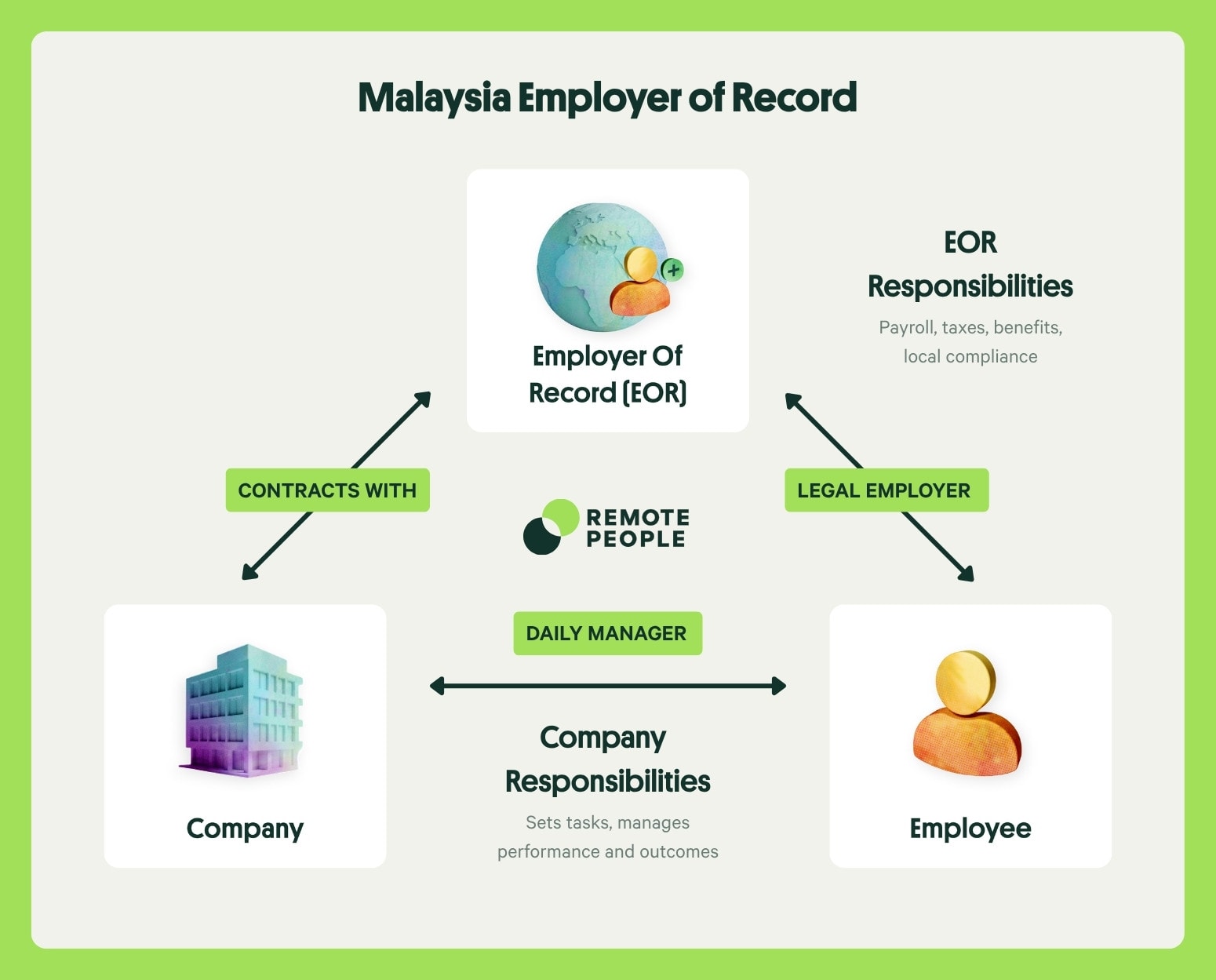
An employer of record (EOR) helps you to hire employees in Malaysia without starting the process of setting up a local entity there.
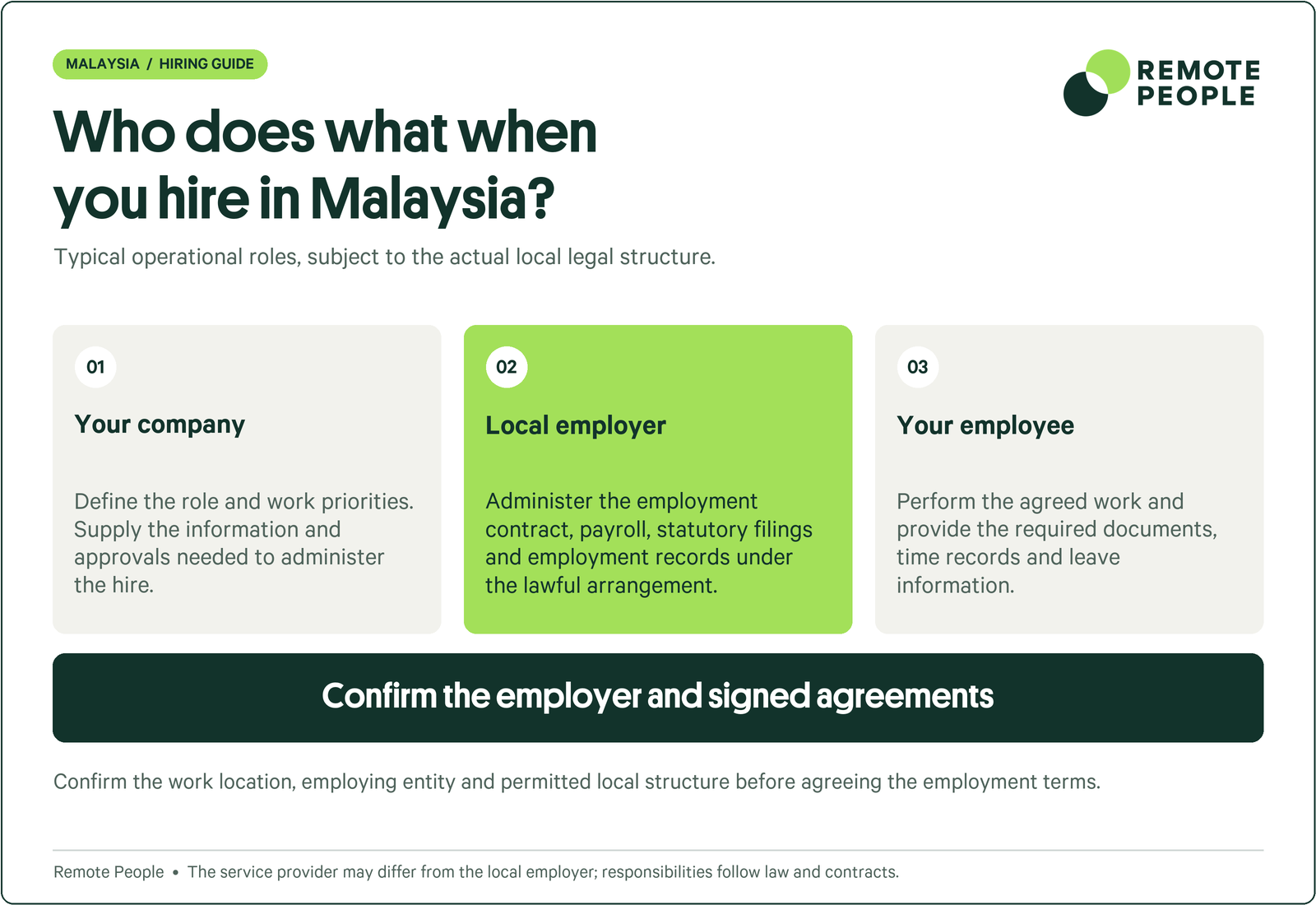
The EOR acts as the legal employer for your new hire in Malaysia, managing payroll, tax filings, and other administrative processes. By hiring an EOR, you remain compliant.
You will remain in charge of your team’s day-to-day work, while the provider handles local employment compliance and tracks regulatory changes.
How an Employer of Record Works in Malaysia
If you’re comparing providers, our Best Employer of Record (EOR) Providers guide reviews the leading platforms to help you choose the right solution for your business.
Who Uses an EOR in Malaysia?
Organizations across the growth spectrum rely on EORs to launch and scale in Malaysia:
- Startups and growth-stage companies without established Malaysian operations
- Multinational corporations testing new markets before building permanent infrastructure
- Organizations hiring remote workers or distributed teams across multiple countries
- Companies that need rapid workforce expansion without long-term local commitments
Typical Onboarding Timeline
The process usually includes these steps. Timing can vary, especially if a work permit is needed.
Days 1–3: Sign the EOR agreement, collect employee details, and check documents.
Days 4–7: For foreign employees, prepare and submit the work permit application.
Days 8–10: Finalize the employment contract in English or Malay, as needed.
Days 11–14: Complete the required EPF, SOCSO, EIS, and tax registrations.
Day 15 onwards: Start payroll once all registrations and any required work permits are approved.
Hire in Malaysia
Competitive employer costs, a well-educated workforce, strategic Southeast Asian location, and strong government incentives for foreign investment make Malaysia one of the region’s most attractive hiring destinations.
We handle employment contracts, payroll, tax withholding, and full Malaysian compliance.
No local entity needed. Your team can start in days.
Employment Contracts
Employment contracts should clearly outline what the employee’s role entails, their pay, any benefits, probation period, and termination terms. Written contracts help both sides understand their responsibilities and reduce the risk of disputes.
Contracts can be written in English or Malay and must follow the employment laws that apply to the employee.
Working Hours and Overtime
Under the Employment Act 1955, standard working hours are generally limited to 45 hours per week and eight hours per day, with some exceptions.
Overtime rates depend on whether the employee works on a normal working day, a rest day, or a public holiday. Eligibility also depends on the employee’s pay and type of work. The table below explains the main requirements:
Overtime Rates and Caps in Malaysia | |||
Hour Type | Rate Multiplier | Weekly/Daily Cap | Notes |
|---|---|---|---|
Normal Working Day Overtime | 1.5x hourly rate | Up to 104 hours/month | Applies to hours beyond 8 daily or 45 weekly |
Rest Day Work – Normal Hours | 1.0x hourly rate | Up to 8 hours | Work on rest day for regular shift length |
Rest Day Work – Beyond Normal Hours | 2.0x hourly rate | Beyond 8 hours | Additional hours on rest day get double pay |
Public Holiday – Normal Hours | 2.0x hourly rate | Up to 8 hours | Work on public holiday receives double rate |
Public Holiday – Overtime | 3.0x hourly rate | Beyond 8 hours | Hours beyond standard shift on public holiday |
Minimum Wage
The minimum wage in Malaysia is MYR 1,700 per month, effective under the Minimum Wages Order 2024. The phased implementation requires employers with 5 or more employees to comply from February 1, 2025, with full compliance across all employers by August 1, 2025. This rate applies to most sectors and is set to reflect the rising cost of living in Malaysia. All employment agreements must specify a salary at or above the minimum wage floor.
Probation Period
Malaysian law doesn’t prescribe a standard probation length, so you and the employee agree on the duration in your contract. Most employers settle on three to six months. Termination rules can differ during probation versus permanent tenure, so spell out probationary conditions explicitly in your contract. When probation ends, employees step into additional statutory protections under Malaysian law.
Leave Entitlements
Annual Leave
How much annual leave your employees get depends on how long they’ve been with you. Those with less than two years earn eight days per year, employees with two to five years get 12 days, and those beyond five years receive 16 days. They’re paid their normal wage during leave, and the timing must suit both your operational needs and their preferences.
Sick Leave
Sick leave entitlements scale with tenure: less than two years yields 14 days yearly, two to five years provides 18 days, and over five years grants 22 days. If an employee faces hospitalization, they can access up to 60 additional days with medical documentation. You’re entitled to request a medical certificate for absences lasting more than two consecutive days.
Maternity Leave
Female employees have a right to 98 consecutive paid maternity leave days, provided they’ve worked at least 90 days in the nine months before leave begins. The benefit traditionally had a cap based on number of surviving children, though contemporary practice and enforcement favor granting the full 98 days regardless.
Paternity Leave
Fathers with at least 12 months tenure earn seven consecutive paid days around their child’s birth. This is the statutory floor, and many employers voluntarily expand it to stay competitive for talent.
Other Statutory Leave
Bereavement leave and marriage leave exist in the law but lack fixed durations, leaving them to contract or company policy. Study leave isn’t a statutory entitlement and must be negotiated separately or embedded in your HR practices. Here’s a full rundown of the main leave types:
Leave Entitlements in Malaysia | ||
Leave Type | Entitlement | Key Eligibility Conditions |
|---|---|---|
Annual Leave | 8–16 days/year (by tenure) | Based on length of service; less than 2 years = 8 days; 2–5 years = 12 days; over 5 years = 16 days |
Sick Leave | 14–22 days/year (by tenure) | Less than 2 years = 14 days; 2–5 years = 18 days; over 5 years = 22 days; hospitalization up to 60 additional days with medical proof |
Maternity Leave | 98 consecutive days (paid) | Must have worked 90 days in the 9 months before leave; fewer than 5 surviving children |
Paternity Leave | 7 consecutive days (paid) | Must have 12 months of continuous service |
Bereavement & Marriage Leave | Contractual or per policy | Not strictly defined by statute; varies by employer and contract |
Statutory Employee Benefits
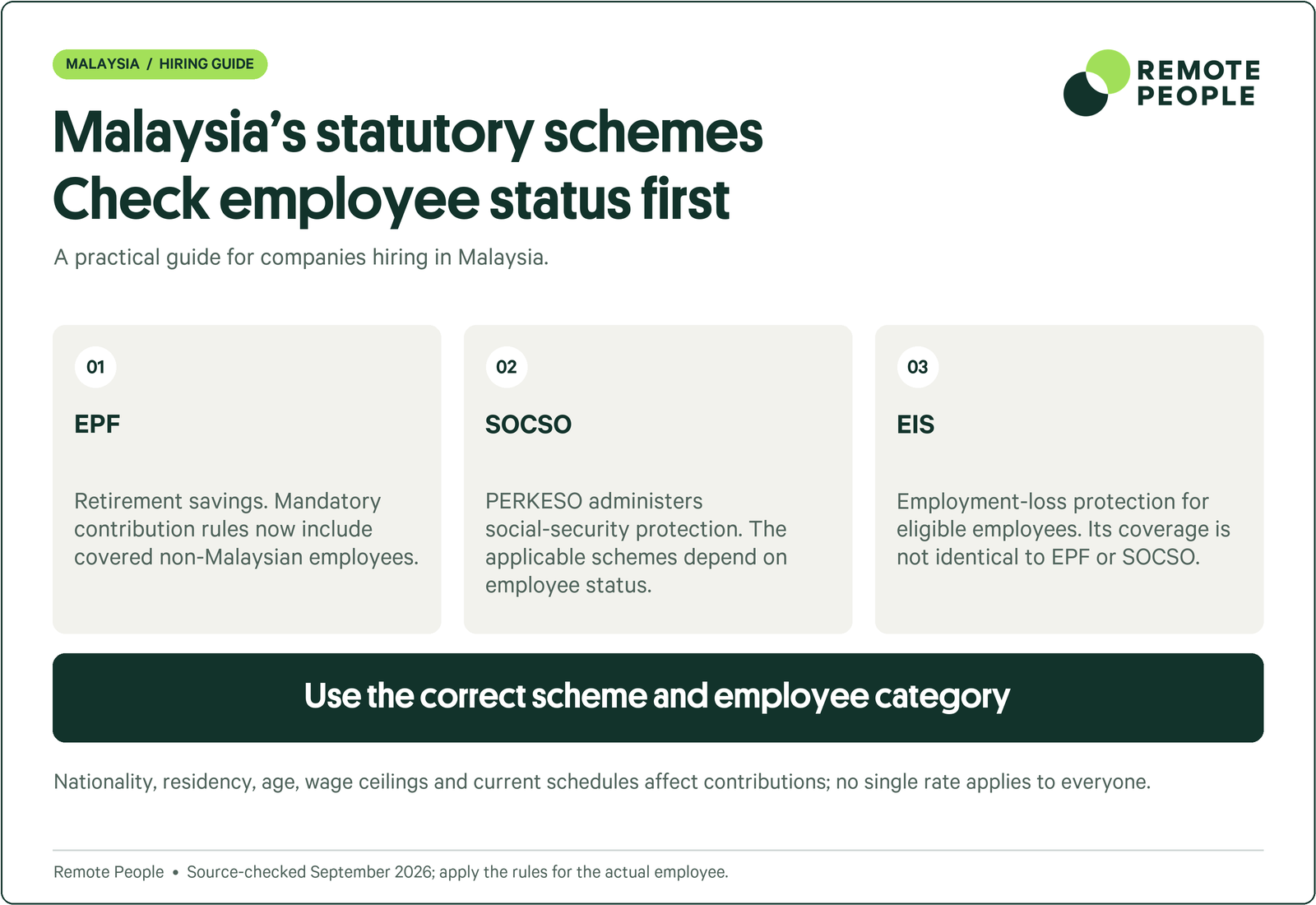
Three mandatory social security schemes sit at the foundation of employee benefits: the Employees Provident Fund (EPF) for retirement, the Employment Insurance Scheme (EIS) for joblessness protection, and SOCSO (run by PERKESO) for disability and accident coverage. Beyond these, employers increasingly provide health insurance as a competitive necessity. Your EOR manages all enrollments and keeps you compliant with evolving requirements.
Recent Regulatory Updates (2026)
Malaysia is actively modernizing its employment and tax landscape to match regional standards. The MYR 1,700 minimum wage (rolling out through 2025) is the headline change. Behind the scenes, the Ministry of Human Resources is debating gig economy rules and digital nomad visas, which will reshape how you classify contractors and remote workers. Before locking in employment agreements, check the latest requirements with your EOR, since the rules evolve annually.
Work Permits and Visas in Malaysia
Work Permit Requirements
Who Needs a Work Permit
Foreign nationals working in Malaysia need a work permit unless they fall into an exemption category under bilateral treaties or special visa schemes. Malaysian citizens don’t require one. The permit type depends on the job, salary level, and your company size.
Eligibility and Required Documents
The Immigration Department of Malaysia (KDN) handles work permits through employer sponsorship. You’ll need to gather standard documents: application form, valid passport, employment offer letter, education credentials, health exam results, and your business registration proof. Senior and specialized roles often have expedited pathways, whereas manual and lower-wage positions bump into strict quotas and sector-by-sector restrictions.
Processing Time and Validity
Expect four to eight weeks from submission to approval, with timing hinging on documentation quality and the department’s current workload. Approved permits typically stay valid for two years, though some categories get shorter initial terms. Validity hinges on contract duration and role type.
Renewal Process
Permits need renewal before they expire. Start the process 60 to 90 days before expiration and expect to submit much the same documentation as the original application. Your EOR coordinates with immigration to keep renewals on track, ensuring your employees maintain unbroken legal status.
Common Visa Types
Malaysia maintains multiple visa tracks tailored to different skill levels and employment scenarios. Here are the main work-related categories:
Common Work Visa Types in Malaysia | ||||
Visa Type | Typical Duration | Target Skills / Salary Range | Eligibility Highlights | Employer Sponsorship Required |
|---|---|---|---|---|
Employment Pass (EP) | 2 years (renewable) | Mid to high-skill roles; monthly salary typically MYR 5,000+ | Professional, technical, or managerial positions; bachelor’s degree or equivalent | Yes – employer-sponsored |
Professional Visit Pass (PVP) | Up to 12 months | Short-term consultants, expatriate experts | Specialized expertise; typically for contract-based or temporary assignments | Yes – employer or client-sponsored |
Temporary Employment Pass (TEP) | Up to 12 months | Skilled or semi-skilled workers in shortage sectors | Designated occupations; lower salary thresholds than EP; quota-based by sector | Yes – employer-sponsored; often sector-limited |
Malaysia My Second Home (MM2H) | 10 years (renewable) | Not employment-focused; long-term residence for retirees or investors | Age 35+, financial criteria (depends on age bracket); not primarily for work | No – individual visa; work restrictions apply |
Dependent Pass | Linked to sponsor’s employment pass validity | Spouse, children, domestic staff of work permit holders | Family member of EP or TEP holder; domestic workers require separate permits | Sponsor’s employer must support |
How an EOR Handles Work Permits
Reliable EOR services in Malaysia shoulder the entire work permit burden. They compile all paperwork, file with Immigration, track progress, and liaise directly with authorities. This matters because delays or mistakes can derail your hiring timeline. Strong EOR firms know the immigration landscape inside out, maintain official relationships, and understand sector quotas, all of which helps your hires clear the process smoothly.
Payroll, Taxes, and Social Security in Malaysia
Employer Contributions
You’re required to contribute to three schemes: the Employees Provident Fund (EPF), Employment Insurance Scheme (EIS), and SOCSO (via PERKESO). These are monthly obligations tied to salary and aren’t tax-deductible in the traditional sense, but they’re non-negotiable. Here’s the breakdown:
Employer Contribution Rates in Malaysia | ||
Contribution Scheme | Employer Rate | Wage Ceiling / Notes |
|---|---|---|
EPF (Employees Provident Fund) | 13% (wages ≤ MYR 5,000/month); 12% (wages > MYR 5,000/month) | No ceiling; percentage applies to gross monthly wage |
SOCSO (Employment Injury + Invalidity) | 1.75% | Ceiling: MYR 6,000/month |
EIS (Employment Insurance Scheme) | 0.2% | Ceiling: MYR 6,000/month |
Total Employer Contribution (example for wage MYR 5,000): 13% + 1.75% + 0.2% = 15.95% of gross wage | ||
Employee Contributions
Your employees chip in too, with deductions taken straight from gross pay each month. Unlike employer contributions, these directly shrink take-home, so they must be crystal-clear on payslips. Here are the rates:
Employee Contribution Rates in Malaysia | ||
Contribution Scheme | Employee Rate | Wage Ceiling / Notes |
|---|---|---|
EPF (Employees Provident Fund) | 11% | No ceiling; deducted from gross salary |
SOCSO (Employment Injury + Invalidity) | 0.5% | Ceiling: MYR 6,000/month |
EIS (Employment Insurance Scheme) | 0.2% | Ceiling: MYR 6,000/month |
Total Employee Contribution (example for wage MYR 5,000): 11% + 0.5% + 0.2% = 11.7% of gross wage | ||
Income Tax
Malaysia taxes employment income on a progressive scale, with rates varying by annual income level. Resident individuals (those in Malaysia for more than 182 days in a tax year) pay progressive tax, while non-residents face a flat 30% rate. Tax rates as of 2024 (PwC) are detailed in the following table:
Malaysia Personal Income Tax Brackets (YA 2024 onwards) | |
Annual Chargeable Income (MYR) | Tax Rate |
|---|---|
0–5,000 | 0% |
5,001–20,000 | 1% |
20,001–35,000 | 3% |
35,001–50,000 | 6% |
50,001–70,000 | 11% |
70,001–100,000 | 19% |
100,001–400,000 | 25% |
400,001–600,000 | 26% |
600,001–2,000,000 | 28% |
Over 2,000,000 | 30% |
Non-residents | 30% (flat rate) |
Payroll Cycle
Malaysian payroll typically runs monthly, with salaries due by the last working day of the month or shortly after. Your EOR calculates gross-to-net accurately, deducting EPF (11%), SOCSO (0.5%), EIS (0.2%), and tax withheld. Payslips go to employees promptly, and records stay available for LHDN audits. Getting payroll right on time is both a compliance imperative and a morale builder.
13th Month Salary and Bonus Pay
A 13th month payment isn’t legally required in Malaysia, but if you promise it in a contract or handbook, you’re obligated to deliver. Many employers voluntarily offer year-end bonuses to stay competitive, though the structure and eligibility vary. Your EOR can benchmark local market norms and help you design bonus arrangements that stay contractually sound and tax-efficient.
Cost of Hiring Through an EOR in Malaysia
EOR Service Fees
EOR fees typically span USD 350 to USD 500 per employee monthly, varying by role complexity and service scope. Standard packages cover payroll, tax filing, work permits, and HR support. Some firms charge variable rates by headcount or offer tiered pricing for larger teams. Nail down what’s included from day one, since extras like relocation, legal support, or training can rack up costs beyond the base fee.
Total Employment Cost Breakdown
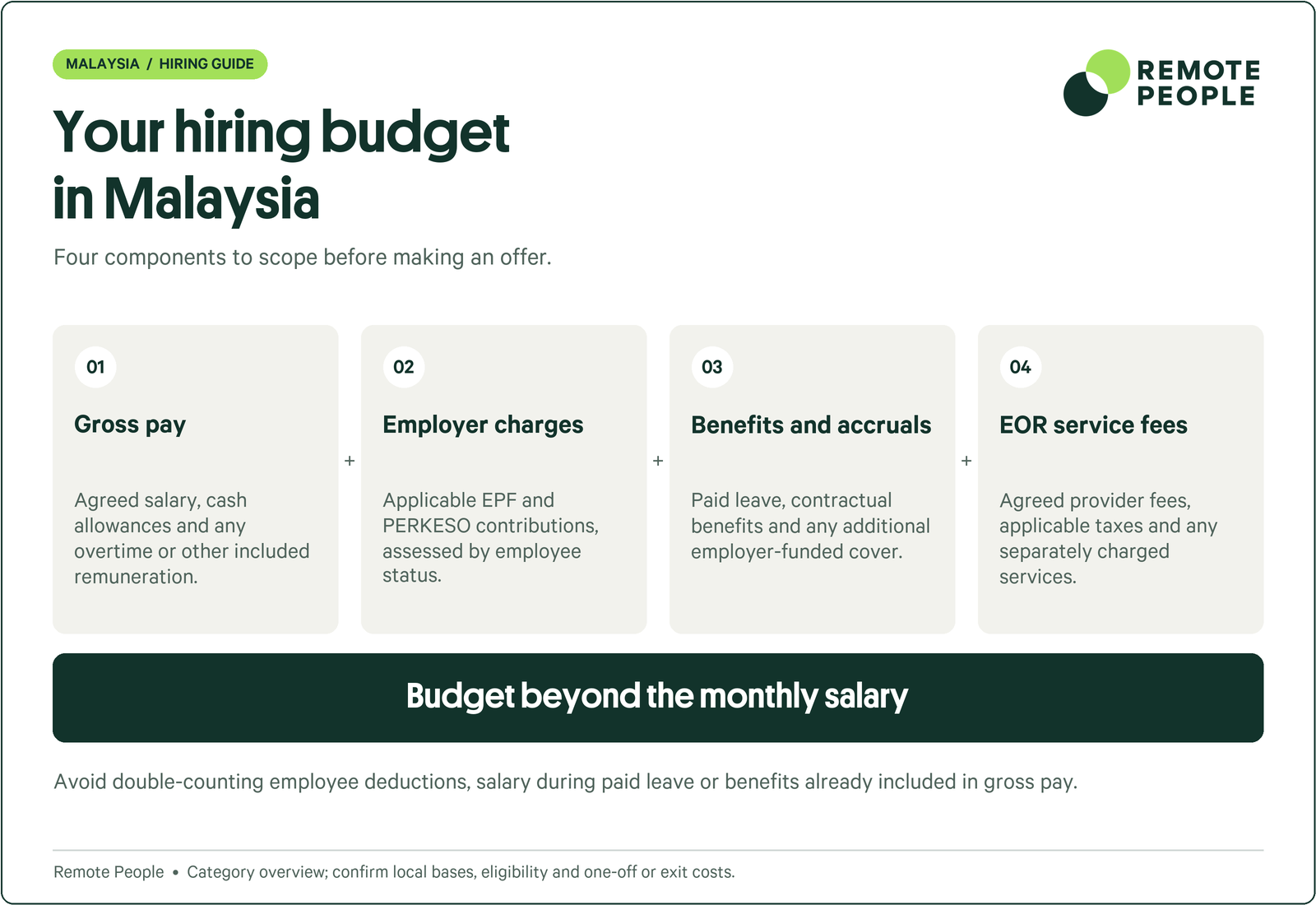
Total hiring cost breaks down into three parts: gross salary, your mandatory social contributions, and the EOR service fee. Here’s a concrete example for a full-time hire at USD 2,000 gross monthly (salaries are actually in MYR, but this is in USD for clarity):
Total Cost of Hiring Through an EOR – Monthly Cost Breakdown (USD) | ||
Cost Component | Rate / Amount | Monthly Cost (USD) |
|---|---|---|
Employee Gross Salary | Base compensation | USD 2,000 |
EPF (Employer Contribution) | 13% of gross | USD 260 |
SOCSO (Employer Contribution) | 1.75% of gross | USD 35 |
EIS (Employer Contribution) | 0.2% of gross | USD 4 |
EOR Service Fee | Monthly platform fee | USD 450 |
Total Estimated Monthly Cost | – | USD 2,749 |
Total Monthly Cost | USD 2,749 | |
Employer Cost Premium Above Gross Salary | 37.45% | |
As you can see, total cost runs roughly 37.45% above gross salary once contributions and fees are included. That percentage shifts depending on salary level (lower salaries inflate the EOR fee relative to salary), tax complexity, and work permit needs. Proper budgeting means accounting for the full employment cost, not just gross pay, so you have realistic forecasts and ROI.
Hiring employees in Malaysia through an EOR helps your company to maintain compliance, reduces administrative tasks and enables your company to expand without going through the hassle of setting up a local entity in Malaysia.
Benefits of Using an EOR in Malaysia
As we’ve mentioned throughout the article, there are many benefits of using an EOR for companies that are hiring employees in Malaysia.
Let’s take a closer look at these advantages:
- Increased Hiring Speed: You can launch your operations in Malaysia within 1-2 weeks; without one, you’d be looking at a few months’ turnaround.
- Stay Compliant: As the EOR becomes legal responsible for your employees, they can help with compliance, helping your company to avoid any penalties and fines.
- Cost Efficient: With most EORs, you can pay them monthly, rather than forking out upfront setup costs as you would have to with an entity setup.
- Flexible Solution: You can hire a small selection of employees without having to commit to opening a local office.
- Less Risk: You can reduce your exposure to any misclassification claims, as the EOR takes responsibility for the legal side.
Termination and Offboarding in Malaysia
Notice Periods
Malaysian law states that notice periods are based on how long an employer has worked in your company. This means the longer your length of employment, the longer your notice period. You are obliged to follow these laws whether you are in your probation period or full employment contract.
Here is the breakdown of these rules:
Position Level / Service Length | Notice Period (Weeks) | During Probation | Notes |
|---|---|---|---|
Less than 2 years service | 4 weeks | 4 weeks | Employment Act Section 12; applies to all probationary employees |
2–5 years service | 6 weeks | 4 weeks minimum | Can be reduced by agreement, but 4 weeks statutory minimum still applies |
5 or more years service | 8 weeks | 4 weeks minimum | Longest statutory notice; payment in lieu is permissible |
Managerial and Specialist Staff | Per contract or 4–8 weeks | Per contract terms | Contractual terms may exceed statutory minimums; common in management roles |
Collective Dismissal (5+ employees) | Statutory period + notification to Department of Labour | N/A | Labor Department notification required 30 days prior to termination |
Severance Pay
Severence pay is valid for those employees who are terminated after the 12-month service mark. The pay that they receive depends on a combination of the length of time they’ve been within the company and their wages. Its a legal requirement for those earning MYR 4,000 or less, or in manual roles. However, employers have the option to offer it to their employees whatever the circumstances.
Check out our Malaysia serverence pay overview:
Years of Service | Severance Rate (Days’ Wages per Year) | Example: 30-Day Month, MYR 4,500/month | Notes |
|---|---|---|---|
Less than 2 years | 10 days per year | 1 year = MYR 1,500; 1.5 years = MYR 2,250 | Pro-rata for incomplete years (to nearest month) |
2–5 years | 15 days per year | 3 years = MYR 6,750; 5 years = MYR 11,250 | Day 1 of 2-year mark triggers higher rate |
5 or more years | 20 days per year | 5 years = MYR 15,000; 10 years = MYR 30,000 | Highest rate; calculated on average daily wage for prior 12 months |
Minimum eligibility | 12 months continuous service required | Less than 12 months = zero severance | Employment Act Section 12 (Termination and Lay-Off Benefits Regs 1980) |
Calculation Method
The formula above uses the average daily wage from the past 12 months, multiplied by the applicable multiplier (10, 15, 20 days service per year). Any partial years are prorated to the next month. Your EOR works out this total for you, ensuring that the severence pay is included in the employees final paycheck.
Caps and Exceptions
Severance legally applies only to Employment Act employees (usually those earning MYR 4,000 or less, or in manual work), though many employers contractually extend it. Dismissal for serious misconduct can trigger forfeiture. Mutual agreement exits typically preserve severance unless both parties sign off on a waiver.
Grounds for Termination
Malaysian law accepts multiple termination grounds, each with its own procedural rules. Misconduct calls for quick investigation and the employee’s chance to respond. Performance terminations need documented failure and corrective attempts. Redundancies must follow statutory retrenchment protocols. Using an EOR ensures all terminations hit these marks, keeping unfair dismissal claims and costly Industrial Court reinstatement orders at bay.
Public Holidays in Malaysia
Malaysia’s 2026 calendar includes 17 gazetted public holidays split between federal and state observances. The law mandates a minimum of 11 paid holidays yearly, five of which are fixed (National Day, Agong Birthday, Labour Day, Malaysia Day, and Federal Territory Day or Ruler’s Birthday). You choose the other six from the gazette. Absent employees get paid their regular daily wage, and work on holidays triggers premium rates or time off in lieu.
Date (2026) | Holiday | Type |
|---|---|---|
Jan 1 | New Year’s Day | National |
Feb 1 | Thaipusam | National (Hindu festival) |
Feb 17 | Chinese New Year | National (Day 1) |
Feb 18 | Chinese New Year | National (Day 2) |
Mar 7 | Nuzul Al-Quran | National (Islamic) |
Mar 20 | Hari Raya Aidilfitri | National (Day 1, Islamic) |
Mar 21 | Hari Raya Aidilfitri | National (Day 2, Islamic) |
May 1 | Labour Day | National (Compulsory) |
May 27 | Hari Raya Haji | National (Islamic) |
May 31 | Wesak Day | National (Buddhist) |
Jun 1 | Birthday of Yang di-Pertuan Agong | National (Compulsory) |
Jun 17 | Awal Muharram (Islamic New Year) | National (Islamic) |
Aug 25 | Maulidur Rasul (Prophet’s Birthday) | National (Islamic) |
Aug 31 | National Day (Merdeka Day) | National (Compulsory) |
Sep 16 | Malaysia Day | National (Compulsory) |
Nov 8 | Deepavali | National (Hindu festival) |
Dec 25 | Christmas Day | National |
Your EOR handles public holiday payroll automatically. They ensure employees get paid on holiday dates, track entitlements, and apply premium rates for any holiday work. This takes the complexity out of payroll and keeps you legal on all 17 dates.
EOR vs. Other Hiring Models in Malaysia
EOR vs. Setting Up a Local Entity
An EOR is the faster, lower-risk entry point for hiring in Malaysia, while a local entity makes sense once your team exceeds 15 people and you commit to long-term operations. Here are the main tradeoffs:
Comparison | EOR Model | Local Entity Setup |
|---|---|---|
Setup time | 1–2 weeks | 2–4 months (SSM registration, tax ID, social insurance, banking) |
Upfront cost | $0 (no setup fee) | $15,000–$30,000 (registration, accounting, legal, initial compliance) |
Ongoing cost (per employee/month) | $300–$600 (includes payroll, tax, compliance) | $8,000–$15,000/year base maintenance + salary + employer contributions |
Local partner required | No (EOR is your legal employer in Malaysia) | No (100% foreign ownership allowed in most sectors under MIDA guidelines) |
Social insurance & payroll | EOR handles all registrations, withholding, filings | You manage (or hire an accounting firm) EPF, SOCSO, EIS, income tax |
Best for team size | 1–15 employees | 15+ employees (cost per employee drops at scale) |
Scale down or exit | Easy; no legal entity to dissolve | Costly and complex (requires formal corporate dissolution, tax clearance, final audit) |
Government contracts eligibility | Not eligible (you are not the registered local entity) | Eligible (your company is the registered entity) |
HR & payroll control | EOR manages within Malaysian law; you set policy direction | You control all HR and payroll; full autonomy |
An EOR shines if you’re piloting the Malaysia market, launching your first overseas team, or want to skip legal and admin headaches. You stay in command of hiring and daily management; the EOR owns compliance. Migrating to your own entity later is straightforward when the time comes.
A local company pencils out once you hit 15 or more employees, commit to long-term operations, or chase government contracts. Cost-per-head drops at scale, and you own all HR decisions. The upfront spend and setup timeline demand serious planning though.
Many companies smartly use EOR solutions to test the market, then shift to a local company as the team expands. This phased path cuts risk and lets you scale at your pace.
EOR vs. Hiring Independent Contractors
Contractors cost less upfront but carry serious legal risk if the relationship looks like employment under Malaysian law. Get the distinction right to dodge reclassification penalties and disputes. Here’s what sets them apart:
Comparison | EOR (Employee) | Independent Contractor |
|---|---|---|
Legal relationship | Employment relationship; you define work, hours, methods | Self-employed; contractor controls how work is delivered |
Compliance risk | Low; EOR ensures statutory compliance (notice, severance, benefits) | High; misclassification claims if relationship resembles employment |
Payroll & tax | EOR withholds income tax, EPF, SOCSO, processes monthly payroll | Contractor invoices you; they file their own taxes and pay SOCSO as self-employed |
Statutory benefits & leave | Full entitlements: annual leave, sick leave, public holiday pay, maternity benefits | No entitlements; all benefits are contractually negotiated |
IP protection | Stronger; employment contract assigns work-product IP by default | Weaker; requires explicit IP assignment clause in services agreement |
Termination | Subject to notice periods (4–8 weeks) and severance (if eligible) | Contract-driven; can end per agreed terms (typically shorter notice) |
Best use case | Long-term, core team roles; ongoing projects with regular hours | Short-term projects, specialized tasks, ad hoc work |
Cost structure | Salary + employer EPF/SOCSO contributions + EOR fee | Contract fee (typically higher per-hour rate, but lower total employer cost) |
Contractors work for specialized, discrete projects where they control execution. But Malaysian courts scrutinize these arrangements closely; regular hours, constant direction, and exclusive work can flip someone into employee status. A disputed classification lands you with back-pay, benefit claims, and Department of Labour penalties.
An EOR cuts this risk by establishing unmistakable employment status. Your employees get full statutory rights and benefits, which shrinks legal exposure and builds a more professional culture. For permanent hires, EOR typically wins on both safety and total cost when you factor in legal risks.
If you need flexible, specialized resources for discrete projects, RemotePeople’s contractor solution provides compliant independent contractor engagement with built-in IP protection and clear scope of work management.
EOR vs. PEO
PEOs and EORs both outsource employment, but they work under different legal models and fit different business stages. Malaysia hasn’t yet regulated PEOs formally, which shapes how they function and what safeguards they offer. Grasping the difference clarifies which path makes sense for you.
Comparison | EOR (Employer of Record) | PEO (Professional Employer Organization) |
|---|---|---|
Legal employer | EOR is the sole legal employer; you have no employer liability | Co-employment; you and PEO share employer status and liability |
Local entity required | No; EOR is your local employer entity | Yes; you must establish and maintain your own Malaysian company |
Best for | Companies without a local presence; market entry, rapid team building | Established local operations seeking HR outsourcing support |
Compliance liability | EOR assumes full compliance responsibility; lower your risk | Shared liability; you remain accountable for HR and labor law compliance |
Setup time | 1–2 weeks to onboard employees | 2–4 months (requires your own entity setup plus PEO partnership) |
Control over HR policy | EOR manages policies within Malaysian law framework; you set direction | More control; you manage policies directly, PEO provides advisory support |
Regulatory framework | Formal frameworks in most countries (EOR regulations well-established) | Malaysia has no formal PEO regulatory framework; less legal certainty |
The EOR route is cleaner and lower-risk when entering Malaysia. By taking legal employer status, the EOR absorbs all liability and compliance work, leaving you free to build and lead your team. Perfect if you’re new to Malaysia and want minimal legal and admin burden.
A PEO works better if you’ve already got a Malaysian company and want HR help with control intact. But co-employment splits liability between you and the PEO on compliance. Malaysia’s regulatory gap around PEOs adds uncertainty, making EOR the safer bet for first-time Malaysia entry.
If you’re building a long-term Malaysia footprint with real headcount and plan to own your entity eventually, an EOR bridges the launch phase nicely, then you migrate staff to your company as it matures.
How to Get Started with an EOR in Malaysia
Getting your first hire into Malaysia via an EOR provider is a clean five-step journey. Most companies go from assessment to payroll in two weeks. Here’s how it flows:
- First, assess your hiring needs. Determine how many employees you plan to hire, their roles, salary expectations, and start timeline. This clarity will help you evaluate pricing and EOR capacity.
- Second, request a proposal and pricing estimate. Provide your requirements to your chosen EOR, including team size, seniority levels, and any specialized compliance needs. Pricing typically ranges from $300–$600 per employee per month.
- Third, select your candidates and complete due diligence. Conduct interviews, background checks, and reference verifications independently or with your EOR’s support. Your EOR can advise on local hiring practices and competitive salary benchmarks.
- Fourth, execute employment agreements and complete onboarding. Your EOR will prepare employment contracts compliant with Malaysian labor law, arrange tax ID registration, and initiate EPF and SOCSO enrollment. You provide employee information and sign contracts; the EOR handles all government filings.
- Fifth, launch payroll and ongoing HR management. On the employee’s start date, the EOR begins payroll processing, benefits administration, and statutory compliance. You manage day-to-day work direction; the EOR handles leave approvals, terminations, and regulatory changes.
Ready to hire in Malaysia? Contact RemotePeople today to discuss your team goals and receive a custom quote. Our EOR specialists will guide you through every step, ensuring a smooth and compliant hiring process.
Frequently Asked Questions
EOR pricing typically ranges from $300–$600 USD per employee per month, depending on salary level, seniority, and your EOR provider's service scope. There are no upfront setup fees or hidden charges. This fee covers payroll processing, tax compliance, EPF and SOCSO administration, statutory leave management, and employment law compliance. Compare this to setting up a local entity, which costs $15,000–$30,000 upfront plus $8,000–$15,000 annually in maintenance. Most organizations find the EOR model cost-effective for teams of 1–15 employees. (Sources: RemotePeople Pricing; ASEAN Briefing Malaysia Employment Services)
You can onboard your first employee within 1–2 weeks from agreement to first paycheck. The EOR handles registration with the Department of Human Resources, tax identification, EPF and SOCSO enrollment, and employment contract preparation. This is significantly faster than setting up a local company, which typically takes 2–4 months. The speed depends on how quickly you finalize your candidate selection and provide required employee documentation. (Sources: RemotePeople Service Timeline; Ministry of Human Resources Malaysia Registration Process)
Yes, but it carries legal and compliance risks. Malaysian courts scrutinize contractor relationships; if the engagement resembles employment (regular hours, ongoing direction, exclusive services), the Department of Labour may reclassify the relationship and demand back-pay, statutory benefits, and EPF contributions. Contractors are best for short-term, project-based work where the contractor controls delivery methods. For long-term team members, an EOR eliminates misclassification risk and provides statutory protections. If you do need independent contractors, RemotePeople's contractor hiring solution provides compliant engagement with built-in IP protection and scope management. (Sources: Employment Act 1955; Baker McKenzie Malaysia Labor Law; ASEAN Briefing Independent Contractor Misclassification)
Statutory mandatory benefits include annual leave (8–16 days based on tenure), paid sick leave (14 days in the first year, 18+ days after), paid public holidays (minimum 11 per year), maternity leave (98 consecutive days), and enrollment in the Employees Provident Fund (EPF, employer contribution of 12%–13% of wages). All employees are also covered by SOCSO (social security, employer contribution of 1.75% of wages capped at MYR 6,000) and the Employment Insurance System (EIS, employer contribution of 0.2% of wages capped at MYR 6,000). Your EOR automatically calculates and deducts all contributions and ensures statutory compliance. (Sources: Employment Act 1955; KWSP and PERKESO Malaysia Contribution Rates)
Yes. Foreign employees must obtain a work permit from the Immigration Department and Ministry of Human Resources. The process typically takes 2–4 weeks and requires an offer letter, qualification documentation, health certificates, and your company's registration. Your EOR can guide the application and coordinate with immigration authorities, but the work permit is your responsibility to arrange. Certain professions (e.g., domestic workers, contract laborers) have streamlined processes. Penalties for unauthorized employment are severe, so ensure permits are obtained before the employee starts work. (Sources: Immigration Department Malaysia (imi.gov.my); ASEAN Briefing Foreign Worker Immigration Requirements)
No. An employer of record in Malaysia removes the need to incorporate a local subsidiary or branch office. The EOR holds the legal employment relationship with your staff, manages payroll and statutory filings, and ensures compliance with the Employment Act 1955. You maintain full operational control of your team without the cost and complexity of entity registration, which typically takes 4–12 weeks and requires local directors.
Employer of Record in
Employer of Record in
Employer of Record in
Employer of Record in
Employer of Record in
Employer of Record in
Employer of Record in
Employer of Record in