
 Recruit
Average Salary in Malaysia
-
 Drew Donnelly
- Published
- September 21, 2026
- 5 ★ on G2








Let RemotePeople handle payroll, compliance, and HR admin worldwide so you can focus on building your team.
Malaysia’s skilled workforce, cost-effective labor, and business-friendly policies make it an excellent outsourcing destination. Employers seeking partnerships in the country may wonder, what is the average salary in Malaysia? This information will help them prepare a competitive job offer.
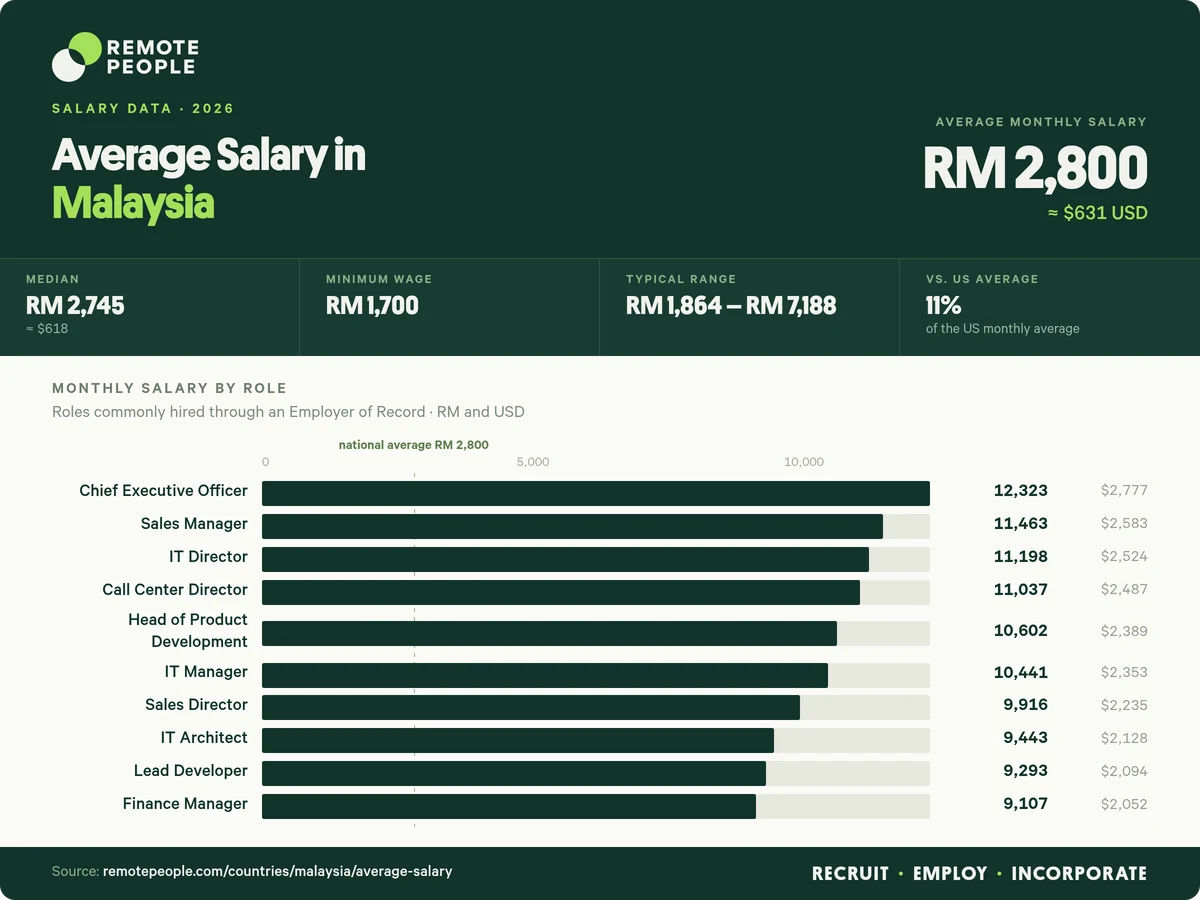
The average monthly salary in Malaysia is 2,800 RM, or about USD 631. However, salaries vary by profession, industry, education, location, and experience. You must also consider how wages compare to those in other countries worldwide.
This guide will explore all aspects of Malaysian salaries to provide a comprehensive view.
What is the Average Salary in Malaysia?
The average salary in Malaysia is 2,800 RM, or about $631. The country’s low wages are due to its reliance on low-skilled industries. The government also has minimum wage issues.
Median Income
The median salary can also be considered the ‘middle salary.’ Malaysia’s median monthly income is 2,745 RM, or about $618. Half the country’s population earns higher salaries, and the other half earns lower salaries.
Salary Range
The salary range spans the lowest to highest salaries in the country. In Malaysia, low earners make around 1,864 RM (about $420), while high earners make closer to 7,188 RM (about $1620).
Salary Comparison by Profession
Salaries vary by education, experience, location, profession, and industry. The following sections will explore how these factors impact earnings.
Profession | Average Monthly Salary (RM) |
|---|---|
Chief Executive Officer | 12,323 |
Sales Manager | 11,463 |
IT Director | 11,198 |
Call Center Director | 11,037 |
Head of Product Development | 10,602 |
IT Manager | 10,441 |
Sales Director | 9,916 |
IT Architect | 9,443 |
Lead Developer | 9,293 |
Finance Manager | 9,107 |
Banking Cashier | 2,261 |
Fabric Cutter | 2,257 |
Clothing Technologist | 2,247 |
General Laborer | 2,234 |
Packer | 2,201 |
Seamstress | 2,102 |
Porter | 2,030 |
Medical Records Clerk | 2,024 |
Tailor | 2,009 |
Average Wage in Malaysia by Education
Education typically contributes to higher earnings. However, in Malaysia, a recent spike in the minimum wage makes some question the value of learning.
Due to the increase, workers in the country can earn a living with minimal education. However, statistics show that education contributes to higher lifetime earnings. Entry-level graduates earn between 2,000 and 3,000 RM, compared to early leavers, who earn between 1,700 and 2,000 RM.
Additionally, graduates benefit from salary increases and career progression over time, while minimum wage earners often face wage and professional development stagnation.
Salary Comparison by Experience
Experience is a factor that weighs heavily on wage determination. Consider the following statistics:
Experience Level | Earnings Increase Compared to Previous Tier |
|---|---|
2–5 years | +32% vs. Entry-level |
5–10 years | +36% vs. 2–5 years |
10–15 years | +36% vs. 5–10 years |
15–20 years | +14% vs. 10–15 years |
20+ years | +9% vs. 15–20 years |
Salary Comparison by Location
Location also impacts salaries. A Business Times report reveals that the median monthly income in urban areas like Kuala Lumpur, Selangor, and Pulau Pinang exceeds the national median wage.
In contrast, areas like Kelantan, Perlis, and Sebah have the lowest median monthly salaries. The high wages in urban areas are directly related to their proximity to big companies that offer more job opportunities and higher living costs.
How Much is Minimum Wage in Malaysia?
As of 2026, Malaysia’s minimum wage is set at RM1,700 per month, following the Minimum Wages Order 2024 that took effect on February 1, 2025 and has been fully enforced nationwide since August 1, 2025. This rate applies to most workers regardless of company size and includes foreign and contract workers, though domestic helpers are excluded. Employers are required to comply with this minimum wage under the National Wages Consultative Council Act 2011, and failure to do so may result in penalties including fines and other enforcement actions.
Average Salary in Malaysia vs. the Rest of the World
Average salaries provide some insight, but the charts below support a better understanding, comparing Malaysian wages to earnings in developed, developing, and undeveloped countries.
Malaysia vs. Developed Countries
Country | Average Salary | Comparison to Average Malaysia Salary |
|---|---|---|
United Kingdom | €3,000 (approx. $3,116) | – 391% |
United States | $5,677 | – 808% |
Norway | 50,790 NOK (approx. $4,700) | – 645% |
Germany | €4,300 (approx. $4,467) | – 612% |
Austria | €3,500 (approx. $3,636) | – 471% |
Malaysia vs. Developing Countries
Country | Average Salary | Comparison to Average Malaysia Salary |
|---|---|---|
Romania | 4,000 RON (approx. $835) | – 33% |
Russia | 73,709 RUB (approx. $700) | – 11% |
Albania | €1,500 (approx. $1,550) | – 146% |
Kazakhstan | 342,082 KZT (approx. $645) | – 3% |
Ukraine | 18,000 UAH (approx. $500) | 26% |
Malaysia vs. Undeveloped Countries
Country | Average Salary | Comparison to Average Malaysia Salary |
|---|---|---|
Thailand | 97,500 Baht (approx. $2,772) | – 344% |
Philippines | 18,423 PHP (approx. $875) | – 39% |
Vietnam | 8.5 million VND (approx. $360) | 75% |
Egypt | 13,244 EGP (approx. $263) | 142% |
Pakistan | 45,000 PKR (approx. $150) | 320% |
Malaysia is a developing country but is on track to achieve high-income status due to its economic transformation from agriculture to manufacturing and service sectors. Its work economy is diversified and export-oriented. The country is a popular source of electrical appliances, parts, healthcare, transport, tourism, and retail trade.
The country is a convenient outsourcing destination due to its skilled workforce, high English proficiency, business-friendly policies, low labor costs, and strategic location. The government supports its outsourcing initiatives with incentives and initiatives. It is seeing significant growth in its operations.
What are the Most Common Outsourced Industries in Malaysia?
Employers will see the most benefits when forming remote partnerships in the following industries:
Manufacturing
Malaysia’s outsourcing industry thrives due to a focus shift from agriculture to manufacturing. It is a popular source for electrical and electronic appliances, components, automotive manufacturing, and construction. The country is also making waves in the defense industry.
Business Processing
Employers often turn to Malaysian workers for assistance with business process operations, including customer support, data entry, accounting, and bookkeeping. It offers a skilled and multilingual workforce, cost-effective labor, and a strategic location.
The average BPO worker in Malaysia earns around 3000 RM (about $676) monthly, while American workers earn closer to $3500 per month. U.S. employers that hire in the country can see significant savings.
IT Services
Malaysia’s IT industry is booming. It is expected to contribute 25.5% to the GDP in 2025. Strong focuses include data analytics, AI, and cybersecurity.
IT workers in Malaysia earn around 4,000 RM (about $901) monthly, while American workers earn closer to $5000. This difference leads to significant expense reductions for employers looking to outsource.
Conclusion
Malaysia’s low average salary, skilled workforce, and strategic location make it an ideal outsourcing destination. Employers that partner with the country on remote opportunities can benefit from cost savings and exceptional products and services while helping workers increase their income, resulting in an advantageous situation for everyone involved.