
 Recruit
Employer of Record (EOR) in Cambodia
-
 Drew Donnelly
- Published
- September 27, 2026
RemotePeople’s employer of record in Cambodia lets you hire employees in Cambodia with NSSF contributions. We handle occupational risk insurance at 0.8%, healthcare scheme contributions at 1.3% borne fully by employer, and pension contributions at 2% from employer in the first five years.
Hire in Cambodia — book a free 30-minute demo
Tell us what you need. You'll get a tailored, transparent proposal within 24 hours, plus a free call to walk through it.
Tell us about your company
So we can match you with a specialist who knows your market — and unlock volume pricing tiers.
* All fields are required.
Where and when are you hiring?
Tell us the geography and timing and we'll quote each country line by line, with onboarding timelines.
* All fields are required.
Help us beat your current setup
We'll benchmark your current deal and send a line-by-line proposal in 24 hours — showing exactly where we cut cost, time, or risk. After you submit, you can book a call to walk through it together.
* All fields are required.
Thanks! Your proposal is on its way.
Expect a tailored, line-by-line proposal in your inbox within 24 hours. In the meantime…
Want to walk through it together?
Book a free 30-minute call with one of our specialists. We'll explain every line, answer your questions, and tailor the proposal further if you need.
No obligation. Pick a time that works for you.








- Hire in Cambodia — book a free 30-minute demo
- Tell us about your company
- Where and when are you hiring?
- Help us beat your current setup
- Thanks! Your proposal is on its way.
- How an Employer of Record Works in Cambodia
- Employment Laws and Regulations in Cambodia
- Work Permits and Visas in Cambodia
- Payroll, Taxes, and Social Security in Cambodia
- Cost of Hiring Through an EOR in Cambodia
- Benefits of Using an EOR in Cambodia
- Termination and Offboarding in Cambodia
- EOR vs. Other Hiring Models in Cambodia
- Public Holidays in Cambodia
- How to Get Started with an EOR in Cambodia
- Where companies hiring in Cambodia expand next
- Frequently Asked Questions
- Related EOR Destinations
Start hiring in Cambodia
Let RemotePeople handle payroll, compliance, and HR admin worldwide so you can focus on building your team.

Cambodia offers one of Southeast Asia’s youngest workforces, a competitive cost base, and a stable regulatory regime that has been opening steadily to foreign employers. For companies looking to hire employees in Cambodia, the challenge is not talent but compliance: the Labour Law requires local employer registration, monthly payroll filings, NSSF contributions, and work permits for every foreign hire.
Setting up a local entity can take three to six months and tie up significant capital. An employer of record in Cambodia removes that overhead entirely. The EOR acts as the legal employer in-country, handles all statutory obligations, and lets you onboard a new hire in roughly one to two weeks.
This guide walks through Cambodia’s employment laws, payroll mechanics, work permits, hiring costs, and how EOR compares to the other ways you might hire in Cambodia.
How an Employer of Record Works in Cambodia
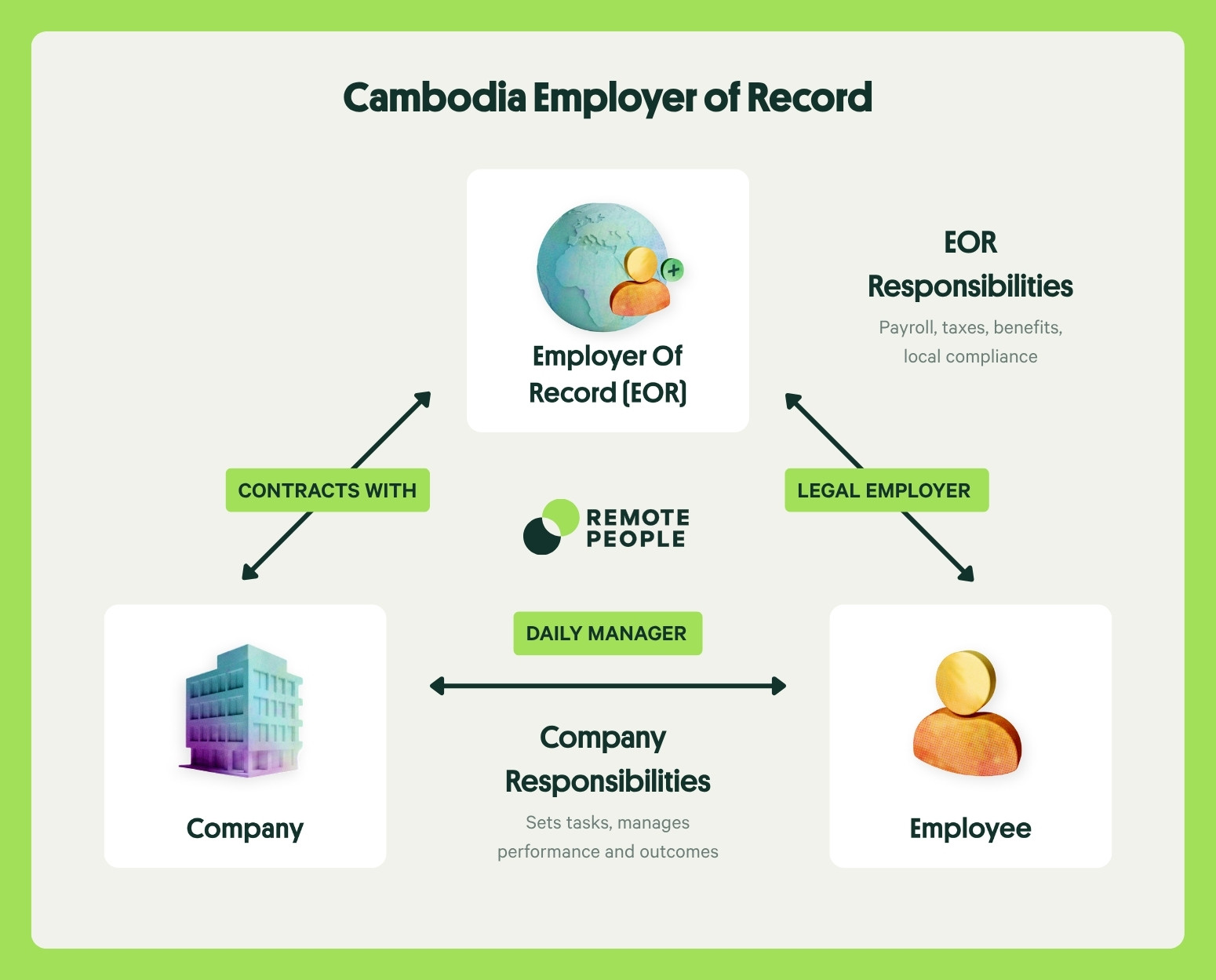
If you’d like to learn more about how Employer of Record (EOR) services work, read our What Is an Employer of Record (EOR)? guide for a complete overview of the model, its benefits, and when to use it.
If you’re comparing providers, our Best Employer of Record (EOR) Providers guide reviews the leading platforms to help you choose the right solution for your business.
Who Uses an EOR in Cambodia?
EORs are the default hiring vehicle for companies that want a presence in Cambodia without the multi-month process of incorporating a limited company, opening corporate bank accounts, and registering with the General Department of Taxation. Common situations include testing the Cambodian market with one or two hires before committing to an entity, onboarding a single specialist who needs to be compliant from day one, hiring a country manager to scout opportunities in Phnom Penh, and converting existing independent contractors into properly registered employees to remove misclassification risk.
Any business hiring employees in Cambodia where the headcount is below 15 will usually find the numbers favor an EOR. Entity maintenance costs in Cambodia (annual audit, patent tax, monthly tax filings, accounting, and legal retainers) run into several thousand dollars per year before any salary is paid. An EOR turns all of that into a predictable monthly fee.
Typical Onboarding Timeline
Most EOR providers can onboard a Cambodian employee within one to two weeks. The timeline stretches if a work permit is required, because the foreign worker quota application runs through the annual FWCMS window that closes on 30 November for the following year. A typical sequence looks like this:
- First, sign the EOR service agreement and provide employee details such as name, position, salary, and start date (1-2 days).
- Second, the EOR drafts a Labour Law-compliant employment contract in Khmer and English and sends it for the employee’s signature (2-3 days).
- Third, the EOR registers the employee with NSSF and the General Department of Taxation in parallel (3-5 days).
- Fourth, payroll is configured, bank details are collected, and benefits enrollment is completed (1-2 days).
- Fifth, the employee starts work on the agreed date and receives their first payslip at the end of the month.
Foreign hires add roughly two to four weeks for the work permit application through FWCMS, assuming the employer’s quota has already been approved for the year. Missing the 30 November quota deadline is the single biggest cause of delayed foreign hires in Cambodia.
Hire in Cambodia
A young, low-cost workforce, growing garment and tourism sectors, and improving ease of doing business make Cambodia a practical option for companies expanding into Southeast Asia.
We handle employment contracts, payroll, tax withholding, and full Cambodian compliance.
No local entity needed. Your team can start in days.
Employment Laws and Regulations in Cambodia
Employment Contracts
Cambodia’s employment framework is set by the Labour Law of 1997, most recently amended in October 2021, and administered by the Ministry of Labour. The law recognizes two main contract types: fixed duration contracts (FDC) that cannot exceed two years including renewals, and undetermined duration contracts (UDC) which have no end date and carry stronger employee protections.
Any contract that rolls past the two-year cumulative limit automatically converts to a UDC under Article 67.
Contracts must be in Khmer, though a bilingual Khmer-English version is common practice for foreign-owned employers. Written contracts are mandatory for foreign employees and strongly recommended for locals.
Working Hours and Overtime
The standard workweek in Cambodia is 48 hours, typically arranged as 8 hours per day over 6 days. Any work beyond 48 hours is overtime and must be paid at a premium: 150% of the regular hourly rate for daytime overtime, and 200% for night work (between 10pm and 5am), work on the weekly rest day, or work on a public holiday (PwC Cambodia).
Employees are entitled to at least one full rest day per week, typically Sunday, and a meal break if the working day exceeds six consecutive hours. Overtime must be voluntary and cannot be systematic.
Cambodia overtime and premium pay rates · Per Labour Law of 1997 | |||
Hour Type |
Rate Multiplier |
Cap |
Notes |
|---|---|---|---|
Standard workweek |
100% (normal wage) |
48 hours per week |
Article 137: 8 hours per day, 6 days per week |
Daytime overtime (weekday) |
150% |
Generally 2 hours per day |
Article 139: must be exceptional and voluntary, never systematic |
Night work (regular shift) |
130% |
11 consecutive hours including 22:00 to 05:00 |
Article 144: employer must provide lodging or transport |
Night overtime (22:00 to 05:00) |
200% |
Same 2 hours per day cap |
Article 139: applies to overtime worked during night hours |
Weekly rest day work |
200% |
One full rest day required per week |
Article 147: rest day is typically Sunday |
Public holiday work |
200% |
21 public holidays in 2026 |
Article 167: in addition to regular pay for the day |
Minimum Wage
Cambodia’s statutory minimum wage applies only to the textile, garment, footwear, and travel goods and bags sector. For 2026 the monthly minimum wage in these industries is $210 per month for regular workers and $208 for those still on probation, set by Prakas No. 214/25 issued by the Ministry of Labour on 17 September 2025 and effective 1 January 2026.
The figure includes mandatory allowances of $7 for transport, $10 for attendance, and roughly $0.50 per day for meals. All other sectors in Cambodia have no statutory minimum wage; pay is set by the market and by individual employment contracts.
The national minimum wage council, which includes representatives of the Garment Manufacturers Association in Cambodia and labour unions, reviews the garment sector rate each year.
For non-garment sectors, average salaries in Cambodia vary by role and location. More detail on the garment sector rate sits on the country’s dedicated minimum wage in Cambodia page.
Probation Period
Probation in Cambodia is capped by Article 68 of the Labour Law at three months for regular employees, two months for specialized workers, and one month for non-specialized workers. The probation length must be written into the contract or the employee is treated as a permanent hire from day one.
During probation either party can end the relationship without notice and without severance, but the employer must still cover travel costs if the worker was hired from outside their home province. More context is available on the probation period in Cambodia subpage.
Leave Entitlements
Cambodia’s statutory leave framework is built around a generous annual leave accrual, paid sick leave that phases down over six months, and a 90-day maternity entitlement. The rules sit in Articles 157 to 186 of the Labour Law and are enforced by the Ministry of Labour through the labour inspectorate.
Annual Leave
Employees accrue annual leave at 1.5 working days per month, which adds up to a statutory minimum of 18 working days per year under Article 166. Workers gain an additional day of annual leave for every three years of continuous service, so an employee with nine years of service is entitled to 21 days.
Leave cannot be split for workers under 18 or apprentices, and any portion above 15 days may be deferred to later in the year. Carryover is permitted for up to three years but only applies to the portion above 12 days.
Sick Leave
Sick leave in Cambodia runs for up to six months on a single medical certificate, with pay scaling down across the period. The employer pays 100% of regular wages for the first month of certified sickness, 60% for the second and third months, and nothing for the fourth through sixth months, though the employment relationship is still protected.
Since 2023 the NSSF’s health scheme covers up to 180 days of incapacity benefits at 70% of the insured wage, which runs alongside the employer’s obligation. A medical certificate from a qualified doctor is required for any absence longer than one day.
Maternity Leave
Women are entitled to 90 calendar days of maternity leave under Article 182 of the Labour Law. Employees with at least one year of continuous service receive 50% of their normal wage during the leave, paid by the employer; those with less than one year of service take the same 90 days but unpaid.
The 90 days can be taken around the delivery date as the employee sees fit, and the Arbitration Council has confirmed that the count runs in calendar days rather than working days. Dismissal during maternity leave is prohibited, and a nursing mother is entitled to one hour per day of breastfeeding time for the first year after returning to work.
Paternity Leave
Cambodia has no statutory paternity leave in the private sector. Fathers typically take one day of special leave for the birth of a child under the general special leave provisions of the Labour Law, and some employers offer additional paid leave as a contractual benefit. A reform to introduce formal paternity leave has been discussed but has not been enacted.
Other Statutory Leave
Workers are entitled to up to seven days of paid special leave per year under Article 171 for events such as their own marriage, the marriage of a child, the birth of a child, or the illness or death of a spouse, parent, or child. The employer may offset special leave against unused annual leave or require compensatory work up to 54 hours per week over the following 90 days. Breastfeeding mothers receive one hour per day for the first 12 months after childbirth.
Cambodia statutory leave entitlements · Per Labour Law of 1997 |
||
Leave Type |
Duration |
Eligibility & Notes |
|---|---|---|
Annual Leave |
18 days/year |
1.5 days accrued per month; +1 day per 3 years of service; fully paid |
Sick Leave |
Up to 6 months |
100% pay month 1, 60% months 2-3, unpaid months 4-6; NSSF covers 70% up to 180 days |
Maternity Leave |
90 calendar days |
50% employer pay after 1 year service; protected from dismissal |
Paternity Leave |
Not statutory |
Private sector has no statutory entitlement; contractual only |
Special Leave |
Up to 7 days/year |
Marriage, childbirth, bereavement, or illness of immediate family; fully paid |
Breastfeeding Leave |
1 hour/day |
For 12 months after childbirth; fully paid |
Public Holidays |
21 days (2026) |
Fully paid; work on a holiday triggers 200% overtime rate |
Source: Labour Law of Cambodia and Ministry of Labour |
||
Statutory Employee Benefits
Cambodia’s mandatory benefits sit almost entirely inside the National Social Security Fund. Every employer with at least one worker must register with NSSF and contribute to three schemes: occupational risk (which funds workplace injury benefits), health care (which covers medical treatment, maternity benefits, and sick leave at 70% of wages), and the pension scheme that launched in October 2022. There is no separate state-run unemployment insurance and no mandatory private health insurance on top of NSSF, although many foreign employers add a supplementary private health plan to attract senior talent in Phnom Penh.
Beyond NSSF, the Labour Law obliges employers to pay a seniority indemnity (Article 89) equal to 15 days of wages per year of service for employees on undetermined duration contracts, paid in two semi-annual instalments rather than accumulated until termination.
This is effectively a structural 13th-month concept even though Cambodia has no formal 13th-month salary rule. Transportation and meal allowances are mandatory in the textile and garment sector as part of the minimum wage package, and customary across other sectors where market competition demands it. The exact contribution rates flow into the payroll tables in the next section rather than being repeated here.
Recent Regulatory Updates (2026)
Cambodia’s biggest 2026 change is the new minimum wage in the textile, garment, footwear, and travel goods sector, raised to $210 per month by Prakas No. 214/25 of 17 September 2025, effective 1 January 2026. The wage includes a $7 transport allowance, a $10 attendance bonus, and a per-day meal subsidy. The increase is modest on a percentage basis but brings the total package above what regional neighbours such as Bangladesh and Myanmar pay in the same sector.
The NSSF pension scheme continues its phased rollout. From its launch in October 2022 through September 2027 the combined rate is 4% (2% employer, 2% employee), after which it is scheduled to rise to 8% combined and step up by 2.75 percentage points per decade thereafter. Employers should build the 2027 transition into medium-term hiring plans because it will materially change the cost base for locally employed staff.
Foreign worker compliance also tightened. Under Prakas No. 498, employers that miss the 30 November quota deadline face a penalty of roughly $3,150 per foreign worker employed without a valid quota. The 2026 quota application window ran from 1 September to 30 November 2025 through the FWCMS portal.
Work Permits and Visas in Cambodia
Work Permit Requirements
Who Needs a Work Permit
Every foreign national working in Cambodia needs a work permit, regardless of nationality or length of stay.
Cambodia has no bilateral exemption agreements of the kind that EU nationals enjoy in some European countries. The employer must hold an approved foreign worker quota before it can sponsor individual permits, and that quota cannot exceed 10% of the local workforce: 3% for office staff, 6% for skilled workers, and 1% for unskilled workers. Quotas are applied for once a year through the FWCMS portal and are valid for the following calendar year.
Eligibility and Required Documents
Applicants must hold a valid business visa (E-type, formerly EB), a signed employment contract, a passport with at least 12 months of validity, educational or professional qualifications relevant to the role, a clean criminal record certificate, and a medical certificate from an approved clinic. The employer submits the application through FWCMS along with its approved quota allocation. Foreign workers whose employer does not hold a quota cannot be granted a permit, which is why the November quota deadline is effectively a hard stop for the following year’s hiring plan.
Processing Time and Validity
A complete work permit file is typically processed within 10 to 30 business days once the underlying quota is in place. Each permit is valid for one calendar year and must be renewed before 31 March of the following year to avoid late penalties. The visa that underpins the work permit is the E-class (business visa) which can be extended in 6-month or 12-month blocks at the General Department of Immigration.
Renewal Process
Work permits must be renewed annually through the same FWCMS portal used for the initial application. The employee can continue working through the renewal window provided the application is filed by 31 March. Quota allocation is required again for the renewal year, and new supporting documents (updated medical certificate, updated passport if renewed, and updated employment contract) are usually required.
Common Visa Types for Foreign Workers
Cambodia’s visa structure is comparatively simple. The most relevant categories for foreign employees are:
- E-class (Ordinary) Business Visa is the default visa for anyone working in Cambodia, extendable in 6 or 12 month blocks and tied to a sponsoring employer.
- EB (Business) is a sub-category of the E-class issued to employees who already hold a work permit, allowing multiple entries during the validity period.
- EG (Job-Seeker) is a short-term visa for foreign nationals entering Cambodia to look for employment, and can be converted to an EB once a contract is signed.
- ER (Retirement) is not a work visa, but is relevant to employers considering older foreign contractors who want to base themselves in Cambodia.
- E-class Investor covers foreign nationals who hold equity in a Qualified Investment Project approved by the Council for the Development of Cambodia.
Cambodia work visa types for foreign workers · 2026 | ||||
Visa Type |
Duration |
Best For |
Leads to Residency? |
Processing |
|---|---|---|---|---|
E-class Ordinary (entry) |
1 month on arrival, extendable in 1, 3, 6 or 12 month blocks |
New foreign hires before the work permit issues |
Indirectly, after conversion to EB and renewals |
3 to 5 business days on entry |
EB (Business Extension) |
1, 3, 6 or 12 months, renewable while employed |
Foreign employees who already hold a work permit |
Yes, supports long-term stay and residency applications |
7 to 14 business days at Immigration |
EG (Job-Seeker) |
1, 3 or 6 months, non-renewable past 6 months |
Candidates entering Cambodia before securing an offer |
No, must convert to EB once a contract is signed |
Around 7 business days |
ER (Retirement) |
12 months, renewable |
Foreign nationals aged 55 and over, no employment permitted |
No, not a work visa |
Around 7 business days |
E-class Investor (QIP) |
12 months, renewable while Qualified Investment Project is active |
Equity holders in CDC-approved Qualified Investment Projects |
Yes, via CDC endorsement and longer term renewals |
14 to 30 business days |
More detail on the procedure, fees, and document requirements sits on the dedicated Cambodia work visa and permit page.
How an EOR Handles Work Permits
The EOR acts as the sponsoring employer for work permit purposes, which means its foreign worker quota is the one used to cover your hires.
That matters in Cambodia because the EOR maintains a continuous quota application cycle across multiple clients, so a single hire for a client arriving in, say, May does not depend on the client having its own November-filed quota. The EOR files the FWCMS application, pays the government fees, coordinates the medical certificate, and tracks the renewal date. The employee only has to provide personal documentation and attend the medical exam.
The work permit process typically extends the onboarding timeline from the 1-2 week baseline to 3-6 weeks. The EOR keeps the employee legally compliant throughout the process and ensures that the business visa and work permit are renewed in parallel each year.
Payroll, Taxes, and Social Security in Cambodia
Employer Contributions
Employers in Cambodia contribute to three NSSF schemes with a combined rate of 4.1% of the contributable wage, which is capped at approximately $300 per month. The Occupational Risk scheme is entirely employer-funded, while health care and pension are split with the employee.
Cambodia employer social security contributions · 2026 rates |
||
Contribution |
Rate |
Notes |
|---|---|---|
NSSF Occupational Risk |
0.8% |
Funds workplace injury benefits; fully employer-funded |
NSSF Health Care |
1.3% |
Funds medical, maternity, and sick leave benefits |
NSSF Pension |
2.0% |
Phase 1 rate through September 2027; rises to 4% thereafter |
Total Employer Contribution |
4.1% |
Capped at ~$300 monthly wage base |
Employee Contributions
Employees pay 3.3% into NSSF schemes, also subject to the same ~$300 monthly contribution ceiling. The amount is withheld by the employer at payroll and remitted together with the employer share.
Cambodia employee payroll deductions · 2026 monthly withholdings |
||
Deduction |
Rate |
Notes |
|---|---|---|
NSSF Health Care |
1.3% |
Matches employer share; funds medical and maternity benefits |
NSSF Pension |
2.0% |
Phase 1 rate; launched October 2022 under Sub-Decree 32 |
Tax on Salary (ToS) |
0% to 20% |
Progressive brackets; withheld under PAYE by the 20th of the following month |
Total Employee Deduction (NSSF only) |
3.3% |
Capped at ~$300 wage base; ToS on top |
Income Tax
Cambodia taxes resident employees on a progressive scale that runs from 0% to 20%, with brackets fixed in Cambodian riel and applied monthly under PAYE. A resident is an individual who is physically present in Cambodia for more than 182 days in any 12-month period, or who has their principal place of abode in the country. Non-residents are taxed at a flat 20% on all Cambodian-sourced income with no tax-free threshold and no personal deductions.
Cambodia income tax brackets · 2026 |
|
Annual Taxable Income (USD) |
Tax Rate |
|---|---|
Up to $4,490 |
0% |
$4,491 to $5,985 |
5% on amount above $4,490 |
$5,986 to $25,435 |
10% on amount above $5,985 |
$25,436 to $37,407 |
15% on amount above $25,435 |
Above $37,407 |
20% on amount above $37,407 |
Non-residents (all income) |
Flat 20% |
Resident employees also benefit from monthly dependent deductions of roughly $37 per child under 14 (or under 25 if in full-time education) and roughly $37 for a non-working spouse. These are applied before the bracket calculation. All figures are shown in USD for reader clarity; the underlying statutory brackets are in Cambodian riel and can drift with the exchange rate.
Payroll Cycle
Cambodian payroll runs monthly. Wages must be paid in cash or by bank transfer no later than the end of the following month, though almost all employers pay by bank transfer on or around the last day of each month. Payslips must show gross wage, each deduction, and the net amount, and must be issued in Khmer.
Tax on Salary and NSSF contributions must be filed and paid to the General Department of Taxation and NSSF respectively by the 20th of the following month. Late filing triggers penalties and interest.
More detail sits on the dedicated Cambodia payroll and tax page.
13th Month Salary and Bonus Pay
Cambodia does not have a statutory 13th-month salary. What it does have is a mandatory seniority indemnity under Article 89 of the Labour Law that pays 15 days of wages per year of service, split into two instalments of 7.5 days paid in June and December each year.
For employees on an undetermined duration contract this works out to roughly 4.1% of annual salary paid in addition to monthly wages. Fixed duration contracts instead receive a severance bonus of 5% of total wages paid during the contract period, payable when the contract ends.
Khmer New Year and Pchum Ben bonuses are customary but not legally required, and many employers use them to remain competitive with peers in Phnom Penh and Siem Reap.
Cost of Hiring Through an EOR in Cambodia
EOR Service Fees
EOR service fees in Cambodia typically run between $300 and $600 per employee per month, depending on the provider, the complexity of the role, whether a work permit is required, and the volume of employees. The fee covers payroll processing, tax withholding and filing, NSSF registration and contributions, employment contracts, benefits administration, work permit sponsorship, and ongoing labour law compliance. Providers at the lower end of the range typically offer a standardized package; higher-tier providers include dedicated HR support, multilingual contracts, and country-specific legal advice.
Total Employment Cost Breakdown
The all-in cost of employing someone in Cambodia goes well beyond gross salary. The table below walks through a realistic cost build-up for a typical hire, layering mandatory employer social contributions, statutory benefits, and payroll taxes on top of base pay so finance teams can budget accurately before an offer goes out.
Cambodia employer cost example · $1,500/month gross · 2026 |
||
Employer Cost |
Amount (USD) |
% of Gross |
|---|---|---|
Gross monthly salary |
$1,500.00 |
100.00% |
NSSF Occupational Risk (0.8%) |
$2.40 |
0.16% |
NSSF Health Care (1.3%) |
$3.90 |
0.26% |
NSSF Pension (2.0%) |
$6.00 |
0.40% |
Seniority indemnity accrual (~4.1%) |
$61.50 |
4.10% |
EOR service fee |
$400.00 |
26.67% |
Total monthly employer cost |
$1,973.80 |
131.59% |
Source: NSSF contribution schedule and PwC Cambodia |
||
At a $1,500 gross monthly salary, the fully-loaded cost to the employer lands around $1,974 per month, a 31.6% markup over gross.
Most of that markup is the EOR fee itself ($400) and the seniority indemnity accrual ($61.50). NSSF contributions are trivially small in absolute terms because the contributable wage base is capped at approximately $300 per month, which keeps Cambodia’s statutory employer burden among the lowest in Southeast Asia.
All USD amounts are approximate conversions at $1 = 4,010 KHR (April 2026 rate). Actual NSSF contributions are computed in riel; the totals here round to the nearest dollar.
Ready to hire in Cambodia? Contact our team to get started with RemotePeople. We handle employment contracts, payroll, NSSF registration, and full Cambodia compliance so you can bring on new hires without setting up a local entity.
Benefits of Using an EOR in Cambodia
Speed to market is the first reason most companies pick an EOR over incorporation. Setting up a Cambodian subsidiary through the Ministry of Commerce takes roughly three to six months once you add bank account opening, tax registration, NSSF enrollment, and obtaining a patent tax certificate. An EOR can onboard your first employee in one to two weeks.
That alone is often the difference between winning a regional deal and watching a competitor move first.
Closely tied to speed is compliance assurance: the EOR absorbs the risk of misreading a Prakas, missing the foreign worker quota deadline, or incorrectly calculating the semi-annual seniority indemnity.
The cost story is equally strong. A Cambodian entity carries ongoing costs for accounting, audit, patent tax, and legal retainers that typically add up to several thousand dollars a year, before any salary.
An EOR converts those fixed costs into a predictable per-employee fee, which makes it the more efficient model for teams under fifteen people. An EOR also provides local expertise on practical issues such as drafting bilingual Khmer-English contracts, navigating the Arbitration Council if a dispute arises, and negotiating with NSSF on audit queries.
Finally, an EOR gives you flexibility. You can scale up for a project, scale down if priorities shift, or exit Cambodia entirely without the legal and tax complexity of dissolving a company. You also get a better employee experience, because workers are paid on time through a local entity that understands Khmer payroll norms rather than by an overseas parent via international wire transfer.
Termination and Offboarding in Cambodia
Notice Periods
Notice periods in Cambodia for undetermined duration contracts are set by Article 75 of the Labour Law and scale with tenure.
Workers with less than six months of service require seven days of notice; between six months and two years requires 15 days; two to five years requires one month; five to ten years requires two months; and over ten years requires three months.
During the notice period the worker is entitled to two paid days per week to search for new employment. Fixed duration contracts end automatically at their agreed date without notice, but early termination without cause can expose the employer to damages equal to the remaining wages.
Cambodia statutory notice periods by length of service · Per Labour Law Article 75 | |||
Length of Service |
Notice Period |
During Probation |
Notes |
|---|---|---|---|
Less than 6 months |
7 days |
None required |
Applies to both employer and employee-initiated termination |
6 months to 2 years |
15 days |
Not applicable (probation ended) |
Written notice is mandatory under Article 75 |
More than 2 to 5 years |
1 month |
Not applicable |
Pay in lieu of notice is permitted |
More than 5 to 10 years |
2 months |
Not applicable |
Parties can agree longer but not shorter |
More than 10 years |
3 months |
Not applicable |
Maximum statutory notice under Article 75 |
Fixed duration contract (FDC) |
10 days (contracts up to 6 months); 15 days (longer FDCs) |
Not applicable |
Article 73: written notice required before FDC term ends |
Severance Pay
Calculation Method
Severance in Cambodia is delivered through two mechanisms.
Employees on undetermined duration contracts receive the seniority indemnity that has already been paid out in semi-annual instalments throughout their employment, at 15 days of wages per year of service. Employees on fixed duration contracts receive a severance bonus equal to 5% of the total wages paid during the contract period, disbursed at contract end. Both calculations use regular monthly wages, excluding overtime and performance bonuses.
Caps and Exceptions
The seniority indemnity does not have a statutory cap and continues to accrue as long as the employment relationship lasts.
Damages for unjust dismissal are separate and can be awarded by the Arbitration Council on top of the seniority indemnity. Employees dismissed for serious misconduct (theft, violence, repeated unjustified absence) lose the right to additional damages but still keep the accrued seniority indemnity.
Employees dismissed during probation are not entitled to seniority indemnity or damages. A March 2024 MLVT notification clarified that termination due to employer bankruptcy counts as a dismissal with cause, which exempts employers from paying additional damages.
Cambodia severance pay schedule by years of service · Per Labour Law Article 89 | |||
Years of Service |
Severance Amount |
At $1,500 Monthly Base |
Notes |
|---|---|---|---|
1 year |
15 days of wages |
$750 |
Accrued 7.5 days in June and 7.5 days in December |
3 years |
45 days of wages |
$2,250 |
Paid in semi-annual instalments under Prakas 443/18 |
5 years |
75 days of wages |
$3,750 |
Mandatory for all UDC employees regardless of dismissal |
10 years |
150 days of wages |
$7,500 |
Continues to accrue at 15 days per year of service |
Fixed duration contract (any length) |
5% of total wages paid during the contract |
$900 on a 12 month FDC at $1,500 per month |
Article 73: paid once at contract end instead of seniority indemnity |
Grounds for Termination
Cambodian employers can terminate an undetermined duration contract for serious misconduct without notice, or for any other reason with the statutory notice period. Protected categories include pregnant women, workers on maternity leave, worker representatives, and union officials, all of whom can only be dismissed with prior approval from the Ministry of Labour. Terminations without cause are permitted provided notice is given and any required indemnity is paid, but if the Arbitration Council finds the dismissal to be without serious reason it can award damages on top of the statutory entitlements.
EOR vs. Other Hiring Models in Cambodia
EOR vs. Setting Up a Local Entity
Choosing between an Employer of Record and setting up your own legal entity in Cambodia comes down to timeline, upfront cost, ongoing administrative burden, and how quickly you can scale up or wind down. The table below lays out both paths side by side across setup time, cost, compliance risk, and flexibility so you can match the right model to the size and duration of your Cambodia hiring plan.
Cambodia EOR vs local entity comparison · Setup time, cost, risk and best-fit |
||
Comparison |
Employer of Record |
Own Entity |
|---|---|---|
Setup time |
1-2 weeks |
3-6 months |
Upfront cost |
$0 |
$3,000-$8,000 |
Ongoing cost |
$300-$600/employee/month |
$5,000-$12,000/year maintenance |
Local partner required |
No (EOR is the local entity) |
No (100% foreign ownership allowed) |
NSSF registration |
Handled by EOR |
You manage it |
Payroll & tax filing |
Handled by EOR |
You manage it (or outsource) |
Best for team size |
1-15 employees |
15+ employees |
Scale down / exit |
Easy, no entity to unwind |
Costly; legal dissolution required |
Government contracts |
Not eligible |
Eligible (requires local entity) |
Source: Council for Development and Ministry of Labour |
||
For most companies hiring their first Cambodian worker, the EOR path is financially and operationally superior. Incorporating a local limited company is technically straightforward because Cambodia permits 100% foreign ownership in most sectors, but the real cost is the recurring overhead: monthly tax filings, annual audit, patent tax, accounting fees, and the time investment from senior managers in another country. The EOR collapses all of that into a single monthly fee per head.
An entity becomes the better choice once you need local legal standing for reasons beyond hiring. That typically means competing for government contracts, holding a regulated license (in sectors such as banking, insurance, or telecoms), or hitting a headcount where the EOR fee per employee exceeds the fixed overhead of an entity. The practical break-even usually sits somewhere between 12 and 20 full-time hires, depending on the complexity of the roles.
An EOR is also the right answer when you need to move fast. If a deal closes and you need a country manager in Phnom Penh within a month, an entity is simply not an option. The EOR path gets you compliant in weeks.
EOR vs. Hiring Independent Contractors
Classifying a Cambodia-based worker as an independent contractor rather than an employee can expose you to back-taxes, unpaid social contributions, and reclassification penalties if the working relationship looks like employment in practice. The table below contrasts EOR employment with contractor engagement across legal relationship, tax and benefits treatment, IP ownership, and misclassification risk so you can pick the right model role by role.
Cambodia EOR vs independent contractors · Compliance, cost, and risk |
||
Comparison |
EOR (Full-Time Employee) |
Independent Contractor |
|---|---|---|
Legal relationship |
Employee of the EOR |
Self-employed, no employment relationship |
Compliance risk |
Low, EOR ensures Labour Law compliance |
Higher, misclassification risk if relationship resembles employment |
Payroll & tax |
EOR handles withholding, NSSF, filings |
Contractor invoices you; they handle their own tax |
Benefits & leave |
Statutory benefits, paid leave, NSSF |
No entitlement to employee benefits |
IP protection |
Stronger; employment contract assigns IP by default |
Weaker; requires explicit IP assignment clause |
Termination |
Subject to Cambodia notice and indemnity rules |
Contract can be ended per agreement terms |
Best for |
Long-term, core team roles |
Short-term projects, specialized tasks |
Cost structure |
Salary + NSSF + EOR fee |
Contractor fee (often higher gross, lower total cost) |
Source: Cambodia Labour Law and PwC Cambodia |
||
Independent contractors are only appropriate in specific cases: short-term project work, genuinely specialized consulting, or roles where the worker has full autonomy over their schedule and methods. When the relationship starts to resemble employment (fixed hours, dedicated workspace, integration into a team, instructions on how to perform the work), the labour inspectorate or the Arbitration Council can reclassify the contractor as an employee. Consequences of reclassification include back-dated NSSF contributions, unpaid Tax on Salary, accrued seniority indemnity, and statutory leave entitlements.
The practical upshot is that most long-term roles in Cambodia should be employees rather than contractors.
Engineers, sales people, customer support staff, and anyone else who works a regular schedule for a single client are clear employee cases. Freelance designers, one-off consulting engagements, or subject matter experts hired for a discrete deliverable are more naturally contractors. RemotePeople also offers a contractor management solution for Cambodia that handles compliant contractor payments, contracts, and classification review if a contractor is the right fit.
EOR vs. PEO
EORs and PEOs both simplify international hiring, but only an EOR becomes the legal employer of record in Cambodia — a critical distinction when you don’t have a local entity of your own. The table below maps the practical differences across legal employer status, entity requirement, liability allocation, and scope of coverage.
Cambodia EOR vs PEO comparison · Legal employer, liability, and setup |
||
Comparison |
Employer of Record (EOR) |
PEO |
|---|---|---|
Legal employer |
EOR is the legal employer |
You remain the legal employer (co-employment) |
Local entity required |
No; the EOR is the local entity |
Yes; you must have your own entity in Cambodia |
Best for |
Companies without a local entity |
Companies that already have a local entity |
Compliance liability |
EOR assumes compliance responsibility |
Shared liability between you and the PEO |
Setup time |
1-2 weeks |
Depends on your entity setup (weeks to months) |
Control over HR policies |
EOR manages within local law framework |
More direct control, PEO advises |
Typical use case |
Market entry, small remote teams, testing new markets |
Established local operations needing HR outsourcing |
Source: Cambodia Labour Law and Ministry of Labour |
||
Cambodia has no formal co-employment framework in its Labour Law. What is marketed as a PEO in Cambodia is typically an HR outsourcing arrangement layered on top of a client’s existing Cambodian entity: the client remains the legal employer, and the PEO handles payroll, benefits administration, and advisory work. Practical liability stays with the client.
The consequence is simple.
If you do not have a Cambodian entity, you cannot use a PEO: there is no entity to attach the co-employment to. You need an EOR, because the EOR itself is the Cambodian entity that holds the employment contract. If you already have a Cambodian subsidiary, a PEO-style arrangement can still make sense for outsourced payroll and HR administration, but you remain the legal employer of record and you carry the compliance risk.
For most foreign companies exploring Cambodia for the first time, the EOR is the only option that combines speed, full compliance transfer, and no upfront capital commitment. A PEO-style engagement is a later-stage consideration once the entity is established and the headcount is large enough to justify it.
Public Holidays in Cambodia
Cambodia observes a defined set of official public holidays on which most private-sector employers must give staff a paid day off (Ministry of Labour). The table below lists the statutory holidays employers need to build into payroll calendars and leave planning for the year, along with the date rule for each.
Cambodia public holidays · 2026 calendar year |
||
Date |
Holiday |
Type |
|---|---|---|
1 January |
New Year’s Day |
National |
7 January |
Victory over Genocide Day |
National |
8 March |
International Women’s Day |
National |
14-16 April |
Khmer New Year (Choul Chnam Thmey) |
National (3 days) |
1 May |
International Labour Day |
National |
31 May |
Visakha Bochea Day |
Religious (lunar date) |
5 May |
Royal Ploughing Ceremony |
National |
14 May |
King Norodom Sihamoni’s Birthday |
National |
18 June |
Queen Mother’s Birthday |
National |
24 September |
Constitution Day |
National |
10-12 October |
Pchum Ben Festival |
Religious (3 days) |
15 October |
Commemoration of King Father Sihanouk |
National |
29 October |
Coronation Day of King Sihamoni |
National |
9 November |
Independence Day |
National |
23-25 November |
Water Festival (Bon Om Touk) |
National (3 days) |
Source: Ministry of Labour and timeanddate.com Cambodia 2026 |
||
Cambodia has 21 paid public holidays in 2026, making it one of the most holiday-rich countries in Southeast Asia.
Most fall on lunar dates that shift slightly each year, with the exception of the fixed civil holidays in January, May, and September. Employers should assume roughly 17-18 working days per month after holidays and standard weekends. When a public holiday falls on a Sunday, a compensatory day off on the following Monday is required under the 2021 amendment to Article 94 of the Labour Law.
How to Get Started with an EOR in Cambodia
The practical path from decision to first day of work is straightforward when handled by an experienced EOR provider:
- First, define the role, salary, and start date, then confirm whether the hire is Cambodian or a foreign national who will need a work permit.
- Second, sign the EOR service agreement and provide the employee’s identification and qualification documents.
- Third, the EOR drafts a Labour Law-compliant employment contract in Khmer and English and sends it for signature.
- Fourth, the EOR registers the employee with NSSF and the General Department of Taxation, and applies for a work permit through FWCMS if required.
- Fifth, the employee starts work and receives their first payslip at the end of the month.
Contact our team to begin hiring in Cambodia. RemotePeople handles the full employment lifecycle so you can focus on managing your new hire rather than navigating Cambodian labour law.
Where companies hiring in Cambodia expand next
Teams hiring in Cambodia typically expand across ASEAN, where cross-border mobility and diverse multilingual talent make regional coverage natural. After building a team in Cambodia, employers often look to an EOR partner in Vietnam for ASEAN-wide talent flows and shared hiring norms, then Thailand for ASEAN integration and cross-border mobility. A team in Singapore follows with the ASEAN single-market trade framework, and operations in Indonesia typically closes the regional footprint via overlapping ASEAN labor and mobility rules.
Frequently Asked Questions
Beyond the employee's gross salary, you'll pay employer NSSF contributions of 4.1% (capped at roughly $12 per month because the contributable wage base is limited to about $300/month), a seniority indemnity accrual of about 4.1% of annual salary, and an EOR service fee of $300 to $600 per employee per month.
For a $1,500 monthly gross salary, the fully-loaded cost lands around $1,974, roughly 31.6% above gross. The exact EOR fee depends on your provider and the complexity of the role.
Most EOR providers can onboard a Cambodian employee within one to two weeks, from signed EOR agreement to the employee's first day. Foreign hires add another two to four weeks for the work permit application through FWCMS, provided the EOR's foreign worker quota has already been approved for the year. Missing the 30 November quota deadline is the main reason foreign hires get delayed.
No. An employer of record is a licensed Cambodian company that hires workers on your behalf, which removes the need to incorporate your own subsidiary.
The EOR is the legal employer, handles NSSF registration, payroll, tax withholding, and work permits, while you manage the employee's day-to-day work. If you eventually scale past 15-20 employees, setting up a Cambodian entity may become more cost-effective.
EORs are designed for employment relationships, not contractor engagements. However, RemotePeople also offers a dedicated Cambodia contractor management solution that handles compliant contractor payments, contracts, and classification risk review.
This is the right choice for short-term projects or specialized consulting. If the relationship starts to resemble employment (fixed hours, dedicated workspace, ongoing direction), you should convert the contractor to an EOR employee to avoid misclassification exposure.
The employment contract assigns intellectual property to the client company (you), not the EOR. The EOR makes sure the contract includes proper IP assignment language so that all work product, inventions, and creative output flow directly to your business. This is a standard clause in every EOR employment contract and should be reviewed before signing.
Cambodia's statutory minimum wage only applies to the textile, garment, footwear, and travel goods and bags sector. For 2026 it is $210 per month for regular workers and $208 for probationary workers, effective 1 January 2026 under Prakas No. 214/25.
All other sectors have no statutory minimum wage and are governed by market rates and individual employment contracts. See the dedicated Cambodia minimum wage page for more detail.
Notice periods on undetermined duration contracts scale with tenure: 7 days for less than 6 months of service, 15 days for 6 months to 2 years, 1 month for 2-5 years, 2 months for 5-10 years, and 3 months for over 10 years of service. The employee is entitled to two paid days per week during the notice period to look for new employment. Fixed duration contracts end automatically at their agreed date.
Cambodia does not have a statutory 13th-month salary. It does have a mandatory seniority indemnity under Article 89 of the Labour Law that pays 15 days of wages per year of service, split into two semi-annual instalments in June and December.
For fixed duration contracts, the equivalent is a 5% severance bonus on total wages paid during the contract, disbursed at contract end. Khmer New Year and Pchum Ben bonuses are customary but not legally required.
Employer of Record in
Employer of Record in
Employer of Record in
Employer of Record in
Employer of Record in
Employer of Record in
Employer of Record in
Employer of Record in