
 Recruit
Employer of Record (EOR) in Japan
-
 Drew Donnelly
- Published
- September 27, 2026
An employer of record in Japan enables companies to hire employees without establishing a local entity, with EOR service costs typically ranging from $500 to $2,000 per month per employee. The EOR acts as the legal employer, managing shakai hoken enrollment, health insurance and pension contributions that vary by prefecture, payroll processing, and compliance with Japan’s Labor Standards Act.
Hire in Japan — book a free 30-minute demo
Tell us what you need. You'll get a tailored, transparent proposal within 24 hours, plus a free call to walk through it.
Tell us about your company
So we can match you with a specialist who knows your market — and unlock volume pricing tiers.
* All fields are required.
Where and when are you hiring?
Tell us the geography and timing and we'll quote each country line by line, with onboarding timelines.
* All fields are required.
Help us beat your current setup
We'll benchmark your current deal and send a line-by-line proposal in 24 hours — showing exactly where we cut cost, time, or risk. After you submit, you can book a call to walk through it together.
* All fields are required.
Thanks! Your proposal is on its way.
Expect a tailored, line-by-line proposal in your inbox within 24 hours. In the meantime…
Want to walk through it together?
Book a free 30-minute call with one of our specialists. We'll explain every line, answer your questions, and tailor the proposal further if you need.
No obligation. Pick a time that works for you.








- Hire in Japan — book a free 30-minute demo
- Tell us about your company
- Where and when are you hiring?
- Help us beat your current setup
- Thanks! Your proposal is on its way.
- How an Employer of Record Works in Japan
- Employment Laws and Regulations in Japan
- Work Permits and Visas in Japan
- Payroll, Taxes, and Social Security in Japan
- Cost of Hiring Through an EOR in Japan
- Benefits of Using an EOR in Japan
- Termination and Offboarding in Japan
- EOR vs. Other Hiring Models in Japan
- Public Holidays in Japan
- How to Get Started with an EOR in Japan
- Where companies hiring in Japan expand next
- Frequently Asked Questions
- Related EOR Destinations
Start hiring in Japan
Let RemotePeople handle payroll, compliance, and HR admin worldwide so you can focus on building your team.

An employer of record (EOR) in Japan lets companies hire employees without setting up a local entity. EOR services in Japan typically cost $300 to $600 per employee per month as a flat fee, covering payroll, tax withholding, social insurance enrollment, and full compliance with the Labor Standards Act.
Japan has the fourth-largest economy globally and a highly educated, technically skilled workforce. The combination of strict labor protections, complex social insurance requirements across five mandatory programs, and Japanese-language compliance obligations makes an EOR the fastest path to building a Japan team, with onboarding in one to two weeks versus three to six months for entity incorporation.
How an Employer of Record Works in Japan
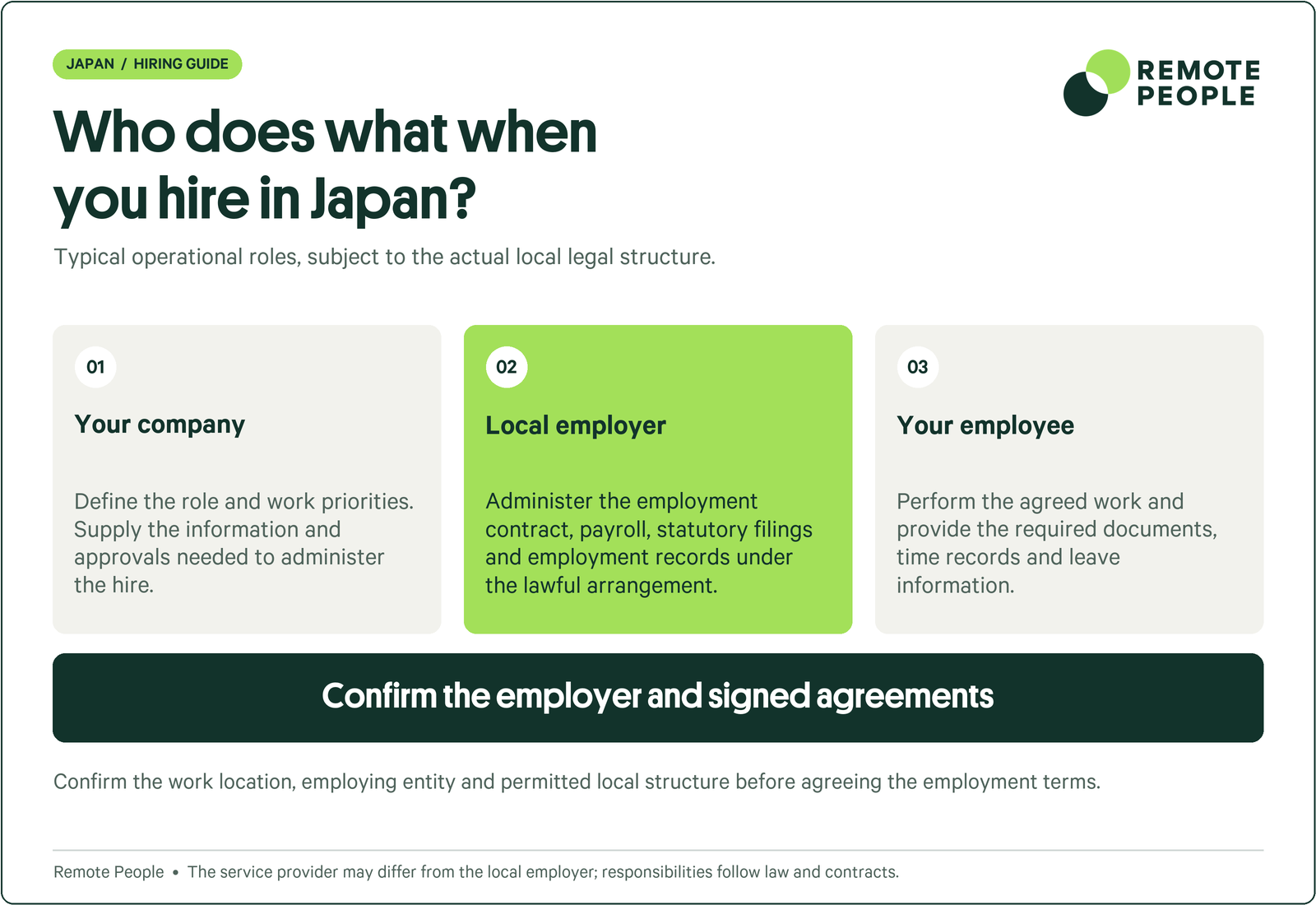
An Employer of Record (EOR) in Japan is the legal employer for your hires and manages all statutory obligations under Japanese labor law. This structure allows foreign companies to onboard employees in Japan within one to two weeks, compared to three to six months for entity incorporation. The EOR registers with the relevant social insurance agencies, files tax returns, and ensures full compliance with the Labor Standards Act and Labor Contract Act on your behalf.

If you’d like to learn more about how Employer of Record (EOR) services work, read our What Is an Employer of Record (EOR)? guide for a complete overview of the model, its benefits, and when to use it.
If you’re comparing providers, our Best Employer of Record (EOR) Providers guide reviews the leading platforms to help you choose the right solution for your business.
Who Uses an EOR in Japan?
Companies across a range of sizes and growth stages use employer of record services to hire in Japan without the cost and complexity of entity setup.
Companies entering the Japanese market for the first time use an EOR to hire a small team and validate demand before committing to entity incorporation, which typically costs $30,000 to $50,000 and takes three to six months. Organizations that need one to fifteen employees in Japan find the EOR model more cost-effective than maintaining a local subsidiary with its own accounting, legal, and HR overhead.
Companies with urgent hiring needs use an EOR to onboard employees within one to two weeks, bypassing the months-long entity registration process at the Legal Affairs Bureau and tax offices. Businesses sponsoring work visas for non-Japanese employees use an EOR that holds a registered office in Japan, which is required to sponsor most visa categories through the Immigration Services Agency.
The EOR model is particularly common among technology companies, consulting firms, and multinational corporations expanding their Asia-Pacific presence through Japan.
Typical Onboarding Timeline
- First, You submit employee information, job descriptions, and proposed compensation to the EOR. This takes one to two business days.
- Second, The EOR drafts a bilingual employment contract compliant with the Labor Standards Act, then obtains the employee’s signature. Contract preparation takes two to three business days.
- Third, The EOR registers the employee with Shakai Hoken (health insurance and pension) and Rodo Hoken (employment and accident insurance). Registration takes three to seven business days, depending on local office processing times.
- Fourth, Payroll setup begins, with the first salary payment processed on the company’s designated pay date. Japanese payroll runs monthly, with salaries typically paid on the 25th of each month.
- Fifth, The EOR provides monthly payroll reports including gross salary, all statutory deductions, employer contributions, and net pay. Ongoing compliance monitoring and reporting continue throughout the employment relationship.
Most EOR providers can onboard an employee in Japan within one to two weeks. If the employee requires a work visa, the timeline extends by four to eight weeks for Certificate of Eligibility processing through the Immigration Services Agency.
Hire in Japan
A highly educated workforce, advanced infrastructure, strong IP protections, and access to the world’s fourth-largest economy make Japan one of the most attractive hiring destinations in Asia-Pacific.
We handle employment contracts, payroll, tax withholding, and full Japan compliance.
No local entity needed. Your team can start in days.
Employment Laws and Regulations in Japan
Japan’s employment framework is governed primarily by the Labor Standards Act (Rodo Kijun Ho) and the Labor Contract Act (Rodo Keiyaku Ho), both enforced by the Ministry of Health, Labour and Welfare (MHLW). Japanese labor law provides strong employee protections, particularly around dismissal, working hours, and leave entitlements. Companies using an employer of record in Japan benefit from having these complex regulations managed by a local compliance team familiar with both the statutory requirements and the practical expectations of Japanese labor practices.
Employment Contracts
The Labor Standards Act Article 15 requires employers to clearly specify working conditions in writing at the time of hiring. The employment contract must include job duties, work location, working hours, rest days, wages, and termination conditions.
While Japanese law does not strictly mandate that contracts be in Japanese, all regulatory filings and social insurance documents must be submitted in Japanese. Most EOR providers prepare bilingual contracts to ensure both parties understand the terms.
Japan recognizes both fixed-term and indefinite-term contracts. Fixed-term contracts can run for a maximum of three years (five years for certain professionals), and employees who have worked on consecutive fixed-term contracts for five or more years can request conversion to an indefinite-term contract under the Labor Contract Act Article 18. Indefinite-term contracts provide the strongest employee protections and are the standard for full-time hires.
Working Hours and Overtime
The standard legal workweek in Japan is 40 hours spread across five days, with a daily limit of eight hours under Labor Standards Act Article 32. Employers must provide a rest period of at least 45 minutes for shifts exceeding six hours and at least 60 minutes for shifts exceeding eight hours. Overtime requires a written agreement between the employer and the labor representative (known as a “36 Agreement” under Article 36), and is subject to strict monthly and annual caps: 45 hours per month and 360 hours per year under normal circumstances.
Japan’s overtime premium rates are defined in Article 37 of the Labor Standards Act and vary based on the type of work performed. The table below outlines each premium category and the applicable rate multiplier.
Japan overtime and premium pay rates · Per Labor Standards Act Article 37 | |||
Hour Type | Rate Multiplier | Weekly/Daily Cap | Notes |
|---|---|---|---|
Regular overtime (beyond 8 hrs/day or 40 hrs/week) | 125% (25% premium) | 45 hrs/month, 360 hrs/year | Requires 36 Agreement |
Late night work (10:00 PM – 5:00 AM) | 125% (25% premium) | No separate cap | Applies regardless of overtime status |
Statutory rest day work | 135% (35% premium) | No separate monthly cap | Rest day hours do not count toward the 45 hr/month overtime cap |
Overtime exceeding 60 hrs/month | 150% (50% premium) | Subject to 36 Agreement special clause | Applies to all employers since April 2023 |
Regular overtime + late night | 150% (50% combined) | Per overtime caps | 25% overtime + 25% late night |
Statutory rest day + late night | 160% (60% combined) | No separate cap | 35% rest day + 25% late night |
Source: Labor Standards Act and PwC Japan Individual Tax Summary | |||
Since April 2024, overtime caps apply equally to all industries, including construction, transportation, and medical services, which were previously exempt. The maximum overtime under a special clause of the 36 Agreement is 100 hours per month and 720 hours per year, and employers must ensure that the average overtime across any two to six consecutive months does not exceed 80 hours. Violations carry penalties of up to six months’ imprisonment or fines of up to JPY 300,000.
Minimum Wage
Japan’s minimum wage is set on a prefectural basis, with each of the 47 prefectures establishing its own hourly rate. As of October 2025, the weighted national average minimum wage is JPY 1,121 per hour (approximately $7.50 USD), a record increase of JPY 66 (6.3%) from the previous year. T
okyo has the highest rate at JPY 1,226 per hour, while prefectures including Okinawa, Kochi, and Miyazaki set the lowest rates at JPY 1,023 per hour. All 47 prefectures now exceed JPY 1,000 per hour for the first time. Rates are reviewed annually each October by regional minimum wage councils under the Ministry of Health, Labour and Welfare.
Probation Period
Japanese labor law does not define a specific statutory probation period, but virtually all employers include a probationary clause in the employment contract. The typical duration is three months, with some companies extending to six months.
During probation, the employer retains broader discretion to assess the employee’s suitability, but after the first 14 days of employment, the standard 30-day notice requirement for dismissal applies under Labor Standards Act Article 21. Excessively long probation periods (beyond one year) may be deemed unreasonable by labor tribunals. Employees on probation are entitled to all statutory benefits, including social insurance enrollment and paid leave accrual.
Leave Entitlements
Annual Leave
Employees in Japan are entitled to 10 days of paid annual leave after six consecutive months of employment, provided they have maintained at least 80% attendance. The entitlement increases with tenure: 11 days after 1.5 years, 12 days after 2.5 years, 14 days after 3.5 years, 16 days after 4.5 years, 18 days after 5.5 years, and a maximum of 20 days after 6.5 years or more of continuous service. Since
April 2019, mandatory five-day leave (Labor Standards Act Article 39). Non-compliance carries a fine of up to JPY 300,000 per affected employee. Unused leave can be carried over for up to two years.
Sick Leave
Japan does not have a statutory paid sick leave entitlement. There is no legal requirement for employers to provide paid days off for illness, though many companies include sick leave in their work rules as a voluntary benefit (typically three to five days per year).
When an employee is absent due to non-work-related illness for four or more consecutive days, they may claim Sickness Allowance (Shobyo Teatekin) through the Employees’ Health Insurance system at approximately two-thirds (67%) of their standard daily remuneration, payable for up to 18 months. Work-related injuries and illnesses are covered separately under Workers’ Accident Compensation Insurance at 80% of the average wage.
Maternity Leave
Female employees are entitled to six weeks of prenatal leave before the expected due date (14 weeks for multiple pregnancies) and eight weeks of postnatal leave. The postnatal period of six weeks is mandatory; the employee cannot return to work during this time even if she wishes to, though she may request to return after six weeks with a physician’s approval.
During maternity leave, Maternity Allowance at approximately two-thirds (67%) of her average daily wage. Health and pension insurance premiums are waived during maternity leave.
Paternity Leave
Since April 2022, fathers in Japan can take “Post-Birth Paternity Leave” (Sango Papa Ikukyu) of up to four weeks within eight weeks of the child’s birth, which can be split into two separate periods. Beyond this, both parents are eligible for standard childcare leave (Ikuji Kyugyo) under the Childcare and Family Care Leave Act, which allows leave until the child’s first birthday.
Childcare leave can be extended to age two if nursery placement is unavailable. During childcare leave, employment insurance pays 67% of the employee’s salary for the first 180 days and 50% thereafter.
As of April 2025, when both parents take at least 14 days of leave each, an additional 13% supplement raises the effective rate to 80% for qualifying periods. Companies with 300 or more employees must publicly disclose their paternity leave uptake rates.
Other Statutory Leave
Japanese law provides several additional leave categories beyond annual and parental leave.
Nursing care leave allows employees up to 93 days per eligible family member requiring constant care, divisible into three separate periods, with employment insurance paying 67% of salary. Parents of pre-school children can take child nursing care leave of up to five days per year (10 days for two or more children) to care for sick or injured children, though this is unpaid under statute.
Bereavement leave is not mandated by statute, but nearly all companies provide three to seven paid days through work rules depending on the relationship to the deceased. Marriage leave is similarly customary at five to seven paid days. Under Labor Standards Act Article 68, employers cannot refuse menstrual leave to a woman experiencing difficult menstruation, though payment depends on company work rules.
Under the Labor Standards Act, Japan’s statutory leave framework provides a full set of protections that apply from the date social insurance enrollment begins. The table below summarizes every major leave entitlement. The most notable feature is that annual paid leave begins accruing after just six months of employment, and the mandatory five-day usage rule ensures employees actually take time off.
Japan statutory leave entitlements · Per Labor Standards Act and Childcare/Family Care Leave Act | ||
Leave Type | Duration | Eligibility and Notes |
|---|---|---|
Annual Paid Leave | 10–20 days (by tenure) | After 6 months with 80%+ attendance; scales to 20 days at 6.5+ years; mandatory 5-day usage |
Sick Leave | Not statutory | Health insurance sickness allowance at 67% of salary for 4+ day absences, up to 18 months |
Maternity Leave (Prenatal) | 6 weeks (14 for multiples) | Before expected due date; 67% paid via health insurance; premiums waived |
Maternity Leave (Postnatal) | 8 weeks (6 mandatory) | After delivery; 67% paid via health insurance; first 6 weeks mandatory rest |
Post-Birth Paternity Leave | 4 weeks | Within 8 weeks of birth; can be split into 2 periods; 67% paid via employment insurance |
Childcare Leave | Until child turns 1 (extendable to 2) | 67% salary for first 180 days, 50% after; both parents eligible |
Nursing Care Leave | 93 days per family member | Divisible into 3 periods; 67% paid via employment insurance |
Child Nursing Care Leave | 5 days/year (10 for 2+ children) | For pre-school age children; unpaid under statute |
Menstrual Leave | As needed | LSA Article 68; employer cannot refuse; payment per company rules |
Source: Labor Standards Act and JETRO Japan Investment Guide | ||
Statutory Employee Benefits
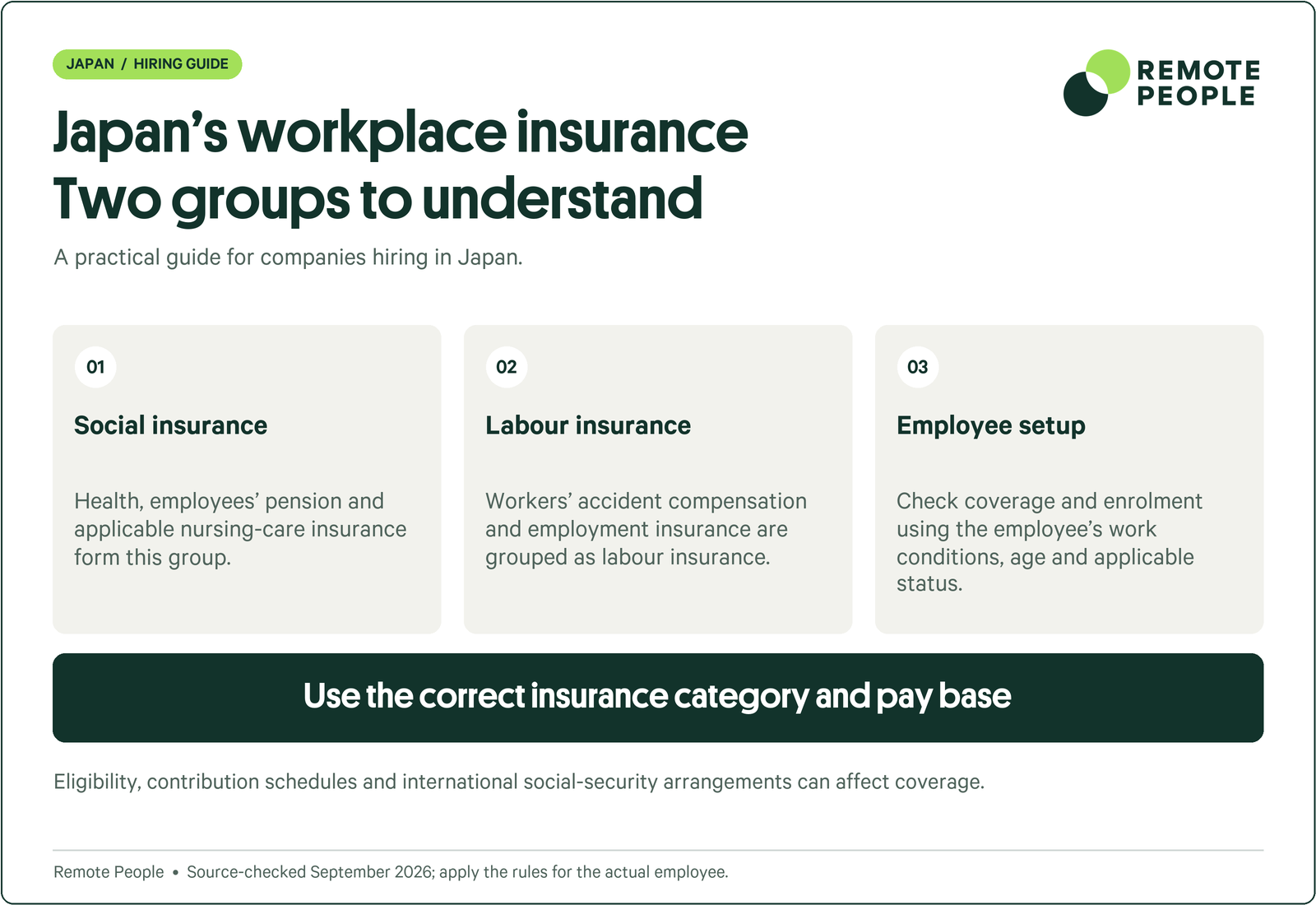
Japan requires employers to enroll all eligible employees in a broad social insurance system that covers health, pension, unemployment, and workplace accidents. The system is split into two main categories.
Health insurance (Kenko Hoken) provides medical coverage for employees and dependents, including hospital visits, prescriptions, and dental care. Employees pay 30% of medical costs out-of-pocket, with insurance covering the remainder. Premiums are shared equally between employer and employee.
The employee pension (Kosei Nenkin) requires mandatory contributions at 18.3% of salary, split equally between employer (9.15%) and employee (9.15%), providing retirement, disability, and survivor benefits. The Japan Pension Service administers enrollment and benefit calculations.
Employment insurance (Koyo Hoken) covers unemployment benefits, childcare leave payments, and vocational training subsidies, with both employer and employee contributing at different rates. Workers’ accident compensation insurance (Rousai Hoken) covers work-related injuries, illnesses, and commuting accidents entirely at employer cost. Employees aged 40 to 64 also pay long-term care insurance (Kaigo Hoken) premiums shared equally with the employer.
Contribution rates for health insurance vary by prefecture and insurer. The exact employer and employee rates are detailed in the payroll tables under H2 4.
Beyond these mandatory programs, many Japanese companies provide supplementary benefits including commuter transportation allowances (tsukin teate), housing allowances, and biannual bonuses, which are customary though not legally required.
Recent Regulatory Updates (2026)
Several significant changes to Japan’s employment framework took effect between 2024 and 2026. In April 2024, overtime cap extension, including construction, road transport, and medical services. This ended a five-year grace period and brought all industries under the same working time limits, with special clause limits of 720 to 960 hours per year depending on the sector.
Japan launched a digital nomad visa in March 2024, allowing remote workers employed by overseas companies to reside in Japan for up to six months. The visa requires annual income of at least JPY 10,000,000 (approximately $67,000 USD) and private health insurance with coverage of JPY 10,000,000 or more. Holders cannot work for Japanese-based employers or clients.
In October 2024, the social insurance eligibility threshold for part-time workers was lowered from companies with 101 or more employees to those with 51 or more employees. Part-time workers meeting the criteria of 20 or more hours per week and JPY 88,000 or more monthly earnings must now be enrolled in Shakai Hoken. For 2026, income tax deductions increased, with the basic deduction rising from JPY 580,000 to JPY 620,000 and the employment income deduction minimum increasing from JPY 650,000 to JPY 690,000, effectively raising the tax-free threshold for workers (EY Japan 2026 Tax Reform).
Work Permits and Visas in Japan
Non-Japanese citizens require a valid work visa (status of residence) to be employed in Japan. The Immigration Services Agency of Japan (ISA), under the Ministry of Justice, administers all visa categories.
Work visa applications typically require a Certificate of Eligibility (COE) issued by a regional immigration bureau before the employee can apply for the actual visa at a Japanese embassy or consulate. Understanding the available visa types and processing requirements is essential for companies hiring foreign talent through an employer of record in Japan.
Work Permit Requirements
Who Needs a Work Permit
All foreign nationals require a work visa to be legally employed in Japan, with limited exceptions for permanent residents, spouses of Japanese nationals, and holders of long-term resident status. Japan does not have a general work permit system tied to employer sponsorship in the way some countries do.
Instead, each status of residence (visa type) authorizes specific categories of work activity. Citizens of countries with bilateral agreements may have simplified visa procedures, but all require a valid status of residence that permits employment.
Eligibility and Required Documents
Eligibility depends on the visa category. For the most common work visa (Engineer/Specialist in Humanities/International Services), applicants must hold a bachelor’s degree or higher, or demonstrate at least 10 years of relevant professional experience.
Required documents typically include a valid passport, the Certificate of Eligibility (obtained by the employer in Japan), a university degree certificate or proof of work experience, a resume, passport-sized photographs, and the visa application form. The sponsoring employer (or EOR) must provide company registration documents, financial statements, and an employment contract specifying the job duties and compensation.
Processing Time and Validity
The Certificate of Eligibility typically takes one to three months to process, depending on the regional immigration bureau and the visa category. Once the COE is issued, the actual visa stamp at a consulate takes one to two weeks.
Most work visas are initially granted for one to three years, with the possibility of renewal. The Highly Skilled Professional visa is granted for five years from the outset. Processing times can extend during peak periods (April, the start of Japan’s fiscal year) or for applications requiring additional documentation review.
Renewal Process
Visa renewals are filed at the regional immigration bureau at least one month before the current visa expires. The employee can continue working while the renewal is pending, provided they applied before expiration.
Required documents include the renewal application, current residence card, employment verification from the EOR, tax payment certificates, and social insurance enrollment proof. Renewals are typically processed within two to four weeks. If the employee changes employers (or EOR providers), a notification of the change must be submitted to the immigration bureau within 14 days.
Common Visa Types for Foreign Workers
Japan offers several visa categories for foreign workers, each tailored to different qualification levels and employment types. The Immigration Services Agency issues each status of residence with specific scope restrictions, meaning a visa holder can only perform work within the authorized category. The EOR can sponsor most of these visa types through its registered legal entity in Japan.
Japan work visa types for foreign workers · 2026 | ||||
Visa Type | Duration | Best For | Leads to PR? | Processing Time |
|---|---|---|---|---|
Engineer/Specialist in Humanities/International Services | 1–5 years | IT engineers, researchers, translators, designers, marketing professionals | Yes (10 years) | 1–3 months (COE) + 1–2 weeks (visa) |
Intra-Company Transferee | 1–5 years | Employees transferring from overseas office to Japan branch | Yes (10 years) | 1–3 months (COE) + 1–2 weeks (visa) |
Highly Skilled Professional | 5 years | High-salary professionals scoring 70+ on points system | Yes (3 years at 70 pts; 1 year at 80 pts) | 1–3 months (COE) + 1–2 weeks (visa) |
Specified Skilled Worker (Tokutei Gino) | 1 year, renewable up to 5 years total | Workers in designated labor shortage sectors (construction, care, hospitality) | No | 2–4 weeks + skills test |
Business Manager | 1–5 years | Entrepreneurs and company executives | Yes (10 years) | 1–3 months (COE) |
Digital Nomad (Designated Activities) | 6 months (non-renewable) | Remote workers employed by overseas companies | No | 2–4 weeks |
Tourist visas allow stays of up to 90 days for citizens of visa-exempt countries but do not permit any employment activity. Student visas permit part-time work of up to 28 hours per week with a separate authorization, though they do not qualify as full-time employment. Dependent visas for spouses and children of work visa holders also allow part-time work up to 28 hours per week with additional authorization.
How an EOR Handles Work Permits
An EOR in Japan manages the visa sponsorship process through its registered legal entity, which is the official employer for immigration purposes. The EOR prepares and submits the Certificate of Eligibility application, compiles required corporate documents (company registration, financial statements, employee roster), and coordinates with the regional immigration bureau throughout the process.
The EOR also handles visa renewals, change-of-status applications, and the mandatory 14-day notification when employment conditions change. If a visa application is denied, the EOR advises on alternative visa categories or documentation improvements.
For employees already in Japan on a different status of residence, the EOR can process a change-of-status application, which typically takes one to two months. The work visa process adds four to eight weeks to the standard onboarding timeline described in H3 1.4.
Payroll, Taxes, and Social Security in Japan
Japan’s payroll system combines employer and employee social insurance contributions with progressive national income tax and flat local inhabitant tax. Payroll is processed monthly, with salaries typically paid on the 25th of each month by bank transfer in Japanese Yen (JPY). The employer of record handles all withholding calculations, social insurance remittances, and annual tax adjustment filings on your behalf.
Employer Contributions
Employers in Japan contribute to five mandatory social insurance programs. Health insurance rates vary by prefecture, but the Tokyo rate of 9.91% (total, shared equally) is representative.
The employee pension rate has been fixed at 18.3% (total, shared equally) since September 2017. Unemployment insurance rates were reduced in April 2025 to 1.45% total. W
orkers’ accident compensation is fully employer-funded and varies by industry risk classification. The table below uses representative rates for standard office-based employment (PwC Japan Tax Summary).
Japan employer social security contributions · 2026 rates | ||
Contribution Type | Employer Rate | Notes |
|---|---|---|
Health Insurance (Kenko Hoken) | 4.955% | Half of 9.91% total (Tokyo rate); varies by prefecture |
Employee Pension (Kosei Nenkin) | 9.15% | Half of 18.3% total; fixed rate since 2017 |
Unemployment Insurance (Koyo Hoken) | 0.9% | Employer share; effective April 2025 |
Workers’ Accident Compensation (Rousai Hoken) | 0.3% | 100% employer-funded; rate shown for office work (varies 0.25%–8.8% by industry) |
Child/Childcare Contribution (Kodomo Kosodate) | 0.36% | Employer-only contribution; supports child welfare programs |
Total Employer Contribution | 15.665% | Representative total for standard office employment |
Employee Contributions
Employees share the cost of health insurance and pension equally with the employer, and contribute a smaller share to unemployment insurance. Employees aged 40 to 64 also pay long-term care insurance premiums.
All contributions are withheld from gross salary each month and remitted by the employer (or EOR). The following rates apply to standard full-time employees.
Japan employee payroll deductions · 2026 monthly withholdings | ||
Deduction Type | Employee Rate | Notes |
|---|---|---|
Health Insurance (Kenko Hoken) | 4.955% | Half of 9.91% total (Tokyo rate); varies by prefecture |
Employee Pension (Kosei Nenkin) | 9.15% | Half of 18.3% total; salary cap at JPY 650,000/month standard remuneration |
Unemployment Insurance (Koyo Hoken) | 0.55% | Employee share; effective April 2025 |
Long-term Care Insurance (Kaigo Hoken) | 0.80% | Applies to employees aged 40–64 only; half of ~1.59% total |
Total Employee Deductions (under 40) | 14.655% | Before income tax; excludes long-term care |
Total Employee Deductions (40–64) | 15.455% | Includes long-term care insurance |
Income Tax
Japan uses a progressive national income tax system with seven brackets, ranging from 5% on the first JPY 1,950,000 of taxable income to 45% on income exceeding JPY 40,000,000. A reconstruction special income tax of 2.1% is applied as a surtax on the national income tax amount (not on gross income) through December 2037. In addition, employees pay local inhabitant tax (Jumin-zei) at a flat rate of approximately 10%, calculated on the previous year’s income and collected through monthly payroll deductions starting in June each year (PwC Japan Personal Income Taxes).
Japan income tax brackets · 2026 | |
Annual Taxable Income (JPY) | Tax Calculation |
|---|---|
Up to JPY 1,950,000 | 5% of taxable income |
JPY 1,950,001 – JPY 3,300,000 | 10% minus JPY 97,500 deduction |
JPY 3,300,001 – JPY 6,950,000 | 20% minus JPY 427,500 deduction |
JPY 6,950,001 – JPY 9,000,000 | 23% minus JPY 636,000 deduction |
JPY 9,000,001 – JPY 18,000,000 | 33% minus JPY 1,536,000 deduction |
JPY 18,000,001 – JPY 40,000,000 | 40% minus JPY 2,796,000 deduction |
Over JPY 40,000,000 | 45% minus JPY 4,796,000 deduction |
For an employee earning JPY 5,000,000 annually, the national income tax calculation is: 20% of JPY 5,000,000 minus the JPY 427,500 deduction, yielding approximately JPY 572,500 in national income tax before the 2.1% reconstruction surtax. After applying standard deductions (basic deduction of JPY 620,000, employment income deduction, and social insurance deduction), the effective rate is lower. The local inhabitant tax adds approximately 10% on the adjusted prior-year income.
Payroll Cycle
Payroll in Japan runs on a monthly cycle, with most companies paying salaries between the 15th and 25th of each month. Payment is made by bank transfer to the employee’s designated Japanese bank account in JPY.
The payslip (kyuyo meisai) must itemize gross salary, each social insurance deduction, income tax withheld, and net pay. Employers perform a year-end tax adjustment (nenmatsu chosei) in December to reconcile taxes withheld throughout the year against the employee’s actual annual tax liability. Social insurance contributions are reported to the Japan Pension Service and health insurance associations through periodic updates to the “standard remuneration” (hyojun hoshu) grade, which is reviewed annually in September based on April–June salary data.
13th Month Salary and Bonus Pay
Japan does not legally mandate a 13th month salary. There is no statutory requirement for employers to pay annual bonuses.
However, biannual bonuses (summer and winter, typically paid in June and December) are a deeply embedded practice in Japanese business culture. Most full-time employees at established companies expect bonus payments equivalent to two to six months’ salary per year combined, depending on company performance and individual evaluation.
Whether bonuses are contractually obligated depends on the employment contract and company work rules. If the work rules or contract specify a formula or guarantee for bonus payment, the bonus becomes a legal obligation enforceable by the employee.
If described as discretionary, the employer retains flexibility to adjust or withhold based on business conditions. All bonus payments are subject to the same social insurance and income tax withholding as regular salary. EOR providers in Japan calculate and process bonus payments in accordance with the employment contract terms they administer.
Cost of Hiring Through an EOR in Japan
EOR Service Fees
Employer of record service fees in Japan typically range from $500 to $2,000 per employee per month, depending on the provider’s service level and the complexity of the engagement. This fee covers employment contract administration, monthly payroll processing, social insurance registration and contributions, income tax withholding, year-end tax adjustment, and ongoing compliance monitoring.
Some providers charge a flat monthly fee, while others charge a percentage of the employee’s gross salary (typically 10% to 20%). Flat-fee models provide more predictable costs, especially for higher-salary positions common in Japan.
Total Employment Cost Breakdown
The total cost of hiring through an EOR in Japan includes the employee’s gross salary, mandatory employer social insurance contributions, and the EOR service fee. The example below uses a monthly gross salary of $5,000 USD to illustrate the full cost structure. Japan’s employer contributions add 15.665% to gross salary before the EOR fee.
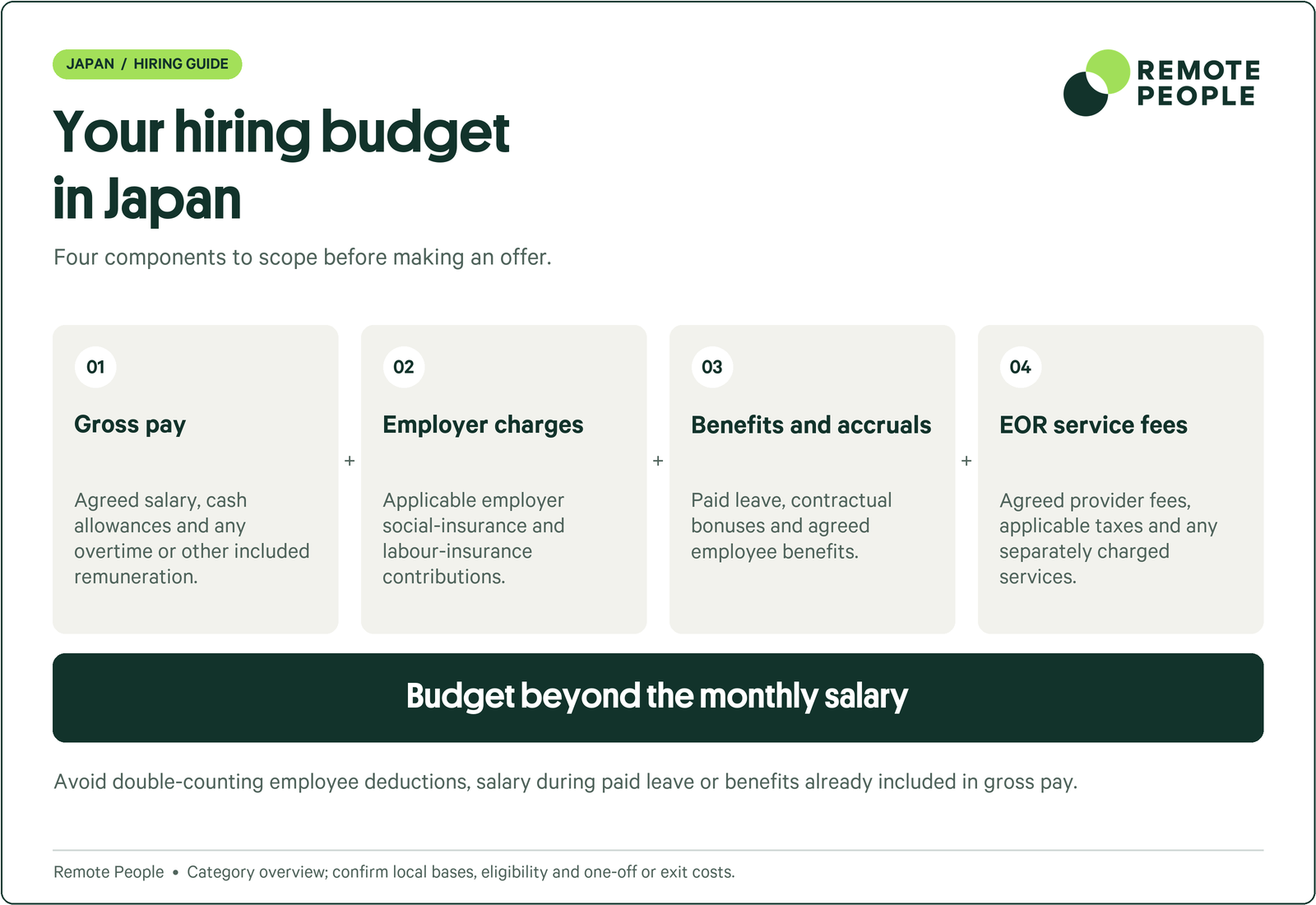
Japan employer cost example · USD $5,000 gross · 2026 | ||
Employer Cost | Amount (USD) | % of Gross |
|---|---|---|
Gross Monthly Salary | $5,000 | 100% |
Health Insurance (4.955%) | $248 | 4.955% |
Employee Pension (9.15%) | $458 | 9.15% |
Unemployment Insurance (0.9%) | $45 | 0.9% |
Workers’ Accident Compensation (0.3%) | $15 | 0.3% |
Child/Childcare Contribution (0.36%) | $18 | 0.36% |
EOR Service Fee | $499 | 9.98% |
Total Monthly Employer Cost | $6,283 | 125.66% |
Figures converted at $1 = JPY 149 (April 2026 rate). Source: payroll and tax and PwC Japan Tax Summary | ||
Ready to hire in Japan? Get started with RemotePeople, we handle employment contracts, payroll, tax withholding, and full Japan compliance. No local entity needed. Contact us for a custom quote.
Benefits of Using an EOR in Japan
Hiring through an employer of record in Japan means you do not need a local subsidiary while still maintaining full compliance with Japanese labor law. The EOR model provides clear advantages for companies that want to access Japan’s talent market without the time, cost, and complexity of entity incorporation.
An EOR can onboard employees in Japan within one to two weeks, compared to three to six months for entity registration with the Legal Affairs Bureau, tax office, labor standards office, and pension office. This speed advantage allows companies to secure talent before competitors complete their own setup.
Japan’s Labor Standards Act, Labor Contract Act, and multiple social insurance regulations create a complex compliance environment. The EOR’s in-house legal and HR teams stay current with regulatory changes, such as the 2024 overtime cap extension and 2025 social insurance expansion, so your company avoids penalties and labor tribunal disputes.
Establishing and maintaining a Japanese subsidiary costs $30,000 to $50,000 upfront and $5,000 to $10,000 per month in ongoing overhead. For teams of one to fifteen employees, an EOR at $300 to $600 per month per employee delivers significant savings while providing full statutory compliance.
Hiring employees through an EOR requires no changes to your corporate structure, allowing you to scale your Japan team up or down without the legal burden of entity restructuring or dissolution. The EOR also mitigates risk around Japan’s doctrine of abusive dismissal by ensuring all termination processes follow the strict requirements of the Labor Contract Act, including the four-factor test for economic dismissals.
Employees hired through an EOR receive the same statutory benefits, social insurance coverage, and employment protections as any directly hired worker in Japan. This creates a professional employment experience that supports retention and engagement.
For companies exploring Japan as a growth market, the EOR model provides a low-risk, fast-deployment path to building a local team. Contact RemotePeople to discuss your Japan hiring needs.
Termination and Offboarding in Japan
Notice Periods
Japan applies a uniform 30-day notice period for all employer-initiated terminations of employees who have completed at least 14 days of employment, as required by Labor Standards Act Article 20. The employer may pay wages in lieu of notice for part or all of the 30-day period.
During the first 14 days of employment, no advance notice is required, though the employer must still have a reasonable basis for termination. Japan does not differentiate notice periods by tenure or position level; the flat 30-day rule applies to all permanent employees regardless of seniority.
Japan statutory notice periods by employment stage · Per Labor Standards Act Article 20 | |||
Employment Stage | Notice Period | During Probation | Notes |
|---|---|---|---|
First 14 days of employment | None required | Typically within probation | Employer must still have reasonable grounds |
After 14 days (any tenure) | 30 calendar days | Same 30-day rule applies | Or payment in lieu of notice (average daily wage x shortfall days) |
Fixed-term contract expiry | 30 days before contract end | N/A | Required for contracts of 1+ year that have been renewed, if employer chooses not to renew |
Employee resignation | 14 days (Civil Code Art. 627) | Same rule applies | Employees can resign with 14 days’ notice; longer periods may apply per contract |
Source: Labor Standards Act and JETRO Japan Investment Guide | |||
For just-cause dismissals (e.g., serious misconduct, criminal acts), the employer may apply for a “dismissal without notice” approval from the Labor Standards Inspection Office, which waives the 30-day notice requirement. Mutual agreement terminations (goi taishoku) do not require any statutory notice period, as both parties agree to the separation terms. Fixed-term contracts that expire at their natural end date do not require notice unless the contract has been renewed one or more times and the employer chooses not to renew.
Severance Pay
Japan has no statutory requirement for severance pay. Unlike many countries in Asia and Europe, Japanese law does not mandate that employers pay a severance amount upon termination.
The only payment required in connection with dismissal is wages in lieu of notice (30 days’ average wage) if the employer does not provide the full notice period. However, voluntary retirement allowance systems (taishoku-kin) are widespread in Japanese business practice.
Japan severance pay practices by years of service · Per common taishoku-kin systems | |||
Years of Service | Typical Severance Amount | Base Salary Definition | Notes |
|---|---|---|---|
1 year | 1 month’s salary | Final monthly base salary (excluding bonuses) | Voluntary; per company work rules |
3 years | 3 months’ salary | Final monthly base salary | Some companies apply a multiplier above 1x per year |
5 years | 5 months’ salary | Final monthly base salary | Multiplier may increase at milestone years |
10 years | 10–15 months’ salary | Final monthly base salary | Enhanced multipliers common for long-tenured employees |
Source: Labor Contract Act and JETRO Japan Investment Guide | |||
Calculation Method
The most common taishoku-kin formula is one month of final base salary per year of service, with multipliers that increase at milestone tenure thresholds (typically 10, 15, and 20 years). Some systems use a “points-based” calculation that factors in job grade, performance ratings, and reason for departure (voluntary resignation typically yields a lower multiplier than company-initiated termination).
The base for calculation is usually the employee’s final monthly base salary, excluding overtime pay, commuter allowances, and bonuses. Retirement allowances receive preferential tax treatment, with a substantial deduction based on years of service (JPY 400,000 per year for the first 20 years, JPY 700,000 per year thereafter), making them an efficient component of total compensation.
Caps and Exceptions
Since retirement allowances are voluntary, caps and exceptions depend entirely on the company’s work rules or collective labor agreement. Once an employer establishes a retirement allowance system in its work rules, it becomes a contractual obligation, and the employer cannot unilaterally reduce or eliminate it without employee consent or a valid change under the Labor Contract Act.
Employees dismissed for serious misconduct (gross negligence, criminal acts) may forfeit all or part of their retirement allowance if the work rules contain a forfeiture clause. Employees who resign voluntarily typically receive a reduced amount (often 50% to 80% of the company-initiated rate).
Grounds for Termination
Japan has some of the strictest dismissal protections globally. Under Labor Contract Act Article 16, a dismissal is invalid if it lacks “objectively reasonable grounds” and is not “appropriate in general societal terms.” This standard, developed through decades of case law, means employers must demonstrate that dismissal was the last resort after all reasonable alternatives were exhausted.
For economic dismissals (seiri kaiko), Japanese courts apply a four-factor test: (1) genuine economic necessity requiring workforce reduction, (2) reasonable efforts to avoid dismissal (hiring freeze, pay cuts, voluntary retirement programs), (3) objective and non-discriminatory selection criteria for affected employees, and (4) adequate consultation with employees or their representatives. Failure on any factor can result in the dismissal being declared void, with the employee entitled to reinstatement and back pay.
Protected categories include pregnant employees, employees on maternity or childcare leave, and workers absent due to work-related injuries (30-day post-return protection). Dismissal based on union membership, gender, nationality, or disability is prohibited.
EOR vs. Other Hiring Models in Japan
EOR vs. Setting Up a Local Entity
Companies evaluating a Japan EOR versus entity setup should consider the cost and time differences. Companies evaluating a Japan EOR versus entity setup should consider the cost and time differences. Establishing a legal entity in Japan requires registration with the Legal Affairs Bureau, tax office, prefectural tax office, municipal tax office, labor standards office, public employment security office, pension office, and health insurance association. The process typically takes three to six months and costs $30,000 to $50,000 in registration fees, legal fees, and initial capital requirements. The table below compares this approach with hiring through an employer of record.
Japan EOR vs local entity comparison · Setup time, cost, risk and best-fit | ||
Comparison | Employer of Record | Own Entity |
|---|---|---|
Setup Time | 1–2 weeks | 3–6 months |
Upfront Cost | $0 | $30,000–$50,000 |
Ongoing Cost (per employee) | $500–$2,000/month | $5,000–$10,000/month overhead |
Local Partner Required | No (EOR is the local entity) | No (KK or GK structure) |
Social Insurance Registration | Handled by EOR | You manage it |
Payroll & Tax Filing | Handled by EOR | You manage it (or outsource) |
Best for Team Size | 1–15 employees | 15+ employees |
Scale Down / Exit | Easy, no entity to unwind | Costly, legal dissolution required |
Government Contracts | Not eligible | Eligible (requires local entity) |
The EOR model is most cost-effective for companies with one to fifteen employees in Japan. Entity incorporation makes sense when the team exceeds 15 employees, when government contracts require a local entity, or when the company needs full control over its corporate presence in Japan (for example, to sign contracts directly with Japanese clients).
Exiting the Japanese market through entity dissolution involves liquidation procedures, final tax filings, employee termination, and deregistration with multiple government agencies, which typically takes six to twelve months and costs $10,000 to $30,000 in legal and accounting fees. With an EOR, the offboarding of remaining employees follows standard termination procedures with no entity wind-down required.
Japan’s strict dismissal protections add another layer of risk to entity ownership: companies that dismiss employees without following the Labor Contract Act requirements face reinstatement orders and potentially substantial damages. An EOR’s compliance expertise provides a buffer against these risks.
EOR vs. Hiring Independent Contractors
Independent contractor arrangements in Japan are subject to scrutiny under both the Labor Standards Act and tax regulations. The distinction between an employee and a contractor in Japan depends on the degree of control exercised by the hiring company, not the label on the contract. The table below highlights the key differences between EOR employment and contractor engagement.
Japan EOR vs independent contractors · Compliance, cost, and risk | ||
Comparison | EOR (Full-Time Employee) | Independent Contractor |
|---|---|---|
Legal Relationship | Employee of the EOR | Self-employed, no employment relationship |
Compliance Risk | Low, EOR ensures local labor law compliance | High, misclassification risk if relationship resembles employment |
Payroll & Tax | EOR handles withholding, contributions, filings | Contractor invoices you; they handle their own taxes |
Benefits & Leave | Statutory benefits, paid leave, social security | No entitlement to employee benefits |
IP Protection | Stronger, employment contract assigns IP by default | Weaker, requires explicit IP assignment clause |
Termination | Subject to local notice periods and severance | Contract can be ended per agreement terms |
Best For | Long-term, core team roles | Short-term projects, specialized tasks |
Cost Structure | Salary + employer contributions + EOR fee | Contractor fee (typically higher gross, lower total cost) |
Misclassification is a significant compliance risk in Japan. The Labor Standards Inspection Office and tax authorities examine the actual working relationship rather than the contract label.
Indicators of employment include fixed working hours, exclusive engagement with one client, use of company equipment, and integration into the company’s organizational structure. If reclassified, the hiring company faces liability for unpaid social insurance contributions, overtime pay, and back taxes, plus potential penalties.
For companies that need ongoing, full-time support from workers in Japan, the EOR model provides the strongest legal foundation and eliminates misclassification risk entirely. contractor arrangements with clear deliverables, defined timelines, and genuine independence in how the work is performed.
EOR vs. PEO (Professional Employer Organization)
Japan does not have a formal co-employment framework equivalent to the PEO model used in the United States. The Worker Dispatching Act (Rodosha Haken Ho) regulates temporary staffing agencies, which is a different model from PEO co-employment.
Under the dispatching act, temporary workers can be placed at a client company for a maximum of three years in the same organizational unit, after which the client must either directly hire the worker or end the placement. The table below compares the EOR and PEO models in the Japanese context.
Japan EOR vs PEO comparison · Legal employer, liability, and setup | ||
Comparison | Employer of Record (EOR) | PEO |
|---|---|---|
Legal Employer | EOR is the legal employer | You remain the legal employer (co-employment) |
Local Entity Required | No, the EOR is the local entity | Yes, you must have your own entity in Japan |
Best For | Companies without a local entity | Companies that already have a local entity |
Compliance Liability | EOR assumes compliance responsibility | Shared liability between you and the PEO |
Setup Time | 1–2 weeks | Depends on your entity setup (weeks to months) |
Control over HR Policies | EOR manages within local law framework | More direct control, PEO advises |
Typical Use Case | Market entry, small remote teams, testing new markets | Established local operations needing HR outsourcing |
Source: RemotePeople EOR Solutions and Japan Labor Standards Act | ||
Since Japan lacks a recognized PEO co-employment framework, companies without a local entity cannot use a traditional PEO structure. The EOR model is the practical default for foreign companies hiring in Japan, as it provides full legal employer status without requiring the client to incorporate locally. The EOR assumes complete responsibility for labor law compliance, social insurance administration, and payroll processing.
For companies that already have a Japanese subsidiary (KK or GK) and want to outsource HR administration, payroll outsourcing services provide a closer equivalent to PEO functionality. These services handle payroll processing and compliance monitoring while the company remains the legal employer. The EOR model, by contrast, is designed specifically for companies that do not have and do not want to establish a local entity.
Public Holidays in Japan
Japan observes 16 national holidays annually under the National Holidays Act (Kokumin no Shukujitsu ni Kansuru Horitsu). Employees are entitled to these days off with pay.
If a national holiday falls on a Sunday, the following Monday becomes a substitute holiday (furikae kyujitsu). When a single weekday falls between two holidays, it also becomes a holiday under the “sandwiched day” rule. The Golden Week period (late April to early May) and the year-end/New Year period are the most significant holiday clusters that affect business operations and payroll scheduling.
Japan public holidays · 2026 calendar year | ||
Date | Holiday | Type |
|---|---|---|
January 1 | New Year’s Day (Ganjitsu) | National |
January 12 | Coming of Age Day (Seijin no Hi) | National |
February 11 | National Foundation Day (Kenkoku Kinen no Hi) | National |
February 23 | Emperor’s Birthday (Tenno Tanjobi) | National |
March 20 | Vernal Equinox Day (Shunbun no Hi) | National |
April 29 | Showa Day (Showa no Hi) | National |
May 3 | Constitution Memorial Day (Kenpo Kinenbi) | National |
May 4 | Greenery Day (Midori no Hi) | National |
May 5 | Children’s Day (Kodomo no Hi) | National |
May 6 | Substitute Holiday | Substitute |
July 20 | Marine Day (Umi no Hi) | National |
August 11 | Mountain Day (Yama no Hi) | National |
September 21 | Respect for the Aged Day (Keiro no Hi) | National |
September 22 | National Rest Day (Kokumin no Kyujitsu) | Sandwiched |
September 23 | Autumnal Equinox Day (Shubun no Hi) | National |
October 12 | Sports Day (Supotsu no Hi) | National |
November 3 | Culture Day (Bunka no Hi) | National |
November 23 | Labor Thanksgiving Day (Kinro Kansha no Hi) | National |
Source: Time and Date and Japan National Holidays Act | ||
Japan observes 16 national holidays in 2026, plus one substitute holiday (May 6) and one sandwiched rest day (September 22), for a total of 18 paid days off. Many companies provide additional days off during the Obon period (mid-August) and year-end/New Year (December 29 to January 3) as customary closures.
Employees who work on national holidays are entitled to premium pay at 135% of regular wages. Your EOR provider automatically adjusts payroll calculations to reflect holiday pay obligations and ensures compliance with the Labor Standards Act requirements for rest days.
How to Get Started with an EOR in Japan
- First, Define your hiring needs by identifying the role, required qualifications, and target start date. Determine whether the employee needs a work visa (if they are not already a resident of Japan) and whether you have a preference for contract type (indefinite or fixed-term). This preparation helps your EOR provider scope the engagement accurately.
- Second, Partner with an EOR provider that has direct experience in Japan and maintains a registered legal entity capable of sponsoring work visas. Confirm the provider handles Shakai Hoken and Rodo Hoken enrollment, year-end tax adjustments, and bilingual employment contracts. Review the fee structure and confirm what is included.
- Third, Complete client onboarding with your EOR provider, which includes KYC verification, signing the service agreement, and providing job descriptions with compensation details. This process typically completes within three to five business days.
- Fourth, Begin recruitment through your own channels or the EOR provider’s network. Once you select a candidate, the EOR drafts the employment contract, obtains the employee’s signature, and initiates social insurance and tax registration. If a work visa is required, the EOR simultaneously begins the Certificate of Eligibility application.
- Fifth, Onboard the employee by providing work assignments, access to company systems, and relevant policies. The EOR handles the administrative setup, including benefits enrollment, payroll configuration, and compliance documentation. The employee begins work as soon as registration is complete.
Choosing an employer of record in Japan is the fastest way to hire compliantly. Ready to hire your first employee? RemotePeople’s EOR team guides you through every step of the process, from contract creation to first payroll. Schedule a consultation to receive a custom proposal for your Japan hiring needs.
Where companies hiring in Japan expand next
Employers with teams in Japan often extend across Northeast Asia, where advanced manufacturing and deep tech ecosystems cluster together. Common expansion paths include an EOR partner in Singapore (access to pan-Asian talent and supply-chain clusters) and South Korea (deep Asian tech and services talent). Teams scaling further usually add a team in Taiwan for Asia-Pacific connectivity and English-proficient hires, with operations in China extending coverage through the Asia-Pacific gateway with multilingual workforce.
Frequently Asked Questions
EOR services in Japan typically cost between $300 and $600 per employee per month as a flat monthly fee. This covers payroll processing, social insurance enrollment, tax withholding, and compliance monitoring. Total employer cost including social insurance contributions adds 15.665% on top of the gross salary, bringing the total cost to approximately 25.66% above gross when the EOR fee is included.
The typical onboarding timeline is one to two weeks from contract signing to employee start date. If the employee requires a work visa, add four to eight weeks for Certificate of Eligibility processing through the Immigration Services Agency. Employees already holding a valid work visa in Japan can start within days.
All Japanese employment laws apply, including the Labor Standards Act, Labor Contract Act, Minimum Wage Act, and social insurance legislation. The EOR assumes responsibility for compliance with all statutory requirements, including the strict dismissal protections, overtime regulations, and mandatory five-day annual leave usage rule.
EOR services are designed for full-time employee relationships, not contractor engagements. If you need to engage independent contractors in Japan, RemotePeople's contractor management solution handles compliance, payments, and contract administration. Misclassification risk in Japan is significant, as authorities examine the actual working relationship rather than the contract label when determining employment status.
Your company (the client) owns all work product and intellectual property created by EOR employees as part of their job duties. This ownership is established through the employment contract, which includes IP assignment clauses as standard practice. Japan’s Patent Act and Copyright Act provide additional protections for employer-owned inventions and works created during employment.
Bonuses are not legally mandatory in Japan. However, biannual bonuses (summer and winter) are a deeply embedded cultural expectation, and most employees at established companies expect them. Whether a bonus is contractually required depends on the language in the employment contract and company work rules. Your EOR provider can advise on competitive compensation structures.
Japan has among the strictest dismissal protections globally. Termination requires 30 days’ advance notice (or payment in lieu) and must meet the "objectively reasonable grounds" standard under the Labor Contract Act. For economic dismissals, courts apply a four-factor test. Your EOR manages the entire termination process to ensure compliance and minimize the risk of the dismissal being declared invalid.
Employers contribute 15.665% of gross salary to five mandatory social insurance programs: health insurance (~5%), employee pension (9.15%), unemployment insurance (0.9%), workers’ accident compensation (~0.3%), and child/childcare contribution (0.36%). Rates for health insurance vary by prefecture and the workers’ accident rate varies by industry.
No, you do not need a local entity to hire employees in Japan. An employer of record (EOR) serves as the legal employer on your behalf, handling employment contracts, payroll, social insurance registration, and tax compliance. Entity incorporation in Japan costs $30,000 to $50,000 and takes three to six months through the Legal Affairs Bureau. An EOR lets you onboard employees within one to two weeks at a fraction of that cost (RemotePeople EOR services).
Employers in Japan contribute 15.665% of gross salary to five mandatory social insurance programs: health insurance at 4.955%, employee pension at 9.15%, unemployment insurance at 0.9%, workers' accident compensation at 0.3%, and child/childcare contribution at 0.36%. Health insurance and pension premiums are shared equally with the employee. Rates for health insurance vary by prefecture, and the figures above reflect the Tokyo standard rate (Japan Pension Service).
Japan sets minimum wages on a prefectural basis, with each of the 47 prefectures establishing its own hourly rate. As of October 2025, the national weighted average is approximately JPY 1,055 per hour. Tokyo has the highest rate at JPY 1,163 per hour. Minimum wages are reviewed annually each October by prefectural minimum wage councils. For detailed rates by prefecture, see our Japan minimum wage guide.
Foreign employees need a work visa (status of residence) issued by the Immigration Services Agency of Japan. The most common category is the Engineer/Specialist in Humanities/International Services visa for professionals, which requires a bachelor's degree or 10 years of experience and is valid for one, three, or five years. The process starts with a Certificate of Eligibility (COE) application, which takes four to eight weeks. An EOR with a registered office in Japan can sponsor work visas directly (Japan work visa guide).
Employer of Record in
Employer of Record in
Employer of Record in
Employer of Record in
Employer of Record in
Employer of Record in
Employer of Record in
Employer of Record in




