Recruit
Employer of Record in Tonga
-
 Drew Donnelly
- Published
- July 24, 2026
RemotePeople’s employer of record in Tonga lets you hire employees in Tonga with Tonga National Retirement Benefits Fund compliance. We handle 5 percent employer pension contributions, Employment Relations Act compliance, and statutory leave administration.
Hire in Tonga — book a free 30-minute demo
No sales call required. Free 30-minute expert call if you want one.
Tell us about your company
So we can match you with a specialist who knows your market — and unlock volume pricing tiers.
* All fields are required.
Where and when are you hiring?
Tell us the geography and timing and we'll quote each country line by line, with onboarding timelines.
* All fields are required.
Help us beat your current setup
We'll benchmark your current deal and send a line-by-line proposal in 24 hours — showing exactly where we cut cost, time, or risk. After you submit, you can book a call to walk through it together.
* All fields are required.
Thanks! Your proposal is on its way.
Expect a tailored, line-by-line proposal in your inbox within 24 hours. In the meantime…
Want to walk through it together?
Book a free 30-minute call with one of our specialists. We'll explain every line, answer your questions, and tailor the proposal further if you need.
No obligation. Pick a time that works for you.








- Hire in Tonga — book a free 30-minute demo
- Tell us about your company
- Where and when are you hiring?
- Help us beat your current setup
- Thanks! Your proposal is on its way.
- How an Employer of Record Works in Tonga
- Hire in Tonga
- Employment Laws and Regulations in Tonga
- Work Permits and Visas in Tonga
- Payroll, Taxes, and Social Security in Tonga
- Cost of Hiring Through an EOR in Tonga
- Benefits of Using an EOR in Tonga
- Termination and Offboarding in Tonga
- EOR vs. Other Hiring Models in Tonga
- Public Holidays in Tonga
- How to Get Started with an EOR in Tonga
- Where companies hiring in Tonga expand next
- Frequently Asked Questions About EOR Tonga
- Related EOR Destinations

Start hiring in Tonga
Let RemotePeople handle payroll, compliance, and HR admin worldwide so you can focus on building your team.

Hiring in Tonga with an Employer of Record (EOR) streamlines your Pacific expansion by handling payroll, taxes, and compliance under the Kingdom’s common law employment framework. RemotePeople’s employer of record Tonga service manages all statutory obligations so your team can focus on building productive relationships with local talent across Tongatapu, Vava’u, and Haʻapai.
How an Employer of Record Works in Tonga
An Employer of Record in Tonga is the legal employer for your international hires, assuming all compliance, payroll, and statutory duties on your behalf. This arrangement lets you hire Tongan talent without establishing a local entity, reducing time to hire and administrative overhead. EORs handle everything from employment contracts to Pay As You Earn (PAYE) filings, allowing you to scale in an economy that relies heavily on remittances and a small private-sector labour market.
What Is an EOR?
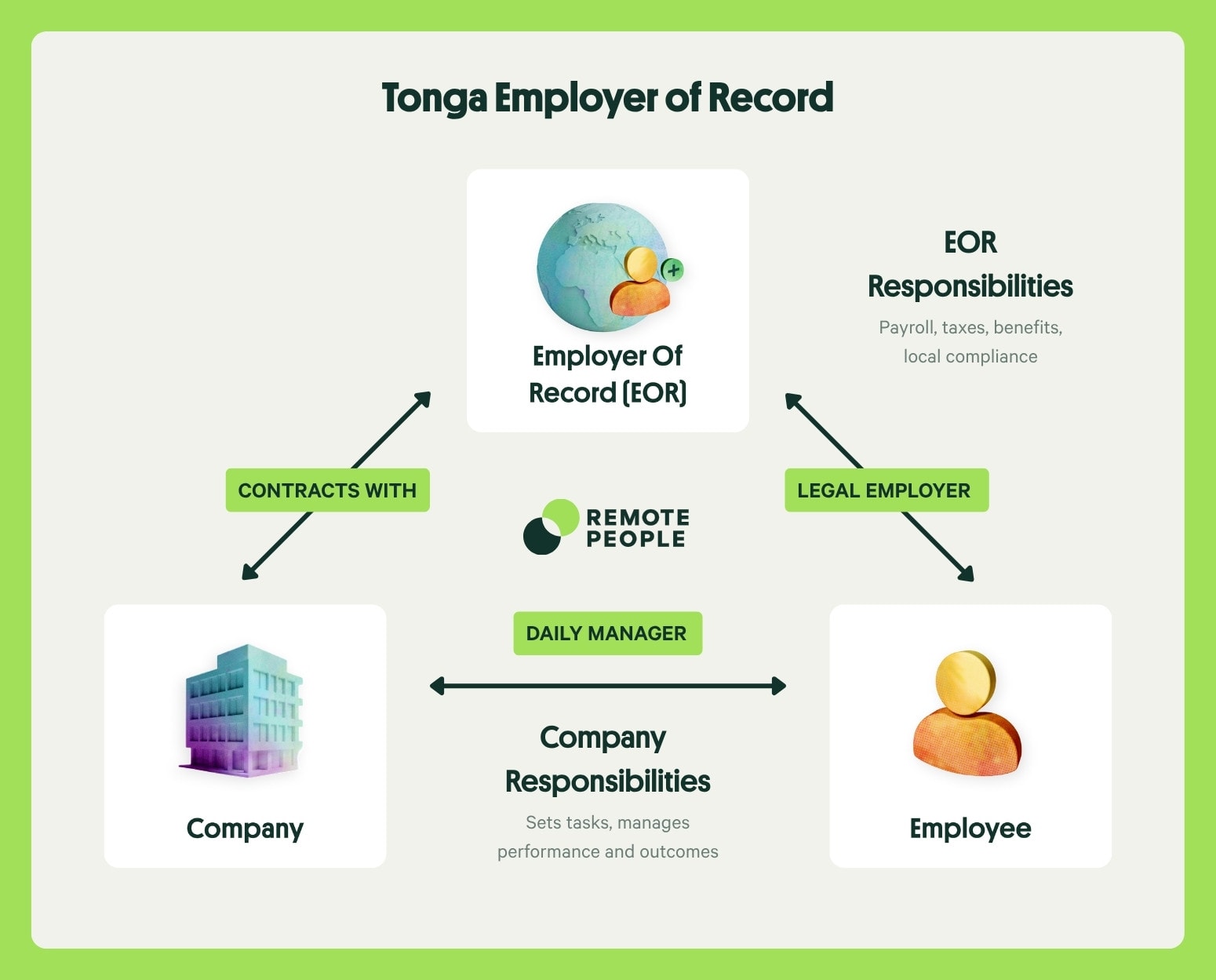
Who Uses an Employer of Record in Tonga?
Multinational firms, Pacific-focused NGOs, aid organisations, technology companies, and mid-sized employers use EORs to hire in Tonga without registering a local subsidiary. Companies entering Tonga for the first time benefit from outsourcing compliance, particularly given the pending Employment Relations Bill 2020 that is expected to modernise private-sector labour law once granted Royal Assent.
Remote-first technology firms, renewable energy developers, tourism operators, and international development agencies commonly engage Tongan professionals through an EOR. Larger enterprises also use EORs for flexible staffing, scaling niche roles without the overhead of a registered Tongan company.
Typical Onboarding Timeline
- First, you submit employee information, job descriptions, and proposed salary. This typically takes 2-3 business days.
- Second, the EOR drafts the employment contract in English, reviews it with the candidate, and gets employee sign-off. This stage takes 3-5 business days.
- Third, the EOR registers the employee with the Ministry of Revenue and Customs for PAYE and with the National Retirement Benefits Fund. Work permit coordination adds time for non-citizens. Registration takes 5-10 business days.
- Fourth, the first payroll cycle begins. The EOR processes gross-to-net calculations, remits PAYE and NRBF contributions, and delivers the employee’s first payslip and salary transfer.
- Fifth, the EOR provides you with a monthly dashboard summarising payroll, statutory remittances, and compliance status, while an account manager handles ongoing adjustments, leave tracking, and queries.
Hire in Tonga
Ready to hire in Tonga without setting up a local entity? Our EOR service takes care of payroll, tax, and compliance so you can onboard Tongan talent in days, not months.
Employment Laws and Regulations in Tonga
Tonga’s employment framework is largely shaped by English common law, individual employment contracts, and a set of specific statutes that govern wages, pensions, tax, and immigration. The private sector does not yet have a consolidated labour code: the Industrial Relations Act 1964 addresses only trade unions and industrial disputes, while the Public Service Act 2002 regulates government employees. Employers relying on an employer of record in Tonga need to understand how contractual obligations, common-law principles, and statutory duties combine to set compliance expectations.
Employment Contracts
Tongan law does not mandate a statutory contract template for the private sector, but written employment contracts are strongly recommended and reflect market practice. Most contracts specify job title, location, compensation, working hours, duration (fixed-term or indefinite), probation, notice periods, and termination grounds. DLA Piper’s global employment guide notes that English common-law principles fill gaps where statutes are silent, so careful contract drafting is the main compliance tool for employers operating in Tonga.
Contracts must be in English and should address confidentiality, intellectual property assignment, post-employment restrictions, and dispute resolution. Fixed-term contracts are permitted and automatically end on the stated date, while indefinite contracts continue until terminated by either party following agreed notice.
Working Hours and Overtime
Market practice in Tonga is a 40-hour workweek, typically structured as 8 hours per day from Monday through Friday. Because the private sector lacks a consolidated labour code, working hours and overtime treatment are set by contract rather than statute, with public-sector and collective-bargaining norms guiding what is considered reasonable. Night work, shift differentials, and on-call arrangements are usually negotiated as part of the individual employment agreement.
Overtime premiums are commonly expressed as 1.25 times the regular rate for hours worked beyond 40 per week on ordinary weekdays and 1.50 times for Sundays and public holidays. These multipliers mirror Public Service Commission norms and are widely adopted in private-sector contracts to avoid disputes. Salaried professional staff may agree to a broader scope that absorbs occasional overtime, but this must be clearly drafted.
Tonga overtime rates · market practice · 2026 | ||
Situation | Multiplier | Notes |
|---|---|---|
Weekday hours beyond 40/week | 1.25x | Standard workweek is Monday-Friday, 8 hours per day |
Sunday work | 1.50x | Sunday observance is culturally significant in Tonga |
Public holiday work | 1.50x | Applies to the 11 declared national public holidays |
Night shift (22:00-06:00) | Negotiable (commonly 1.15-1.25x) | Set by individual or collective agreement |
Salaried exempt professionals | Not applicable | Overtime usually absorbed in base salary, must be clear in contract |
Minimum Wage
Tonga has no statutory national minimum wage for the private sector as of 2026. Wages are set by individual contract and by reference to local labour market conditions, industry benchmarks, and Public Service pay scales. The International Labour Organization country profile for Tonga confirms that Tonga has not yet ratified the Minimum Wage Fixing Convention 1970, and the Employment Relations Bill 2020 is the first proposal to introduce a statutory wage-setting mechanism.
In the absence of a floor, employers typically benchmark salaries against Public Service Commission grades, NGO pay surveys, and regional comparisons. Employers using an EOR can set competitive compensation packages informed by current market data without running afoul of a wage law that does not yet exist.
Probation Period
Probation periods of three to six months are customary in Tongan private-sector contracts. During probation either party may end the employment with short notice, typically one week, provided the contract sets out clear probation terms. Longer probation periods may be agreed for managerial or technical roles where extended assessment is reasonable, but the probation terms must be explicit in the written contract to be enforceable under common law.
Leave Entitlements
Annual Leave
Annual leave of 10 working days per year after 12 months of continuous service is the customary private-sector baseline in Tonga, mirroring Public Service Commission practice for non-senior staff. Many employers offer 15 to 20 working days to attract qualified professionals, particularly in sectors that compete with regional labour markets. Leave accrues monthly and is typically taken within the leave year, with carryover limited by individual contract.
Sick Leave
Paid sick leave of 10 working days per year is the common benchmark in Tongan private-sector employment, again following public-sector practice. Employees usually must provide a medical certificate for absences of more than two consecutive days. Extended illness beyond the annual entitlement is handled by contract terms, with some employers offering an additional period at half pay, consistent with English common-law norms.
Maternity Leave
Female employees in the public service are entitled to 12 weeks of paid maternity leave under the Public Service Act, typically structured as 6 weeks before delivery and 6 weeks after. Private-sector employers commonly apply the same 12-week standard through individual contracts or company policy because no consolidated private-sector statute yet mandates it. Employers using an EOR in Tonga should align maternity benefits with the public-service benchmark to remain competitive.
Paternity Leave
There is no statutory paternity leave in Tonga for either the public or private sector. Paternity provisions, when offered, are a matter of contractual agreement or company policy, with one to five days of paid leave being a common arrangement in larger employers. An EOR can structure paternity terms in the employment contract to match your organisation’s global standards.
Other Statutory Leave
Bereavement leave of three to five days for immediate family is customary. Employees are entitled to public holiday leave on the 11 declared national public holidays. Jury or court-witness leave is recognised under common law when summoned, and study leave may be granted by agreement. Religious-observance and special-event leave reflect Tonga’s strong cultural norms, particularly around Sunday observance and church commitments.
Leave Entitlements in Tonga (2026) | |||
Leave Type | Duration | Compensation | Notes |
|---|---|---|---|
Annual Leave | 10 working days after 12 months | 100% salary | Customary baseline; 15-20 days common in competitive roles |
Sick Leave | 10 working days per year | 100% salary | Medical certificate usually required beyond 2 days |
Maternity Leave | 12 weeks (6 pre + 6 post) | 100% salary (public sector standard) | Applied via contract in private sector; no consolidated statute |
Paternity Leave | Not statutory | By contract or policy | 1-5 days common where offered |
Public Holidays | 11 days in 2026 | 100% salary | Work on a holiday typically paid at 1.5x |
Bereavement Leave | 3-5 days | 100% salary | Customary for immediate family |
Jury / Court Leave | As required | Salary protected | Recognised under common law when summoned |
Study Leave | As agreed with employer | Varies by agreement | For professional development |
Statutory Employee Benefits
Tonga requires employers to enrol qualifying employees in the National Retirement Benefits Fund (NRBF), the mandatory retirement savings scheme established under the National Retirement Benefits Fund Act 2010. Coverage applies to employees aged 18 to 70, with both employer and employee contributing a fixed percentage of gross monthly wages. The International Social Security Association country profile confirms the rates and coverage scope.
Employers contribute 7.5% of gross salary and employees contribute 5.0%, for a combined 12.5% remitted monthly to the NRBF. There is no separate social health insurance scheme in Tonga; public healthcare is funded through general taxation and delivered by the Ministry of Health through Vaiola Hospital and district health centres. Many employers provide private health cover or medical allowances as a contractual benefit, particularly for senior staff and expatriates.
There is no mandatory unemployment insurance or workers’ compensation fund in Tonga. Work injuries are typically addressed through employer-provided accident cover or negotiated settlements under common-law principles. Life insurance and income-protection benefits are optional but common in larger employers’ benefits packages.
Recent Regulatory Updates (2026)
The Employment Relations Bill 2020 has been introduced in the Legislative Assembly of Tonga and remains pending Royal Assent as of 2026. Once enacted, the bill is expected to establish a comprehensive private-sector labour code covering minimum employment standards, working hours, leave entitlements, termination procedures, and dispute resolution mechanisms. Employers should monitor parliamentary progress because the new framework will materially change compliance obligations.
The Ministry of Revenue and Customs continues to update PAYE procedures and e-filing capacity under the Income Tax Act 2007 framework. Tax summaries show the Pacific region is standardising PAYE reporting, and Tonga’s Form 7 monthly remittance regime is expected to move to a full online portal during the current fiscal year.
Work Permits and Visas in Tonga
Non-Tongan employees hired through an employer of record in Tonga require both a work permit (issued by the Ministry of Labour, Commerce and Industries) and an entry visa or permit (issued by the Immigration Division of the Ministry of Foreign Affairs). The permit process is coordinated with local sponsorship and follows specific documentation requirements.
Standard processing for an Employment Visa takes approximately one month once the complete application package has been submitted, though timelines can stretch when additional vetting is required. Understanding visa categories and work permit obligations is important for any international hire joining a team based in Tonga.
Work Permit Requirements
Who Needs a Work Permit
All non-Tongan citizens who plan to work in Tonga for a Tongan employer require a work permit. The permit is issued to the individual employee and is tied to a specific employer and position, so changing jobs requires a new application. Tongan citizens and permanent residents do not require a work permit.
Employers are expected to show that the role genuinely cannot be filled by a Tongan candidate, typically through a documented recruitment exercise. The Ministry of Labour, Commerce and Industries issues a letter of support when the local-labour-market test has been satisfied, which forms part of the immigration package submitted to the Immigration Division.
Eligibility and Required Documents
Employers prepare a job description, signed employment contract, proof of recruitment effort, and evidence of the candidate’s qualifications. The applicant supplies a passport valid for at least six months beyond the intended stay, medical certificate, police clearance certificate, academic and professional credentials, and completed application forms.
Supporting materials typically include two passport-sized photographs, proof of accommodation in Tonga, and the employer’s business licence or registration documents. The Tonga Embassy website lists the visa categories and the standard supporting documents required for each type. All foreign-language documents must be officially translated into English.
Processing Time and Validity
An Employment Visa application typically takes approximately one month from the date of a complete submission. Once granted, the Employment Visa is valid for up to two years and is renewable, subject to continued employment and compliance with permit conditions. The work permit is tied to the Employment Visa and expires alongside it.
Renewal Process
Renewals follow the same documentary requirements as initial applications and should be submitted at least 60 days before expiry to avoid a lapse in status. Employers generally cover renewal fees as part of the relocation package. If the employee changes employers, a new work permit and Employment Visa must be obtained by the new sponsor.
Common Visa Types
- Visitor visa: 31 days on arrival for most nationalities; extensions possible up to six months; does not permit paid employment.
- Business visa: short-stay permit for business meetings, conferences, and site visits; does not permit local employment.
- Employment visa: issued to foreign nationals taking up employment in Tonga; typically valid for two years and renewable; requires a work permit and employer sponsorship.
- Diplomatic and official visas: issued for accredited diplomatic missions, international organisations, and official delegations.
- Retirement or investor visas: available for qualifying individuals under specific capital or residency requirements; separate from employment pathways.
Tonga work and business visa categories · 2026 | |||
Visa Type | Purpose | Validity | Work Allowed |
|---|---|---|---|
Visitor Visa | Tourism, family visits | 31 days on arrival (extendable up to 6 months) | No |
Business Visa | Short business meetings | Up to 3 months | No local employment |
Employment Visa | Paid employment with a Tongan employer | Up to 2 years, renewable | Yes, with work permit |
Diplomatic / Official Visa | Accredited diplomats and officials | Duration of posting | Official duties only |
Retirement / Investor Visa | Long-term residence by qualified individuals | Typically 1-5 years | Limited, per category |
How an EOR Handles Work Permits
An EOR coordinates the entire work permit and Employment Visa process on your behalf, compiling documentation and liaising with the Ministry of Labour, Commerce and Industries and the Immigration Division. The EOR obtains the employer letter of support, prepares the immigration package, and tracks application status through to approval.
If an application is denied, the EOR advises on remediation or alternative visa routes. Renewals are initiated well before expiry so the employee’s right to work is not interrupted, and payroll records are kept aligned with permit validity to ensure tax residency and NRBF coverage remain correct.
Payroll, Taxes, and Social Security in Tonga
Tonga’s payroll system, administered by your employer of record, combines PAYE income tax, National Retirement Benefits Fund contributions, and contractual deductions. Payroll runs on a monthly cycle, salaries are paid in Tongan paʻanga (TOP) by bank transfer, and filings go to the Ministry of Revenue and Customs and the NRBF. Understanding the tax brackets, contribution rates, and filing deadlines is central to accurate payroll management.
Employer Contributions
Employers contribute 7.5% of each employee’s gross monthly salary to the National Retirement Benefits Fund. This is the sole mandatory employer social contribution in Tonga: there is no separate health, unemployment, or workers’ compensation fund at the national level. The International Social Security Association country profile confirms the 7.5% employer rate.
Tonga Employer Contribution Rates (2026) | |||
Contribution Type | Rate | Calculation Basis | Annual Cost Example (USD) |
|---|---|---|---|
NRBF (Retirement Benefits) | 7.5% | Gross monthly salary | $1,080 on $14,400 annual salary |
Total Employer Contribution | 7.5% | Gross monthly salary | $1,080 on $14,400 annual salary |
Employee Contributions
Employees contribute 5% of gross salary to the NRBF, deducted from each paycheck. Employees also pay PAYE income tax on a progressive scale administered by the Ministry of Revenue and Customs. PAYE is deducted each month using Form 7 and remitted with the employer’s own statutory filing.
Tonga Employee Deductions (2026) | |||
Deduction Type | Rate | Calculation Basis | Example (Monthly Salary $1,200) |
|---|---|---|---|
NRBF (Retirement Benefits) | 5% | Gross salary | $60.00 |
PAYE Income Tax | 0%, 10%, 20%, or 25% by bracket | Annualised gross income | $0-$300 depending on bracket |
Total Employee Deductions | 5% + PAYE | Gross salary + bracket | $60-$360 |
Income Tax
Tonga’s personal income tax system uses progressive annual brackets set under the Income Tax Act 2007 and administered by the Ministry of Revenue and Customs. The fiscal year runs from 1 July to 30 June. Employees earning up to TOP 10,000 annually pay no income tax, while higher earners pay 10%, 20%, or 25% on portions of their income above each threshold. PAYE is deducted monthly based on an annualised estimate of earnings.
Tonga Personal Income Tax Brackets (FY 2025-2026) | |||
Annual Income (TOP) | Annual Income (USD) | Marginal Rate | Notes |
|---|---|---|---|
Up to 10,000 | Up to $4,167 | 0% | Tax-free threshold for resident individuals |
10,001 – 30,000 | $4,167 – $12,500 | 10% | Applied to the portion of income in this range |
30,001 – 60,000 | $12,500 – $25,000 | 20% | Applied to the portion of income in this range |
60,001 and above | $25,000 and above | 25% | Top marginal rate |
USD conversions at 1 USD = 2.40 TOP (April 2026). Source: Tonga Ministry of Revenue and Customs and PwC Worldwide Tax Summaries | |||
Tax calculations use the portion-by-portion method. For an employee earning TOP 34,560 ($14,400) annually, tax is calculated as 0% on the first TOP 10,000, then 10% on the next TOP 20,000 (TOP 2,000), then 20% on the remaining TOP 4,560 (TOP 912), for a total annual PAYE of TOP 2,912 (approximately $1,213). This is withheld in roughly equal monthly instalments of TOP 243 (about $101) via Form 7 filings.
Corporate income tax in Tonga is levied at a flat 25% rate on resident company profits, and the Consumption Tax (Tonga’s VAT equivalent) is 15%. Non-resident employees may face different withholding rules, and double-tax treaty protection is narrower than in larger economies, so resident status and tax residency analysis are typically part of the EOR’s onboarding process for expatriate hires.
Payroll Cycle
Payroll in Tonga is processed monthly, with salaries paid on or before the last working day of each month for work performed during that month. Payment is by bank transfer in Tongan paʻanga to the employee’s nominated account. Payslips itemise gross salary, PAYE deduction, NRBF deduction, any other allowances or deductions, and net pay.
PAYE and NRBF contributions must be remitted to the Ministry of Revenue and Customs and the NRBF by the statutory monthly deadline, typically within 15 days after month end. Employers retain payroll records for at least seven years to support tax audits and NRBF reconciliation. If an employee leaves mid-month, final pay is processed within a reasonable period, usually five to seven working days, and all accrued entitlements are settled.
13th Month Salary and Bonus Pay
Tonga does not mandate a 13th month salary or annual bonus. Bonuses, if paid, are discretionary and set by individual contract or collective arrangement. Many employers pay a performance or Christmas bonus aligned with company profitability, but no statutory obligation exists. When bonuses are paid, they are subject to PAYE withholding and NRBF contributions in the month the payment is made.
Cost of Hiring Through an EOR in Tonga
EOR Service Fees
Employer of record service fees in Tonga typically range from $300 to $600 per employee per month, depending on the provider’s service level and the complexity of the payroll. These fees cover compliance, payroll processing, tax filing, NRBF administration, work permit coordination, and benefits administration. Fees are typically charged as a flat monthly amount rather than a percentage of salary.
Total Employment Cost Breakdown
The total cost of hiring through an EOR includes the gross salary, the mandatory employer NRBF contribution, and the EOR service fee. Understanding this breakdown helps organisations budget accurately for remote hiring in Tonga.
Tonga employer cost example · $1,200/month gross · 2026 | ||
Employer Cost | Amount (USD) | % of Gross |
|---|---|---|
Gross Salary | $1,200 | 100% |
NRBF Employer Contribution (7.5%) | $90 | 7.5% |
EOR Service Fee | $400 | 33.3% |
Total Monthly Cost | $1,690 | 140.8% |
All USD amounts approximate at 1 USD = 2.40 TOP (April 2026). Source: RemotePeople Tonga Payroll & Tax and National Retirement Benefits Fund | ||
Ready to simplify your hiring costs in Tonga? Contact our team for a custom pricing proposal based on your team size and needs at https://remotepeople.com/contact/.
Benefits of Using an EOR in Tonga
Hiring through an employer of record in Tonga eliminates the complexity of establishing a local legal entity while maintaining full employment compliance. Your organisation gains immediate access to vetted Tongan and Pacific talent without navigating the Companies Act registration, Ministry of Trade, Economic Development, Industry requirements, or ongoing corporate administrative overhead.
An employer of record provider handles all payroll calculations, PAYE and NRBF filings, and benefit administration, reducing your operational burden and freeing internal HR or finance teams to focus on core business activities. You retain full control over hiring decisions, work assignments, and team management while the EOR carries the legal employment relationship and its associated responsibilities.
The flexibility to scale your Tongan team up or down without long-term financial commitments is particularly valuable in an economy of fewer than 120,000 people, where demand for specialised skills fluctuates. You can test the Tonga market, support project-based assignments, or adjust headcount based on business needs without the time and expense required to wind down a local subsidiary.
Working with an EOR also mitigates risk during the transition to the Employment Relations Bill 2020. Once the bill receives Royal Assent, private-sector employers will need to adapt contracts, policies, and payroll procedures. An EOR tracks regulatory developments and updates documentation proactively, reducing the risk of compliance gaps during the transition.
Termination and Offboarding in Tonga
Notice Periods
Because Tonga does not yet have a consolidated private-sector labour code, notice periods are primarily governed by the individual employment contract and by English common-law principles that require reasonable notice. During probation, one week’s notice is customary. After confirmation, two to four weeks’ notice is common for junior and mid-level roles, with senior and executive positions typically requiring one to three months. An EOR in Tonga ensures notice terms are clearly drafted and enforced.
The notice period begins from the date the written notice is received and continues through the last working day of employment. Employees remain entitled to full wages and benefits during notice unless placed on garden leave by the employer under the terms of the contract.
Tonga notice periods · market practice · 2026 | ||
Employment Status | Typical Notice Period | Notes |
|---|---|---|
During Probation (3-6 months) | 1 week | Must be written into the contract |
Junior / Support Staff | 2 weeks | Common-law reasonable notice after probation |
Mid-Level Professional | 4 weeks (1 month) | Standard market practice |
Senior / Managerial | 1-3 months | Set by individual agreement |
Executive / C-Suite | 3-6 months | Reflects seniority and handover requirements |
Severance Pay
Calculation Method
Tonga does not have a statutory severance pay requirement for the private sector, which is another gap that the Employment Relations Bill 2020 is expected to address once enacted. In current practice, severance is a contractual or market-practice matter, with many employers paying an ex-gratia amount based on tenure for redundancy terminations after 12 months of service. A typical market benchmark is two to four weeks of base salary per year of service, capped at a negotiated maximum.
Caps and Exceptions
No severance is typically paid during probation or where dismissal is for serious misconduct such as theft, fraud, or gross negligence. Voluntary resignations do not trigger severance, although unused annual leave must be paid out. Employers are expected to act fairly and consistently to avoid unfair-dismissal claims brought under common-law principles, and well-drafted employment contracts reduce ambiguity.
Tonga severance · market practice · 2026 | ||
Termination Reason | Typical Payment | Notes |
|---|---|---|
Redundancy (after 12 months) | 2-4 weeks per year of service | Customary market practice; no statutory formula |
Termination without cause | Negotiated (often 2-4 weeks per year) | Aligned with contractual severance clause if present |
Termination for cause | None | Serious misconduct, fraud, or gross negligence |
Resignation | None (accrued leave only) | Payout of unused annual leave |
End of fixed-term contract | None (unless contractual) | Contract ends on stated expiry date |
Probation termination | None | 1 week notice is customary |
Severance is not a statutory entitlement in Tonga; figures reflect typical market practice subject to contract. Source: DLA Piper Global Employment Guide and Legislative Assembly of Tonga | ||
Grounds for Termination
Employers may terminate employees for just cause, including repeated failure to meet performance standards after warnings, serious violations of company policies, theft or fraud, or insubordination. Terminations without cause remain permissible but must be handled with care: employers should provide clear documentation, reasonable notice, and any contractual severance entitlement to avoid breach-of-contract or unfair-dismissal claims. Terminations based on pregnancy, family status, race, religion, or other discriminatory grounds would expose the employer to common-law claims and reputational risk.
Post-employment restrictive covenants such as non-compete clauses are generally enforceable in Tonga only to the extent that they are reasonable in scope, duration, and geography. Courts in common-law jurisdictions take a narrow view of restraints of trade, and broad non-competes are often unenforceable. An EOR ensures contract language is calibrated to local enforceability standards.
EOR vs. Other Hiring Models in Tonga
EOR vs. Setting Up a Local Entity
EOR versus establishing your own entity in Tonga · 2026 | ||
Comparison | Employer of Record | Own Entity |
|---|---|---|
Setup Time | 1-2 weeks | 3-6 months |
Upfront Cost | $0 | $15,000-$40,000 |
Ongoing Cost (per employee) | $300-$600/month | $3,000-$8,000/month |
Local Partner Required | No | Yes |
Social Insurance Registration | EOR handles | Company handles |
Payroll & Tax Filing | Included | Must hire locally |
Best for Team Size | 1-20 employees | 20+ employees |
Scale Down/Exit | Immediate | Months of wind-down |
Government Contracts | Limited eligibility | Full eligibility |
The EOR model offers clear advantages for organisations testing the Tonga market or maintaining small to mid-sized remote teams. Setup occurs within 1-2 weeks compared with 3-6 months for company incorporation through the Ministry of Trade, Economic Development, Industry, and requires no upfront capital commitment. The administrative burden of registering a Tongan company, opening corporate bank accounts, and appointing local directors disappears.
Ongoing operational costs through an EOR remain predictable on a per-employee basis, whereas a local entity requires hiring a finance manager, HR coordinator, and local legal counsel, typically totalling US$3,000 to $8,000 monthly in overhead before considering office leases and compliance fees. For teams of 20 or fewer employees, the EOR cost advantage is compelling.
The flexibility to exit the market without lengthy wind-down periods, regulatory deregistration, or asset liquidation provides substantial risk mitigation. However, organisations anticipating rapid expansion beyond 20 employees or requiring eligibility for government contracts and donor-funded procurement may eventually benefit from transitioning to a local entity.
EOR vs. Hiring Independent Contractors
EOR employment versus independent contractor engagement in Tonga · 2026 | ||
Comparison | EOR (Full-Time Employee) | Independent Contractor |
|---|---|---|
Legal Relationship | Employer-employee | Self-employed service provider |
Compliance Risk | Low (EOR handles) | High (misclassification risk) |
Payroll & Tax | EOR withholds PAYE and NRBF | Contractor handles own income tax |
Benefits & Leave | Annual leave, sick leave, public holidays | None (not entitled) |
IP Protection | Work product owned by employer | Contractor retains IP unless assigned |
Termination | Notice per contract + any severance | End contract per agreement |
Best for | Core team, long-term roles | Project work, specialised tasks |
Cost Structure | Predictable monthly cost | Variable (hourly/project rates) |
The choice between EOR employment and independent contractor engagement hinges on control, duration, and compliance tolerance. EOR provides the strongest legal foundation for ongoing work relationships where you direct daily activities and expect results to be delivered within your organisation’s processes. Contractors suit discrete projects, specialised expertise, and situations where the individual maintains their own client base and operates autonomously.
Misclassification is a material risk even in Tonga’s common-law environment. Courts will look at the reality of the relationship rather than the label used: mutuality of obligation, control over work, exclusivity, integration into the business, and provision of tools are standard indicators of employment. An arrangement that resembles employment but is documented as a contract can be reclassified, exposing the principal to back-taxes, NRBF contributions, and potential unfair-dismissal claims.
For teams requiring long-term talent with investment in training and development, EOR employment delivers better cost efficiency and reduces turnover risk. Contractor arrangements work best for specialised or short-term engagements where fixed deliverables replace ongoing management.
EOR vs. PEO
EOR versus PEO models in Tonga · 2026 | ||
Comparison | Employer of Record (EOR) | PEO |
|---|---|---|
Legal Employer | EOR company | PEO company (co-employment) |
Local Entity Required | No | Yes |
Best for | Cross-border remote hiring | Expanding existing operations |
Compliance Liability | EOR assumes full liability | Shared between PEO and client |
Setup Time | 1-2 weeks | 4-8 weeks |
Control over HR Policies | Client sets policies | PEO-defined policies (limited customisation) |
Typical Use Case | Start remote hiring immediately | Transition local staff to professional management |
Tonga has no formal PEO framework with a defined co-employment concept in statute, which makes true PEO services effectively unavailable in this market. The distinction matters primarily for organisations expanding existing local operations where co-employment could theoretically simplify management of a mixed local and remote workforce, but this scenario rarely arises in Tonga given the small private-sector footprint of most foreign employers.
For foreign organisations initiating Tongan hiring, the EOR model offers faster deployment, clearer liability, and full compliance with Tongan law. The EOR assumes full legal employer status, eliminating shared-responsibility concerns and establishing clear accountability for PAYE, NRBF, and employment-law obligations. You retain full control over hiring decisions, compensation, and performance management without PEO-imposed policy templates.
Rapid deployment (1-2 weeks), the absence of a local entity requirement, and full compliance coverage make EOR the practical default for cross-border Tongan hiring. PEO benefits would theoretically only emerge for organisations with existing Tongan subsidiaries looking to outsource HR operations, which is an uncommon scenario among early-stage remote hiring initiatives.
Public Holidays in Tonga
Tonga public holidays · 2026 | ||
Date | Holiday | Type |
|---|---|---|
January 1 | New Year’s Day | National |
April 3 | Good Friday | Religious |
April 6 | Easter Monday | Religious |
April 25 | ANZAC Day | National |
May 4 | Crown Prince’s Birthday | National |
June 4 | Emancipation Day | National |
July 6 | Birthday of King Tupou VI (observed) | National |
September 17 | Crown Prince’s Birthday (observed) | National |
November 4 | Constitution Day | National |
December 4 | King Tupou I Day | National |
December 25 | Christmas Day | Religious |
Tonga observes 11 public holidays annually, with additional observance days for royal birthdays and national commemorations. Employers pay employees their normal wage for public holidays, or provide compensatory pay at 1.5x for staff required to work on those days. Sunday observance remains a strong cultural norm, and many businesses close on Sundays even when not legally required to do so. Your EOR provider manages payroll adjustments for statutory holidays and aligns your team’s calendar with local observances.
How to Get Started with an EOR in Tonga
- First: Define your hiring needs by identifying the role, required skills, and desired start date. Clarify team size, expected growth, and whether you need ongoing support or project-based talent so your EOR provider can prepare accurate pricing and compliance documentation for the Tongan market.
- Second: Partner with an EOR provider by reviewing capabilities, pricing structures, and Pacific-region expertise. Confirm the provider handles Tongan PAYE, NRBF administration, employment visa coordination, and has established relationships with the Ministry of Revenue and Customs and the Immigration Division.
- Third: Complete the provider’s client onboarding, which typically involves KYC verification, job description review, and compensation benchmarking. This process usually completes within 1-2 weeks and requires minimal back-and-forth documentation.
- Fourth: Begin recruitment either through your own networks or the EOR provider’s talent marketplace. The EOR handles employment contract creation, work permit coordination if required, and payroll registration from day one.
- Fifth: Onboard your first employee by providing work assignments, access credentials, and company policies. The EOR manages administrative setup including NRBF enrolment, PAYE registration, and the employee’s first-month payroll.
Ready to hire your first team member in Tonga? Our EOR experts guide you through every step of the hiring and onboarding process. Schedule a consultation today at https://remotepeople.com/contact/ to receive tailored guidance for your Tonga hiring strategy.
Where companies hiring in Tonga expand next
Companies operating in Tonga often extend across the Asia-Pacific, drawing on English-speaking talent and aligned business culture. Teams frequently add Fiji for shared Pacific business rhythm; a team in Papua New Guinea often follows for the regional Pacific talent footprint; operations in Australia is a common next step, offering Pacific-region proximity and English-first hiring; and New Zealand rounds out the regional footprint with aligned Pacific workforce norms.
Frequently Asked Questions About EOR Tonga
EOR fees in Tonga range from $300 to $600 per employee per month, charged as a flat monthly fee rather than a percentage of salary. This fee covers payroll processing, PAYE and NRBF compliance, benefits administration, and work permit coordination when required. The specific cost depends on the provider's service level and any additional features such as visa support or specialised reporting.
No. Tonga has no statutory minimum wage for the private sector as of 2026. Salaries are set by individual contract and benchmarked against Public Service Commission pay scales and regional market data. RemotePeople's Tonga minimum wage guide provides current benchmarks for common roles.
Yes, independent contractor arrangements are possible in Tonga, but they carry misclassification risk if the relationship resembles employment. A contractor platform designed for Tonga ensures proper structuring. Contractors suit project work or specialised expertise, while EOR employment provides stronger protection for ongoing team roles.
Your client company (you) owns all work product and intellectual property created by EOR employees as part of their regular job duties. Ownership is established through the employment contract and applies automatically unless specific provisions reserve IP for the employee. Your EOR provider ensures IP ownership clauses appear in all Tonga employment agreements.
The typical timeline from contract signature to start date ranges from 1 to 3 weeks for Tongan citizens. For non-citizen hires, add approximately one month to process the Employment Visa and work permit. Initial EOR setup completes within 1-2 weeks, including KYC verification and contract preparation.
Tonga's private sector operates under English common law supplemented by the Income Tax Act 2007, the National Retirement Benefits Fund Act 2010, and the Immigration Act. The Employment Relations Bill 2020 is pending Royal Assent and will introduce a consolidated private-sector labour code once enacted. Your EOR provider handles compliance with existing statutes and adapts contracts as new legislation takes effect.
Employers must enrol qualifying employees (ages 18-70) in the National Retirement Benefits Fund, contributing 7.5% of gross salary on top of the employee's 5% contribution. Customary leave entitlements include 10 days annual leave, 10 days sick leave, 12 weeks maternity leave, and the 11 national public holidays. Private health cover and bonuses are common but not mandatory.
Termination follows the notice period set in the employment contract, with two to four weeks being typical for mid-level roles after probation. Tonga has no statutory severance, but many employers pay market-practice severance of two to four weeks per year of service for redundancy terminations. Your EOR provider manages notice, final payroll, NRBF reconciliation, and work permit cancellation where applicable.
Employer of Record in
Employer of Record in
Employer of Record in
Employer of Record in
Employer of Record in
Employer of Record in
Employer of Record in
Employer of Record in