
 Recruit
Employer of Record in Vanuatu
-
 Drew Donnelly
- Published
- September 22, 2026
RemotePeople’s employer of record in Vanuatu lets you hire employees in Vanuatu with Vanuatu National Provident Fund compliance. We handle VNPF contributions at 4 percent employer share, Employment Act compliance, and statutory leave administration.
Hire in Vanuatu — book a free 30-minute demo
Tell us what you need. You'll get a tailored, transparent proposal within 24 hours, plus a free call to walk through it.
Tell us about your company
So we can match you with a specialist who knows your market — and unlock volume pricing tiers.
* All fields are required.
Where and when are you hiring?
Tell us the geography and timing and we'll quote each country line by line, with onboarding timelines.
* All fields are required.
Help us beat your current setup
We'll benchmark your current deal and send a line-by-line proposal in 24 hours — showing exactly where we cut cost, time, or risk. After you submit, you can book a call to walk through it together.
* All fields are required.
Thanks! Your proposal is on its way.
Expect a tailored, line-by-line proposal in your inbox within 24 hours. In the meantime…
Want to walk through it together?
Book a free 30-minute call with one of our specialists. We'll explain every line, answer your questions, and tailor the proposal further if you need.
No obligation. Pick a time that works for you.








- Hire in Vanuatu — book a free 30-minute demo
- Tell us about your company
- Where and when are you hiring?
- Help us beat your current setup
- Thanks! Your proposal is on its way.
- How an Employer of Record Works in Vanuatu
- Employment Laws and Regulations in Vanuatu
- Work Permits and Visas in Vanuatu
- Payroll, Taxes, and Social Security in Vanuatu
- Cost of Hiring Through an EOR in Vanuatu
- Benefits of Using an EOR in Vanuatu
- Termination and Offboarding in Vanuatu
- EOR vs. Other Hiring Models in Vanuatu
- Public Holidays in Vanuatu
- How to Get Started with an EOR in Vanuatu
- Where companies hiring in Vanuatu expand next
- Frequently Asked Questions
- Related EOR Destinations

Start hiring in Vanuatu
Let RemotePeople handle payroll, compliance, and HR admin worldwide so you can focus on building your team.

Vanuatu pairs a zero-income-tax regime with a familiar common-law employment framework, making it one of the more attractive Pacific jurisdictions for remote hiring. For companies looking to hire employees in Vanuatu, the challenge is less about tax than it is about navigating the Employment Act [CAP 160], the Vanuatu National Provident Fund (VNPF), and a work-permit system that requires local advertising before any non-citizen can be hired. An employer of record in Vanuatu handles all of this, contracts, VNPF registration, payroll, leave tracking, and immigration paperwork, so you can onboard a compliant team within weeks rather than months.
How an Employer of Record Works in Vanuatu
An employer of record (EOR) in Vanuatu is the legal employer of your staff on paper, while you direct their day-to-day work. The EOR signs the employment contract, registers the employee with the VNPF, calculates and remits the mandatory provident fund contributions, tracks statutory leave, and manages any termination or severance obligations under the Employment Act. You retain full operational control and assign the work; the EOR carries the compliance burden and the local entity requirement.
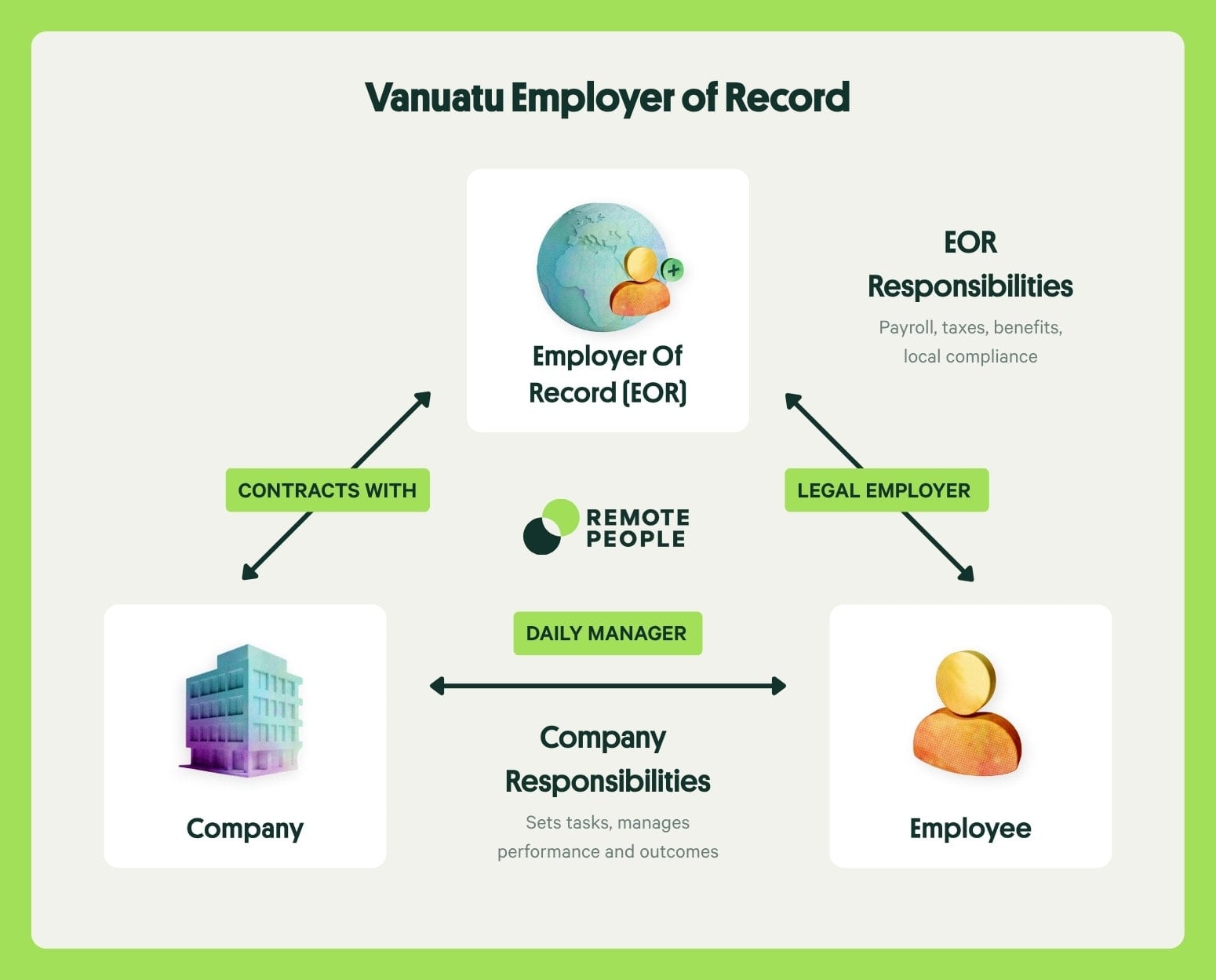
If you’d like to learn more about how Employer of Record (EOR) services work, read our What Is an Employer of Record (EOR)? guide for a complete overview of the model, its benefits, and when to use it.
If you’re comparing providers, our Best Employer of Record (EOR) Providers guide reviews the leading platforms to help you choose the right solution for your business.
Who Uses an Employer of Record in Vanuatu?
Companies use an EOR in Vanuatu when they need a local hire but cannot justify the time and cost of incorporating a Vanuatu company. The country is small, most hiring happens in Port Vila or Luganville, and incorporation plus VNPF registration can take several weeks even without a work permit in the mix. An EOR compresses that timeline to days.
- Market entry testing: A company exploring the Pacific region can hire one or two Vanuatu staff through an EOR, validate demand, and only incorporate later if volumes justify it.
- Small teams without entity overhead: For organisations expanding into Vanuatu with fewer than 10 staff, the annual cost of maintaining a local company, VNPF employer number, and licensed office usually exceeds the EOR fee.
- Rapid onboarding: Any business hiring employees in Vanuatu for a time-sensitive project can have a signed contract, VNPF registration, and first payroll complete inside two weeks.
- Hiring foreign nationals: Non-citizens need a work permit tied to a specific Vanuatu employer, and an EOR can sponsor that permit without the foreign company having to register locally.
The EOR model is particularly useful in Vanuatu because the zero-income-tax regime keeps take-home pay high, but the Employment Act still imposes detailed leave, severance, and VNPF rules that catch unwary overseas employers.
Typical Onboarding Timeline
- First, you share the employee’s personal details, proposed salary, and job description with the EOR. This usually takes 1 to 2 business days.
- Second, the EOR drafts the employment contract under the Employment Act [CAP 160], circulates it for signature, and confirms probation terms. Drafting and sign-off takes 2 to 3 business days.
- Third, the EOR registers the new hire with the VNPF and sets up payroll. This takes 3 to 5 business days.
- Fourth, if the hire is a non-citizen, the EOR files the work permit with the Department of Labour and the entry visa with Immigration. Expect 4 to 8 weeks for first-time permits, including the mandatory local-advertising period.
- Fifth, the employee starts, receives their first payslip on the normal monthly cycle, and begins accruing annual leave from the start date. Most EOR providers can onboard a local Vanuatu citizen within 1 to 2 weeks; work-permit cases extend to 6 to 10 weeks.
Hire in Vanuatu
Zero personal income tax, a 6% VNPF contribution, and a growing South Pacific talent pool make Vanuatu an unusually cost-effective place to hire.
We handle employment contracts, payroll, VNPF compliance, and full Employment Act [CAP 160] obligations.
No local entity needed. Your team can start in days.
Employment Laws and Regulations in Vanuatu
Employment in Vanuatu is governed primarily by the Employment Act [CAP 160], originally enacted in 1983 and consolidated in 2019. The Department of Labour is the main regulator, supported by the Minimum Wages Act [CAP 182], the Trade Disputes Act, and the Vanuatu National Provident Fund Act. The Employment Act covers all private-sector employees and sets minimum standards for contracts, hours, leave, termination, and severance. The Employment Services portal publishes guidance on compliance for employers.
Employment Contracts
Under the Employment Act [CAP 160], every contract of employment exceeding six months must be in writing. The written contract must record the parties, job title and duties, wage rate, hours of work, place of employment, duration (fixed-term or indefinite), and probation period. English, French, and Bislama are all acceptable contract languages. Oral contracts are permitted for short engagements but carry a much higher compliance risk and are rarely used by EOR providers.
Indefinite contracts are the default. Fixed-term contracts are permitted but cannot be used to indefinitely defer severance obligations, repeated renewals of a fixed-term contract can be reclassified as indefinite employment by the Supreme Court. The Department of Labour publishes a summary of minimum contract terms for reference.
Working Hours and Overtime
The standard workweek in Vanuatu is 44 hours, typically structured as eight hours Monday to Friday and four hours on Saturday, with a 48-hour weekly maximum. Section 26 of the Employment Act sets the overtime multiplier at 1.5 times the normal hourly rate for any hour worked beyond the standard schedule. Sunday and public-holiday work also attracts premium pay. The Department of Labour’s overtime calculation brochure walks through the full formula.
The table below summarises how overtime and premium pay are calculated under CAP 160. The most important detail for an EOR setting up payroll is that the ordinary hourly rate is derived from the monthly wage divided by 190 (44 hours per week, averaged over a month), not by calendar hours.
Vanuatu overtime and premium pay rates · Per Employment Act [CAP 160] | |||
Hour Type | Rate Multiplier | Cap / Schedule | Notes |
|---|---|---|---|
Standard hours | 1.0x | Up to 44 hrs/week | Section 26, Employment Act [CAP 160] |
Weekday overtime | 1.5x | Any hour over 44/week | Applies to hours beyond standard schedule |
Sunday work | 1.5x (minimum) | If worked as overtime day | Must have a weekly rest day of 24 hrs |
Public holiday work | 2.0x | All hours on gazetted holiday | Double the normal daily wage |
Night work | 1.5x (if overtime) | Between 9 pm and 5 am | No separate statutory night premium |
Daily maximum | n/a | 8 hrs standard, 10 hrs absolute | Overtime beyond 10 hrs requires consent |
Managerial staff paid on a flat salary are generally excluded from overtime pay under section 27 of the Act, provided their contract clearly states the role and the salary reflects the irregular hours. Overtime cannot be banked indefinitely; it must be paid in the month in which it is earned or in the very next payroll cycle.
Minimum Wage
Vanuatu’s statutory minimum wage is VUV 300 per hour, set by the Minister of Internal Affairs under the Minimum Wages Act [CAP 182] and effective from 1 June 2023. The rate was recommended by the Tripartite Labour Advisory Council (TLAC) and applies nationally to all employees regardless of sector, age, or role. Based on a 44-hour workweek and roughly 190 hours per month, this translates to a monthly floor of approximately VUV 57,000 for full-time workers. There are no sector-specific minimums above this floor, though collective agreements in tourism and construction sometimes set higher rates.
Probation Period
Every indefinite contract in Vanuatu is subject to a probation period not exceeding three months under the Employment Act [CAP 160]. During probation, either party may terminate the contract with the notice period that corresponds to the pay interval (typically two weeks for weekly or fortnightly paid staff). Probation must be expressly stated in the written contract; if it is not, the employee is deemed to be past probation from day one. Annual leave accrues from the start of employment, including during probation, though most employers do not permit leave to be taken until probation has been successfully completed.
Leave Entitlements
Vanuatu’s Employment Act sets out five main categories of statutory leave: annual leave, sick leave, maternity leave, public holidays, and unpaid personal leave. Paternity leave is not a statutory entitlement in Vanuatu, though many larger employers grant a few days as a matter of internal policy. The leave framework is modest by regional standards but strictly enforced by the Department of Labour.
Annual Leave
Annual leave in Vanuatu accrues monthly once an employee has completed three months of continuous service. Employees with 1 to 6 years of service earn 1.25 working days of paid leave per month (approximately 15 working days per year). Employees with 7 to 19 years of service earn 1.75 working days per month (approximately 21 working days per year). Leave is paid at the employee’s ordinary rate. Unused leave can be carried forward by agreement or paid out on termination.
Sick Leave
Employees who have completed three months of full-time service are entitled to up to 21 days of paid sick leave per calendar year, paid at full salary by the employer. A medical certificate from a registered practitioner is required for absences longer than two consecutive days. Unused sick leave does not carry over to the following year and is not paid out on termination. Vanuatu does not have a state-funded sickness benefit, so the full cost falls on the employer.
Maternity Leave
Female employees are entitled to 12 weeks of paid maternity leave under section 36 of the Employment Act, with at least six weeks to be taken after birth. Pay during maternity leave is set at 66% of the employee’s normal wage and is funded by the employer. The entitlement applies regardless of length of service, full-time or part-time status, and cannot be contracted out. Dismissal on the grounds of pregnancy is expressly prohibited, and the employee must be reinstated to the same or an equivalent position on return.
Paternity Leave
There is no statutory paternity leave in Vanuatu. Fathers may negotiate unpaid leave around the birth of a child with their employer, and many EOR providers and larger domestic employers offer 3 to 5 days as a contractual benefit to stay competitive in the labour market. Any paternity leave beyond contractual entitlement must be taken from the employee’s accrued annual leave or approved as unpaid personal leave.
Other Statutory Leave
The Employment Act recognises several other forms of leave, typically unpaid unless the employer agrees otherwise. Bereavement leave for the death of a close family member, compassionate leave, and study leave for professional development are the most common categories. Reservist military service leave is protected under separate defence legislation. Jury duty and summoned court attendance are treated as protected absences without counting against annual or sick leave balances.
The following table summarises Vanuatu’s statutory leave framework at a glance, drawing directly from the Employment Act [CAP 160] and the Department of Labour’s published guidance. The single most important takeaway is that annual leave accrues from the first day of employment but can only be taken once the three-month qualifying period has passed.
Vanuatu statutory leave entitlements · Per Employment Act [CAP 160] | ||
Leave Type | Duration | Eligibility & Notes |
|---|---|---|
Annual Leave (1–6 yrs service) | 1.25 working days per month (~15/year) | Paid at 100% of normal wage; accrues from day one |
Annual Leave (7–19 yrs service) | 1.75 working days per month (~21/year) | Higher accrual rate for long-service employees |
Sick Leave | Up to 21 days per year | Paid at 100%; medical certificate after 2 days |
Maternity Leave | 12 weeks | Paid at 66% by employer; min. 6 weeks post-natal |
Paternity Leave | No statutory entitlement | Contractual only; 3–5 days common in practice |
Public Holidays | 14 gazetted days per year | Paid day off; double-time if worked |
Bereavement / Compassionate | Discretionary, usually 1–3 days | Not mandated by statute; employer policy |
Jury Duty / Court Attendance | As required | Protected absence; employee cannot be penalised |
Statutory Employee Benefits
Vanuatu’s statutory benefits framework centres on the Vanuatu National Provident Fund (VNPF), which replaces the social security and pension systems found in most other jurisdictions. VNPF acts as a retirement savings scheme funded by mandatory employer and employee contributions, with payouts at retirement age (55) or on permanent emigration. There is no state health insurance, no unemployment insurance, and no statutory disability scheme, those risks are either borne by the employee or covered by private insurance.
- VNPF retirement savings (mandatory): From January 2026, employers contribute 6% and employees contribute 6% of gross monthly wages under the VNPF Act amendments 2025. Contributions must be remitted by the 15th of the following month.
- Health insurance (not statutory): There is no mandatory employer-funded health insurance. Employees rely on the public hospital network in Port Vila and Luganville or purchase private cover. EORs commonly add a private medical benefit as a competitive differentiator.
- Workers’ compensation: Employers must carry workers’ compensation insurance covering work-related injuries. The Department of Labour publishes compliance guidance on policy requirements and claim procedures.
- Severance allowance (on termination): One month’s wage per completed year of service, payable on dismissal other than for serious misconduct, after 12 months of service.
- Transport and meal allowances (not statutory): Not required by law but customary in contracts for positions based outside Port Vila or involving shift work. These allowances can be tax-advantaged in the absence of income tax.
Because Vanuatu has no income tax, no corporate income tax, and no social security beyond VNPF, the total statutory employer burden is unusually light: 6% of payroll plus workers’ compensation premiums. Reference Table 1 in section 4.1 for the exact contribution structure.
Recent Regulatory Updates (2026)
The most significant recent change for Vanuatu employers is the VNPF contribution rate increase that took effect on 1 January 2026. Under amendments to the VNPF Act passed by Parliament in 2025, the total mandatory contribution rose from 8% (4% employer + 4% employee) to 12% (6% employer + 6% employee). The new rate applied from the January 2026 contribution, payable in February 2026, and was confirmed by the Vanuatu Daily Post and the Pacific Legal Network’s 2025 briefing. All EOR providers and payroll systems have been adjusted to reflect the new rate.
The minimum wage has remained at VUV 300 per hour since the June 2023 revision. There is no scheduled review for 2026, though the Tripartite Labour Advisory Council typically reviews the rate every two to three years. The Department of Immigration has continued to refine the Remote Worker Visa introduced in 2020, which remains a key pathway for foreign digital professionals wanting to live in Vanuatu while employed by a company abroad. No major changes to the Employment Act [CAP 160] itself have been enacted since the 2019 consolidation.
Work Permits and Visas in Vanuatu
Non-citizens hiring into Vanuatu through an EOR need both a residency visa and a separate work permit before they can legally start work. The residency visa is issued by the Department of Immigration and Passport Services, while the work permit itself is issued by the Department of Labour. The process is paper-heavy but well-defined, and EOR providers typically manage both applications in parallel.
Work Permit Requirements
Who Needs a Work Permit
Every non-citizen who intends to work in Vanuatu for remuneration, whether under a local contract, a secondment, or a project assignment, must hold a current work permit tied to a specific employer and role. Citizens of Vanuatu do not require a permit. There are no blanket exemptions for citizens of Pacific Islands Forum member states or for dual nationals who hold a second passport but are not Vanuatu citizens.
Eligibility and Required Documents
The employer (the EOR) must demonstrate that the position has been advertised locally for a reasonable period and that no qualified Vanuatu citizen applied. Once local-advertising is complete, the application bundle must include the signed employment contract, proof of the advertising, the employee’s passport, police clearance from the country of residence for the past two years, a health certificate, and evidence of qualifications relevant to the role. Positions identified as “reserved for Vanuatu citizens” under Immigration regulations cannot be filled by foreigners at all.
Processing Time and Validity
Initial work-permit processing typically takes 4 to 8 weeks from lodgement, assuming no Department of Labour queries. Permits are issued for an initial 12-month period and can be renewed annually for up to four years of continuous employment before the employer must justify continued foreign hiring. The linked residency visa (Employment Visa) runs concurrently with the work permit.
Renewal Process
Renewal applications must be filed at least 30 days before the current permit expires. The employee may continue to work while the renewal is in process, provided the application was filed before expiry. Renewal documents are broadly the same as the initial application but with updated police clearance and medical certificates. Change of employer requires a fresh application; the permit is not portable between companies.
Common Visa Types for Foreign Workers
Vanuatu’s immigration framework offers several visa categories that permit work or extended stay, each tailored to a specific use case. The Department of Immigration is the sole issuing authority, and an EOR can sponsor the main employment-linked categories. The table below summarises the most common routes.
Vanuatu work visa types for foreign workers · 2026 | ||||
Visa Type | Duration | Best For | Leads to Residency? | Processing |
|---|---|---|---|---|
Employment Visa | 1 year, renewable up to 4 years | Standard foreign hires with a local employer | Yes (after extended residence) | 4–8 weeks |
Short-Term Employment Visa | Up to 4 months | Project-based or seasonal work | No | 2–4 weeks |
Remote Worker Visa | 12 months, renewable | Digital nomads employed by foreign companies | No | 3–6 weeks |
Disaster Recovery Visa | Up to 12 months | Response and recovery workers after emergencies | No | Fast-tracked |
Religious Worker Visa | Up to 5 years | Missionaries and faith-based personnel | Possible | 6–10 weeks |
Investor Residence Visa | Up to 3 years, renewable | Qualifying investors and business owners | Yes | 8–12 weeks |
- Tourist Visa: 30 to 120 days visa-free or visa-on-arrival depending on nationality. Does not permit employment of any kind.
- Business Visitor Visa: Short meetings, conferences, or negotiations. Does not permit local employment without a separate work permit.
- Student Visa: For enrolled students at Vanuatu institutions. Part-time work requires a separate permit.
How an EOR Handles Work Permits
An EOR sponsors the Employment Visa and work permit as the legal employer named on the application. The EOR conducts the local-advertising step, compiles the documentary evidence, liaises with the Department of Labour, and covers the government fees as a pass-through cost. The employee is responsible for presenting their passport, police clearance, and health certificate. Because a work permit adds 4 to 8 weeks to the onboarding timeline referenced in section 1.4, foreign hires typically need 6 to 10 weeks of lead time from signed offer to Day 1. The EOR’s role ends only when the employee leaves, at which point the EOR cancels the permit and notifies Immigration.
Payroll, Taxes, and Social Security in Vanuatu
Employer Contributions
Employer payroll obligations in Vanuatu are unusually light. The only statutory payroll-linked cost is the VNPF employer contribution, now set at 6% of gross wages. There is no employer social security, no payroll tax, no unemployment insurance, and no employer-funded health contribution. Workers’ compensation insurance is mandatory but paid as a commercial insurance premium rather than a payroll deduction.
Vanuatu employer social security contributions · 2026 rates | ||
Contribution | Rate | Notes |
|---|---|---|
VNPF (retirement savings) | 6.0% | On gross monthly wage; effective Jan 2026 |
Workers’ compensation insurance | Variable (commercial) | Private premium, not a payroll deduction |
Personal income tax withholding | 0.0% | Vanuatu has no personal income tax |
Total statutory employer payroll cost | 6.0% | VNPF only |
Employee Contributions
Employee-side payroll deductions are equally simple. The employee pays 6% of gross wages into the VNPF each month, matched by the employer. There is no personal income tax, so the VNPF contribution is the only compulsory deduction from the payslip. Net take-home pay in Vanuatu is therefore 94% of gross wages, one of the highest ratios in the Asia-Pacific region.
Vanuatu employee payroll deductions · 2026 monthly withholdings | ||
Deduction | Rate | Notes |
|---|---|---|
VNPF (employee share) | 6.0% | Deducted at source; effective Jan 2026 |
Personal income tax | 0.0% | No personal income tax in Vanuatu |
Unemployment insurance | 0.0% | No statutory scheme |
Total employee deduction | 6.0% | VNPF only, net is 94% of gross |
Income Tax
Vanuatu does not levy a personal income tax, a corporate income tax, a capital gains tax, an inheritance tax, or a withholding tax on salaries. This has been confirmed by the Department of Customs and Inland Revenue and reiterated in PwC’s Worldwide Tax Summaries. Because there are no brackets, thresholds, or allowances, the standard “income tax brackets” table used in most country EOR guides is not applicable to Vanuatu and is therefore omitted from this guide.
Government revenue is raised instead through indirect taxes: a 15% Value Added Tax on most goods and services supplied in Vanuatu (registration required at a VT 4 million annual turnover threshold), a rent tax of 12.5% on rental income above VUV 200,000 per six-month period, customs duties, and business licence fees. None of these touch payroll directly, and none create a withholding obligation for the EOR on employee wages.
Payroll Cycle
The standard payroll cycle in Vanuatu is monthly, paid by bank transfer on or before the last working day of the month. Fortnightly and weekly cycles are permitted and common in the tourism and construction sectors. Payment must be made in Vanuatu Vatu unless both parties agree otherwise in the written contract. Every payslip must show gross wages, the VNPF deduction, overtime, and net pay. VNPF contributions must be remitted to the Fund by the 15th of the following month; late contributions attract penalties under the VNPF Act. There are no payroll tax filings beyond the monthly VNPF return and annual workers’ compensation renewal.
13th Month Salary and Bonus Pay
A 13th month salary is not mandatory in Vanuatu. The Employment Act [CAP 160] does not require any annual bonus, holiday allowance, or profit-share payment. Bonuses are a matter of individual contract or employer policy, and where they do exist they are typically performance-based and paid at year-end. Some employers operate discretionary Christmas bonuses as a cultural gesture, but these carry no legal weight unless written into the contract. Because there is no personal income tax, any bonus paid is received gross by the employee, subject only to the 6% VNPF deduction if it forms part of ordinary wages.
Cost of Hiring Through an EOR in Vanuatu
EOR Service Fees
EOR service fees in Vanuatu typically range between $300 and $600 per employee per month. This covers the local entity, the employment contract, monthly payroll and VNPF remittance, leave tracking, payslip delivery, and compliance updates. Work-permit processing for foreign hires is usually billed as a one-off pass-through cost of around $500 to $1,500 per application, separate from the monthly fee. Private health insurance, if added as a benefit, is an additional commercial premium.
Total Employment Cost Breakdown
The table below shows a representative monthly cost for a mid-level employee earning a USD 2,500 gross monthly salary in Vanuatu. Because Vanuatu has no personal income tax and a light employer contribution structure, the total employer cost is only about 24% above gross, among the lowest total-cost ratios in the Asia-Pacific region.
Vanuatu employer cost example · USD 2,500 gross · 2026 | ||
Employer Cost Item | Amount (USD) | % of Gross |
|---|---|---|
Gross monthly salary | $2,500.00 | 100.0% |
VNPF employer contribution (6%) | $150.00 | 6.0% |
Workers’ compensation insurance (est.) | $25.00 | 1.0% |
EOR service fee (est.) | $450.00 | 18.0% |
Total monthly employer cost | $3,125.00 | 125.0% |
Figures converted at 1 USD ≈ 121 VUV, April 2026. Workers’ compensation premium is an estimate based on standard commercial rates for office-based roles; industrial and construction sectors will pay more.
Ready to hire in Vanuatu? Get started with RemotePeople, we handle employment contracts, VNPF registration, payroll, and full Vanuatu compliance. No local entity needed. Contact our team to scope your first hire.
Benefits of Using an EOR in Vanuatu
Using an EOR to hire in Vanuatu gives you immediate access to the country’s talent pool and its zero-income-tax advantage without the fixed costs of company formation. The following benefits apply across most industries and company sizes, and they are the main reason multinationals choose the EOR model over local incorporation for their first few Vanuatu hires.
- Speed to market: An EOR can onboard a local Vanuatu citizen in 1 to 2 weeks, compared with 2 to 4 months to incorporate a Vanuatu company, register with the VNPF, and obtain a business licence.
- Compliance assurance: The EOR owns every statutory obligation under the Employment Act [CAP 160], the VNPF Act, and the Minimum Wages Act, eliminating the risk of unjustified-dismissal claims or late VNPF penalties.
- Cost efficiency versus a local entity: Running a Vanuatu company involves annual licence fees, audited accounts, and a registered agent. For teams of fewer than 10 employees, the EOR fee is almost always lower than the all-in entity cost.
- Local expertise: An EOR understands the local-advertising requirement, the nuances of Bislama-language contracts, and how the Department of Labour actually processes work permits, which avoids the common mistakes foreign employers make on their own.
- Flexibility to scale: Headcount can be added or reduced without triggering corporate restructuring, liquidation, or tax-resident status changes, useful for pilot programmes or tourism-led seasonal hiring.
- Risk mitigation on termination: The 1-month-per-year severance formula is strict, and the Supreme Court of Vanuatu has awarded substantial damages for unjustified dismissal. An EOR manages notice and severance correctly from the outset.
- Employee experience: Local staff receive compliant payslips, timely VNPF contributions, and proper leave tracking, which builds trust and reduces turnover in a small labour market where reputations travel quickly.
The combination of a fast start, compliant payroll, and full work-permit support makes an EOR the default choice for any company hiring their first few employees in Vanuatu before committing to a full entity.
Termination and Offboarding in Vanuatu
Notice Periods
Notice periods in Vanuatu are set by section 49 of the Employment Act [CAP 160] and depend on the pay interval and length of service. Notice can be given by either party or paid in lieu by the employer. Failure to give the correct notice, or to pay in lieu, can void the employee’s entitlement to severance and annual-leave pay-out, a point confirmed in multiple Court of Appeal judgments.
Vanuatu statutory notice periods by position level · Per Employment Act [CAP 160] | |||
Service / Pay Interval | Notice Period | During Probation | Notes |
|---|---|---|---|
Paid at less than 14-day intervals | Equal to pay interval (e.g. 1 week) | Same as post-probation | Typical for weekly-paid staff |
Paid at 14-day or monthly intervals | 14 days (before end of pay period) | Same as post-probation | Standard for most office staff |
3 years or more of service | Minimum 3 months | n/a (past probation) | Cannot be reduced by contract |
Fixed-term contract | End of term (no notice needed) | As per contract | Early termination triggers damages |
Serious misconduct | Summary dismissal (no notice) | n/a | Must give employee chance to respond |
Notice need not be given if the employer pays the employee the full wages they would have received during the notice period, plus any accrued leave. Mutual agreement to end the contract and genuine fixed-term expiry are the main exceptions to the notice rules. Summary dismissal for serious misconduct is legally available but carries a high evidentiary bar: the employer must show the misconduct itself and prove they gave the employee an adequate opportunity to respond to the allegation.
Severance Pay
Severance pay in Vanuatu is mandatory for any employee dismissed after 12 or more months of continuous service, other than for serious misconduct. Section 56 of the Employment Act [CAP 160] sets the rate at one month’s wages for each completed year of service, calculated on the employee’s most recent monthly wage. The severance allowance is in addition to notice (or pay in lieu) and to accrued but untaken annual leave. Severance is also payable on redundancy, business closure, death of the employee, and resignation for certain qualifying reasons.
Vanuatu severance pay schedule by years of service · Per Employment Act [CAP 160] | |||
Years of Service | Severance Amount | Base Salary | Notes |
|---|---|---|---|
Under 1 year | Nil | Not applicable | Below the 12-month threshold |
1 year | 1 month’s wages | Most recent monthly wage | Pro-rata for partial years rounded up |
3 years | 3 months’ wages | Most recent monthly wage | Also triggers 3-month notice floor |
5 years | 5 months’ wages | Most recent monthly wage | Plus 3-month notice or pay in lieu |
10 years | 10 months’ wages | Most recent monthly wage | No statutory cap on total years |
Serious misconduct dismissal | Nil | Not applicable | Burden of proof on employer |
Calculation Method
Severance is calculated as the employee’s most recent monthly wage multiplied by the number of completed years of continuous service, with partial years rounded up in practice. “Wage” for this purpose is the ordinary monthly cash wage and excludes overtime, bonuses, and one-off allowances unless the contract explicitly incorporates them. Payment is made as a single lump sum at the point of termination. The worked examples in Table 13 illustrate how the formula scales across service tenures.
Caps and Exceptions
There is no statutory cap on total severance, which means a long-serving employee can accrue a significant liability. The main exceptions are serious misconduct, which extinguishes the severance entitlement entirely if proven, and genuine fixed-term contracts that reach their scheduled end (no severance where the contract simply expires). Probation-period dismissals also do not attract severance because the 12-month continuous-service threshold has not been reached. An employer who fails to give proper notice forfeits the right to rely on just-cause defences for avoiding severance.
Grounds for Termination
Vanuatu recognises two broad categories of termination: with cause and without cause. Without-cause dismissal requires the correct notice and full severance and annual-leave pay-out. With-cause dismissal, “serious misconduct” in the statutory language, allows summary dismissal but only where the employer has given the employee an adequate opportunity to answer the charges and the conduct meets the threshold set in case law (theft, assault, repeated wilful disobedience, fraud). Protected categories include pregnant employees, employees on approved leave, and trade-union officials, who cannot be dismissed on those grounds. Unjustified-dismissal claims are filed with the Supreme Court and frequently result in damages equal to six months’ wages on top of statutory severance.
EOR vs. Other Hiring Models in Vanuatu
EOR vs. Setting Up a Local Entity
Vanuatu EOR vs local entity comparison · Setup time, cost, risk and best-fit | ||
Factor | Employer of Record | Own Entity |
|---|---|---|
Setup time | 1–2 weeks | 2–4 months |
Upfront cost | $0 | $3,000–$8,000 (incorporation + licences) |
Ongoing cost | $300–$600/employee/month | $8,000–$20,000/year maintenance |
Local partner required | No (EOR is the local entity) | No, but local registered office required |
VNPF registration | Handled by EOR | You manage it |
Payroll & compliance | Handled by EOR | You manage it (or outsource) |
Best for team size | 1–15 employees | 15+ employees |
Scale down / exit | Easy, no entity to unwind | Costly, legal dissolution required |
Government contracts | Not eligible | Eligible (requires local entity) |
Incorporating in Vanuatu is relatively fast by regional standards but still involves a Companies Office filing, VNPF registration, business licence, and, for foreign owners, a Foreign Investor Approval Certificate from the Vanuatu Foreign Investment Promotion Agency. The all-in first-year cost typically exceeds $10,000 once professional fees are included.
An EOR bypasses every one of those steps. For teams of up to about 15 staff, the EOR is almost always cheaper on a fully loaded basis, and it keeps the parent company out of any Vanuatu tax residency or permanent-establishment questions. Once a team grows beyond that point, or once the company needs to bid on government contracts, incorporating a local entity becomes the sensible next step.
A common pattern is to start with an EOR, grow to 10 to 15 staff over 12 to 18 months, then transfer those employees to a newly incorporated Vanuatu company while keeping the EOR relationship for any specialised contractor or foreign-hire cases.
EOR vs. Hiring Independent Contractors
Vanuatu EOR vs independent contractors · Compliance, cost, and risk | ||
Comparison | EOR (Full-Time Employee) | Independent Contractor |
|---|---|---|
Legal relationship | Employee of the EOR | Self-employed, no employment relationship |
Compliance risk | Low, EOR ensures Employment Act compliance | Moderate, misclassification risk if relationship resembles employment |
Payroll & tax | EOR handles VNPF withholding and remittance | Contractor invoices you; manages own VAT if registered |
Benefits & leave | Statutory leave, VNPF, severance | No entitlement to employee benefits |
IP protection | Stronger, employment contract assigns IP by default | Weaker, requires explicit IP assignment clause |
Termination | Subject to local notice periods and severance | Contract can be ended per agreement terms |
Best for | Long-term, core team roles | Short-term projects, specialised tasks |
Cost structure | Salary + VNPF + EOR fee | Contractor fee (typically higher gross, lower total cost) |
Vanuatu’s courts apply a multi-factor test to distinguish employment from genuine contracting: control over how the work is performed, integration into the business, provision of tools, and exclusivity. If a “contractor” in fact works fixed hours for one client under the client’s direction, the Department of Labour can reclassify them as an employee, triggering back-dated VNPF, leave, and severance obligations.
Contractors are only appropriate in some cases, such as short-term consulting engagements, specialised technical projects, or genuinely independent professionals who serve multiple clients. For any ongoing, full-time role that looks like employment, the EOR model is the safer and often simpler option. RemotePeople also offers a contractor-of-record solution for companies that need a compliant way to engage genuine contractors without taking on the misclassification risk directly.
EOR vs. PEO (Professional Employer Organization)
Vanuatu EOR vs PEO comparison · Legal employer, liability, and setup | ||
Comparison | Employer of Record (EOR) | PEO |
|---|---|---|
Legal employer | EOR is the legal employer | You remain the legal employer (co-employment) |
Local entity required | No, the EOR is the local entity | Yes, you must have your own Vanuatu entity |
Best for | Companies without a local entity | Companies with an existing Vanuatu entity |
Compliance liability | EOR assumes compliance responsibility | Shared liability between you and the PEO |
Setup time | 1–2 weeks | Depends on your entity setup |
Control over HR policies | EOR manages within local law framework | More direct control, PEO advises |
Typical use case | Market entry, small teams, testing new markets | Established local operations needing HR outsourcing |
Vanuatu does not have a distinct statutory framework for PEOs, and in practice the PEO model is rare in the country. Most HR outsourcing providers either operate as full EORs (where they are the legal employer and hold the VNPF employer number) or as payroll-only bureaus that process wages on behalf of a client that already holds its own entity.
The key practical difference remains the entity question: an EOR is the right fit when you have no local company, while a PEO or payroll bureau only makes sense once you have already incorporated and registered with the VNPF. For most companies making their first Vanuatu hires, the EOR is the faster and lower-risk path.
Public Holidays in Vanuatu
Vanuatu observes 14 public holidays each year, all gazetted by the Prime Minister’s Office. Employees are entitled to a paid day off on each gazetted holiday, and any work performed on a holiday attracts double-time pay under the Employment Act. The 2026 list below is drawn from the PMO’s official publication and cross-checked against the timeanddate.com calendar. Movable religious holidays (Good Friday, Easter Monday, Ascension Day) depend on the Western Christian calendar.
Vanuatu public holidays · 2026 calendar year | ||
Date | Holiday | Type |
|---|---|---|
1 January 2026 | New Year’s Day | National |
21 February 2026 | Father Walter Lini Day | National |
5 March 2026 | Custom Chief’s Day | National |
3 April 2026 | Good Friday | Religious (movable) |
6 April 2026 | Easter Monday | Religious (movable) |
1 May 2026 | Labour Day | National |
14 May 2026 | Ascension Day | Religious (movable) |
24 July 2026 | Children’s Day | National |
30 July 2026 | Independence Day | National |
15 August 2026 | Assumption Day | Religious |
5 October 2026 | Constitution Day | National |
29 November 2026 | Unity Day | National |
25 December 2026 | Christmas Day | Religious |
26 December 2026 | Family Day | National |
When a gazetted holiday falls on a Sunday, the following Monday is typically observed as the official non-working day. Employers should plan payroll around the three long weekends in March–April and year-end, which are the busiest periods for domestic travel and the most common for leave requests.
How to Get Started with an EOR in Vanuatu
- First, scope the hire. Identify the role, proposed salary, and whether the candidate is a Vanuatu citizen or a foreign national. The latter adds 4 to 8 weeks for work-permit processing.
- Second, share the details with the EOR. Provide job description, salary, start date, and candidate contact details. The EOR will confirm compliance with the minimum wage and Employment Act requirements.
- Third, sign the service agreement and employment contract. The EOR drafts a CAP 160-compliant contract and a master services agreement for your company to sign. Employee signature typically follows within 24 to 48 hours.
- Fourth, complete registration and onboarding. The EOR registers the new hire with the VNPF, opens a payroll file, and (for foreign hires) lodges the Employment Visa and work permit. Local hires can start within 1 to 2 weeks.
- Fifth, run the monthly cycle. Each month the EOR processes payroll, remits VNPF contributions by the 15th, tracks leave, and provides you with a consolidated invoice. You stay focused on managing the work.
Contact RemotePeople to start hiring in Vanuatu. We handle employment contracts, VNPF compliance, payroll, and full Employment Act obligations, you focus on the team. No local entity needed, and first hires can be live within two weeks.
Where companies hiring in Vanuatu expand next
Companies operating in Vanuatu often extend across the Asia-Pacific, drawing on English-speaking talent and aligned business culture. Common expansion paths include hiring in Australia (the regional Pacific talent footprint) and an EOR partner in New Zealand (Pacific-region proximity and English-first hiring). Teams scaling further usually add Fiji for aligned Pacific workforce norms, with a team in Papua New Guinea extending coverage through shared Pacific business rhythm.
Frequently Asked Questions
EOR services in Vanuatu typically cost between $300 and $600 per employee per month, covering the employment contract, monthly payroll, VNPF registration, and statutory leave tracking. On top of the EOR fee, you pay the gross salary and the 6% VNPF employer contribution (VNPF). There is no personal income tax or corporate income tax in Vanuatu, so total employer cost is typically only 24% to 26% above gross salary, among the lowest in the Asia-Pacific region.
Local Vanuatu citizens can be fully onboarded and paid within 1 to 2 weeks, covering contract drafting, VNPF registration, and payroll setup. Foreign nationals typically take 6 to 10 weeks because the Department of Labour work permit requires 4 to 8 weeks of processing, including the mandatory local-advertising step (Department of Immigration). The EOR can run both processes in parallel to minimise lead time.
From 1 January 2026, employers contribute 6% and employees contribute 6% of gross monthly wages to the Vanuatu National Provident Fund, for a combined 12% rate. This is an increase from the previous 4% + 4% = 8% rate and was introduced by the VNPF Act amendments 2025. Contributions must be remitted by the 15th of the following month.
No. Vanuatu does not levy a personal income tax, a corporate income tax, or a capital gains tax. Employees receive 94% of gross salary as net pay (the only deduction is the 6% VNPF employee contribution). Government revenue is raised through a 15% Value Added Tax, rental income tax, customs duties, and business licence fees (Department of Customs and Inland Revenue).
The statutory minimum wage in Vanuatu is VUV 300 per hour, effective from 1 June 2023 under the Minimum Wages Act [CAP 182]. Based on a 44-hour week, this works out to roughly VUV 57,000 per month. The rate applies to all employees regardless of sector or age. The Tripartite Labour Advisory Council typically reviews the rate every two to three years (Employment Services Vanuatu).
Under section 56 of the Employment Act [CAP 160], employees dismissed after 12 or more months of service (other than for serious misconduct) are entitled to severance of one month's wages per completed year of service, with no statutory cap. Severance is calculated on the most recent monthly wage and is paid in addition to notice and accrued annual leave (Employment Act [CAP 160]).
Contractors are only appropriate for short-term, project-based, or genuinely independent engagements. Vanuatu's courts apply a multi-factor test (control, integration, exclusivity) to distinguish employment from contracting, and misclassification can trigger back-dated VNPF, leave, and severance liabilities. For ongoing full-time roles, an EOR is safer. RemotePeople's contractor solution provides a compliant alternative for genuine contractors.
The EOR is the legal employer on the employment contract, VNPF records, and any work-permit application. Your company directs the day-to-day work and pays the EOR a fee plus the fully loaded wage costs. Intellectual property created during the engagement is assigned to the client company (you), not the EOR, through a standard IP assignment clause in the EOR service agreement.
Employer of Record in
Employer of Record in
Employer of Record in
Employer of Record in
Employer of Record in
Employer of Record in
Employer of Record in
Employer of Record in




