
 Recruit
Employer of Record (EOR) in Fiji
-
 Drew Donnelly
- Published
- September 21, 2026
RemotePeople’s employer of record in Fiji lets you hire employees in Fiji with full statutory compliance. We handle 10% Fiji National Provident Fund contributions, PAYE tax withholding, and maternity leave requirements.
Hire in Fiji — book a free 30-minute demo
Tell us what you need. You'll get a tailored, transparent proposal within 24 hours, plus a free call to walk through it.
Tell us about your company
So we can match you with a specialist who knows your market — and unlock volume pricing tiers.
* All fields are required.
Where and when are you hiring?
Tell us the geography and timing and we'll quote each country line by line, with onboarding timelines.
* All fields are required.
Help us beat your current setup
We'll benchmark your current deal and send a line-by-line proposal in 24 hours — showing exactly where we cut cost, time, or risk. After you submit, you can book a call to walk through it together.
* All fields are required.
Thanks! Your proposal is on its way.
Expect a tailored, line-by-line proposal in your inbox within 24 hours. In the meantime…
Want to walk through it together?
Book a free 30-minute call with one of our specialists. We'll explain every line, answer your questions, and tailor the proposal further if you need.
No obligation. Pick a time that works for you.








- Hire in Fiji — book a free 30-minute demo
- Tell us about your company
- Where and when are you hiring?
- Help us beat your current setup
- Thanks! Your proposal is on its way.
- How an Employer of Record Works in Fiji
- Employment Laws and Regulations in Fiji
- Work Permits and Visas in Fiji
- Payroll, Taxes, and Social Security in Fiji
- Cost of Hiring Through an EOR in Fiji
- Benefits of Using an EOR in Fiji
- Termination and Offboarding in Fiji
- EOR vs. Other Hiring Models in Fiji
- Public Holidays in Fiji
- How to Get Started with an EOR in Fiji
- Where companies hiring in Fiji expand next
- Frequently Asked Questions
- Related EOR Destinations

Start hiring in Fiji
Let RemotePeople handle payroll, compliance, and HR admin worldwide so you can focus on building your team.

An employer of record in Fiji is the fastest compliant way to hire local staff or relocate expatriate talent without registering a company in Suva. Fiji offers a skilled, English-speaking Pacific workforce, one of the lowest employer payroll burdens in the region at roughly 10% of gross salary, and a tax-free income threshold of about $13,300 per year that leaves mid-salary workers with strong take-home pay.
The trade-off is administrative: the Employment Relations Act 2007, monthly Fiji National Provident Fund (FNPF) remittances, PAYE filings with the Fiji Revenue and Customs Service, and Ministry of Immigration work permit procedures all apply from the first hire. An employer of record in Fiji removes that setup burden by becoming the legal employer of your staff, handling payroll, social contributions, tax withholding, and compliance, while you direct the day-to-day work.
This guide covers how an EOR works in Fiji, the statutory framework employers must follow, tax and FNPF contributions for 2026, the total cost of hiring, work permit rules for expatriates, termination procedures, and a comparison with setting up your own entity or hiring contractors. All monetary amounts are shown in USD for easy comparison with other markets, using the April 2026 reference rate of approximately 2.25 Fiji dollars per US dollar.
How an Employer of Record Works in Fiji
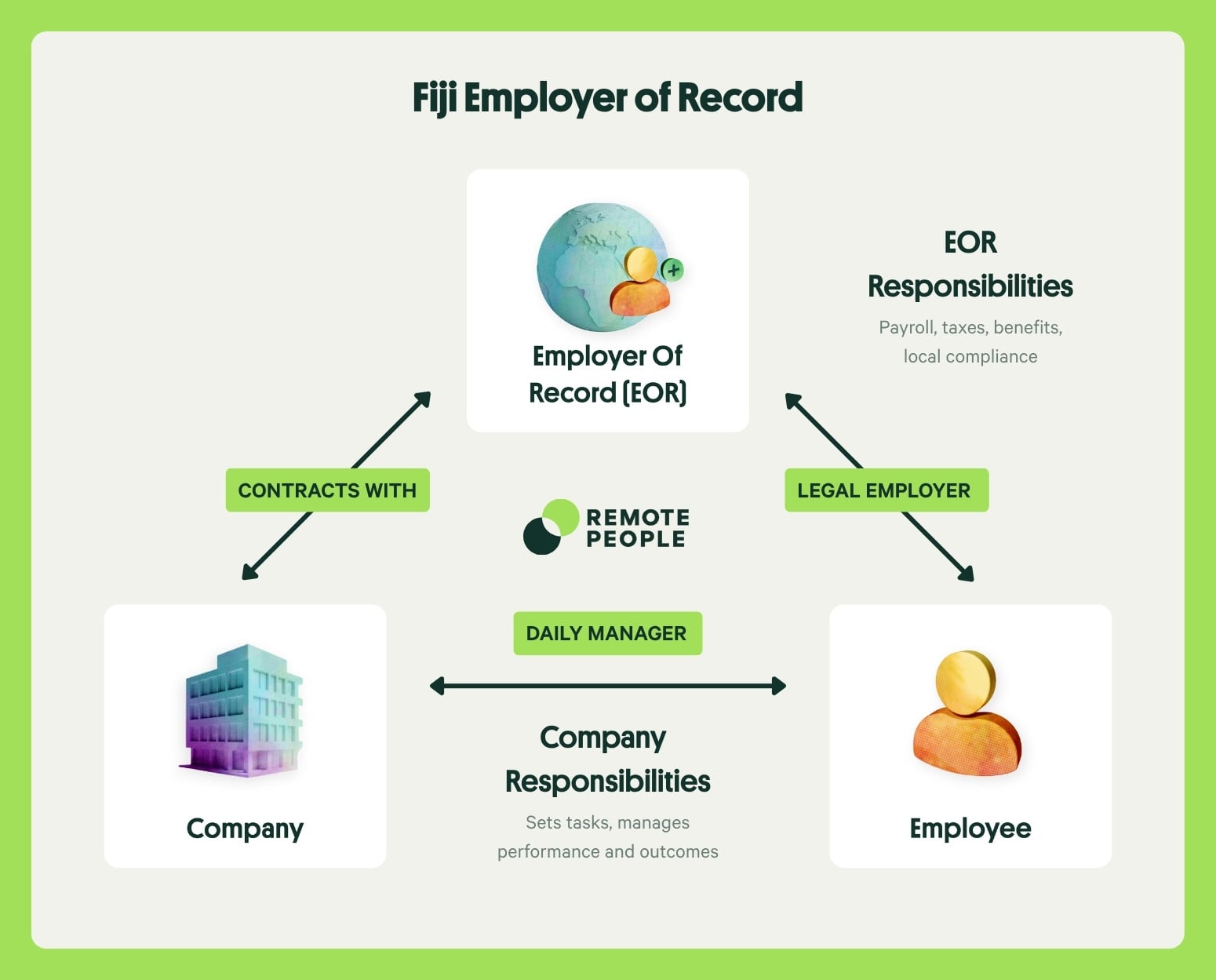
If you’d like to learn more about how Employer of Record (EOR) services work, read our What Is an Employer of Record (EOR)? guide for a complete overview of the model, its benefits, and when to use it.
If you’re comparing providers, our Best Employer of Record (EOR) Providers guide reviews the leading platforms to help you choose the right solution for your business.
Who Uses an EOR in Fiji?
Any company that wants to place a small team in Fiji without the cost and lead time of setting up a local entity is a candidate for an EOR. Typical use cases include testing Fiji as a growth market before committing to incorporation, hiring one to fifteen employees where a subsidiary does not make financial sense, bringing on a country manager to support operations in the broader Pacific region, and retaining a Fijian citizen who would otherwise leave a remote role because of contractor classification risk. Organizations expanding across the Pacific also use an EOR in Fiji as a staging point for regional hires, since Suva is the main commercial hub for the island nations and home to several regional bodies.
Typical Onboarding Timeline
Most EOR providers can onboard a Fijian citizen within one to two weeks. Expatriate hires take longer because the Ministry of Immigration must process the work permit before the employee can legally start. The steps below outline the standard timeline for a local hire.
- First, sign the EOR service agreement and provide employee details, salary, and job description. This takes 1 to 2 business days.
- Second, the EOR drafts a compliant employment contract and sends it to the employee for signature. This takes 2 to 3 business days.
- Third, the EOR registers the employee with FNPF, files the PAYE tax code declaration, and sets up the payroll file. Registration is completed within 3 to 5 business days in Suva.
- Fourth, payroll is configured, the FNPF member number is confirmed, and the employee begins work with full coverage from day one.
- Fifth, for expatriate hires, the work permit application is filed in parallel. Add 4 to 8 weeks for the Ministry of Immigration to process the long-term work permit before the employee can legally start.
Hire in Fiji
A 10% employer payroll burden, an English-speaking workforce, and a $13,300 tax-free income threshold make Fiji one of the most cost-efficient places to hire in the Pacific.
We handle employment contracts, payroll, FNPF and PAYE remittances, and full Fiji compliance.
No local entity needed. Your team can start in days.
Employment Laws and Regulations in Fiji
Employment in Fiji is governed by the Employment Relations Act 2007 (No. 36 of 2007), together with its amending acts, wage regulation orders, and the Accident Compensation Act. The Ministry of Employment, Productivity and Industrial Relations is the primary regulator, the Employment Relations Tribunal hears individual disputes, and the Employment Relations Court sits as a division of the High Court for appeals. The Fiji Revenue and Customs Service collects PAYE, and the Fiji National Provident Fund administers the compulsory retirement savings scheme.
Employment Contracts
Every employment relationship in Fiji that exceeds one month must be documented in a written contract under Section 37 of the Employment Relations Act 2007. The contract must specify the parties, job title, workplace, basic wage, working hours, paid leave entitlements, and notice period. Contracts are drafted in English, the official language of commercial and legal matters in Fiji, and a summary in a language known to the employee must be provided where the worker’s first language is not English. Fixed-term contracts are permitted, as are indefinite contracts, and task-specific contracts may be used for project-based roles. Foreign contracts of service must be attested by the Permanent Secretary responsible for employment before they take effect.
Working Hours and Overtime
The standard workweek in Fiji is 48 hours for workers on a six-day roster or 45 hours for workers on a five-day roster, with a maximum of 8 ordinary hours per day under Section 43 of the Employment Relations Act 2007. Any work beyond those weekly ceilings counts as overtime and must be compensated at a premium.
Overtime pay in Fiji follows a two-tier structure. The first four overtime hours in any week are paid at 150% of the ordinary hourly rate. Any hours beyond the first four, and all hours worked on a Sunday or a public holiday, are paid at 200% of the ordinary rate. Young workers under 18 may not be assigned to night work or hazardous duties, and all employees are entitled to at least one full rest day per week.
Minimum Wage
The minimum wage in Fiji is approximately $2.22 per hour at the April 2026 reference rate. The current rate took effect on 1 April 2025 under a wage regulation order announced by the Ministry of Employment (Fiji Government press release). On a standard 45-hour week, the national minimum works out to roughly $433 per month.
Sectoral wage orders set higher floors for specific industries such as construction, manufacturing, wholesale and retail, hospitality, security, and garment workers. In every case the applicable floor is the higher of the national rate and the sector rate.
Probation Period
The Employment Relations Act 2007 does not specify a maximum probation period in Fiji, so the duration is set by agreement between employer and employee in the written contract. Market practice is a probation of three months for entry-level and administrative roles and six months for professional, technical, or managerial positions. During probation, either party may terminate with the shorter notice agreed in the contract, but the Employment Relations Tribunal still expects a fair process if the employer ends the arrangement, and statutory leave continues to accrue throughout.
Leave Entitlements
Fijian employees accrue paid leave under the Employment Relations Act 2007, which sets separate statutory entitlements for annual leave, sick leave, maternity leave, paternity leave, bereavement leave, and family care leave. Each category has its own eligibility rule and pay treatment. The sections below break them down, followed by a comparison table.
Annual Leave
Employees are entitled to a minimum of 10 working days of paid annual leave for each completed year of continuous service under Section 58 of the Employment Relations Act 2007. Annual leave accrues from the first day of employment and is paid at the ordinary rate of pay. Collective agreements in industries such as civil service, banking, and hospitality commonly provide 15 to 20 days per year. Unused annual leave is generally non-cumulative unless the contract expressly allows carryover.
Sick Leave
Employees are entitled to 10 working days of paid sick leave per year once they have completed three months of continuous service, under Section 68 of the Employment Relations Act. A medical certificate from a registered practitioner is required for any absence exceeding two consecutive working days, and the employer pays the worker at the ordinary rate during the statutory entitlement. Sick leave does not accumulate beyond the annual ceiling unless the contract or a collective agreement provides otherwise.
Maternity Leave
Female employees are entitled to 98 consecutive days of paid maternity leave under Section 101 of the Employment Relations Act 2007, as amended in 2018. The leave can start up to 42 days before the expected date of delivery, with the remainder taken after the birth. The employer pays the worker’s ordinary wages throughout the 98-day period for mothers who have worked at least 150 days in the nine months preceding the confinement. Dismissal during maternity leave is prohibited except in narrowly defined cases of serious misconduct, and the employee has a legal right to return to the same or a comparable position.
Paternity Leave
Fathers are entitled to 2 working days of paid paternity leave under Section 101A of the Employment Relations Act, as amended by the Employment Relations (Amendment) Act 2020. The entitlement applies where the employee’s spouse or de facto partner has given birth and is eligible for maternity leave. The reduction from the previous 5-day standard was introduced during the 2020 COVID response, and no reversion has been gazetted as of April 2026.
Other Statutory Leave
Beyond annual, sick, maternity, and paternity leave, Fijian workers are entitled to bereavement leave of 3 working days per qualifying death under Section 70 of the Employment Relations Act, and to family care leave of 5 working days per year under Section 70A to provide care for an immediate family member. Both entitlements require three months of continuous service and are paid at the ordinary rate. Paid public holidays add a further 11 days in 2026, listed in the public holidays section below.
Fiji statutory leave entitlements · Per Employment Relations Act 2007 | ||
Leave Type | Duration | Eligibility & Notes |
|---|---|---|
Annual leave | 10 working days/year | Full pay; accrues from day one of employment |
Sick leave | 10 working days/year | Full pay; requires 3 months service; medical certificate after 2 days |
Maternity leave | 98 days (14 weeks) | Full pay by employer; requires 150 days worked in prior 9 months |
Paternity leave | 2 working days | Full pay; applies where spouse or partner is on maternity leave |
Bereavement leave | 3 working days per death | Full pay; requires 3 months service |
Family care leave | 5 working days/year | Full pay; to care for immediate family or household member |
Public holidays | 11 days in 2026 | Paid; work on a public holiday attracts a 200% premium |
Statutory Employee Benefits
Statutory employee benefits in Fiji are funded primarily through the Fiji National Provident Fund. Every employer must register new hires with FNPF within seven days of their start date and remit combined monthly contributions of 18% of ordinary wages, split 10% from the employer and 8% from the employee.
FNPF is the universal pension and savings scheme and also provides housing assistance loans, medical withdrawal rights, and death and disability benefits to members. Workplace injuries are covered separately through the Accident Compensation Commission, which replaced employer-funded workers’ compensation insurance in 2019 and is financed through levies administered by the government rather than direct employer premiums.
Beyond FNPF, there are no other mandatory payroll-funded benefits for private sector employers in Fiji, which makes the country one of the lowest-cost payroll jurisdictions in the Pacific region. Many employers add voluntary benefits such as private health insurance, group life cover, a housing or transport allowance, and a meal allowance to stay competitive in a tight labour market. These top-ups are typical for professional, technical, and managerial roles in Suva, Nadi, and Lautoka, where English-speaking talent is in high demand.
Recent Regulatory Updates (2026)
The most significant recent change is the Employment Relations (Amendment) Act 2025, which Parliament passed in the second half of 2025. The amendment introduces criminal liability for wage theft and underpayment of wages, strengthens penalties for sexual harassment, expands the prosecution powers of labour inspectors, and raises the maximum fine for repeat offenders to about $444,000.
Employers and individual directors can now be held personally liable, so payroll accuracy and harassment-prevention policies have become material compliance risks in Fiji.
The FNPF contribution rate was restored to the pre-COVID level of 18% (10% employer plus 8% employee) on 1 January 2024 after two temporary reductions during the pandemic years, and the rate has remained unchanged for 2026 (FNPF 2023 turnaround release). The national minimum wage was increased to roughly $2.22 per hour on 1 April 2025 and has not been revised for 2026. No further bracket changes to PAYE have been announced beyond the Social Responsibility Tax integration completed in January 2024.
Work Permits and Visas in Fiji
Every non-Fijian citizen who wants to take up paid employment in Fiji needs a work visa or permit before they can lawfully start work. The Ministry of Immigration administers the work permit system, and the sponsoring employer (or the EOR acting on behalf of the client) is responsible for filing the dossier and paying the statutory fees.
Work Permit Requirements
Who Needs a Work Permit
All foreign nationals require a work permit regardless of their country of origin, and Fijian citizens and permanent residents do not. Change of employer while inside Fiji is not permitted without prior immigration approval, so the permit is tied to the specific sponsoring employer. Applicants who are in Fiji on a visitor permit must depart the country before lodging a work permit application, which makes lead time management critical for expatriate hires. Fiji operates a local-preference rule, so the sponsoring employer must normally document that the role was advertised locally before a foreign candidate can be sponsored.
Eligibility and Required Documents
The sponsoring employer files the work permit dossier with the Fiji Ministry of Immigration and must attach a range of supporting documents. Standard requirements include the signed employment contract, the applicant’s passport biodata page, certified copies of academic and professional qualifications, a recent medical certificate, a police clearance certificate from the country of citizenship, a current curriculum vitae, proof of relevant work experience, the local job advertisement, and a completed applicant declaration form. Applicants must be at least 18 years old at the time of filing.
Processing Time and Validity
The Ministry of Immigration quotes an official processing time of 21 working days for a complete long-term work permit application, but realistic planning should assume 4 to 8 weeks from lodgment to issuance (Fiji Immigration long-term work permit). The long-term permit is issued for an initial period of up to three years and is tied to the sponsoring employer and position. Short-term work permits are capped at one year. Delays come from missing documents, sector-specific scrutiny, and the April 2025 policy shift requiring strict compliance with the Immigration Act 2003.
Renewal Process
Long-term work permits must be renewed before expiry, and renewal applications should be lodged at least 30 working days in advance. The renewal dossier requires an updated medical certificate, an updated police clearance, and proof that the employee has been compliant with PAYE and FNPF obligations during the previous term. Employees may continue to work while the renewal is being processed if the application was filed before the original permit expired and the Ministry has acknowledged receipt.
Common Visa Types for Foreign Workers
The main immigration categories for foreign hires in Fiji are summarized below:
Work Permit Types in Fiji | ||
Permit Type | Validity | Typical Use |
|---|---|---|
Long-term work permit | Up to 3 years | Permanent or open-ended employment with a Fiji employer |
Short-term work permit | Up to 1 year | Temporary assignments and project work |
NGO work permit | Project-linked | Foreign staff employed by international or regional NGOs based in Fiji |
Maritime crew permit | Contract-linked | Foreign crew on fishing vessels or other maritime operations registered in Fiji |
Foreign company permit | Assignment-linked | Employees of an overseas employer not paid from Fiji sources |
Source: Fiji Immigration Department and Immigration Act 2003 | ||
How an EOR Handles Work Permits
An EOR acts as the local sponsor for the work permit because it is the legal employer of the expatriate in Fiji. The EOR prepares and files the dossier with the Ministry of Immigration, pays the statutory fees, tracks renewal deadlines, and liaises with the Ministry on any document requests. The expatriate supplies the personal documents (passport, medical certificate, police clearance, qualifications) and attends any required in-person appointments. Because the EOR is the named employer on the permit, the authorization is tied to the EOR rather than to the client’s foreign entity, which simplifies onboarding but also means the permit must be cancelled and reissued if the employee changes EORs.
Using an EOR adds the work permit timeline to the onboarding process described earlier. A Fijian citizen can start within 1 to 2 weeks, while an expatriate hire should plan for 6 to 10 weeks from offer to first day. Clients who need immediate-start coverage usually prioritize local candidates and use a contractor management solution as a bridge for expatriates already in Fiji under another valid status.
Payroll, Taxes, and Social Security in Fiji
Employer Contributions
Employers in Fiji face one of the lowest statutory burdens in the Pacific: the only mandatory employer payroll contribution is the 10% FNPF employer share on ordinary wages. There is no separate social security tax, no mandatory health insurance premium, and no payroll levy. Workplace injury cover runs through the publicly funded Accident Compensation Commission rather than a direct employer premium. FNPF applies to ordinary wages without a statutory cap, so the effective rate remains flat as salaries rise.
Fiji employer social security contributions · 2026 rates | ||
Contribution | Rate | Notes |
|---|---|---|
FNPF employer share (pension, housing, death benefit) | 10.00% | On ordinary wages; no income cap; remitted monthly to FNPF |
Accident Compensation Commission levy | 0.00% | Workplace injury cover funded through general government levies, not direct employer premiums |
Total employer burden | 10.00% | Uncapped; applied to all ordinary wages |
Employee Contributions
Employees in Fiji contribute 8% of ordinary wages to FNPF, deducted from each pay cycle alongside PAYE income tax. There is no separate social security deduction and no unemployment insurance premium. The employee’s 8% share and the employer’s 10% share together make up the full 18% statutory contribution to the national provident fund.
Fiji employee payroll deductions · 2026 monthly withholdings | ||
Deduction | Rate | Notes |
|---|---|---|
FNPF employee share | 8.00% | On ordinary wages; no income cap; remitted monthly by employer |
PAYE income tax | 0% to 20% | Progressive; tax-free threshold of $13,300 per year; see income tax bracket table |
Total employee deduction (FNPF only) | 8.00% | Plus PAYE based on chargeable income |
Income Tax
Fiji applies a progressive PAYE system with a generous tax-free threshold that keeps most lower and middle earners out of the income tax net. Chargeable income up to about $13,300 per year is taxed at 0%, income between $13,301 and $22,200 is taxed at 18% of the excess over $13,300, and income between $22,201 and $119,800 is taxed at $1,600 plus 20% of the excess over $22,200.
For chargeable income above $119,800, additional Social Responsibility Tax tiers apply, integrated into the PAYE brackets since January 2024. PAYE is a final tax for single-source employment income, so employees do not need to file an annual return.
Fiji income tax brackets · 2026 | |
Annual Taxable Income (USD) | Tax Calculation |
|---|---|
$0 – $13,300 | Nil (tax-free threshold) |
$13,301 – $22,200 | 18% of the excess over $13,300 |
$22,201 – $119,800 | $1,600 + 20% of the excess over $22,200 |
Above $119,800 | $21,120 + 20% plus Social Responsibility Tax tiers of 13% to 19% |
Source: FRCS PAYE Tax Tables and PwC Fiji Individual Taxes | |
Payroll Cycle
Payroll in Fiji is typically monthly for salaried staff and fortnightly for hourly and casual workers. Payment must be made in Fiji dollars through bank transfer to the employee’s nominated account, and a written or electronic pay slip showing gross wages, PAYE, FNPF, and net pay must be issued on or before the payment date under Section 46 of the Employment Relations Act. Employers must remit FNPF contributions to the fund by the 7th day of the month following the pay period, and PAYE withholdings to FRCS by the end of the month following deduction. Late remittances attract interest and penalty charges.
13th Month Salary and Bonus Pay
A 13th month salary is not mandatory in Fiji. The Employment Relations Act 2007 contains no provision requiring an annual bonus, and there is no equivalent of a statutory vacation bonus or profit-sharing requirement. Many private-sector employers voluntarily pay a Christmas bonus equal to one to four weeks of ordinary wages, particularly in banking, insurance, hospitality, and the civil service, but the payment is discretionary and governed by the individual contract or collective agreement.
Cost of Hiring Through an EOR in Fiji
EOR Service Fees
EOR service fees in Fiji typically range from $300 to $600 per employee per month. The fee covers payroll processing, PAYE and FNPF remittance, employment contract drafting, statutory leave administration, pay slip issuance, and ongoing compliance monitoring under the Employment Relations Act 2007. Work permit sponsorship for expatriates, benefits enrollment, and background checks are usually charged as add-ons, and some providers bundle them into a higher all-inclusive rate.
Total Employment Cost Breakdown
The total cost of hiring through an EOR in Fiji combines the gross salary, the statutory employer contribution of 10% to FNPF, and the EOR service fee. The example below uses a $1,500 per month gross salary, a typical mid-market figure for a professional or technical role in Suva (see average salary in Fiji for sector benchmarks). Because Fiji has no employer-side income tax, health insurance levy, or payroll tax, the total cost above gross salary is one of the lowest in the Asia-Pacific region.
Fiji employer cost example · $1,500/month gross · 2026 | ||
Employer Cost | Amount (USD) | % of Gross |
|---|---|---|
Gross monthly salary | $1,500.00 | 100.00% |
FNPF employer contribution | $150.00 | 10.00% |
EOR service fee (est.) | $400.00 | 26.67% |
Total employer cost | $2,050.00 | 136.67% |
On a $1,500 gross salary the total employer cost is approximately $2,050, which is about 36.67% above gross once the FNPF contribution and EOR service fee are added. All USD amounts are approximate conversions at $1 to 2.25 Fiji dollars (April 2026 rate). The Fiji employer burden is materially lower than in Australia or New Zealand, which both approach or exceed 15% employer-side contributions, and below most Southeast Asian markets.
Ready to hire in Fiji? Contact our team and RemotePeople will handle employment contracts, payroll, PAYE withholding, FNPF remittance, and full Fiji compliance. No local entity needed.
Benefits of Using an EOR in Fiji
The primary benefit of using an EOR in Fiji is speed. A company can onboard a local hire in 1 to 2 weeks compared with the 3 to 6 months typically required to incorporate a Fijian company, register with FRCS, open an FNPF employer account, and set up payroll. The EOR absorbs the regulatory learning curve and assumes legal responsibility for compliance with the Employment Relations Act 2007, which matters because the 2025 amendment introduced criminal liability for wage theft and significantly raised the cost of payroll errors.
Cost efficiency is the second benefit. Setting up a wholly owned Fiji company typically costs between $5,000 and $15,000 upfront, plus ongoing accounting, audit, and statutory filing fees of several thousand dollars per year. For a team of fewer than 15 employees, an EOR is almost always cheaper over a three-year horizon, and the pay-as-you-grow structure lets you scale the workforce up or down without unwinding a local entity. Access to local expertise is the third benefit: a Fiji-based EOR already knows the Ministry of Immigration’s document conventions, the FNPF remittance cycle, and the FRCS filing calendar, which removes a source of avoidable mistakes.
Risk mitigation and employee experience round out the value proposition. By making the EOR the legal employer, the client limits direct exposure to unjustified dismissal claims under Section 230 of the Employment Relations Act, while the worker still receives the full statutory package of leave, FNPF contributions, and pay slip documentation. For the employee, the arrangement looks like any other local employment, which avoids the contractor classification risk that has become a focus for FRCS and the Ministry of Employment.
Termination and Offboarding in Fiji
Notice Periods
Statutory notice periods in Fiji scale with length of service under Section 29 of the Employment Relations Act 2007. Employees with less than one year of continuous service are entitled to one week of notice, employees with one to five years are entitled to two weeks, and employees with more than five years are entitled to four weeks. Longer notice periods may be agreed in the written contract, and collective agreements in unionized industries often provide three months for senior staff. Notice may be given in writing or by paying the equivalent in lieu.
Severance Pay
Calculation Method
Fiji does not have a general severance pay entitlement for ordinary dismissal, but it does require redundancy pay when a role is eliminated for economic, structural, or technological reasons. Under Section 108 of the Employment Relations Act 2007, a redundancy payment of at least one week’s ordinary wages per completed year of service is owed to any employee with one year or more of continuous service. The base salary for the calculation is the employee’s ordinary gross wage, excluding overtime and discretionary bonuses.
Caps and Exceptions
There is no statutory cap on redundancy pay in Fiji, and collective agreements commonly improve the formula to two or four weeks per year of service. Employees dismissed for serious misconduct, summary dismissal cases under Section 33 of the Employment Relations Act, and workers whose fixed-term contracts expire at the agreed end date do not qualify for a redundancy payment. Probationers with less than one year of service are also outside the statutory entitlement, although they remain entitled to any notice period agreed in writing.
Grounds for Termination
The Employment Relations Act 2007 recognizes three main grounds for termination: expiry of a fixed-term or task-specific contract, summary dismissal for serious misconduct, and ordinary termination with notice for a lawful reason such as redundancy, incapacity, or poor performance. Employers must give written reasons and follow a fair process, and the worker can challenge an unjustified dismissal before the Employment Relations Tribunal under Section 114. Protected categories include employees on maternity leave, pregnant employees, union representatives exercising statutory rights, and workers raising a bona fide health and safety complaint. The Tribunal can order reinstatement, compensation, or both where it finds that a dismissal was unjustified.
EOR vs. Other Hiring Models in Fiji
EOR vs. Setting Up a Local Entity
Choosing between an Employer of Record and setting up your own legal entity in Fiji comes down to timeline, upfront cost, ongoing administrative burden, and how quickly you can scale up or wind down. The table below lays out both paths side by side across setup time, cost, compliance risk, and flexibility so you can match the right model to the size and duration of your Fiji hiring plan.
Fiji EOR vs local entity comparison · Setup time, cost, risk and best-fit | ||
Comparison | Employer of Record | Own Entity |
|---|---|---|
Setup time | 1–2 weeks | 3–6 months |
Upfront cost | $0 | $5,000–$15,000 |
Ongoing cost | $300–$600/employee/month | $5,000–$12,000/year maintenance |
Local partner required | No (EOR is the local entity) | No (but local director may be needed for banking) |
FNPF and FRCS registration | Handled by EOR | You manage it |
Payroll & tax filing | Handled by EOR | You manage it (or outsource) |
Best for team size | 1–15 employees | 15+ employees |
Scale down / exit | Easy, no entity to unwind | Costly, legal dissolution required |
Government contracts | Not eligible | Eligible (requires local entity) |
Source: Investment Fiji and Fiji Employment Relations Act 2007 | ||
An EOR is the better choice for most foreign companies entering Fiji for the first time or testing the market. Incorporating a local company in Suva typically takes 3 to 6 months once you account for name reservation at the Registrar of Companies, share capital deposit, tax identification number registration with FRCS, FNPF employer account setup, and opening a corporate bank account. The upfront legal and setup cost runs between $5,000 and $15,000, and ongoing accounting and audit fees add several thousand dollars per year even when no employees are on payroll.
A wholly owned entity only becomes the more economical option once a team grows beyond about 15 employees, or when the business needs to bid for Fiji government contracts, hold commercial real estate, or obtain specific sector licences that require local corporate status. For everything else, an EOR gives you the same compliance outcome at a fraction of the setup cost and in a fraction of the time.
EOR vs. Hiring Independent Contractors
Classifying a Fiji-based worker as an independent contractor rather than an employee can expose you to back-taxes, unpaid social contributions, and reclassification penalties if the working relationship looks like employment in practice. The table below contrasts EOR employment with contractor engagement across legal relationship, tax and benefits treatment, IP ownership, and misclassification risk so you can pick the right model role by role.
Fiji EOR vs independent contractors · Compliance, cost, and risk | ||
Comparison | EOR (Full-Time Employee) | Independent Contractor |
|---|---|---|
Legal relationship | Employee of the EOR | Self-employed, no employment relationship |
Compliance risk | Low, EOR ensures Fiji labour law compliance | Higher, misclassification risk if relationship resembles employment |
Payroll & tax | EOR handles PAYE withholding, FNPF, and filings | Contractor invoices you; they file their own PAYE and FNPF |
Benefits & leave | Statutory benefits, paid leave, FNPF coverage | No entitlement to employee benefits |
IP protection | Stronger, employment contract assigns IP by default | Weaker, requires explicit IP assignment clause |
Termination | Subject to statutory notice and redundancy rules | Contract can be ended per agreement terms |
Best for | Long-term, core team roles | Short-term projects, specialized tasks |
Cost structure | Salary + 10% FNPF + EOR fee | Contractor fee (higher gross, lower total cost) |
Hiring through an EOR is the right choice when the worker is integrated into a regular team, follows the client’s schedule, uses the client’s tools, and reports on daily output. Fijian tax and employment law follows the same substance-over-form test as most common law jurisdictions, so a contractor arrangement that looks like employment on the facts can be reclassified by FRCS or the Employment Relations Tribunal, triggering back taxes, unpaid FNPF, and possible penalties.
Independent contracting is only appropriate in some cases, such as short-term project work, specialized consulting engagements, or roles where the worker has genuine autonomy, multiple clients, and control over their own tools and schedule. The misclassification risk means that for ongoing, core roles the EOR route is almost always the safer option. RemotePeople also offers a contractor management solution for cases where contracting is the right fit, which handles compliant contractor payments, IP assignment, and classification risk review.
EOR vs. PEO (Professional Employer Organization)
EORs and PEOs both simplify international hiring, but only an EOR becomes the legal employer of record in Fiji — a critical distinction when you don’t have a local entity of your own. The table below maps the practical differences across legal employer status, entity requirement, liability allocation, and scope of coverage.
Fiji EOR vs PEO comparison · Legal employer, liability, and setup | ||
Comparison | Employer of Record (EOR) | PEO |
|---|---|---|
Legal employer | EOR is the legal employer | You remain the legal employer (co-employment) |
Local entity required | No, the EOR is the local entity | Yes, you must have your own entity in Fiji |
Best for | Companies without a local entity | Companies that already have a Fiji entity |
Compliance liability | EOR assumes compliance responsibility | Shared liability between you and the PEO |
Setup time | 1–2 weeks | Depends on your entity setup (weeks to months) |
Control over HR policies | EOR manages within Fiji law framework | More direct control, PEO advises |
Typical use case | Market entry, small remote teams, testing Fiji | Established Fiji operations needing HR outsourcing |
The critical difference between an EOR and a PEO is who holds the employment contract. An EOR is the legal employer on record with FNPF, FRCS, and the Ministry of Immigration, while a PEO is a co-employer that manages HR and payroll for a client that already has its own Fiji entity. Fiji does not operate a distinct PEO regulatory framework, so most arrangements described as PEO in the local market are effectively outsourced payroll services for established employers.
Choose an EOR if you do not have a Fiji subsidiary and want to avoid incorporating one for a small team. Choose a PEO if your business already has a local entity in Suva or Nadi and you want to offload payroll, leave administration, and FNPF remittance to a specialist while keeping the legal employer status in your own name. For most new entrants to the Fiji market, the EOR model is the faster and lower-risk path.
Public Holidays in Fiji
Fiji observes a defined set of official public holidays on which most private-sector employers must give staff a paid day off (Fiji Government Public Holidays). The table below lists the statutory holidays employers need to build into payroll calendars and leave planning for the year, along with the date rule for each.
Fiji public holidays · 2026 calendar year | ||
Date | Holiday | Type |
|---|---|---|
1 January | New Year’s Day | National |
3 April | Good Friday | Religious |
4 April | Easter Saturday | Religious |
6 April | Easter Monday | Religious |
15 May | Girmit Day | National |
29 May | Ratu Sir Lala Sukuna Day | National |
24 August | Prophet Mohammed’s Birthday | Religious |
10 October | Fiji Day | National |
9 November | Diwali | Religious |
25 December | Christmas Day | Religious |
28 December | Boxing Day (observed) | Religious |
Fiji observes 11 public holidays in 2026. Employees receive paid leave on each day, and any work performed on a public holiday is compensated at 200% of the ordinary hourly rate. Religious holidays such as Prophet Mohammed’s Birthday and Diwali move each year with the lunar and Hindu calendars, so employers should confirm the gazetted dates with the Ministry of Employment before finalizing payroll schedules.
How to Get Started with an EOR in Fiji
- First, define the role, salary, and location. Decide whether the hire is a Fijian citizen or an expatriate who will need work permit sponsorship.
- Second, request a quote from a Fiji EOR provider and compare the service fee, benefits package, and work permit support against your timeline.
- Third, sign the EOR service agreement and provide employee details, salary, and job description for contract drafting.
- Fourth, the EOR drafts a compliant employment contract, completes FNPF and PAYE registration, and files any work permit application for expatriate hires.
- Fifth, the employee starts work, runs payroll on the agreed cycle, and the EOR handles all ongoing compliance with the Employment Relations Act.
RemotePeople can have your Fiji hire onboarded in 1 to 2 weeks for local employees. Get started with RemotePeople to handle employment contracts, payroll, PAYE withholding, FNPF remittance, and full Fiji compliance from day one.
Where companies hiring in Fiji expand next
Companies operating in Fiji often extend across the Asia-Pacific, drawing on English-speaking talent and aligned business culture. Many companies add hiring in Papua New Guinea first, drawing on the regional Pacific talent footprint. An EOR partner in Vanuatu follows as Pacific-region proximity and English-first hiring, while Australia offers aligned Pacific workforce norms. A team in New Zealand is often the fourth step, valued for shared Pacific business rhythm.
Frequently Asked Questions
Beyond the employee's gross salary and the 10% employer FNPF contribution, you will pay an EOR service fee of $300 to $600 per employee per month. The exact amount depends on your provider, the complexity of the role, and whether work permit sponsorship is needed. On a $1,500 monthly gross salary, the total employer cost is approximately $2,050 all-in.
A Fijian citizen can be onboarded within 1 to 2 weeks. An expatriate hire typically takes 6 to 10 weeks from offer to first day because the Ministry of Immigration must process the long-term work permit before the employee can legally start work.
No. A 13th month salary is not mandatory under Fiji's Employment Relations Act 2007. Some employers in banking, insurance, hospitality, and the civil service voluntarily pay a Christmas bonus, but the payment is discretionary and depends on the individual contract or collective agreement.
The employment contract assigns intellectual property to the client company (you), not the EOR. The EOR makes sure the contract contains proper IP assignment and confidentiality language so that all work product flows directly to your business, even though the EOR is technically the legal employer for compliance purposes.
You can, but only in the right circumstances such as a short-term project, specialized consulting work, or a role where the worker has genuine autonomy. For long-term or integrated roles, misclassification risk can trigger back taxes and unpaid FNPF contributions. RemotePeople offers a contractor management solution that handles compliant contractor payments, IP assignment, and classification risk review in Fiji.
Statutory benefits include 10 working days of annual leave, 10 working days of sick leave, 98 days of paid maternity leave, 2 days of paternity leave, 3 days of bereavement leave per death, 5 days of family care leave, 11 paid public holidays, and FNPF coverage funded by the combined 18% contribution to the Fiji National Provident Fund.
Yes. Because the EOR is the legal employer of the worker in Fiji, it can file the work permit application with the Ministry of Immigration, pay the statutory fees, and handle renewals. The permit is tied to the EOR rather than the client's foreign entity.
The EOR gives statutory notice (1 to 4 weeks depending on length of service), calculates any redundancy payment owed under Section 108 of the Employment Relations Act, issues the final pay slip, deregisters the employee with FNPF, and provides a statutory certificate of service. Employees can challenge unjustified dismissal before the Employment Relations Tribunal, so having an EOR follow the right process is material.
Employer of Record in
Employer of Record in
Employer of Record in
Employer of Record in
Employer of Record in
Employer of Record in
Employer of Record in
Employer of Record in




