
 Recruit
Employer of Record in New Zealand
-
 Drew Donnelly
- Published
- September 22, 2026
RemotePeople’s employer of record in New Zealand lets you hire employees in New Zealand with KiwiSaver and ACC compliance. We handle mandatory KiwiSaver employer matching of at least 3%, Work Accident Compensation levy of 1.3%, and Working Safer levy at 0.08% per NZD 100 of payroll.
Hire in New Zealand — book a free 30-minute demo
Tell us what you need. You'll get a tailored, transparent proposal within 24 hours, plus a free call to walk through it.
Tell us about your company
So we can match you with a specialist who knows your market — and unlock volume pricing tiers.
* All fields are required.
Where and when are you hiring?
Tell us the geography and timing and we'll quote each country line by line, with onboarding timelines.
* All fields are required.
Help us beat your current setup
We'll benchmark your current deal and send a line-by-line proposal in 24 hours — showing exactly where we cut cost, time, or risk. After you submit, you can book a call to walk through it together.
* All fields are required.
Thanks! Your proposal is on its way.
Expect a tailored, line-by-line proposal in your inbox within 24 hours. In the meantime…
Want to walk through it together?
Book a free 30-minute call with one of our specialists. We'll explain every line, answer your questions, and tailor the proposal further if you need.
No obligation. Pick a time that works for you.








- Hire in New Zealand — book a free 30-minute demo
- Tell us about your company
- Where and when are you hiring?
- Help us beat your current setup
- Thanks! Your proposal is on its way.
- How an Employer of Record Works in New Zealand
- Employment Laws and Regulations in New Zealand
- Work Permits and Visas in New Zealand
- Payroll, Taxes, and Social Security in New Zealand
- Cost of Hiring Through an EOR in New Zealand
- Benefits of Using an EOR in New Zealand
- Termination and Offboarding in New Zealand
- EOR vs. Other Hiring Models in New Zealand
- Public Holidays in New Zealand
- How to Get Started with an EOR in New Zealand
- Where companies hiring in New Zealand expand next
- Frequently Asked Questions
- Related EOR Destinations

Start hiring in New Zealand
Let RemotePeople handle payroll, compliance, and HR admin worldwide so you can focus on building your team.

An employer of record in New Zealand is the legal employer of your team, handling payroll, KiwiSaver, ACC, payday filing, and full Employment Relations Act 2000 compliance, so you can hire in 1 to 2 weeks without setting up a New Zealand company. EOR services in New Zealand typically cost $300 to $600 per employee per month and let you onboard talent without becoming an Accredited Employer with Immigration New Zealand or registering with Inland Revenue for PAYE yourself. New Zealand offers one of the Asia-Pacific region’s most stable labour markets, native English speakers, strong intellectual property protection under the Copyright Act 1994 and the Patents Act 2013, and time-zone overlap with both Australia and the US West Coast.
This guide walks through how an employer of record works in New Zealand, the employment laws you must follow in 2026, work visa options for foreign hires, payroll and tax mechanics under the 1 April 2026 rate changes, total hiring cost, termination rules, and how an EOR compares with setting up an NZ limited company, using contractors, or partnering with a PEO.
How an Employer of Record Works in New Zealand
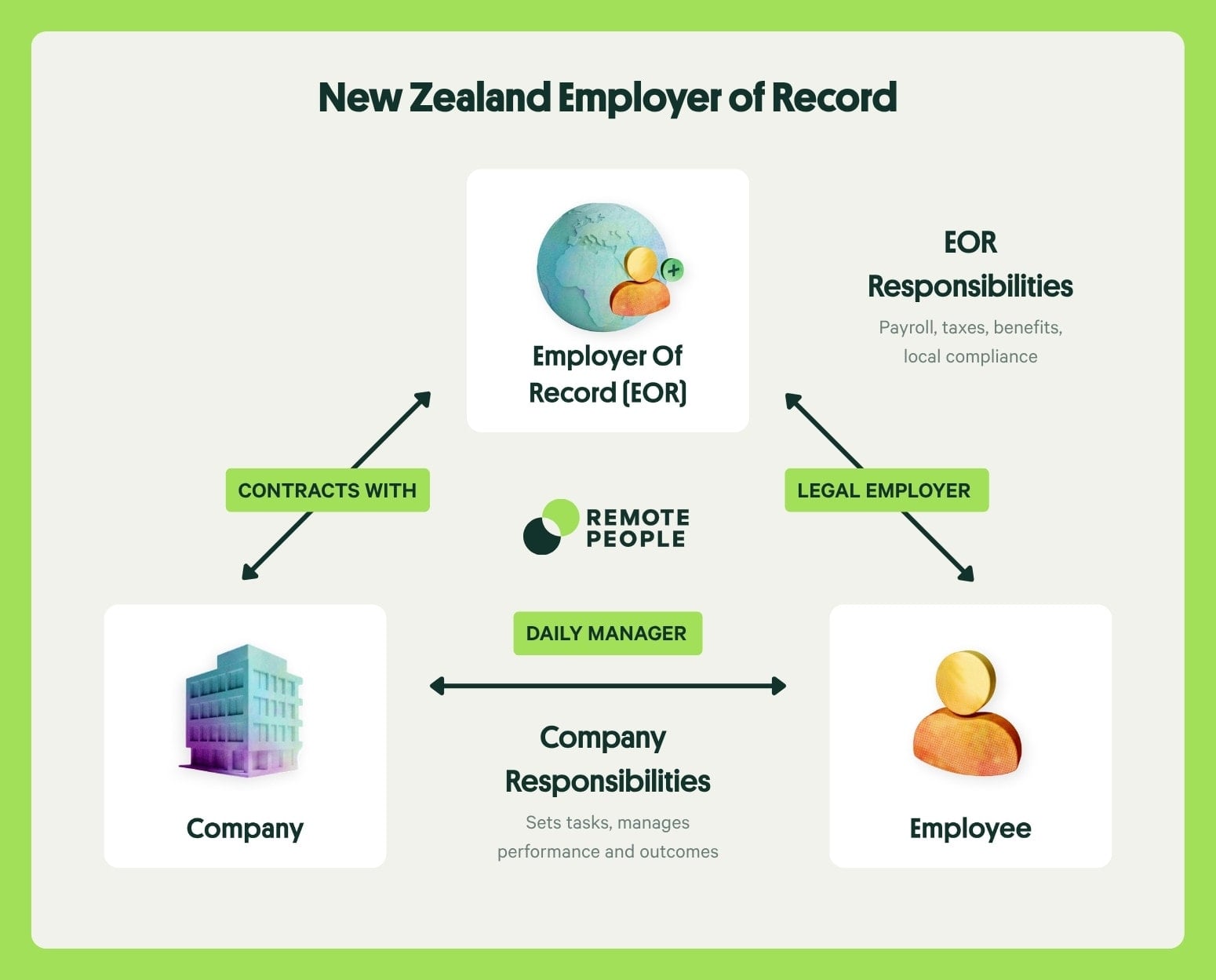
If you’d like to learn more about how Employer of Record (EOR) services work, read our What Is an Employer of Record (EOR)? guide for a complete overview of the model, its benefits, and when to use it.
If you’re comparing providers, our Best Employer of Record (EOR) Providers guide reviews the leading platforms to help you choose the right solution for your business.
Who Uses an EOR in New Zealand?
The EOR model suits any business that wants a compliant New Zealand team without standing up a subsidiary. Setting up a New Zealand limited company through the Companies Office, registering for GST and PAYE with Inland Revenue, opening a local bank account, and securing INZ accreditation typically takes 6 to 12 weeks and carries ongoing annual compliance costs. An EOR compresses that to 1 to 2 weeks with no standing legal infrastructure.
- Market testing: A company looking to validate demand in New Zealand before committing to an entity can hire one or two staff through an EOR and scale or withdraw based on results.
- Small remote teams: Any business hiring 1 to 15 employees in New Zealand where the overhead of a local company, a director with residency, and ongoing filings does not justify the entity cost.
- Speed to hire: Organisations that need to close a candidate within weeks rather than quarters rely on an EOR because payroll, KiwiSaver, and ACC registration are already in place.
- Work visa sponsorship: For organisations expanding into New Zealand with non-resident candidates, an accredited-employer EOR can sponsor an AEWV without the sponsoring business itself having to apply for INZ accreditation.
Government agencies and tendering bodies that require a local registered supplier are the main category that cannot use an EOR, because eligibility for New Zealand Government contracts usually requires the contracting party itself to be registered locally.
Typical Onboarding Timeline
Most EOR providers can onboard an employee in New Zealand within 1 to 2 weeks, assuming the worker already has the right to work. The timeline extends to 3 to 6 weeks when an AEWV is required, because the employer accreditation check, Job Check, and visa application all sit on Immigration New Zealand processing timelines.
- First, EOR agreement and employee details (1 to 2 days): Sign the EOR service agreement and share the employee’s personal details, salary, start date, role description, and tax code declaration (IR330).
- Second, employment agreement drafting and review (2 to 3 days): The EOR drafts an individual employment agreement that meets ERA section 65 requirements, including any 90-day trial clause, and sends it to the employee for signature with the required fair-opportunity-to-seek-advice period.
- Third, IRD and ACC registration (3 to 5 days): The EOR links the new hire to its employer number, applies the declared tax code, and notifies ACC of the new employee in the relevant industry classification unit.
- Fourth, KiwiSaver, payroll, and bank details (2 to 3 days): Auto-enrol the employee in KiwiSaver if they are aged 18 to 64, set up the bank transfer, and prepare the first payday filing report to Inland Revenue.
- Fifth, employee start date (1 day): The employee begins work, the EOR runs the first pay cycle, and PAYE, KiwiSaver, and ACC amounts flow through Inland Revenue and ACC on the normal schedule.
Factors that can extend the timeline include Accredited Employer Work Visa processing (typically 2 to 4 weeks for straightforward cases), police vetting for regulated sectors, and background checks required by the hiring company.
Hire in New Zealand in 1 to 2 weeks
Skip the 6-to-12-week entity setup. RemotePeople handles employment contracts, payroll, PAYE, KiwiSaver, ACC, and full New Zealand compliance so your first hire can start within days.
Employment Laws and Regulations in New Zealand
Employment Contracts
New Zealand’s core employment statute is the Employment Relations Act 2000, administered by the Ministry of Business, Innovation and Employment (MBIE) and enforced through the Employment Relations Authority and Employment Court. Every employee must have a written employment agreement under section 65, and the employer must keep a signed copy and provide one on request. Penalties under ERA section 235 for failing to retain or provide an agreement start at $20,000 for companies.
The written agreement must name the parties, describe the work, set out the place of work, specify hours, state the pay rate and method, list permitted deductions, include a plain-language explanation of personal grievance rights, and record any 90-day trial or probation clause. Agreements are typically indefinite. Fixed-term contracts are permitted only where there is a genuine reason based on reasonable grounds under ERA section 66, and seasonal work, specific projects, or covering a temporary absence are the most common justifications. Contracts must be in English, and Employment New Zealand publishes an Employment Agreement Builder template that the EOR can start from.
Working Hours and Overtime
Standard full-time hours in New Zealand are 40 per week, but the country does not set a statutory maximum workweek or mandatory overtime premium in legislation. Working hours, overtime rates, and shift loadings are agreed in the individual or collective employment agreement, subject to the Minimum Wage Act 1983, which requires that every hour actually worked is paid at no less than the adult minimum wage. The Employment Relations Act section 69ZD entitles employees to paid rest breaks and unpaid meal breaks on a sliding scale that depends on the length of the work period, and most full-time rosters provide two 10-minute paid breaks plus a 30-minute unpaid meal break over an 8-hour shift.
Because overtime is contractual rather than statutory, the market practice reflected in collective agreements and employer policies is the reference point for employers. The schedule below summarises the typical premium pay multipliers used in New Zealand collective agreements and major employer policies for the 2026 year, and these rates are what an EOR will typically put into an individual employment agreement if the role involves shift work or on-call duty.
New Zealand overtime and premium pay rates · Per market practice and Employment Relations Act 2000 | |||
Hour Type | Rate Multiplier | Weekly/Daily Cap | Notes |
|---|---|---|---|
Standard weekday work | 1.0x base rate | 40 hours/week typical | No statutory overtime threshold; set by agreement |
Weekday overtime (first 3 hours) | 1.5x base rate | As per agreement | Common CBA practice, not statutory |
Weekday overtime (beyond 3 hours) | 2.0x base rate | As per agreement | Double time typical in construction and manufacturing CBAs |
Saturday work | 1.5x base rate | Per agreement | Where not part of ordinary roster |
Sunday work | 2.0x base rate | Per agreement | Where not part of ordinary roster; no statutory Sunday premium |
Public holiday work | 1.5x base rate + alternative day | Statutory | Holidays Act 2003 section 50; worker also gets a paid day in lieu |
Night shift loading | 1.15x to 1.25x typical | Per agreement | Common in 24/7 operations; not statutory |
The only statutory premium is time-and-a-half plus an alternative paid day off when an employee works a public holiday that is also an otherwise-working day, under Holidays Act 2003 section 50. There is no statutory monthly or annual cap on overtime hours, but total hours must still allow reasonable rest, and the Health and Safety at Work Act 2015 imposes a duty on employers to manage fatigue risks.
Minimum Wage
The adult minimum wage in New Zealand is NZ$23.95 per hour from 1 April 2026, set under the Minimum Wage Order 2026 pursuant to the Minimum Wage Act 1983. The Ministry of Business, Innovation and Employment reviews rates annually in December for implementation on 1 April. The starting-out and training minimum wages, which apply to specific young worker and trainee categories, rise to NZ$19.16 per hour on the same date.
- Adult minimum wage: NZ$23.95 per hour for workers aged 16 and over who do not fall into the starting-out or training categories (Employment New Zealand).
- Starting-out minimum wage: NZ$19.16 per hour for 16 and 17 year olds in their first six months of continuous employment and for certain 18 and 19 year olds on benefits.
- Training minimum wage: NZ$19.16 per hour for workers aged 20 and above engaged in recognised industry training of at least 60 credits per year.
- No sub-minimum rates by industry: The adult rate is the universal floor across all sectors, and collective agreements cannot reduce it.
There is no annual minimum salary for full-time employment in statute, but the Accredited Employer Work Visa requires that a migrant worker be paid at or above the median wage threshold (NZ$33.56 per hour as at the August 2025 update) unless the occupation appears on a lower-paid exception list (Immigration NZ).
Probation Period
New Zealand does not have a general statutory probation period, but the Employment Relations Act 2000 sections 67A and 67B permit a 90-day trial clause that can be included in an employment agreement signed before the employee starts work. Since 23 December 2023, the 90-day trial is available to all employers regardless of headcount, after being restricted to businesses with fewer than 20 staff between 2011 and 2023 (Employment New Zealand). If the trial clause is valid and the employer terminates within 90 days, the employee cannot bring a personal grievance for unjustified dismissal, although grievances for discrimination, harassment, or unjustified disadvantage remain available.
To be enforceable, the trial clause must be in writing, agreed to before the employee starts work, specify a trial period of no more than 90 days, and state that the employer may dismiss without the employee being able to raise a personal grievance for unjustified dismissal. A separate non-trial probationary period under ERA section 67 is also permitted, but it does not remove grievance rights and is rarely used now that the 90-day trial is open to all employers. Annual leave and sick leave continue to accrue during a trial period on the same basis as any other employee.
Leave Entitlements
New Zealand’s statutory leave framework sits in the Holidays Act 2003, the Parental Leave and Employment Protection Act 1987, and the Domestic Violence Victims’ Protection Act 2018. All employees accrue paid annual holidays, sick leave, bereavement leave, family violence leave, public holidays, and parental leave, with payments funded either by the employer or by Inland Revenue through parental leave payments.
Annual Leave
Every employee is entitled to four weeks of paid annual holidays after each completed 12 months of continuous employment under Holidays Act 2003 section 16 (Holidays Act 2003). Four weeks means four weeks of the employee’s ordinary working pattern, so a full-time worker on five days a week receives 20 working days. Pay during leave is the higher of ordinary weekly pay or average weekly earnings over the prior 52 weeks, and untaken leave at termination is paid out at 8% of gross earnings since the last anniversary. Employers must allow the employee to take at least two weeks in a single block and can direct the timing with 14 days’ notice after negotiation. Leave accrues from day one, including during a 90-day trial.
Sick Leave
Full-time and regular part-time employees receive 10 days of paid sick leave each year after six months of continuous employment, or after six months of working at least 10 hours per week including at least one hour in every seven consecutive days (Employment New Zealand sick leave). The 10-day entitlement, doubled from five days on 24 July 2021, can be carried forward up to a maximum of 20 days, and sick leave may be taken for the employee’s own illness or injury or to care for a dependent spouse, partner, child, or other person who depends on the employee for care. Employers can require proof of illness after three consecutive days and may require earlier proof if they pay for the medical certificate. Sick leave is employer-funded at the employee’s relevant daily pay.
Maternity Leave
The Parental Leave and Employment Protection Act 1987 governs parental leave in New Zealand. A pregnant employee or the primary carer is entitled to up to 26 weeks of primary carer leave, plus up to 52 weeks of total unpaid parental leave including any extended leave (Employment New Zealand parental leave). Paid parental leave is funded by Inland Revenue, not the employer, and the weekly cap from 1 July 2025 to 30 June 2026 is NZ$788.66 before tax for employees or the equivalent of the employee’s average weekly earnings, whichever is lower. Eligibility requires at least an average of 10 hours per week over any 26 of the 52 weeks before the expected due date. Special leave of up to 10 days unpaid is also available for pregnancy-related appointments.
Paternity Leave
New Zealand uses a partner’s leave model rather than dedicated paternity leave. An eligible partner of a primary carer is entitled to one week of unpaid partner’s leave if they meet the six-month eligibility threshold, or two weeks if they meet the 12-month threshold, under the Parental Leave and Employment Protection Act 1987 section 71. Partner’s leave can be taken between 21 days before the expected due date and 21 days after the child or adopted child comes into the employee’s care. Partners who meet the longer-service threshold can also take a block of extended leave, which may run concurrently or consecutively with the primary carer’s leave, up to the combined 52-week cap.
Other Statutory Leave
Beyond annual leave, sick leave, and parental leave, New Zealand law provides several additional statutory entitlements that an EOR tracks and pays on the employer’s behalf.
- Bereavement leave: Three days paid leave on the death of an immediate family member (spouse or partner, parent, child, sibling, grandparent, grandchild, or parent-in-law) and one additional day if the employee accepts a bereavement responsibility for someone outside the immediate family list, under Holidays Act sections 69 to 72.
- Family violence leave: Ten days paid leave per year for employees affected by family violence, introduced by the Domestic Violence Victims’ Protection Act 2018 and available from six months of service (family violence leave).
- Jury service leave: Unpaid leave with job protection for the duration of court-ordered jury service, with the court paying a daily allowance that the employer may top up as a matter of policy.
- Military and volunteer leave: Unpaid leave with job protection for Territorial Forces volunteer service and for certain civil defence emergencies under the Volunteers Employment Protection Act 1973.
- Study and community leave: No statutory entitlement, but many collective agreements provide paid or unpaid study leave for relevant qualifications and training.
All statutory leave entitlements are governed by the Holidays Act 2003, the Parental Leave and Employment Protection Act 1987, and the Domestic Violence Victims’ Protection Act 2018. The table below summarises each entitlement an EOR will administer under a standard New Zealand employment agreement, with the most important takeaway being that all four weeks of annual leave accrue from day one even though the employee cannot take them as paid leave until the end of year one.
New Zealand statutory leave entitlements · Per the Holidays Act 2003 and Parental Leave and Employment Protection Act 1987 | ||
Leave Type | Duration | Eligibility & Notes |
|---|---|---|
Annual holidays | 4 weeks per year | Accrues from day one; taken after 12 months; paid at higher of ordinary weekly pay or average weekly earnings |
Sick leave | 10 days per year | After 6 months of continuous service; carry over to max 20 days; employer-funded |
Bereavement leave | 3 days per bereavement (immediate family) | Plus 1 day for wider bereavement; no annual cap; employer-funded |
Family violence leave | 10 days per year | After 6 months of service; does not carry over; employer-funded |
Primary carer leave | 26 weeks | Paid by IRD at capped weekly rate (NZ$788.66 max for 1 July 2025 – 30 June 2026) |
Partner’s leave | 1 to 2 weeks unpaid | 1 week at 6 months’ service, 2 weeks at 12 months’ service |
Extended unpaid parental leave | Up to 52 weeks total | Shared with primary carer leave; job-protected |
Public holidays | 12 days per year | Paid day off if an otherwise-working day; see H2 9 for the full 2026 calendar |
Statutory Employee Benefits
Beyond paid leave, New Zealand employers must provide or enrol employees in a short list of mandatory benefits. An EOR administers each of these on your behalf so that the employee receives the full statutory package from their first payday.
- KiwiSaver auto-enrolment and employer contribution: All employees aged 18 to 64 who are new to a job must be auto-enrolled in KiwiSaver, with the option to opt out between days 14 and 56 of employment. The employer pays a compulsory contribution of 3.5% of gross salary from 1 April 2026, rising to 4% from 1 April 2028 (IRD KiwiSaver changes).
- ACC cover: Every employee is automatically covered by the Accident Compensation Corporation’s 24/7 no-fault injury insurance scheme, funded jointly through the employer Work Levy and the employee Earners’ Levy (ACC for business).
- Paid parental leave funding: Primary carer leave is funded by Inland Revenue, but employers must preserve the role and cooperate with the application, under the Parental Leave and Employment Protection Act 1987.
- Public health system access: All New Zealand residents and most work-visa holders on a visa of at least two years have access to the publicly funded health system, so employers are not required to provide private medical insurance.
- Health and safety duty of care: The Health and Safety at Work Act 2015 requires every employer to ensure, so far as is reasonably practicable, the health and safety of workers, with fines up to NZ$3 million for a category 1 offence by a corporate PCBU.
Private medical insurance, life insurance, and income protection are not mandatory and are treated as additional benefits. When provided, they may attract Fringe Benefit Tax (FBT) at the 2025/26 single rate of 63.93% or at the alternate rate where the employer qualifies.
Recent Regulatory Updates (2026)
Several regulatory changes took effect on or near 1 April 2026, and an EOR monitors them so that client employers remain compliant from day one. The largest change is the staged KiwiSaver employer contribution increase announced in Budget 2025, which raised the employer minimum from 3% to 3.5% of gross pay from 1 April 2026 and will raise it again to 4% from 1 April 2028, with KiwiSaver eligibility also extending to 16 and 17 year olds from the same date (Budget 2025 factsheet).
The ACC Earners’ Levy also increased on 1 April 2026 to NZ$1.75 per NZ$100 of liable earnings from NZ$1.59, and the average Work Levy rose to approximately NZ$0.69 per NZ$100, with the maximum liable earnings ceiling moving to NZ$156,641 (MBIE ACC levy settings). The adult minimum wage moved to NZ$23.95 per hour on the same date, and the Employment Relations Amendment Act 2026, which came into force on 21 February 2026, expanded restrictions on personal grievances for conduct-based matters and introduced a NZ$180,000 earning threshold above which unjustified dismissal claims are not available. Immigration New Zealand continues to refine the Accredited Employer Work Visa framework, with new seasonal visa options under the AEWV umbrella that opened on 8 December 2025 and a reduction in the Skilled Migrant Category work-experience requirement from three years to two years scheduled for August 2026.
Work Permits and Visas in New Zealand
Work Permit Requirements
Who Needs a Work Permit
Right to work in New Zealand is automatic for New Zealand citizens, residence-class visa holders, and Australian citizens and permanent residents under the Trans-Tasman Travel Arrangement. Every other nationality requires a work visa appropriate to the role and duration. Most employer-sponsored hiring flows through the Accredited Employer Work Visa (AEWV), which replaced the Essential Skills Work Visa on 4 July 2022 and which requires the hiring business (or the EOR) to hold Immigration New Zealand accreditation.
Eligibility and Required Documents
AEWV applicants must submit a passport valid for the duration of the visa, a chest x-ray and medical certificate if staying more than 12 months, a police certificate for each country the applicant has lived in for 12 months or more in the past 10 years, evidence of qualifications and work experience matching the role, proof of English language ability for occupations at ANZSCO skill level 4 or 5, and an Immigration New Zealand approved job offer from an accredited employer that has passed the Job Check. The employer side requires the employer accreditation, a Job Check approval confirming the role cannot be filled by a New Zealand citizen or resident, and an offer that pays at or above the applicable wage threshold.
Processing Time and Validity
Standard AEWV processing takes 2 to 4 weeks once the employer accreditation and Job Check are complete, although complex cases can take 8 to 12 weeks. The visa is typically granted for the length of the job offer up to a maximum of five years for roles paying at or above the median wage, three years for occupations on the Green List but below the higher threshold, and two years for lower-paid exception occupations. Visa fees are set by Immigration New Zealand and are typically NZ$750 for the main application plus an Immigration Levy, an International Visitor Levy where applicable, and a Job Check fee of NZ$735 paid by the employer (INZ AEWV fees).
Renewal Process
AEWV renewal requires a fresh application at least eight weeks before the current visa expires, with the employee able to continue working on an interim visa while the new application is processed provided they apply before the current visa lapses. The employer’s accreditation must still be valid, and a new Job Check is required if the role has changed. Employees on the Green List Straight-to-Residence pathway can apply for residence after qualifying periods, and those on the Work-to-Residence pathway can apply for residence after 24 months of employment with an accredited employer at or above the median wage. An EOR that holds accreditation manages the entire renewal cycle.
Common Visa Types for Foreign Workers
Immigration New Zealand issues a catalogue of temporary and residence visas depending on the role, duration, and the applicant’s circumstances. An EOR with employer accreditation can sponsor an AEWV and a small number of related categories, but not residence-class visas (which the applicant files directly). The table below summarises the main work-authorising visa types for the 2026 year, and only visas that the EOR or employer can sponsor are listed as “sponsored” in the relevant column.
New Zealand work visa types for foreign workers · 2026 | ||||
Visa Type | Duration | Best For | Leads to Residence? | Processing |
|---|---|---|---|---|
Accredited Employer Work Visa (AEWV) | Up to 5 years | Most employer-sponsored hires | Yes, via Work-to-Residence after 24 months | 2 to 4 weeks typical |
Green List Straight-to-Residence Visa | Permanent | Tier 1 Green List occupations | Yes, immediate | 4 to 8 weeks |
Skilled Migrant Category Resident Visa | Permanent | Skilled workers with ANZSCO 1 to 3 occupation | Yes, direct | 8 to 16 weeks |
Specific Purpose Work Visa | Up to 3 years | Intra-company transfers, short-term specialists, sports, film | No | 4 to 8 weeks |
Working Holiday Visa | 1 year (2 years for UK, US, Canada) | Ages 18 to 30 or 35 (country-dependent) | No | 1 to 3 weeks |
Post Study Work Visa | 1 to 3 years | Recent graduates of NZ qualifications | Indirectly (via AEWV or SMC) | 4 to 8 weeks |
Partner of a Worker Visa | Matches primary visa | Partners of AEWV or residence-class holders | Yes, via partner-of-resident pathway | 4 to 8 weeks |
Visitor visas, student visas, transit visas, and Specific Purpose dependent visas do not permit the holder to take up general employment and are outside the scope of this guide.
- Visitor Visa: Permits tourism, business meetings, and family visits but not paid employment.
- Student Visa: Permits study at an approved institution with limited part-time work of up to 20 hours per week during term (higher in scheduled holidays).
- Transit Visa: Permits passage through New Zealand for up to 24 hours without any right to work.
How an EOR Handles Work Permits
A New Zealand EOR that holds Immigration New Zealand employer accreditation can sponsor an AEWV for a candidate on the hiring company’s behalf. The EOR runs the Job Check process with Immigration New Zealand to confirm the role cannot be filled by a local worker, lodges the role details against the employer accreditation, supports the employee through the AEWV application, and signs the employment agreement once the visa is approved. The employee works for the EOR on paper but reports to the hiring company in practice. Because the Job Check and visa processing happen in parallel with contract drafting, the work-permit pathway adds 3 to 6 weeks to the standard onboarding timeline outlined in H3 1.4 rather than months. Residence-class visas such as the Skilled Migrant Category or Green List Straight-to-Residence are filed by the employee in a personal capacity; the EOR provides supporting documentation and employment evidence but does not act as sponsor.
Payroll, Taxes, and Social Security in New Zealand
Employer Contributions
Employer contributions in New Zealand are modest compared with Europe, totalling roughly 5% to 6% of gross pay for a median-wage worker. The main components are the compulsory 3.5% KiwiSaver employer contribution (from 1 April 2026), the ACC Work Levy at an industry-classified rate averaging NZ$0.69 per NZ$100 of liable earnings for 2026/27, and the Employer Superannuation Contribution Tax (ESCT) withheld from the KiwiSaver employer contribution at rates of 10.5% to 39% depending on the employee’s total remuneration. Fringe Benefit Tax only applies where the employer provides non-cash benefits such as a motor vehicle or low-interest loan.
New Zealand employer social security contributions · 2026/27 rates | ||
Contribution | Rate | Notes |
|---|---|---|
KiwiSaver employer contribution | 3.5% of gross pay | Compulsory for KiwiSaver members from 1 April 2026; rises to 4% on 1 April 2028 |
ACC Work Levy (average) | NZ$0.69 per NZ$100 | Industry-classified rate; levy capped at NZ$156,641 per employee per year |
ESCT on KiwiSaver contribution | 10.5% to 39% | Withheld from the employer’s KiwiSaver contribution based on total employee remuneration |
Fringe Benefit Tax (if applicable) | 63.93% single rate | Only if non-cash benefits are provided; alternate rate available |
Typical total employer on-cost | 4% to 6% | Excludes FBT; excludes optional benefits; rises with higher ACC industry rates |
Source: IRD KiwiSaver employer contributions and ACC Work Levy | ||
Employee Contributions
Employees in New Zealand see three main deductions from gross pay: PAYE income tax, the ACC Earners’ Levy, and the employee side of KiwiSaver if they are enrolled. Student loan repayments of 12% are deducted from income above the NZ$24,128 annual threshold if the employee has a balance with IRD. All deductions are collected by the employer and passed to Inland Revenue through payday filing. The table below shows the statutory employee withholdings for a standard enrolled worker.
New Zealand employee payroll deductions · 2026/27 monthly withholdings | ||
Deduction | Rate | Notes |
|---|---|---|
PAYE income tax | 10.5% to 39% | Progressive; see Income Tax Brackets table |
ACC Earners’ Levy | NZ$1.75 per NZ$100 | Capped at liable earnings of NZ$156,641 (2026/27) |
KiwiSaver employee contribution | 3%, 4%, 6%, 8%, or 10% | Employee chooses rate; default 3% if none nominated |
Student loan (if applicable) | 12% | Applies above NZ$24,128 annual threshold (NZ$464 per week) |
Typical total employee withholding (salary NZ$70,000, KiwiSaver 3%) | ~22% | Includes PAYE, ACC, and KiwiSaver; excludes student loan |
Source: IRD individual tax rates and IRD ACC Earners’ Levy rates | ||
Income Tax
New Zealand taxes individual income on a progressive five-band schedule, last adjusted by the Taxation (Annual Rates for 2024–25, Emergency Response, and Remedial Matters) Act 2024 which increased the lower thresholds from 31 July 2024. The tax year runs from 1 April to 31 March, and the rates below apply for the 2025/26 and 2026/27 tax years without change. Inland Revenue publishes PAYE deduction tables annually (IR340) that the EOR uses to apply the correct withholding at each pay run.
New Zealand income tax brackets · 2026/27 (effective 1 April 2025 onwards) | |
Annual Taxable Income | Tax Rate |
|---|---|
NZ$0 – NZ$15,600 | 10.5% |
NZ$15,601 – NZ$53,500 | 17.5% |
NZ$53,501 – NZ$78,100 | 30% |
NZ$78,101 – NZ$180,000 | 33% |
NZ$180,001 and over | 39% |
Payroll Cycle
Payroll frequency in New Zealand is a matter for the employment agreement, but weekly, fortnightly, and monthly cycles are all common. Salaried professional roles are typically paid monthly on the 20th or the last working day of the month, while hourly roles are often paid fortnightly. All payments are made by bank transfer, cash payment is permitted but rare, and every pay cycle requires a payslip showing gross pay, deductions, and net pay. Employers must file employment information with Inland Revenue within two working days of each payday under the payday filing rules that have applied since 1 April 2019.
PAYE and ACC Earners’ Levy collected through payroll must be paid to Inland Revenue by the 20th of the month following payday for small employers (annual PAYE plus ESCT below NZ$500,000), or by the 5th and 20th of the month following payday for large employers above that threshold. ESCT on KiwiSaver employer contributions follows the same schedule, and the annual ACC Work Levy invoice is issued by ACC between July and October covering the prior year of actual payroll.
13th Month Salary and Bonus Pay
New Zealand does not have a statutory 13th month salary, a 14th month payment, a vacation bonus, or a profit-sharing requirement. Any bonus, commission, or incentive scheme is entirely discretionary and governed by the individual employment agreement or a separate bonus plan document. When paid, bonuses are treated as extra-pay income under Income Tax Act 2007 section RD 17 and are taxed at the employee’s marginal rate using the IRD extra-pay tables. Common market practice for salaried professional roles is an annual discretionary bonus of 5% to 20% of base salary, paid after year-end performance review, but there is no legal obligation to pay one. An EOR will administer a bonus scheme on your behalf provided it is documented in the employment agreement and the PAYE treatment is applied correctly.
Cost of Hiring Through an EOR in New Zealand
EOR Service Fees
EOR service fees in New Zealand typically range from $300 to $600 per employee per month, charged as a flat USD fee by most global EOR providers. The fee covers the employment agreement, monthly payroll processing, payday filing, KiwiSaver and ACC administration, leave tracking, the employer accreditation to sponsor AEWVs when needed, and compliance monitoring. Some providers charge on a percentage-of-salary basis (typically 10% to 15%), but the flat fee model is more common and more predictable. Set-up fees for onboarding a new employee are usually included in the first month or charged at NZ$200 to NZ$500 per hire.
Total Employment Cost Breakdown
The table below illustrates the total monthly employer cost for a mid-level professional hire on a gross annual salary equivalent to US$70,000, using the 2026/27 employer rates (KiwiSaver at 3.5%, ACC Work Levy at the average rate, ESCT at the 30% band). Because RemotePeople is a US-dollar-priced service and most buyers compare costs in USD, the cost example stays in USD; the statutory rates used to calculate each line item are sourced from Inland Revenue and ACC for New Zealand. Figures converted at NZ$1 ≈ US$0.58, April 2026.
New Zealand employer cost example · USD $70,000 gross · 2026 | ||
Employer Cost | Amount (USD) | % of Gross |
|---|---|---|
Gross annual salary | $70,000 | 100.00% |
KiwiSaver employer contribution (3.5%) | $2,450 | 3.50% |
ACC Work Levy (average 0.69%) | $483 | 0.69% |
ESCT on KiwiSaver contribution (30%) | $735 | 1.05% |
EOR service fee (est. $450 × 12) | $5,400 | 7.71% |
Total annual employer cost | $79,068 | 112.95% |
Exchange rate: NZ$1 ≈ US$0.58, April 2026.
Ready to hire in New Zealand? Get started with RemotePeople. We handle employment contracts, payroll, PAYE and KiwiSaver administration, ACC registration, and full New Zealand compliance. No local entity needed, no INZ accreditation on your side, and your first hire can start in as little as 1 to 2 weeks. Contact us for a scoped quote.
Benefits of Using an EOR in New Zealand
An EOR removes the three largest barriers to hiring in New Zealand: the six-to-twelve-week entity setup, INZ employer accreditation for visa sponsorship, and the ongoing compliance overhead of payday filing, KiwiSaver administration, and ACC levies. For small teams and fast-moving market entries, the economics are straightforward. The following benefits cover the full scope of why companies choose the EOR model over standing up their own New Zealand subsidiary.
- Speed to market: A compliant New Zealand hire can start within 1 to 2 weeks through an EOR, compared with 6 to 12 weeks to incorporate a company through the Companies Office, register for PAYE and GST with Inland Revenue, open a bank account, and secure INZ employer accreditation.
- Compliance assurance: The EOR assumes direct legal liability for Employment Relations Act 2000 obligations, Holidays Act 2003 leave calculations, KiwiSaver auto-enrolment, ACC levies, and payday filing, so a missed sick-leave accrual or a late PAYE payment sits with the EOR rather than with you.
- Cost efficiency vs a local entity: Setting up a New Zealand limited company, maintaining a registered office, filing annual returns, and paying an NZ-resident director typically costs NZ$15,000 to NZ$30,000 per year in accounting, legal, and statutory compliance fees, compared with $3,600 to $7,200 per year for a single EOR-employed hire.
- Local expertise: A New Zealand EOR understands the difference between an individual and a collective employment agreement, the nuances of the 90-day trial clause, and the Job Check process for the AEWV, which a remote HR team in another country will not have in-house.
- Flexibility to scale up or down: Because there is no local entity to wind up, closing a New Zealand presence is as simple as ending the last employment agreement with statutory notice, compared with the 3-to-9-month liquidation process for a New Zealand limited company.
- Visa sponsorship without accreditation: An accredited-employer EOR can sponsor AEWVs on your behalf, letting you hire non-resident specialists without going through the INZ accreditation process yourself and without maintaining the ongoing compliance obligations that accreditation imposes.
- Cleaner employee experience: The EOR delivers a single compliant payslip with correct PAYE, ACC, and KiwiSaver treatment, an NZ bank transfer on a familiar cycle, and statutory leave tracked correctly from day one, which is typically a better experience than receiving a cross-border contractor invoice payment.
When the goal is a small, compliant, and fast-launched New Zealand team, these benefits combine into an order-of-magnitude difference in both time-to-first-hire and total ongoing cost.
Termination and Offboarding in New Zealand
Notice Periods
New Zealand does not specify a statutory minimum notice period outside of the 90-day trial framework. Notice is set in the individual employment agreement and must be “fair and reasonable,” which the Employment Relations Authority has interpreted to mean notice appropriate to the role, tenure, and seniority of the position. Where the agreement is silent, case law requires “reasonable” notice, and the Employment Relations Act 2000 confirms that notice can be paid out in lieu if the employer prefers not to have the employee working out the notice period.
New Zealand statutory notice periods by position level · Per Employment Relations Act 2000 and market practice | |||
Position Level | Typical Notice Period | During Trial / Probation | Notes |
|---|---|---|---|
Entry-level / frontline staff | 1 to 2 weeks | Nil (if 90-day trial valid) | Market convention; not statutory |
Professional / skilled employees | 4 weeks | Nil (if 90-day trial valid) | Standard period in most IEAs |
Management / team leaders | 4 to 8 weeks | As per agreement | Mid-management roles |
Senior executives / specialists | 3 to 6 months | As per agreement | Director, C-suite, or high-value specialists |
Termination for serious misconduct | Nil (summary) | Nil | Still requires fair and thorough investigation under ERA |
Regardless of the notice period, the employer must follow a fair process including a substantive reason (such as redundancy, poor performance, or misconduct) and procedural fairness. Summary dismissal without notice is permitted only for serious misconduct, and even then the employer must investigate, put the concerns to the employee, and give them a genuine opportunity to respond before deciding.
Severance Pay
New Zealand does not have a statutory severance or redundancy payment scheme. Severance entitlements arise only where they are written into the individual or collective employment agreement, or where they are negotiated on a case-by-case basis as part of a settlement (Employment New Zealand on redundancy). This is one of the most distinctive features of the New Zealand employment framework and stands in contrast to Australia, which has a statutory redundancy formula under the Fair Work Act 2009.
Because there is no statutory schedule, the table below illustrates the redundancy payment ranges that appear in published New Zealand collective agreements and typical individual employment agreements for permanent salaried staff, sourced from MBIE guidance and Employment New Zealand’s redundancy resources. Actual entitlements in any specific case are whatever is written into the employment agreement.
New Zealand severance pay schedule by years of service · Per typical employment agreement terms | |||
Years of Service | Typical Contractual Severance | Base Salary | Notes |
|---|---|---|---|
Less than 1 year | Notice only (no severance) | Ordinary weekly pay | Statutory floor is fair notice; no redundancy payment |
1 to 3 years | 0 to 4 weeks (if in IEA) | Gross monthly base | Most IEAs silent; payment only where clause exists |
3 to 5 years | 4 to 8 weeks (if in IEA) | Gross monthly base | Reflects collective agreement norms in public sector |
5 to 10 years | 8 to 16 weeks (if in IEA) | Gross monthly base | Senior roles often include tapered schedules |
10+ years | 16 to 26 weeks (if in IEA) | Gross monthly base | Typical cap in published IEAs is 6 months |
Calculation Method
Where a redundancy clause exists in the employment agreement, the most common formula is a fixed number of weeks of base pay per completed year of service, often with a cap at 6 months’ base pay. Base pay typically means ordinary weekly pay excluding overtime, bonuses, and allowances. The alternative formula is a lump sum escalating with tenure, for example four weeks for the first year plus two weeks for each additional year to a cap. Untaken annual leave accrued to the termination date is always paid out separately under Holidays Act section 25 and is not a redundancy payment.
Caps and Exceptions
Because severance is contractual, the cap is whatever the agreement specifies. Published public-sector collective agreements tend to cap at 26 to 52 weeks of base pay, while private-sector individual agreements rarely exceed 16 to 24 weeks. No severance is owed if the termination is for serious misconduct, if the trial period is valid and the employer ends employment within 90 days, if the fixed-term contract simply ends on its agreed end date, or if the employment agreement does not include a redundancy compensation clause. Where an employer cannot show a genuine redundancy (for example, if the role is re-advertised shortly after), the Employment Relations Authority can award remedies under ERA section 123 including lost wages, compensation for hurt and humiliation, and reinstatement.
Grounds for Termination
Under the Employment Relations Act 2000, an employer may end employment only on substantively justified grounds, following a procedurally fair process, and giving proper notice. Valid grounds include performance issues, misconduct, serious misconduct, genuine redundancy, medical incapacity, and (for fixed-term contracts) the expiry of the agreed term. Protected categories include union membership, race, gender, family status, sexual orientation, disability, and political opinion, and dismissal for any protected reason is automatically unjustified. The Human Rights Act 1993 and ERA section 104 set out the protected grounds. If the employee raises a personal grievance within 90 days of the dismissal, the Employment Relations Authority can award remedies including up to three months of lost wages, compensation for hurt and humiliation, and reinstatement.
EOR vs. Other Hiring Models in New Zealand
EOR vs. Setting Up a Local Entity
The choice between an EOR and a New Zealand limited company usually comes down to team size, permanence of the presence, and whether the hiring business needs to tender for NZ Government contracts (which require a local entity). The table below shows the headline differences at 2026 rates.
New Zealand EOR vs local entity comparison · Setup time, cost, risk and best-fit | ||
Comparison | Employer of Record | Own Entity (NZ Limited Company) |
|---|---|---|
Setup time | 1 to 2 weeks | 6 to 12 weeks |
Upfront cost | $0 | NZ$3,000 to NZ$10,000 |
Ongoing cost | $300 to $600 per employee per month | NZ$15,000 to NZ$30,000 per year in compliance and admin |
Local partner required | No (EOR is the local entity) | NZ-resident director required under Companies Act 1993 |
Social insurance registration | Handled by EOR | You manage it (IRD, ACC, KiwiSaver provider) |
Payroll and tax filing | Handled by EOR | You manage it (payday filing, PAYE, ACC) |
Best for team size | 1 to 15 employees | 15+ employees |
Scale down or exit | Easy, no entity to unwind | Costly, formal liquidation under Companies Act 1993 |
Government contracts | Not eligible | Eligible (requires local entity) |
Source: NZ Companies Office and IRD employing staff | ||
For a single hire or a small team below 10 people, the EOR path is almost always cheaper and faster. Once the team grows beyond 15 to 20 staff, the fixed costs of operating a New Zealand company start to compare favourably with the per-employee EOR fee, and a full subsidiary also enables government tendering, local capital raising, and direct INZ accreditation in the subsidiary’s own name. Many companies begin with an EOR, then migrate to a subsidiary once a clear expansion plan is in place, with the EOR handling the transfer of employment agreements and continuity of service.
EOR vs. Hiring Independent Contractors
A contractor of record in New Zealand is legitimate where the relationship genuinely reflects a contract for services rather than a contract of service. The New Zealand courts and the Employment Relations Authority apply a multi-factor test drawing on control, integration, and economic reality, and a worker who is in substance an employee can retrospectively claim all employment entitlements regardless of what the contract calls them.
New Zealand EOR vs independent contractors · Compliance, cost, and risk | ||
Comparison | EOR (Full-Time Employee) | Independent Contractor |
|---|---|---|
Legal relationship | Employee of the EOR | Self-employed, no employment relationship |
Compliance risk | Low, EOR ensures ERA compliance | Moderate to high, misclassification risk under the multi-factor test |
Payroll and tax | EOR handles PAYE, KiwiSaver, ACC, payday filing | Contractor invoices you; they handle their own tax and GST |
Benefits and leave | Statutory leave, KiwiSaver, ACC cover | No entitlement to employee benefits |
IP protection | Stronger, employment contract assigns IP by default | Weaker, requires explicit IP assignment clause |
Termination | Subject to notice and fair process (or valid 90-day trial) | Contract can be ended per agreement terms |
Best for | Long-term, core team roles | Short-term projects, specialised tasks |
Cost structure | Salary + employer KiwiSaver + ACC + EOR fee | Contractor fee (typically higher gross, lower total cost) |
If the work is short-term, autonomous, and genuinely project-based, contractor is appropriate. For long-term, integrated, directed work, the EOR path delivers correct classification from day one. RemotePeople also operates a contractor management solution for the cases where contractor is the right fit, giving you compliant contractor agreements, invoicing, and payments without the misclassification risk of handling it yourself. Getting classification wrong can trigger liability for backdated leave, KiwiSaver, and PAYE, plus penalties from the Employment Relations Authority and Inland Revenue.
EOR vs. PEO (Professional Employer Organization)
The PEO model is a US-origin concept built around a co-employment relationship, where the client company is legally an employer of its workforce and the PEO is a second legal employer providing HR services. New Zealand law does not define a PEO, and the closest local analogues are HR outsourcing and payroll bureau services, which are distinct from the EOR model.
New Zealand EOR vs PEO comparison · Legal employer, liability, and setup | ||
Comparison | Employer of Record (EOR) | PEO / HR Outsourcing |
|---|---|---|
Legal employer | EOR is the legal employer | You remain the legal employer |
Local entity required | No, the EOR is the local entity | Yes, you must have your own entity in New Zealand |
Best for | Companies without a local entity | Companies that already have a New Zealand entity |
Compliance liability | EOR assumes compliance responsibility | Shared, you retain primary liability under ERA 2000 |
Setup time | 1 to 2 weeks | Depends on your entity setup (weeks to months) |
Control over HR policies | EOR manages within ERA 2000 framework | More direct control, service provider advises |
Typical use case | Market entry, small remote teams, testing new markets | Established local operations needing HR outsourcing |
The critical distinction is that New Zealand has no statutory PEO framework, so all legal employer obligations under the Employment Relations Act 2000 sit with the legal employer of record. In an EOR arrangement, that is the EOR; in a PEO-style outsourcing arrangement, that remains the client company. Businesses that already have a New Zealand subsidiary can outsource payroll and HR operations to a bureau, but they cannot offload statutory employer liability the way the EOR model allows.
Public Holidays in New Zealand
New Zealand observes 12 nationwide public holidays in 2026, covering the summer holiday season, Waitangi Day, ANZAC Day, Matariki, and the King’s Birthday. Each region also observes its own anniversary day, which is a public holiday only in that region. When a public holiday falls on a weekend, the paid day off is Mondayised (transferred to the next Monday) for the major year-end holidays.
New Zealand public holidays · 2026 calendar year | ||
Date | Holiday | Type |
|---|---|---|
1 January 2026 | New Year’s Day | National public holiday |
2 January 2026 | Day after New Year’s Day | National public holiday |
6 February 2026 | Waitangi Day | National public holiday |
3 April 2026 | Good Friday | National public holiday |
6 April 2026 | Easter Monday | National public holiday |
25 April 2026 | ANZAC Day | National public holiday (Saturday; Mondayised 27 April) |
1 June 2026 | King’s Birthday | National public holiday |
10 July 2026 | Matariki | National public holiday |
26 October 2026 | Labour Day | National public holiday |
25 December 2026 | Christmas Day | National public holiday |
26 December 2026 | Boxing Day | National public holiday (Saturday; Mondayised 28 December) |
Region-specific | Anniversary Day | Regional public holiday (varies by region) |
Employees who work on a public holiday that is otherwise a working day are entitled to 1.5 times the ordinary rate plus a paid alternative day off under Holidays Act 2003 section 50. For payroll cycles that coincide with Mondayised public holidays, the EOR calculates the additional entitlements automatically.
How to Get Started with an EOR in New Zealand
Getting your first New Zealand hire running through an EOR follows a straightforward five-step sequence and typically takes 1 to 2 weeks from initial scope to first pay run.
- First, scope the role and salary: Confirm the role, the reporting line, the gross annual salary in NZD, and the start date. If the candidate is not a New Zealand citizen, Australian, or residence-class visa holder, flag the work-permit requirement early so the AEWV process can run in parallel.
- Second, sign the EOR service agreement: The EOR provides its master service agreement covering fees, scope, data handling, and liability allocation. Review, sign, and share the candidate’s details (full name, IRD number if available, bank account, KiwiSaver status, tax code declaration).
- Third, review and approve the individual employment agreement: The EOR drafts an ERA-compliant IEA including any 90-day trial clause, agreed hours, pay, benefits, and notice. You review for commercial alignment, the employee signs after a fair-opportunity-to-seek-advice window, and all parties counter-sign.
- Fourth, complete onboarding: The EOR registers the employee with Inland Revenue and ACC, auto-enrols into KiwiSaver, sets up payroll, and prepares the first payday filing submission. You provide IT, equipment, and any internal onboarding separately.
- Fifth, go live and run the first payroll: On the start date, the employee begins working for you (reporting to your line manager), while the EOR runs the first pay cycle, processes PAYE, KiwiSaver, and ACC, and files the payday report with IRD within two working days.
Ready to build your New Zealand team? Contact RemotePeople for a scoped quote and hire your first New Zealand employee in 1 to 2 weeks with full PAYE, KiwiSaver, and ACC compliance handled end to end.
Where companies hiring in New Zealand expand next
Companies operating in New Zealand often extend across the Asia-Pacific, drawing on English-speaking talent and aligned business culture. Most teams start with Australia — Pacific-region proximity and English-first hiring. Hiring in Fiji typically follows, with aligned Pacific workforce norms. An EOR partner in Singapore is a natural addition for Asia-Pacific connectivity and English-proficient hires, and the United Kingdom completes the regional picture with shared Commonwealth business frameworks.
Frequently Asked Questions
EOR services in New Zealand typically cost between $300 and $600 per employee per month, charged as a flat USD fee. The fee covers the employment agreement, monthly payroll, payday filing with Inland Revenue, KiwiSaver and ACC administration, leave tracking, and compliance with the Employment Relations Act 2000. Some providers charge a percentage of salary (10% to 15%) instead, but flat-fee pricing is more predictable for budgeting and aligns with how RemotePeople prices its service.
Most EOR providers can onboard a New Zealand hire within 1 to 2 weeks for a candidate who already holds New Zealand citizenship, residence, or Australian citizenship. If the candidate needs an Accredited Employer Work Visa, the timeline extends to 3 to 6 weeks because the EOR must run a Job Check with Immigration New Zealand and wait for AEWV processing (typically 2 to 4 weeks). Setting up your own New Zealand limited company and INZ accreditation takes 6 to 12 weeks, which is why the EOR path is significantly faster (Immigration New Zealand AEWV).
No. An employer of record acts as the local legal employer, holds the employment agreement, runs payroll through the New Zealand tax system, and handles KiwiSaver, ACC, and payday filing, so you do not need to register a company with the Companies Office, appoint an NZ-resident director under the Companies Act 1993, or secure Immigration New Zealand accreditation. If you plan to bid for New Zealand Government contracts or grow beyond 15 to 20 staff, you may later want your own subsidiary, but for small teams the EOR route is the standard path.
Employer on-costs in New Zealand total roughly 4% to 6% of gross pay, significantly lower than most European markets. The components are the KiwiSaver employer contribution at 3.5% of gross pay from 1 April 2026 (rising to 4% from 1 April 2028), the ACC Work Levy at an industry-classified rate averaging NZ$0.69 per NZ$100 of liable earnings, and ESCT withheld from the KiwiSaver employer contribution at 10.5% to 39% depending on total remuneration (IRD KiwiSaver changes).
Yes. The adult minimum wage is NZ$23.95 per hour from 1 April 2026 under the Minimum Wage Act 1983 and the Minimum Wage Order 2026. The starting-out minimum (for 16 to 17 year olds in their first six months) and the training minimum (for workers in recognised industry training) are both NZ$19.16 per hour. The minimum wage is reviewed annually by the Ministry of Business, Innovation and Employment with a 1 April effective date (Employment NZ minimum wage).
Yes, although if your relationship has the hallmarks of employment (control, integration, ongoing work for you alone) you are better off with an employment agreement to avoid misclassification risk under the multi-factor test applied by the Employment Relations Authority. RemotePeople offers a contractor management solution for genuinely independent contractors, covering compliant contract templates, invoicing, and payments, so you can use the right model for each engagement without picking up misclassification exposure.
No. New Zealand has no statutory redundancy or severance pay scheme. Severance entitlements arise only where they are written into the individual employment agreement or a collective agreement, or where they are negotiated as part of a settlement at termination. This makes New Zealand unusual among developed economies and contrasts with Australia, which has a statutory redundancy formula under the Fair Work Act 2009. However, the employer must always pay out accrued but untaken annual leave at 8% of gross earnings under Holidays Act section 25 (Employment NZ redundancy).
The client company (you), not the EOR. A properly drafted New Zealand employment agreement assigns all work-related intellectual property to the client company through a standard IP clause, and the EOR signs the IEA on terms that route IP ownership to you. This is stronger than typical contractor arrangements in New Zealand, where IP does not automatically pass to the hiring business and must be assigned explicitly in writing under the Copyright Act 1994 and the Patents Act 2013.
Full-time work in New Zealand is generally 40 hours per week, typically Monday to Friday with 8-hour days. The Employment Relations Act 2000 caps standard hours at 40 per week unless the parties agree in writing to more, and any work above the agreed weekly hours triggers overtime pay or time off in lieu under the employment agreement. Most New Zealand employees work around 1,920 paid hours per year after subtracting the four weeks of annual leave and 12 public holidays. Overtime, rest breaks, and meal breaks are governed by the agreement and Employment Relations Act section 69ZD.
Yes. Every employer in New Zealand must confirm a candidate has the legal right to work before they start, under the Immigration Act 2009. New Zealand citizens, permanent residents, and resident visa holders have unrestricted work rights, while temporary visa holders must have a valid work visa that matches the job and the employer. When you hire through an EOR, the EOR is the legal employer and runs the right-to-work check on your behalf, including any Accredited Employer Work Visa sponsorship through Immigration New Zealand if the candidate needs sponsorship.
Employer of Record in
Employer of Record in
Employer of Record in
Employer of Record in
Employer of Record in
Employer of Record in
Employer of Record in
Employer of Record in