
 Recruit
Employer of Record in the Solomon Islands
-
 Drew Donnelly
- Published
- September 22, 2026
RemotePeople’s employer of record in Solomon Islands lets you hire employees in Solomon Islands with National Provident Fund compliance. We handle 7.5 percent NPF employer contributions, employment contract registration, and statutory leave administration.
Hire in Solomon Islands — book a free 30-minute demo
Tell us what you need. You'll get a tailored, transparent proposal within 24 hours, plus a free call to walk through it.
Tell us about your company
So we can match you with a specialist who knows your market — and unlock volume pricing tiers.
* All fields are required.
Where and when are you hiring?
Tell us the geography and timing and we'll quote each country line by line, with onboarding timelines.
* All fields are required.
Help us beat your current setup
We'll benchmark your current deal and send a line-by-line proposal in 24 hours — showing exactly where we cut cost, time, or risk. After you submit, you can book a call to walk through it together.
* All fields are required.
Thanks! Your proposal is on its way.
Expect a tailored, line-by-line proposal in your inbox within 24 hours. In the meantime…
Want to walk through it together?
Book a free 30-minute call with one of our specialists. We'll explain every line, answer your questions, and tailor the proposal further if you need.
No obligation. Pick a time that works for you.








- Hire in Solomon Islands — book a free 30-minute demo
- Tell us about your company
- Where and when are you hiring?
- Help us beat your current setup
- Thanks! Your proposal is on its way.
- How an Employer of Record Works in Solomon Islands
- Employment Laws and Regulations in Solomon Islands
- Work Permits and Visas in Solomon Islands
- Payroll, Taxes, and Social Security in Solomon Islands
- Cost of Hiring in Solomon Islands
- Benefits of Using an EOR in Solomon Islands
- Termination, Notice Periods and Severance in Solomon Islands
- EOR vs. Other Hiring Models in Solomon Islands
- Public Holidays in Solomon Islands
- How to Get Started with an EOR in Solomon Islands
- Where companies hiring in the Solomon Islands expand next
- Frequently Asked Questions
- Related EOR Destinations

Start hiring in Solomon Islands
Let RemotePeople handle payroll, compliance, and HR admin worldwide so you can focus on building your team.
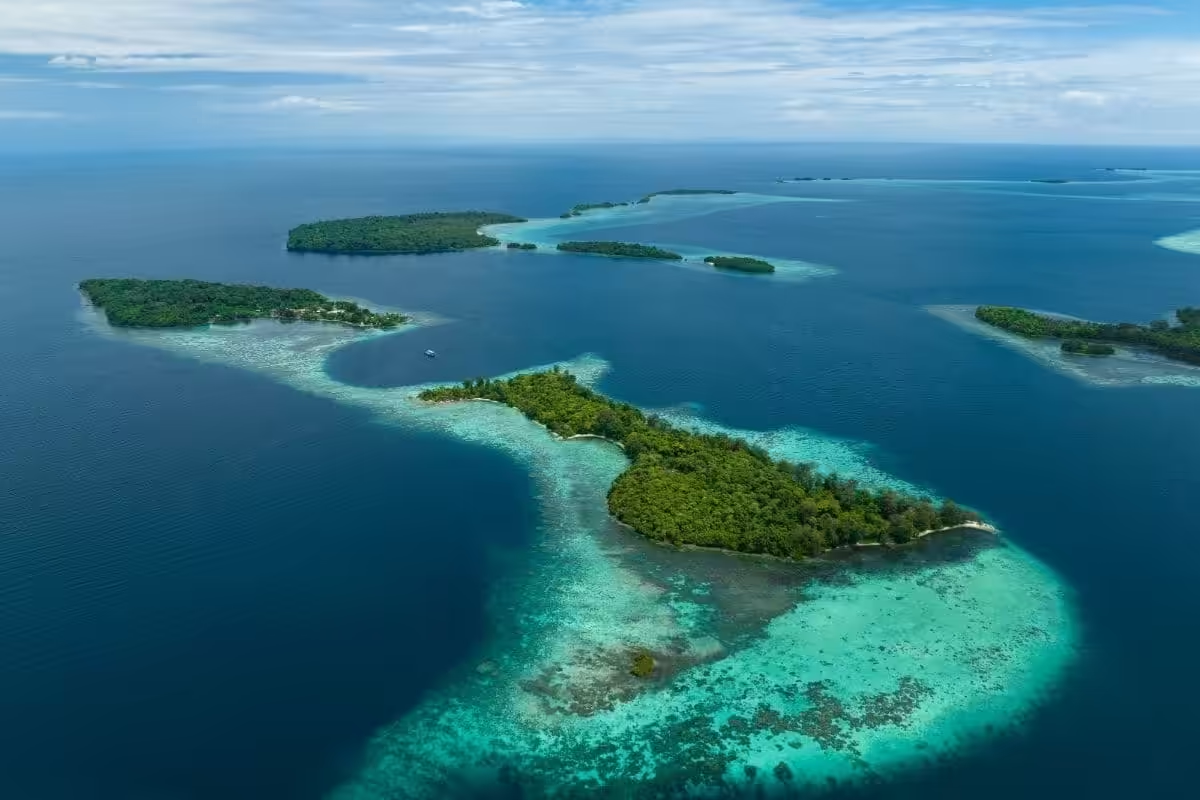
Solomon Islands is a South Pacific island nation of roughly 700,000 people, sitting at the intersection of Asia-Pacific and Commonwealth trade networks, with a growing focus on renewable energy, aquaculture, and regional finance. For companies looking to hire employees in Solomon Islands, the attraction is an English-speaking workforce, strategic regional location, and competitive labour costs. The challenge is compliance. Solomon Islands spreads its employment framework across the Labour Act (Cap. 73), the Employment Act (Cap. 72), the Income Tax Act (Cap. 123), the Solomon Islands National Provident Fund (SINPF) scheme, and work permit rules administered by the Ministry of Commerce, Industry, Labour and Immigration (MCILI).
An employer of record in Solomon Islands becomes the legal employer of your team on the ground, enrols them with the SINPF, withholds income tax at rates up to 40%, remits employer and employee superannuation contributions, sponsors work permits and entry visas, and manages leave and termination compliance so you can build a Solomon Islands team without registering a local company or navigating four separate government agencies.
How an Employer of Record Works in Solomon Islands
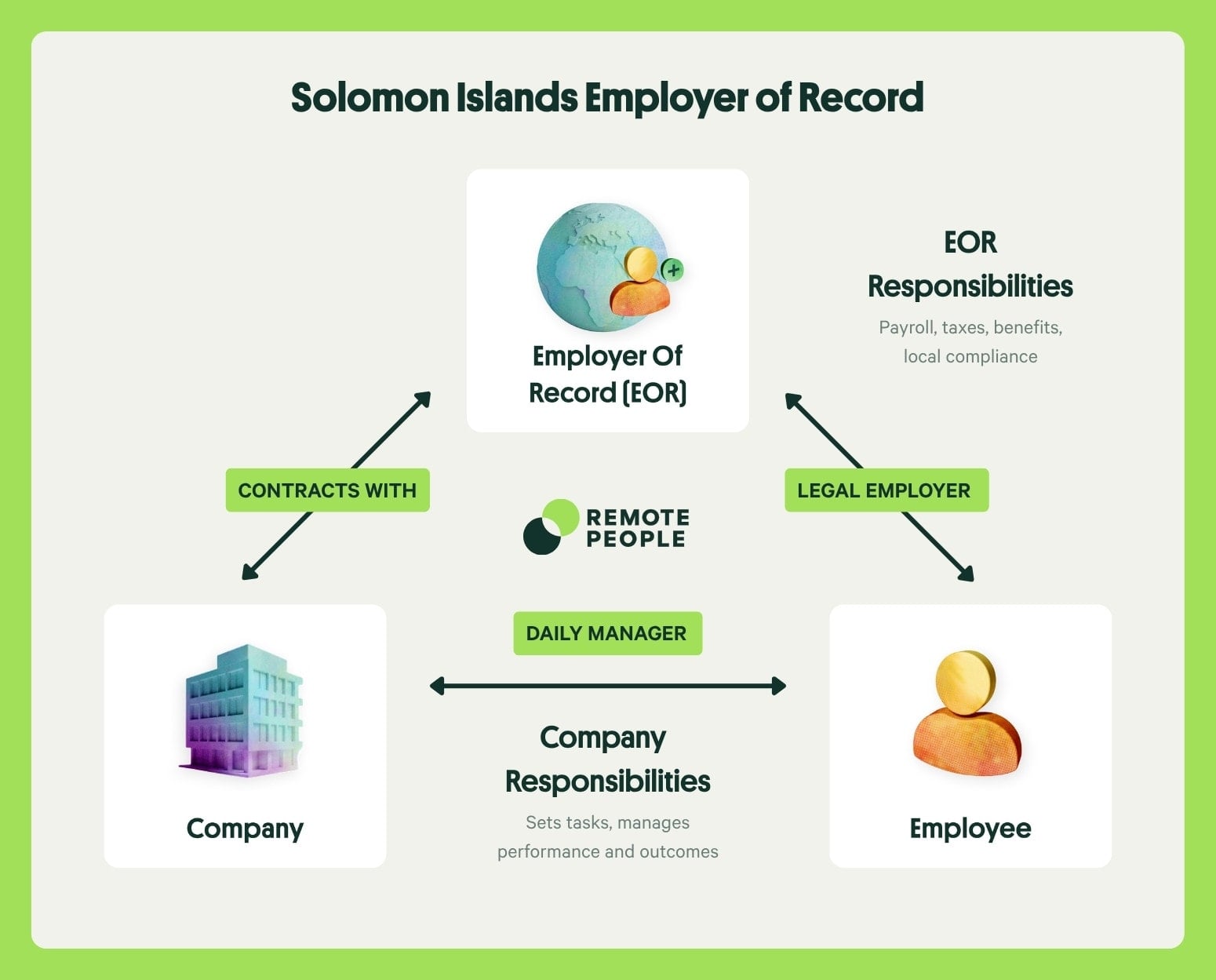
If you’d like to learn more about how Employer of Record (EOR) services work, read our What Is an Employer of Record (EOR)? guide for a complete overview of the model, its benefits, and when to use it.
If you’re comparing providers, our Best Employer of Record (EOR) Providers guide reviews the leading platforms to help you choose the right solution for your business.
Who Uses an EOR in Solomon Islands?
Because Solomon Islands’ employment framework requires direct engagement with four government agencies and statutory compliance with superannuation, tax, and workers’ compensation regimes, EOR demand comes from companies that want one local entity handling everything. Common situations include:
- Testing the Solomon Islands market: A company expanding into the Pacific that wants a small team in Honiara or other provinces for six to twelve months before committing to a registered Solomon Islands company and long-term investment authorisation.
- Small remote teams: Businesses hiring one to ten employees in Solomon Islands for back-office, technical, consulting, or government-support roles, where the cost of incorporating and maintaining local filings outweighs the revenue.
- Fast onboarding of Solomon Islands citizens: Companies needing to put a Solomon Islands national on payroll quickly, with proper SINPF enrolment and income tax withholding from day one rather than treating them as a contractor.
- Hiring non-citizen specialists: Employers that need to bring in a specialist from Australia, Fiji, or elsewhere and sponsor a work permit plus entry visa, without first registering a local company authorised to hire non-citizens.
- Aid-funded and development projects: Organisations executing contracts tied to Australian aid programmes, World Bank initiatives, or multilateral development bank projects that need Solomon Islands-resident staff on compliant employment terms.
In each case, the EOR absorbs the registration, filing, and advisory burden that would otherwise require the client to staff a full in-country HR, tax, and immigration function.
Typical Onboarding Timeline
Most EOR providers can onboard a Solomon Islands-resident citizen employee within two to three weeks, assuming the candidate is already in country. The steps below are sequential but several overlap in practice:
- EOR agreement and employee details: Two to three business days to sign the client-EOR service agreement and collect the new hire’s passport or National Identification Card, tax file number, SINPF membership number (if any), and signed offer.
- Employment contract drafting and review: Three to five days to issue the Solomon Islands-compliant contract, localise it to the employee’s work location, and incorporate client-specific benefits and IP assignment clauses.
- SINPF and tax registration: Five to ten days for SINPF to assign or confirm the member number and for the EOR to register the employee with the IRD for income tax withholding.
- Payroll and benefits setup: Two to three days to load the employee into the payroll system, set up SBD direct deposit to a local bank (BSP, National Bank of Solomon Islands, ANZ, or Westpac), and arrange workers’ compensation cover.
- First day of work: One day to deliver the signed contract, equipment, and client orientation.
When a non-citizen is involved, the timeline extends by six to ten weeks for work permit and entry visa processing: the MCILI issues the work permit, which is a prerequisite to the entry visa application, plus police clearance, medical certification, and employment sponsorship documentation.
Employment Laws and Regulations in Solomon Islands
Employment Contracts
Employment in Solomon Islands is governed primarily by the Labour Act (Cap. 73) and the Employment Act (Cap. 72), which cover contracts of service, wages, leave, termination, and protections. Written contracts are required for any contract of service longer than one month, and in practice nearly all EOR engagements use written contracts from day one. Oral contracts of less than one month are legally recognised but expose employers to evidentiary risk in any dispute, so the EOR convention is always a written, signed agreement. Contracts may be for a fixed term or for an indefinite period; fixed-term contracts are common for development-project and aid-funded work, while indefinite contracts are standard for permanent hires. English is the working language of government and business and is used in virtually all written contracts, though Pidgin English and other languages are also spoken.
Working Hours, Overtime and Rest
The standard working week in Solomon Islands is 45 hours, typically spread over five and a half to six days with a standard day of approximately nine hours or less. Section 26 of the Labour Act (Cap. 73) sets the framework, and the MCILI enforces compliance through inspections and complaint investigation. Time worked beyond the standard 45 hours per week is paid at premium rates, and work on public holidays or rest days attracts double-time. Contracts for managerial and supervisory roles routinely exempt those employees from overtime eligibility. All overtime is treated as ordinary wages for SINPF contributions and income tax withholding.
Solomon Islands overtime and premium pay rates · Per Labour Act (Cap. 73) | |||
Hour Type | Rate Multiplier | Weekly/Daily Cap | Notes |
|---|---|---|---|
Hours over 45/week (weekday) | 1.5x base hourly rate | No statutory absolute cap; must not be excessive | Statutory minimum under the Labour Act (Cap. 73). Must be paid in the pay period worked or by the next cycle. |
Weekly rest day (typically Sunday) | 2.0x base hourly rate | No statutory cap | Statutory rate. Employees are entitled to at least one full day of rest in every seven-day period. |
Public holidays (10 gazetted holidays) | 2.0x base hourly rate | Per holiday worked | Applies to the 10 national holidays gazetted each calendar year. |
Night-shift premium | Contractual (commonly 1.15x to 1.25x) | No statutory cap | Not set by statute. Negotiated in the employment contract or sectoral agreement. |
Managerial / supervisory | Often exempt | n/a | Salaried management is typically excluded from overtime in the written contract. |
Source: Labour Act (Cap. 73) and Solomon Islands Labour Division | |||
Minimum Wage
Solomon Islands’ minimum wage in Solomon Islands is SBD 8.00 per hour for workers in most sectors and SBD 7.20 per hour for workers in agriculture, plantations, and fishing, both effective since 1 August 2019 (Unskilled Workers (Minimum Wages) Order). The most recent rate applies to all private-sector employment covered by the Labour Act (Cap. 73). Youth workers, domestic workers in private households, and certain agricultural piecework arrangements remain outside the standard minimum-wage regime. For a detailed breakdown of how the SBD 8.00 floor applies to different job categories and in-kind benefits, consult the MCILI’s guidance on remuneration compliance.
Probation Period
The Labour Act (Cap. 73) does not set a fixed statutory probation period, but in practice most Solomon Islands employers and EOR providers use a contractual probation period in Solomon Islands of three to six months. During probation, the contract typically permits termination with a shorter notice period (often one week) than applies after the probation clause expires. The EOR writes the probation clause into the employment contract to match the client’s internal policy, keeping it within the three- to six-month range that Solomon Islands courts routinely uphold.
Leave Entitlements
Solomon Islands’ statutory leave regime is set out primarily in the Labour Act (Cap. 73). The statutory entitlements below are a floor; many EOR clients and larger employers provide more generous terms for professional roles.
Annual Leave
Every employee is entitled to paid annual leave of at least 1.25 working days for each completed calendar month of service, translating to a minimum of 15 working days per year under the Labour Act (Cap. 73). Leave accrues from the first day of service and is payable in cash if it cannot reasonably be taken. EOR contracts for professional, technical, and managerial roles commonly enhance this to 20 or more working days, in line with market practice in Honiara and among multinational employers in the region.
Sick Leave
The Labour Act (Cap. 73) provides paid sick leave entitlements, with employees typically receiving paid sick leave for absences due to illness. Medical certificates are required for absences of more than two to three consecutive days. Most EOR-managed contracts for professional roles provide 10 to 15 working days of sick leave per year with carry-forward provisions, reflecting regional market practice.
Maternity Leave
The Labour Act (Cap. 73) provides 12 weeks of maternity leave, consisting of six weeks before confinement and six weeks after, with the employer paying the employee not less than 25% of basic wages for the duration under section 29 of the Act. Job protection during pregnancy relies on the general unfair-dismissal provisions and the contract. The EOR writes explicit job-protection and return-to-work clauses into every contract for female employees in childbearing age ranges.
Paternity Leave
Solomon Islands has no statutory paternity leave requirement in the private sector. EOR providers commonly offer a discretionary three to five working days of paid paternity leave, aligned with regional and multinational practice.
Other Statutory Leave
Solomon Islands recognises several additional categories of leave under the Labour Act (Cap. 73) and subsidiary regulations, which are routinely adopted in private-sector contracts:
- Long service leave: Entitlements after 10+ years of service, typically pro-rata on termination.
- Compassionate / bereavement leave: Typically three working days for the death of an immediate family member; contractual in the private sector and almost always granted.
- Court / jury duty leave: Paid leave for employees required to appear as witnesses or jurors in Solomon Islands courts.
- Study leave: Unpaid or partially paid leave available at the employer’s discretion for approved study.
- Leave to vote: Reasonable time off to vote in national and local elections.
The table below summarises the combined statutory and typical-contract leave framework that most EOR providers apply.
Solomon Islands statutory leave entitlements · Per Labour Act (Cap. 73) | ||
Leave Type | Duration | Eligibility & Notes |
|---|---|---|
Annual (recreation) leave | 15 working days per 12 months of service (statutory) | Accrues from day one at 1.25 days per calendar month. Professional contracts commonly enhance to 20+ working days. |
Sick leave | Per contract; typically 10–15 days/year | Medical certificate required for 3+ consecutive days. Professional contracts commonly provide 10–15 days with carry-forward. |
Maternity leave | 12 weeks (6 weeks before + 6 weeks after) | Employer pays at least 25% of basic wages. Labour Act (Cap. 73) s. 29. |
Paternity leave | 3–5 working days (contractual) | No statutory entitlement. Typically granted as discretionary paid leave. |
Long service leave | Pro-rata after 10+ years of service | Contractual provision common in EOR arrangements. |
Compassionate / bereavement leave | 3 working days (contractual) | Limited to immediate family. Almost always granted despite no statutory minimum. |
Public holidays | 10 paid days per year | Gazetted annually. Work on a public holiday attracts 2x pay. |
Source: Labour Act (Cap. 73) and Solomon Islands Labour Division | ||
Statutory Employee Benefits
Beyond wages, statutory superannuation, and tax, Solomon Islands imposes several mandatory benefits and protections that an EOR must provide. A detailed guide to employee benefits in Solomon Islands covers all statutory entitlements:
- Superannuation contributions: 7.5% employer and 5% employee of gross basic salary and overtime, remitted to the SINPF by the 15th of the month following the payroll period, with a 2% surcharge if late. Participation is mandatory for every employee.
- Workers’ compensation insurance: Employers are required under the Workmen’s Compensation Act (Cap. 78) to carry compulsory insurance cover for work-related injury, disease, and death. Policies are placed with licensed insurers in the Solomon Islands market; the EOR selects a compliant carrier and pays the annual premium.
- Income tax withholding and remittance: Employers are required to withhold graduated income tax under the Income Tax Act (Cap. 123) and remit it to the IRD by the 15th of the following month. This is a compliance obligation rather than a benefit, but failure to comply exposes the employer (and therefore the client of the EOR) to penalties and interest.
- Public holiday pay: Employers observe the 10 national holidays gazetted each calendar year, with paid time off and double-time pay if work is required on those days.
- Private health cover: Not statutory, but increasingly common for professional and expatriate staff given the reliance on private health services. The EOR typically arranges optional health insurance at the employee’s discretion.
Unlike many jurisdictions, Solomon Islands has no statutory 13th-month salary, no national health insurance levy, and no unemployment insurance contribution. All statutory contribution rates and remittance deadlines are shown in the employer and employee contribution tables in the Payroll section below.
Recent Regulatory Updates (2026)
As of 2026, Solomon Islands’ employment regulations remain stable with no major statutory reforms to the Labour Act (Cap. 73) or the Employment Act (Cap. 72) since the last major gazetted change. The SINPF continues to operate under the National Provident Fund Act (Cap. 128) with the current 7.5% employer / 5% employee contribution framework. The Income Tax Act (Cap. 123) income tax bands and thresholds have not changed materially. Employers and EOR providers should monitor the MCILI and Inland Revenue Division websites for any gazetted amendments or regulatory guidance, particularly around work permit processing timelines and SINPF compliance deadlines.
Work Permits and Visas in Solomon Islands
Work Permit Requirements
Who Needs a Work Permit
Solomon Islands citizens need no permit to work in their own country. All non-citizens require a work permit issued by the MCILI under the Employment of Non-Citizens Regulations before taking up employment, and a separate entry visa issued through the MCILI Immigration Services before entering Solomon Islands. The work permit is tied to a specific employer and role; a change of employer or material change of role requires a new application. Short-term business activities (meetings, conferences, non-remunerated advisory work) can be conducted on a business visa without a work permit, but any remunerated engagement requires the permit-plus-visa combination.
Eligibility and Required Documents
For non-citizens, the work permit application requires the sponsoring employer (the EOR, in this model) to demonstrate that the role cannot reasonably be filled by a Solomon Islands citizen, and to submit the following:
- Passport valid for at least 12 months beyond the intended period of stay
- Signed employment contract specifying position, duration, and compensation in SBD
- Curriculum vitae and evidence of qualifications relevant to the role
- Police clearance from each country where the applicant has resided for 12 months or more in the past five years
- Medical certificate confirming fitness to work
- Employer sponsorship letter, business registration, and proof of local operating status of the sponsor
- Evidence that no qualified Solomon Islands citizens are available for the role
- Work permit fee paid to the MCILI
Processing Time and Validity
Work permit processing typically takes two to three weeks once a complete application is submitted, and the entry visa processing may take a further one to two weeks at the Immigration Services. The initial work permit is usually issued for 12 or 24 months, tied to the sponsoring employer, and renewable. The employee must hold both the work permit and corresponding entry visa before travelling. Delays most often come from missing police clearances, incomplete qualifications documentation, or gaps in the local employment preference justification.
Renewal Process
Renewal applications are filed with the MCILI before the current permit expires, typically at least 60 days in advance. Documentation includes an updated employment contract, current passport, and evidence that the role still cannot be filled by a Solomon Islands citizen. Employees with a valid and pending renewal may continue to work while the renewal is under review, provided the application was lodged before the expiration date. The EOR coordinates renewals on behalf of the employee and the client.
Common Visa Types for Foreign Workers
Solomon Islands’ immigration framework separates the work permit (issued by the MCILI) from the entry visa (issued through MCILI Immigration). The work permit authorises employment; the entry visa authorises entry and stay. Both are required for any non-citizen taking up remunerated work. The table below covers the main visa categories an EOR sponsors for the client company’s employees.
Solomon Islands work visa types for foreign workers · 2026 | ||||
Visa Type | Duration | Best For | Requires Work Permit? | Processing Time |
|---|---|---|---|---|
Employment Visa (Long-term) | 12–24 months | Professional and skilled workers taking up employment with a registered employer | Yes – work permit required first | 2–3 weeks (work permit) + 1–2 weeks (visa) |
Business Visitor Visa | 30 days (extendable) | Short-term business meetings, conferences, non-remunerated consultations, investor visits | No – business activity only, no remuneration | 3–5 days on arrival or pre-arrival |
Visitor Visa | 30 days (extendable) | Tourism, family visits, short recreational stays | No – non-work activity only | On arrival (visa exemption or on-arrival visa available for many nationalities) |
Spouse / Partner Visa | 12 months (renewable) | Spouses and de facto partners of Solomon Islands citizens or work permit holders | No – dependent visa only | 3–4 weeks |
Student Visa | Duration of course + grace period | Enrolment in accredited educational institutions in Solomon Islands | No – study only | 2–3 weeks |
Payroll, Taxes, and Social Security in Solomon Islands
Employer Contributions
Employers in Solomon Islands are responsible for remitting several statutory contributions on behalf of their employees. The primary obligations are superannuation contributions to the SINPF and workers’ compensation insurance. Both are mandatory and must be remitted on time to avoid penalties and interest surcharges.
Solomon Islands employer social security contributions · 2026 rates | |||
Contribution | Rate | Calculation Base | Remittance & Notes |
|---|---|---|---|
SINPF (Superannuation) | 7.5% employer | Gross basic salary + overtime | Monthly remittance to SINPF; 2% surcharge if late. Registration within 14 days of hire. |
Workers’ Compensation Insurance | Varies by industry risk classification | Gross payroll (or portion thereof per insurance terms) | Annual premium to licensed insurer under Workmen’s Compensation Act (Cap. 78). Required for all employees. |
Source: SINPF and Solomon Islands Labour Division | |||
Employee Deductions
The primary statutory deduction from employee pay is income tax withheld by the employer under the Income Tax Act (Cap. 123). SINPF contributions are also deducted from gross pay, and both appear on payslips. Voluntary deductions (union dues, loans, health insurance) may be included with signed employee authorisation. All deductions must be remitted to the correct authority or fund holder on time.
Solomon Islands employee payroll deductions · 2026 monthly withholdings | |||
Deduction | Rate / Amount | Applied To | Remittance & Notes |
|---|---|---|---|
Income tax (PAYE) | 0–40% (graduated) | Gross salary; see tax brackets table below | Remit to IRD by 15th of following month. Annual statement due 31 January of following tax year. |
SINPF (Superannuation) | 5% employee | Gross basic salary + overtime | Remit to SINPF monthly with employer’s 7.5%; 2% surcharge if late. Mandatory for all employees. |
Voluntary deductions | Per signed authorisation | Net salary | Union fees, charitable donations, health insurance, loans, etc. Requires written employee consent. |
Source: Inland Revenue Division and SINPF | |||
Income Tax Brackets and Thresholds
Solomon Islands operates a graduated income tax system under the Income Tax Act (Cap. 123). Employers withhold tax on a monthly basis using the IRD tax tables, and the first SBD 30,080 of annual taxable income is subject to a zero initial rate before the graduated brackets apply. The rates shown below are the current statutory rates in effect for the 2026 tax year.
Solomon Islands income tax brackets · 2026 | ||
Annual Taxable Income (SBD) | Rate | Tax Calculation |
|---|---|---|
0 – 30,080 | 0% | No tax (tax-free threshold) |
30,081 – 45,080 | 11% | 11% of amount over 30,080 |
45,081 – 60,080 | 23% | 1,650 + 23% of amount over 45,080 |
60,081 – 90,080 | 35% | 5,100 + 35% of amount over 60,080 |
90,081 and above | 40% | 15,600 + 40% of amount over 90,080 |
Source: Inland Revenue Division and A Guide to Income Tax | ||
Tax and Contribution Remittance
All withholdings must be remitted to the correct authorities by strict deadlines. The Inland Revenue Division (IRD) requires PAYE remittance by the 15th of the month following the payroll period, and SINPF contributions must be remitted to the SINPF by the same deadline. Failure to remit on time triggers a 2% monthly surcharge on SINPF contributions and penalties on income tax under the Income Tax Act (Cap. 123). Annual tax documentation (similar to a P60 statement) must be filed with the IRD by 31 January of the following tax year.
Cost of Hiring in Solomon Islands
Employer Cost Breakdown
The total cost of hiring an employee in Solomon Islands includes the gross salary, statutory contributions, and optional benefits. The example below illustrates the monthly and annual cost of hiring a professional employee earning USD 2,500 gross per month (approximately SBD 20,080 at the April 2026 exchange rate of 1 USD = SBD 8.03). This is a realistic mid-range professional salary in Honiara.
Solomon Islands employer cost example · USD 2,500 gross · 2026 | ||
Cost Item | Monthly (USD) | Annual (USD) |
|---|---|---|
Gross salary | 2,500 | 30,000 |
SINPF employer contribution (7.5%) | 187.50 | 2,250 |
Workers’ compensation insurance (est. 1–2% of payroll) | 25–50 | 300–600 |
EOR service fee (typical range) | 100–150 | 1,200–1,800 |
Total monthly cost (employer) | 2,813–2,888 | 33,750–34,650 |
Total annual cost (employer) | – | 33,750–34,650 |
Note: Exchange rate 1 USD = SBD 8.03 (April 2026). Workers’ compensation premium varies by industry and risk. EOR fees vary by provider and complexity. This example assumes a professional-grade employee in Honiara with no public holiday or leave payouts in the month of calculation. | ||
Benefits of Using an EOR in Solomon Islands
Using an employer of record to hire in Solomon Islands delivers strategic advantages beyond compliance. An EOR service removes the operational and regulatory burden of managing a local employment infrastructure, freeing your organisation to focus on growth and market entry. The following benefits are particularly valuable for companies scaling teams in the Pacific region.
- Speed to market: Onboard your first Solomon Islands employee in 2-3 weeks instead of 8-12 weeks required to incorporate a local company, open a bank account, and register with four government agencies. A compliant hire can start work within days of signing the EOR agreement.
- Compliance assurance: The EOR holds all employment and tax compliance risk. Your team receives payslips with correct tax withholding, SINPF contributions are remitted on time, work permits are current, and leave is tracked against statutory entitlements. No in-country HR infrastructure is needed.
- Cost efficiency: Avoid the fixed costs of registering a Solomon Islands company (registration, annual filings, local director fees, accounting). An EOR’s per-employee fee typically saves 30-50% compared to the cost of a local entity for teams under 20 people.
- Local expertise and relationships: The EOR maintains relationships with the MCILI, Inland Revenue Division, SINPF, licensed workers’ compensation insurers, and local banks. They navigate policy changes, administrative delays, and regulatory inquiries on your behalf, eliminating the need to build these networks yourself.
- Flexibility to scale: Add or reduce headcount month-to-month without restructuring a legal entity or unwinding a registered company. EOR agreements are designed for rapid scaling and contraction, making them ideal for project-based, seasonal, or pilot hires.
- Risk mitigation: The EOR assumes employment contract liability, termination compliance, and workers’ compensation insurance as the legal employer. Your exposure is limited to the services agreement with the EOR provider.
- Employee experience: Employees receive professional payslips, tax documentation, superannuation statements, and leave management through a single point of contact. The EOR’s admin and payroll teams handle all government interactions, reducing friction for your team members.
Whether you are testing the Solomon Islands market, building a small remote team, or scaling quickly, an EOR removes barriers to hiring local talent. Get in touch to discuss your hiring needs.
Termination, Notice Periods and Severance in Solomon Islands
Statutory Notice Periods
The Labour Act (Cap. 73) requires employers and employees to provide written notice of termination. The length of notice depends on the length of service and whether the termination is for cause or without cause. Notice may be given by either party, and the contract may specify notice periods that are more generous than the statutory minimum. Failure to provide the required notice may result in the employer being liable for payment in lieu of notice or damages for wrongful termination.
Solomon Islands statutory notice periods by position level · Per Labour Act (Cap. 73) | |||
Employment Stage / Role | Employer Notice | Employee Notice | Notes |
|---|---|---|---|
During probation (0–6 months) | 1 week | 1 week | Either party may terminate with one week’s written notice during probation period. |
First year of employment | 1 month | 1 month | After probation expires, one month notice required by both parties. |
1–3 years of service | 1 month | 1 month | Standard notice period for mid-tenure employees. |
3 years+ of service | 1 month | 1 month | Notice may be contractually extended to 2–3 months for senior or specialist roles. |
Senior management / executives | 3–6 months (contractual) | 3–6 months (contractual) | Extended notice periods are standard in executive contracts. |
Source: Labour Act (Cap. 73) and Solomon Islands Labour Division | |||
Severance and Retrenchment Pay
The Labour Act (Cap. 73) requires employers to pay severance compensation when an employee is terminated due to business closure, retrenchment, or role elimination (redundancy). Severance is not required for voluntary resignation, termination for cause (misconduct), or completion of a fixed-term contract, but employers often provide exit packages as market practice. The severance formula is calculated on the basis of length of service and final salary. The table below shows the statutory minimum severance entitlements.
Solomon Islands severance pay schedule by years of service · Per Labour Act (Cap. 73) | ||
Years of Continuous Service | Severance Entitlement | Notes |
|---|---|---|
Less than 1 year | No statutory severance | Termination during first year generally does not trigger severance, unless contracted otherwise. |
1–3 years | 2 weeks’ basic wages per year of service | Basic wage calculation includes ordinary wages, excludes overtime and irregular payments. |
3–10 years | 2–4 weeks’ basic wages per year of service | Sliding scale; exact formula depends on circumstances and contract terms. |
10+ years | 4–6 weeks’ basic wages per year of service | Long-service employees receive higher severance entitlements; pro-rata on part years. |
Source: Labour Act (Cap. 73) and Solomon Islands Labour Division | ||
Calculation Method
Severance in Solomon Islands is calculated on “basic wages” as defined in the Labour Act (Cap. 73), which means ordinary monthly or weekly wages excluding overtime, bonuses, commission, and irregular allowances. The formula multiplies the number of completed years of continuous service by the applicable weekly rate from the table above. Refer to Table 13 for the worked tier examples; the prose here does not duplicate those numbers. Pro-rata calculations apply to partial years of service above the 1-year threshold.
Caps and Exceptions
The Labour Act (Cap. 73) does not impose an absolute monetary cap on statutory severance in Solomon Islands, but entitlements do not apply during the probation period or when dismissal is for serious misconduct properly documented under the Act. Fixed-term contracts that run their course are not entitled to severance, though contractual exit packages are common. Employees dismissed without valid cause may also claim additional compensation through the Trade Disputes Panel, which can award re-engagement or further damages beyond the statutory severance formula.
EOR vs. Other Hiring Models in Solomon Islands
EOR vs. Local Company Registration
Setting up a local company in Solomon Islands requires business registration with the MCILI, a bank account, and ongoing compliance filings. An EOR offloads all of these in exchange for a service fee, typically 8–15% of payroll depending on complexity and whether work permits are involved. For companies hiring one to five employees for fewer than 18 months, an EOR is almost always more cost-effective and faster than registering a local entity. For larger, permanent operations (10+ employees, indefinite duration), a registered company may eventually become more cost-effective because you eliminate the EOR service fee and gain operational control and liability protection. However, setting up a local company in Solomon Islands requires MCILI approvals, local director appointments, and ongoing compliance costs (accounting, audit, tax filings) that run SBD 15,000–25,000 per year.
Solomon Islands EOR vs local entity comparison · Setup time, cost, risk and best-fit | ||
Factor | EOR Model | Local Company Registration |
|---|---|---|
Setup time | 2–3 weeks (employee only); 6–10 weeks (with work permit) | 8–12 weeks (MCILI approval, bank account, director appointments) |
Setup cost | SBD 500–2,000 (one-time EOR agreement + admin) | SBD 5,000–10,000 (registration, legal, accounting, audit setup) |
Ongoing monthly cost | 8–15% of gross payroll | Salary + superannuation + insurance + ~SBD 1,500–2,000 accounting and compliance |
Payroll liability | EOR is legal employer; client company has limited liability if EOR complies | Local company is liable for all wage, tax, and superannuation compliance |
Employment contracts | EOR drafts and holds contract; client company provides work direction | Local company drafts and holds contract; full operational control |
Work permit sponsorship | EOR handles sponsorship on behalf of client | Local company sponsors non-citizen employees directly |
Tax and SINPF compliance | EOR handles all withholdings and remittances; client company reimburses | Local company handles all withholdings and remittances directly |
Best for | Short-term pilots (6–18 months), small teams (1–10 employees), market testing | Permanent operations (2+ years), large teams (10+ employees), full operational control needed |
Source: Comparative analysis based on Solomon Islands law and EOR industry practice | ||
EOR vs. Independent Contractors
Using independent contractors (1099-equivalent arrangements in Solomon Islands) avoids many compliance costs because contractors are self-employed and responsible for their own taxes and superannuation. However, contractors cannot receive benefits like leave entitlements, public holiday pay, or workers’ compensation. Misclassifying an employee as a contractor exposes the client company to liability for unpaid superannuation, tax withholding, and potential back-pay claims. The MCILI actively investigates contractor–employee misclassification in formal sectors. An EOR ensures the individual is properly classified as an employee, receives all statutory benefits, and is compliant with labour law from day one.
Solomon Islands EOR vs independent contractors · Compliance, cost, and risk | ||
Factor | EOR (Employee) | Independent Contractor |
|---|---|---|
Legal relationship | Employee; full Labour Act (Cap. 73) protections apply | Self-employed; no employment protections |
Superannuation (SINPF) | Mandatory 7.5% employer + 5% employee contributions | Contractor’s responsibility; often none |
Income tax withholding | Employer withholds; remits to IRD monthly | Contractor files own tax return and pays tax on invoice value |
Annual leave | 15 working days minimum per year (statutory) | No entitlement; income continues only if actively working |
Sick leave and maternity | Sick leave and 12 weeks maternity (statutory) | No paid leave; period of non-work = no income |
Workers’ compensation cover | Mandatory employer insurance under Workmen’s Compensation Act (Cap. 78) | No coverage; contractor responsible for own insurance |
Public holiday pay | 10 paid holidays per year; double-time if worked | No automatic holiday pay; contractual only |
Termination notice | Statutory notice periods apply; severance may be owed | Contract termination only; no severance |
Misclassification risk | No misclassification risk; employee status clear | High risk of reclassification by MCILI; back-pay exposure |
Best for | Full-time roles, permanent or long-term engagements (6+ months) | Project-based, task-specific, or short-term (under 3 months) work only |
Source: Labour Act (Cap. 73), Employment Act (Cap. 72), and Workmen’s Compensation Act (Cap. 78) | ||
EOR vs. Professional Employer Organisation (PEO)
A PEO (Professional Employer Organisation) is a company that takes on co-employer status with the client company, sharing HR, payroll, and compliance responsibilities. In Solomon Islands, the PEO market is nascent and limited; most international PEO firms (ADP, TriNet, etc.) do not operate there. An EOR remains the sole employer of the employee on the contract and on all government filings, whereas a PEO shares employment responsibility. For Solomon Islands operations, an EOR is the more practical and available model. If a true PEO arrangement were available, it would offer less separation of liability than an EOR but potentially more integrated HR technology and reporting.
Solomon Islands EOR vs PEO comparison · Legal employer, liability, and setup | ||
Factor | EOR (Sole Employer) | PEO (Co-Employer) |
|---|---|---|
Legal employer status | EOR is sole employer on employment contract and all government filings | PEO and client company are co-employers; split responsibilities |
Liability for employment law | EOR holds liability for wage, tax, superannuation, and leave compliance | Liability is shared; PEO handles some functions, client company retains operational control |
Payroll and tax compliance | EOR handles all payroll, tax withholding, SINPF, and remittances | Typically split; PEO handles payroll and tax, client company may handle HR decisions |
HR systems and technology | EOR provides basic HR/payroll platform; integration may be limited | PEO typically provides integrated HR, payroll, benefits, and reporting platforms |
Availability in Solomon Islands | Multiple established EOR providers operate | PEO market is underdeveloped; few or no major international PEOs present |
Best for | Companies seeking clean separation of liability; smaller operations; market entry | Larger, integrated HR operations where shared liability and technology is acceptable (if available) |
Source: EOR and PEO industry definitions and comparative practice | ||
Public Holidays in Solomon Islands
Solomon Islands observes 10 statutory public holidays each calendar year, gazetted by the government. All full-time employees are entitled to paid time off on these days, and any work performed on a public holiday attracts double-time pay (2.0x the base hourly rate) under the Labour Act (Cap. 73). The holidays listed below are the gazetted dates for 2026. On years when a holiday falls on a weekend, the following Monday is typically observed as a substitute holiday.
Solomon Islands public holidays · 2026 calendar year | ||
Holiday Name | Date (2026) | Notes |
|---|---|---|
New Year’s Day | Friday, 1 January | National holiday |
Good Friday | Friday, 3 April | Easter period; moveable |
Easter Saturday | Saturday, 4 April | Easter period; moveable |
Easter Monday | Monday, 6 April | Easter period; moveable |
Whit Monday | Monday, 25 May | Moveable; 50 days after Easter |
The Queen’s Official Birthday (King’s Birthday) | Friday, 12 June | Honour the reigning monarch |
Independence Day | Tuesday, 7 July | Celebrates independence from the United Kingdom (7 July 1978) |
Christmas Day | Monday, 25 December | National holiday |
Boxing Day | Tuesday, 26 December | Day after Christmas |
Additional public holiday (government-declared) | Variable | One additional day may be gazetted in any given year |
Source: Time and Date and Solomon Islands Labour Division | ||
How to Get Started with an EOR in Solomon Islands
Starting your Solomon Islands team with an EOR is a structured, five-step process that typically takes 2-3 weeks from agreement signature to first day of work (or 8-12 weeks if you need a work permit for a non-citizen). Here is how it works:
- First, share your hiring requirements – Tell the EOR your job title, role description, salary target, start date, and any special requirements (work permit needed, contract length, specific location within Solomon Islands). The EOR will confirm the feasibility, local market rates, and any visa or documentation needs based on your candidate’s citizenship.
- Second, sign the EOR service agreement – Execute the master services agreement (MSA) between your company and the EOR. This agreement sets out fees, payment terms, liability, termination provisions, and the scope of the EOR’s responsibilities. Most agreements are 12 months with monthly billing.
- Third, collect employee documentation – Gather your candidate’s passport, National Identification Card (if Solomon Islands citizen), tax file number (if any), SINPF membership number (if existing member), signed offer letter, and any required background checks or certifications. The EOR will prepare the employment contract and send it for signature.
- Fourth, complete SINPF and IRD registration – The EOR registers your employee with the Solomon Islands National Provident Fund (SINPF) and the Inland Revenue Division (IRD) for income tax withholding. If a work permit is needed, the EOR submits the application to the Ministry of Commerce, Industry, Labour and Immigration (MCILI) and coordinates police clearance and medical certification.
- Fifth, onboard your Solomon Islands team member – Set up payroll, direct deposit to a local bank, workers’ compensation insurance, and hardware/systems access. Your employee receives a signed contract, payslip template, superannuation statement, leave balance, and company orientation on their first day.
Throughout this process, the EOR handles all compliance, documentation, and government liaison. Your only involvement is confirming role details, collecting employee documents, and approving the contract terms. Ready to hire in Solomon Islands? Contact us to start the conversation.
Where companies hiring in the Solomon Islands expand next
Companies operating in the Solomon Islands often extend across the Asia-Pacific, drawing on English-speaking talent and aligned business culture. Many companies add an EOR partner in Australia first, drawing on the regional Pacific talent footprint. New Zealand follows as Pacific-region proximity and English-first hiring, while a team in Fiji offers aligned Pacific workforce norms. Operations in Papua New Guinea is often the fourth step, valued for shared Pacific business rhythm.
Frequently Asked Questions
The statutory minimum wage in Solomon Islands is SBD 8.00 per hour for workers in most sectors, and SBD 7.20 per hour for workers in agriculture, plantations, and fishing. Both rates have been in effect since 1 August 2019. These rates are set by the Unskilled Workers (Minimum Wages) Order and apply to all private-sector employment covered by the Labour Act (Cap. 73).
Employers contribute 7.5% of gross basic salary and overtime to the SINPF, and employees contribute 5%. Both contributions are mandatory under the National Provident Fund Act (Cap. 128). The employer's 7.5% must be remitted to SINPF by the 15th of the month following the payroll period. A 2% surcharge is applied if remittances are late.
Every employee is entitled to a minimum of 15 working days of paid annual leave per year (accruing at 1.25 days per calendar month of service) under the Labour Act (Cap. 73). Leave accrues from the first day of employment and is payable in cash if it cannot be taken. Professional and managerial contracts commonly enhance this to 20 or more working days.
Work permit processing through the MCILI typically takes 2–3 weeks once a complete application is submitted. The entry visa through Immigration may take a further 1–2 weeks. Non-citizens must obtain both the work permit and entry visa before taking up employment or entering the country. For employees already in-country, processing may be slightly faster.
Solomon Islands does not currently offer a dedicated digital nomad visa as of 2026. Foreign remote workers or digital nomads would need to apply for a Business Visitor Visa (for short stays of up to 30 days without remuneration) or an Employment Visa (if sponsoring themselves as a contractor). The remote work visa category has not been adopted in Solomon Islands law.
The total cost includes gross salary, SINPF contributions (7.5% employer), workers' compensation insurance (typically 1–2% of payroll), and the EOR service fee (usually 8–15% of gross payroll). For a USD 2,500 gross monthly salary, the total monthly employer cost is roughly USD 2,813–2,888, or USD 33,750–34,650 per year, depending on insurance premiums and EOR fees.
If an employee is terminated without cause (retrenchment or redundancy), the employer must provide statutory notice (typically one month after probation) and pay severance compensation based on length of service under the Labour Act (Cap. 73). For employees with 1–3 years of service, severance is approximately 2 weeks' basic wages per year of service. Employees must also be paid for any accrued annual leave and sick leave. If the termination is for cause (misconduct), severance may not be owed, but proper disciplinary procedures must be followed.
Yes, the EOR can and typically does sponsor work permits on behalf of the foreign employee through the MCILI. The EOR is listed as the sponsoring employer, and the foreign employee's work permit is tied to that EOR. If the employee later switches to a local company, the work permit must be transferred or a new one obtained. The EOR manages the entire application, documentation, and renewal process.
Employer of Record in
Employer of Record in
Employer of Record in
Employer of Record in
Employer of Record in
Employer of Record in
Employer of Record in
Employer of Record in




