
 Recruit
Employer of Record in Samoa
-
 Drew Donnelly
- Published
- September 22, 2026
RemotePeople’s employer of record in Samoa lets you hire employees in Samoa with Samoa National Provident Fund compliance. We handle mandatory SNPF pension contributions, employment permits for non-citizens, and Labor and Employment Relations Act compliance.
Hire in Samoa — book a free 30-minute demo
Tell us what you need. You'll get a tailored, transparent proposal within 24 hours, plus a free call to walk through it.
Tell us about your company
So we can match you with a specialist who knows your market — and unlock volume pricing tiers.
* All fields are required.
Where and when are you hiring?
Tell us the geography and timing and we'll quote each country line by line, with onboarding timelines.
* All fields are required.
Help us beat your current setup
We'll benchmark your current deal and send a line-by-line proposal in 24 hours — showing exactly where we cut cost, time, or risk. After you submit, you can book a call to walk through it together.
* All fields are required.
Thanks! Your proposal is on its way.
Expect a tailored, line-by-line proposal in your inbox within 24 hours. In the meantime…
Want to walk through it together?
Book a free 30-minute call with one of our specialists. We'll explain every line, answer your questions, and tailor the proposal further if you need.
No obligation. Pick a time that works for you.








- Hire in Samoa — book a free 30-minute demo
- Tell us about your company
- Where and when are you hiring?
- Help us beat your current setup
- Thanks! Your proposal is on its way.
- How an Employer of Record Works in Samoa
- Employment Laws and Regulations in Samoa
- Work Permits and Visas in Samoa
- Payroll, Taxes, and Social Security in Samoa
- Cost of Hiring Through an EOR in Samoa
- Benefits of Using an EOR in Samoa
- Termination and Offboarding in Samoa
- EOR vs. Other Hiring Models in Samoa
- Public Holidays in Samoa
- How to Get Started with an EOR in Samoa
- Where companies hiring in Samoa expand next
- Frequently Asked Questions
- Related EOR Destinations

Start hiring in Samoa
Let RemotePeople handle payroll, compliance, and HR admin worldwide so you can focus on building your team.

Samoa offers a bilingual (Samoan and English) workforce in the Pacific region, a stable parliamentary democracy, and a cost base well below New Zealand and Australian benchmarks. The statutory framework is compact but specific, with the Labour and Employment Relations Act 2013 alongside parallel tax, social security, and workplace-accident laws. An employer of record in Samoa becomes the legal employer for your hires, handling contracts, payroll in Samoan tala, PAYE filings with MCR, and contributions to SNPF and ACC, so you can onboard a team without incorporating locally. This guide walks through Samoa’s payroll, leave and termination rules, work permit routes, and the real cost of an EOR hire in 2026.
How an Employer of Record Works in Samoa
An employer of record in Samoa is the legal employer for your hires under the Labour and Employment Relations Act 2013, while your business retains day-to-day operational control. The EOR signs the employment contract, runs monthly payroll in Samoan tala (WST), registers the worker with the Samoa National Provident Fund, remits the 1% Accident Compensation Corporation levy, withholds PAYE income tax to the Ministry of Customs and Revenue, and manages statutory leave, notice, and redundancy procedures. You direct the employee’s work, approve deliverables, and set compensation, but the compliance and payroll mechanics sit with the EOR.
This model suits Samoa because the country’s regulatory framework expects formal written contracts, tala-denominated payments, and prompt filings with three separate agencies, conditions that are expensive to service through a one-off local entity.
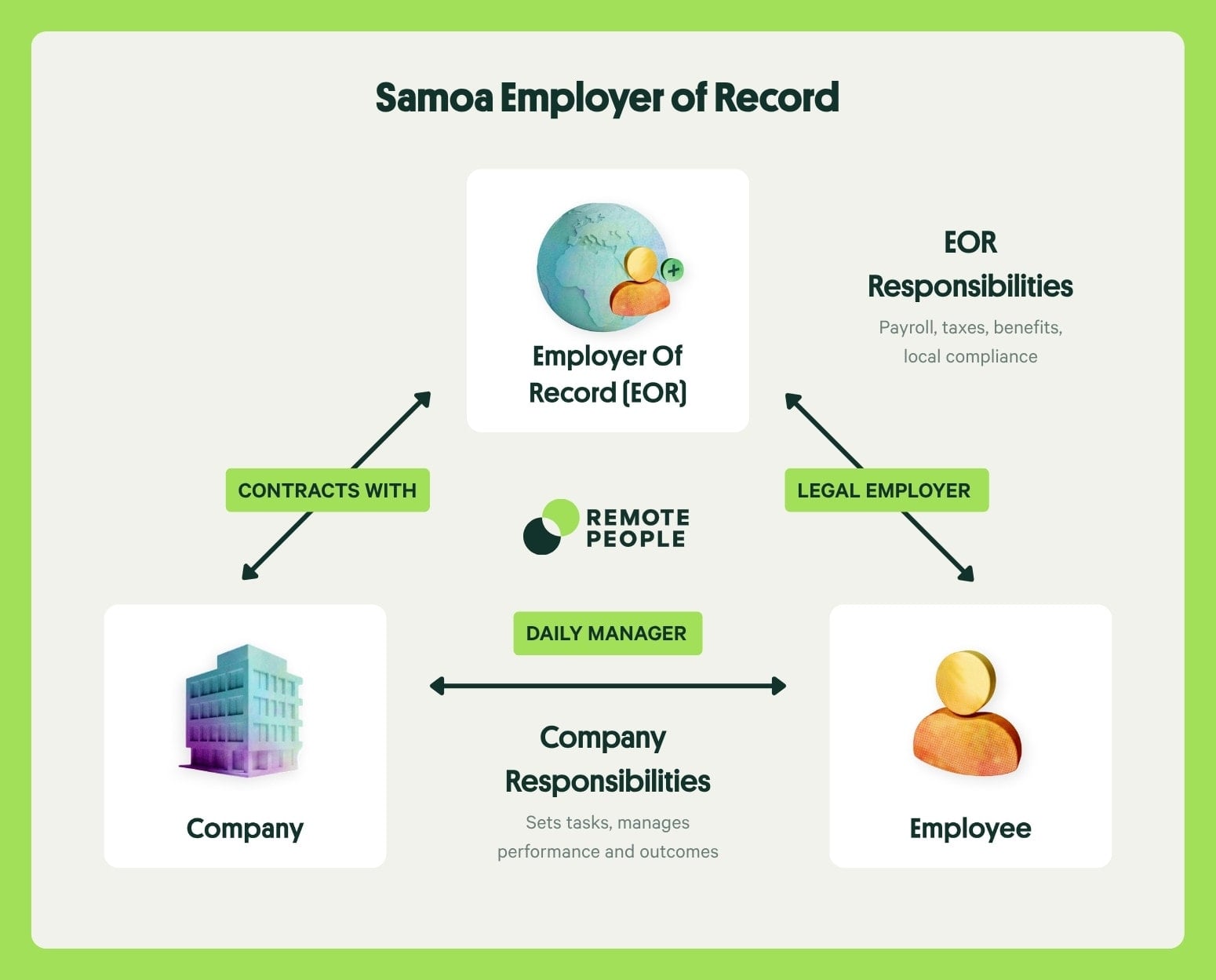
If you’d like to learn more about how Employer of Record (EOR) services work, read our What Is an Employer of Record (EOR)? guide for a complete overview of the model, its benefits, and when to use it.
If you’re comparing providers, our Best Employer of Record (EOR) Providers guide reviews the leading platforms to help you choose the right solution for your business.
Who Uses an EOR in Samoa?
Companies turn to an EOR in Samoa when a local entity would be disproportionate to the headcount, when speed-to-hire matters more than long-term physical presence, or when the hire depends on a foreign employment permit that the EOR can sponsor.
- Testing the Pacific market before committing: Incorporating a Samoan subsidiary involves Companies Office registration, business licensing, and ongoing annual returns. An EOR lets you validate the market with one or two hires before deciding whether a permanent entity is warranted.
- Building a small team without entity overhead: For teams of 1 to 15 people, the annual cost of maintaining a Samoan legal entity, corporate tax filings, audit, company secretary, local director requirements, typically exceeds the marginal cost of running those same hires through an EOR.
- Onboarding quickly: The EOR model collapses what would otherwise be a multi-month entity setup into a 1–2 week onboarding window, which is useful when a candidate has a competing offer or a defined project start date.
- Hiring non-Samoan talent needing work permits: Because section 58 of the Labour Act bars any non-citizen from working in Samoa without a Foreign Employment Permit, the sponsoring employer matters. An EOR that is already registered with MCIL can file the permit application on day one, shortening the 4–6-week processing window.
- Remote or distributed teams: Organisations with no physical office in the Pacific use an EOR to formalise Samoan hires without introducing a new corporate subsidiary on the group structure.
The common thread is compliance risk versus fixed cost: the cost of getting PAYE, SNPF, or ACC filings wrong (with penalties and potential director liability) tends to exceed the fee an EOR charges.
Typical Onboarding Timeline
- EOR agreement and employee details (1–2 days): You confirm the candidate’s name, role, gross wage in Samoan tala, start date, and bank details. The EOR finalises its service agreement with your company.
- Employment contract drafting and review (2–3 days): The EOR drafts a Labour Act compliant contract in English, including a probationary period of up to three months under section 36, and sends it to the employee for signature.
- SNPF, ACC, and tax registration (3–5 days): The EOR registers the employee with the Samoa National Provident Fund, enrols them under the Accident Compensation Corporation scheme, and sets up their Ministry of Customs and Revenue PAYE record.
- Payroll setup and benefits enrolment (2–3 days): Banking details, withholding rules, and benefit enrolments are configured in the payroll system so the first pay run lands on time.
- Employee onboarding and first day (1 day): The employee starts work under the EOR’s contract. For a Samoan citizen or permanent resident, most EOR providers onboard within 1–2 weeks end to end.
Non-citizen hires add the Foreign Employment Permit process, which the Ministry of Commerce, Industry and Labour typically completes in 4–6 weeks from a complete file. Background checks, overseas document legalisation, and police clearances from the applicant’s home country are the most common reasons a timeline extends.
Hire in Samoa
Tala-denominated payroll, a bilingual English-Samoan workforce, compact statutory framework, and cost levels well below New Zealand and Australia make Samoa an attractive Pacific hire for distributed teams.
We handle employment contracts, payroll, tax withholding, and full Samoan Labour and Employment Relations Act compliance.
No local entity needed. Your team can start in days.
Employment Laws and Regulations in Samoa
Samoa’s employment framework is anchored by the Labour and Employment Relations Act 2013, as amended by the Labour and Employment Relations Amendment Act 2023 (Act No. 2 of 2023). The Ministry of Commerce, Industry and Labour (MCIL) administers the Act, including its occupational safety, foreign employment permit, and labour inspection functions. Parallel statutes, the Income Tax Act 2012 (administered by the Ministry of Customs and Revenue), the Accident Compensation Act 1989, the National Provident Fund Act 1972, and the Public Holidays Act 2008, complete the framework. Together these laws prescribe written contracts, a 40-hour workweek, 10 days of annual and sick leave per year after 12 months, maternity and paternity protections, tenure-based notice on termination, and mandatory social security and accident cover.
Employment Contracts
Under section 35 of the Labour and Employment Relations Act 2013, an employer must issue a written contract of service for any employment engagement that exceeds three months in a calendar year. The contract must set out the job title, duties, wages and wage period, working hours, leave entitlements, notice of termination, and any probationary period. Contracts can be for a specific period or task (section 37), or for an unspecified (indefinite) period, which is the default form for most permanent hires.
Wages must be paid in Samoan tala unless the contract explicitly allows a different currency, at intervals no longer than one month (sections 23 and 24). Section 37A lets parties agree more favourable terms, but any waiver of a statutory entitlement is unenforceable. Contracts are typically written in English, with Samoan translations where required.
Working Hours and Overtime
Section 47 of the Labour and Employment Relations Act 2013 sets the standard working week at 40 hours, with a cap of 8 hours per day and a mandatory one-hour meal break after every 4.25 hours of continuous work (which can be reduced to a 15-minute break after 3 hours in shift arrangements). Every employee must have at least 36 consecutive hours of rest in any 7-day period, and the Act prohibits requiring an employee to work 12 consecutive hours, with a mandatory 8-hour rest between working days. Managerial personnel paid on an annual salary that expressly compensates for additional hours may be excluded from statutory overtime under section 48(4).
Section 48 sets overtime at 1.5 times the ordinary rate of pay once an employee exceeds either 8 hours in a day or 40 hours in a week at the employer’s request. Under section 38, an employee who is required to work on a Sunday that is not an ordinary working day must be paid at double the ordinary rate, unless a substitute day is agreed within three days either side. Section 39 applies the same doubling to public holiday work that falls on a day the employee would not ordinarily work.
Samoa overtime and premium pay rates · Per Labour and Employment Relations Act 2013 | |||
Hour Type |
Rate Multiplier |
Daily / Weekly Cap |
Notes |
|---|---|---|---|
Ordinary hours |
1.0x |
8 hours / day; 40 hours / week |
Section 47. Excludes meal breaks. |
Weekday overtime (over 8 hrs/day) |
1.5x |
Max 9 hrs/day under flexi-arrangement |
Section 48(1). Triggered by employer request. |
Weekly overtime (over 40 hrs/week) |
1.5x |
No statutory weekly cap, but 36-hour rest must be preserved |
Section 48(2). No double-pay stacking with daily overtime. |
Sunday work (not ordinary work day) |
2.0x |
Or substitute day within 3 days either side |
Section 38. Shift workers excluded where Sunday is ordinary. |
Public holiday work (non-ordinary day) |
2.0x |
Or ordinary pay + substitute rest day |
Section 39. Applies to 10 statutory holidays in 2026. |
Time off in lieu |
1:1 banked hours |
At employee request |
Section 48(3). Employer may grant instead of overtime pay. |
There is no monthly or annual cap on total overtime hours, but section 47(4) hard-stops any single continuous work period at 12 hours. Overtime is calculated on the ordinary hourly rate; SNPF and ACC levies apply to gross wages including overtime. Overtime is paid in the payroll cycle immediately following the week worked.
Minimum Wage
The statutory minimum wage in Samoa is WST 4.84 per hour, effective 1 July 2025. This is the second phase of a two-stage Cabinet increase (WST 4.00 from July 2024, then WST 4.84 from July 2025), and applies uniformly across private-sector, state-owned, and public-sector employers. At 40 hours per week the rate translates to roughly WST 838 per fortnight and WST 1,677 per month gross, before PAYE, SNPF, and ACC deductions. Employers paying below the minimum must, under SNPF rules, bear the full 20% combined Provident Fund contribution rather than deducting the employee’s 10% share. For a full breakdown by sector, see the Samoa minimum wage guide.
Probation Period
Section 36 of the Labour and Employment Relations Act 2013 allows an employer to place an employee on probation for a maximum of three months at the start of employment. The employer must confirm or terminate the probationer’s appointment in writing before the probationary period ends. If no written confirmation is issued, the appointment is automatically taken to have been confirmed at the end of the probation. Annual leave and sick leave both accrue during probation, because sections 40 and 42 count the probationary period toward the 12-month continuous service threshold for entitlement. Notice on termination during probation still follows Schedule 2, the Act does not provide a reduced probationary notice period, so an employer ending a probation in month three must give one week’s notice or pay in lieu under section 55.
Leave Entitlements
Samoa’s statutory leave regime is set out in sections 40–46 of the Labour and Employment Relations Act 2013. Entitlements are modest by regional standards but are clearly defined, with explicit pay rates, eligibility thresholds, and carry-over rules in the Act itself. The principal categories are annual leave, sick leave, maternity leave, paternity leave, and public holiday leave, with the balance of leave types governed by employment contract or employer policy.
Annual Leave
Every employee is entitled to at least 10 paid annual leave days after 12 months’ continuous service with the same employer, with probation counting towards that threshold (section 40(1)). Leave accrues pro rata, so a full-time employee builds up about 0.83 days per month. Unused leave carries forward up to 20 days, extendable by written agreement (sections 40(3) and 40(4)). Section 41 allows cash-out with employer approval. Failing to provide the 10-day entitlement is an offence of up to 100 penalty units.
Sick Leave
Section 42 provides at least 10 days of paid sick leave per year after 12 months’ continuous service, with pro-rata accrual starting three months after commencement. Sick leave is paid at the normal rate (section 42(6)). A medical certificate is required for any absence of three or more continuous days. Unused sick leave carries forward up to 20 days, extendable by agreement (sections 42(4)–(5)). Dismissal during sick leave is permitted only where a medical report confirms the employee cannot perform the role currently or in future (section 52(3)).
Maternity Leave
Under sections 43 and 44, a female employee with at least 12 months’ continuous service elects one of two maternity options: 4 weeks on full pay plus 2 weeks unpaid, or 6 weeks on two-thirds pay. The employee selects the start date and notifies the employer in writing (section 43(5)). Section 45 prohibits termination during pregnancy or the post-pregnancy period except for reasons unrelated to the pregnancy, placing the burden of proof on the employer. Returning employees are guaranteed the same or equivalent role at the same pay rate, plus breastfeeding or milk-expression breaks. Leave and protection also apply to third-trimester miscarriage or stillbirth.
Paternity Leave
Section 46 provides a minimum of 5 days of paid paternity leave to a male employee after 12 months of continuous service. Eligibility requires a medical certificate stating the presumed date of childbirth and a written request from the employee’s wife or spouse. “Spouse” extends to a de facto partner where the parties have co-habited for at least 9 months (section 46(3)).
Other Statutory Leave
Beyond annual, sick, maternity, and paternity leave, the Labour and Employment Relations Act 2013 does not prescribe bereavement, marriage, study, or jury leave as statutory entitlements. Employers commonly grant 3–5 days of paid bereavement leave and 1–3 days for marriage by contract or policy, in line with market practice. Public holiday leave is governed by section 39 of the Labour Act and the Public Holidays Act 2008, with the full list of 2026 holidays set out in the Public Holidays section below.
The statutory leave regime combines 10 paid annual days, 10 paid sick days, substantive maternity protections, and a short paid paternity window. The table below consolidates every statutory leave type with its Act section, duration, and funding source. Both annual and sick leave count probationary service toward the 12-month threshold, so passing probation does not erase accrual already earned.
Samoa statutory leave entitlements · Per Labour and Employment Relations Act 2013 | ||
Leave Type |
Duration |
Eligibility & Notes |
|---|---|---|
Annual leave |
10 days / year |
Section 40. After 12 months continuous service (probation counts). Pro-rata accrual. Carry-over capped at 20 days, extendable by agreement. Employer-funded. |
Sick leave |
10 days / year |
Section 42. Pro-rata after 3 months; full entitlement at 12 months. Medical certificate required for 3+ consecutive days. Carry-over capped at 20 days. Employer-funded at normal rate. |
Maternity leave |
6 weeks (option A: 4 paid + 2 unpaid; option B: 6 at 2/3 pay) |
Sections 43–45. After 12 months continuous service. Elected by employee. Employer-funded. Job protection and return-to-work guarantee. |
Paternity leave |
5 days (paid) |
Section 46. After 12 months continuous service. Requires medical certificate and partner’s written request. Employer-funded. |
Public holidays |
10 days / year (2026) |
Section 39 LERA and Public Holidays Act 2008. Paid at ordinary rate. Double pay (or substitute day) if worked and not an ordinary work day. |
Sunday work premium |
Not leave. 2x rate |
Section 38. Paid at double time unless a substitute weekday is agreed within 3 days either side. |
Bereavement / compassionate |
Not statutory |
No Act entitlement. Market practice: 3–5 days paid by contract or policy. |
Study / training leave |
Not statutory |
No Act entitlement. Discretionary under employer policy. |
Statutory Employee Benefits
Beyond paid leave, Samoan law requires employers to contribute to two statutory schemes (SNPF for retirement savings, ACC for workplace injury cover) and observe workplace safety rules under the Occupational Safety and Health Act 2002. There is no mandatory private health insurance; public healthcare is available to citizens and residents through the Samoa Ministry of Health.
- Retirement savings (Samoa National Provident Fund): A minimum of 10% of gross wages is contributed by the employer, with a matching 10% deducted from the employee, for a combined 20% monthly remittance to SNPF. Higher voluntary contributions are permitted with written notice.
- Workplace accident cover (Accident Compensation Corporation): 1% employer levy and 1% employee levy on gross wages, providing no-fault cover for personal injury at work or in transit. The scheme, administered by the Accident Compensation Corporation, pays medical expenses, rehabilitation, and earnings replacement under the Accident Compensation Act 1989.
- Occupational safety: Employers must provide a safe working environment, personal protective equipment where required, and hazard reporting channels under the Occupational Safety and Health Act 2002, which MCIL enforces through labour inspectors.
- Public healthcare access: There is no statutory private medical insurance. Employees access public healthcare through the Samoa Ministry of Health. Employers often offer private health cover as a voluntary benefit to attract senior talent.
- Transport and meal allowances: No statutory requirement. Where provided under contract, these allowances are generally treated as taxable cash wages and included in the SNPF and ACC contribution base.
Exact rates and bases are in the Payroll section below.
Recent Regulatory Updates (2026)
The most significant recent change is the 1 July 2025 minimum wage increase to WST 4.84 per hour across all sectors, completing a two-stage Cabinet adjustment (WST 4.00 from July 2024, WST 4.84 from July 2025), the first material minimum wage increase in over a decade.
On the legislative side, the Labour and Employment Relations Amendment Act 2023 (Act No. 2 of 2023) modified several operational provisions, repealed the original Schedule 1, and tightened public holiday substitution under section 39(3). SNPF rates and the 10/10 employer-employee split were retained. PAYE brackets under the Income Tax Act 2012 (WST 0–15,000 tax-free, 20% on WST 15,001–30,000, 27% above WST 30,000) also remain unchanged for 2026 per the Ministry of Customs and Revenue. Monitor MCIL announcements and the annual National Budget address each May–June for further adjustments.
Work Permits and Visas in Samoa
Work Permit Requirements
Who Needs a Work Permit
Section 58 prohibits employment in Samoa unless the worker is a citizen, permanent resident, or holder of a temporary residence permit authorising employment under the Immigration Act 2004. Every other foreign national needs a Foreign Employment Permit from MCIL before starting work, regardless of duration or whether the employer is local or offshore. Employing without a permit is an offence attracting fines of up to 100 penalty units on the employer (section 58(3)) and 50 penalty units on the worker (section 58(2)).
Eligibility and Required Documents
Under section 60, the MCIL CEO weighs the applicant’s qualifications and references, industry development needs, the number of Samoan citizens already employed in that industry, Foreign Investment Act 2000 requirements, and pending criminal matters. The MCIL work permit checklist calls for: application form, letter of offer and contract, business registration certificate, labour market justification (showing local recruitment attempts), CV and educational certificates, passport biodata page (six months’ validity beyond the intended stay), medical exam, and police clearance from every country the applicant has lived in over the past five years.
Processing Time and Validity
MCIL typically processes a complete Foreign Employment Permit in 4–6 weeks. Permits are valid for a period set by the CEO up to a maximum of three years (section 60(3)(a)) and are tied to the sponsoring employer and role. A permit holder cannot lawfully transfer employers without a fresh application. The employee also usually needs a temporary residence permit from the MPMC Immigration Division under the Immigration Act 2004.
Renewal Process
Renewals should be filed at least 30 days before expiry. The renewal revisits the section 60 criteria with updated local recruitment evidence, tax compliance confirmation, SNPF contribution history, and proof the employee is still performing the sponsored role. Section 61 allows the CEO to revoke a permit for breach of conditions, so gaps in coverage should be avoided.
Common Visa Types for Foreign Workers
Work-related entry is coordinated between two agencies: MCIL issues the Foreign Employment Permit authorising employment under the Labour Act, while the MPMC Immigration Division issues the residence or entry permit under the Immigration Act 2004. The EOR typically sponsors the work permit and coordinates the immigration paperwork.
Samoa work visa types for foreign workers · 2026 | ||||
Visa / Permit Type |
Duration |
Best For |
Leads to APT? |
Processing |
|---|---|---|---|---|
Foreign Employment Permit (MCIL) |
Up to 3 years, renewable |
All non-citizen salaried employees |
No direct path (independent from residency) |
4–6 weeks from complete file |
Temporary Residence Permit – Employment (MPMC) |
Aligned to work permit (up to 3 years) |
Legal residence while holding a work permit |
Yes, after qualifying years of residence |
2–4 weeks (in parallel with MCIL) |
Permanent Residence Permit (MPMC) |
Indefinite |
Long-term residents after qualifying period |
Yes |
8–12 weeks + discretionary review |
Investor / Business Permit (MCIL + Foreign Investment Act 2000) |
Up to 3 years, renewable |
Foreign investors running a registered business |
Supports residence application |
6–10 weeks |
Visitor / Business Visitor Permit |
Up to 60 days (extendable) |
Short business visits, conferences, site inspections |
No |
Visa-free for many nationals; otherwise 1–2 weeks |
- Tourist visa: Many nationalities enjoy visa-free entry for up to 60 days, but tourist status does not permit paid work of any kind in Samoa.
- Transit permit: Used for stopovers at Faleolo International Airport; does not permit employment.
- Student permit: Issued through the Ministry of Education, Sports and Culture; does not automatically permit employment.
How an EOR Handles Work Permits
An EOR already registered with MCIL can sponsor the Foreign Employment Permit on day one, removing the entity-setup lag that stretches many permit applications into months. The EOR prepares employer-side documents (business registration, letter of offer, SNPF and ACC registration proof, labour market justification), coordinates employee-side documents (CV, qualifications, passport, medical, police clearance), and files with MCIL. For the companion residence permit, the EOR works with the Immigration Division at MPMC. Sponsorship adds 4–6 weeks to onboarding; the EOR cannot accelerate MCIL processing but can minimise delays by filing a complete first submission. Because the permit is tied to the EOR as sponsoring employer, transferring the employee to a later Samoan subsidiary requires a fresh application.
Payroll, Taxes, and Social Security in Samoa
Employer Contributions
Employers in Samoa are responsible for two statutory employer-side levies on every employee’s gross wages: a 10% contribution to the Samoa National Provident Fund under the National Provident Fund Act 1972, and a 1% Accident Compensation Corporation levy under the Accident Compensation Act 1989. Both are calculated on the full gross wage including overtime and most allowances, and both are remitted monthly with the PAYE return. There is no separate employer payroll tax or health insurance levy. The table below consolidates the employer-side cost stack.
Samoa employer social security contributions · 2026 rates | ||
Component |
Rate |
Notes |
|---|---|---|
Samoa National Provident Fund (SNPF) |
10.0% |
Retirement savings, employer share. Calculated on gross wages, including overtime. No statutory ceiling. |
Accident Compensation Corporation (ACC) levy |
1.0% |
Workplace accident cover. Calculated on gross wages. No statutory ceiling. |
Total employer statutory cost |
11.0% |
Excludes voluntary benefits and EOR fee. |
Employee Contributions
Employees are subject to three monthly deductions: a 10% SNPF contribution matched by the employer, a 1% ACC levy also matched by the employer, and progressive PAYE income tax under the Income Tax Act 2012. Where the employer pays below the national minimum wage, SNPF rules shift the full 20% SNPF obligation onto the employer so the employee’s take-home is protected. The table below shows the employee-side deductions and the combined take-home impact.
Samoa employee payroll deductions · 2026 monthly withholdings | ||
Withholding |
Rate |
Notes |
|---|---|---|
Samoa National Provident Fund (SNPF) |
10.0% |
Employee share of retirement savings, deducted from gross. Higher voluntary deductions permitted with SNPF written notice. |
Accident Compensation Corporation (ACC) levy |
1.0% |
Employee share of workplace accident insurance. Deducted from gross. |
PAYE income tax (progressive) |
0% / 20% / 27% |
Applied to gross wages per Income Tax Act 2012. First WST 15,000 annual / WST 288 fortnightly is tax-free. |
Total employee deductions (excluding PAYE) |
11.0% |
PAYE varies by income. See Income Tax section below. |
Income Tax
Samoa operates a progressive residents’ income tax under the Income Tax Act 2012, with three rate bands and a substantial personal allowance in the bottom bracket. PAYE is withheld each pay cycle and remitted to the Ministry of Customs and Revenue by the 7th of the following month. Fortnightly bracket equivalents are WST 576.92 (20% threshold) and WST 1,153.85 (27% threshold), computed as annual amounts divided by 26. Rates apply to gross wages before SNPF and ACC deductions.
Samoa income tax brackets · 2026 | |
Annual Taxable Income (WST) |
Tax Calculation |
|---|---|
0 – 15,000 |
0% (tax-free personal allowance) |
15,001 – 30,000 |
20% on income above WST 15,000 |
Above 30,000 |
WST 3,000 + 27% on income above WST 30,000 |
Payroll Cycle
Section 23 caps the wage period at one month. Most Samoan employers run a fortnightly or monthly cycle; fortnightly dominates because SNPF and PAYE are historically calibrated to fortnightly thresholds. Wages must be paid in Samoan tala (section 25) by bank transfer, cheque, or cash, with bank transfer the formal-sector default. Payslips showing gross pay, each statutory deduction, and net pay are required.
PAYE returns and SNPF contributions are due by the 7th of the month following the payroll month. ACC levies are reported alongside payroll and remitted monthly. The end-of-year PAYE reconciliation is filed with the Ministry of Customs and Revenue after 30 June (Samoa’s financial year ends 30 June), and SNPF year-end member statements are issued separately. For the detailed monthly mechanics, including forms and deadlines, see the Samoa payroll and tax guide.
13th Month Salary and Bonus Pay
Samoa has no statutory 13th-month salary. Neither the Labour Act nor the Income Tax Act 2012 prescribes an annual bonus, vacation bonus, or profit share. Larger employers often pay a discretionary Christmas or year-end bonus of one to four weeks’ wages, but the practice is market-driven. Contractual bonuses are taxable wages for PAYE and included in the SNPF and ACC contribution base in the month paid. State the bonus formula clearly in the contract to avoid disputes over pro-rata for mid-year joiners and leavers.
Cost of Hiring Through an EOR in Samoa
EOR Service Fees
RemotePeople’s EOR service in Samoa sits in the market range of $300–$600 per employee per month, depending on headcount and benefits complexity. The fee covers the full employment-compliance stack: contract drafting, monthly payroll in Samoan tala, PAYE remittance to MCR, SNPF and ACC administration, leave tracking, Foreign Employment Permit sponsorship, expense reimbursements, and offboarding. Exchange-rate management on WST payouts is included. Optional add-ons (private health, life insurance, supplemental retirement savings) are charged at cost plus a small administration margin.
Total Employment Cost Breakdown
The table below shows the monthly cost of employing a worker on a USD 3,000 gross salary through an EOR in Samoa. Figures are converted at an indicative rate of 1 USD ≈ 2.75 WST for illustration; the exact rate on any given day is used for actual remittance calculations. This is the one table in this guide priced in USD because buyers typically compare EOR costs across markets in USD.
Samoa employer cost example · USD 3,000 gross · 2026 | ||
Line Item |
Amount (USD) |
% of Gross |
|---|---|---|
Gross employee salary |
$3,000.00 |
100.0% |
SNPF employer contribution (10%) |
$300.00 |
10.0% |
ACC employer levy (1%) |
$30.00 |
1.0% |
EOR service fee (flat) |
$500.00 |
16.7% |
Total monthly employer cost |
$3,830.00 |
127.7% |
Exchange rate: 1 USD ≈ 2.75 WST (April 2026, indicative). Actual conversions use the spot rate on the remittance date.
Compared with New Zealand or Australia, the statutory employer load in Samoa is modest: 11% combined SNPF and ACC on gross salary. The Foreign Employment Permit process is the main variable to plan around for non-citizens. For local hires, the fully-loaded monthly cost of a USD 3,000 salary lands near USD 3,830, with PAYE, SNPF employee share, and ACC employee share coming out of gross rather than added on top.
Ready to hire in Samoa? Get started with RemotePeople, we handle employment contracts, payroll in Samoan tala, PAYE withholding, SNPF and ACC administration, and full Samoa compliance. No local entity needed. Talk to our Pacific EOR team.
Benefits of Using an EOR in Samoa
Samoa’s employment framework is concise but spread across three agencies (MCIL, MCR, SNPF) and a separate ACC scheme, with foreign hires needing MCIL-sponsored work permits before they can lawfully start. An EOR absorbs that regulatory surface area and lets you hire as a local employer would, without the capital and time cost of incorporating in Apia.
- Speed to market: Entity incorporation (Companies Office, business licence, SNPF, ACC, tax number) typically runs 2–4 months. An EOR onboards a local hire in 1–2 weeks because its entity and agency registrations are already in place.
- Compliance assurance: The EOR is the legal employer under the Labour Act and carries the statutory exposure on PAYE, SNPF, ACC, and termination process. The client is shielded from direct regulatory sanction on employment matters.
- Cost efficiency versus a local entity: For teams of 1–15, the fully-loaded EOR cost (USD 300–600 per employee per month) undercuts the fixed cost of a Samoan subsidiary (annual returns, audit, company secretary, local director).
- Local expertise: A reputable EOR advises on customary contract terms, Sunday-work premium practice under section 38, minimum wage compliance at WST 4.84/hour, and MCIL work permit mechanics that are hard to assemble from public sources.
- Flexibility to scale up and down: Schedule 2 notice (1–8 weeks) and the absence of statutory severance mean EOR contracts wind down with predictable, bounded cost. No entity to dissolve if the market doesn’t work out.
- Risk mitigation on redundancy: Section 54A consultation and MCIL notification for 20+ employee redundancies sit with the EOR, reducing procedural-misstep exposure that could trigger Employment Tribunal claims.
- Employee experience: Workers get Labour Act-compliant contracts, accurate PAYE withholding, on-time SNPF contributions, and ACC cover from day one, all of which matter when they later claim benefits or apply for a home loan.
For most mid-market or distributed teams hiring their first one to five workers in Samoa, the EOR route is the lower-risk, lower-friction option. Entity incorporation becomes attractive once headcount approaches 15–20 and the subsidiary’s compliance overhead starts to amortise across a larger team.
Termination and Offboarding in Samoa
Notice Periods
Notice on termination is set by Schedule 2 of the Labour Act, referenced in sections 54(2) and 55(2). Notice is tenure-based, rising in one-week increments from 1 week at 3 months’ service to 8 weeks above 19 years. The schedule applies to both employer- and employee-initiated terminations, and section 55 permits payment in lieu at the employee’s full rate of pay (including bonuses and overtime). Probationary employees under section 36 follow the same schedule once they cross the 3-month threshold.
Samoa statutory notice periods by position level · Per Labour and Employment Relations Act 2013 | |||
Length of Service |
Notice Period |
During Probation |
Notes |
|---|---|---|---|
Less than 3 months |
None required |
None |
Casual employees under section 56 also exempt under 2 months tenure. |
3 months – 1 year |
1 week |
1 week from month 3 |
Schedule 2. Pay in lieu permitted under section 55. |
1 – 4 years |
2 weeks |
n/a |
Schedule 2. |
4 – 7 years |
3 weeks |
n/a |
Schedule 2. |
7 – 10 years |
4 weeks |
n/a |
Schedule 2. |
10 – 13 years |
5 weeks |
n/a |
Schedule 2. |
13 – 16 years |
6 weeks |
n/a |
Schedule 2. |
16 – 19 years |
7 weeks |
n/a |
Schedule 2. |
More than 19 years |
8 weeks |
n/a |
Schedule 2. Statutory maximum. |
Section 56 exempts seasonal employees, trainees ending at the expiry of a training agreement, and casual employees with under 2 months’ continuous service. Section 57 permits summary dismissal without notice for serious misconduct, provided the employee has had a reasonable opportunity to respond in writing. Fixed-term contracts end at expiry (section 53) with no additional notice required.
Severance Pay
Samoan law imposes no general statutory severance. The Labour Act requires notice (or pay in lieu) under sections 54–55 but no lump-sum severance. Section 54A covers redundancy obligations: mandatory consultation, redeployment review, written reasons, and 1-month advance notice to the MCIL CEO for redundancies affecting 20+ employees. Any severance beyond notice payment is a matter of contract, collective agreement, or discretion.
Samoa severance pay schedule by years of service · Per Labour and Employment Relations Act 2013 | |||
Years of Service |
Statutory Severance |
Base Salary Definition |
Notes |
|---|---|---|---|
1 year |
No statutory severance; notice pay only (2 weeks) |
Full rate of pay under section 55(3) (wages + bonuses + overtime + allowances) |
Schedule 2 notice applies. Accrued leave paid out under section 57A. |
3 years |
No statutory severance; notice pay only (2 weeks) |
Full rate of pay |
Redundancy consultation required under section 54A if dismissal on redundancy grounds. |
5 years |
No statutory severance; notice pay only (3 weeks) |
Full rate of pay |
Section 54A consultation requirements apply on redundancy. |
10 years |
No statutory severance; notice pay only (4 weeks) |
Full rate of pay |
Many employers pay discretionary long-service severance by contract. |
Redundancy (20+ employees) |
No statutory severance; Schedule 2 notice + section 54A process |
Full rate of pay |
MCIL CEO must be notified 1 month in advance. Consultation and redeployment review mandatory. |
Calculation Method
With no statutory severance formula, the calculation defaults to notice pay under section 55 plus any contractual severance. Notice pay uses the full rate of pay: base wages, incentive payments and bonuses, monetary allowances, overtime, and any other entitlement in the contract (section 55(3)). Accrued annual leave must be paid out (section 55(4)), and all sums settled within five working days of the last day (section 57A).
Caps and Exceptions
The statutory notice maximum is 8 weeks under Schedule 2, and that cap is not increased by longer service. No severance is owed in cases of serious misconduct that justify summary dismissal under section 57(2), provided the employer has followed a fair process. Fixed-term contracts simply expire without severance or notice obligations (section 53). Where an employer terminates during maternity leave or on grounds related to pregnancy, section 45 reverses the burden of proof and exposes the employer to a reinstatement claim.
Grounds for Termination
Section 52 prohibits termination on grounds of sick leave, paternity or maternity leave, or for raising a compliance enquiry to a public body or trade union under the Labour Act or Occupational Safety and Health Act 2002. Beyond those prohibited grounds, termination can proceed for three reasons: unsatisfactory conduct or performance (section 57), serious misconduct warranting summary dismissal (section 57(2)), and redundancy (sections 54(2)(c) and 54A). For conduct or performance, section 57(1) requires at least three written warnings, an opportunity to improve, an opportunity to respond to allegations, written reasons, and Schedule 2 notice. Summary dismissal without notice is permitted only for serious misconduct and only after a written opportunity to respond.
EOR vs. Other Hiring Models in Samoa
EOR vs. Setting Up a Local Entity
Incorporating a Samoan subsidiary opens up ownership of customer contracts, eligibility for local government tenders, and long-term cost amortisation once headcount exceeds roughly 15–20 employees. The trade-off is a 2–4 month setup window, tens of thousands of USD in incorporation and compliance costs, and ongoing company-secretary and statutory filing obligations. The table below compares the two routes on the most material factors.
Samoa EOR vs local entity comparison · Setup time, cost, risk and best-fit | ||
Factor |
Employer of Record |
Own Entity |
|---|---|---|
Setup time |
1–2 weeks |
2–4 months |
Upfront cost |
$0 |
$8,000–$20,000 (incorporation, legal, licensing) |
Ongoing cost |
$300–$600 / employee / month |
$15,000–$35,000 / year maintenance (audit, secretary, returns) |
Local partner required |
No (EOR is the local entity) |
Typically yes. Local director or agent often required |
Social insurance registration (SNPF, ACC) |
Handled by EOR |
You register and manage |
Payroll & tax filing (MCR) |
Handled by EOR |
You manage (in-house or outsourced to a Samoan accountant) |
Best for team size |
1–15 employees |
15+ employees |
Scale down / exit |
Easy. No entity to unwind |
Costly. Formal dissolution required |
Government contracts |
Not eligible |
Eligible (Foreign Investment Act 2000 compliance required) |
For a 1–5-person pilot, the EOR route captures hiring speed without locking capital into a subsidiary. As headcount grows, a local entity amortises better on a per-head basis and opens up Samoan government contracts and local business licensing. A common pattern is to start with an EOR then migrate to a subsidiary at the 10–15-employee threshold, with the EOR handling the transition.
EOR vs. Hiring Independent Contractors
Engaging workers as contractors looks attractive (no SNPF, no ACC, no PAYE), but misclassification risk is real. MCIL labour inspectors and MCR apply a substance-over-form test: a contractor who works fixed hours, uses employer tools, reports to a supervisor, and is paid by time rather than deliverable is functionally an employee regardless of contract title. Consequences include back-payment of both SNPF shares with interest, retrospective PAYE assessments, ACC levies, and penalties under the Labour Act and Tax Administration Act 2012.
Samoa EOR vs independent contractors · Compliance, cost, and risk | ||
Factor |
EOR (Full-Time Employee) |
Independent Contractor |
|---|---|---|
Legal relationship |
Employee of the EOR |
Self-employed, no employment relationship |
Compliance risk |
Low. EOR ensures Labour Act compliance |
High. Misclassification risk if relationship resembles employment |
Payroll & tax |
EOR handles PAYE, SNPF, ACC filings |
Contractor invoices you; they handle their own tax |
Benefits & leave |
Statutory leave, SNPF, ACC, paid holidays |
No entitlement to employee benefits |
IP protection |
Stronger. Employment contract assigns IP by default |
Weaker. Requires explicit IP assignment clause |
Termination |
Subject to Schedule 2 notice periods and section 57 process |
Contract can be ended per agreement terms |
Best for |
Long-term, core team roles |
Short-term projects, specialised tasks |
Cost structure |
Salary + 11% statutory contributions + EOR fee |
Contractor fee (typically higher gross, lower total cost) |
As a rule of thumb, if the worker will spend more than 30 hours per week on your work, report to your managers, and use your systems, an employment relationship is the safer structure. Contractor arrangements work best for discrete, deliverable-driven engagements (IT implementations, design projects, defined consulting scopes) where the worker controls how and when the work is done. For long-term team members, the EOR route removes misclassification exposure entirely.
EOR vs. PEO (Professional Employer Organization)
The PEO (Professional Employer Organization) model has no formal legal status in Samoan law. Where used in the Pacific, the term typically describes a co-employment arrangement closer to an outsourced payroll bureau than a legal employer. Because a PEO requires the client to already hold a Samoan legal entity, it rarely fits cross-border hiring. Most buyers considering a PEO should first ask whether an EOR is the better fit.
Samoa EOR vs PEO comparison · Legal employer, liability, and setup | ||
Factor |
Employer of Record (EOR) |
PEO |
|---|---|---|
Legal employer |
EOR is the legal employer |
You remain the legal employer (co-employment) |
Local entity required |
No. The EOR is the local entity |
Yes. You must have your own entity in Samoa |
Best for |
Companies without a local entity |
Companies that already have a local entity |
Compliance liability |
EOR assumes compliance responsibility |
Shared liability between you and the PEO |
Setup time |
1–2 weeks |
Depends on your entity setup (2–4 months) |
Control over HR policies |
EOR manages within Labour Act framework |
More direct control, PEO advises |
Typical use case |
Market entry, small remote teams, testing the Pacific |
Established Samoan operations needing HR outsourcing |
In Samoa, the lack of a distinct regulatory category for PEOs means most providers advertising PEO services are either payroll bureaux (not legal employers) or offshore EORs that happen to use the PEO label. For buyers without a Samoan entity, the decision is effectively binary: set up a subsidiary, or use an EOR.
Public Holidays in Samoa
Samoa public holidays · 2026 calendar year | ||
Date |
Holiday |
Type |
|---|---|---|
Thursday, 1 January 2026 | New Year’s Day | National |
Friday, 2 January 2026 | Day after New Year | National |
Friday, 3 April 2026 | Good Friday | National (Christian) |
Saturday, 4 April 2026 | Holy Saturday | National (Christian) |
Monday, 6 April 2026 | Easter Monday | National (Christian) |
Monday, 11 May 2026 | Mother’s Day (2nd Monday of May) | National |
Monday, 1 June 2026 | Independence Day | National |
Monday, 10 August 2026 | Father’s Day (2nd Monday of August) | National |
Monday, 12 October 2026 | Lotu a Tamaiti (White Sunday), observed | National (Christian) |
Friday, 25 December 2026 | Christmas Day | National (Christian) |
Monday, 28 December 2026 | Boxing Day (observed) | National |
Under section 39 of the Labour and Employment Relations Act 2013, an employee who would ordinarily work on a public holiday is entitled to the day off on full ordinary pay. Where the employer requires work on a public holiday that is not the employee’s ordinary working day, the employee must be paid at double the ordinary rate, or at the ordinary rate with a substitute day off. Saturdays are normal working days in Samoa; Boxing Day when it falls on a Saturday is observed on the following Monday under the Public Holidays Act 2008, which is why the 2026 calendar includes 28 December as a national holiday.
How to Get Started with an EOR in Samoa
- Step 1: Define the role and compensation. Decide on the job title, scope, gross wage in Samoan tala (or USD-equivalent to be converted), start date, and any benefits you want to offer beyond the statutory SNPF and ACC minimums. For a reference on market wages, see the Samoa minimum wage guide.
- Step 2: Talk to an EOR provider. Share the role requirements, expected headcount, and any nationality considerations (citizen, permanent resident, foreign hire). Ask for a quote that shows the base salary, the 11% employer statutory load, and the fixed EOR fee per month. Confirm whether the quote includes Foreign Employment Permit sponsorship for non-citizens.
- Step 3: Sign the EOR service agreement. The agreement sets out fees, scope of services (payroll, leave, permits, terminations), SLA for onboarding, and the allocation of IP and non-compete terms to be written into the employee’s contract of service.
- Step 4: Collect employee information and issue the contract. Provide the candidate’s personal details, bank account, and any documents required for SNPF and ACC registration. The EOR drafts the Labour Act compliant contract, the employee signs, and onboarding begins. For non-citizens, the Foreign Employment Permit application is filed at this stage.
- Step 5: Go live with payroll and ongoing compliance. The first monthly payroll runs on schedule, with PAYE remitted by the 7th of the following month, SNPF and ACC levies paid on time, and the EOR tracking leave balances in real time. Ongoing HR escalations, leave approvals, and performance management flow through you, with the EOR handling the compliance mechanics behind the scenes.
Ready to move? RemotePeople runs EOR services across the Pacific, including Samoa, Fiji, and Tonga. If you have a candidate in hand or are planning your first hire in Samoa, get in touch and we’ll come back with a compliance-clean quote within one business day.
Where companies hiring in Samoa expand next
Companies operating in Samoa often extend across the Asia-Pacific, drawing on English-speaking talent and aligned business culture. Teams frequently add operations in Papua New Guinea for Pacific-region proximity and English-first hiring; Australia often follows for aligned Pacific workforce norms; hiring in New Zealand is a common next step, offering shared Pacific business rhythm; and an EOR partner in Fiji rounds out the regional footprint with the regional Pacific talent footprint.
Frequently Asked Questions
EOR services in Samoa typically cost between $300 and $600 per employee per month, plus the gross salary and the 11% employer statutory load (10% SNPF + 1% ACC). For a USD 3,000 gross salary, the fully-loaded monthly employer cost lands near USD 3,830. See the SNPF contribution schedule for the full employer share.
Samoan citizens and permanent residents can be onboarded in 1 to 2 weeks, covering the Labour and Employment Relations Act 2013 contract, SNPF and ACC registration, and payroll setup. Non-citizens require a Foreign Employment Permit under section 58 of the Labour Act, which adds 4 to 6 weeks of MCIL processing time before the employee can lawfully start.
No. Samoa has no statutory 13th-month or 14th-month salary under the Labour and Employment Relations Act 2013 or the Income Tax Act 2012. Discretionary Christmas or end-of-financial-year bonuses of one to four weeks' wages are common in larger employers but remain a matter of contract, not law, and are fully taxable when paid.
The statutory minimum wage in Samoa is WST 4.84 per hour, effective from 1 July 2025. The rate applies uniformly across private-sector businesses, state-owned enterprises, and the public sector. It is the second stage of a two-phase increase approved by Cabinet in 2024, up from WST 4.00 per hour. See the Ministry of Commerce, Industry and Labour for the latest notice.
No. The Labour and Employment Relations Act 2013 requires notice or payment in lieu under sections 54 and 55 following Schedule 2 (1 to 8 weeks by tenure), but does not impose a separate severance lump sum. Redundancies affecting 20 or more employees require 1-month advance notice to the MCIL CEO and a consultation process under section 54A.
Yes. An EOR registered with MCIL as a Samoan employer can sponsor the Foreign Employment Permit required under section 58 of the Labour and Employment Relations Act 2013. Processing takes 4 to 6 weeks from a complete application, and permits are valid for up to three years. Renewal requires evidence that no qualified Samoan candidate was available.
Samoan employment contracts under the Labour and Employment Relations Act 2013 typically include an IP assignment clause transferring work-product IP to the employer. Under EOR arrangements, the service agreement between the client company (you) and the EOR ensures IP created in the course of employment flows through to the client company (you), not the EOR, by contractual assignment.
Schedule 2 of the Labour and Employment Relations Act 2013 sets notice by tenure (1 to 8 weeks), accrued leave is paid out under section 57A within five working days, and if 20 or more employees are affected the MCIL CEO must be notified 1 month in advance per section 54A. The EOR handles the procedural mechanics so offboarding stays compliant.
Employer of Record in
Employer of Record in
Employer of Record in
Employer of Record in
Employer of Record in
Employer of Record in
Employer of Record in
Employer of Record in




