
 Recruit
Employer of Record (EOR) in Azerbaijan
-
 Drew Donnelly
- Published
- September 27, 2026
RemotePeople’s employer of record in Azerbaijan lets you hire employees in Azerbaijan with total employer costs of 24% to 25%. We handle employer contributions of 22% to the State Social Protection Fund, mandatory medical insurance contributions of 2% on salaries up to AZN 8,000, and unemployment insurance.
Hire in Azerbaijan — book a free 30-minute demo
Tell us what you need. You'll get a tailored, transparent proposal within 24 hours, plus a free call to walk through it.
Tell us about your company
So we can match you with a specialist who knows your market — and unlock volume pricing tiers.
* All fields are required.
Where and when are you hiring?
Tell us the geography and timing and we'll quote each country line by line, with onboarding timelines.
* All fields are required.
Help us beat your current setup
We'll benchmark your current deal and send a line-by-line proposal in 24 hours — showing exactly where we cut cost, time, or risk. After you submit, you can book a call to walk through it together.
* All fields are required.
Thanks! Your proposal is on its way.
Expect a tailored, line-by-line proposal in your inbox within 24 hours. In the meantime…
Want to walk through it together?
Book a free 30-minute call with one of our specialists. We'll explain every line, answer your questions, and tailor the proposal further if you need.
No obligation. Pick a time that works for you.








- Hire in Azerbaijan — book a free 30-minute demo
- Tell us about your company
- Where and when are you hiring?
- Help us beat your current setup
- Thanks! Your proposal is on its way.
- How an Employer of Record Works in Azerbaijan
- Employment Laws and Regulations in Azerbaijan
- Work Permits and Visas in Azerbaijan
- Payroll, Taxes, and Social Security in Azerbaijan
- Cost of Hiring Through an EOR in Azerbaijan
- Benefits of Using an EOR in Azerbaijan
- Termination and Offboarding in Azerbaijan
- EOR vs. Other Hiring Models in Azerbaijan
- Public Holidays in Azerbaijan
- How to Get Started with an EOR in Azerbaijan
- Where companies hiring in Azerbaijan expand next
- Frequently Asked Questions
- Related EOR Destinations
Start hiring in Azerbaijan
Let RemotePeople handle payroll, compliance, and HR admin worldwide so you can focus on building your team.
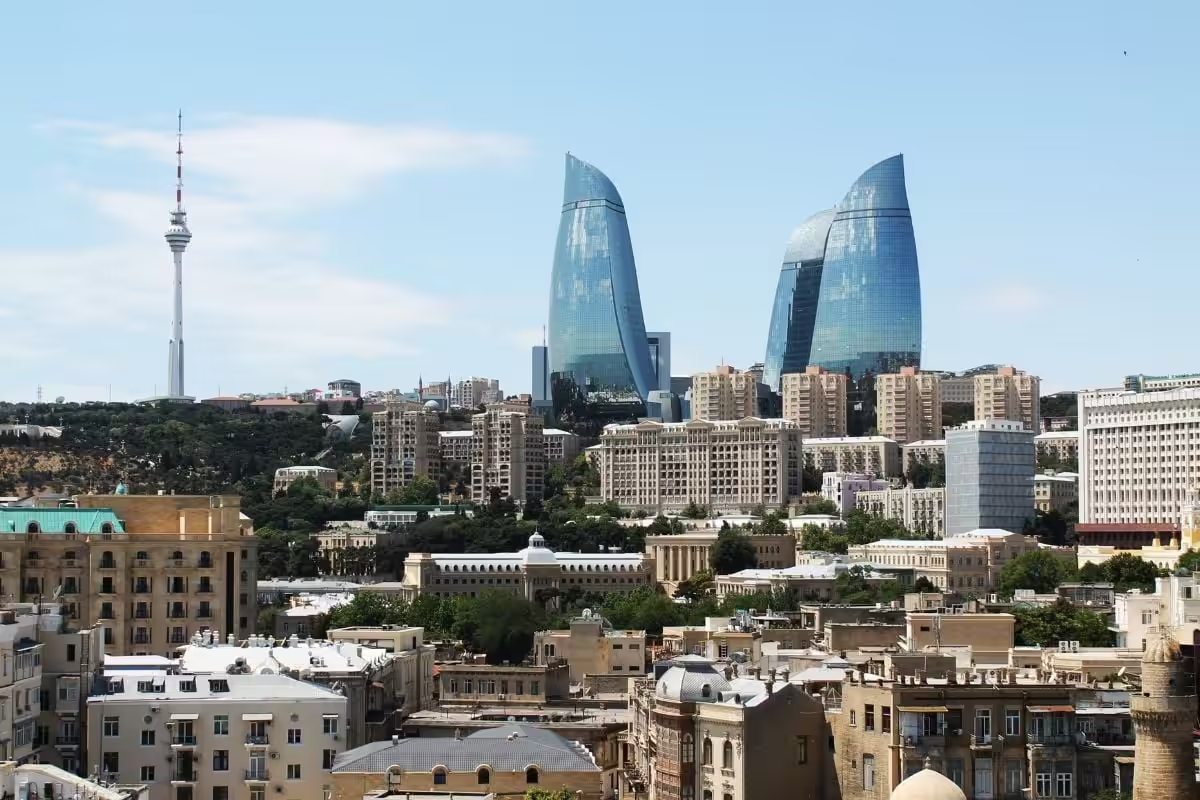
Azerbaijan offers a skilled, multilingual workforce, competitive salaries, and a strategic location bridging Europe and Central Asia. For companies looking to hire employees in Azerbaijan, the challenge is navigating the 1999 Labor Code, monthly payroll filings with the State Tax Service, and a 2026 tax regime that has just changed for non-oil private sector workers. An employer of record in Azerbaijan lets you hire, pay, and manage local talent compliantly without registering a company, opening a local bank account, or mastering the Azerbaijani-language documentation requirements. RemotePeople acts as the legal employer on paper while you direct the day-to-day work.
How an Employer of Record Works in Azerbaijan
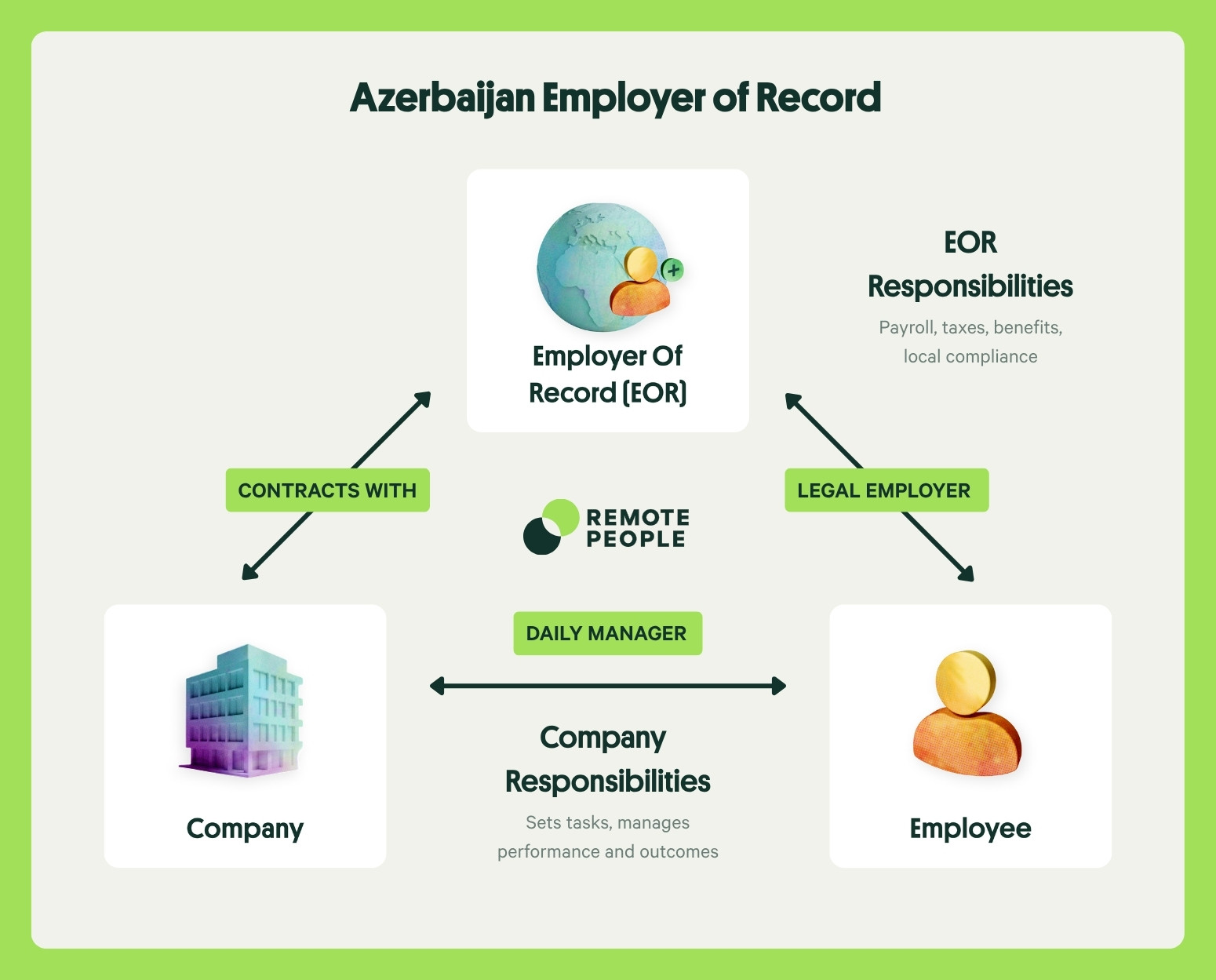
If you’d like to learn more about how Employer of Record (EOR) services work, read our What Is an Employer of Record (EOR)? guide for a complete overview of the model, its benefits, and when to use it.
If you’re comparing providers, our Best Employer of Record (EOR) Providers guide reviews the leading platforms to help you choose the right solution for your business.
Who Uses an EOR in Azerbaijan?
An EOR in Azerbaijan is used by companies that want to hire in the country quickly without registering a local legal entity. Typical use cases include testing the Azerbaijani market with a small remote team, hiring one to fifteen employees where incorporation does not make financial sense, onboarding foreign specialists who need work permit sponsorship, and reducing compliance risk by outsourcing Labor Code obligations to a local expert.
An EOR is also a good fit for organizations expanding into Azerbaijan from Europe, the GCC, or North America that need a presence in Baku or Ganja without months of entity setup. For short-term or project-based work of under a year, an EOR is almost always faster and cheaper than forming a subsidiary.
Typical Onboarding Timeline
Most EOR providers can onboard an employee in Azerbaijan within 1-2 weeks. The process typically moves through these stages:
- First, sign the EOR service agreement and share employee details including passport, bank account, and compensation (1-2 days).
- Second, the EOR drafts a Labor Code-compliant employment contract in Azerbaijani and the employee reviews and signs it (2-3 days).
- Third, social security registration with the SSPF and tax registration happen in parallel through the State Tax Service portal (3-7 days).
- Fourth, payroll is configured and benefits enrollment is completed so the first salary can be paid correctly (2-3 days).
- Fifth, the employee starts work on day one with full compliance coverage.
Work permit applications for non-CIS foreign nationals add 4-8 weeks to this timeline because the State Migration Service needs up to 20 working days to issue a decision, and background checks or document legalization can extend the process further.
Hire in Azerbaijan
A skilled, multilingual workforce, a new 2026 progressive tax regime, no entity required, and a strategic location between Europe and Central Asia make Azerbaijan a smart market entry.
We handle employment contracts, payroll, tax withholding, and full Azerbaijan compliance.
No local entity needed. Your team can start in days.
Employment Laws and Regulations in Azerbaijan
Employment Contracts
Employment relationships in Azerbaijan are governed by the Labor Code of the Republic of Azerbaijan, Law No. 618-IQ of February 1, 1999, and enforced by the Ministry of Labour and Social Protection of Population. All employment contracts must be in writing, drafted in the Azerbaijani language, and signed before the employee starts work. Contracts can be indefinite or fixed-term, and Article 45 of the Labor Code requires that a fixed-term contract that continues uninterrupted for more than five years is automatically treated as indefinite.
The written contract must specify the parties, job title and duties, workplace, start date, term, working hours, salary, and leave entitlements. Employers also submit a notification of hire to the State Tax Service electronic notification system within one business day of signing.
Working Hours and Overtime
The standard workweek in Azerbaijan is 40 hours, typically arranged as 8 hours per day over 5 days with two weekly rest days. Employees under the age of 18, pregnant women, and workers in hazardous occupations have reduced maximum hours. Overtime is capped at 4 hours over two consecutive days and cannot be imposed without the employee’s consent, except in narrowly defined emergencies.
Overtime pay is calculated at 200% of the regular hourly rate under Article 165 of the Labor Code. Work on weekly rest days and public holidays is also paid at double the regular rate, and night work between 10 PM and 6 AM carries additional premiums.
Azerbaijan overtime and premium pay rates · Per Labor Code No. 618-IQ |
|||
Hour Type |
Rate Multiplier |
Cap |
Notes |
|---|---|---|---|
Standard weekday overtime | 200% of regular hourly rate | 4 hours over 2 consecutive days | Requires employee consent (Art. 99, 101, 165). Exemptions for minors, pregnant women, and hazardous occupations. |
Weekly rest day work | 200% (double) of regular rate | Same overtime cap applies | Compensation can be paid as cash or an equivalent day off in lieu, per Art. 162. |
Public holiday work | 200% (double) of regular rate | Same overtime cap applies | Applies to all 18 paid public holidays listed under Art. 105 of the Labor Code. |
Night work (10 PM to 6 AM) | At least 120% of regular rate | Shift reduced by 1 hour | Premium set at not less than 20% above regular rate per Art. 176. Banned for minors and pregnant employees. |
Minimum Wage
The minimum monthly wage in Azerbaijan is AZN 400, approximately $235 USD, set by Presidential Decree of December 23, 2024, and unchanged for 2026. The rate applies uniformly to all employees regardless of sector, age, or experience and serves as the basis for calculating social insurance contributions. You can find a live rate reference on the minimum wage in Azerbaijan page.
Probation Period
The standard probation period in Azerbaijan is up to 3 months, and it can be extended to 6 months by mutual written agreement for managerial or technical roles. Probation clauses are optional and must be stated explicitly in the employment contract to be enforceable. Amendments to the Labor Code that took effect on January 16, 2026, removed the automatic right to terminate an employee on the grounds of “failing probation”. The employer now needs a reasoned written order (decision) to end the contract during probation, even when performance is unsatisfactory.
You can read more detail on the probation period in Azerbaijan page.
Leave Entitlements
Azerbaijan’s Labor Code provides a framework of paid annual leave, sick leave, maternity leave, and other statutory entitlements. The baseline figures below apply to most private-sector employees in the non-oil sector.
Annual Leave
Employees in Azerbaijan are entitled to a minimum of 21 calendar days of paid annual leave per year under Article 114 of the Labor Code. Specific categories of workers (including educators, medical staff, and researchers) receive 30 days. Tenure adds supplementary leave. Employees with 5 to 10 years of service gain 2 extra days, and those with more than 15 years gain 6 extra days. Annual leave accrues during probation and can be carried over only when the employer failed to provide it in the reference year.
Sick Leave
Sick leave in Azerbaijan is available for up to 365 days in a rolling 12-month period, provided the employee has been at the company for at least 6 months and produces a medical certificate. The employer pays 100% of salary for the first 14 calendar days, and the State Social Protection Fund covers the balance from day 15 onward. The exact SSPF payout depends on tenure and the employee’s average insurable earnings.
Maternity Leave
Maternity leave in Azerbaijan is 126 calendar days (70 days before birth and 56 days after) and is paid at 100% of the employee’s average earnings over the previous 12 months by the State Social Protection Fund. Complicated births or multiple births extend post-natal leave to 70 days for a total of 140 days. Mothers are also entitled to unpaid childcare leave until the child turns three.
Paternity Leave
Paternity leave in Azerbaijan is 14 calendar days of unpaid leave following the birth of a child. Many private employers pay the father through internal policy, but statutory pay is not required. Amendments effective January 16, 2026, removed the previous entitlement to supplementary 14-day leave for fathers whose wives were on maternity leave.
Other Statutory Leave
Additional paid leave entitlements apply in specific circumstances:
- Marriage leave: up to 3 calendar days (unpaid unless collective agreement provides otherwise)
- Bereavement leave: up to 3 calendar days for the death of a close family member
- Study leave: paid leave for employees combining work with secondary or higher education, based on the institution’s exam schedule
- Leave for employees with two or more children under 14: an additional 2 calendar days per year
- Blood donation: one paid day off on the day of donation plus one additional paid day
Azerbaijan statutory leave entitlements · Per Labor Code No. 618-IQ |
||
Leave Type |
Duration |
Eligibility & Notes |
|---|---|---|
Annual leave |
21 calendar days (min.) |
30 days for educators, medical staff, and researchers. Tenure-based supplementary days from 5 years of service. |
Sick leave |
Up to 365 days |
Employer pays 100% for first 14 days, SSPF pays from day 15. Requires medical certificate and 6 months service. |
Maternity leave |
126 days (70 pre + 56 post) |
Extended to 140 days for complicated or multiple births. 100% paid by SSPF. |
Childcare leave |
Until child turns 3 |
Unpaid. Job protection guaranteed under the Labor Code. |
Paternity leave |
14 calendar days |
Unpaid under statute. Many private employers pay through internal policy. |
Marriage / bereavement |
Up to 3 days each |
Unpaid unless a collective agreement provides otherwise. |
Study leave |
Per exam schedule |
Paid leave for employees combining work with accredited education. |
Statutory Employee Benefits
Mandatory employee benefits in Azerbaijan center on social insurance, medical insurance, and unemployment insurance, all of which are co-funded by the employer and the employee through monthly payroll contributions. Health coverage runs through the State Agency for Mandatory Health Insurance (TABIB), which provides access to the public healthcare system, while the State Social Protection Fund administers pensions, maternity pay, disability allowances, and long-term sickness benefits.
Beyond social insurance, Azerbaijani law does not require employers to provide private health insurance, life insurance, meal allowances, or transport subsidies. These perks are common in international companies but remain voluntary. For detailed rate information, see employee benefits in Azerbaijan. Exact employer and employee contribution rates appear in the payroll tables in Section 4 of this guide.
Recent Regulatory Updates (2026)
Azerbaijan’s employment and tax landscape changed substantially on January 1, 2026. The 7-year income tax exemption for non-oil private sector employees (which had removed income tax on monthly earnings up to AZN 8,000 since 2019) expired and was replaced by a progressive 3% / 10% / 14% structure (covered in detail in H3 4.3 below).
A separate law cut social insurance and medical insurance contributions on high earners in the non-oil private sector: for monthly wages above AZN 8,000, the combined SSPF rate drops from 25% to 21% (split 11% employer, 10% employee), as reported by APA News Agency.
Amendments to the Labor Code effective January 16, 2026, also removed the 14-day leave entitlement for fathers whose wives were on maternity leave and the supplementary leave previously granted to employees with children with disabilities. The automatic right to terminate during probation on “failure to adapt” grounds was also abolished. Dismissal during probation now requires a reasoned written order from the employer.
Work Permits and Visas in Azerbaijan
Work Permit Requirements
Who Needs a Work Permit
Foreign nationals from non-CIS countries need a work permit to be employed in Azerbaijan. Citizens of the Commonwealth of Independent States (CIS) countries are exempt from the work permit requirement under bilateral agreements, though they still need a temporary residence permit for stays longer than 90 days. Certain categories are also exempt, including foreign heads of companies registered in Azerbaijan, diplomats, journalists accredited by the Ministry of Foreign Affairs, and investors with long-term residence permits.
Eligibility and Required Documents
The employer sponsors the work permit application through the State Migration Service. The employer must demonstrate that the vacancy cannot be filled by a qualified local candidate. Documents typically required from the employee include a valid passport with at least 12 months remaining, a notarized copy of academic credentials, a criminal background check from the country of origin, a medical certificate, color photos, and a signed employment contract with the sponsoring Azerbaijani entity.
Processing Time and Validity
The official processing time for a work permit in Azerbaijan is 20 working days after the complete file is submitted, though employers should budget 6-8 weeks end-to-end to account for document legalization, translation into Azerbaijani, and apostille requirements. The initial permit is valid for up to 1 year.
Renewal Process
Work permit renewals must be filed at least 30 days before expiration. The renewal process largely mirrors the initial application but does not require a new labor market test if the role has not changed. The employee can continue working while the renewal decision is pending, provided the application was filed on time.
Common Visa Types for Foreign Workers
Azerbaijan uses several visa categories relevant to foreign professionals:
- Standard work visa: the default category for foreign employees sponsored by a local employer, issued after the work permit is approved.
- Intra-company transfer: available for managers, specialists, and trainees moving from a foreign parent or subsidiary to an Azerbaijani affiliate.
- Highly qualified specialist exemption: expanded in 2024 and 2025 to let certain high-earning specialists work without a standard work permit under conditions set by the State Migration Service.
- Investor and entrepreneur visas: available to individuals making qualifying investments in Azerbaijani entities.
- Electronic visa (ASAN): a 30-day tourist or business visa issued through the official e-visa portal, not valid for employment.
Azerbaijan work visa types for foreign workers · 2026 |
||||
Visa Type |
Duration |
Best For |
Leads to Residency? |
Processing |
|---|---|---|---|---|
Standard work visa | Up to 1 year, renewable | Foreign employees sponsored by a local employer after work permit approval | Yes, after continuous lawful stay | 20 to 30 business days |
Intra-company transfer | Matches work permit term (1 to 3 years) | Managers, specialists, and trainees moving from a foreign parent or subsidiary | Yes, via standard residence track | 20 to 30 business days |
Highly qualified specialist exemption | Set by State Migration Service | High-earning specialists in priority sectors, working without a standard permit | Case-by-case | Varies by sector |
Investor and entrepreneur visa | Tied to the qualifying investment | Founders and investors in Azerbaijani entities | Yes, may lead to long-term residence | 30 to 45 business days |
Electronic visa (ASAN) | 30 days, single entry | Short tourist or business visits only, not valid for employment | No | 3 business days |
How an EOR Handles Work Permits
An EOR in Azerbaijan can act as the sponsoring employer for foreign hires because it is locally registered and has standing with the State Migration Service. The EOR files the work permit application, tracks processing, and handles renewals. The employee is responsible for providing authentic personal documents, passing the medical exam, and attending any in-person appointments. See the work visa and permit in Azerbaijan page for a deeper walkthrough. Work permit sponsorship adds 4-8 weeks to the onboarding timeline described in Section 1 above.
Payroll, Taxes, and Social Security in Azerbaijan
Employer Contributions
Employers in Azerbaijan contribute to three mandatory funds each month: the State Social Protection Fund (SSPF), the State Agency for Mandatory Health Insurance (DMHSI), and the Unemployment Insurance Fund. For non-oil private sector employees earning up to AZN 8,000 (approximately $4,706) per month, the standard total employer burden is 23.5% of gross salary.
Azerbaijan employer social security contributions · 2026 rates |
||
Contribution |
Rate |
Notes |
|---|---|---|
State Social Protection Fund (SSPF) |
22% |
Funds pensions, maternity pay, disability allowances, and long-term sickness benefits. Reduces to 11% on wages above AZN 8,000 in the non-oil private sector. |
Mandatory medical insurance (DMHSI) |
1% |
Applies on wages up to AZN 8,000 ($4,706). Reduces to 0.5% on the portion of wages above AZN 8,000. |
Unemployment insurance |
0.5% |
Funds the Unemployment Insurance Fund administered by the State Employment Agency. |
Total employer contribution |
23.5% |
Non-oil private sector, wages up to AZN 8,000/month. |
Source: PwC Worldwide Tax Summaries and APA News Agency |
||
Employee Contributions
Employees in Azerbaijan also contribute to the same three funds, alongside income tax withholding handled by the employer. Standard employee deductions total 4.5% of gross salary for non-oil private sector workers earning up to AZN 8,000 per month.
Azerbaijan employee payroll deductions · 2026 monthly withholdings |
||
Deduction |
Rate |
Notes |
|---|---|---|
State Social Protection Fund (SSPF) |
3% |
Withheld by employer. Rises to 10% on the portion of wages above AZN 8,000 in the non-oil private sector. |
Mandatory medical insurance (DMHSI) |
1% |
Applies on wages up to AZN 8,000. Reduces to 0.5% above that threshold. |
Unemployment insurance |
0.5% |
Matching contribution to the Unemployment Insurance Fund. |
Income tax (PIT) |
3% / 10% / 14% |
Progressive brackets applied to monthly gross minus social insurance. See H3 4.3 for full brackets. |
Total employee deduction (excl. PIT) |
4.5% |
Income tax is added on top per the bracket schedule. |
Source: PwC Worldwide Tax Summaries and Mercans Statutory Alert |
||
Income Tax
Azerbaijan levies personal income tax on a monthly basis. From January 1, 2026, non-oil private sector employees face a new three-bracket progressive schedule: 3% up to AZN 2,500 per month, 10% on earnings between AZN 2,500 and AZN 8,000, and 14% on earnings above AZN 8,000. Employees in the oil and gas sector and state-sector workers remain on the long-standing 14% / 25% schedule, and the low bracket will step up to 5% in 2027 and 7% in 2028.
Azerbaijan income tax brackets · 2026 |
|
Annual Taxable Income (USD) |
Tax Calculation |
|---|---|
Up to $17,647 |
3% of taxable income |
$17,647 – $56,471 |
$529 + 10% of the amount over $17,647 |
Over $56,471 |
$4,412 + 14% of the amount over $56,471 |
Source: PwC Worldwide Tax Summaries and APA News Agency. Non-oil private sector brackets; USD amounts converted at $1 = 1.70 AZN (April 2026 rate). |
|
Payroll Cycle
Salaries in Azerbaijan are paid monthly and must be transferred by bank transfer to the employee’s account in Azerbaijani manat, not cash. The Labor Code requires payment at least twice a month in installments, though most employers pay a single consolidated amount by the last working day of the month. Payslips in Azerbaijani must be issued each pay period. Employers file monthly payroll tax and social security reports through the State Tax Service’s electronic portal by the 20th of the following month, and pay the related liabilities by the same deadline.
13th Month Salary and Bonus Pay
A 13th month salary is not mandatory in Azerbaijan. The Labor Code does not require annual bonuses, 13th or 14th month payments, or vacation premiums. Where such payments exist, they are agreed individually in the employment contract or collectively at the enterprise level. Many international companies operating in Baku offer discretionary performance bonuses, but there is no statutory minimum or calculation rule set by law.
Cost of Hiring Through an EOR in Azerbaijan
EOR Service Fees
EOR service fees in Azerbaijan typically range from $300 to $600 per employee per month. The fee covers payroll processing, Labor Code-compliant contracts, monthly tax filings, social insurance registration, statutory benefit administration, and ongoing compliance support. Work permit sponsorship, background checks, and document legalization are usually billed as one-time add-ons.
Total Employment Cost Breakdown
For a sample employee earning $1,500 USD per month gross (around AZN 2,550), here is the full monthly cost of hiring through an EOR in the non-oil private sector.
Azerbaijan employer cost example · $1,500/month gross · 2026 |
||
Employer Cost |
Amount (USD) |
% of Gross |
|---|---|---|
Gross salary |
$1,500.00 |
100.0% |
SSPF (22%) |
$330.00 |
22.0% |
Mandatory medical insurance (1%) |
$15.00 |
1.0% |
Unemployment insurance (0.5%) |
$7.50 |
0.5% |
EOR service fee (est.) |
$400.00 |
26.7% |
Total monthly cost |
$2,252.50 |
150.2% |
Source: PwC Worldwide Tax Summaries and Caspian Legal Center |
||
The total monthly cost of a $1,500 gross employee in Azerbaijan works out to $2,252.50, about 50.2% above gross salary once social insurance and the EOR fee are included. Statutory employer contributions alone add 23.5% of gross salary, and the EOR service fee contributes the remaining 26.7%. The Azerbaijani manat has been pegged to the US dollar at roughly 1.70 AZN for several years, which keeps these conversions stable. All USD amounts above are approximate conversions at $1 = 1.70 AZN (April 2026 rate).
Ready to hire in Azerbaijan? Contact our team to get a tailored quote. RemotePeople handles employment contracts, payroll, tax withholding, and full Azerbaijan compliance. No local entity needed.
Benefits of Using an EOR in Azerbaijan
The biggest practical benefit of an EOR in Azerbaijan is speed. An EOR can onboard a compliant employee in 1-2 weeks, compared with the 3-6 months needed to register a local company, open a corporate bank account, and obtain a tax identification number from the State Tax Service. For companies that want to test the Azerbaijani market or hire a single specialist, the difference is decisive.
Compliance is the second advantage. The 2026 income tax reform, the January 2026 Labor Code amendments around probation and parental leave, and the layered social insurance rate structure are all easy to misinterpret from abroad. A local EOR keeps contracts, payroll calculations, and filings aligned with current law so you do not inherit back-tax liabilities or wrongful-dismissal claims. Cost efficiency follows naturally. An EOR avoids the upfront capital, registered-office lease, and ongoing accounting fees of running an Azerbaijani subsidiary, while still giving you full control over what your employee does day to day.
Finally, an EOR provides local expertise, flexibility to scale up or down, and a better employee experience. Your hire signs a proper Azerbaijani-language contract, gets paid in manat to a local bank account, and is properly enrolled with the SSPF and DMHSI from day one. If you decide to wind the engagement down, there is no entity to dissolve and no redundancy procedure to run under Azerbaijani corporate law.
Termination and Offboarding in Azerbaijan
Notice Periods
The default notice period for terminating an indefinite employment contract in Azerbaijan is 1 month, regardless of tenure. The notice period can be extended up to 6 months by contractual agreement, and it increases to 2 months when the termination is driven by company downsizing or staff redundancy. During the probation period, either party can terminate the contract with 3 calendar days’ written notice.
Azerbaijan statutory notice periods by termination scenario · Per Labor Code No. 618-IQ |
|||
Termination Scenario |
Notice Period |
During Probation |
Notes |
|---|---|---|---|
Indefinite contract, employer initiative (general) | 1 month minimum | 3 calendar days | Statutory default for employer-initiated dismissal under Art. 68 and Art. 70. |
Redundancy or company liquidation | 2 months minimum | 3 calendar days | Longer notice applies when dismissal is driven by economic grounds under Art. 70. |
Extended by contract or collective agreement | Up to 6 months | Not applicable | Parties may agree a longer notice in writing; pay in lieu of notice is permitted. |
Employee resignation (indefinite contract) | 1 month | 3 calendar days | Employee must give written notice; contract ends on the last day of the notice period. |
Dismissal for just cause | No notice required | No notice required | Gross misconduct, unauthorized absence, or material breach permits summary dismissal under Art. 70. |
Severance Pay
Calculation Method
Severance pay in Azerbaijan is triggered when an employment contract is terminated because of company liquidation or staff redundancy. The statutory formula is based on the employee’s average monthly salary and increases with length of service: up to 1 year earns 1 month’s average salary, 1 to 5 years earns at least 1.4 months, 5 to 10 years earns at least 1.7 months, and more than 10 years earns at least 2 months. The “average monthly salary” includes base pay and regular allowances.
Caps and Exceptions
There is no absolute monetary cap on statutory severance, but severance is not owed when the termination is for just cause (gross misconduct, unauthorized absence, or material breach of duties) or when the employee resigns voluntarily. Severance is also not payable on the expiry of a fixed-term contract. A special rule applies when termination is triggered by the employee’s military conscription: the employer must pay at least 3 times the average monthly salary.
Azerbaijan severance pay schedule by years of service · Per Labor Code No. 618-IQ |
|||
Years of Service |
Severance Amount |
Base Salary |
Notes |
|---|---|---|---|
Up to 1 year | 1 month average salary | Average monthly salary | Statutory minimum under Art. 77.1 for liquidation or redundancy. |
1 to 5 years | At least 1.4 months salary | Average monthly salary | Includes base pay plus regular allowances computed over preceding months. |
5 to 10 years | At least 1.7 months salary | Average monthly salary | Payable only on employer-initiated liquidation or staff reduction. |
More than 10 years | At least 2 months salary | Average monthly salary | Collective agreement may raise the minimum; no statutory upper cap. |
Military conscription (any tenure) | At least 3 months salary | Average monthly salary | Flat amount due when termination is triggered by the employee’s call-up. |
Grounds for Termination
The Labor Code recognizes several valid grounds for termination, including mutual agreement, expiry of a fixed-term contract, employer initiative (liquidation, redundancy, or employee misconduct), employee initiative (resignation with notice), and circumstances outside both parties’ control (military service, death, court judgment). Protected categories (pregnant women, women with children under 3, and single parents with children under 14) cannot be dismissed except on narrow grounds. Dismissal during probation now requires a reasoned written order from the employer under the January 2026 amendments.
EOR vs. Other Hiring Models in Azerbaijan
EOR vs. Setting Up a Local Entity
Choosing between an Employer of Record and setting up your own legal entity in Azerbaijan comes down to timeline, upfront cost, ongoing administrative burden, and how quickly you can scale up or wind down. The table below lays out both paths side by side across setup time, cost, compliance risk, and flexibility so you can match the right model to the size and duration of your Azerbaijan hiring plan.
Azerbaijan EOR vs local entity comparison · Setup time, cost, risk and best-fit |
||
Comparison |
Employer of Record |
Own Entity |
|---|---|---|
Setup time |
1-2 weeks |
3-6 months |
Upfront cost |
$0 |
$5,000-$15,000 |
Ongoing cost |
$300-$600/employee/month |
$8,000-$20,000/year maintenance |
Local partner required |
No (EOR is the local entity) |
No (100% foreign ownership allowed) |
Social insurance registration |
Handled by EOR |
You manage it |
Payroll & tax filing |
Handled by EOR |
You manage it (or outsource) |
Best for team size |
1-15 employees |
15+ employees |
Scale down / exit |
Easy, no entity to unwind |
Costly, legal dissolution required |
Government contracts |
Not eligible |
Eligible (requires local entity) |
Entity setup in Azerbaijan typically takes 3-6 months and involves registering a limited liability company with the Ministry of Taxes, opening a corporate bank account, notifying the State Tax Service and the SSPF, and hiring a local accountant who can file in Azerbaijani. Upfront costs run from $5,000 to $15,000 depending on legal support and translation fees, with $8,000 to $20,000 per year in ongoing maintenance for bookkeeping, audit, and annual corporate filings.
For a team of 1-15, an EOR in Azerbaijan is almost always the cheaper and faster path. The cross-over point is typically around 15+ employees or when a local entity is required for government contracts, local tenders, or substantial physical operations. Until then, an EOR lets you focus on running the business rather than managing Azerbaijani compliance.
EOR vs. Hiring Independent Contractors
Classifying a Azerbaijan-based worker as an independent contractor rather than an employee can expose you to back-taxes, unpaid social contributions, and reclassification penalties if the working relationship looks like employment in practice. The table below contrasts EOR employment with contractor engagement across legal relationship, tax and benefits treatment, IP ownership, and misclassification risk so you can pick the right model role by role.
Azerbaijan EOR vs independent contractors · Compliance, cost, and risk |
||
Comparison |
EOR (Full-Time Employee) |
Independent Contractor |
|---|---|---|
Legal relationship |
Employee of the EOR |
Self-employed, no employment relationship |
Compliance risk |
Low. EOR ensures Labor Code compliance |
Higher. Misclassification exposure if the relationship resembles employment |
Payroll & tax |
EOR handles withholding, contributions, filings |
Contractor invoices you and handles own taxes |
Benefits & leave |
Statutory benefits, paid leave, social security |
No entitlement to employee benefits |
IP protection |
Stronger. Employment contract assigns IP by default |
Weaker. Requires explicit IP assignment clause |
Termination |
Subject to Labor Code notice and severance |
Contract can be ended per agreement terms |
Best for |
Long-term, core team roles |
Short-term projects, specialized tasks |
Cost structure |
Salary + employer contributions + EOR fee |
Contractor fee (typically higher gross, lower total cost) |
Engaging independent contractors is only appropriate in some cases in Azerbaijan: short-term project work, specialized consulting engagements, and roles with genuine autonomy where the worker controls their own schedule and uses their own tools. When a contractor relationship starts to resemble employment (fixed hours, a single client, employer-provided equipment, integration into the team), the State Tax Service can recharacterize it as employment and claim back-taxes, social insurance contributions, and penalties.
For long-term, full-time roles the safest path is an EOR. For genuine project work, RemotePeople’s hire and pay contractors in Azerbaijan service handles compliant contractor payments, agreements, and classification review so you avoid misclassification exposure.
EOR vs. PEO (Professional Employer Organization)
EORs and PEOs both simplify international hiring, but only an EOR becomes the legal employer of record in Azerbaijan — a critical distinction when you don’t have a local entity of your own. The table below maps the practical differences across legal employer status, entity requirement, liability allocation, and scope of coverage.
Azerbaijan EOR vs PEO comparison · Legal employer, liability, and setup |
||
Comparison |
Employer of Record (EOR) |
PEO |
|---|---|---|
Legal employer |
EOR is the legal employer |
You remain the legal employer (co-employment) |
Local entity required |
No. The EOR is the local entity |
Yes. You must have your own entity in Azerbaijan |
Best for |
Companies without a local entity |
Companies that already have a local entity |
Compliance liability |
EOR assumes compliance responsibility |
Shared liability between you and the PEO |
Setup time |
1-2 weeks |
Depends on your entity setup (weeks to months) |
Control over HR policies |
EOR manages within Labor Code framework |
More direct control, PEO advises |
Typical use case |
Market entry, small remote teams, testing new markets |
Established local operations needing HR outsourcing |
The practical difference between an EOR and a PEO comes down to legal employment. An EOR is the legal employer of record, a locally registered company that hires your worker under its own entity. A PEO enters a co-employment arrangement with your own local entity, handling HR administration while you remain the employer on paper.
Azerbaijan does not have a formal PEO framework equivalent to the US model, and co-employment is not explicitly recognized in the Labor Code. In practice, “PEO” services in Azerbaijan usually mean HR and payroll outsourcing for companies that already have a registered Azerbaijani subsidiary. If you do not yet have a local entity, an EOR is the right structure. If you already own an Azerbaijani company, a payroll outsourcing provider is closer to what you actually need.
Public Holidays in Azerbaijan
Azerbaijan observes a defined set of official public holidays on which most private-sector employers must give staff a paid day off (Cabinet of Ministers of Azerbaijan). The table below lists the statutory holidays employers need to build into payroll calendars and leave planning for the year, along with the date rule for each.
Azerbaijan public holidays · 2026 calendar year |
||
Date |
Holiday |
Type |
|---|---|---|
Jan 1 (Thu) | New Year’s Day | National |
Jan 2 (Fri) | New Year’s Holiday | National |
Jan 20 (Tue) | Martyrs’ Day (Black January) | National |
Mar 8 (Sun) | International Women’s Day | National |
Mar 9 (Mon) | Day off for Women’s Day | Substitute |
Mar 20-24 | Novruz Bayram (Spring Holiday) + Ramadan Holiday | National |
May 9 (Sat) | Victory Day over Fascism | National |
May 11 (Mon) | Day off for Victory Day over Fascism | Substitute |
May 27-28 | Gurban Bayram (Feast of Sacrifice) + Republic Day | National |
Jun 15 (Mon) | Day of National Salvation | National |
Jun 26 (Fri) | Armed Forces Day | National |
Nov 8 (Sun) | Victory Day of the Republic of Azerbaijan | National |
Nov 9 (Mon) | State Flag Day (+ Day off for Victory Day) | National |
Dec 31 (Thu) | World Azerbaijanis Solidarity Day | National |
Source: Cabinet of Ministers of Azerbaijan and timeanddate.com |
||
Azerbaijan observes around 17 non-working days in 2026, with Novruz (the 5-day spring festival from March 20 to 24) and the Gurban Bayram / Republic Day cluster in late May creating the two longest breaks in the payroll calendar. When a public holiday falls on a weekend, the following Monday is typically declared a substitute non-working day. Employers should plan month-end payroll and deliveries accordingly.
How to Get Started with an EOR in Azerbaijan
Getting started with an EOR in Azerbaijan is a short, sequential process:
- First, define the role, target compensation, and start date, and confirm whether the hire is an Azerbaijani national or a foreign citizen who will need work permit sponsorship.
- Second, request a quote from RemotePeople covering the EOR fee, employer contributions, and any one-off add-ons such as work permits or document legalization.
- Third, sign the EOR service agreement and share the employee’s details (passport, bank account, tax residency).
- Fourth, the EOR drafts the Azerbaijani-language employment contract, the employee signs, and social insurance registration runs in parallel.
- Fifth, payroll is configured and the employee starts work on the agreed date, usually within 1-2 weeks of signature.
Contact our team to start hiring in Azerbaijan. RemotePeople handles employment contracts, payroll, tax withholding, work permits, and full Azerbaijani compliance so you can focus on building your team.
Where companies hiring in Azerbaijan expand next
Teams hiring in Azerbaijan commonly extend across the South Caucasus and broader CIS region, where shared Russian-language business culture and overlapping trade networks anchor regional hiring. Companies often add operations in Georgia first, leveraging South Caucasus workforce portability. Armenia typically follows with parallel South Caucasus talent dynamics, while hiring in Kazakhstan adds access to CIS-wide talent mobility. An EOR partner in Turkey often completes the regional footprint with deep cross-border trade alignment.
Frequently Asked Questions
Beyond the gross salary and employer contributions (around 23.5% of gross for non-oil private sector workers earning under AZN 8,000/month), you'll pay an EOR service fee of $300-$600 per employee per month. The exact amount depends on your provider and the complexity of the role.
Most Azerbaijani nationals can be onboarded within 1-2 weeks once the EOR agreement is signed. Foreign hires who need a work permit typically add 4-8 weeks because the State Migration Service takes up to 20 working days to issue a decision.
You can, but only for genuine project work with clear autonomy. The State Tax Service can reclassify long-term, full-time contractor arrangements as employment and claim back-taxes and penalties. For safe, compliant contractor management, RemotePeople offers a dedicated contractor solution that handles contracts, payments, and classification review. See our contractor hiring service.
The employment contract assigns IP to the client company (you), not the EOR. RemotePeople makes sure the contract has proper IP assignment language so all work product, code, designs, and inventions flow directly to your business from day one.
The national minimum wage in Azerbaijan is AZN 400 per month (approximately $235 USD), unchanged since January 1, 2025 under the Presidential Decree of December 23, 2024. See our minimum wage in Azerbaijan page for detail.
No, a 13th month salary is not mandatory in Azerbaijan. Annual bonuses, 13th month payments, and vacation premiums are at the employer's discretion and are usually set in the individual employment contract or an enterprise-level collective agreement.
Indefinite employment contracts can be terminated with 1 month's written notice (2 months in a redundancy), and the employer must pay statutory severance calculated as a multiple of the average monthly salary based on tenure. Just-cause dismissals do not require severance. Protected categories (pregnant women, single parents with young children) can only be dismissed on narrow grounds.
Yes. Because the EOR is a locally registered Azerbaijani company, it can act as the sponsoring employer for work permit applications through the State Migration Service. The official timeline is 20 working days, but most applications take 6-8 weeks once document legalization and translation are included.
Employer of Record in
Employer of Record in
Employer of Record in
Employer of Record in
Employer of Record in
Employer of Record in
Employer of Record in
Employer of Record in