Recruit
Tajikistan Employer of Record (EOR) Service
-
 Drew Donnelly
- Published
- September 22, 2026
Hire in Tajikistan — book a free 30-minute demo
Tell us what you need. You'll get a tailored, transparent proposal within 24 hours, plus a free call to walk through it.
Tell us about your company
So we can match you with a specialist who knows your market — and unlock volume pricing tiers.
* All fields are required.
Where and when are you hiring?
Tell us the geography and timing and we'll quote each country line by line, with onboarding timelines.
* All fields are required.
Help us beat your current setup
We'll benchmark your current deal and send a line-by-line proposal in 24 hours — showing exactly where we cut cost, time, or risk. After you submit, you can book a call to walk through it together.
* All fields are required.
Thanks! Your proposal is on its way.
Expect a tailored, line-by-line proposal in your inbox within 24 hours. In the meantime…
Want to walk through it together?
Book a free 30-minute call with one of our specialists. We'll explain every line, answer your questions, and tailor the proposal further if you need.
No obligation. Pick a time that works for you.








- Hire in Tajikistan — book a free 30-minute demo
- Tell us about your company
- Where and when are you hiring?
- Help us beat your current setup
- Thanks! Your proposal is on its way.
- How an Employer of Record Works in Tajikistan
- Employment Laws and Regulations in Tajikistan
- Work Permits and Visas in Tajikistan
- Payroll, Taxes, and Social Security in Tajikistan
- Cost of Hiring Through an EOR in Tajikistan
- Benefits of Using an EOR in Tajikistan
- Termination and Offboarding in Tajikistan
- EOR vs. Other Hiring Models in Tajikistan
- Public Holidays in Tajikistan
- How to Get Started with an EOR in Tajikistan
- Related EOR Destinations

Start hiring in Tajikistan
Let RemotePeople handle payroll, compliance, and HR admin worldwide so you can focus on building your team.

Tajikistan’s economy is growing, and its strategic location in Central Asia makes it an attractive market for companies seeking to expand. For organizations looking to hire employees in Tajikistan, navigating the country’s employment regulations, tax obligations, and payroll requirements can be complex and time-consuming. An employer of record in Tajikistan handles all these obligations, allowing you to build a team quickly without establishing a local legal entity. This guide provides a complete overview of what you need to know about hiring in Tajikistan through an EOR.
How an Employer of Record Works in Tajikistan
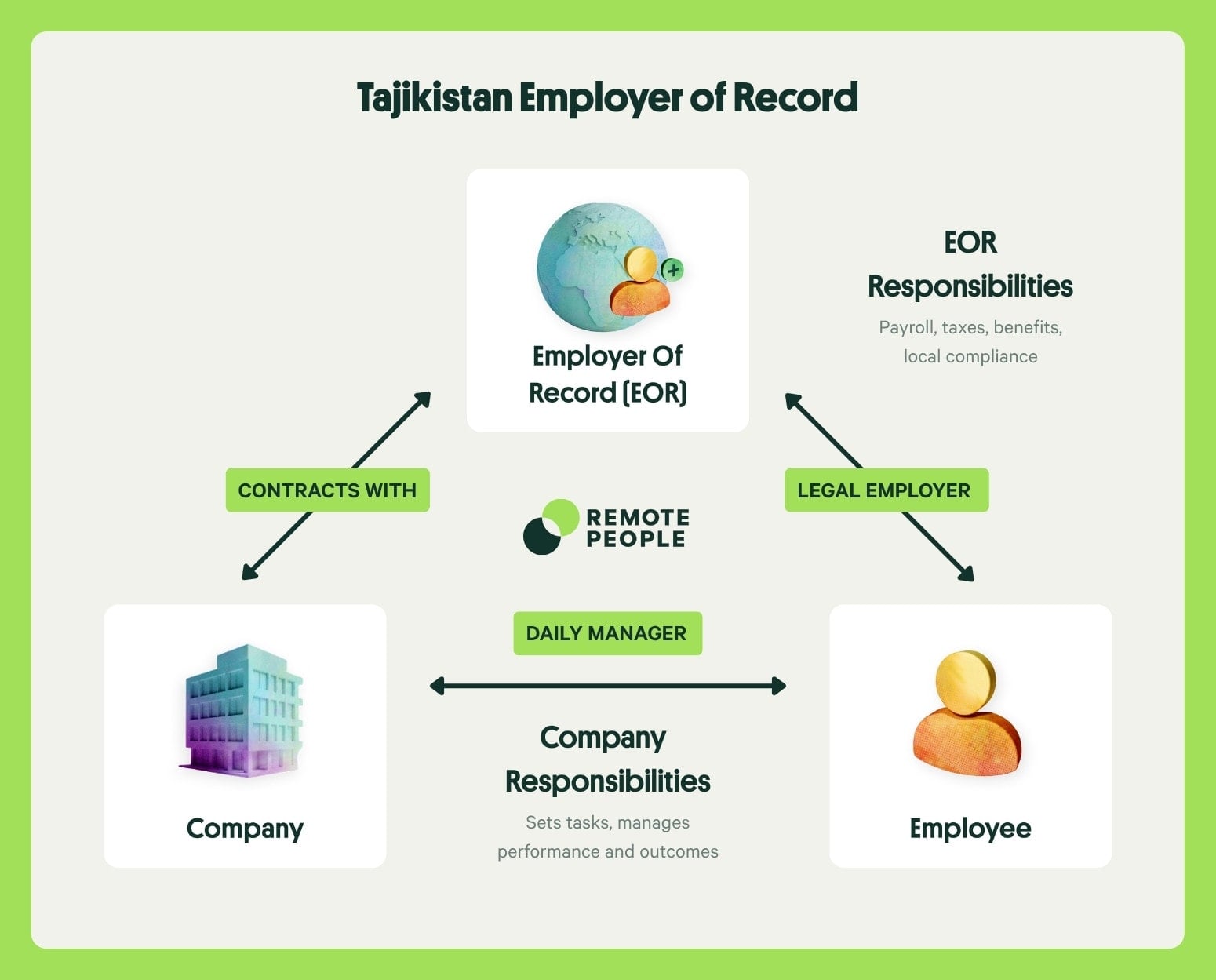
If you’d like to learn more about how Employer of Record (EOR) services work, read our What Is an Employer of Record (EOR)? guide for a complete overview of the model, its benefits, and when to use it.
If you’re comparing providers, our Best Employer of Record (EOR) Providers guide reviews the leading platforms to help you choose the right solution for your business.
Who Uses an EOR in Tajikistan?
Organizations use an EOR in Tajikistan for several reasons:
- Testing the Market: Companies entering Tajikistan for the first time can hire 1-3 employees through an EOR to validate demand and understand local business conditions before committing to a full legal entity and larger team.
- Hiring a Small Remote Team: Organizations that want to build a small distributed team in Tajikistan can avoid the overhead of incorporating a local subsidiary and instead leverage the EOR’s existing local infrastructure.
- Rapid Market Expansion: If your company needs to onboard employees quickly (within weeks rather than months), an EOR eliminates the delays of company registration, tax registration, and opening local bank accounts.
- Hiring Foreign Nationals and Specialists: Companies needing to employ expatriates or highly specialized talent can delegate the complex work permit sponsorship process to the EOR, which handles all government liaisons and documentation.
- Cost Control: An EOR allows you to scale your Tajikistan team up or down flexibly without carrying the fixed legal and administrative costs of maintaining your own entity.
Typical Onboarding Timeline
Most EOR providers can onboard an employee in Tajikistan within 1-2 weeks. Here’s the typical timeline:
- EOR Agreement & Employee Details (1-2 days): You and the EOR sign the service agreement and provide basic employee information (name, passport details, job title, salary).
- Employment Contract Drafting & Review (2-3 days): The EOR prepares the employment contract in Tajik and Russian, compliant with the Labour Code, and sends it to you for review and approval.
- Social Security & Tax Registration (3-7 days): The EOR registers the employee with the Agency of Social Insurance and Pensions and the State Tax Committee, obtaining a tax identification number and social security account.
- Payroll Setup & Benefits Enrollment (2-3 days): The EOR sets up payroll processing, confirms banking details, and enrolls the employee in mandatory health insurance and pension schemes.
- Employee Onboarding & First Day (1 day): The employee receives their contract, payroll details, and onboarding materials and begins work.
Note: If the employee requires a work permit (i.e., they are a foreign national), the onboarding timeline extends by 15-30 working days for visa and permit processing. Similarly, if background checks or medical examinations are required, these add 1â2 weeks.
Hire in Tajikistan
Highly competitive labor costs, an emerging services and technology talent pool, and ongoing reforms simplifying business registration make Tajikistan a cost-effective market for global teams.
We handle employment contracts, payroll, tax withholding, and full Tajikistan compliance.
No local entity needed. Your team can start in days.
Employment Laws and Regulations in Tajikistan
Employment Contracts
Employment relationships in Tajikistan are governed by the Labour Code of the Republic of Tajikistan (adopted in 1992, with amendments through 2025). All employment must be formalized by a written contract that specifies key terms: job title, duties, compensation, working hours, leave entitlements, termination conditions, and confidentiality obligations.
Contracts can be indefinite (open-ended) or fixed-term. A fixed-term contract is permissible only if there is an objective reason: replacement of a temporarily absent employee, completion of a specific project, or seasonal work. Fixed-term contracts must not be used as a device to avoid statutory protections.
Contracts must be in Tajik, the official language of Tajikistan. If an employee is a foreign national with limited Tajik proficiency, a Russian translation is often provided for clarity, but the Tajik version is the official contract.
Working Hours and Overtime
The standard working week in Tajikistan is 40 hours. For a five-day work week, this translates to 8 hours per day. Daily working time must not exceed 12 hours under any circumstances. Employees under age 18, employees aged 16â18, and employees working in hazardous conditions are entitled to reduced working hours (24 hours per week for ages 15â16, 35 hours per week for ages 16â18 and those in harmful conditions).
Employees are entitled to at least one day of weekly rest, typically Sunday or another day agreed by contract. Rest periods during the workday are mandatory (at least a 30-minute break for an 8-hour shift).
Overtime and Premium Pay Rates
Overtime is permitted in Tajikistan but must be compensated at higher rates. According to the Labour Code of the Republic of Tajikistan, overtime work is compensated as follows:
Tajikistan overtime and premium pay rates · Per Labour Code |
|||
Hour Type |
Rate Multiplier |
Weekly/Daily Cap |
Notes |
|---|---|---|---|
Weekday overtime (first 2 hours) |
1.5x hourly rate |
2 hours max per day in hazardous; 4 hours max in other work |
Requires employee agreement; female employees with children under 3 cannot work overtime |
Weekday overtime (beyond first 2 hours) |
2x hourly rate |
Subject to daily 12-hour cap |
Employees under 18 are prohibited from overtime |
Weekly rest day work (Sunday or designated day) |
2x hourly rate |
No statutory daily cap if work extends across multiple days |
Employee must receive a compensatory day off within two weeks |
Public holiday work |
2x hourly rate |
In addition to public holiday pay |
Employee receives both overtime pay and public holiday bonus |
Overtime must not exceed 2 hours per day in unhealthy or strenuous work and 4 hours per day in other non-hazardous work. Pregnant women and women with children under age 3 are prohibited from working overtime. Employees under age 18 cannot work overtime at all. All overtime must be compensated; employers cannot require unpaid overtime.
Minimum Wage
As of 2026, the national monthly minimum wage in Tajikistan is TJS 1,000 (approximately USD 100â110, depending on exchange rates). Effective September 1, 2026, this rate is scheduled to increase to TJS 1,300, representing a 30% increase. This minimum applies to all sectors unless a higher sectoral minimum is established by government decree via official gazette.
Foreign employees and local employees are subject to the same minimum wage floor. Any contractual salary below the statutory minimum is void, and the employee is entitled to the minimum wage by law (Tax Code and Labour Code of the Republic of Tajikistan).
Probation Period
Employers and employees may agree to a probationary period not to exceed three months. During the probation period, the employer may terminate the employee with seven days’ notice if the employee does not meet performance standards or lacks the required qualifications. The employer must inform the employee in writing of the grounds for termination.
Employees under age 18 and employees on seasonal contracts cannot have a probationary period. Time spent on medical leave or other justified absence does not count toward the probation period.
Leave Entitlements
Tajikistan’s Labour Code guarantees comprehensive statutory leave entitlements for all employees. Here is an overview of each leave type:
Annual Leave
All employees are entitled to a minimum of 24 calendar days of paid annual leave per year. Eligibility begins after 11 months of continuous employment. Employees under age 18 and employees with disabilities are entitled to 30 calendar days. Employees in hazardous, harmful, or strenuous working conditions are entitled to additional leave (the exact number depends on the hazard classification, typically ranging from 28 to 36 days). Annual leave accrues continuously and can be split into parts of at least 12 calendar days each. Unused leave may carry over to the next year, but employers may require employees to take leave (up to a reasonable level) to prevent excessive carryover. Upon termination, employees receive payment for any unused annual leave.
Sick Leave
Employees are entitled to paid sick leave upon presentation of a medical certificate. The Labour Code does not specify a maximum duration for sick leave; rather, the duration is determined by the medical certificate issued by a licensed physician. The first three days of sick leave are typically unpaid, and subsequent days are paid at 70â100% of the employee’s average wage, depending on the duration and the employer’s policy. Sick leave is funded through the social insurance system, with the employer recovering a portion of costs from social insurance contributions.
Maternity Leave
Mothers are entitled to paid maternity leave of 140 calendar days (70 days before delivery and 70 days after delivery). In cases of difficult or complicated delivery, maternity leave may be extended by up to 86 additional calendar days. For births of two or more children (multiple births), maternity leave may be extended by up to 110 additional calendar days. Maternity benefits are paid from the State Social Insurance Fund. After maternity leave, mothers are entitled to childcare leave for up to three years, with the first 1.5 years paid at a reduced social insurance rate and the remaining period unpaid but with job protection.
Paternity Leave
Tajikistan’s Labour Code does not provide for paid paternity leave for fathers. However, if the mother dies, is deprived of parental rights, has prolonged hospitalization, or is unable to care for the child, the father may be eligible to receive maternity benefits for up to 70 days (or 110 days in the case of multiple births). Additionally, fathers may take unpaid childcare leave for up to three years with job security (similar to mothers).
Other Statutory Leave
Employees in Tajikistan are entitled to additional leave for bereavement (3 days for the death of a close family member), marriage (3 days for the employee’s own marriage), and study leave (if pursuing education related to their job, as agreed by contract). Government employees may be entitled to voting leave, and other categories may have additional entitlements based on collective agreements or special regulations). Government employees may be entitled to voting leave, and other categories may have additional entitlements based on collective agreements or special regulations.
Tajikistan’s statutory leave framework is comprehensive and designed to protect employee welfare and work-life balance. Under the Labour Code of the Republic of Tajikistan, employees accrue annual leave from the first day of employment (not after probation), and all leave is paid at the employee’s average daily wage. The most important takeaway is that annual leave is a non-negotiable right: employers cannot deny leave or pressure employees to waive it, and unused leave must be paid upon termination.
Leave Entitlements Table
Tajikistan statutory leave entitlements · Per Labour Code of the Republic of Tajikistan |
||
Leave Type |
Duration |
Eligibility & Notes |
|---|---|---|
Annual leave (standard) |
24 calendar days |
All employees; accrues from day one; paid at average daily wage; can be split into parts of at least 12 days |
Annual leave (under 18 or disabled) |
30 calendar days |
Employees under age 18 or those with officially recognized disabilities |
Annual leave (hazardous work) |
28â36 calendar days |
Employees in harmful, hazardous, or strenuous conditions; specific number depends on hazard classification per government decree |
Sick leave |
As medically certified |
First 3 days unpaid; subsequent days paid at 70â100% of average wage; requires medical certificate; funded through social insurance |
Maternity leave |
140 calendar days (70 before, 70 after); up to 86 additional in difficult cases; up to 110 additional for multiple births |
All pregnant employees; paid from State Social Insurance Fund; followed by optional paid childcare leave for 1.5 years and unpaid for up to 3 years total |
Paternity leave (paid) |
None (Labour Code provides no statutory paid paternity leave) |
Exception: if mother dies or is incapacitated, father receives maternity benefits for up to 70 days (110 for multiple births) |
Bereavement / marriage leave |
3 calendar days per event |
For death of close family member or employee’s own marriage; paid leave |
Statutory Employee Benefits
Beyond leave entitlements, Tajikistan requires employers to provide several mandatory benefits per the Labour Code:
- Health Insurance: Employers must ensure all employees have coverage under the mandatory health insurance system. The employer’s contribution is included in the social security/unified social tax (approximately 20â25% of gross salary, depending on sector).
- Pension Contributions: Employers contribute to the national pension system (part of the unified social tax) to fund employee retirement benefits. Employees also contribute a small percentage (approximately 1% of gross salary).
- Disability Insurance: Coverage is included within the social insurance system; no separate premium is required.
- Sickness and Maternity Benefits: The State Social Insurance Fund provides income replacement during sick leave and maternity leave. The employer recovers a portion of maternity benefit costs through the social insurance system.
- Unemployment Insurance: A small unemployment insurance contribution (included in the unified social tax) provides limited benefits to employees who lose their jobs through no fault of their own.
Employers are not required to provide additional voluntary benefits (private health insurance, life insurance, retirement plans, bonuses), but they may do so by contract. Meal allowances and transportation subsidies are not statutory unless specified in a collective agreement or local regulations.
Recent Regulatory Updates (2026)
As of 2026, Tajikistan’s employment framework remains stable, with no major legislative reforms enacted in the past 12 months. However, several developments are noteworthy:
- Minimum Wage Increase (Effective September 2026): The national minimum wage is scheduled to increase from TJS 1,000 to TJS 1,300, effective September 1, 2026. This represents a 30% increase and is one of the most significant employment-related changes for 2026.
- VAT Reduction: VAT is scheduled to decrease from 14% (current as of 2026) to 13% effective January 1, 2027. This affects pricing and invoice calculations but does not directly impact employment law.
- Corporate Tax Rates: Manufacturing enterprises benefit from a reduced corporate income tax rate of 13%; other sectors are subject to the standard 18% rate (reduced from 23% in 2022).
- Social Insurance Rate Stability: Employer social security contribution rates remain at approximately 20â25% of gross salary, depending on sector. The Labour Code and social insurance regulations remain largely unchanged.
No major changes to leave entitlements, working hours, termination rules, or work permit requirements have been enacted in 2026.
Work Permits and Visas in Tajikistan
Work Permit Requirements
Foreign nationals seeking employment in Tajikistan must obtain a work permit from the Ministry of Labor, Migration, and Employment of Population. Tajikistan citizens do not require a work permit.
Work permits are not automatically issued; the employer must demonstrate a legitimate business need to hire a foreign national and justify why the position cannot be filled by a Tajik citizen. The employer must submit an application to the Ministry of Labor or its regional office, providing the following documentation:
- Completed work permit application form
- Passport copy and biographical information of the foreign national
- Educational credentials and professional qualifications
- Medical certificate (recent health examination)
- Police clearance certificate from the applicant’s home country
- Draft employment contract or letter of offer
- Employer registration and tax documentation
- Written justification for hiring a foreign national (explaining the business need and why local talent is unavailable)
- Proof of payment of state fees
The processing time for work permits typically ranges from 15 to 30 working days after submission of a complete application.
Common Visa Types for Foreign Workers
Tajikistan offers several visa categories for foreign nationals seeking to work in the country:
Tajikistan work visa types for foreign workers · 2026 |
||||
Visa Type |
Duration |
Best For |
Leads to Residency? |
Processing Time |
|---|---|---|---|---|
M Visa (Work) |
Initial 3 months; renewable annually for up to 1 year per extension |
Standard employment; requires work permit from Ministry of Labor |
Yes â long-term residency possible with renewals |
15â30 working days (including work permit processing) |
K Visa (Business) |
1â3 months |
Short-term business activities, meetings, conferences; does not permit employment |
No â business visa is short-term only |
3â7 working days |
C Visa (Investor/Entrepreneur) |
Initial 1 year; renewable |
Business owners and investors establishing enterprises in Tajikistan |
Yes â path to long-term residency |
15â45 working days (investment application review required) |
Intra-Company Transfer (ICT) |
1 year (renewable) |
Employees of multinational companies transferred to Tajikistan subsidiary; requires company sponsorship and work permit |
Yes â renewable annually |
20â45 working days |
T Visa (Tourist) |
30 days (single entry) |
Tourism and leisure; does NOT permit employment or business activities |
No â cannot be converted to work visa |
3â10 working days |
Note: Visa types not listed above (including tourist visas, transit visas, and student visas) do not permit employment. Individuals on these visas who engage in paid work violate Tajikistan immigration law and face deportation and fines.
How an EOR Handles Work Permits
An EOR simplifies the work permit process significantly. The EOR takes responsibility for:
- Liaising with the Ministry of Labor and local immigration authorities
- Preparing and submitting the work permit application with all required documentation
- Obtaining the work permit before the employee’s visa application
- Coordinating with the Consular Department for visa issuance once the work permit is approved
- Monitoring renewal deadlines and handling permit extensions
Your role is to provide employee information, educational credentials, and the employment agreement terms. The EOR handles all government submissions and follow-ups. If your employee is already in Tajikistan on a tourist or business visa, the EOR can facilitate a visa conversion once the work permit is approved (though this typically requires the employee to exit and re-enter on the new work visa).
Payroll, Taxes, and Social Security in Tajikistan
Employer Contributions
Tajikistan imposes a unified social tax (often called the “social insurance tax” or “payroll tax”) on employers. This is a single consolidated contribution that funds health insurance, pensions, disability insurance, unemployment benefits, and sickness/maternity insurance. The rate varies by sector but typically ranges from 20% to 25% of the employee’s gross salary.
Tajikistan employer social security contributions · 2026 rates |
||
Component |
Rate |
Notes |
|---|---|---|
Unified social tax (standard sectors) |
20â25% of gross salary |
Funds health insurance, pensions, disability, unemployment, sickness/maternity benefits; rate depends on sector and risk classification |
Unified social tax (reduced rate â manufacturing) |
18% of gross salary |
Manufacturing enterprises and certain export-oriented businesses may qualify for reduced rate per government incentive policy |
Unemployment insurance contribution |
Included in unified social tax |
No separate premium; funded from unified social tax |
Health insurance contribution |
Included in unified social tax |
Mandatory coverage; no separate opt-out; employee also contributes 1% (withheld from salary) |
Total Employer Contribution (Standard) |
20â25% of gross |
Applies to most service, commercial, and professional organizations |
Employee Contributions
Employees in Tajikistan have two main payroll deductions: personal income tax (withheld by the employer) and the employee’s share of social insurance (also withheld).
Tajikistan employee payroll deductions · 2026 monthly withholdings |
||
Withholding |
Rate |
Notes |
|---|---|---|
Personal income tax (residents) |
12% flat rate |
Applies to all Tajik residents earning employment income; applies to foreign residents earning income sourced in Tajikistan |
Personal income tax (non-residents) |
30% flat rate |
Applies to foreign nationals not meeting Tajikistan tax residency requirements (e.g., on short-term assignments) |
Personal income tax (self-employed / entrepreneurs) |
15% flat rate |
Applies to independent contractors and business owners; not applicable to W-2 employees |
Employee social insurance contribution |
~1% of gross salary |
Withheld from employee salary; funds portion of employee benefits (health, pension, disability, sickness/maternity) |
Total Employee Deduction (Standard) |
~13% of gross |
12% income tax + ~1% social insurance for residents earning employment income |
Income Tax
Tajikistan applies a flat personal income tax rate of 12% for residents and a 30% rate for non-residents. A resident is defined as an individual who spends 183 or more days in Tajikistan during a calendar year, or who has a permanent home in the country. Most employees hired by foreign companies are considered residents after the first year of employment.
There are no income tax brackets in Tajikistan; the 12% rate applies equally to all employment income. This simplifies payroll calculations but also means that employees at all salary levels pay the same tax rate.
Tajikistan income tax brackets · 2026 |
|
Bracket |
Tax Calculation |
|---|---|
Residents (all income levels) |
12% flat rate on employment income |
Non-residents (all income levels) |
30% flat rate on Tajikistan-source income |
Entrepreneurs/self-employed |
15% flat rate on business income |
Payroll Cycle
Employers in Tajikistan typically process payroll on a monthly basis, with payment due by the last day of the month for work performed in that month. Monthly payroll is the legal standard; biweekly or weekly payroll is less common but permissible if stipulated in the employment contract and collective agreement.
Salaries must be paid in Tajik Somoni (TJS) via bank transfer to the employee’s personal account. Cash payments are permitted only under specific circumstances (e.g., for per diem allowances or small advances) and are not standard for regular salary. The employer must issue a pay slip for each payroll period detailing the gross salary, tax withholdings, social insurance contributions, and net pay.
Tax Filing & Social Security Reporting Deadlines:
- Monthly tax withholding and social security contributions must be remitted to the State Tax Committee and the Agency of Social Insurance and Pensions by the 10th of the following month.
- Annual income tax returns are due by March 31 of the following year.
- Quarterly and annual social insurance reports are due on dates set by the Agency of Social Insurance and Pensions (typically within 15 days of the quarter/year end).
An EOR handles all tax remittance and reporting on your behalf.
13th Month Salary and Bonus Pay
Tajikistan does not require employers to pay a 13th month salary, year-end bonus, or any other mandatory bonus or additional compensation. This is entirely voluntary and at the employer’s discretion.
If an employer chooses to provide a bonus or additional month’s pay, the terms (amount, payment date, eligibility conditions) must be specified in the employment contract or a separate bonus agreement. Bonuses, when paid, are subject to the same 12% personal income tax and social insurance deductions as regular salary.
Some employers in Tajikistan offer year-end bonuses as a matter of practice or contractual obligation, but this is not legally required and does not constitute an entitlement under the Labour Code.
Cost of Hiring Through an EOR in Tajikistan
EOR Service Fees
EOR service fees in Tajikistan typically range from USD 300 to USD 600 per employee per month, depending on the provider, service level (administrative support, HR consulting, compliance updates), and team size (larger teams may receive volume discounts). This fee covers payroll processing, tax withholding and remittance, social security administration, benefits coordination, leave management, and termination support.
Some EOR providers charge a one-time setup fee (USD 200â500) to cover initial registration and contract preparation. Most providers waive setup fees for annual contracts or larger teams.
Total Employment Cost Breakdown
The total cost of employing someone through an EOR in Tajikistan includes the gross salary, employer social security contributions, and the EOR service fee. Here’s a worked example:
Tajikistan employer cost example · USD 2,000 gross · 2026 |
||
Line Item |
Amount (USD) |
% of Gross |
|---|---|---|
Gross salary (monthly) |
$2,000.00 |
100% |
Employer unified social tax (20â25%) |
$450.00 |
22.5% (midpoint) |
EOR service fee (flat monthly) |
$400.00 |
20% |
Total Monthly Cost to Employer |
$2,850.00 |
142.5% |
Employee net pay (after 12% tax + 1% insurance) |
$1,740.00 |
87% |
Note on Exchange Rates: This cost example uses a notional exchange rate of approximately 1 USD = 10 TJS (January 2026). Actual costs in TJS will be higher or lower depending on real-time exchange rates. The EOR can provide cost estimates in both TJS and USD.
In this scenario, a USD 2,000 gross monthly salary costs the employer approximately USD 2,850 per month when including social security contributions and the EOR fee. The employee receives approximately USD 1,740 in net pay after taxes and social insurance deductions.
Ready to hire in Tajikistan? Get started with RemotePeople â we handle employment contracts, payroll, tax withholding, and full Tajikistan compliance. No local entity needed. Contact us for a quote.
Benefits of Using an EOR in Tajikistan
An EOR in Tajikistan provides significant advantages for organizations seeking to expand or test new markets in Central Asia:
- Speed to Market: Instead of 3â6 months to incorporate a local subsidiary, register for taxes, and set up payroll, you can hire your first employee through an EOR in 1â2 weeks. This speed is critical if you need to seize a business opportunity or respond to competitive pressure quickly.
- Compliance Assurance: The EOR is responsible for ensuring all employment contracts comply with the Labour Code, payroll taxes are withheld correctly, social security contributions are remitted on time, and leave is administered legally. You avoid penalties, back-tax liability, and reputational damage from compliance failures.
- Cost Efficiency vs. Local Entity: Hiring through an EOR avoids the upfront costs of company registration (USD 2,000â5,000), legal entity setup and maintenance (USD 5,000â10,000 annually), and hiring a local HR manager or HR consultant (USD 2,000â3,000 monthly). For small teams (1â10 employees), an EOR is typically more cost-effective than a local subsidiary.
- Local Expertise: The EOR has deep knowledge of Tajikistan’s ever-changing employment law, tax code, social security regulations, and government agency procedures. You benefit from their expertise without investing in internal compliance capacity.
- Flexibility to Scale: As your team grows, you can seamlessly add employees through the EOR. If business conditions change and you need to reduce headcount, you can offboard employees without unwinding a legal entity or dealing with entity wind-down costs.
- Risk Mitigation: The EOR assumes liability for employment law compliance, payroll tax accuracy, and statutory benefits administration. If a regulatory audit occurs, the EOR represents you and handles disputes, protecting your organization from direct liability.
- Employee Experience: Employees benefit from professional payroll processing, accurate benefits administration, and clear employment documentation. This professionalism enhances your employer brand and helps attract and retain talent in Tajikistan’s competitive labor market.
Termination and Offboarding in Tajikistan
Notice Periods
Tajikistan’s Labour Code requires employers and employees to provide notice before terminating an employment relationship. Notice periods vary based on the reason for termination and the employee’s tenure.
Employee-initiated termination: An employee who resigns must provide 2 weeks’ notice in writing to the employer.
Employer-initiated termination (for cause â poor performance, lack of qualification): An employer may terminate an employee with 1 month’s notice. If the termination occurs during probation, the notice period is reduced to 7 days. The employer must provide written notice specifying the grounds for termination.
Employer-initiated termination (organizational reasons â business closure, restructuring, liquidation): An employer may terminate an employee due to business necessity with 2 months’ notice.
For cause (gross misconduct, criminal act): An employer may terminate an employee immediately without notice if the employee engages in gross misconduct (theft, violence, violation of safety protocols) or is convicted of a crime related to their duties.
Notice periods run consecutively from the date of written notice. The employee must continue to work during the notice period unless the employer explicitly excuses them from work (which is uncommon in Tajikistan).
Notice Period Table
Tajikistan statutory notice periods by position level · Per Labour Code |
|||
Termination Reason |
Notice Period |
During Probation |
Notes |
|---|---|---|---|
Employee resignation / voluntary termination |
2 weeks written notice |
2 weeks (same as post-probation) |
Employee must provide notice in writing; employer cannot waive notice period |
Employer termination â poor performance / lack of qualification |
1 month written notice |
7 days written notice |
Employer must specify grounds in writing; employee may contest |
Employer termination â organizational reasons (restructuring, liquidation) |
2 months written notice |
May not apply during probation; context-dependent |
Employer must provide notice to all affected employees; alternative employment options must be offered if possible |
Employer termination â for cause (gross misconduct, crime) |
Immediate (no notice) |
Immediate (no notice) |
Employer must have documentary evidence; employee may have right to appeal |
Severance Pay
When an employment relationship terminates, the employer must calculate and pay severance to the employee based on the length of service. Severance is mandatory (not voluntary) for all terminations except resignation. The severance formula is straightforward: one-quarter of the employee’s average salary multiplied by the number of years of service, with a minimum of three months’ salary.
Formula: Severance = (Average Salary ÷ 4) à Years of Service, with a floor of 3 times the monthly average salary.
Average Salary: Calculated as the average monthly gross salary over the 12 months preceding termination, including bonuses and allowances paid during that period.
Minimum: Even if the formula yields less than 3 months’ salary, the employee receives a minimum severance of 3 times the monthly average salary.
Calculation Method
Severance is calculated based on the employee’s average salary (calculated monthly) multiplied by the tenure in years (converted to months and divided by 12 for partial years), multiplied by a factor of 0.25 (one-quarter). The result is compared to the 3-month minimum, and whichever is higher is paid.
Example calculations:
- 1 year of service: (Average Salary ÷ 4) à 1 = Average Salary ÷ 4. If the average salary is TJS 2,000, severance is TJS 500. Since this is less than 3 à TJS 2,000 (TJS 6,000), the minimum of TJS 6,000 is paid.
- 5 years of service: (Average Salary ÷ 4) à 5 = Average Salary à 1.25. If the average salary is TJS 2,000, severance is TJS 2,500. Since this is still less than the TJS 6,000 minimum, TJS 6,000 is paid.
- 10 years of service: (Average Salary ÷ 4) à 10 = Average Salary à 2.5. If the average salary is TJS 2,000, severance is TJS 5,000. Since this is still less than the TJS 6,000 minimum, TJS 6,000 is paid.
- 15 years of service: (Average Salary ÷ 4) à 15 = Average Salary à 3.75. If the average salary is TJS 2,000, severance is TJS 7,500, which exceeds the minimum and is therefore paid.
Caps and Exceptions
There is no statutory maximum cap on severance pay in Tajikistan; severance increases with tenure. However, severance is not due in the following circumstances:
- Employee voluntary resignation: Severance is not mandatory when an employee resigns of their own volition. The employer pays only the final month’s salary and any unused annual leave.
- Termination for gross misconduct: If an employee is terminated for theft, violence, safety violations, or other criminal conduct, severance may be waived or reduced, depending on the severity and the employer’s evidence.
- End of fixed-term contract: Severance is not due when a fixed-term employment contract expires naturally and is not renewed, provided the employee was informed in advance (typically 1â2 months before expiry).
In all other terminations (performance-based, organizational, reduction in force), severance is mandatory.
Severance Pay Table
Tajikistan severance pay schedule by years of service · Per Labour Code |
|||
Years of Service |
Severance Amount |
Base Salary Definition |
Notes |
|---|---|---|---|
1 year |
Minimum 3 months (formula: 1/4 à salary à 1 year = less than 3 months minimum, so 3 months paid) |
Average gross monthly salary for the 12 months preceding termination |
Formula yields less than minimum threshold; employee receives minimum of 3 months’ salary |
3 years |
Minimum 3 months (formula: 1/4 à salary à 3 = 0.75 months, which is less than 3 months minimum, so 3 months paid) |
Average gross monthly salary for the 12 months preceding termination |
Most employees with under 12 years of service receive the 3-month minimum |
5 years |
Minimum 3 months (formula: 1/4 à salary à 5 = 1.25 months; 3 months minimum applies) |
Average gross monthly salary for the 12 months preceding termination |
Minimum 3-month floor ensures adequate transition support |
10 years |
Minimum 3 months (formula: 1/4 à salary à 10 = 2.5 months; 3 months minimum applies) |
Average gross monthly salary for the 12 months preceding termination |
3-month minimum still applies even at 10 years tenure |
15 years |
3.75 months (formula: 1/4 à salary à 15 = 3.75 months; exceeds 3-month minimum) |
Average gross monthly salary for the 12 months preceding termination |
At 12+ years of tenure, formula typically exceeds minimum |
20 years |
5 months (formula: 1/4 à salary à 20 = 5 months) |
Average gross monthly salary for the 12 months preceding termination |
Long-service employees receive significantly higher severance |
Grounds for Termination
The Labour Code permits termination on the following grounds:
Termination without cause (at-will, but with notice and severance):
- Lack of professional qualifications or repeated poor performance
- Organizational reasons: business closure, restructuring, downsizing
- Mutual agreement between employer and employee
Termination for cause (with or without notice, depending on severity):
- Gross misconduct: theft, violence, safety violations, insubordination
- Absence without justification for more than 3 consecutive days
- Conviction of a crime related to the employee’s job duties
- Violation of safety or confidentiality protocols
- Repeated violations of employment obligations after written warning
All terminations must be documented in writing, with the employer providing the employee a written notice specifying the grounds for termination. Employees have the right to contest terminations through labor disputes procedures (negotiation, mediation, labor tribunal). Wrongful termination claims can result in reinstatement or damages.
Grounds for Termination by Employer
Employment can be terminated by the employer for:
- Lack of qualifications or poor performance (after notice period)
- Organizational reasons (1â2 months’ notice depending on cause)
- For cause (misconduct, safety violations, criminal activity; typically immediate)
All terminations must be documented in writing, and the employee must receive a formal notice specifying the grounds.
EOR vs. Other Hiring Models in Tajikistan
EOR vs. Setting Up a Local Entity
Many companies considering a Tajikistan expansion face a fundamental choice: hire through an EOR or establish a local subsidiary. Here’s how the two models compare:
Tajikistan EOR vs local entity comparison · Setup time, cost, risk and best-fit |
||
Factor |
Employer of Record |
Own Entity (Subsidiary) |
|---|---|---|
Setup time |
1â2 weeks |
6â12 weeks (registration, tax ID, bank account) |
Upfront cost |
$0 (EOR handles all setup) |
$3,000â$8,000 (legal, registration, compliance setup) |
Ongoing cost |
$300â$600 per employee per month |
$5,000â$15,000 per year (office, accounting, HR staff) |
Local partner required |
No (EOR is the local partner) |
Yes, or hire local management |
Social insurance registration |
Handled by EOR |
You manage it |
Payroll & tax filing |
Handled by EOR |
You manage it (or outsource to accountant) |
Best for team size |
1â15 employees |
15+ employees (economies of scale) |
Scale down / exit |
Easy â terminate contract with EOR, no entity wind-down |
Costly â legal dissolution of entity required |
Government contracts |
Not eligible (EOR’s entity, not yours) |
Eligible (your own entity can bid for tenders) |
An EOR is ideal for companies testing Tajikistan’s market, hiring small remote teams, or expanding rapidly without the overhead of a local entity. A local subsidiary becomes cost-effective when your team grows to 15+ employees and you need direct control over hiring, company policies, and government contracting.
EOR vs. Hiring Independent Contractors
Some companies consider hiring independent contractors instead of employees to avoid employment law compliance and minimize costs. However, this approach carries significant risks in Tajikistan:
Tajikistan EOR vs independent contractors · Compliance, cost, and risk |
||
Factor |
EOR (Full-Time Employee) |
Independent Contractor |
|---|---|---|
Legal relationship |
Employerâemployee relationship; employer controls schedule, duties, methods |
Independent contractual relationship; contractor controls their own work methods |
Compliance risk |
Low â EOR ensures full labour law compliance |
High â misclassification risk if contractor resembles employee; tax evasion exposure |
Payroll & tax |
EOR withholds 12% income tax, 1% social insurance, remits all taxes |
Contractor invoices you; contractor responsible for own taxes (15% self-employed rate); you may owe withholding tax if contractor non-resident |
Benefits & leave |
All statutory benefits: health insurance, pension, sick leave, maternity leave, annual leave |
No entitlement to employee benefits; contractor bears own costs |
IP protection |
Stronger â employment contract assigns work product IP to employer by default |
Weaker â requires explicit IP assignment clause; contractor may retain rights by default |
Termination |
Subject to notice periods and severance obligations |
Can be ended per contract terms; no severance (but potential misclassification claims if relationship was truly employment) |
Best for |
Long-term, core team roles; ongoing strategic work |
Short-term projects, specialized tasks, one-off consulting; NOT for ongoing, regular duties |
Cost structure |
Salary + employer contributions (20â25%) + EOR fee (20% typical) = ~140% of gross salary |
Contractor fee (typically 20â40% higher than equivalent employee salary to account for no benefits); you save social contributions but assume misclassification risk |
Misclassification risk: Tajikistan’s Labour Code contains strict tests for independent contractor status. If a contractor works on-site, follows your company policies, reports to a manager, or works regular hours, they are likely classified as an employee regardless of the contract label. Misclassification exposes you to back taxes, penalties, and forced reclassification. An EOR eliminates this risk entirely.
EOR vs. PEO (Professional Employer Organization)
PEOs are less common in Tajikistan than in developed markets, but the distinction from an EOR is important:
Tajikistan EOR vs PEO comparison · Legal employer, liability, and setup |
||
Factor |
Employer of Record (EOR) |
Professional Employer Organization (PEO) |
|---|---|---|
Legal employer |
EOR is the legal employer |
You remain the legal employer (co-employment) |
Local entity required |
No â the EOR is the local entity |
Yes â you must have your own entity in Tajikistan |
Best for |
Companies without a local entity; rapid market entry |
Companies that already have a local entity; outsourcing HR/payroll |
Compliance liability |
EOR assumes compliance responsibility |
Shared liability between you and the PEO |
Setup time |
1â2 weeks |
Depends on your entity setup (weeks to months) |
Control over HR policies |
EOR manages within local law framework |
More direct control; PEO advises but you decide |
Typical use case |
Market entry, small remote teams, testing new markets |
Established local operations needing HR outsourcing |
Tajikistan has no formally regulated PEO industry. If you establish your own local entity, you can outsource payroll and HR to an accounting firm or HR consultant, but this is not the same as a PEO arrangement and carries higher compliance risk.
Public Holidays in Tajikistan
Tajikistan observes 13â14 public holidays per year, depending on whether movable Islamic holidays fall within the calendar year. Employees are not required to work on public holidays and must receive their regular wage if they do. Here is the full 2026 calendar:
Tajikistan public holidays · 2026 calendar year |
||
Date |
Holiday |
Type |
|---|---|---|
January 1 |
New Year’s Day |
Fixed |
March 8 |
International Women’s Day |
Fixed |
March 21â24 (4 days) |
Navruz (Spring Festival) |
Fixed (traditional celebration) |
May 1 |
International Labor Day |
Fixed |
May 9 |
Victory Day (WWII commemoration) |
Fixed |
May 27 (subject to lunar calendar) |
Eid al-Adha (Sacrifice Feast) |
Movable (Islamic holiday) |
June 27 |
National Unity Day |
Fixed |
September 9 |
Independence Day |
Fixed |
November 6 |
Constitution Day |
Fixed |
Movable (lunar calendar) |
Eid al-Fitr (End of Ramadan) |
Movable (Islamic holiday); in 2026 expected early April |
Employees who work on public holidays are entitled to time-and-a-half pay (1.5 times the normal hourly rate) or a compensatory day off within two weeks. The exact treatment (pay or day off) is negotiated between employer and employee but must be documented in the employment contract or collective agreement.
How to Get Started with an EOR in Tajikistan
Hiring your first employee in Tajikistan through an EOR is straightforward. Follow these steps:
- First, select an EOR Provider: Research EOR providers offering services in Tajikistan. Verify they have legal registration in Tajikistan, experience with Tajik labour law and payroll, and strong client reviews. Request a service agreement and cost proposal.
- Second, provide Employee Information: Gather the following details about the employee(s) you plan to hire: full legal name, date of birth, passport/ID number and expiry date, email address, phone number, proposed job title, job description, start date, and proposed salary in USD or local currency.
- Third, agree on Salary and Terms: Work with the EOR to confirm gross salary, benefits (if any), remote work arrangement, and any special terms (probation, fixed-term vs indefinite contract). The EOR will provide a cost estimate including social contributions and their service fee.
- Fourth, sign the EOR Agreement: Execute the master service agreement with the EOR, specifying scope, fees, payment terms, termination conditions, and liability limits. Most EOR contracts allow monthly cancellation with 30 days’ notice.
- Fifth, prepare and Review the Contract: The EOR drafts an employment contract in Tajik compliant with the Labour Code. You review and approve it. The contract is then signed by the employee and the EOR (as the legal employer).
- Sixth, complete Government Registration and Payroll Setup: The EOR registers the employee with the Agency of Social Insurance and Pensions, obtains a tax ID, and sets up payroll processing. This typically takes 3â5 business days.
- Seventh, process First Payroll and Onboarding: The employee begins work. The EOR processes the first month’s payroll and remits all taxes and social contributions. You receive monthly payroll reports and compliance updates.
Throughout the process, your EOR provider is available to answer questions, troubleshoot issues, and ensure smooth compliance. Most providers offer 24/7 support via email or phone.
Ready to expand your team to Tajikistan? Contact RemotePeople to discuss your hiring needs. We’ll provide a customized proposal, walk you through the EOR process, and manage all Tajikistan employment compliance. Get in touch with our team.
A typical cost is USD 2,500–3,500 per month for a USD 2,000 gross monthly salary, including employer social security contributions (20–25%) and the EOR fee (USD 300–600/month). The exact cost depends on salary level, sector, and EOR provider.
Most onboarding is complete within 1–2 weeks, assuming the employee is a Tajik citizen or already has a valid visa. If the employee requires a work permit, add 15–30 working days for visa and permit processing.
Yes. The EOR coordinates the work permit application with the Ministry of Labor. The employer must justify the business need to hire a foreign national. Work permits are issued for 3 months initially and can be renewed annually.
The employee provides 2 weeks' written notice. On the final date, you pay all outstanding salary, unused annual leave, and the EOR processes final tax settlements. The employee's social insurance account is closed.
The EOR can include non-compete and confidentiality clauses in the employment contract. However, non-compete agreements in Tajikistan are enforceable only if they are reasonable in scope, duration (typically up to 2 years post-termination), and geographic area. Overly broad restrictions may be unenforceable.
The employer provides notice (1–2 months depending on cause) and the EOR calculates severance pay based on the statutory formula (one-quarter of average salary × years of service, minimum 3 months' salary). The EOR also handles all final tax and social security settlements.
No. Tajikistan does not mandate a 13th month salary, bonus, or profit-sharing payment. These can be offered contractually if you choose, but they are not legally required.
Yes. The EOR is the legal employer for compliance purposes, but you retain full control over the employee's job duties, schedule, performance management, and day-to-day direction. The EOR does not interfere with your management relationship.
Without an EOR (and without your own legal entity), hiring is illegal in Tajikistan. You would be personally liable for unpaid taxes, social contributions, and employment law violations. Using an EOR or establishing a legal entity are the only compliant options.
Yes. Once your team grows to 15+ employees, you may want to establish your own legal entity. The EOR can help facilitate the transition, transferring employees to your new entity. There may be a short transition period, but the process is straightforward.
All employees receive a minimum of 24 calendar days of paid annual leave per year. Employees under 18 and those with disabilities receive 30 days. Employees also receive paid sick leave (with a medical certificate), 140 days of paid maternity leave, and a few days for bereavement or marriage.
The minimum wage is scheduled to increase from TJS 1,000 to TJS 1,300 effective September 1, 2026. No major changes to leave, working hours, or tax rates are expected. VAT is scheduled to decrease from 14% to 13% effective January 2027.
Employer of Record in
Employer of Record in
Employer of Record in
Employer of Record in
Employer of Record in
Employer of Record in
Employer of Record in
Employer of Record in