
 Recruit
Employer of Record in Turkmenistan
-
 Drew Donnelly
- Published
- September 22, 2026
RemotePeople’s employer of record in Turkmenistan lets you hire employees in Turkmenistan with simplified social security management. We handle unified social insurance fund contributions at 20 percent, PAYE system compliance, and mandatory employment contract registration.
Hire in Turkmenistan — book a free 30-minute demo
Tell us what you need. You'll get a tailored, transparent proposal within 24 hours, plus a free call to walk through it.
Tell us about your company
So we can match you with a specialist who knows your market — and unlock volume pricing tiers.
* All fields are required.
Where and when are you hiring?
Tell us the geography and timing and we'll quote each country line by line, with onboarding timelines.
* All fields are required.
Help us beat your current setup
We'll benchmark your current deal and send a line-by-line proposal in 24 hours — showing exactly where we cut cost, time, or risk. After you submit, you can book a call to walk through it together.
* All fields are required.
Thanks! Your proposal is on its way.
Expect a tailored, line-by-line proposal in your inbox within 24 hours. In the meantime…
Want to walk through it together?
Book a free 30-minute call with one of our specialists. We'll explain every line, answer your questions, and tailor the proposal further if you need.
No obligation. Pick a time that works for you.








- Hire in Turkmenistan — book a free 30-minute demo
- Tell us about your company
- Where and when are you hiring?
- Help us beat your current setup
- Thanks! Your proposal is on its way.
- How an Employer of Record Works in Turkmenistan
- Employment Laws and Regulations in Turkmenistan
- Work Permits and Visas in Turkmenistan
- Payroll, Taxes, and Social Security in Turkmenistan
- Cost of Hiring Through an EOR in Turkmenistan
- Benefits of Using an EOR in Turkmenistan
- Termination and Offboarding in Turkmenistan
- EOR vs. Other Hiring Models in Turkmenistan
- Public Holidays in Turkmenistan
- How to Get Started with an EOR in Turkmenistan
- Where companies hiring in Turkmenistan expand next
- Frequently Asked Questions
- Related EOR Destinations

Start hiring in Turkmenistan
Let RemotePeople handle payroll, compliance, and HR admin worldwide so you can focus on building your team.
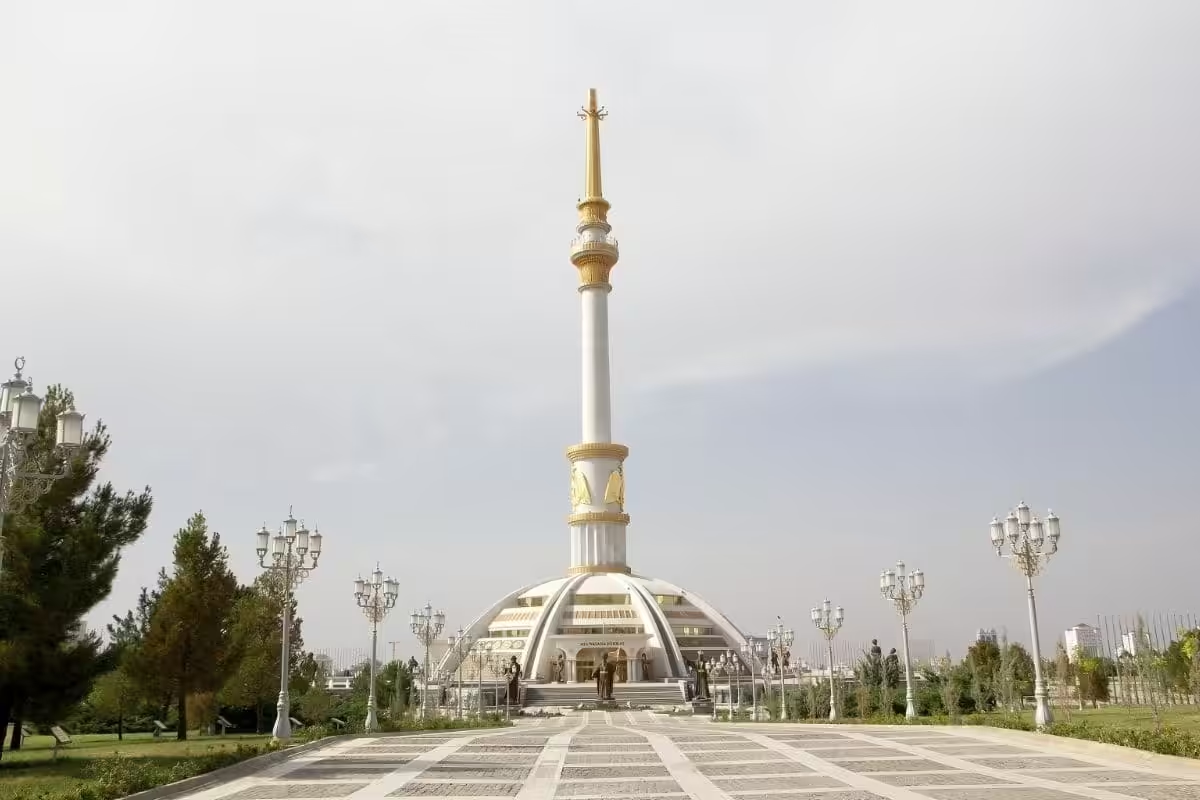
Turkmenistan, the gas-rich nation of Central Asia, presents a unique combination of opportunity and complexity for foreign employers. The country’s Labour Code (adopted 18 April 2009 and amended several times since) sets out comprehensive worker protections, while a flat 10% personal income tax keeps payroll calculations straightforward. Currency controls, foreign worker quotas, and a closed visa regime, however, mean that hiring locally requires careful navigation of state procedures. For international companies expanding into Turkmenistan, an Employer of Record (EOR) typically costs between USD 400 and USD 700 per employee per month and removes the need to register a local entity.
This guide explains the legal framework, payroll obligations, leave entitlements, and termination rules that apply in Turkmenistan in 2026, and shows how an EOR partner can put compliant employees on payroll within two to four weeks.
How an Employer of Record Works in Turkmenistan

If you’d like to learn more about how Employer of Record (EOR) services work, read our What Is an Employer of Record (EOR)? guide for a complete overview of the model, its benefits, and when to use it.
If you’re comparing providers, our Best Employer of Record (EOR) Providers guide reviews the leading platforms to help you choose the right solution for your business.
Who Uses an EOR in Turkmenistan?
EOR partnerships are particularly valuable in Turkmenistan because of the country’s restrictive business environment. Common use cases include:
- Foreign companies entering Turkmenistan for the first time without a local legal entity
- Energy, construction, and engineering firms hiring project-based teams for state-owned enterprise contracts
- Organisations managing small teams of 1 to 20 employees where the cost of a subsidiary is disproportionate to headcount
- Businesses that want to test the market before committing capital to a permanent presence
- NGOs, embassies, and international organisations needing local staff under a fully compliant arrangement
Typical Onboarding Timeline
The EOR onboarding process for a Turkmen national typically follows a predictable sequence:
- Days 1–2: Initial consultation; the EOR confirms scope, pricing, and documentation requirements
- Days 3–7: Service agreement signed; employee personal data, passport, and education credentials collected
- Days 8–14: Bilingual employment contract drafted, reviewed, and signed; registration with the Pension Fund and State Tax Service initiated
- Days 15–21: Tax and pension registration completed; payroll setup finalised; employee ready to start work
For foreign hires, add 30 to 45 days for the work permit issued by the State Migration Service plus the corresponding work visa. An EOR partnership typically offers a faster and far cheaper route into Turkmenistan than the alternative of registering a wholly foreign-owned enterprise, which requires Ministry of Finance approval, a state notarised charter, and several months of administrative processing.
Hire in Turkmenistan
Specialized talent in energy, engineering, and construction, paired with a labor market that runs on strict quotas and government approval, makes local expertise essential for building a team in Turkmenistan.
We handle employment contracts, payroll, tax withholding, and full Turkmenistan compliance.
No local entity needed. Your team can start in days.
Employment Laws and Regulations in Turkmenistan
Turkmenistan’s employment framework is governed by the Labour Code of Turkmenistan, adopted 18 April 2009 and amended on multiple occasions, most recently in late 2024 and 2025. The Code establishes minimum protections for all employees, sets out the rights and obligations of both parties, and prescribes detailed procedures for hiring, compensation, leave, and termination. Supplementary regulations cover social insurance, the rules on hiring foreign labour, and the statutory pension system administered by the Pension Fund of Turkmenistan. These rules apply to every employment relationship in the country, regardless of whether staff are engaged directly by a local entity or through an EOR.
Employment Contracts
Employment contracts in Turkmenistan must be in writing and concluded in Turkmen, with a Russian translation common in practice. The contract must specify the job title, duties, place of work, start date, working hours, salary in manat, probation period (if any), and grounds for termination. Contracts may be either indefinite (open-ended) or fixed-term; fixed-term contracts are permitted for specific projects, seasonal work, or to replace a temporarily absent employee, and must state the duration. Both parties must sign before work begins, and the employer must issue an internal order (prikaz) confirming the engagement. An EOR drafts contracts that meet every Labour Code requirement and stores them for the audit trail required during state inspections.
Working Hours and Overtime
Turkmenistan’s standard working week is 40 hours, distributed across five days at 8 hours per day or six days at shorter daily shifts. Workers under 16 are limited to 24 hours per week, and minors aged 16 to 18 to 36 hours per week. Reduced hours also apply to employees in hazardous occupations and those with certain medical conditions. Overtime is permitted only with the employee’s written consent and is capped at 4 hours over any two consecutive days and 120 hours per calendar year. The first two hours of daily overtime are paid at 1.5 times the regular rate, and any overtime beyond two hours in a day is paid at 2 times the regular rate. Work on rest days and public holidays is paid at double the standard rate or, with the employee’s agreement, compensated by an equivalent day off. Night work (between 10 PM and 6 AM) attracts a supplement of at least 20% above the standard rate, and pregnant women, employees under 18, and certain protected categories cannot be assigned to night shifts.
The following table summarises overtime and premium pay rates under Turkmenistan’s Labour Code:
Turkmenistan overtime and premium pay rates · Per Labour Code of Turkmenistan | |||
Hour Type | Rate Multiplier | Daily/Annual Cap | Notes |
|---|---|---|---|
Weekday overtime (first 2 hours) | 1.5x regular rate | First 2 hours of any overtime day | Requires written employee consent; documented in payroll records |
Weekday overtime (beyond 2 hours) | 2.0x regular rate | Max 4 hours/2 consecutive days; 120 hours/year | Cap is statutory and cannot be waived by contract |
Night work (10 PM – 6 AM) | Base + at least 20% supplement | No statutory daily limit for adults | Restricted for under-18s, pregnant women, and protected categories |
Weekend / rest day work | 2.0x regular rate (or compensatory day off) | No statutory limit | Day in lieu requires the employee’s written agreement |
Public holiday work | 2.0x regular rate (or compensatory day off) | No statutory limit | 14 statutory holidays observed in 2026 |
Minimum Wage
Turkmenistan enforces a single national minimum wage set by Presidential decree and applicable to all sectors and regions. As of 1 January 2025 (in force throughout 2026), the monthly minimum wage stands at 1,410 manat, following a 10% increase signed into law by Presidential decree in July 2024. This figure converts to roughly USD 403 at the official rate of approximately 3.5 manat to the dollar, though parallel-market rates are significantly weaker. The minimum applies to a standard 40-hour week; pro-rata reductions apply to part-time roles. The minimum wage is the gross statutory floor before income tax and the 1% employee social contribution. Many private-sector roles in Ashgabat pay well above the minimum, particularly in the energy, telecoms, and international NGO sectors. For more detail on national pay levels, see RemotePeople’s Turkmenistan minimum wage guide.
Probation Period
Probation in Turkmenistan is governed by Article 28 of the Labour Code. The standard probation period is up to 3 months, and may extend to 6 months for senior management positions, including heads of organisations, their deputies, chief accountants, and heads of branches or representative offices. Probation must be expressly stated in the written contract before work begins; if the contract is silent, the employee is treated as hired without probation. Periods of sick leave or other authorised absence are excluded from the probation calculation. During probation the employee enjoys the same rights and protections as a confirmed employee, including the full minimum wage and statutory benefits. Either party may terminate the contract during probation with three working days’ written notice. Probation cannot be applied to pregnant women, mothers of children under 3, employees under 18, or workers transferred from another employer by mutual agreement. See RemotePeople’s Turkmenistan probation period guide for further detail.
Leave Entitlements
Turkmenistan’s Labour Code provides generous statutory leave covering annual vacation, sick leave, maternity, and other circumstances. Every employee is entitled to a minimum of 30 calendar days of paid annual leave after 11 months of continuous service, with longer entitlements for workers in hazardous conditions, those under 18, and certain other protected categories. Maternity leave totals 112 calendar days at 100% of salary, paternity leave is not statutorily mandated, and parents may extend leave up to age 3 of the child. Sick leave is paid by the State Pension Fund from day one for insured employees. The sections below detail each category.
Annual Leave
The Labour Code grants every employee a minimum of 30 calendar days of paid annual leave per working year, accrued after 11 months of continuous service with the same employer. Workers in hazardous or harmful conditions, those with disabilities, employees under 18, and certain protected categories receive additional days, taking entitlement up to 35–45 calendar days depending on the role. Annual leave may, by mutual agreement, be split into two parts, provided one part is at least 14 calendar days. Unused leave may be carried into the following year only with the employer’s consent and is paid out in cash on termination. The leave year does not need to align with the calendar year; it runs from the employee’s start date.
Sick Leave
Sick leave in Turkmenistan is paid through the State Pension Fund’s social insurance scheme, not directly by the employer. The employee must present a medical certificate (bulletin) issued by a licensed doctor. Sick pay is calculated as a percentage of average earnings and depends on continuous service: roughly 60% of average pay for under 5 years of insured service, 80% for 5–8 years, and 100% for over 8 years of service or for work-related injuries. There is no statutory cap on the duration of paid sick leave so long as the medical certificate is renewed; however, after extended absence the employer may transfer the employee to lighter duties or, in some cases, terminate the contract with severance.
Maternity Leave
Turkmenistan grants 112 calendar days of paid maternity leave: 56 calendar days before the expected due date and 56 calendar days after birth. In the event of a complicated birth or multiple births, leave is extended by an additional 14 days, giving a total of 126 calendar days. Maternity leave is paid at 100% of the employee’s average salary, funded through the State Pension Fund’s social insurance scheme. Following the maternity leave, either the mother or another family member may take unpaid childcare leave that is job-protected up to the child reaching the age of 3. Pregnant women cannot be dismissed except on the grounds of complete liquidation of the employer.
Paternity Leave
Turkmenistan’s Labour Code does not provide statutory paid paternity leave. Some collective agreements in larger state-owned enterprises grant a few days of unpaid leave around the birth of a child, but this is at employer discretion and is not common in the private sector. The father (or another family member) may take the unpaid childcare leave to age 3 in place of the mother, and this period counts toward continuous service for pension and other entitlements.
Other Statutory Leave
Additional leave categories under the Labour Code include unpaid family-event leave (up to 5 calendar days for marriage, the birth of a child, or the death of a close relative), study leave for employees enrolled in approved educational programmes, and short-term leave for state or civic duties such as jury service or election work. Blood donors are entitled to a paid day off on the day of donation and a further day at a time of their choosing. Employees called up for short military service or training receive job-protected unpaid leave.
The following table summarises Turkmenistan’s statutory leave entitlements:
Turkmenistan statutory leave entitlements · Per Labour Code of Turkmenistan | ||
Leave Type | Duration | Eligibility & Notes |
|---|---|---|
Annual paid leave (standard) | 30 calendar days/year | All employees after 11 months of continuous service; payable in cash on termination |
Annual paid leave (hazardous/protected) | 35–45 calendar days/year | Hazardous occupations, employees under 18, workers with disabilities |
Sick leave (state-funded) | No statutory cap (with medical certificate) | 60–100% of average earnings depending on insured service tenure |
Maternity leave | 112 calendar days (126 if complications/multiples) | 56 prenatal + 56 postnatal; paid at 100% via State Pension Fund |
Paternity leave | Not statutory | Not mandated by Labour Code; some collective agreements offer unpaid days |
Childcare leave | Unpaid, until child reaches age 3 | Available to mother, father, or another family member; job-protected |
Family event leave | Up to 5 calendar days | Marriage, birth of a child, or death of a close relative; usually unpaid |
Study leave | As prescribed by Labour Code | Employees enrolled in approved education programmes; partly paid |
Statutory Employee Benefits
Employers in Turkmenistan must contribute to a single consolidated social insurance scheme administered by the Pension Fund of Turkmenistan. The standard employer contribution is 20% of gross payroll, with an additional 3.5% surcharge on payroll for employees engaged in hazardous occupations. Employees contribute 1% of gross salary. These contributions fund pensions, maternity benefits, sick pay, work-injury compensation, and survivor benefits. Personal income tax is withheld at a flat 10% on residents (those present in Turkmenistan for 183 or more days in a calendar year) and 10% at source for non-residents on Turkmenistan-sourced income. Filing and remittance deadlines are monthly, and EORs handle the calculation, withholding, and submission of all contributions and taxes through the State Tax Service portal.
Recent Regulatory Updates
The most recent material changes to Turkmenistan’s labour and pay framework include the 10% across-the-board increase to wages, pensions, state benefits, and student stipends effective 1 January 2025 (signed by Presidential decree in July 2024), which lifted the monthly minimum wage to 1,410 manat. The Labour Code itself has been amended on several occasions since 2009, with adjustments to working time, leave provisions, and protections for vulnerable categories of workers. The personal income tax rate has remained stable at 10% flat. Foreign employer reporting and currency-conversion procedures continue to evolve under guidance from the Central Bank of Turkmenistan; EOR providers monitor these changes and adjust payroll and reporting workflows accordingly.
Work Permits and Visas in Turkmenistan
Turkmenistan operates one of the most controlled visa regimes in Central Asia. Foreign nationals require both a work permit issued by the State Migration Service and a corresponding work visa from a Turkmen embassy or consulate before they can legally enter the country to work. Employers are subject to a quota that caps foreign workers at approximately 10% of total payroll, with exceptions for certain executive and specialist roles. The process is paper-intensive, takes 30 to 45 days on average, and requires careful coordination between the EOR, the prospective hire, and Turkmen consular posts abroad.
Work Permit Requirements
All foreign nationals (with very limited exceptions for certain CIS citizens and short-term technical visitors) require a work permit before commencing employment in Turkmenistan. The permit is employer-specific: it authorises a named foreign individual to work for a named employer in a named role, and it cannot be transferred between employers. The employer (or the EOR acting on its behalf) is the applicant; the employee plays a supporting role by providing personal documents and undergoing the required medical examinations.
Who Needs a Work Permit
Any foreign national intending to take up paid employment in Turkmenistan needs a work permit. This includes managers seconded from abroad, technical specialists working on long-term projects, foreign nationals hired locally, and consultants engaged on an employment basis. Diplomats accredited to Turkmenistan, employees of accredited international organisations, and certain inter-governmental project staff fall outside the standard permit regime, but these are narrow exceptions. Citizens of countries that have ratified specific bilateral agreements with Turkmenistan may benefit from procedural simplifications, though the underlying permit requirement still applies in most cases.
Eligibility and Required Documents
Permit eligibility depends on the role, the employer’s compliance record, and the share of foreign workers already on the employer’s payroll. Standard documents include a completed application form filed by the employer, the candidate’s passport (with at least 12 months’ validity), academic and professional qualifications (legalised and translated into Turkmen or Russian), a detailed CV, evidence of the employer’s registration in Turkmenistan, the draft employment contract, and medical certificates including HIV and tuberculosis screening. Some categories require additional sector-specific certifications, such as engineering qualifications for oil and gas roles. The employer must also demonstrate that no qualified Turkmen citizen is available for the role; a labour market test through the State Employment Service typically takes around two weeks.
Processing Time and Validity
Standard permit processing takes 30 to 45 days from the date of complete submission, with longer timelines during peak application periods or for sensitive sectors. Once approved, the work permit is generally valid for one year and is renewable while the employment continues and the quota allows. With the permit issued, the employee applies for the corresponding work visa at a Turkmen embassy or consulate abroad. Visa issuance typically takes 5 to 15 working days. The employee must enter Turkmenistan within the validity window stamped on the visa, register with the State Migration Service within 3 working days of arrival, and submit residency paperwork if staying longer than 30 days.
Renewal Process
Permit and visa renewals must be filed before expiry, typically 30 to 45 days in advance. The renewal application mirrors the initial submission, but the labour market test may be waived if the role and employer are unchanged. If the foreign worker quota for the employer has been reached or sector restrictions apply, renewal can be denied even when the employment relationship is otherwise compliant. An EOR tracks expiry dates centrally and initiates renewals proactively to prevent gaps in legal status, which would otherwise expose both the employer and the employee to fines and possible deportation.
Common Visa Types
Turkmenistan issues several categories of entry visa, of which the work and business categories are most relevant to employers. The work visa, granted on the strength of an issued work permit, is the standard route for employed foreign staff. Business visas are short-term and intended for negotiations, conferences, or technical visits, not for taking up employment. Private visas cover family visits, transit visas cover travel through the country, and tourist visas (issued sparingly) cover leisure travel. There is no remote-worker or digital-nomad visa scheme in Turkmenistan as of 2026. The table below outlines the categories most relevant to employers.
Turkmenistan work and business visa categories · 2026 | ||||
Visa Type | Duration | Best For | Leads to Residence? | Processing Time |
|---|---|---|---|---|
Work visa (single-entry) | Up to 1 year; renewable | Foreign employees with an issued work permit; standard for employed staff | Yes, after continuous lawful employment | 5–15 working days at consulate (after 30–45 day permit) |
Work visa (multiple-entry) | Up to 1 year; co-terminous with permit | Employees who travel frequently in and out of Turkmenistan | Yes, on the same basis as single-entry | 5–15 working days |
Business visa | Up to 90 days per entry | Negotiations, contract signing, conferences, short technical visits; not for paid employment | No | 10–30 working days |
Family / private visa | Up to 1 year | Family members of work-visa holders; does not authorise employment | Yes, family reunification routes available | 15–30 working days |
Transit visa | Up to 5 days | Travel through Turkmenistan en route to a third country | No | 5–10 working days |
How an EOR Handles Work Permits
An EOR takes end-to-end responsibility for work permit and visa administration. After you confirm the hire and provide the candidate’s basic details, the EOR runs the labour market test through the State Employment Service, prepares the permit application packet (including translations, notarisations, and apostilles where needed), and files it with the State Migration Service. The EOR liaises with the Ministry of Labour for any sector-specific approvals and tracks the application through to issuance. Once the permit is approved, the EOR coordinates with the relevant Turkmen embassy or consulate for visa issuance and briefs the employee on entry procedures. After arrival, the EOR completes the mandatory migration registration within three working days and arranges any required medical re-examinations. Throughout the engagement, the EOR monitors expiry dates and initiates renewals 30 to 45 days in advance, keeping every foreign hire in continuous legal status.
Payroll, Taxes, and Social Security in Turkmenistan
Turkmenistan’s payroll and tax framework is comparatively simple by Central Asian standards: a flat 10% personal income tax, a single consolidated social insurance contribution paid to the Pension Fund of Turkmenistan, and monthly filing deadlines through the State Tax Service. The complexity for foreign employers lies less in calculating the numbers than in handling currency controls, manat-denominated bank transfers, and the strict documentation that supports every payroll cycle. EORs automate every step and ensure on-time remittance to the appropriate state accounts.
Employer Contributions
Employers in Turkmenistan contribute a single consolidated 20% rate on gross payroll to the Pension Fund of Turkmenistan, which administers pensions, maternity benefits, sick pay, and survivor benefits in one combined fund. An additional 3.5% surcharge applies to payroll for employees engaged in hazardous occupations as defined by the Labour Ministry. There are no separate health-insurance, unemployment, or workplace-injury contributions; the consolidated rate covers all branches of social insurance. The total employer cost is therefore 20% of gross payroll for standard roles and up to 23.5% for hazardous-duty roles. EOR providers manage the calculation, deduction, and remittance through the State Tax Service portal each month.
Turkmenistan employer social security contributions · 2026 rates | ||
Contribution Type | Rate | Notes |
|---|---|---|
Pension Fund of Turkmenistan (consolidated social insurance) | 20% | Funds pensions, maternity benefits, sick pay, work-injury, and survivor benefits |
Hazardous-occupation surcharge | 3.5% | Applied to payroll for employees in hazardous duties as classified by the Labour Ministry |
Total Employer Contribution (standard roles) | 20% | Standard payroll burden; rises to 23.5% for hazardous occupations |
Employee Deductions
Employees in Turkmenistan see two deductions from their gross salary each month: a flat 10% personal income tax and a 1% contribution to the Pension Fund of Turkmenistan. Total employee withholding is therefore 11% of gross salary, one of the lowest combined rates in Central Asia. There are no progressive tax brackets, no separate medical or unemployment contributions, and no statutory pension cap on the employee side. The simplicity of the deductions makes payslips easy to read and net-pay forecasts straightforward.
Turkmenistan employee payroll deductions · 2026 monthly withholdings | ||
Deduction Type | Rate | Notes |
|---|---|---|
Personal Income Tax (PIT) | 10% | Flat rate on residents (183+ days/year); withheld at source by employer |
Employee Pension Fund contribution | 1% | Deducted from gross salary and remitted with employer’s 20% contribution |
Total Employee Withholding | 11% | Combined PIT and pension deduction; no progressive brackets |
Income Tax Brackets
Turkmenistan applies a flat personal income tax rate, not a progressive structure. Resident individuals (those present in Turkmenistan for 183 or more days in a calendar year) pay 10% on worldwide income. Non-residents pay 10% only on Turkmenistan-sourced income, including employment income earned for work performed in the country. Limited dividend, capital-gains, and royalty rules apply at the same 10% level for residents. The flat structure means payroll calculations are predictable across all salary levels and avoids the bracket-creep issues common in progressive systems.
Turkmenistan personal income tax structure · 2026 | |
Taxpayer Status & Income Source | Tax Calculation |
|---|---|
Resident – employment and worldwide income | Flat 10% on gross income |
Non-resident – Turkmenistan-sourced employment income | Flat 10% withheld at source |
Resident – dividend and interest income | Flat 10% withheld at source (no separate bracket) |
Resident – capital gains on most asset classes | Flat 10% (subject to applicable exemptions) |
Payroll Cycle
The Labour Code requires that wages be paid at least once per month and no later than 10 calendar days after the end of the pay period. Most Turkmen employers operate a single end-of-month payroll, paid into a manat-denominated bank account at one of the state-licensed banks. Some employers offer a mid-month advance with a final settlement at month-end; this is permitted but optional. Personal income tax and the consolidated social insurance contribution must be remitted to the State Tax Service and the Pension Fund by the 10th of the month following the payroll period. EOR providers automate the schedule and ensure that every filing meets the statutory deadline; late payment attracts penalties and interest under the Tax Code.
13th Month Salary and Bonus Pay
Turkmenistan’s Labour Code does not require a 13th month salary or year-end bonus. Bonuses, profit shares, and performance incentives are entirely at employer discretion and must be documented in the employment contract, internal regulations, or a collective agreement. Many state-owned enterprises pay an end-of-year stimulus bonus tied to plan fulfilment, and private-sector employers often follow suit informally. Any bonus paid is treated as ordinary income for tax and social insurance purposes, with the standard 10% PIT and 1% employee pension contribution withheld on payment.
Cost of Hiring Through an EOR in Turkmenistan
The total monthly cost of employing someone in Turkmenistan through an EOR breaks into three layers: the gross salary, the employer’s 20% social insurance contribution, and the EOR service fee. Combined, these components typically push the all-in cost to between 25% and 35% above the gross salary, depending on salary level and provider. Understanding this breakdown is essential for budgeting and for comparing EOR economics with the alternative of registering a local entity.
EOR Service Fees
EOR service fees in Turkmenistan typically range from USD 400 to USD 700 per employee per month, reflecting the higher administrative burden of the local regime compared with neighbouring Central Asian markets. Fees usually cover payroll processing, tax and social insurance filings, employment contract drafting and storage, work permit and visa administration for foreign hires, and routine HR support. Some providers price on a percentage of payroll rather than a flat per-employee fee; others bundle benefits administration, expense management, or local banking arrangements. When evaluating providers, compare both the headline monthly fee and what is included, since add-on charges for permit work or currency conversion can materially change the total cost of ownership.
Total Employment Cost Breakdown
The example below assumes a gross monthly salary of USD 5,000 for a standard (non-hazardous) role, paid through an EOR at a mid-range fee. Employer social insurance is calculated at the consolidated 20% rate. The total monthly cost to the foreign employer comes out at roughly 30% above gross salary. For lower salaries the percentage is higher because the EOR fee is broadly fixed; for higher salaries the percentage falls.
Turkmenistan employer cost example · USD $5,000 gross · 2026 | ||
Cost Component | Amount (USD) | % of Gross Salary |
|---|---|---|
Gross Salary (Employee) | $5,000 | 100% |
Pension Fund of Turkmenistan – consolidated social insurance (20%) | $1,000 | 20% |
EOR Service Fee (mid-range, per employee) | $500 | 10% |
Total Monthly Employer Cost | $6,500 | 130% |
This breakdown shows why the EOR model is the practical choice for small and medium-sized teams in Turkmenistan. Setting up a wholly foreign-owned enterprise instead requires Ministry of Finance approval, a notarised charter, share-capital deposits, and several months of administrative processing, plus the ongoing cost of in-country accountants, payroll staff, and legal advisers. For headcounts under 20, an EOR is typically the lower-cost and faster path; for permanent operations with 30+ employees, a local entity may eventually pay back the higher fixed cost.
Benefits of Using an EOR in Turkmenistan
An Employer of Record removes the operational and compliance friction of hiring in a tightly regulated market. Rather than building local payroll, tax, and HR capabilities from scratch, your business can focus on the work the employee will do and leave the rest to a partner that already operates inside Turkmenistan’s legal framework. The principal benefits include:
- Instant compliance: EOR providers track every Labour Code amendment, tax rule change, and Pension Fund update so your payroll stays correct without in-house Turkmen expertise.
- No local entity setup: Avoid the multi-month process of registering a wholly foreign-owned enterprise, securing Ministry of Finance approvals, and depositing statutory share capital. The EOR is the legal employer.
- Predictable monthly costs: A single all-in fee covers payroll, contributions, filings, and HR administration. No surprise compliance bills, currency-conversion shocks, or unexpected fines.
- Risk mitigation: The EOR bears statutory liability for payroll, tax, and labour-law compliance, shielding your organisation from the penalties that follow inspection failures.
- Currency and banking handled: Manat-denominated salary payments, state-bank transfers, and currency-conversion mechanics sit with the EOR, removing one of the trickiest barriers for foreign employers.
- Flexible scaling: Hire one person or twenty; the model expands and contracts without entity restructuring or capital commitments. Exit is straightforward.
- Employee experience: Staff receive bilingual contracts, monthly payslips itemised in manat, and full statutory benefits, giving them the security of formal employment under Turkmen law.
For most companies entering Turkmenistan for the first time, the EOR route delivers the fastest and lowest-risk path to a compliant local hire. The combination of speed, predictable cost, and full liability transfer makes it the default choice for headcounts where building infrastructure cannot be justified.
Termination and Offboarding in Turkmenistan
Termination of employment in Turkmenistan is closely regulated by the Labour Code, with prescribed notice periods, severance amounts, and procedural steps depending on the reason for termination. The Code distinguishes between termination during probation, termination at the employer’s initiative (including redundancy and liquidation), termination at the employee’s initiative, termination by mutual agreement, and termination for cause (gross misconduct). Employers must document the grounds carefully and follow each procedural step; non-compliance is a frequent source of reinstatement orders and damages awards in Turkmen labour courts.
Notice Periods
The standard notice period for a permanent employee terminated at the employer’s initiative without cause is one month after at least six months of service. During probation, the notice period is three working days for either party. Employees resigning voluntarily must give at least two weeks’ written notice; this can be reduced by mutual agreement. Termination for gross misconduct (theft, intoxication, repeated disciplinary breaches) is permitted without notice. The table below summarises the principal notice periods applicable in Turkmenistan.
Turkmenistan statutory notice periods by termination type · Per Labour Code | |||
Termination Type | Notice Period | During Probation | Notes |
|---|---|---|---|
Employer-initiated (non-cause, post-probation) | 1 month | 3 working days | Standard for redundancy and most no-fault terminations |
Employee-initiated resignation | 2 weeks | 3 working days | Reducible by mutual agreement; written notice required |
Senior management (CEO, CFO, branch head) | 1 month | 3 working days | Probation may extend to 6 months for senior roles |
Fixed-term contract expiry | As per contract (typically 3 days) | 3 working days | Notice not required if contract simply runs to its stated end |
Termination for serious misconduct | Immediate | Immediate | Theft, intoxication, repeated breaches, or disclosure of trade secrets |
Severance Pay
Severance pay in Turkmenistan is keyed to the reason for termination rather than the length of service. Employees terminated due to redundancy, workforce reduction, or company liquidation are entitled to severance equal to two weeks’ average pay, with additional support during the job-search period in some circumstances. Employees in protected categories (pregnant women, mothers with young children, workers within two years of pension age) receive enhanced protection and may not be dismissed except in narrow circumstances. Severance is not owed for resignations, mutual-consent terminations, or dismissals for serious misconduct.
Turkmenistan severance pay schedule by termination reason · Per Labour Code | |||
Reason for Termination | Severance Amount | Calculation Base | Notes |
|---|---|---|---|
Company liquidation | 2 weeks’ average pay | Average daily/monthly pay | Mandatory; applies to all employees of dissolved entity |
Workforce reduction / redundancy | 2 weeks’ average pay | Average daily/monthly pay | Position eliminated due to operational or economic need |
Refusal to relocate with employer | 2 weeks’ average pay | Average daily/monthly pay | Employee declines transfer to a new locality offered by employer |
Health-related inability to perform duties | 2 weeks’ average pay | Average daily/monthly pay | Where medical evidence prevents continued performance |
Mutual consent termination | None (negotiable) | N/A | No statutory severance; parties may agree to additional compensation |
Termination during probation | None | N/A | No severance owed; 3 working days’ notice applies |
Termination for serious misconduct | None | N/A | Theft, intoxication, repeated discipline breaches; final wages and accrued leave still owed |
Calculation Method
Average pay for severance purposes is calculated over the previous 12 months of employment (or the full period of employment if shorter). The calculation includes base salary plus regular bonuses, allowances, and overtime; one-off payments are excluded. Severance is paid as a lump sum on the final working day, together with accrued and untaken annual leave converted to cash. The Labour Code does not impose a statutory cap on severance amounts. EOR providers run the calculation and ensure final payment lands in the employee’s account on time.
Caps and Exceptions
Severance is not owed in three principal scenarios: voluntary resignation, mutual-consent termination (unless the parties agree otherwise), and dismissal for serious misconduct. The Labour Code also provides enhanced protection for pregnant women, mothers of children under 3, single parents of children under 14, and employees within two years of pension age; these categories cannot be dismissed except on narrow grounds such as complete liquidation. Where a fixed-term contract simply runs to its stated end, severance is not owed unless the contract or a collective agreement provides otherwise.
Grounds for Termination
Article 42 and the surrounding provisions of the Labour Code list the exhaustive grounds on which an employer may terminate employment. They include: complete liquidation of the employer; reduction in headcount or staffing structure; the employee’s failure to meet job requirements (confirmed by attestation results); systematic non-performance of duties without good reason; absence from work for more than four hours in a working day without justification; appearing at work intoxicated; theft of employer property; gross breach of safety rules; loss of trust where the employee handles money or valuables; and disclosure of trade secrets. Mutual agreement and contract expiry are separate, no-fault grounds. The Labour Code does not permit at-will dismissal; every termination must align with a listed ground and be properly documented. EORs ensure the paper trail (orders, attestation records, disciplinary letters) supports any termination decision.
EOR vs. Other Hiring Models in Turkmenistan
Foreign employers in Turkmenistan typically choose between three approaches: an Employer of Record, a wholly foreign-owned enterprise registered locally, or independent contractor arrangements. Each model carries distinct setup costs, ongoing obligations, and risk profiles. The right choice depends on headcount, time horizon, capital available, and tolerance for compliance risk in a market with active state inspection and currency controls.
EOR vs. Setting Up a Local Entity
An EOR and a wholly foreign-owned enterprise sit at opposite ends of the operational spectrum. A local entity gives you full control, the ability to bid for state contracts, and direct access to the local banking system, but it requires Ministry of Finance approval, share-capital deposits, ongoing audit and corporate-governance obligations, and several months of setup time. An EOR delivers speed, predictable cost, and full compliance liability transfer, at the price of less direct control over the legal-employer entity. The table below compares the two side by side.
Turkmenistan EOR vs local entity comparison · Setup time, cost, risk and best-fit | ||
Decision Factor | Employer of Record (EOR) | Own Local Entity (WFOE) |
|---|---|---|
Setup Time | 2–4 weeks | 3–6 months (Ministry of Finance approval, charter notarisation, tax registration, bank account) |
Upfront Cost | Minimal (EOR enrollment fee, typically USD 0–500) | USD 8,000–15,000 (registration fees, legal, share-capital deposit, initial compliance) |
Ongoing Monthly Cost | USD 400–700 per employee | USD 1,500–3,000+ (local accountant, payroll staff, legal advisor, office) |
Local Partner Required | No – EOR is the legal employer | Often – local accountant or legal advisor strongly recommended |
Pension & Tax Registration | EOR handles; no action required from you | Your responsibility; register with Pension Fund and State Tax Service |
Payroll & Tax Filing | Fully managed by EOR provider | Your responsibility (or outsourced to local payroll service) |
Best for Team Size | 1–20 employees; pilot operations or uncertain commitment | 20+ employees; long-term operations; intent to bid for state contracts |
Scale Down / Exit | Simple – end the EOR arrangement; no wind-down obligations | Complex – formal entity dissolution, tax clearance, multi-month liquidation |
Government Contracts | Restricted; most public tenders require a local entity | Eligible; may bid directly on state-owned enterprise contracts |
EOR vs. Hiring Independent Contractors
Independent contractors look superficially cheaper and simpler than employees, but Turkmenistan’s tax authorities apply a substance-over-form test when classifying relationships. If a worker performs regular duties under your direction, with set hours, exclusive engagement, and the trappings of an ongoing employment relationship, the State Tax Service can reclassify the engagement as employment and assess back taxes, social contributions, and penalties. Genuine project-based work with a clear deliverable and an independently operated counterparty remains a valid model, but the line is policed strictly. The table below sets out the trade-offs.
Turkmenistan EOR vs. independent contractors · Compliance, cost, and risk | ||
Decision Factor | EOR (Full-Time Employee) | Independent Contractor |
|---|---|---|
Legal Relationship | Employer–employee; governed by Labour Code | Service contract; governed by Civil Code |
Social Contributions | Employer pays 20%; employee pays 1%; mandatory | Contractor pays own social contributions; engager has no liability if relationship is genuine |
Compliance Risk | Low – EOR ensures every statutory obligation is met | High – misclassification triggers back taxes, contributions, and penalties; State Tax Service applies substance-over-form |
Payroll & Tax | EOR withholds taxes, pays contributions, and files monthly returns | Contractor self-files; engager pays gross invoice amount |
Benefits & Leave | Statutory: 30 days’ annual leave, sick leave, 112-day maternity, pension | None – contractor receives agreed fee only |
Intellectual Property | Clear – work created in employment vests in employer by default | Unclear – contractor may retain rights unless explicit assignment in contract |
Termination | Subject to Labour Code (notice, severance, listed grounds) | Simple – contract termination per agreed terms; fewer procedural requirements |
Best For | Full-time roles, long-term staffing, ongoing operational positions | Project-based work, defined deliverables, short engagements with autonomous specialists |
EOR vs. PEO
Professional Employer Organisations (PEOs) and Employers of Record (EORs) both provide outsourced employment solutions, but they differ in legal structure. A PEO operates a co-employment model in which both the PEO and the client share employer responsibilities; this works well in jurisdictions that recognise co-employment, but Turkmenistan’s Labour Code does not formally accommodate the structure. An EOR, by contrast, is the sole legal employer; the client is purely a service recipient. This single-employer model maps cleanly onto Turkmen law and is the dominant outsourced-employment structure in the country.
Turkmenistan EOR vs. PEO · Legal employer, liability, and operational control | ||
Decision Factor | Employer of Record (EOR) | Professional Employer Organisation (PEO) |
|---|---|---|
Legal Employer Status | EOR is the sole legal employer; client is the service recipient | Co-employment; both PEO and client share employer responsibilities |
Local Entity Required | No – EOR’s entity serves as employer | Often required; PEO model has limited recognition under Turkmen law |
Best For | Companies entering Turkmenistan for first time without local infrastructure | Companies that already operate a local entity and want shared HR services |
Compliance Liability | EOR bears full statutory liability; client is insulated | Shared liability; client retains exposure to compliance failures |
Setup Time | 2–4 weeks; minimal documentation | 2–4 months if local entity setup is required first |
Control Over HR Policies | Limited – EOR sets statutory policies; client configures within framework | Greater – client co-authors policies and procedures |
Typical Use Case in Turkmenistan | Standard route for foreign employers without local entity | Niche; rarely used in Turkmenistan due to legal-structure mismatch |
Public Holidays in Turkmenistan
Turkmenistan observes 14 statutory public holidays in 2026, encompassing secular state celebrations, two Islamic religious holidays (Oraza Bayram and Gurban Bayram, the dates of which shift annually with the lunar Hijri calendar), and the major national observances of independence, neutrality, and the Constitution. When a public holiday falls on a weekend, the Cabinet of Ministers customarily designates a transferred day off on the following working day. Employees who work on a public holiday are entitled to double pay or, with their agreement, an equivalent compensatory day off. The full 2026 holiday calendar is set out below.
Turkmenistan public holidays · 2026 calendar year | ||
Date | Holiday Name | Type |
|---|---|---|
January 1 | New Year’s Day | National holiday |
January 12 | Memorial Day (Day of Remembrance) | National holiday |
February 19 | State Flag Day | National holiday |
March 8 | International Women’s Day | National holiday |
March 21–22 | Nowruz (Spring Festival) | National holiday (2 days) |
March 20–22 (Hijri-dependent) | Oraza Bayram (Eid al-Fitr) | Religious holiday; date confirmed by Mufti’s office |
May 9 | Victory Day | National holiday |
May 18 | Constitution and Magtymguly Pyragy Day | National holiday |
May 27–29 (Hijri-dependent) | Gurban Bayram (Eid al-Adha) | Religious holiday (3 days); date confirmed by Mufti’s office |
September 27 | Independence Day | National holiday |
December 12 | International Day of Neutrality | National holiday |
How to Get Started with an EOR in Turkmenistan
Putting your first hire on the ground in Turkmenistan through an EOR follows a predictable sequence and typically takes two to four weeks for a Turkmen national, or six to eight weeks if a foreign work permit and visa are involved. The following steps cover the standard onboarding journey:
- First, request a quote and consultation. Contact an EOR provider with the role, expected salary, and intended start date. The EOR confirms service inclusions, fee structure, and any role- or sector-specific requirements. Typically takes 1–2 days.
- Second, review and sign the service agreement. Review the EOR master service agreement, which covers responsibilities, fees, payment terms, liability allocation, and exit. Once aligned, sign and pay any enrollment fee.
- Third, provide employee information. Furnish the candidate’s personal details, passport or national ID, education credentials, address, and bank account. The EOR uses this to draft the employment contract and register the employee.
- Fourth, execute the employment contract. The EOR generates a bilingual contract that meets every Labour Code requirement and clears it with you for sign-off. The employee and the EOR sign; the employer issues the corresponding internal order.
- Fifth, complete payroll setup. Confirm pay schedule (typically monthly), payment method, and any benefits in scope. The EOR registers the employee with the Pension Fund of Turkmenistan and the State Tax Service. Initial registration takes 1–2 weeks.
- Sixth, manage on an ongoing basis. Use the EOR’s portal to submit timesheets, approve leave, and review payslips. The EOR handles every monthly filing, contribution, and statutory report. You pay the EOR’s monthly invoice on time to keep payroll uninterrupted.
Throughout the engagement, the EOR is your single point of contact for compliance questions, regulatory updates, and operational support. This removes the burden of mastering Turkmenistan’s Labour Code and tax system and lets you focus on the work the employee was hired to do.
Ready to hire in Turkmenistan? Get in touch today to speak with our team about your hiring needs and receive a tailored proposal.
Where companies hiring in Turkmenistan expand next
Teams building a presence in Turkmenistan often extend across the Caucasus and Central Asia, where Russian-language coordination and cross-border trade corridors remain strong. After building a team in Turkmenistan, employers often look to operations in Azerbaijan for Central Asian cost parity and tech talent, then Kazakhstan for aligned Central Asian labor frameworks. Hiring in Georgia follows with shared Central Asian hiring dynamics, and an EOR partner in Armenia typically closes the regional footprint via overlapping Central Asian talent profiles.
Frequently Asked Questions
Total monthly cost depends on the salary and the EOR provider's fee. For a USD 5,000 gross monthly salary, the employer pays USD 1,000 in social insurance (20%) plus an EOR service fee of USD 400–700 per employee, bringing the total to roughly USD 6,400–6,700 per month. For lower salaries, the percentage impact is higher because the EOR fee is broadly fixed; for higher salaries, the percentage falls. Always request a detailed cost breakdown that itemises pension contributions, EOR fees, and any add-ons such as work permit handling.
For a Turkmen national, EOR enrollment and contract signing typically take 1–2 weeks, with state pension and tax registration adding another 1–2 weeks. Total: 2–4 weeks from start to first day of work. For a foreign hire, add 30–45 days for the work permit issued by the State Migration Service and 1–2 weeks for the corresponding work visa. This is dramatically faster than registering a wholly foreign-owned enterprise locally, which takes 3–6 months.
No. The EOR maintains its own Turkmen legal entity and acts as the sole legal employer for your staff. You do not need to register a local company, deposit share capital, secure Ministry of Finance approvals, or maintain a Turkmen bank account. Removing the local-entity requirement is one of the principal advantages of the EOR model in Turkmenistan, where business registration is unusually time-consuming.
Genuine independent-contractor arrangements are permitted under the Civil Code, but the State Tax Service applies a strict substance-over-form test. If a worker performs regular duties under your direction with set hours and exclusive engagement, the relationship is likely to be reclassified as employment, triggering back taxes, social contributions, and penalties. Contractors work for genuinely project-based, deliverable-driven engagements; ongoing operational roles should always go through an EOR.
Employers contribute a single consolidated 20% of gross payroll to the Pension Fund of Turkmenistan. This covers pensions, maternity benefits, sick pay, work-injury, and survivor benefits in one combined payment. An additional 3.5% surcharge applies to payroll for employees in hazardous occupations. There are no separate health-insurance, unemployment, or workplace-injury contributions on top. Employees contribute a further 1% from their gross salary.
Termination procedures depend on the reason and the employee's status. Standard non-cause termination of a permanent employee requires one month's written notice and severance equal to two weeks' average pay for redundancy, liquidation, or similar grounds. Termination during probation requires three working days' notice and no severance. Dismissal for serious misconduct may be immediate but requires documented evidence. Pregnant women, mothers of young children, and employees near pension age have enhanced protection and may be dismissed only on narrow grounds. The EOR calculates severance, drafts the necessary documentation, and ensures the final payment lands on the last working day.
Yes. EOR-employed workers are full employees under the Labour Code of Turkmenistan and receive every statutory protection: 30 days of annual leave, 112-day paid maternity leave, sick pay through the Pension Fund, the minimum wage of 1,410 TMT per month, overtime premiums, and severance in prescribed circumstances. The legal status of an EOR-employed worker is identical to that of a directly hired employee.
Yes. The EOR runs the labour market test through the State Employment Service, prepares and files the work permit application with the State Migration Service, coordinates with the Turkmen consulate where the candidate applies for the visa, and handles post-arrival migration registration. Standard processing time is 30–45 days for the permit plus 5–15 working days for the visa, so the realistic end-to-end timeline for a foreign hire is six to eight weeks from EOR engagement to first day of work in Turkmenistan.
Employer of Record in
Employer of Record in
Employer of Record in
Employer of Record in
Employer of Record in
Employer of Record in
Employer of Record in
Employer of Record in