
 Recruit
Employer of Record (EOR) in Kazakhstan
-
 Drew Donnelly
- Published
- September 12, 2026
An employer of record (EOR) in Kazakhstan lets you hire employees compliantly without setting up a local entity, with services starting at $199/month per employee. The EOR manages payroll, tax filings, mandatory social contributions, and pension fund compliance under Kazakhstan’s Labor Code, so your team can start in days.
Hire in Kazakhstan — book a free 30-minute demo
Tell us what you need. You'll get a tailored, transparent proposal within 24 hours, plus a free call to walk through it.
Tell us about your company
So we can match you with a specialist who knows your market — and unlock volume pricing tiers.
* All fields are required.
Where and when are you hiring?
Tell us the geography and timing and we'll quote each country line by line, with onboarding timelines.
* All fields are required.
Help us beat your current setup
We'll benchmark your current deal and send a line-by-line proposal in 24 hours — showing exactly where we cut cost, time, or risk. After you submit, you can book a call to walk through it together.
* All fields are required.
Thanks! Your proposal is on its way.
Expect a tailored, line-by-line proposal in your inbox within 24 hours. In the meantime…
Want to walk through it together?
Book a free 30-minute call with one of our specialists. We'll explain every line, answer your questions, and tailor the proposal further if you need.
No obligation. Pick a time that works for you.








- Hire in Kazakhstan — book a free 30-minute demo
- Tell us about your company
- Where and when are you hiring?
- Help us beat your current setup
- Thanks! Your proposal is on its way.
- How an Employer of Record Works in Kazakhstan
- Hire in Kazakhstan
- Employment Laws and Regulations in Kazakhstan
- Work Permits and Visas in Kazakhstan
- Payroll, Taxes, and Social Security in Kazakhstan
- Cost of Hiring Through an EOR in Kazakhstan
- Benefits of Using an EOR in Kazakhstan
- Termination and Offboarding in Kazakhstan
- EOR vs. Other Hiring Models in Kazakhstan
- Public Holidays in Kazakhstan
- How to Get Started with an EOR in Kazakhstan
- Where companies hiring in Kazakhstan expand next
- Frequently Asked Questions
- Related EOR Destinations

Start hiring in Kazakhstan
Let RemotePeople handle payroll, compliance, and HR admin worldwide so you can focus on building your team.

Kazakhstan has emerged as a strategic hub for regional business expansion in Central Asia, combining a modern labour framework with a growing economy. The country’s Labour Code No. 414-V (2015, as amended) establishes comprehensive employment protections and statutory benefits for workers, while its tax regime has recently introduced progressive rates to accommodate higher earners. For international employers seeking to hire in Kazakhstan, understanding local employment rules, from mandatory social contributions to visa categories and leave entitlements, is essential for compliance and cost planning.
This guide walks you through the legal requirements, worker protections, and administrative procedures that govern employment relationships in Kazakhstan, equipping you with the knowledge to hire confidently through an Employer of Record (EOR) partner or direct employment.
How an Employer of Record Works in Kazakhstan
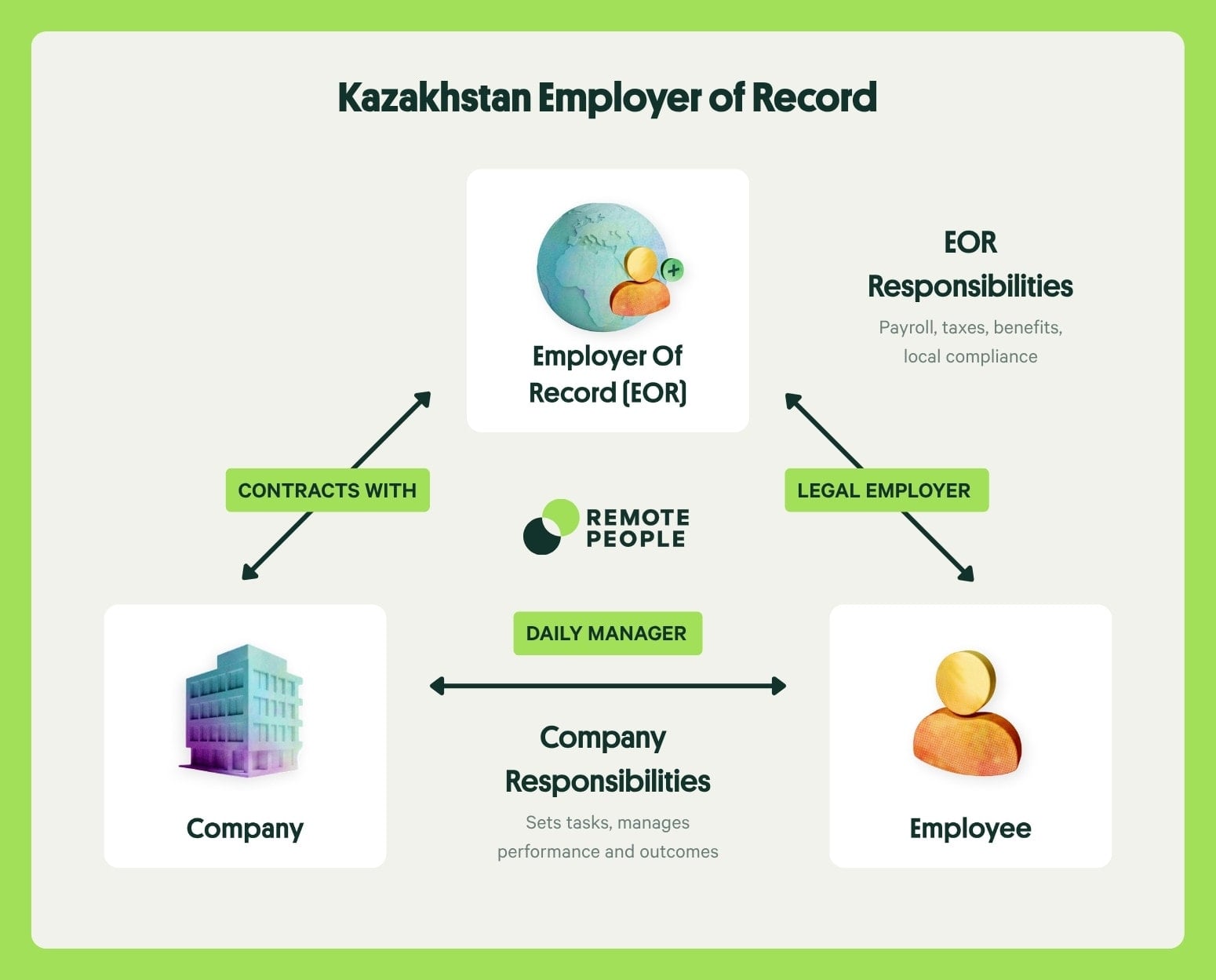
If you’d like to learn more about how Employer of Record (EOR) services work, read our What Is an Employer of Record (EOR)? guide for a complete overview of the model, its benefits, and when to use it.
If you’re comparing providers, our Best Employer of Record (EOR) Providers guide reviews the leading platforms to help you choose the right solution for your business.
Who Uses an EOR in Kazakhstan?
EOR partnerships appeal to various business scenarios.
- Foreign companies entering Kazakhstan for the first time without local legal infrastructure
- Companies seeking rapid hiring without 2–4 month delays for local entity setup
- Organizations managing small to medium-sized teams (1–20 employees) with uncertainty about long-term commitment
- Businesses wanting to isolate compliance risk and avoid local payroll/HR overhead
Typical Onboarding Timeline
The EOR onboarding process follows a structured timeline.
- Days 1–2: Initial consultation; EOR clarifies services, pricing, and requirements
- Days 3–7: Service agreement signed; employee information collected
- Days 8–14: Employment contract drafted, reviewed, and executed; state registration initiated
- Days 15–28: State registration with tax authorities, social insurance, and pension fund completed; employee officially registered and ready to commence work
EOR partnerships typically offer a more cost-effective and faster route to employment in Kazakhstan than setting up a branch or subsidiary, which would require local registration, legal registration with tax authorities, ongoing corporate governance, and dedicated in-house payroll and HR functions. An EOR can onboard employees in weeks rather than months, and you avoid ongoing compliance risks associated with local entity management.
Hire in Kazakhstan
A skilled, multilingual workforce, strong presence in oil, gas, and mining, and a Eurasian Economic Union market position make Kazakhstan a strategic option for companies expanding into Central Asia.
We handle employment contracts, payroll, tax withholding, and full Kazakhstani compliance.
No local entity needed. Your team can start in days.
Employment Laws and Regulations in Kazakhstan
Kazakhstan’s employment framework is anchored in the Labour Code of the Republic of Kazakhstan No. 414-V, enacted on 23 November 2015 and amended multiple times, most recently through legislative updates approved in late 2025 for implementation in 2026. The Code establishes minimum protections for all workers, defines employer obligations, and outlines procedures for hiring, compensation, and termination. Recent amendments have introduced digital contracting capabilities via the Unified Labor Contract System (ULCS) and strengthened protections against workplace sexual harassment. These foundational regulations apply to all employment relationships, regardless of whether staff are engaged directly or through an EOR.
Employment Contracts
Employment contracts in Kazakhstan must be written and typically conclude in both Kazakh and Russian, as both are official languages in official contexts. The contract must clearly specify the job title, duties, reporting relationships, compensation structure (base salary and any allowances or bonuses), working hours, probation period if applicable, and conditions for termination. Contracts may be indefinite (open-ended) or fixed-term; fixed-term agreements are common for project-based or temporary roles and require objective justification. Under amendments coming into force in 2026, contracts can now be concluded electronically via the Unified Labor Contract System (ULCS) using digital signatures, enabling faster hiring processes. Both parties must sign or electronically approve the contract before work begins. An EOR ensures your contracts are drafted to meet all Labour Code requirements and stored securely for audit compliance.
Working Hours and Overtime
Kazakhstan establishes a standard workweek of 40 hours, typically distributed Monday through Friday (8 hours daily). The Labour Code permits flexibility through agreement; some sectors or roles may negotiate shorter or flexible schedules, but any arrangement must be documented in the employment contract. Overtime, work beyond the standard 40 hours per week, is permitted but heavily regulated. The first 2 hours of daily overtime are compensated at 1.5 times the regular hourly rate; any additional overtime beyond 2 hours in a day is paid at double the regular rate. Monthly overtime is capped at 12 hours, and daily overtime is limited to 2 hours per day (1 hour for hazardous or dangerous work). Overtime must be voluntary unless the employer has an operational emergency. Employees working between 10 PM and 6 AM (night shifts) receive a night work supplement, typically 20–30% above the regular hourly rate, negotiated in the contract. Certain groups (workers under 18, pregnant women with medical certification, and employees with disabilities) are restricted from night work unless medically cleared.
Work on weekends and public holidays is compensated at 1.5 times the standard hourly rate. Alternatively, with the employee’s written consent, the employer may provide a compensatory day off in lieu of additional pay. In 2026, Kazakhstan will observe approximately 15 statutory public holidays, including New Year (4 days), Orthodox Christmas (7 January), International Women’s Day (8–9 March), Nauryz Meiramy (21–25 March), Day of Unity (1 May), Defender of the Fatherland Day (7 May), Victory Day (9 May), Kurban Ait (27 May), Capital City Day (6 July), Constitution Day (31 August), Republic Day, and a day off on 16 December, resulting in 119 non-working days and 246 working days across the calendar.
The following table outlines overtime compensation and premium pay rates under Kazakhstan’s Labour Code No. 414-V.
Kazakhstan overtime and premium pay rates · Per Labour Code No. 414-V | |||
Hour Type | Rate Multiplier | Weekly/Daily Cap | Notes |
|---|---|---|---|
Weekday overtime (hours 41–48) | 1.5x regular rate | First 2 hours/day; 12 hours/month max | Must be voluntary; documented in contract |
Weekday overtime (hours 49+) | 2.0x regular rate | Beyond 2 hours/day; 12 hours/month total | Only permitted in emergencies or by agreement |
Night work (10 PM–6 AM) | Base + 20–30% supplement | No statutory daily limit; restricted for minors | Restricted for under-18s, pregnant women, disabled workers |
Weekend work (Saturday–Sunday) | 1.5x regular rate (or time off) | No statutory limit | Alternative: compensatory day off; written consent required |
Public holiday work | 1.5x regular rate (or time off) | No statutory limit | ~15 public holidays in 2026; time off negotiable |
Minimum Wage
Kazakhstan enforces a single national minimum wage applicable to all full-time employees across all sectors and regions. As of January 2026, the minimum wage remains frozen at KZT 85,000 per month (approximately USD 170 at current exchange rates). This minimum applies to a standard 40-hour workweek. All compensation, whether salary or hourly, must meet or exceed this threshold. Employers cannot offset statutory benefits (such as social contributions against minimum wage obligations; the full minimum must be paid as gross compensation. Any additional bonuses, allowances, or performance pay may be added above the minimum. For part-time or contracted roles, the minimum wage is prorated based on actual hours worked. The Monthly Calculation Index (MCI), used to set administrative penalties, contribution bases, and benefit thresholds, is adjusted annually and impacts payroll calculations.
Probation Period
Employers in Kazakhstan may include a probationary period in the employment contract to assess an employee’s suitability for the role. The standard probation period is up to 3 months. However, for senior positions (heads of organizations, their deputies, chief accountants, and heads of structural divisions), probation can extend up to 6 months. The probation period must be explicitly stated in the contract before work begins. During probation, employees enjoy the same labour law protections as permanent staff; there is no reduced status. If the employer determines the employee is unsuitable during probation, the contract can be terminated with written notice (typically 7 calendar days before the end of probation). Conversely, employees can resign at any time during probation with standard notice. Probation cannot be extended retroactively or repeated if the contract is renewed. Successful completion of probation is assumed unless the employer formally notifies the employee of unsuitability.
Leave Entitlements
Kazakhstan mandates generous statutory leave entitlements covering annual vacation, sick leave, maternity leave, and other circumstances. Every employee accrues paid annual leave; most categories receive a minimum of 24 calendar days per year. Employees in hazardous, harmful, or difficult working conditions receive 6 additional days (30 days total). Sick leave is paid for the first 15 calendar days, after which social insurance takes over. Maternity leave totals 126 days (70 before birth, 56 after), with an additional 14 days if complications arise. Paternity leave is not statutory in Kazakhstan, though some employers offer 5 unpaid days by policy. All parents may access unpaid leave to care for a child until age 3. The following sections detail each category and required eligibility rules.
Annual Leave
All employees in Kazakhstan are entitled to at least 24 calendar days of paid annual leave per year. Employees engaged in heavy work, harmful or dangerous conditions, or those with disabilities receive 6 additional days (30 calendar days total). By mutual agreement, employers and employees may split annual leave into multiple periods in a single year, provided at least one period lasts at least 14 consecutive calendar days. Employees can request leave at any time of the working year; employers must approve or schedule it to ensure business continuity. Upon termination of employment, any unused annual leave must be paid out in full cash compensation, regardless of the reason for termination. Leave entitlements accrue throughout the year and do not expire; carry-over is permitted for up to 50 calendar days, with any excess paid in cash at year-end.
Sick Leave
Sick leave in Kazakhstan is paid by the employer for the first 15 calendar days of absence in a calendar year. The employee must provide a medical certificate (issued by a doctor) to substantiate the absence. For absences beyond 15 calendar days in a year, payment is covered by social insurance (state social insurance fund). Employees may take up to 60 calendar days of sick leave per year under the statutory framework. If a worker has not made sufficient social insurance contributions, gaps may affect benefits. Sick leave does not accrue unpaid; it is consumed as needed and certified by medical evidence.
Maternity Leave
Kazakhstan provides 126 days of fully paid maternity leave: 70 days before the expected due date (prenatal) and 56 days after birth (postnatal). If childbirth is complicated, an additional 14 days of leave is granted. In case of multiple births, postnatal leave increases to 70 days. The employer pays maternity leave at 100% of the employee’s average salary during the leave period. After the 126-day maternity leave, either parent may take unpaid leave to care for the child until the child reaches 3 years of age. This extended unpaid leave is job-protected; the employer cannot terminate the employee for taking parental leave.
Paternity Leave
Kazakhstan’s Labour Code does not mandate paid paternity leave. However, some sources and employer practices provide 5 calendar days of leave following the birth of a child; the eligibility and compensation structure (paid or unpaid) varies by employer and collective agreement. Any paternity leave must be documented in company policy or collective agreement. Either parent may access unpaid leave to care for a child until age 3; this leave is job-protected and does not affect the employee’s legal status or benefits eligibility.
Other Statutory Leave
Kazakhstan recognizes several other forms of leave. Employees are entitled to unpaid leave for important family events (up to 3 calendar days, such as marriages or funerals), which must be certified with supporting documents. Blood donors are entitled to 1 day of paid leave per donation. Employees participating in public elections or serving as witnesses in legal proceedings may take necessary leave, typically unpaid. Career development or professional training leave is not statutorily mandated but may be offered by employers under collective agreements. Leave for relocation when transferring employment or retirement is job-protected but typically unpaid.
Kazakhstan’s Labour Code establishes several categories of statutory leave.
Kazakhstan statutory leave entitlements · Per Labour Code No. 414-V | ||
Leave Type | Duration | Eligibility & Notes |
|---|---|---|
Annual paid leave (standard) | 24 calendar days/year | All employees; may be split into multiple periods; unused leave paid out on termination |
Annual paid leave (hazardous/harmful) | 30 calendar days/year | Employees in hazardous, harmful, or difficult working conditions; includes base 24 days + 6 additional |
Sick leave (employer-paid) | First 15 calendar days/year | Paid by employer; requires medical certificate; beyond 15 days covered by social insurance |
Maternity leave | 126 calendar days total | 70 days prenatal + 56 days postnatal; +14 days if complications; paid at 100% salary; job-protected |
Paternity leave | 5 calendar days (non-statutory) | Not mandated by law; some employers provide; varies by company policy; unpaid or paid per agreement |
Parental leave (child care) | Unpaid, until child reaches age 3 | Either parent; job-protected; follows maternity or paternity leave; no statutory pay |
Leave for important family events | Up to 3 calendar days | Marriage, funeral, other significant events; unpaid; must be documented with certificates |
Statutory Employee Benefits
Employers in Kazakhstan must contribute to mandatory social insurance and health programs on behalf of all employees. These are statutory deductions and employer costs, not optional. The primary benefits include mandatory pension contributions (ECPC), medical and social health insurance (MSHI), obligatory social insurance, and state social insurance coverage for sick leave and temporary disability. Employers contribute 3.5% for the Employer’s Compulsory Pension Contribution (ECPC) to the Unified Accumulative Pension Fund (UAPF), increasing gradually to 5% by 2028. Employers also pay 5% for obligatory social insurance (managed by the State Pension Centre) and 3% for medical and social health insurance (MSHI). These contributions are based on employee gross salary, calculated from a minimum of one minimum wage (KZT 85,000) up to a maximum of 50 minimum wages (KZT 4.25 million) per employee per month. Employees separately contribute 10% to the UAPF (their personal pension account) and 2% to MSHI, deducted from gross salary. Additionally, employers must withhold personal income tax from employees at a progressive rate: 10% on annual income up to 8,500 MCI (approximately KZT 36.75 million in 2026) and 15% on income above that threshold. All contributions and taxes are remitted to the State Revenue Committee and social insurance authorities according to strict monthly deadlines.
Recent Regulatory Updates (2026)
Kazakhstan’s labour and tax framework has undergone significant changes effective from January 2026. The Personal Income Tax (PIT) system shifted from a flat 10% rate to a progressive structure: income up to 8,500 MCI (the Monthly Calculation Index) is taxed at 10%, and any income exceeding this threshold is taxed at 15%. This change is designed to increase tax revenue from higher earners while maintaining lower rates for average workers. The Employer’s Compulsory Pension Contribution (ECPC) was increased from 2.5% in 2025 to 3.5% in 2026, continuing an annual phase-in schedule (reaching 4.5% in 2027 and 5% in 2028). The social tax rate was reduced from 11% (with deductions) to 6% in January 2025, providing a net cost relief for employers. The Monthly Calculation Index for 2026 has been updated to reflect inflation and economic changes; this index cascades through contribution bases, fine calculations, minimum wage thresholds, and administrative penalties, making annual recalibration essential for accurate payroll. The government approved significant amendments to the Labour Code in late 2025, effective January 2026, which introduce digital contracting via the Unified Labor Contract System (ULCS) with electronic digital signatures, allowing faster and more secure contract execution. New provisions strengthen workplace protections by defining and prohibiting sexual harassment, establishing complaint procedures, and requiring employers to respond formally to allegations. Additional amendments expand the right to respect and protection of dignity at work and clarify employee rights during disputes. These updates collectively make 2026 a pivotal year for compliance; employers and EORs must ensure payroll systems account for the progressive tax structure, updated ECPC rates, and the Monthly Calculation Index, while contracts should be reviewed to comply with new harassment protections and digital signature provisions.
Work Permits and Visas in Kazakhstan
Foreign nationals wishing to work in Kazakhstan must obtain both a work permit issued by the employer and a corresponding work visa for entry and legal residence. Kazakhstan has streamlined its visa and work permit procedures in recent years, but the process remains multi-step and quota-dependent. The visa and permit system is designed to prioritize local talent while allowing qualified foreign specialists, managers, and skilled workers to fill gaps. Understanding the categories, eligibility criteria, processing times, and visa types is essential for timely and compliant hiring of international staff.
Work Permit Requirements
All foreign nationals seeking employment in Kazakhstan must obtain a work permit before commencing employment. A work permit is issued by the Ministry of Labour and Social Protection (or delegated authorities) and is employer-specific; it authorizes a named foreign individual to work for a named employer in Kazakhstan. The work permit is a prerequisite for the corresponding work visa. Only legal employers (companies registered with tax authorities or branches of foreign entities) can sponsor work permits. Once a work permit is issued, the employee can apply for a work visa (typically a C3 or M1 visa) to enter or remain in Kazakhstan.
Who Needs a Work Permit
All foreign nationals intending to work in Kazakhstan, whether as employees, managers, consultants, or contractors, require a work permit. Citizens of some countries may benefit from visa-free entry agreements or simplified procedures, but a work permit is still mandatory for legal employment. Exceptions are extremely limited and do not apply to standard employment. Diplomatic staff, representatives of international organizations, and some seasonal workers may have alternative pathways, but these are outside the scope of standard employment. If your hire will be working in Kazakhstan for any duration, a work permit is required.
Eligibility and Required Documents
Work permit eligibility depends on the job category and labour market conditions. Kazakhstan sets an annual general quota (0.25% of the total labour force in 2026) for foreign workers across all categories. Categories are defined by role: Category 1 covers top executives and their deputies; Category 2 covers heads of structural divisions (middle management); Category 3 covers specialists requiring higher education and relevant experience; Category 4 covers skilled manual or technical workers. Certain nationalities and highly qualified specialists (HQS) may have higher quotas or exemptions. Before issuing a work permit, employers must demonstrate that a local Kazakh citizen is unavailable or unsuitable for the role. This is typically proved through a labour market test: the employer must post the job vacancy on the Electronic Labour Exchange (Kazakhstan’s national job portal) for at least 15 calendar days in the specific region where the position is based. If no suitable local candidates apply, the employer may proceed with the foreign hire. Required documents typically include a completed work permit application form, the employee’s passport (copy), educational credentials and certificates (higher education diploma or vocational qualifications), a job description or offer letter, proof of employer registration, and medical examination results (including HIV/TB tests). Some categories require additional documentation, such as professional licenses or proof of relevant work experience.
Processing Time and Validity
Work permit processing times vary by category and application completeness. For managers, specialists, and qualified workers, processing typically takes 2 to 5 months from application to approval. For representative office visas for chief executives, processing takes 1 to 3 months. Once approved, the work permit is typically valid for 1 year and is renewable if the employment relationship continues and quota/exemption conditions remain met. After the work permit is approved, the employee applies for a corresponding work visa (usually within 30 days of permit issuance). Work visas are issued in approximately 5 working days at the embassy or consulate and are valid for the same duration as the underlying work permit (up to 1 year). The employee must enter Kazakhstan within 90 days of visa issuance; after entry, the visa must be registered with local migration authorities within 10 days.
Renewal Process
Work permits and visas are renewable, provided the employment relationship continues and the employee still meets category requirements and quota conditions. Renewal applications must be submitted before the current permit expires (typically 30–60 days beforehand). The renewal process mirrors the initial application but is often faster (taking 4–8 weeks). If quotas are exhausted in the employee’s category, renewal may be delayed or denied, requiring the employer to explore exemptions or alternatives. An EOR will monitor expiry dates and initiate renewals proactively to avoid gaps in legal work authorization. It is critical not to allow permits or visas to lapse; employing someone with an expired permit is a violation and may result in fines or deportation.
Common Visa Types
Kazakhstan issues five main categories of work visas for foreign nationals. The M1 visa is granted to foreign workers who have been issued a work permit by an employer in Kazakhstan; this is the most common visa for employed foreign staff and is valid for up to 1 year, renewable. The M2 visa is granted to family members (spouse and children) of M1 visa holders and permits them to reside in Kazakhstan but not work, unless they separately obtain their own work permit. The M3 visa is issued to foreign nationals who must complete work permit procedures locally (less common; used when the employee is already in the country). The M4 visa is for “business immigrants” or entrepreneurs establishing a business in Kazakhstan and is not typically used for employment. The M5 visa is for seasonal workers and is issued for shorter durations (typically up to 6 months). In addition, a remote worker visa launched in 2025–2026 allows remote employees of foreign companies to reside in Kazakhstan for a specified period without a traditional work permit, though local employment authorities should be consulted on compliance. The Astana International Financial Centre (AIFC) offers a streamlined visa process for foreign professionals joining AIFC-regulated entities, with work visa validity of 1–3 years and simplified sponsorship. A new “Almaty Priority Talent” (APT) residence permit for high-value specialists has also been introduced in some markets, though eligibility and coverage vary.
Kazakhstan offers several work visa and permit categories for foreign nationals.
Kazakhstan work visa types for foreign workers · 2026 | ||||
Visa Type | Duration | Best For | Leads to APT/Residence? | Processing Time |
|---|---|---|---|---|
M1 (Work Permit Holder) | Up to 1 year; renewable | Employed foreign staff in all categories; managers, specialists, skilled workers | Yes; can transition to residence permit after continuous employment | 5 working days (visa); 2–5 months (permit) |
M2 (Family of M1) | Up to 1 year; co-terminous with M1 | Spouse and children of M1 visa holders; permits residence only, no work | No; family dependents cannot work unless they obtain separate M1 | 5 working days (visa) |
M3 (Local Completion) | Up to 1 year | Employees already in Kazakhstan who must finalize work permit locally | Yes; functionally equivalent to M1 once completed | Varies; 3–6 weeks local processing |
M4 (Business Immigrant) | 2–5 years | Entrepreneurs establishing business in Kazakhstan; not for standard employment | Yes; can lead to residence and business registration | 4–12 weeks |
M5 (Seasonal Worker) | Up to 6 months | Temporary roles; harvest, construction, or other seasonal labour | No; seasonal only; does not lead to residence | 3–4 weeks |
Remote Worker Visa (2025–2026) | Up to 1 year; subject to extension | Remote employees of foreign companies; work for non-Kazakhstan employer | Limited; designed for residence, not local employment integration | 3–6 weeks |
How an EOR Handles Work Permits
An EOR takes full responsibility for work permit sponsorship and visa administration. Once you have identified your hire and provided the EOR with basic information (name, educational credentials, passport details, job title, start date), the EOR begins the work permit process. They submit the labour market test posting to the Electronic Labour Exchange in the relevant region, wait the mandatory 15 calendar days, then file the formal work permit application with the Ministry of Labour and Social Protection (or delegated regional authority). The EOR prepares all required documentation, manages translations and notarizations, and tracks the application status. Concurrently, they advise on visa type (typically M1 for standard employment) and guide the employee on consular procedures. Once the work permit is approved, the EOR coordinates with the embassy or consulate to issue the visa. They also arrange for the visa to be registered with local migration authorities upon the employee’s arrival in Kazakhstan. The EOR maintains the work permit throughout employment, monitors renewal deadlines, and initiates renewal applications before expiry. If the role, salary, or location changes significantly, the EOR will advise whether a permit amendment is needed. This end-to-end management eliminates the burden of navigating Kazakhstan’s immigration bureaucracy and ensures your hire remains in legal compliance from day one.
Payroll, Taxes, and Social Security in Kazakhstan
Navigating Kazakhstan’s payroll and tax system requires understanding multiple employer and employee contributions that feed into a comprehensive social security framework. The Labour Code of the Republic of Kazakhstan No. 414-V establishes the legal foundation for all wage payments, deductions, and statutory contributions. For employers using an EOR, these calculations are handled automatically, ensuring compliance with current rates and filing deadlines.
Employer Contributions
Employers in Kazakhstan must contribute to four key social security programs on behalf of their employees. These contributions are calculated as a percentage of gross salary and are mandatory regardless of company size or industry. The total employer contribution burden reaches approximately 17.5% of payroll, making it one of the highest in Central Asia.
Kazakhstan employer social security contributions · 2026 rates | ||
Contribution Type | Rate | Notes |
|---|---|---|
Social Tax | 6% | Reduced from 11% in 2026; funds unemployment and disability support |
Employer’s Compulsory Pension Contribution (ECPC) | 3.5% | Increased from 2.5% in 2025; contributes to individual pension accounts; exemptions apply for certain employee categories |
Social Insurance | 5% | Covers workplace injuries, accidents, and occupational illness |
Mandatory Social Health Insurance (MSHI) | 3% | Employer portion; provides access to public and accredited private healthcare |
Total Employer Contribution | 17.5% | Combined burden on payroll for each employee |
Employee Deductions
Employees in Kazakhstan see deductions from their gross salary for mandatory pension, health insurance, and income tax. The total withholding varies by salary level due to progressive personal income tax (PIT) brackets introduced in 2026. Most employees contribute approximately 12% of gross salary to mandatory programs, with higher earners facing additional PIT at the top bracket.
Kazakhstan employee payroll deductions · 2026 monthly withholdings | ||
Deduction Type | Rate | Notes |
|---|---|---|
Pension Contribution (UAPF) | 10% | Mandatory contribution to individual pension accumulation account; unchanged since 2015 |
Mandatory Social Health Insurance (MSHI) | 2% | Employee portion; capped at KZT 17,000/month; calculation base limited to 10 minimum wages |
Personal Income Tax (PIT) | 10% – 15% | Progressive brackets: 10% up to 8,500 MCI/month; 15% on excess (new in 2026) |
Total Employee Withholding | ~22% – 27% | Variable based on salary level and PIT bracket |
Income Tax Brackets
Kazakhstan reformed its personal income tax system effective January 1, 2026, introducing progressive tax brackets for the first time. Previously, all resident employees paid a flat 10% rate. The new structure taxes income in two brackets: a 10% rate on earnings up to 8,500 monthly calculation indices (MCI), and 15% on earnings above that threshold.
Kazakhstan income tax brackets · 2026 | |
Income Bracket | Tax Calculation |
|---|---|
Up to 8,500 MCI per month | 10% of income |
Income exceeding 8,500 MCI per month | 10% on first 8,500 MCI + 15% on excess amount |
Dividend income up to 230,000 MCI | 5% of dividend income |
Dividend income exceeding 230,000 MCI | 5% on first 230,000 MCI + 15% on excess |
Payroll Cycle
Kazakhstan’s Labour Code mandates that wages be paid at least twice monthly. The most common payroll structure is a two-part cycle: an advance payment mid-month and a final settlement payment no later than the 10th of the following month. All wage payments, social tax, pension contributions, and insurance premiums must be submitted to state accounts by the 10th of the month following the payroll period.
13th Month Salary and Bonus Pay
The Labour Code of the Republic of Kazakhstan does not require employers to pay a 13th month salary or year-end bonus. Kazakhstan law treats bonus and incentive payments as discretionary employer benefits rather than mandatory compensation. Employers may introduce bonus schemes or incentive programs at their discretion, provided they are clearly documented in the employment contract or internal regulations.
Cost of Hiring Through an EOR in Kazakhstan
Calculating the true cost of employment in Kazakhstan requires adding employer contributions, EOR service fees, and any ancillary compliance expenses. An EOR model consolidates employer social contributions, payroll processing, tax filing, and regulatory compliance into a single monthly fee. The total monthly cost to a foreign employer typically ranges from 20% to 28% above the employee’s gross salary, depending on the salary level and the EOR provider’s fee structure. Understanding this breakdown helps businesses budget accurately and compare the cost of an EOR against the expenses of setting up and operating a local legal entity.
EOR Service Fees
EOR service fees in Kazakhstan typically range from USD 300 to USD 600 per employee per month, depending on the provider, complexity of the employment arrangement, and service level. Fees usually include payroll processing, statutory tax and social contribution filings, regulatory compliance monitoring, employment contract management, and routine HR administration. Some providers offer tiered pricing based on employee salary, number of concurrent employees, or add-on services such as benefits administration, performance management, or custom reporting. When evaluating EOR options, compare the total monthly cost and the scope of services included to determine the best fit for your hiring needs and budget.
Total Employment Cost Breakdown
A realistic cost example illustrates the full financial commitment of hiring in Kazakhstan through an EOR. Assuming a gross monthly salary of USD 5,000, the table below shows how employer contributions, mandatory deductions, and EOR fees accumulate to form the total monthly employment cost. This example uses 2026 tax rates and contribution percentages and assumes the employee falls in the lower PIT bracket (10%). The total cost to the employer is nearly 22% higher than the gross salary alone.
Kazakhstan employer cost example · USD $5,000 gross · 2026 | ||
Cost Component | Amount (USD) | % of Gross Salary |
|---|---|---|
Gross Salary (Employee) | $5,000 | 100% |
Social Tax (6%) | $300 | 6% |
Employer’s Compulsory Pension Contribution – ECPC (3.5%) | $175 | 3.5% |
Social Insurance (5%) | $250 | 5% |
Mandatory Social Health Insurance – MSHI (3%) | $150 | 3% |
EOR Service Fee (per-employee) | $450 | 9% |
Total Monthly Employer Cost | $6,325 | 126.5% |
This cost breakdown demonstrates why an EOR can be advantageous for small and medium-sized teams. The all-in monthly fee of USD 450–600 includes payroll processing, tax filing, statutory compliance, and ongoing regulatory monitoring – expenses that would be far higher if managed separately or through a local accounting firm. For employers hiring multiple employees, the per-person cost may decrease as EOR providers achieve operational scale. Compared to the expense of establishing a local entity (USD 3,000–5,000 upfront, plus ongoing local staff or outsourced payroll), an EOR model offers lower barriers to entry and faster time-to-hire.
Benefits of Using an EOR in Kazakhstan
An Employer of Record simplifies the complexity of hiring in Kazakhstan by handling all employment-related responsibilities on behalf of the hiring company. Rather than managing unfamiliar labour laws, calculating payroll, or maintaining compliance with Kazakhstan’s tax and social security authorities, your business can focus on talent management and growth. The EOR becomes the legal employer, bears statutory compliance obligations, and shields your organization from regulatory penalties. Below are the key benefits of partnering with an EOR in Kazakhstan.
- Instant Compliance: EOR providers stay current with all Labour Code amendments, tax rate changes, and social contribution requirements, ensuring your payroll is always compliant without in-house expertise.
- No Local Entity Setup: Avoid the cost, complexity, and time required to register a local limited liability partnership (LLP). An EOR eliminates the need for a Kazakh legal entity, allowing you to hire within weeks rather than months.
- Predictable Monthly Costs: All-in pricing removes uncertainty around employer contributions, tax filings, and HR administration. You pay a fixed EOR fee plus agreed salary – no hidden costs or surprise compliance bills.
- Risk Mitigation: The EOR assumes legal employer status and full responsibility for statutory obligations, payroll accuracy, and regulatory filings. Your company is protected from labour law violations and penalties.
- Flexible Scaling: Hire one employee or one hundred; the EOR model scales seamlessly without requiring entity restructuring, additional registrations, or capital commitments. Exit is straightforward – simply end the arrangement.
- Employee Experience: EOR-employed staff receive payslips in their local language, pay statements detailing all contributions, and direct access to statutory benefits (pension, health insurance, social insurance). Employees know they are legally employed and fully protected.
- HR Administration: Many EOR providers offer templated employment contracts compliant with Kazakhstan law, leave tracking, performance record management, and offboarding support – reducing administrative overhead for your internal team.
For most companies entering Kazakhstan for the first time, an EOR is the fastest and most cost-effective path to hiring. The combination of legal compliance, operational simplicity, and fixed pricing makes it an attractive alternative to bearing regulatory risk and complexity independently.
Termination and Offboarding in Kazakhstan
Termination of employment in Kazakhstan is governed by the Labour Code and carries specific notice periods, severance obligations, and procedural requirements depending on the reason for termination. The law distinguishes between termination for cause (serious misconduct), termination without cause (redundancy, restructuring), and termination during probation. Employers must follow prescribed notice periods and, in most non-probationary cases, provide severance compensation. Understanding these rules is essential to avoiding wrongful dismissal claims and ensuring a compliant offboarding process.
Notice Periods
Kazakhstan’s Labour Code establishes clear notice periods that vary by employment phase and reason for termination. Standard notice is one month, allowing both employer and employee time to prepare for the transition. During probation, the notice period is shorter – just three working days – reflecting the trial nature of the employment relationship. Employees on fixed-term contracts may have different notice rules depending on contract language. EOR providers ensure notice requirements are met and documented properly, protecting both employer and employee interests.
Kazakhstan statutory notice periods by position level · Per Labour Code No. 414-V | |||
Position/Employment Phase | Notice Period | During Probation | Notes |
|---|---|---|---|
Regular Employee (Full-Time) | 1 month | 3 working days | Standard notice applies to all dismissals except for cause; probation period may last up to 3 months (6 months for senior roles) |
Senior Management (CEO, CFO, Branch Head) | 1 month | 3 working days | Probation may extend to 6 months for senior positions; same notice periods apply after probation |
Fixed-Term Contract Employee | As per contract | As per contract | Notice period determined by contract terms; some contracts allow termination without notice upon expiration |
Termination for Serious Misconduct | Immediate | Immediate | No notice required for theft, violence, intoxication, unauthorised absence >3 hours, or gross insubordination |
Severance Pay
Severance pay in Kazakhstan is not based on tenure but on the reason for termination and, in some cases, the number of months’ average salary. Severance is mandatory when an employer initiates termination without just cause (e.g., redundancy, company liquidation, restructuring). Conversely, termination for serious misconduct typically carries no severance obligation. The amount is calculated as a multiple of the employee’s average monthly salary. Employees terminated during probation or by mutual consent generally receive no severance, though this may be waived or negotiated. EOR providers calculate severance obligations correctly and ensure final payment by the statutory deadline.
Kazakhstan severance pay schedule by years of service · Per Labour Code No. 414-V | |||
Reason for Termination | Severance Amount | Calculation Base | Notes |
|---|---|---|---|
Company Liquidation | 1 month | Average monthly salary | Mandatory; applies to all employees of dissolved entity; employee entitled to notice period and severance |
Workforce Reduction / Restructuring | 1 month | Average monthly salary | Applies when position is eliminated due to operational or economic need; employer must provide 1 month notice |
Decreased Production Output / Economic Hardship | 2 months | Average monthly salary | Applies when termination results from documented decline in sales, output, or services causing economic strain |
Mutual Consent Termination | None (negotiable) | N/A | No statutory severance required; parties may agree to additional compensation voluntarily |
Termination During Probation | None | N/A | No severance due; 3 working days’ notice applies (or none if terminated immediately for cause) |
Termination for Serious Misconduct / Just Cause | None | N/A | Gross violations (theft, violence, intoxication, insubordination) allow immediate dismissal without severance; final wages and accrued leave still owed |
Calculation Method
Severance is calculated as a multiple of the employee’s average monthly salary over the previous three months of employment (or for the entire employment period if tenure is less than three months). The average is computed by summing all gross wages paid during the reference period and dividing by the number of months. Bonuses, commissions, and other variable pay are included in the average if they were received during the period. Once the average monthly salary is determined, it is multiplied by the number of months prescribed for the severance reason (typically 1 or 2 months). The resulting amount is paid out to the employee in a single lump sum on or before the final working day, or within three working days if immediate payment is not possible.
Caps and Exceptions
The Labour Code does not impose a statutory cap on severance amounts; however, very high severance obligations are rare and typically apply only in cases of company liquidation or significant workforce reductions. Severance is not owed if the employee is terminated during probation, by mutual written agreement (unless the parties agree otherwise), or for serious misconduct. Additionally, severance obligations may be waived or reduced if the employee voluntarily resigns or accepts early termination with additional compensation. Employees who were already past or near retirement age at the time of termination may have different entitlements under special provisions. Any dispute over severance calculation should be resolved through labour dispute procedures outlined in the Labour Code.
Grounds for Termination
The Labour Code of Kazakhstan provides an exhaustive list of grounds on which an employer may terminate an employment contract. Termination is permitted only for reasons explicitly set out in the law; arbitrary or pretextual dismissals are prohibited and may result in reinstatement, damages, or penalties. Valid grounds include: company liquidation or cessation of operations; workforce reduction due to economic, operational, or technological reasons; the employee’s failure to meet minimum performance standards despite prior warnings; the employee’s breach of labour discipline or specific job duties; serious misconduct (theft, violence, intoxication, gross insubordination); and expiration of a fixed-term contract. In all cases, employers must document the reason for termination clearly and provide the employee with written notice explaining the grounds. An EOR ensures termination procedures are lawful and properly documented.
EOR vs. Other Hiring Models in Kazakhstan
When hiring in Kazakhstan, employers typically consider three main approaches: using an Employer of Record (EOR), establishing a local legal entity (LLP or JSC), or engaging independent contractors. Each model has distinct advantages, risks, and cost implications. The choice depends on your hiring timeline, budget, level of commitment, and risk tolerance. Below is a detailed comparison of each approach to help you determine the best fit for your business.
EOR vs. Setting Up a Local Entity
An EOR and a local legal entity represent opposite ends of the spectrum in terms of control, cost, and time investment. Establishing a Kazakh LLC (LLP – Limited Liability Partnership) or Joint-Stock Company (JSC) gives you full legal and operational control but requires significant upfront investment, local compliance expertise, and ongoing administrative overhead. An EOR provides the speed and simplicity of cloud-based hiring but means delegating employment management to a third party. The comparison below illustrates key differences across setup time, cost, risk, and best-use scenarios.
Kazakhstan EOR vs local entity comparison · Setup time, cost, risk and best-fit | ||
Comparison | Employer of Record (EOR) | Own Local Entity (LLP/JSC) |
|---|---|---|
Setup Time | 1–2 weeks | 2–4 months (registration, tax ID, bank account, social contributions) |
Upfront Cost | Minimal (EOR enrollment fee, typically USD 0–200) | USD 3,000–5,000 (registration, legal setup, initial compliance) |
Ongoing Monthly Cost | USD 300–600 per employee | USD 800–1,500+ (payroll processor, accountant, HR staff, office/systems) |
Local Partner Required | No – EOR is the legal employer | Yes – typically a Kazakhstan accountant or legal advisor |
Social Insurance Registration | EOR handles; no action required from you | Your responsibility; must register with state authorities |
Payroll & Tax Filing | Fully managed by EOR provider | Your responsibility (or outsourced to local payroll service) |
Best for Team Size | 1–20 employees; rapid growth or uncertain commitment | 20+ employees; long-term presence; intent to scale significantly |
Scale Down / Exit | Simple – end EOR arrangement; no wind-down obligations | Complex – requires formal entity dissolution, tax clearance, state notifications |
Government Contracts | May be restricted; some public sector tenders require local entity ownership | Eligible; own entity can bid directly on government contracts |
EOR vs. Hiring Independent Contractors
Independent contractors offer an alternative to employee hiring that can appear less costly and require minimal compliance overhead. However, Kazakhstan’s Labour Code and tax authorities have strict rules about what qualifies as a true independent contractor arrangement. Misclassifying an employee as a contractor to avoid social contributions and payroll obligations can expose the hiring company to significant penalties, back taxes, and legal liability. An EOR-employed worker is a legitimate employee with full legal protections and statutory benefits. Below is a comparison of EOR employment versus independent contractor arrangements.
Kazakhstan EOR vs. independent contractors · Compliance, cost, and risk | ||
Comparison | EOR (Full-Time Employee) | |
|---|---|---|
Legal Relationship | Employer–employee; governed by Labour Code | Contractual service provider; governed by Civil Code |
Social Contributions | Employer pays 17.5%; employee pays 12%; mandatory | Contractor responsible for own contributions; employer has no obligation |
Compliance Risk | Low – EOR ensures all statutory obligations are met | High – misclassification penalties can exceed USD 10,000; back taxes and fines apply |
Payroll & Tax | EOR withholds taxes, pays contributions, files returns; fully managed | Contractor self-reports and pays taxes; hiring company issues invoice/payment |
Benefits & Leave | Statutory: annual leave (24+ days), sick leave, maternity, MSHI, pension, social insurance | None – contractor receives agreed fee only; no statutory protections |
Intellectual Property (IP) | Clear – work created in employment belongs to employer by default (employment agreement specifies) | Unclear – contractor may retain IP rights unless explicit assignment in contract |
Termination | Subject to Labour Code (notice periods, severance, grounds); procedural protections | Simple – contract termination; fewer procedural requirements; no severance obligation |
Best For | Full-time roles, long-term staffing, ongoing operational positions, teams with growth trajectory | Project-based work, temporary assignments, specialised consulting, short-term engagements |
Cost Structure | Monthly salary + 17.5% employer contributions + EOR fee (typically 20–28% markup) | Invoice-based fees, no statutory contributions; contractor pays own taxes |
EOR vs. PEO
Professional Employer Organizations (PEOs) and Employers of Record (EORs) both offer outsourced employment solutions, but they operate under different legal structures. A PEO typically co-employs workers – the PEO is the legal employer for payroll and statutory purposes, but the hiring company retains some HR control and operational authority. In contrast, an EOR is the sole legal employer and handles all employment responsibilities. Both models eliminate the need for a local legal entity, but the EOR model is often preferable in Kazakhstan because it provides clearer liability protection, full compliance management, and a simpler exit path. Below is a detailed comparison.
Kazakhstan EOR vs. PEO · Legal employer, liability, and operational control | ||
Comparison | Employer of Record (EOR) | Professional Employer Organization (PEO) |
|---|---|---|
Legal Employer Status | EOR is the sole legal employer; hiring company is client (not co-employer) | Co-employment model; both PEO and client share employer responsibilities and liability |
Local Entity Required | No – EOR’s entity serves as employer; no local setup needed | Varies; some PEOs require client to establish local entity; others use their own |
Best For | Companies entering Kazakhstan for first time; no local legal infrastructure; full compliance outsourcing desired | Companies wanting shared HR control; larger teams; ability to co-manage employment matters |
Compliance Liability | EOR bears full legal and statutory liability; client is insulated from compliance violations | Shared liability; both parties responsible for certain compliance obligations; exposure remains |
Setup Time | 1–2 weeks; minimal documentation | 2–6 weeks; often requires local entity setup or integration with existing PEO infrastructure |
Control Over HR Policies | Limited – EOR sets policies and procedures; clients configure within EOR framework | Greater – clients co-author policies; more customization available |
Typical Use Case | Remote hiring, global workforce expansion, rapid scaling without operational commitment | Local offices, hands-on HR management, long-term regional presence with co-employment arrangement |
Public Holidays in Kazakhstan
Kazakhstan observes 15 statutory public holidays per year, which are non-working days on which employees remain paid. The calendar includes New Year celebrations, religious observances (Orthodox Christmas, Islamic holidays), historical and patriotic dates (International Women’s Day, Victory Day, Independence Day), and the national Nauryz spring festival. When a public holiday falls on a weekend, the following working day is designated as an additional day off (a “transferred holiday”). Employees who work on a public holiday are entitled to additional compensation or compensatory time off. Understanding the full holiday calendar is essential for workforce planning, payroll processing, and compliance with leave entitlements.
Kazakhstan public holidays · 2026 calendar year | ||
Date | Holiday Name | Type |
|---|---|---|
January 1–2 | New Year’s Day | State holiday (extended: Jan 1–4) |
January 7 | Orthodox Christmas | State holiday (day off transferred if falls on weekend) |
March 8 | International Women’s Day | State holiday (falls on Sunday in 2026; day off transferred to March 9) |
March 21–23 | Nauryz (Spring Festival) | State holiday (5 days off in 2026: March 21–25, with transferred days March 24–25) |
May 1 | Day of Unity of the People of Kazakhstan | State holiday (formerly International Labour Day) |
May 7 | Defender of the Fatherland Day | State holiday |
May 9 | Victory Day | State holiday |
May 27 | Kurban Ait (Eid al-Adha) | State holiday (Islamic calendar; date may shift annually) |
July 6 | Capital City Day | State holiday |
August 30 | Constitution Day | State holiday (day off transferred to August 31 if falls on weekend) |
October 25 | Republic Day | State holiday |
December 16 | Independence Day | State holiday |
How to Get Started with an EOR in Kazakhstan
Hiring your first employee in Kazakhstan through an EOR is a straightforward process that typically takes one to two weeks from initial inquiry to employment start. Unlike setting up a local legal entity or managing payroll independently, the EOR model removes complexity and puts you on a fast path to recruiting. Below are the key steps to get started.
- First, request a quote and consultation. Contact an EOR provider with details about your desired employee’s role, expected salary, and start date. The EOR will clarify service inclusions, pricing, and any Kazakhstan-specific requirements. This step typically takes 1–2 days.
- Second, review and agree to terms. Review the EOR service agreement, which outlines both parties’ responsibilities, fees, payment terms, liability limits, and termination procedures. Ask questions about compliance coverage, regulatory updates, and support availability. Once satisfied, sign the agreement.
- Third, provide employee information. Furnish the EOR with the prospective employee’s personal details, passport/ID information, bank account, address, and job title. The EOR will use this to prepare the employment contract and register the employee with state authorities.
- Fourth, execute the employment contract. The EOR will generate an employment contract compliant with Kazakhstan’s Labour Code, specifying salary, benefits, probation terms (if applicable), and job duties. You review and approve the contract; the employee and EOR sign it. Employment officially begins on the agreed start date.
- Fifth, complete payroll setup. Confirm payroll schedule (typically twice monthly), payment method, and any payroll deductions or benefits. The EOR will register the employee with the State Social Insurance Fund, tax authorities, and pension fund. Initial registration takes 1–2 weeks.
- Sixth, monitor and manage ongoing compliance. Use the EOR’s platform to submit timesheets, approve leave requests, track pay slips, and communicate with the employee. The EOR handles all tax filings, contribution remittances, and statutory compliance automatically. You pay the EOR monthly invoices on time to ensure uninterrupted payroll.
Throughout the process, your EOR partner serves as a single point of contact for employment compliance questions, regulatory changes, and operational support. This removes the burden of learning Kazakhstan’s Labour Code, tax system, and administrative requirements independently.
Ready to hire in Kazakhstan? Get in touch today to speak with our team about your hiring needs and receive a customized proposal.
Where companies hiring in Kazakhstan expand next
Teams building a presence in Kazakhstan often extend across the Caucasus and Central Asia, where Russian-language coordination and cross-border trade corridors remain strong. Teams frequently add Armenia for Central Asian cost parity and tech talent; a team in Azerbaijan often follows for aligned Central Asian labor frameworks; operations in Uzbekistan is a common next step, offering shared Central Asian hiring dynamics; and Georgia rounds out the regional footprint with overlapping Central Asian talent profiles.
Frequently Asked Questions
The total monthly cost depends on the employee’s salary and the EOR provider’s fee. Assuming a USD 5,000 gross monthly salary, the employer contributes approximately USD 875 in social taxes and insurance (17.5%, per Kazakhstan Labour Ministry rates) plus an EOR service fee of USD 300–600 per employee, bringing the total to roughly USD 6,175–6,475 per month. For lower salaries, the percentage impact may be higher due to fixed EOR fees; for higher salaries, the percentage decreases. Always request a detailed cost breakdown from your EOR provider.
The EOR enrollment and employment contract setup typically takes 1–2 weeks from the date you provide the employee’s information. However, state registration with tax authorities, the Social Insurance Fund, and the pension fund takes an additional 1–2 weeks. In total, you can expect an employee to be fully registered and ready to begin work within 2–4 weeks. This is significantly faster than establishing a local legal entity, which takes 2–4 months.
No. The EOR is the legal employer and maintains its own Kazakh legal entity. You do not need to register a local company, open a bank account in Kazakhstan, or hire local support staff. The EOR handles all employment, payroll, tax, and statutory obligations on your behalf. This is one of the primary advantages of the EOR model.
Termination procedures depend on the reason and whether the employee is in probation. For most non-probationary terminations, you must provide one month’s written notice. Severance of one month’s average salary is typically owed if the dismissal is not for serious misconduct. The EOR calculates severance, ensures proper notice is given, and handles all documentation and final payments on your behalf (Labour Code No. 414-V).
Yes. EOR-employed workers are full employees under the Labour Code and receive all statutory protections, including annual leave (minimum 24 days), sick leave, maternity leave, health insurance, pension contributions, and social insurance. They are entitled to statutory minimum wage (currently KZT 85,000 per month), overtime pay, and severance in prescribed circumstances. The EOR ensures compliance with all Labour Code requirements.
Generally, EOR employment in Kazakhstan is based on the employment contract’s terms, which may specify work location. If the employment contract permits remote work or specifies the employee’s physical location outside Kazakhstan, this is permissible. However, if the employee relocates permanently or establishes tax residency in another country, the EOR provider and your company should be notified, as this may trigger additional tax, immigration, or compliance considerations in the new jurisdiction.
Kazakhstan’s Labour Code does not mandate a 13th month salary or year-end bonus. Any bonus or incentive payment is entirely discretionary and must be documented in the employment contract, collective agreement, or the employer’s internal regulations. A 13th month bonus, if offered, is typically a fixed payment (one month’s salary) paid in December. A performance bonus is variable and depends on meeting specified metrics or targets. Both types are lawful if clearly documented and applied consistently, but neither is required by law.
While independent contractor arrangements exist, Kazakhstan's labour authorities and tax authorities scrutinize these relationships carefully. If the individual is performing regular work under your direction, with set hours and ongoing duties, the relationship is likely to be reclassified as employment regardless of how it is labeled (Labour Code No. 414-V). Misclassification can result in back taxes, social contributions, penalties exceeding USD 10,000, and potential legal liability. RemotePeople's contractor management solution helps you engage contractors compliantly, while an EOR-employed worker provides full compliance for ongoing roles.
Employer of Record in
Employer of Record in
Employer of Record in
Employer of Record in
Employer of Record in
Employer of Record in
Employer of Record in
Employer of Record in




