
 Recruit
Employer of Record (EOR) in Armenia
-
 Drew Donnelly
- Published
- September 12, 2026
RemotePeople’s employer of record in Armenia lets you hire employees in Armenia without local entity setup. We handle mandatory social insurance fund contributions, employee pension withholding of 5% to 10% capped at AMD 87,500, and mandatory 20 working days of annual paid leave.
Hire in Armenia — book a free 30-minute demo
Tell us what you need. You'll get a tailored, transparent proposal within 24 hours, plus a free call to walk through it.
Tell us about your company
So we can match you with a specialist who knows your market — and unlock volume pricing tiers.
* All fields are required.
Where and when are you hiring?
Tell us the geography and timing and we'll quote each country line by line, with onboarding timelines.
* All fields are required.
Help us beat your current setup
We'll benchmark your current deal and send a line-by-line proposal in 24 hours — showing exactly where we cut cost, time, or risk. After you submit, you can book a call to walk through it together.
* All fields are required.
Thanks! Your proposal is on its way.
Expect a tailored, line-by-line proposal in your inbox within 24 hours. In the meantime…
Want to walk through it together?
Book a free 30-minute call with one of our specialists. We'll explain every line, answer your questions, and tailor the proposal further if you need.
No obligation. Pick a time that works for you.








- Hire in Armenia — book a free 30-minute demo
- Tell us about your company
- Where and when are you hiring?
- Help us beat your current setup
- Thanks! Your proposal is on its way.
- How an Employer of Record Works in Armenia
- Employment Laws and Regulations in Armenia
- Work Permits and Visas in Armenia
- Payroll, Taxes, and Social Security in Armenia
- Cost of Hiring Through an EOR in Armenia
- Benefits of Using an EOR in Armenia
- Termination and Offboarding in Armenia
- EOR vs. Other Hiring Models in Armenia
- Public Holidays in Armenia
- How to Get Started with an EOR in Armenia
- Where companies hiring in Armenia expand next
- Frequently Asked Questions
- Related EOR Destinations

Start hiring in Armenia
Let RemotePeople handle payroll, compliance, and HR admin worldwide so you can focus on building your team.

Armenia combines a highly educated workforce, a thriving technology sector, and one of the most employer-friendly tax structures in the region. For companies looking to hire employees in Armenia, the country offers a rare advantage: zero employer-side social security contributions, which keeps total employment costs predictable and low. An employer of record in Armenia lets you onboard talent quickly, stay compliant with the Labor Code, and avoid the cost and complexity of incorporating a local entity in Yerevan.
The Labor Code of the Republic of Armenia (adopted in 2004, amended through 2026) sets clear rules on contracts, leave, termination, and payroll. An employer of record Armenia service takes on the role of legal employer, handling everything from income tax withholding to mandatory pension deductions on your behalf. Below, we cover employment law, payroll taxes, costs, work permits, and how hiring through an EOR compares to setting up your own entity or using contractors.
How an Employer of Record Works in Armenia
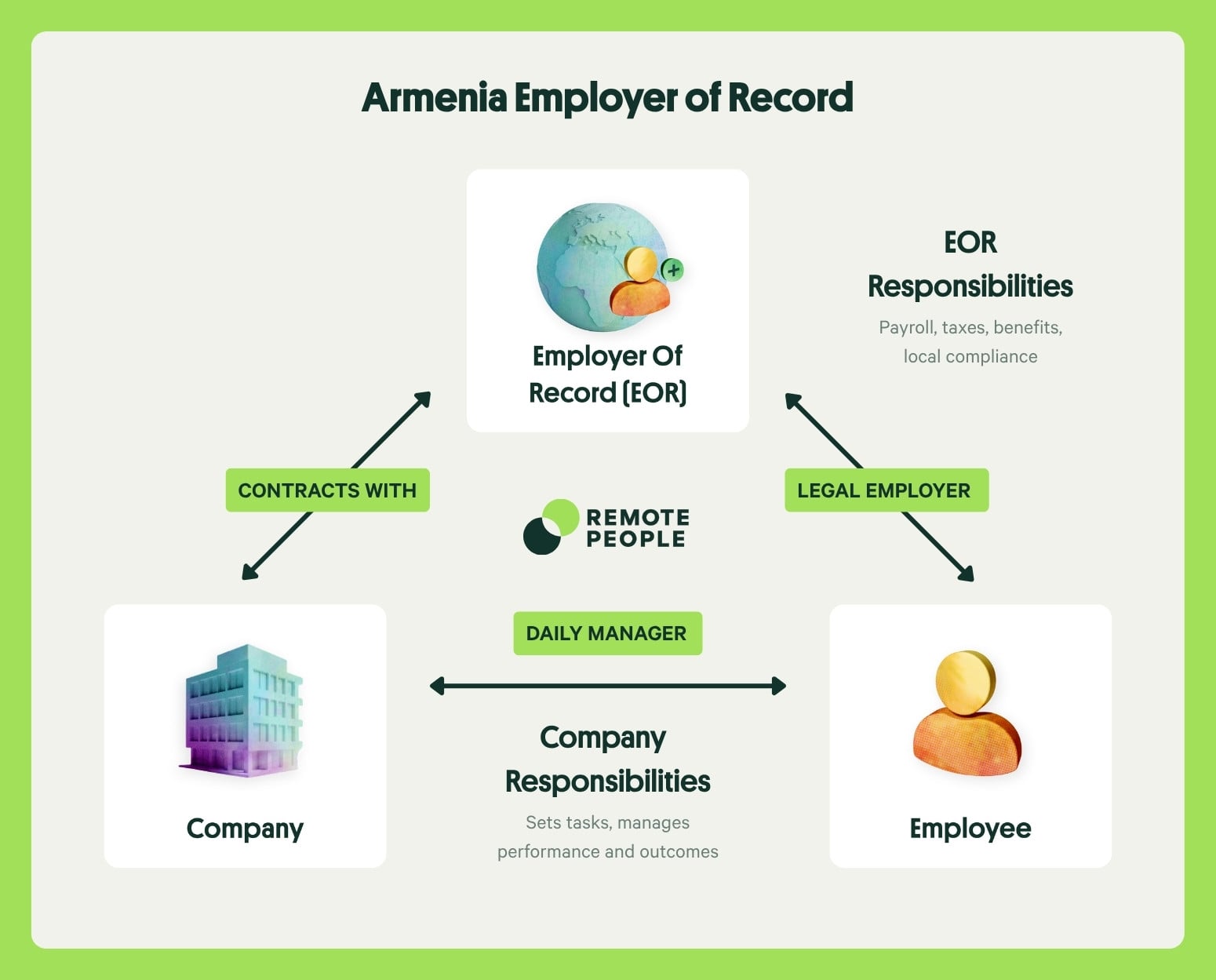
If you’d like to learn more about how Employer of Record (EOR) services work, read our What Is an Employer of Record (EOR)? guide for a complete overview of the model, its benefits, and when to use it.
If you’re comparing providers, our Best Employer of Record (EOR) Providers guide reviews the leading platforms to help you choose the right solution for your business.
Who Uses an Employer of Record in Armenia?
The most common users are companies hiring one or two software engineers in Yerevan without wanting to register a local LLC. Armenia’s technology sector has grown rapidly, and businesses across Europe and North America increasingly tap Armenian talent for development, design, and data science roles. An EOR makes this possible within weeks rather than the months needed for entity setup.
Organizations testing the Armenian market before committing to a full subsidiary also use EOR services, as do companies onboarding remote workers quickly, teams of fewer than 15 employees where incorporation does not make financial sense, and businesses that need to sponsor work permits for foreign nationals moving to Armenia.
Typical Onboarding Timeline
The onboarding process typically takes one to two weeks for Armenian nationals:
- First, sign the EOR service agreement and provide employee details, including role, salary, and start date (1 to 2 days).
- Second, the EOR drafts a compliant employment contract under the Armenian Labor Code and sends it for review and signature (2 to 3 days).
- Third, the EOR registers the employee with the State Revenue Committee for income tax, pension, and health insurance withholding (3 to 5 days).
- Fourth, payroll is configured in Armenian dram, benefits enrollment is confirmed, and the employee’s digital employment contract is entered into the mandatory Digital System (2 to 3 days).
- Fifth, the employee begins work on the agreed start date.
Most EOR providers can onboard an employee in Armenia within one to two weeks. If the hire requires a work permit or temporary residence card, the timeline extends by four to eight weeks depending on the labor market test and processing at the Ministry of Labor and Social Affairs.
Hire in Armenia
Zero employer social security contributions, a flat 20% income tax, funded pension system, and a growing tech talent pool make Armenia one of the most cost-effective hiring markets in the Caucasus.
We handle employment contracts, payroll, tax withholding, and full Armenian compliance.
No local entity needed. Your team can start in days.
Employment Laws and Regulations in Armenia
Employment Contracts
The Labor Code of the Republic of Armenia (WIPO Lex) requires all employment relationships to be documented in a written contract. Since January 1, 2026, all new employment contracts must be signed through the mandatory Digital System operated by the State Revenue Committee (Armenian Lawyer). Employers must migrate existing contracts to this system by June 30, 2028.
Contracts must specify the place and date of signing, full names of both parties, job title and duties, salary structure, working hours, contract duration, and the length of any probation period.
Armenian law recognizes both indefinite-term and fixed-term contracts. Fixed-term contracts are permitted for seasonal work, project-based roles, and temporary replacements, but must not exceed five years.
Working Hours and Overtime
The standard workweek in Armenia is 40 hours, arranged as eight hours per day over five days (Labor Code, Article 139). Employees in hazardous or physically demanding roles work a reduced schedule of 36 hours per week.
Overtime compensation is paid at 150% of the standard hourly rate for each hour worked beyond the regular schedule. Night work (between 10:00 PM and 6:00 AM) is compensated at 130% of the standard rate. Overtime may not exceed four hours over any two consecutive days or 120 hours per calendar year.
The Armenian Labor Code (Article 144) sets statutory multipliers for overtime, night work, and work performed on rest days or public holidays. All overtime must be voluntary, capped under the Labor Code, and paid at the rates below or compensated with equivalent time off in lieu.
Armenia overtime and premium pay rates · Per Labor Code of the Republic of Armenia | |||
Hour Type | Rate Multiplier | Weekly or Daily Cap | Notes |
|---|---|---|---|
Weekday overtime | 1.5x | Max 4 hours over 2 consecutive days; 120 hours/year | Any work beyond the standard 40-hour week; requires written employee consent |
Night work (10 PM–6 AM) | 1.3x | Same annual overtime cap applies | Prohibited or restricted for pregnant workers, minors, and caregivers of young children |
Weekly rest day work | 2.0x | Counts toward the annual overtime cap | Permitted only with employee consent or for continuous-operations sectors |
Public holiday work | 2.0x | Limited to essential operations | Equivalent paid time off in lieu may be granted instead of the premium |
Minimum Wage
Armenia’s minimum wage increased to AMD 85,000 per month (approximately $226) effective in 2026, up from AMD 75,000 in 2025 (ARKA News Agency). The average salary in Armenia is significantly higher than the minimum, particularly in the technology and finance sectors where monthly salaries commonly range from $800 to $2,500.
Probation Period
The maximum probation period under the Armenian Labor Code is three months (Articles 91 to 93). In cases specified by law, probation may extend to six months.
During probation, all Labor Code provisions apply to both parties. The employer may dismiss an employee during probation with three days’ written notice, without the standard notice period or severance obligations.
Leave Entitlements
Armenia’s Labor Code provides a comprehensive framework of statutory leave entitlements covering annual leave, sick leave, maternity and paternity leave, and other categories. The EOR tracks all leave balances and ensures correct pay calculations for each type.
Annual Leave
Employees working a five-day week are entitled to 20 working days of paid annual leave per year. Those on a six-day schedule receive 24 working days.
Employees in hazardous or high-stress occupations receive extended leave of up to 35 working days (five-day week) or 42 working days (six-day week). Leave accrues from the first day of employment, and unused days can generally be carried over to the following year.
Sick Leave
Employees are entitled to sick leave with pay for up to 120 calendar days per illness or injury. The employer pays the first five days at the employee’s full salary.
From the sixth day onward, the state social security system covers sick leave payments. A medical certificate from a licensed healthcare facility is required from the first day of absence.
Maternity Leave
Maternity leave in Armenia totals 140 calendar days: 70 days before the expected delivery date and 70 days after birth. Complicated deliveries extend the postnatal period to 85 days (155 total).
Multiple births extend it to 110 days (180 total). Maternity benefits are funded through the state budget, not by the employer directly (Armenian Lawyer).
Paternity Leave
Fathers are entitled to five working days of paid paternity leave, which must be taken within 30 days following the birth of the child. This leave is paid by the employer at the employee’s regular salary rate.
Other Statutory Leave
The Labor Code provides additional leave entitlements for specific life events:
- Marriage leave: 3 days (unpaid)
- Bereavement leave: 3 days (unpaid) for the death of a close family member
- Study leave: granted to employees pursuing education, with duration depending on the program
- Civic duty leave: paid time off for jury service, military reserve duty, or voting
Armenia statutory leave entitlements · Per Labor Code of the Republic of Armenia | ||
Leave Type | Duration | Eligibility & Notes |
|---|---|---|
Annual leave | 20 working days | 5-day week; 24 days for 6-day week; up to 35/42 days for hazardous roles |
Sick leave | Up to 120 days | First 5 days paid by employer; remainder by state; medical certificate required |
Maternity leave | 140 days | 70 pre-birth + 70 post-birth; 155 days for complicated births; 180 for multiples; state-funded |
Paternity leave | 5 working days | Paid by employer; must be taken within 30 days of birth |
Marriage leave | 3 days | Unpaid; available to all employees |
Bereavement leave | 3 days | Unpaid; for death of a close family member |
Study leave | Varies | Duration depends on the educational program; employer approval required |
Source: WIPO Lex, Labor Code of Armenia and Armenian Lawyer | ||
Statutory Employee Benefits
Armenia’s mandatory benefit system is notable for placing nearly all contribution obligations on the employee rather than the employer. The most significant statutory benefit is the mandatory funded pension, which applies to all employees born after January 1, 1974. Employees contribute 5% of gross salary if their monthly earnings are below AMD 500,000 (approximately $1,326), or 10% of gross minus AMD 25,000 for salaries above that threshold, capped at AMD 87,500 per month (~$232).
The employer’s role is limited to withholding and remitting these contributions to the Central Depository of Armenia (CDA).
Armenia launched its Universal Health Insurance system on January 1, 2026, covering all residents. Employed individuals contribute a fixed monthly amount: AMD 4,800 (~$13) for gross salaries up to AMD 500,000, or AMD 10,800 (~$29) for salaries above AMD 500,000. Employers act as withholding agents, deducting and remitting these amounts alongside income tax (EY Armenia).
Beyond pension and health insurance, there are no mandatory employer-funded benefits such as meal allowances, transportation subsidies, or housing funds. Many employers in Armenia voluntarily offer supplementary private health insurance, performance bonuses, and professional development budgets to remain competitive in the talent market.
Recent Regulatory Updates (2026)
Armenia introduced several significant legislative changes taking effect in 2025 and 2026. The most impactful is the mandatory Digital System for employment contracts, which requires all new contracts to be signed electronically through the State Revenue Committee’s platform from January 1, 2026 (Chambers and Partners). Employers must transfer existing contracts into the system by June 30, 2028.
The Universal Health Insurance law took effect on December 25, 2025, introducing mandatory health insurance contributions for all employed residents starting January 1, 2026 (Government of Armenia). The minimum wage increased to AMD 85,000 per month in 2026, and a proposed amendment to reduce the standard workweek from 40 to 35 hours is currently under parliamentary discussion.
Armenia’s new Law on Foreigners, adopted on January 20, 2026, takes effect on November 1, 2026. It replaces the labor market test with annual government quotas, introduces a work entry visa for visa-required nationals, and moves all immigration applications to a unified digital platform (Visas Update).
Work Permits and Visas in Armenia
Work Permit Requirements
Who Needs a Work Permit
Foreign nationals who wish to work in Armenia generally need a work permit issued by the Ministry of Labor and Social Affairs, combined with a temporary residence card. Citizens of Eurasian Economic Union (EAEU) member states, including Russia, Belarus, Kazakhstan, and Kyrgyzstan, are exempt from work permit requirements and can work freely in Armenia. Citizens of over 80 countries, including the United States, EU member states, Canada, and Japan, can enter Armenia visa-free for up to 180 days per calendar year, but still require a work permit for employment (Armenian Lawyer).
Eligibility and Required Documents
The employer must submit the work permit application on behalf of the foreign employee. Required documents typically include a valid passport with at least six months’ remaining validity, a signed employment contract, educational credentials (apostilled or legalized), a medical examination certificate, a criminal background check from the employee’s country of residence, and proof that the employer conducted a labor market test. The labor market test requirement will be replaced by annual government quotas from November 1, 2026.
Processing Time and Validity
Work permit processing typically takes 30 to 45 days from submission. The temporary residence card is normally valid for one year.
Factors that extend the timeline include incomplete documentation, additional verification of credentials, or backlogs at the Ministry of Labor and Social Affairs. Total time from application to work authorization is generally four to eight weeks.
Renewal Process
Renewal applications should be submitted at least 30 days before the current permit expires. The renewal requires updated employment contract details, continued employer sponsorship, and evidence of tax compliance. Employees can generally continue working during the renewal process provided the application was filed before expiration.
Common Visa Types for Foreign Workers
Armenia offers several pathways for foreign workers depending on their nationality and purpose of stay.
Armenia visa and work permit types for foreign workers · 2026 | ||
Visa / Permit Type | Validity | Key Details |
|---|---|---|
Standard work permit + temporary residence card | 1 year, renewable | Most common route for long-term employment; employer sponsors via Ministry of Labor and Social Affairs |
EAEU citizen exemption | No permit required | Nationals of Russia, Belarus, Kazakhstan, and Kyrgyzstan can work freely without a work permit |
Visa-free entry (80+ countries) | Up to 180 days | Includes US, EU, Canada, and Japan; a work permit is still required for employment |
Work entry visa (from November 2026) | Up to 120 days | New category for visa-required nationals; single or multiple entry; replaces labor market test with quota system |
Highly qualified specialist exemption | Varies | Senior executives and specialists in designated fields may qualify for expedited processing or permit exemptions |
Source: Armenian Lawyer and Visas Update | ||
How an Employer of Record Handles Work Permits
The employer of record acts as the sponsoring employer for work permit applications in Armenia. It prepares and submits all documentation to the Ministry of Labor and Social Affairs, manages the labor market test (or quota application from November 2026), and coordinates with the employee on document authentication. The EOR also handles the temporary residence card application and ensures all immigration-related deadlines are met.
Work permit processing adds four to eight weeks to the standard onboarding timeline described in the section above. During this period, the employee cannot legally begin working in Armenia. The EOR monitors application status and notifies both the client company and the employee of any requests for additional documentation.
Payroll, Taxes, and Social Security in Armenia
Employer Contributions
Armenia has one of the simplest employer tax structures in the world. There are no mandatory employer-side social security contributions, pension payments, or payroll taxes. The entire social protection system is funded through employee-side deductions (income tax, pension, health insurance) and the state budget (PwC Tax Summaries).
The employer’s only payroll obligation is to correctly withhold and remit employee deductions to the State Revenue Committee each month.
Armenia employer social security contributions · 2026 rates | ||
Contribution | Rate | Notes |
|---|---|---|
Social security | 0% | No employer-side social security contributions in Armenia; system funded through employee income tax and state budget |
Pension fund | 0% | Mandatory funded pension is employee-only; employer acts as withholding agent |
Health insurance | 0% | Universal Health Insurance (from Jan 2026) is funded by employee contributions; employer withholds and remits |
Total employer burden | 0% | Armenia has no mandatory employer payroll taxes; all contributions are employee-funded |
Source: PwC Worldwide Tax Summaries and Trading Economics | ||
Employee Deductions
While employers contribute nothing above gross salary, Armenian employees face several mandatory deductions. The flat 20% income tax is the largest, followed by funded pension contributions and the military stamp duty.
From 2026, health insurance contributions also apply. The EOR calculates all deductions, withholds them from gross salary, and remits them to the State Revenue Committee by the 20th of the following month.
Armenia employee payroll deductions · 2026 monthly withholdings | ||
Deduction | Rate | Notes |
|---|---|---|
Income tax | 20% | Flat rate on all employment income; effective since July 1, 2023 |
Mandatory funded pension | 5% or 10% | 5% if gross < AMD 500,000 (~$1,326); 10% minus AMD 25,000 if gross ≥ AMD 500,000; capped at AMD 87,500/month (~$232); applies to those born after Jan 1, 1974 |
Military stamp duty | Fixed: AMD 1,000 | Fixed monthly amount for gross salary up to AMD 1,000,000 (~$2,653); higher bands apply above this threshold |
Health insurance | Fixed: AMD 4,800 or AMD 10,800 | AMD 4,800/month (~$13) if gross ≤ AMD 500,000; AMD 10,800/month (~$29) if gross > AMD 500,000; effective Jan 1, 2026 |
Total employee deductions | ~26% to 31% | Varies by salary level and birth year; pension contributions are the main variable |
Source: PwC Worldwide Tax Summaries and Armenian Lawyer | ||
Income Tax
Armenia applies a flat 20% personal income tax rate on all employment income, effective since July 1, 2023 (PwC Tax Summaries). Unlike many countries, Armenia does not use progressive tax brackets for salary income. Different rates apply to other income types, as shown in the table below.
Armenia income tax brackets · 2026 | |
Income Type | Tax Rate |
|---|---|
Employment income (all levels) | 20% flat rate |
Royalties and interest income | 10% |
Rental income | 10% |
Capital gains (property sales) | 10% or 20% depending on asset type |
Dividends (resident) | 5% |
Source: PwC Worldwide Tax Summaries and Trading Economics | |
Payroll Cycle
Payroll in Armenia runs on a monthly cycle. Salaries must be paid at least once per month, typically by the last working day of the month or as specified in the employment contract. Payment must be made via bank transfer; cash payments are legally possible but increasingly uncommon due to the digital contract system and tax reporting requirements.
Employers must file monthly tax returns and remit all withheld income tax, pension contributions, stamp duty, and health insurance to the State Revenue Committee by the 20th of the following month. Annual tax reconciliation is completed by April 20 of the following year. Pay slips must detail gross salary, each deduction, and net pay.
13th Month Salary and Bonus Pay
Armenia does not require employers to pay a 13th month salary. There is no statutory obligation for year-end bonuses, vacation bonuses, or profit-sharing payments under the Labor Code.
Some employers in Armenia, particularly larger companies and those in the technology sector, voluntarily offer annual bonuses or 13th month payments as part of their compensation packages. These voluntary bonuses are subject to the standard 20% income tax and applicable pension deductions.
Cost of Hiring Through an EOR in Armenia
Employer of Record Service Fees
Employer of record service fees in Armenia typically range from $300 to $600 per employee per month. This fee covers employment contract management, monthly payroll processing, tax withholding and filing, benefits administration, leave tracking, and ongoing compliance with the Armenian Labor Code. The exact fee depends on the provider, the complexity of the role, and whether additional services like work permit sponsorship are included.
Check RemotePeople’s pricing page for current rates.
Total Employment Cost Breakdown
Armenia’s zero employer contribution rate makes the total cost of employment exceptionally transparent. The only costs above gross salary are the EOR service fee and any voluntary benefits you choose to offer. The table below uses a $1,200 per month gross salary to illustrate the full employer cost.
Armenia employer cost example · $1,200/month gross · 2026 | ||
Employer Cost | Amount (USD) | % of Gross |
|---|---|---|
Gross monthly salary | $1,200 | 100% |
Employer social contributions | $0 | 0% |
EOR service fee (est.) | $400 | 33.3% |
Total monthly cost | $1,600 | 133.3% |
Source: PwC Worldwide Tax Summaries and Trading Economics | ||
The total monthly employer cost for a $1,200 gross salary in Armenia is approximately $1,600, representing 33.3% above gross.
This figure is significantly lower than most countries where employer social security contributions add 20% to 40% on top of gross salary. All USD amounts are approximate conversions at $1 = AMD 377 (April 2026 rate).
Ready to hire in Armenia? Get started with RemotePeople: we handle employment contracts, payroll, tax withholding, and full Armenia compliance. No local entity needed.
Benefits of Using an EOR in Armenia
An employer of record eliminates the need to register a legal entity in Armenia, saving you $3,000 to $8,000 in setup fees and two to four months of waiting. You can onboard your first Armenian employee in one to two weeks while the EOR handles every compliance obligation from day one. In a market where top software engineers and data scientists field multiple offers, that speed can be the difference between landing a candidate and losing them.
Armenia’s employment framework has grown more complex in recent years. The new digital contract system, universal health insurance deductions, military stamp duty, and pension contribution rules that differ by birth year all require precise monthly calculations. The EOR stays current with every regulatory change, including the upcoming Law on Foreigners (November 2026) and the proposed 35-hour workweek, so you avoid penalties from the State Revenue Committee for late filings or incorrect deductions.
Zero employer-side payroll taxes keep the total cost in Armenia predictable. The EOR fee of $300 to $600 per month is typically less than what you would spend on a local accountant, legal counsel, and registered office if you maintained your own entity. For teams under 15 employees, the EOR route is almost always cheaper.
And if your needs change, you scale down without the legal complexity of dissolving an Armenian LLC.
Termination and Offboarding in Armenia
Notice Periods
The required notice period in Armenia depends on the grounds for termination. Employers must provide two months’ written notice when terminating due to company liquidation or workforce reduction (Article 113 of the Labor Code). For other employer-initiated terminations, a minimum of 14 days’ notice is standard.
During the probation period, either party may terminate with just three days’ notice.
Employers may choose to pay in lieu of notice, calculated based on the employee’s average daily wage for each remaining day of the notice period. Employee resignation requires 30 days’ written notice, unless a shorter period is agreed in the contract (Armenian Lawyer).
Armenian notice periods are governed by two separate regimes. For non-fault, employer-initiated terminations (unsuitability, health, or refusal of changed conditions), notice scales with continuous service under Article 115 of the Labor Code. Liquidation and workforce reduction instead trigger a flat two-month notice regardless of tenure, and during the probation period (Article 93), either party may end the contract with three days’ notice.
Armenia statutory notice periods by years of service · Per Labor Code of the Republic of Armenia | |||
Continuous Service | Non-Fault Grounds | Liquidation or Redundancy | Notes |
|---|---|---|---|
Less than 1 year | 14 days | 2 months | Graduated scale under Article 115 starts at the shortest tier |
1 to 5 years | 35 days | 2 months | Applies to unsuitability, health-based incapacity, and changed conditions |
5 to 10 years | 42 days | 2 months | Redundancy notice remains flat regardless of tenure |
10 to 15 years | 49 days | 2 months | Pay in lieu is permitted at the average daily wage × remaining notice days |
Over 15 years | 60 days | 2 months | Longest graduated tier under Article 115 |
Severance Pay
The tenure-based severance schedule under Article 129 of the Armenian Labor Code pays a multiple of the employee’s average daily wage based on continuous service. It applies to non-fault dismissals (unsuitability, health-based incapacity, or refusal of changed conditions) and supplements the flat one-month base severance paid in liquidation and redundancy cases.
Armenia severance pay schedule by years of service · Per Labor Code of the Republic of Armenia | |||
Years of Service | Severance Amount | Base Salary | Notes |
|---|---|---|---|
Less than 1 year | 10 × average daily wage | Average daily wage (12-month lookback) | Article 129 graduated tier; no severance during probation or for just-cause dismissal |
1 to 5 years | 25 × average daily wage | Average daily wage | Applies to non-fault grounds under Article 113 |
5 to 10 years | 30 × average daily wage | Average daily wage | Scale increases with continuous service |
10 to 15 years | 35 × average daily wage | Average daily wage | Collective agreements may provide higher amounts |
Over 15 years | 44 × average daily wage | Average daily wage | Longest graduated tier; final payment due on the last working day (Article 130) |
Calculation Method
Severance pay under Article 129 of the Armenian Labor Code consists of two components. The base severance is one month’s average salary, payable when termination occurs due to liquidation, redundancy, the employee’s inability to perform the role, or long-term incapacity (more than 120 consecutive days or 180 days in a 12-month period). An additional tenure-based payment is calculated using the employee’s average daily salary (Armenian Lawyer).
Caps and Exceptions
The tenure-based severance component scales with length of service: 10 times the average daily salary for employees with less than one year of service; 25 times for one to five years; 30 times for five to ten years; 35 times for ten to fifteen years; and 44 times the average daily salary for fifteen or more years. No severance is required when termination occurs during the probation period, for just cause (serious disciplinary violations), or when a fixed-term contract expires naturally.
All final payments, including severance and unused annual leave, must be made on the employee’s last working day (Article 130).
Grounds for Termination
Armenian law recognizes several grounds for employer-initiated termination: liquidation of the company, reduction in workforce, the employee’s failure to meet job requirements, long-term incapacity, the employee reaching retirement age (with certain conditions), and serious disciplinary violations including repeated absence without valid reason. Termination for pregnancy, union membership, filing a complaint, or exercising a legal right is prohibited.
The employer bears the burden of proving the legitimacy of the termination grounds, and wrongful termination can result in reinstatement and compensation for forced downtime (Profin Consulting).
EOR vs. Other Hiring Models in Armenia
Choosing between an Employer of Record and setting up your own legal entity in Armenia comes down to timeline, upfront cost, ongoing administrative burden, and how quickly you can scale up or wind down. The table below lays out both paths side by side across setup time, cost, compliance risk, and flexibility so you can match the right model to the size and duration of your Armenia hiring plan.
Armenia EOR vs local entity comparison · Setup time, cost, risk and best-fit | ||
Comparison | Employer of Record | Own Entity |
|---|---|---|
Setup time | 1 to 2 weeks | 2 to 4 months |
Upfront cost | $0 | $3,000 to $8,000 |
Ongoing cost | $300 to $600/employee/month | $5,000 to $15,000/year maintenance |
Local partner required | No (EOR is the local entity) | No (Armenia allows 100% foreign ownership) |
Social insurance registration | Handled by EOR | You manage it |
Payroll & tax filing | Handled by EOR | You manage it (or outsource) |
Best for team size | 1 to 15 employees | 15+ employees |
Scale down / exit | Easy; no entity to unwind | Costly; legal dissolution required |
Government contracts | Not eligible | Eligible (requires local entity) |
Source: PwC Armenia Tax Summary and RemotePeople | ||
For companies hiring fewer than 15 employees in Armenia, an EOR is nearly always the better choice. The setup cost and timeline difference is dramatic: zero upfront cost and one to two weeks versus $3,000 to $8,000 and two to four months. Armenia’s zero employer contribution rate means the ongoing cost comparison is straightforward, since there are no complex social security calculations to manage internally.
A local entity becomes worthwhile when your Armenian team exceeds 15 employees, when you need to bid on Armenian government contracts, or when you want to establish a permanent commercial presence. Armenia allows 100% foreign ownership of LLCs, which simplifies the incorporation process compared to many other countries in the region.
The exit cost is also worth considering. Dissolving an Armenian entity involves legal fees, tax clearance, and a multi-month wind-down process. With an EOR, you simply terminate the service agreement after completing all employee offboarding obligations.
Armenia EOR vs independent contractors · Compliance, cost, and risk | ||
Comparison | EOR (Full-Time Employee) | Independent Contractor |
|---|---|---|
Legal relationship | Employee of the EOR | Self-employed, no employment relationship |
Compliance risk | Low; EOR ensures local labor law compliance | High; misclassification risk if relationship resembles employment |
Payroll & tax | EOR handles withholding, contributions, filings | Contractor invoices you; they handle their own taxes |
Benefits & leave | Statutory benefits, paid leave, social security | No entitlement to employee benefits |
IP protection | Stronger; employment contract assigns IP by default | Weaker; requires explicit IP assignment clause |
Termination | Subject to local notice periods and severance | Contract can be ended per agreement terms |
Best for | Long-term, core team roles | Short-term projects, specialized tasks |
Cost structure | Salary + employer contributions + EOR fee | Contractor fee (typically higher gross, lower total cost) |
Hiring independent contractors in Armenia is only appropriate for genuinely independent engagements: short-term project work, specialized consulting, or roles where the worker sets their own schedule, uses their own tools, and serves multiple clients. Armenian tax authorities can reclassify a contractor relationship as employment if the worker operates under your direction, works fixed hours, uses company equipment, or depends on you as their sole income source.
The consequences of misclassification include back payment of income tax and pension contributions, penalties from the State Revenue Committee, and the forced establishment of an employment relationship with retroactive benefits. For any role that looks like ongoing, full-time work, an EOR-based employment arrangement is the compliant path. RemotePeople also offers a contractor management solution that handles compliant contractor payments, contracts, and classification risk assessment for roles that genuinely qualify as independent work.
In Armenia specifically, the distinction matters because the digital contract system introduced in 2026 creates a clear audit trail. All employment contracts are registered with the State Revenue Committee, making it easier for authorities to identify arrangements that should be classified as employment but are structured as contractor agreements.
Armenia EOR vs PEO comparison · Legal employer, liability, and setup | ||
Comparison | Employer of Record (EOR) | PEO |
|---|---|---|
Legal employer | EOR is the legal employer | You remain the legal employer (co-employment) |
Local entity required | No; the EOR is the local entity | Yes; you must have your own entity in Armenia |
Best for | Companies without a local entity | Companies that already have a local entity |
Compliance liability | EOR assumes compliance responsibility | Shared liability between you and the PEO |
Setup time | 1 to 2 weeks | Depends on your entity setup (weeks to months) |
Control over HR policies | EOR manages within local law framework | More direct control, PEO advises |
Typical use case | Market entry, small remote teams, testing new markets | Established local operations needing HR outsourcing |
Source: PwC Armenia Tax Summary and RemotePeople | ||
The fundamental difference is that an EOR is the legal employer, while a PEO operates under a co-employment model where you retain legal employer status. In Armenia, where there is no formal regulatory framework for PEO arrangements, the EOR model provides clearer legal standing. The co-employment concept is not well-established in Armenian labor law, which means a PEO arrangement carries more regulatory uncertainty.
For companies entering Armenia without an existing entity, an EOR is the only viable option between these two models. A PEO requires you to already have a registered Armenian LLC or branch office. If you already have an Armenian entity and want to outsource HR and payroll administration while retaining employer status, a PEO may be appropriate.
Given Armenia’s straightforward tax structure (zero employer contributions, flat income tax), the compliance complexity that PEOs typically help manage is relatively low. Most companies find that an EOR provides sufficient HR infrastructure for teams under 15 employees, and beyond that threshold, a direct entity with outsourced payroll is more common than a PEO arrangement.
Public Holidays in Armenia
Armenia observes a defined set of official public holidays on which most private-sector employers must give staff a paid day off (timeanddate.com). The table below lists the statutory holidays employers need to build into payroll calendars and leave planning for the year, along with the date rule for each.
Armenia public holidays · 2026 calendar year | ||
Date | Holiday | Type |
|---|---|---|
January 1 to 2 | New Year Holidays | National holiday |
January 6 | Christmas Day (Armenian Apostolic) | National holiday |
January 28 | National Army Day | National holiday |
March 8 | International Women’s Day | National holiday |
April 24 | Armenian Genocide Remembrance Day | National holiday |
May 1 | Labour Day | National holiday |
May 9 | Victory and Peace Day | National holiday |
May 28 | Republic Day (First Republic Day) | National holiday |
July 5 | Constitution Day | National holiday |
September 21 | Independence Day | National holiday |
December 31 | New Year’s Eve | National holiday |
Source: timeanddate.com and Nager.Date | ||
Armenia observes 11 official public holidays in 2026. Employees who work on a public holiday are entitled to overtime compensation at 200% of their standard hourly rate, or they may receive a compensatory day off. The Armenian government occasionally declares additional one-time holidays, particularly around Easter Monday (April 21 in 2026), which is not a fixed statutory holiday but is frequently recognized by government decree.
Employers should plan payroll schedules around the extended New Year period (December 31 through January 6), when most businesses close for the full week.
How to Get Started with an EOR in Armenia
Setting up your first hire in Armenia through an EOR is straightforward:
- First, choose your EOR provider and sign the service agreement. Confirm that the provider has a legal entity registered in Armenia and experience with the digital contract system.
- Second, provide the employee’s details, including role, salary, start date, and any special requirements such as work permit sponsorship or supplementary benefits.
- Third, the EOR drafts a compliant employment contract, registers the employee in the Digital System, and sets up payroll with the State Revenue Committee.
- Fourth, the employee reviews and signs the contract through the digital platform. The EOR enrolls them in mandatory pension and health insurance.
- Fifth, payroll runs monthly. The EOR withholds income tax, pension, stamp duty, and health insurance, and provides you with a cost summary each pay period.
RemotePeople can onboard your Armenia team in as little as five business days for local hires. Contact our team for a free consultation on hiring costs, timelines, and compliance requirements specific to your situation.
Where companies hiring in Armenia expand next
Teams hiring in Armenia often extend across the South Caucasus and into CIS/EAEU markets, where overlapping labor standards and Russian-language business ease regional expansion. Employers frequently add operations in Georgia for South Caucasus talent overlap. Azerbaijan typically follows with shared South Caucasus hiring norms. Hiring in Kazakhstan is a natural addition for CIS-wide Russian-speaking talent and EAEU mobility, and an EOR partner in Ukraine typically closes the regional footprint with comparable tech-services labor supply.
Frequently Asked Questions
Beyond the employee's gross salary, you will pay an EOR service fee of $300 to $600 per employee per month. Armenia has no employer-side social security contributions, so the EOR fee is the only cost above gross salary. For a $1,200 monthly gross salary, the total employer cost is approximately $1,600 per month, or 33% above gross. The exact EOR fee depends on your provider and whether additional services like work permit sponsorship are included.
For Armenian nationals, the typical onboarding timeline is one to two weeks. This includes drafting the employment contract, registering with the State Revenue Committee, and enrolling the employee in pension and health insurance. If the hire requires a work permit and temporary residence card, add four to eight weeks for immigration processing.
RemotePeople offers a contractor management solution that handles compliant contractor payments, contracts, and classification risk assessment. Contractor arrangements in Armenia are only appropriate for genuinely independent engagements such as short-term projects or specialized consulting. The 2026 digital contract system makes it easier for authorities to identify misclassified relationships, so proper classification is essential.
The employment contract assigns IP to the client company (you), not the EOR. The EOR ensures the contract includes proper IP assignment language so that all intellectual property created during the employment relationship flows directly to your business. Armenian law allows contractual IP assignment, and the EOR makes sure this clause is enforceable under the Labor Code.
The EOR handles the full termination process in compliance with the Armenian Labor Code. This includes providing the required notice period (two months for redundancy, 14 days for other grounds, three days during probation), calculating tenure-based severance under Article 129, paying all final amounts on the last working day, and filing the termination through the digital contract system. The EOR ensures all legal requirements are met to avoid wrongful termination claims.
No. Armenia does not mandate a 13th month salary, year-end bonus, or profit-sharing payment. Some employers voluntarily offer annual bonuses, particularly in the technology sector, but this is at the company's discretion. Any voluntary bonus payments are subject to the standard 20% income tax.
Armenian employees face several mandatory deductions: a flat 20% income tax on all employment income; mandatory funded pension contributions of 5% (for gross salary under AMD 500,000) or 10% minus AMD 25,000 (for higher salaries, capped at AMD 87,500/month); military stamp duty of AMD 1,000 per month; and health insurance of AMD 4,800 or AMD 10,800 per month depending on salary level. The employer has no separate contribution obligation beyond withholding these amounts.
Employer of Record in
Employer of Record in
Employer of Record in
Employer of Record in
Employer of Record in
Employer of Record in
Employer of Record in
Employer of Record in




