
 Recruit
Employer of Record (EOR) in Brunei
-
 Drew Donnelly
- Published
- September 27, 2026
RemotePeople’s employer of record in Brunei lets you hire employees in Brunei with TAP and SCP pension coverage. We handle 5% employer contributions to Employee Trust Fund matched by employees, Supplemental Contributory Pension at 3.5% with minimums of BND 17.50 and maximums of BND 98 per month.
Hire in Brunei — book a free 30-minute demo
Tell us what you need. You'll get a tailored, transparent proposal within 24 hours, plus a free call to walk through it.
Tell us about your company
So we can match you with a specialist who knows your market — and unlock volume pricing tiers.
* All fields are required.
Where and when are you hiring?
Tell us the geography and timing and we'll quote each country line by line, with onboarding timelines.
* All fields are required.
Help us beat your current setup
We'll benchmark your current deal and send a line-by-line proposal in 24 hours — showing exactly where we cut cost, time, or risk. After you submit, you can book a call to walk through it together.
* All fields are required.
Thanks! Your proposal is on its way.
Expect a tailored, line-by-line proposal in your inbox within 24 hours. In the meantime…
Want to walk through it together?
Book a free 30-minute call with one of our specialists. We'll explain every line, answer your questions, and tailor the proposal further if you need.
No obligation. Pick a time that works for you.








- Hire in Brunei — book a free 30-minute demo
- Tell us about your company
- Where and when are you hiring?
- Help us beat your current setup
- Thanks! Your proposal is on its way.
- How EOR Works in Brunei
- Hire in Brunei
- Employment Laws and Regulations in Brunei
- Work Permits and Visas in Brunei
- Payroll, Taxes, and Social Security in Brunei
- Cost of Hiring Through an EOR in Brunei
- Benefits of Using an EOR in Brunei
- Termination and Offboarding in Brunei
- EOR vs. Other Hiring Models in Brunei
- Public Holidays in Brunei
- How to Get Started with an EOR in Brunei
- Where companies hiring in Brunei expand next
- Frequently Asked Questions
- Related EOR Destinations
Start hiring in Brunei
Let RemotePeople handle payroll, compliance, and HR admin worldwide so you can focus on building your team.

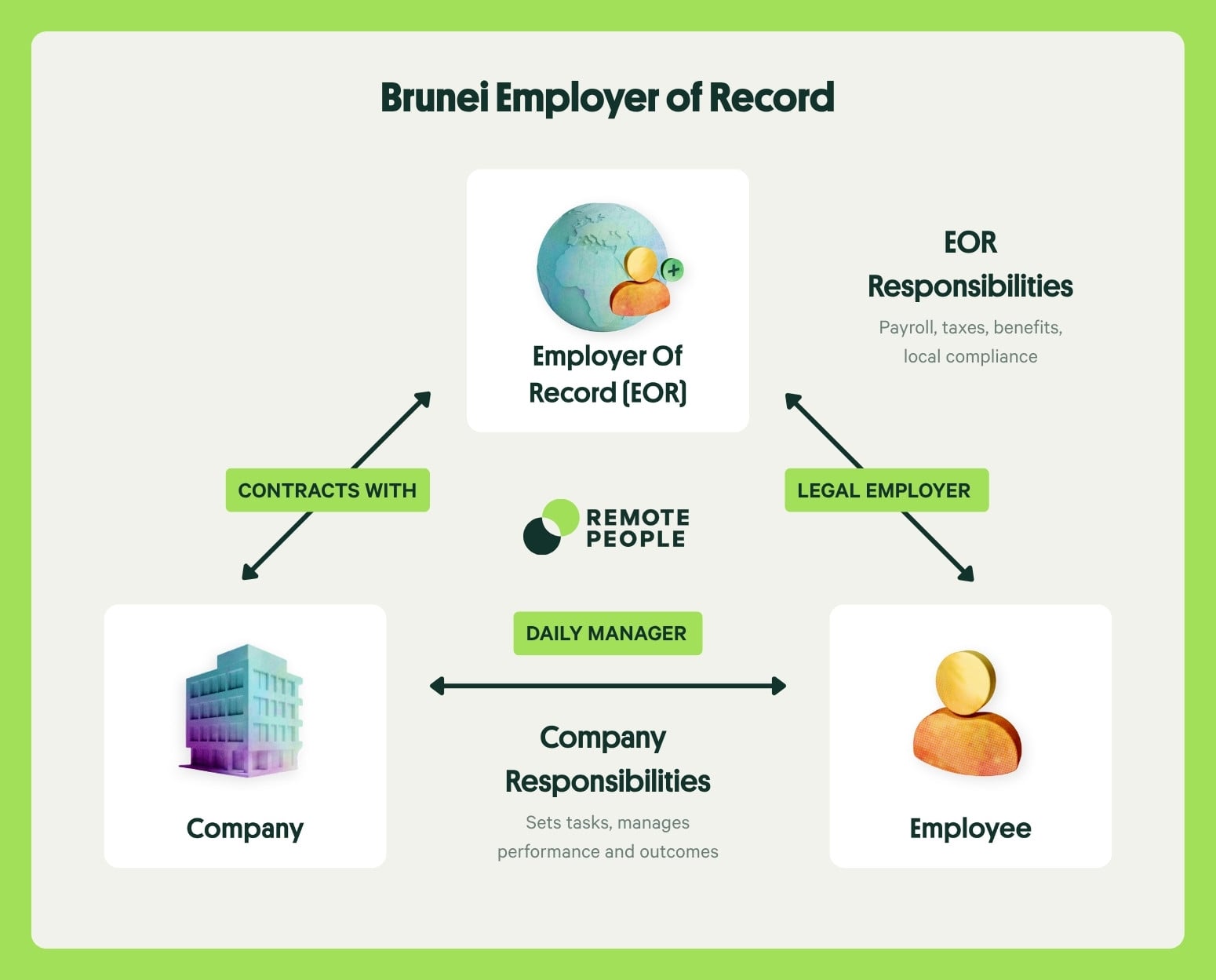
An employer of record (EOR) in Brunei is a local legal entity that hires, manages, and pays your employees on your behalf, eliminating the need to register a local company. Brunei’s employment landscape is governed by the Employment Order 2009, administered by the Department of Labour under the Ministry of Home Affairs. What makes Brunei exceptionally attractive for EOR hiring is its unique tax environment: there is zero personal income tax, no capital gains tax, and no VAT. For foreign nationals employed through an EOR, there are also zero mandatory social security contributions, meaning the employer’s statutory burden is essentially limited to the EOR service fee. This article walks you through employment law requirements, payroll mechanics, work permits, hiring costs, and the strategic advantages of using an EOR to enter or scale in Brunei.
How EOR Works in Brunei
If you’d like to learn more about how Employer of Record (EOR) services work, read our What Is an Employer of Record (EOR)? guide for a complete overview of the model, its benefits, and when to use it.
If you’re comparing providers, our Best Employer of Record (EOR) Providers guide reviews the leading platforms to help you choose the right solution for your business.
How Your Costs Flow to the EOR
You pay the EOR a fixed monthly service fee (typically $300–$600 per employee in USD) that covers all administrative, compliance, and payroll processing costs. In addition, you fund the employee’s gross salary, which the EOR pays monthly after deducting statutory withholdings (if applicable; see the critical nuance below). If the employee is a Brunei citizen or permanent resident, the EOR remits TAP and SCP contributions to the government from both the employee’s salary and your account. For foreign nationals, no such contributions are due, so the total cost to you is the salary plus the EOR fee. Unlike a local entity hire, you do not manage bank accounts, sign government filings, or handle regulatory reporting. The EOR handles all of it.
Onboarding Timeline and Cost Structure
EOR onboarding in Brunei typically takes 1–2 weeks from signed agreement to the employee’s first working day. The process begins with you signing the EOR service agreement and providing employee details (name, qualifications, expected start date). The EOR then drafts a compliant employment contract and sends it for your approval and the employee’s signature (2–3 days). Simultaneously, the EOR applies for labour quota approval from the Department of Labour (14 days) and, once approved, processes the employment pass through the Immigration Department (5 working days). While the work permit processes in the background, payroll and tax registration begin, allowing the employee to start work within 1–2 weeks. Foreign nationals may need to register with the national identity system if staying 3+ months. The EOR absorbs all government application fees; you pay only the monthly service fee and the employee’s salary.
Hire in Brunei
Zero personal income tax, low employer contributions (8.5% for citizens, 0% for foreign nationals), and a stable English-speaking workforce make Brunei one of the most cost-effective hiring markets in Southeast Asia.
We handle employment contracts, payroll, tax withholding, and full Brunei compliance.
No local entity needed. Your team can start in 1–2 weeks.
Employment Laws and Regulations in Brunei
Governing Legislation and Regulatory Authority
Brunei’s employment framework is established by the Employment Order 2009 (Chapter 278), which is the primary statute governing all employment relationships in the private sector. The order is administered by the Department of Labour under the Ministry of Home Affairs. Recent amendments, including the Employment (Minimum Wage) Order 2025 (Version 2, effective April 1, 2025), have modernized minimum wage standards and expanded sector coverage. The employment framework remains stable, with no major legislative reforms enacted since the 2009 order. Employers should monitor the Department of Labour website for updates to the minimum wage handbook and any amendments to working hours, leave, or maternity provisions.
Probation Periods
Probation periods in Brunei are contractual, not statutory. The typical probation duration is 3–6 months, specified in the employment contract at hire. During probation, both the employee and employer may terminate the relationship with reduced notice (often as short as 1 day). Once probation ends, the statutory notice periods apply (see Notice Periods below). Probation must be clearly documented in the contract; if no probation period is specified, the employee is considered permanent from the start and is entitled to full statutory notice periods immediately.
Working Hours and Overtime
The standard workweek in Brunei is a maximum of 44 hours, with a daily maximum of 8 hours. Employers may flex hours across the week (for example, 48 hours one week and 40 hours the next) as long as the average remains 44 hours over the cycle. No employee may work more than 12 hours per day including overtime, except in genuine emergencies. Overtime is paid at a minimum of 1.5 times the regular hourly rate, and work on rest days or public holidays is paid at 2 times the regular rate. Overtime payment must be made within 14 days after the last day of the salary period. Employees are entitled to a minimum of one full rest day per week (typically Sunday) and a meal break of at least 30 minutes for any work period of 5 or more consecutive hours.
Brunei regulates working hours and overtime under the Employment Order 2009 (Chapter 278), specifically Sections 35 through 37. The standard workweek is 44 hours, typically spread across six working days, and no employee may work more than 12 hours in a single day including overtime. Weekday overtime is paid at 1.5 times the basic hourly rate, while work performed on a rest day or a gazetted public holiday carries a 2.0x premium. Employers must settle overtime wages within 14 days of the end of the salary period, and total overtime may not exceed 72 hours in any one month without prior approval from the Commissioner of Labour. Reference the Employment Order 2009 (Chapter 278) for the full statutory text.
Brunei overtime and premium pay rates · Per Employment Order 2009 (Chapter 278) |
|||
Hour Type |
Rate Multiplier |
Weekly or Daily Cap |
Notes |
|---|---|---|---|
Standard hours | 1.0x basic rate | 44 hrs/week, 8 hrs/day | Section 35; 6-day workweek is standard practice |
Weekday overtime | 1.5x basic hourly rate | Max 12 hrs/day including OT | Sections 36–37; paid within 14 days of salary period end |
Rest day work | 2.0x basic hourly rate | Per work instance | Rest day is typically Sunday; double pay applies for all hours worked |
Public holiday work | 2.0x basic hourly rate | Per work instance | Section 37; employee retains the paid holiday entitlement |
Monthly overtime cap | N/A | 72 hrs/month maximum | May be exceeded only with prior Commissioner of Labour approval |
Minimum Wage
Brunei introduced a statutory minimum wage on July 12, 2023, which applies to employees in seven key sectors: finance, healthcare, hospitality, food and beverage, retail, wholesale, and domestic work. The minimum wage is BND 500 per month (approximately $394 USD) for full-time employees and BND 2.62 per hour (approximately $2.06 USD) for part-time workers. The rates were updated in the Employment (Minimum Wage) Order 2025 (Version 2), effective April 1, 2025. Sector-specific rates may vary slightly, and employers in covered sectors must verify applicability with the Department of Labour. Non-covered sectors and management roles are not subject to this minimum, though market rates typically exceed it.
Critical Nuance: Social Security Exemption for Foreign Nationals
This is a unique advantage of Brunei’s EOR environment and bears special emphasis. Contributions to the TAP (Tabung Amanah Pekerja / Employees’ Trust Fund) and SCP (Supplemental Contributory Pension) are mandatory only for Brunei citizens and permanent residents. Foreign nationals employed through an EOR are explicitly exempt from TAP and SCP contributions. This means hiring a foreign national via an EOR in Brunei involves zero statutory social security employer contributions; a rare advantage in Southeast Asia. The employer’s only statutory costs are the salary itself and the EOR service fee. For a Brunei citizen or permanent resident, the total statutory burden is 8.5% employer contribution (5% TAP + 3.5% SCP), plus the EOR fee. But for a foreign national, there is no statutory burden beyond the EOR fee. This distinction is crucial when modeling total cost of hire.
Leave Entitlements
Annual Leave
Annual leave in Brunei is statutory and accrues based on tenure. Employees with less than 1 year of service receive 7 days paid annual leave. Employees with 1–2 years of service receive 8 days. Leave increases by 1 day per additional year of service, up to a maximum of 14 days after 8+ years. Annual leave not taken within 12 months of the qualifying year is forfeited unless the employer and employee agree otherwise. Employers cannot pay out unused annual leave in lieu of taking it (except upon termination of employment).
Sick Leave
Employees are entitled to 14 days paid sick leave per year for outpatient care and up to 60 days paid leave per year for hospitalization. However, sick leave taken during the first 6 months of employment is unpaid. Medical certificates are typically required after 2–3 consecutive days of sick leave absence, and employers may request certification for individual sick days if a pattern emerges. Hospitalization leave is in addition to outpatient sick leave and does not count against the 14-day annual limit.
Maternity Leave
Maternity leave entitlements differ by employee citizenship. Brunei citizens receive 15 weeks total maternity leave (13 weeks paid), with the first 8 weeks paid by the employer and the remaining 5 weeks paid by the government. Foreign nationals receive 9 weeks total (8 weeks paid by the employer, 1 week unpaid). Pre-natal leave begins at least 4 weeks before the expected delivery date. Post-natal leave is flexible within 6 months after birth, allowing mothers to extend leave or return earlier if desired. Maternity leave is non-transferable; fathers do not receive statutory paternity leave in the private sector.
Paternity Leave
Paternity leave is not a statutory entitlement in Brunei’s private sector, though public sector employees receive 15 days paternity leave. Private sector employers may offer paternity leave as a discretionary benefit in the employment contract, but it is not required by law.
Public Holidays
Employees receive paid time off on all gazetted public holidays. See Section 9 for the 2026 public holiday calendar. If an employee is required to work on a public holiday, they are entitled to either a day off in lieu or payment at 2 times the regular rate.
Brunei statutory leave entitlements · Per Employment Order 2009 |
||
Leave Type |
Entitlement |
Notes |
|---|---|---|
Annual Leave (0–12 months) |
7 days/year |
Paid; forfeited if not taken within 12 months |
Annual Leave (12–24 months) |
8 days/year |
Paid; increases 1 day/year to max 14 days (8+ years tenure) |
Annual Leave (24+ months) |
9–14 days/year (progressive) |
Paid; max 14 days after 8 years service |
Sick Leave (Outpatient) |
14 days/year |
Unpaid for first 6 months; paid thereafter. Medical cert may be required. |
Sick Leave (Hospitalization) |
Up to 60 days/year |
Paid; in addition to outpatient sick leave |
Maternity Leave (Citizens) |
15 weeks (13 paid) |
Employer pays first 8 weeks; govt covers remainder. Pre-natal 4+ weeks. |
Maternity Leave (Foreign Nationals) |
9 weeks (8 paid) |
Employer paid only |
Paternity Leave (Private Sector) |
Not statutory |
Contractual only; not required by law |
Public Holidays |
13 days (2026) |
Paid; if worked, 2x regular rate or day off in lieu |
Work Permits and Visas in Brunei
Work Permit Requirements
Who Needs a Work Permit
Any foreign national (non-Brunei citizen) planning to work in Brunei must obtain an Employment Pass (EP). Brunei citizens and permanent residents do not require a work permit. The EP is the standard work authorization for all foreigners entering employment and is administered jointly by the Department of Labour and the Immigration Department.
Eligibility and Required Documents
To be eligible for an Employment Pass, the foreign national must have a valid passport, relevant professional qualifications or work experience in their field, and an employment contract signed by the EOR. The employer (or EOR on behalf of the client) must demonstrate to the Department of Labour that the role cannot be filled by a qualified Brunei citizen or permanent resident. Required documents typically include a completed application form, a copy of the employment contract, passport and visa pages, educational certificates or professional licenses, and a medical examination certificate (if required). Some roles may require additional background checks or sector-specific approvals.
Processing Time and Validity
The work permit process in Brunei involves two sequential steps. First, the Department of Labour reviews the labour quota application and approves it within approximately 14 days. Once approved, the Immigration Department issues the Employment Pass, which typically takes 5 working days. Total processing from application to pass issuance is approximately 3 weeks. The Employment Pass is valid for 2 years and is renewable. The employee can begin work as soon as the EP is issued; they do not need to wait for renewal to start employment.
Renewal Process
The Employment Pass must be renewed before expiration. The renewal application is submitted to the Department of Labour 30–60 days before the pass expires. Renewal typically requires the same documentation as the initial application (updated employment contract, medical exam, and identity documents). The processing time for renewal is similar to initial issuance (approximately 2–3 weeks). The employee may continue working during the renewal period if the application is filed on time, though employers should plan for any administrative delays and ensure continuous compliance.
Common Visa Types for Foreign Workers
Foreign workers in Brunei require sponsorship from a licensed local employer and, in most cases, a combination of a valid Foreign Worker License on the employer side and an individual Employment Pass or Visit Pass on the employee side. The Ministry of Foreign Affairs and the Department of Immigration and National Registration publish the official visa catalog; only the passes listed below are recognized work-authorizing categories as of 2026. Brunei does not issue a digital nomad visa or a freelance self-employment permit. For the authoritative list of visa categories, see the Ministry of Foreign Affairs visa directory.
Brunei work visa types for foreign workers · 2026 | ||||
Visa Type | Duration | Best For | Leads to Long-Term Residency? | Processing Time |
|---|---|---|---|---|
Employment Pass (EP) | 2 years, renewable | Long-term employment for foreign professionals, managers, and technical staff | No; permanent residency is a separate application | Approx. 5 working days after employer LPA approval |
Foreign Worker License (Lesen Pekerja Asing, LPA) | Tied to employee contract term | Mandatory employer-side quota and license; prerequisite for every EP filing | N/A; employer license, not an individual visa | Approx. 14 working days |
Professional Visit Pass | Up to 3 months | Short-term consultancy, technical training, specialist assignments | No | Approx. 3–5 working days |
Business Visit Visa | Up to 14 days | Client meetings, conferences, and non-employment business activity | No | Approx. 3–5 working days |
Dependant Pass | Matches sponsor Employment Pass | Spouse and children of Employment Pass holders | No; derivative of sponsor status | Processed alongside sponsor EP application |
How an EOR Handles Work Permits
The EOR manages the entire Employment Pass process on behalf of the client company. The EOR prepares the labour quota application, submits it to the Department of Labour, and tracks approval status. Once labour quota approval is granted, the EOR collects the required documents from the foreign employee (passport, medical exam results, education certificates) and files the Employment Pass application with Immigration. The EOR also handles any follow-up communications with the authorities, pays government fees, and delivers the final pass to the employee. The client company and employee do not need to interact directly with government agencies; the EOR serves as the intermediary throughout. The only action required from the employee is providing their identity documents and attending a medical examination (if required). Work permit processing adds approximately 2–3 weeks to the onboarding timeline but does not delay payroll setup or contract start date.
Payroll, Taxes, and Social Security in Brunei
Employer Contributions
Employers hiring in Brunei owe mandatory contributions on top of gross salary, funding social security, health, pensions, and other statutory schemes (TAP Board Official Portal). The table below lists the employer-side contribution rates so you can calculate the true all-in cost of each hire.
Brunei employer social security contributions · 2026 rates |
||
Contribution |
Rate (% of Gross) |
Notes |
|---|---|---|
TAP (Employees’ Trust Fund) |
5.0% |
Brunei citizens and permanent residents only. Payment due by 15th of following month. |
SCP (Supplemental Contributory Pension) |
3.5% |
Capped at BND 2,800/month (≈$2,205 USD) earnings base. Min BND 17.50/max BND 98/month. |
Foreign Nationals (TAP + SCP) |
0% |
Exempt. No statutory contributions required. Cost to employer = salary + EOR fee only. |
Total Employer Contribution (Citizens/PRs) |
8.5% |
Combined TAP + SCP. Plus EOR service fee ($300–600/month USD). |
Total Employer Contribution (Foreign Nationals) |
0% |
No statutory contributions. EOR fee only. |
Source: TAP Board Official Portal and PwC Brunei Tax Summaries |
||
Employee Contributions
Alongside income tax, employees in Brunei pay statutory payroll deductions that fund social security, health cover, and other state schemes (PwC Brunei Individual Tax Summary). The table below summarises the employee-side contribution rates payroll must withhold from gross pay each month.
Brunei employee payroll deductions · 2026 monthly withholdings |
||
Deduction |
Rate (% of Gross) |
Notes |
|---|---|---|
Personal Income Tax |
0% |
Brunei has zero personal income tax. No withholding required. |
TAP (Employees’ Trust Fund) |
5.0% |
Citizens and permanent residents only. Deducted from gross salary. |
SCP (Supplemental Contributory Pension) |
3.5% |
Capped at BND 2,800/month (≈$2,205 USD) earnings base. Min BND 17.50/max BND 98/month. |
Total Employee Withholding (Citizens/PRs) |
8.5% |
Combined TAP + SCP. Foreign nationals: 0%. |
Source: PwC Brunei Individual Tax Summary and TAP Board |
||
Income Tax
Personal income tax in Brunei is levied on a progressive basis, with the rate rising as taxable income crosses statutory thresholds (PwC Brunei Individual Taxes on Personal Income). The table below sets out the current income-tax brackets that apply to resident employees so you can model net-of-tax compensation before making an offer.
Brunei income tax brackets · 2026 |
|
Taxable Income |
Tax Rate |
|---|---|
All taxable income |
0% – no personal income tax in Brunei |
Brunei’s zero personal income tax is one of the world’s most distinctive tax environments. There is no personal income tax, no capital gains tax, and no VAT. This means employees take home their full gross salary with no income tax deduction. Only statutory TAP and SCP contributions apply (and only for citizens and permanent residents). Brunei’s hydrocarbon wealth (oil and gas) funds government operations, enabling the government to forgo personal income taxation entirely. From a payroll perspective, this simplifies withholding calculations significantly: the EOR deducts only TAP and SCP (if applicable) from the employee’s salary, with no income tax to calculate or remit.
Payroll Cycle
Payroll in Brunei is processed monthly. The EOR calculates gross salary, deducts applicable withholdings (TAP, SCP for citizens/PRs; nothing for foreign nationals), and transfers net pay to the employee’s bank account by the last business day of the month. Pay slips must be provided to the employee and should itemize gross salary, all deductions, and net pay. TAP and SCP contributions are due to the government by the 15th of the following month. The EOR handles all tax filings and contribution remittances; the client company does not file directly with the tax authority or social security board. Payment must be made by bank transfer; cash salaries are discouraged under modern Brunei labour practices.
13th Month Salary and Bonus Pay
A 13th month salary (year-end bonus) is not mandatory in Brunei. It is a discretionary benefit offered by employers at their choice. When provided, the 13th month bonus is customarily equivalent to one month’s basic salary and is typically paid before or during the December holiday period. Annual salary supplements (including 13th month bonus) cannot exceed 1.5 months of basic salary under contractual norms. Some employers provide additional bonuses tied to performance or company results, but these are always contractual and not statutory. The EOR will include any agreed 13th month bonus in the employment contract and process it according to the agreed schedule.
Cost of Hiring Through an EOR in Brunei
EOR Service Fees
EOR service fees in Brunei typically range from $300 to $600 per employee per month (USD), depending on the provider and the complexity of the role. The fee covers payroll processing, employment contract drafting and management, government compliance and filings, work permit and labour quota handling, statutory contribution enrollment (TAP/SCP), leave tracking, and termination procedures. Fees are usually quoted as flat monthly amounts, not as a percentage of salary, and are billed to the client company separately from the employee’s salary. There are no upfront setup fees; pricing begins on the employee’s first working day.
Total Employment Cost Breakdown
The all-in cost of employing someone in Brunei goes well beyond gross salary. The table below walks through a realistic cost build-up for a typical hire, layering mandatory employer social contributions, statutory benefits, and payroll taxes on top of base pay so finance teams can budget accurately before an offer goes out.
Brunei employer cost example · $1,200/month gross · 2026 |
||
Employer Cost |
Amount (USD) |
% of Gross Salary |
|---|---|---|
Employee Gross Salary |
$1,200 |
100.0% |
Employer TAP Contribution (5%) |
$60 |
5.0% |
Employer SCP Contribution (3.5%) |
$42 |
3.5% |
EOR Service Fee |
$400 |
33.3% |
Total Employer Cost |
$1,702 |
141.8% |
This breakdown applies to Brunei citizens and permanent residents and shows the maximum statutory burden. For foreign nationals employed via an EOR, the calculation is simpler: TAP and SCP contributions do not apply, so total employer cost drops to approximately $1,600/month. A gross salary of $1,200 plus the $400 EOR fee, with zero statutory social security burden. This is a significant cost advantage and makes Brunei exceptionally attractive for hiring foreign talent through an EOR. All USD amounts are approximate conversions at $1 = 1.27 BND (April 2026 rate).
Ready to hire in Brunei? Get started with RemotePeople. We handle employment contracts, payroll, tax withholding, and full Brunei compliance. Contact our team for a free cost estimate and timeline.
Benefits of Using an EOR in Brunei
Hiring through an EOR in Brunei offers substantial advantages over setting up a local company. Speed is paramount: you can onboard your first employee within 1–2 weeks, compared to 2–4 months to incorporate a local entity and register all required licenses. You avoid the upfront capital investment. Entity setup costs in Brunei typically range from $5,000 to $15,000, and the ongoing accounting and compliance overhead that a local company requires is significant. The EOR assumes all employment law risk, ensuring that contracts, payroll, leave tracking, and termination procedures comply with the Employment Order 2009 and any amendments. You gain immediate access to local expertise in Brunei employment law and tax compliance without hiring HR or finance staff. For foreign nationals, the zero statutory social security burden is a unique advantage: you pay no TAP or SCP contributions, making the total cost significantly lower than hiring in neighboring jurisdictions.
An EOR also provides flexibility to scale your Brunei team without commitment. You can add employees quickly and reduce headcount with statutory notice periods. No entity dissolution or legal wind-down required. If you later decide to establish a local entity, the EOR can transition employees to your own company with minimal disruption. The EOR handles work permit processing, which typically takes 2–3 weeks, removing a significant administrative burden and reducing time-to-productivity. For companies testing the Brunei market or building a small remote team, an EOR is the fastest and lowest-risk path to hiring locally.
Termination and Offboarding in Brunei
Notice Periods
Notice period requirements in Brunei depend on the employee’s tenure. Employees with less than 26 weeks of service require 1 day notice. Those employed for 26 weeks to less than 2 years require 1 week notice. Employees with 2–5 years of service require 2 weeks notice. Employees with 5 or more years of service require 4 weeks notice, which is the maximum notice period in Brunei. Employers may provide payment in lieu of notice instead of requiring the employee to work through the notice period. The EOR manages notice calculations and processes termination in full compliance with these statutory timelines.
Notice requirements in Brunei are governed by Sections 40 through 42 of the Employment Order 2009 (Chapter 278), and they scale with length of service rather than with position or job level. The same notice schedule applies whether the employer or the employee initiates termination, which is a defining feature of Brunei employment law. Probationary employees may be released at any time without notice unless their contract specifies otherwise, and payment in lieu of notice is permitted for both parties. The statutory cap is four weeks; no longer notice can be mandated by the Order itself, although contracts may exceed it by agreement. See the Employment Order 2009 (Chapter 278), Sections 40–42, for the statutory schedule.
Brunei statutory notice periods by position level · Per Employment Order 2009 (Chapter 278) | |||
Length of Service | Notice Period | During Probation | Notes |
|---|---|---|---|
Less than 26 weeks | 1 day | No notice required | Applies equally to employer and employee; Section 40 |
26 weeks to less than 2 years | 1 week | Not applicable (probation already ended) | Payment in lieu of notice is permitted under Section 41 |
2 to 5 years | 2 weeks | Not applicable | Symmetric: same notice for employer and employee initiated termination |
5 years or more | 4 weeks | Not applicable | Statutory cap; contracts may exceed 4 weeks by mutual agreement |
Summary dismissal for misconduct | No notice required | No notice required | Section 42; requires proven just cause after inquiry |
Severance Pay
Calculation Method
Severance pay is not a mandatory statutory entitlement in Brunei. There is no universal formula requiring employers to pay severance based on years of service. However, some employment contracts or collective agreements may include severance provisions. If severance is contractually agreed, it is typically calculated as a multiple of the employee’s final monthly salary multiplied by years of service (for example, 0.5 months per year). Severance, when provided, is based on the employee’s basic salary, not including bonuses or benefits.Caps and Exceptions
Since severance is not statutory in Brunei, there is no government-mandated cap on severance amounts. However, contractual severance is subject to negotiation and is often limited to 3–6 months of salary for standard terminations. Employees dismissed for just cause (gross misconduct) are typically not entitled to severance, regardless of contract terms. Employees on fixed-term contracts or during probation may have reduced severance rights, as specified in their contract. The EOR ensures that any contractual severance obligations are calculated correctly and paid upon termination.
Brunei does not impose a statutory severance formula under the Employment Order 2009 (Chapter 278). Termination payments beyond final wages, accrued leave, and the employee’s Tabung Amanah Pekerja (TAP) and Supplemental Contributory Pension (SCP) account balances are contractual and are negotiated between the employer and employee at the time of hire.
Grounds for Termination
Employers may terminate employees in Brunei with or without cause. Termination without cause requires only the applicable notice period and (if contractually provided) severance payment. Termination for cause (just cause) may permit employers to dismiss an employee summarily without notice. Section 82 of the Employment Order 2009 permits summary dismissal in cases of gross misconduct, such as theft, violence, persistent insubordination, or breach of confidentiality. However, procedural fairness is important: employers should document misconduct and provide the employee an opportunity to respond before final dismissal. Upon termination, the employer must pay all outstanding wages, accrued leave, and any other benefits owed (Section 86 of the Employment Order 2009). The EOR ensures final payments are calculated correctly and made without delay.
EOR vs. Other Hiring Models in Brunei
EOR vs. Setting Up a Local Entity
Choosing between an Employer of Record and setting up your own legal entity in Brunei comes down to timeline, upfront cost, ongoing administrative burden, and how quickly you can scale up or wind down. The table below lays out both paths side by side across setup time, cost, compliance risk, and flexibility so you can match the right model to the size and duration of your Brunei hiring plan.
Brunei EOR vs local entity comparison · Setup time, cost, risk and best-fit |
||
Comparison |
Employer of Record FASTER |
Own Local Entity |
|---|---|---|
Setup Time |
1–2 weeks |
2–4 months |
Upfront Cost |
$0 |
$5,000–$15,000 |
Ongoing Cost |
$300–$600/employee/month |
$3,000–$8,000/year maintenance |
Local Partner Required |
No – EOR is the local entity |
No – 100% foreign ownership allowed via Sdn Bhd |
Social Insurance Registration |
Handled by EOR |
You manage it |
Payroll & Tax Filing |
Handled by EOR |
You manage it (or outsource) |
Best for Team Size |
1–15 employees |
15+ employees |
Scale Down / Exit |
Easy – no entity to unwind |
Costly – legal dissolution required |
Government Contracts |
Not eligible |
Eligible (requires local entity) |
An EOR is the fastest and lowest-cost option for companies entering Brunei or building small teams of 1–15 employees. You avoid the setup delays, administrative complexity, and capital outlay required to incorporate a local company. The EOR assumes all compliance responsibility, reducing your legal risk. Scaling down is seamless: you can terminate employees with statutory notice and stop using the EOR without dissolving an entity or unwinding legal structures.
A local entity becomes attractive once your team reaches 15+ employees, generating sufficient annual payroll to justify the maintenance costs. At that scale, the per-employee overhead of the EOR fee ($300–600/month) exceeds the per-employee cost of entity maintenance. Additionally, if you plan to bid on government contracts, which require local entity status, you must eventually establish a company. Brunei permits 100% foreign ownership through a private company limited by shares (Sdn Bhd), so no local partner is required. The transition path is straightforward: register your Brunei company, apply to transfer employees from the EOR to your payroll, and continue operations with your own entity.
EOR vs. Hiring Independent Contractors
Classifying a Brunei-based worker as an independent contractor rather than an employee can expose you to back-taxes, unpaid social contributions, and reclassification penalties if the working relationship looks like employment in practice. The table below contrasts EOR employment with contractor engagement across legal relationship, tax and benefits treatment, IP ownership, and misclassification risk so you can pick the right model role by role.
Brunei EOR vs independent contractors · Compliance, cost, and risk |
||
Comparison |
EOR (Full-Time Employee) |
Independent Contractor |
|---|---|---|
Legal Relationship |
Employee of EOR; directed by client company |
Self-employed; no employment relationship |
Compliance Risk |
Low – EOR ensures labor law compliance |
High – misclassification risk if relationship resembles employment |
Payroll & Tax |
EOR handles all withholding and filings |
Contractor invoices you; they handle own taxes |
Benefits & Leave |
Statutory benefits, paid leave, social security |
No entitlement to employee benefits |
IP Protection |
Stronger – employment contract assigns IP by default |
Weaker – requires explicit IP assignment clause |
Termination |
Subject to statutory notice and severance |
Contract can be ended per agreement terms |
Best For |
Long-term, core team roles |
Short-term projects, specialized tasks |
Cost Structure |
Salary + employer contributions + EOR fee |
Contractor fee (typically higher gross, lower total cost) |
Choosing between an EOR employee and an independent contractor depends on the nature of the work and your tolerance for compliance risk. An EOR employee is appropriate for ongoing, core roles where you need direct control over the person’s work, schedule, and deliverables. The EOR manages all compliance, leaving you free to focus on management. The employee receives statutory benefits: paid leave, social security contributions (if a citizen or PR), and severance protections. This reduces turnover and improves retention.
An independent contractor is suitable for short-term projects, specialized consulting, or roles with genuine autonomy and discrete deliverables. Contractors typically invoice you monthly and handle their own taxes, so you avoid payroll processing. However, misclassification risk exists: if the contractor relationship functionally resembles employment (regular work, your direct oversight, exclusive commitment), Brunei labour authorities may reclassify them as employees, resulting in back TAP/SCP contributions, penalties, and forced employment status. To minimize this risk, ensure contractors work on defined projects with clear end dates, use formal service agreements with IP assignment clauses, and avoid practices that blur the line between contractor autonomy and employee control.
RemotePeople also offers a contractor management solution that handles compliant contractor payments, contract drafting, and classification risk assessment. If you’re uncertain whether independent contractor status is appropriate, explore our contractor of record service to ensure compliance while retaining the flexibility of short-term engagements.
EOR vs. PEO (Professional Employer Organization)
EORs and PEOs both simplify international hiring, but only an EOR becomes the legal employer of record in Brunei — a critical distinction when you don’t have a local entity of your own. The table below maps the practical differences across legal employer status, entity requirement, liability allocation, and scope of coverage.
Brunei EOR vs PEO comparison · Legal employer, liability, and setup |
||
Comparison |
Employer of Record (EOR) |
PEO |
|---|---|---|
Legal Employer |
EOR is the legal employer |
You remain the legal employer (co-employment) |
Local Entity Required |
No – the EOR is the local entity |
Yes – you must have your own entity in Brunei |
Best For |
Companies without a local entity |
Companies that already have a local entity |
Compliance Liability |
EOR assumes compliance responsibility |
Shared liability between you and the PEO |
Setup Time |
1–2 weeks |
Depends on your entity setup (weeks to months) |
Control Over HR Policies |
EOR manages within local law framework |
More direct control; PEO advises |
Typical Use Case |
Market entry, small remote teams, testing markets |
Established local operations needing HR outsourcing |
Source: RemotePeople EOR Brunei Service and Department of Labour |
||
The key distinction between an EOR and a PEO is the legal employment structure. An EOR is the legal employer, so you do not need a local entity in Brunei; the EOR handles all employment law compliance. A PEO is an HR outsourcing partner that works with your existing local entity. You remain the legal employer, and you and the PEO share compliance responsibilities. Brunei has no formal PEO regulatory framework; the country’s labour market is served primarily by EOR providers. If you already have a Brunei company and want to outsource HR and payroll operations, you would work with a professional services firm or payroll provider (similar to PEO functions) under a consulting arrangement, but this is not the traditional “co-employment” PEO model seen in larger markets.
For companies entering Brunei without a local entity, an EOR is the only practical choice. You avoid the upfront investment and time required to incorporate, and you immediately comply with all employment laws. If you later establish your own Brunei company, you can transition employees from the EOR to your direct payroll with minimal disruption, and the EOR relationship can end.
Public Holidays in Brunei
Brunei observes a defined set of official public holidays on which most private-sector employers must give staff a paid day off (timeanddate.com Brunei 2026 Holidays). The table below lists the statutory holidays employers need to build into payroll calendars and leave planning for the year, along with the date rule for each.
Brunei public holidays · 2026 calendar year |
||
Date |
Holiday |
Type |
|---|---|---|
January 1 |
New Year’s Day |
National |
January 17 |
Isra and Mi’raj |
Religious (Islamic) |
February 17 |
Chinese New Year |
Cultural |
February 23 |
National Day |
National |
March 6 |
Nuzul Al-Quran |
Religious (Islamic) |
March 20 |
Hari Raya Aidilfitri Day 1 |
Religious (Islamic) |
March 21 |
Hari Raya Aidilfitri Day 2 |
Religious (Islamic) |
May 26 |
Hari Raya Aidiladha |
Religious (Islamic) |
May 31 |
Royal Brunei Armed Forces Day |
National |
June 16 |
Awal Muharram (Islamic New Year) |
Religious (Islamic) |
July 15 |
Sultan Hassanal Bolkiah’s Birthday |
National |
August 24 |
Maulidur Rasul (Prophet’s Birthday) |
Religious (Islamic) |
December 25 |
Christmas Day |
Religious (Christian) |
Brunei observes 13 gazetted public holidays in 2026, a mix of national, cultural, and religious (predominantly Islamic) observances. Employees are entitled to paid time off on all gazetted holidays. If an employee is required to work on a public holiday, they are entitled to either a day off in lieu within a reasonable period or payment at 2 times the regular rate. The EOR tracks public holidays in your payroll calendar and ensures employees are paid correctly whether they work or take the day off.
How to Get Started with an EOR in Brunei
First, define your hiring needs. Identify the role(s), required qualifications, and expected salary range. Research the applicable minimum wage if the role falls within the seven covered sectors (finance, healthcare, hospitality, food and beverage, retail, wholesale, domestic work). Second, contact RemotePeople and schedule a consultation. Share your employee details, role description, and any specific compliance requirements. Our team will provide a cost estimate, onboarding timeline, and answer questions about Brunei employment law and work permits. Third, sign the EOR service agreement and provide employee information (name, passport details, expected start date, qualifications). The EOR will begin draft employment contract preparation and, if the employee is a foreign national, initiate the work permit and labour quota process. Fourth, review and approve the employment contract. Ensure it complies with your expectations for role, probation period, leave entitlements, and termination provisions. Once signed by you and the employee, the contract is registered with the Department of Labour. Fifth, arrange payroll setup. Provide your employee’s bank details and confirm salary amount. The EOR will configure the monthly payroll schedule and process the first payment on the agreed start date. Your employee is now fully onboarded and ready to work, with all Brunei compliance in place.
Get started with RemotePeople today. We’re here to guide you through every step of hiring in Brunei and ensure your team is set up for success.
Where companies hiring in Brunei expand next
Teams hiring in Brunei typically expand across ASEAN, where cross-border mobility and diverse multilingual talent make regional coverage natural. After building a team in Brunei, employers often look to hiring in Thailand for ASEAN-wide talent flows and shared hiring norms, then an EOR partner in Singapore for ASEAN integration and cross-border mobility. Indonesia follows with the ASEAN single-market trade framework, and a team in Vietnam typically closes the regional footprint via overlapping ASEAN labor and mobility rules.
Frequently Asked Questions
Beyond the employee’s gross salary, you’ll pay an EOR service fee of $300–$600 per employee per month. If the employee is a Brunei citizen or permanent resident, you also fund TAP and SCP contributions (8.5% of gross salary combined). If the employee is a foreign national, there are no social security contributions — only salary plus the EOR fee. For a $1,200/month salary with a foreign national, total employer cost is approximately $1,600/month. For a citizen or PR at the same salary, total cost is approximately $1,702/month ($1,200 salary + $60 TAP + $42 SCP + $400 EOR fee).
Onboarding typically takes 1–2 weeks from contract signature to the employee’s first working day. Work permit processing for foreign nationals (labour quota approval plus employment pass issuance) takes approximately 3 weeks in parallel with payroll setup, so the employee can start work as soon as the permit is approved. For Brunei citizens and permanent residents, onboarding is even faster — just 5–10 business days.
You can hire contractors, but independent contractor status in Brunei carries misclassification risk. If a contractor’s relationship resembles employment (regular hours, your direct control, exclusive commitment), the Department of Labour may reclassify them as employees, triggering back contributions and penalties. RemotePeople offers a contractor of record solution that handles compliant contractor payments, contracts, and classification risk assessment. Explore our contractor hiring service if you need short-term or project-based workers.
The employment contract assigns intellectual property to the client company (you), not the EOR. The EOR ensures the contract includes proper IP assignment language so all intellectual property (code, designs, documents, patents) flows directly to your business. This is a standard clause in EOR employment contracts and is enforceable under Brunei law.
No. Brunei has zero personal income tax, no capital gains tax, and no VAT. This is one of the world’s most distinctive tax environments and a major advantage for both employers and employees. Salaries are not subject to income tax withholding; only TAP and SCP contributions apply (and only for Brunei citizens and permanent residents).
The EOR continuously monitors regulatory changes through the Department of Labour and government gazettes. Recent updates include the Employment (Minimum Wage) Order 2025 (Version 2) and the phased implementation of the national pension scheme (SPK). If legislation changes, the EOR updates employment contracts and payroll processes accordingly and notifies you of any cost or compliance impacts. You are never liable for regulatory breaches; the EOR assumes that responsibility.
Yes. Once the employee has a valid work permit and employment contract, they can work remotely from Brunei or from other locations, depending on your company’s policy. Remote arrangements do not affect employment law compliance or tax obligations. However, if an employee relocates to another country, additional employment law considerations may apply in that jurisdiction, and the EOR will advise accordingly.
Employer of Record in
Employer of Record in
Employer of Record in
Employer of Record in
Employer of Record in
Employer of Record in
Employer of Record in
Employer of Record in