Recruit
Employer of Record (EOR) in Malawi
-
 Drew Donnelly
- Published
- July 21, 2026
RemotePeople’s employer of record in Malawi lets you hire employees in Malawi with mandatory pension compliance. We handle National Social Security Fund (NSSF) registrations, employer contributions of 10% and employee contributions of 5% to approved pension funds, and monthly contribution remittance.
Hire in Malawi — book a free 30-minute demo
No sales call required. Free 30-minute expert call if you want one.
Tell us about your company
So we can match you with a specialist who knows your market — and unlock volume pricing tiers.
* All fields are required.
Where and when are you hiring?
Tell us the geography and timing and we'll quote each country line by line, with onboarding timelines.
* All fields are required.
Help us beat your current setup
We'll benchmark your current deal and send a line-by-line proposal in 24 hours — showing exactly where we cut cost, time, or risk. After you submit, you can book a call to walk through it together.
* All fields are required.
Thanks! Your proposal is on its way.
Expect a tailored, line-by-line proposal in your inbox within 24 hours. In the meantime…
Want to walk through it together?
Book a free 30-minute call with one of our specialists. We'll explain every line, answer your questions, and tailor the proposal further if you need.
No obligation. Pick a time that works for you.








- Hire in Malawi — book a free 30-minute demo
- Tell us about your company
- Where and when are you hiring?
- Help us beat your current setup
- Thanks! Your proposal is on its way.
- How an Employer of Record Works in Malawi
- Employment Laws and Regulations in Malawi
- Work Permits and Visas in Malawi
- Cost of Hiring Through an EOR in Malawi
- Benefits of Using an EOR in Malawi
- Termination and Offboarding in Malawi
- EOR vs. Other Hiring Models in Malawi
- Public Holidays in Malawi
- How to Get Started with an EOR in Malawi
- Where companies hiring in Malawi expand next
- Frequently Asked Questions
- Related EOR Destinations

Start hiring in Malawi
Let RemotePeople handle payroll, compliance, and HR admin worldwide so you can focus on building your team.

An employer of record (EOR) in Malawi lets your company hire employees in Malawi without setting up a local entity. EOR services typically cost $300–$600 per employee per month and handle employment contracts, payroll, mandatory pension contributions, work permits, and full compliance with the Employment Act No. 6 of 2000.
Malawi offers a competitive labor market with strong English proficiency and growing technical talent, but local registration, tax withholding, and the Temporary Employee Permit process for foreign workers can take months to navigate independently. A Malawi EOR removes those barriers so you can onboard a Malawian or expatriate employee in 1–2 weeks instead of waiting on entity setup or work-permit processing alone.
How an Employer of Record Works in Malawi
What Is an EOR?
Who Uses an EOR in Malawi?
EOR services are most valuable for specific business scenarios in Malawi:
- Market entry teams: Companies testing Malawi’s market without committing to a permanent local entity, typically hiring 1â5 initial employees in sales, operations, or customer support.
- Remote hiring: Organizations building distributed teams across multiple African countries who prefer centralized compliance and standardized onboarding without operating separate entities in each location.
- Small to mid-sized operations: Employers with 1â15 Malawian team members who want to avoid the overhead of setting up a local company, maintaining banking relationships, and filing annual accounts.
- Time-limited projects: Companies staffing specific initiatives with defined timelines, avoiding the expense of founding a company that will need eventual dissolution.
Typical Onboarding Timeline
The process from first contact to employee start date typically follows this schedule:
Week 1: Initial intake call, collection of employee information (CV, personal details, tax identification), and contract drafting based on your job description and compensation terms.
Week 2: Employment agreement review and signature by both parties. Government work permit application preparation begins, including submission of police clearance, medical exam results, and proof of skills not available locally in Malawi.
Week 3â4: Immigration processing occurs in parallel (typically 6â12 weeks for a new Temporary Employee Permit, but processing may accelerate for standard roles). EOR establishes employee master record, opens payroll account, and configures direct deposit banking.
Weeks 5â6: Employee is ready to start work once permit approval is received. First payroll cycle occurs at month-end. Banking details are confirmed, tax registration is active, and statutory contributions begin flowing to relevant funds.
Hire in Malawi
Competitive labor costs, a growing workforce across agriculture, manufacturing, and services, straightforward employment regulations, and an expanding talent pool make Malawi an attractive hiring destination in Southern Africa.
We handle employment contracts, payroll, tax withholding, and full Malawi compliance.
No local entity needed. Your team can start in days.
Employment Laws and Regulations in Malawi
Employment Contracts
All employment relationships in Malawi you must documented in writing. The Employment Act No. 6 of 2000, Section 27, requires employers to provide a written statement of particulars to every employee within one calendar month of the commencement of employment (MalawiLII). This statement must cover the employee’s name and address, job title and description, place of work, date of commencement, probation period (if any), hours of work, rate of pay, benefits, and termination conditions.
Employment contracts in Malawi are either fixed-term (for a specified duration) or indefinite (until termination by either party). Fixed-term contracts must specify an expiration date and may be renewed by mutual agreement. Indefinite contracts continue until formal notice of termination is given by either party, under the statutory notice periods in Section 29 of the Employment Act. All contract variations or amendments you must made in writing and signed by both parties.
Working Hours and Overtime
The maximum working week in Malawi is 48 hours, established under Section 36 of the Employment Act. This translates to 8 hours per day for a 6-day work week, or 12 hours per day for a 5-day work week. You can structure work schedules as needed, but hours cannot exceed the 48-hour ceiling without triggering overtime compensation.
Overtime hours are compensated at a premium rate depending on the circumstances. The following table outlines overtime pay rates and conditions:
Malawi Overtime Pay Rates Under Employment Act Section 39 | |||
Overtime Type | Rate Multiplier | Weekly/Daily Cap | Notes |
|---|---|---|---|
Ordinary overtime | 1.5x base hourly rate | 10 hours per week maximum | Hours worked beyond 48/week or 8/day (6-day) or 12/day (5-day) |
Day-off overtime | 2x base hourly rate | No statutory cap | Work performed on a designated day off (rest day) |
Public holiday work | 2x base hourly rate | No statutory cap | Work performed on any declared public holiday in Malawi |
Night work | 1.5x base hourly rate | As per contract terms | Work between 10 PM and 6 AM; premium applies if not contractually specified |
Minimum Wage
Malawi adjusts its minimum wage annually. As of June 1, 2025, the national minimum wage is MWK 126,000 per month (approximately USD 123) for general workers in the formal private sector (MalawiLII). For daily-rate calculations, this equates to MWK 4,846.16 per day (based on 26 working days per month).
Domestic workers are subject to a separate minimum wage of MWK 72,800 per month. Micro, small, and medium enterprises (MSMEs) with an annual turnover below a specified threshold may apply a reduced minimum wage of MWK 105,000.17 per month, with approval from the Ministry of Labour. All employers must verify current minimum wage rates with the official minimum wage announcement before hiring to ensure full compliance.
Probation Period
A probation period lets both the employer and employee assess the employment relationship before committing to permanent terms. Under Section 26 of the Employment Act, a probation period for skilled workers can extend up to 12 months, while typical probation for semi-skilled or general workers ranges from 3 to 6 months. The specific duration you must stated in the employment contract.
During probation, either the employer or the employee may terminate the contract without providing notice or cause, provided that the contract explicitly states this condition. After the probation period ends, standard notice periods and severance provisions apply. Probation terms you must clearly documented at the outset; if no probation term is specified in the employment agreement, the employee is deemed to have started on a permanent, indefinite basis.
Leave Entitlements
Malawi guarantees employees paid leave. These entitlements are core to every employment relationship.
Annual Leave
Every employee is entitled to annual paid leave. Under Section 44 of the Employment Act, employees working a 6-day week receive 18 calendar days per year, while those on a 5-day week receive 15 calendar days. Annual leave is typically accrued monthly (1.5 days per month for 6-day week, 1.25 days for 5-day week) and must be taken within the calendar year or carried forward by mutual agreement. Unused annual leave at year-end is paid out at the employee’s current rate of pay if not taken.
Sick Leave
Sick leave protects employees who are unable to work due to illness or medical treatment. Under Section 46 of the Employment Act, employees get 4 weeks of full-pay sick leave per 12-month period after completing 12 months of service, followed by an additional 8 weeks of half-pay leave in the same period. Sick leave in the first 12 months is typically 2 weeks paid at the employer’s discretion. Medical certification is required for absences exceeding 2 consecutive days.
Maternity Leave
Female employees are entitled to maternity leave under Section 47 of the Employment Act. The statutory maternity leave is 8 weeks of full-pay leave per 3-year period. This leave can be taken before and after childbirth and is paid directly by the employer (not by a government scheme). Additional leave beyond the 8-week entitlement may be negotiated with the employer.
Paternity Leave
Paternity leave was introduced by the Employment Amendment Act of 2021 and entitles male employees to 2 weeks of full-pay leave per child, depending on continuous service and notification to the employer. This leave is typically taken within the first three months following the child’s birth or adoption.
Other Statutory Leave
Bereavement leave of 3 to 5 days is granted for the death of a spouse, child, or parent, generally without pay reduction. Compassionate leave (such as for serious family illness) is granted at the employer’s discretion. Study leave for accredited courses may be granted by agreement. All leave absences must be clearly documented and tracked in the payroll system.
The following table summarizes Malawi’s statutory leave entitlements:
Malawi Statutory Leave Entitlements 2026 | ||
Leave Type | Duration | Eligibility & Notes |
|---|---|---|
Annual leave (6-day week) | 18 calendar days/year | Accrues monthly; must be taken within calendar year or carried forward by agreement; unused leave paid out at year-end |
Annual leave (5-day week) | 15 calendar days/year | Accrues at 1.25 days/month; same carry-forward and payout rules as 6-day week |
Sick leave (after 12 months) | 4 weeks full pay + 8 weeks half pay per 12-month period | Medical certificate required for absences beyond 2 consecutive days; first 12 months at employer discretion |
Maternity leave | 8 weeks full pay per 3-year period | Female employees; paid directly by employer; taken before/after childbirth; additional leave by negotiation |
Paternity leave | 2 weeks full pay per child | Male employees; requires continuous service; must be taken within 3 months of birth/adoption; per Employment Amendment Act 2021 |
Bereavement leave | 3–5 days | Death of spouse, child, or parent; typically unpaid unless employer agrees otherwise |
Compassionate leave | Variable | Family medical emergency or hardship; granted at employer discretion; terms by mutual agreement |
Statutory Employee Benefits
Malawi has established a formal pension system and workers compensation framework. Employers must contribute to the Malawi Pension Fund under the Pension Act of 2023. The employer contribution rate is 10% of gross monthly salary, and employees contribute 5%. The EOR deducts the employee contribution from gross pay and remits both portions to the respective fund monthly (Malawi Pension Act 2023).
There is no statutory health insurance scheme in Malawi; however, many employers offer private health insurance as a competitive benefit. Meal allowances and transport allowances are not mandatory by law, though some employers provide them as contractual benefits.
Workers compensation insurance is compulsory for all employers. Employees are covered for work-related injuries and illnesses under the Workmen’s Compensation Act. The premium rate varies by industry and is paid entirely by the employer; the EOR ensures this coverage is active from day one of employment.
Recent Regulatory Updates (2026)
The Malawi regulatory environment for employment has evolved significantly in 2025–2026. The minimum wage increased from MWK 93,541 to MWK 126,000 effective June 1, 2025, representing a 34.6% increase. The Taxation Amendment Act No. 36 of 2025 introduced revised PAYE tax brackets effective January 1, 2026, increasing rates in higher income brackets to improve tax revenue (MyWorkPay 2026 Update).
The Pension Act 2023 took full effect in 2024, creating a formal mandatory pension scheme; all employers must register and contribute on behalf of employees. The Employment Amendment Act of 2021 expanded paternity leave entitlements, bringing Malawi into closer alignment with international labor standards. EOR providers monitor these updates continuously to ensure payroll systems remain compliant.
Work Permits and Visas in Malawi
Work Permit Requirements
Who Needs a Work Permit
All foreign nationals working in Malawi require a Temporary Employee Permit (TEP), regardless of their country of origin or citizenship. This is a critical distinction: a SADC visa (which grants visa-free entry to Malawi for citizens of Southern African Development Community member states) does not authorize employment. Even a 90-day SADC visa entry requires a work permit for any compensated work.
Eligibility and Required Documents
To obtain a Temporary Employee Permit, the employer (or the EOR on your behalf) must submit an application package to the Department of Immigration. Required documents include a valid passport (with at least 6 months remaining validity), a detailed curriculum vitae, a signed employment contract outlining job title, duties, and salary, a police clearance certificate (typically from the applicant’s home country), a medical examination report from a licensed physician confirming fitness for work, proof that the position was advertised locally in Malawi and no suitable local candidate was found, and an understudy plan outlining how local staff will be trained to eventually fill the role (Department of Immigration).
Processing Time and Validity
A Temporary Employee Permit takes 6 months to 2 years to process, depending on the role, the applicant’s background, and the immigration office workload. Once approved, the permit is typically valid for 1–2 years and is renewable. An applicant can renew the permit up to two additional times, meaning the maximum duration of work authorization in Malawi under continuous TEP renewals is approximately 6 years. After six years, the employee must either transition to permanent residency or exit the country.
Renewal Process
TEP renewal requires submission of the TEP Renewal Application Form (obtainable from the Department of Immigration), proof of continuous employment, payroll records showing salary payments, and updated police and medical clearances. Renewal applications should be submitted 60–90 days before permit expiration to avoid employment gaps.
Common Visa Types for Foreign Workers
Malawi offers several visa categories for foreign employment. The following table outlines the primary options:
Malawi Work Visa and Permit Types for Foreign Employees | ||||
Visa Type | Duration | Best For | Path to Permanent Residency? | Processing Time |
|---|---|---|---|---|
Temporary Employee Permit (TEP) | 1–2 years; renewable up to 2 additional times (max 6 years total) | Skilled workers, managers, expatriate staff; most common work authorization | Yes, after 6 years of TEP renewal | 6–24 months |
Business Residence Permit | 2 years; renewable | Business investors, company directors, entrepreneurs launching a local venture | Yes, with demonstrated investment | 3–6 months |
Permanent Residence Permit | Indefinite | Long-term residents, retired persons, applicants with family ties to Malawi | N/A (is permanent residency) | 6–12 months |
Visitor/Business Visit Permit | 90 days; can be extended | Temporary site visits, short-term consultations, conference attendance; NOT for employment | No; must convert to TEP or other work permit for employment | Same-day to 2 weeks (at border or consulate) |
How an EOR Handles Work Permits
An EOR manages the entire work permit lifecycle on your behalf. Upon hire, the EOR collects all required documents (passport, CV, contract, police clearance, medical exam) and submits the TEP application to the Department of Immigration. The EOR tracks the application status, follows up with immigration authorities if needed, and notifies you when approval is received. The EOR also manages permit renewals, ensuring applications are filed 6–90 days before expiration, and maintains proof of continuous employment and payroll records required for renewals. This eliminates the administrative burden of navigating Malawi’ immigration system independently.
v>
Income Tax
Malawi uses a progressive income tax system administered by the Malawi Revenue Authority. Employees pay PAYE tax based on their gross monthly income, with tax brackets adjusted annually. The 2026 tax brackets, effective January 1, 2026 under the Taxation Amendment Act No. 36 of 2025, are as follows:
oss salary
Employee Contributions
Employees in Malawi have statutory deductions from their gross salary that are withheld by the employer and remitted to the appropriate government entities. These deductions reduce the employee’s take-home pay but are mandatory. The following table outlines standard employee deductions:
Malawi Employee Statutory Deductions per Month | ||
Deduction Type | Rate | Notes |
|---|---|---|
Malawi Pension Fund | 5% of gross salary | Mandatory employee contribution under Pension Act 2023; matched by 10% employer contribution |
Income Tax (PAYE) | 0–40% (progressive, see tax brackets below) | Pay-as-you-earn withholding by employer; remitted to Malawi Revenue Authority; depends on income level |
Total Employee Deductions | 5% + PAYE (varies) | Pension deduction is fixed; PAYE varies based on income bracket and personal relief allowances |
Income Tax
Malawi uses a progressive income tax system administered by the Malawi Revenue Authority. Employees pay PAYE tax based on their gross monthly income, with tax brackets adjusted annually. The 2026 tax brackets, effective January 1, 2026 under the Taxation Amendment Act No. 36 of 2025, are as follows:
Malawi PAYE Income Tax Brackets 2026 (MWK) | |
Income Range (MWK) | Tax Calculation |
|---|---|
MWK 0–170,000 | 0% (no tax) |
MWK 170,001–1,570,000 | 30% on amount above MWK 170,000 |
MWK 1,570,001–10,000,000 | 35% on amount above MWK 1,570,000 |
Above MWK 10,000,000 | 40% on amount above MWK 10,000,000 |
Source: tax updates and Malawi Revenue Authority | |
Personal relief allowances and other tax exemptions may apply depending on employment status, disability, or dependents. The EOR calculates PAYE withholding monthly based on these brackets and remits the amount to the MRA by the 15th of the following month.
Payroll Cycle
Payroll in Malawi is typically processed on a monthly basis. Salaries are paid on or before the last working day of each month, with direct bank transfer being the standard payment method. The EOR manages salary processing, ensuring PAYE and pension contributions are calculated correctly and remitted on time. For hourly or daily workers, some employers operate weekly or bi-weekly payroll cycles; these arrangements you must clearly documented in the employment contract.
PAYE returns are filed monthly with the Malawi Revenue Authority by the 15th of the following month. The EOR handles all PAYE filing and maintains detailed payroll records for compliance audits.
13th Month Salary and Bonus Pay
Malawi law does not mandate a 13th month salary or annual bonus. However, many employers, particularly in the private sector, offer a 13th month gratuity as a voluntary benefit or contractual term. If offered, the 13th month salary is typically paid in December and is subject to the same PAYE and pension contributions as regular monthly salary. The 13th month you must explicitly stated in the employment contract to be considered a binding obligation.
Cost of Hiring Through an EOR in Malawi
EOR Service Fees
EOR service fees in Malawi typically range from USD 300 to USD 600 per employee per month (RemotePeople Pricing). The fee covers all payroll processing, tax filing, statutory contribution administration, leave management, work permit liaison, and compliance oversight. Fees vary based on the number of employees (larger teams may qualify for volume discounts), the complexity of the role, and whether specialized benefits administration is required.
Total Employment Cost Breakdown
The all-in cost of hiring an employee in Malawi through an EOR includes the gross salary, employer statutory contributions (pension, TEVET, workers compensation), and the EOR service fee. The following table shows a typical cost breakdown for a USD 1,500 monthly gross salary:
Total Cost of Hiring One Employee in Malawi via EOR (Monthly) | ||
Cost Component | Amount (USD) | Percentage of Gross Salary |
|---|---|---|
Gross salary (employee take-home base) | $1,500.00 | 100.0% |
Pension Fund employer contribution (10%) | $150.00 | 10.0% |
TEVET Levy (1%) | $15.00 | 1.0% |
Workers Compensation Insurance (est. 1%) | $15.00 | 1.0% |
EOR service fee | $400.00 | 26.7% |
Total monthly cost to employer | $2,080.00 | 38.7% |
Source: Malawi Pension Act 2023, Malawi Revenue Authority, and market EOR rates | ||
This example demonstrates that the total cost of employment (salary plus contributions plus EOR fee) is approximately 39% above the gross salary. The employee’s take-home pay will be reduced by the 5% pension deduction and PAYE withholding, which varies based on the income brackets outlined above. For a USD 1,500 gross salary, assuming minimal PAYE due to allowances, the employee typically receives USD 1,425–USD 1,475 after deductions.
Hiring through an EOR is most cost-effective for small teams (1–10 employees) testing new markets. For larger teams (15+ employees), setting up a local entity may offer better long-term cost economics, though it requires substantially higher upfront investment.
Benefits of Using an EOR in Malawi
Hiring through an employer of record in Malawi provides substantial operational and financial advantages for companies entering the market. The following benefits make EOR an attractive option:
Establish a team in Malawi within 1–2 weeks without the complexity of founding a local company. You can hire, onboard, and have employees productive on day one, enabling faster market validation and business growth.
The EOR ensures all employment relationships comply with Malawi’s Employment Act, including written contracts, statutory leave tracking, overtime compensation, and termination procedures. You avoid the risk of employment disputes, labor inspections, or regulatory penalties.
All payroll processing, PAYE withholding, pension contributions, and tax remittances are handled by the EOR. You eliminate manual payroll tasks, reduce accounting overhead, and ensure on-time payment to government agencies.
The EOR prepares and submits work permit applications, tracks processing status, and manages renewals. This removes the administrative burden of navigating Malawi’s immigration system and ensures employees remain authorized to work legally.
Statutory benefits (pension, workers compensation), annual leave, sick leave, maternity leave, and paternity leave are automatically tracked, accrued, and paid by the EOR. You avoid overpayment or under-payment disputes and maintain full audit readiness.
Instead of hiring an HR manager or outsourcing to a local agency, the EOR acts as your HR department. You pay a transparent per-employee fee rather than salary plus benefits for dedicated staff.
You avoid upfront company registration costs (USD 5,000–USD 15,000), local banking setup, annual filing obligations, and eventual company dissolution costs if you exit the market. EOR relationships are flexible and can scale up or down easily.
Using an EOR allows you to build a compliant, professional Malawian team without the operational distraction of local entity management. The EOR assumes all employer legal liability, freeing you to focus on business strategy and team performance. Whether hiring your first employee or scaling a small team to 10–15 people, an EOR provides a cost-effective, low-risk employment model tailored to companies without an established local presence.
Termination and Offboarding in Malawi
Notice Periods
Termination of employment in Malawi requires adherence to statutory notice periods, except in cases of gross misconduct or during a probation period. Section 29 of the Employment Act establishes notice period requirements based on the employee’s pay frequency and tenure. Both the employer and the employee must provide notice, and notice periods begin immediately upon verbal or written communication.
Malawi Employment Termination Notice Periods (Section 29, Employment Act) | |||
Position Level / Pay Frequency | Notice Period | During Probation | Notes |
|---|---|---|---|
Monthly-paid employees | 1 month | No notice required | Notice period runs from first day of following month; applies to all salary/wage earners paid monthly |
Fortnightly-paid, less than 5 years service | 15 days | No notice required | Applies to employees paid every two weeks with fewer than 5 years continuous service |
Fortnightly-paid, 5 or more years service | 30 days | No notice required | Extended notice reflects long-term service commitment; 30-day period applies from notice date |
Weekly-paid, less than 2 years service | 1 week | No notice required | Applies to hourly/daily workers paid weekly with less than 2 years tenure |
Weekly-paid, 2–5 years service | 2 weeks | No notice required | Mid-tenure protection; notice period begins from end of current week |
Weekly-paid, 5 or more years service | 1 month | No notice required | Maximum notice protection for long-serving weekly workers; 30-day notice from date of termination |
Severance Pay
Employees terminated without cause (or by redundancy) are entitled to severance compensation. Severance pay is calculated based on years of continuous service and the employee’s base salary (exclusive of allowances or bonuses). The following table outlines severance entitlements under the First Schedule of the Employment Act:
Malawi Severance Pay Schedule (First Schedule, Employment Act) | |||
Years of Continuous Service | Severance Amount | Calculation Basis | Notes |
|---|---|---|---|
1 year | 2 weeks | 2 weeks × base daily wage | Minimum severance; applies to terminations after 12 months of continuous service |
3 years | 6 weeks | 6 weeks × base daily wage | Pro-rata accrual between 1 and 3 years; exact amount depends on tenure within the year |
5 years | 10 weeks | 10 weeks × base daily wage | Pro-rata calculation between 3 and 5 years; reflects increased tenure protection |
10 years | 30 weeks | 30 weeks × base daily wage | Extended service benefit; pro-rata accrual continues beyond 10 years (max 52 weeks for 20+ years) |
Calculation Method
Severance is calculated by multiplying the number of weeks by the employee’s base daily wage. The base daily wage is determined by dividing monthly salary by 26 working days (Malawi’s standard calculation). For example, an employee with 5 years of service and a MWK 126,000 monthly salary (MWK 4,846/day) receives severance of 10 weeks × 5 working days = 50 days × MWK 4,846 = MWK 242,300 (approximately USD 237).
Caps and Exceptions
Severance is capped at 52 weeks of wages for employees with 20+ years of service. Severance is not paid if an employee is dismissed for gross misconduct (theft, violence, willful insubordination) or if the employee resigns voluntarily without justification. Severance also does not apply to terminations during the probation period.
Grounds for Termination
Sections 57–60 of the Employment Act outline the circumstances under which an employer may terminate an employee. Termination you must based on legitimate grounds: (1) redundancy or reorganization; (2) incapacity due to illness, injury, or inability to perform the job; (3) gross misconduct (violence, theft, insubordination); or (4) poor performance after a fair disciplinary process. Arbitrary or discriminatory termination is prohibited and may result in wrongful termination claims.
The EOR ensures that all terminations follow Malawi’s legal framework, including notice provision, calculation of final pay (salary, accrued leave, severance), and proper documentation. The EOR also handles final payments and provides the employee with a termination letter and proof of service statement.
EOR vs. Other Hiring Models in Malawi
EOR vs. Setting Up a Local Entity
Companies considering employment in Malawi often evaluate whether to hire through an EOR or establish their own legal entity. Each model offers distinct advantages and trade-offs. The following comparison outlines the key differences:
EOR vs. Setting Up Your Own Entity in Malawi | ||
Aspect | EOR Model | Own Legal Entity |
|---|---|---|
Setup time | 1–2 weeks | 4–8 weeks (company registration, tax registration, bank account) |
Upfront cost | $0 (no registration fees) | $5,000–$15,000 (legal, registration, banking, initial compliance) |
Ongoing cost | $300–$600 per employee per month | $8,000–$20,000 per year (accounting, legal, audit, rent, utilities, staff) |
Local partner required | No (EOR is the local entity) | Yes (local shareholders, directors, or parent entity) |
Social insurance registration | Handled by EOR | You manage (or outsource to accountant) |
Payroll & tax filing | Handled by EOR | You manage (or hire HR/accounting staff) |
Best for team size | 1–15 employees | 15+ employees (cost per employee decreases at scale) |
Scale down / exit | Easy (no entity to unwind; terminate through EOR) | Costly (legal dissolution, final tax returns, creditor settlement required) |
Government contracts | Not eligible (EOR is the contractor, not your company) | Eligible (local entity can bid and contract directly) |
Source: Market data and EOR/entity setup cost comparisons in Malawi | ||
The EOR model is ideal for companies that are new to Malawi, have uncertain market size, or plan to hire fewer than 15 people. The low upfront cost and fast setup allow rapid testing without long-term commitment. In contrast, companies planning to scale to 20+ employees, bid on government contracts, or establish a permanent local footprint benefit from a dedicated entity despite higher upfront cost and administrative burden.
One critical consideration: operating through an EOR means the EOR owns the employment relationships. If you transition to your own entity, all existing employees you must formally transferred; this process involves new contracts, new work permit arrangements, and a window of administrative complexity.
EOR vs. Hiring Independent Contractors
Another hiring alternative is to engage workers as independent contractors rather than employees. This approach offers flexibility but carries significant legal and financial risks in Malawi. The following comparison details the differences:
EOR Employee vs. Independent Contractor in Malawi | ||
Aspect | EOR Employee | Independent Contractor |
|---|---|---|
Legal relationship | Employee of the EOR; full employment relationship under Employment Act | Self-employed; no employment relationship; contractual arrangement for services |
Compliance risk | Low (EOR ensures full local labor law compliance) | High (misclassification risk; if work resembles employment, Malawi Revenue Authority may reclassify) |
Payroll & tax | EOR handles withholding, contributions, PAYE filings | Contractor invoices you; they handle their own tax obligations (often unreliable) |
Benefits & leave | Statutory benefits, annual leave, sick leave, maternity/paternity leave, severance | No entitlement; contractor manages own insurance and time off |
IP protection | Stronger (employment contract assigns IP by default) | Weaker (requires explicit IP assignment; contractor may retain ownership) |
Termination | Subject to statutory notice periods and severance (Section 29, Employment Act) | Contract can be ended per agreed terms; no statutory notice or severance obligation |
Best for | Long-term team roles, core business functions, ongoing work requiring management | Short-term projects, specialized expertise, one-off deliverables, work from external parties |
Cost structure | Salary + 12% employer contributions + EOR fee (total ~39% overhead) | Contractor fee (typically higher gross rate, but no employer contributions or benefits cost) |
Source: Employment Act No. 6 of 2000 and Malawi independent contractor tax guidance from Malawi Revenue Authority | ||
Misclassification is a serious risk in Malawi. If a worker is paid as a contractor but performs regular duties, reports to a manager, works from your premises, or has exclusivity obligations, the Malawi Revenue Authority may reclassify the relationship as employment retroactively. This can trigger back-pay claims for pension contributions, PAYE, severance, and leave entitlements. For ongoing, recurring work, the EOR employee model is substantially safer than contractor misclassification.
EOR vs. PEO
A professional employer organization (PEO) differs from an EOR in a critical way: under a PEO arrangement, you remain the legal employer, and the PEO acts as a co-employer providing HR and payroll services. In contrast, an EOR assumes full employer status. The following table compares these models:
EOR vs. PEO in Malawi | ||
Aspect | EOR Model | PEO Model |
|---|---|---|
Legal employer | EOR is the legal employer; you direct the work | You remain the legal employer; PEO is co-employer for HR/payroll |
Local entity required | No (EOR is the local entity) | Yes (you must have your own Malawian company) |
Best for | Companies without a local entity; rapid market entry; small teams (1–15 people) | Companies that already have a local Malawian entity; outsourcing HR/payroll functions |
Compliance liability | EOR assumes full compliance responsibility | Shared liability between you and the PEO; you retain some obligations |
Setup time | 1–2 weeks (EOR onboarding) | Weeks to months (depends on your entity setup and integration) |
Control over HR policies | EOR manages policies within local law; you influence via contract terms | You retain more direct control; PEO advises and implements your policies |
Typical use case | Market entry, small remote teams, testing new markets | Established local operations needing HR and payroll outsourcing |
Source: Industry EOR vs. PEO comparison and Malawi employment law | ||
Malawi does not have a formal PEO regulatory framework comparable to mature markets like the United States or Europe. As a result, PEO arrangements in Malawi are less common and more complex, typically involving a local HR firm providing outsourced services rather than a formal co-employment relationship. An EOR remains the simpler and more straightforward option for companies entering Malawi without an existing local entity.
Public Holidays in Malawi
Malawi observes both fixed and religious public holidays. Employees are entitled to paid time off on all gazetted public holidays, and work performed on a public holiday is compensated at 2x the base hourly rate. The following table lists all public holidays observed in Malawi in 2026:
Malawi Public Holidays 2026 | ||
Date | Holiday Name | Type |
|---|---|---|
January 1 | New Year’s Day | Fixed |
January 15 | John Chilembwe Day | Fixed |
March 3 | Martyrs Day | Fixed |
March 20 | Eid al-Fitr | Variable (Islamic calendar) |
April 3 | Good Friday | Variable (Easter-based) |
April 6 | Easter Monday | Variable (Easter-based) |
May 1 | Labour Day | Fixed |
May 27 | Eid al-Adha | Variable (Islamic calendar) |
June 14 | Kamuzu Day | Fixed |
July 6 | Independence Day | Fixed |
October 14 | Mothers Day | Fixed |
December 25 | Christmas Day | Fixed |
December 26 | Boxing Day | Fixed |
The EOR automatically tracks public holidays and ensures employees receive paid time off on gazetted dates. If an employee is required to work on a public holiday (in essential services or emergency situations), the EOR calculates the 2x premium payment. Variable dates (Islamic holidays and Easter) are confirmed each year by the Government of Malawi; the EOR stays abreast of these announcements and updates payroll schedules accordingly.
How to Get Started with an EOR in Malawi
Getting started with an employer of record in Malawi is straightforward. Follow these five steps to hire your first employee:
First, identify your role and prepare a job description. Determine the job title, responsibilities, reporting line, required skills, and monthly salary. The EOR will use this information to draft a compliant employment contract and initiate work permit documentation.
Second, submit candidate information to the EOR. Provide the candidate’s full name, date of birth, passport number, nationality, CV, and any other relevant background information. The EOR collects this data and begins preliminary administrative setup.
Third, arrange work permit documentation. Coordinate with the candidate to obtain a police clearance certificate (from their home country), a medical examination report from a licensed physician, and any education/credential verification. The EOR submits these documents to Malawi’s Department of Immigration along with the employment contract and job posting proof.
Fourth, finalize the employment contract and compensation details. Review the EOR-drafted contract, confirm salary, benefits, probation terms, and any special clauses. Both you and the candidate sign the agreement. The EOR sets up payroll processing, pension fund registration, and workers compensation insurance.
Fifth, confirm start date and prepare for onboarding. Once the work permit is approved (or during the approval process if permitted by immigration), coordinate the employee’s first day. The EOR ensures banking details are active, the first payroll cycle is scheduled, and all statutory registrations are live. You conduct your standard onboarding (systems access, team introduction, workstation setup).
The entire process typically takes 1–2 weeks from initial inquiry to employee start date, assuming the work permit approval proceeds on a normal timeline. Work permit processing (6–12 weeks) occurs in parallel with contract finalization and payroll setup.
Ready to hire in Malawi? Contact RemotePeople today to discuss your hiring needs and get a customized quote for EOR services in Malawi.
Where companies hiring in Malawi expand next
Employers with staff in Malawi often extend across Southern Africa, drawing on shared SADC labor frameworks and cross-border mobility. Many companies add South Africa first, drawing on shared SADC workforce mobility. Hiring in Zambia follows as aligned SADC labor rules, while an EOR partner in Zimbabwe offers SADC-wide hiring and compliance parity. Botswana is often the fourth step, valued for SADC labor framework alignment.
Frequently Asked Questions
The total monthly cost is approximately USD 2,080 for a USD 1,500 gross salary. This includes USD 1,500 (gross salary), USD 150 (pension contribution 10%), USD 15 (TEVET levy 1%), USD 15 (workers compensation ~1%), and USD 400 (EOR service fee). The employee’s take-home pay is approximately USD 1,425–USD 1,475 after deductions for the 5% pension contribution and PAYE withholding. For a detailed breakdown, see the Cost of Hiring section above.
Temporary Employee Permit processing typically takes 6–12 months, though some applications have been approved in as little as 6 weeks or extended beyond 12 months depending on the applicant’s profile and the Department of Immigration’s workload. The EOR tracks application status and coordinates with immigration authorities to expedite processing where possible. In many cases, you can hire an employee and begin work while the permit is under review; the employee just cannot be paid until the permit is formally approved.
If the employee resigns, you must follow Malawi’s notice period requirements (1 month for monthly-paid employees). If you terminate the employee without cause, you must provide notice and severance pay based on years of service. If the termination is for gross misconduct, no notice or severance is required. The EOR handles all notice calculations, final pay processing, and termination documentation to ensure compliance.
Yes, IP is protected more strongly under an employment relationship than a contractor arrangement. The employment contract includes standard IP assignment clauses stating that work created by the employee as part of their duties belongs to the client company (you), not the EOR. This is a default provision in most employment agreements in Malawi. Ensure the employment contract clearly specifies IP ownership to avoid disputes.
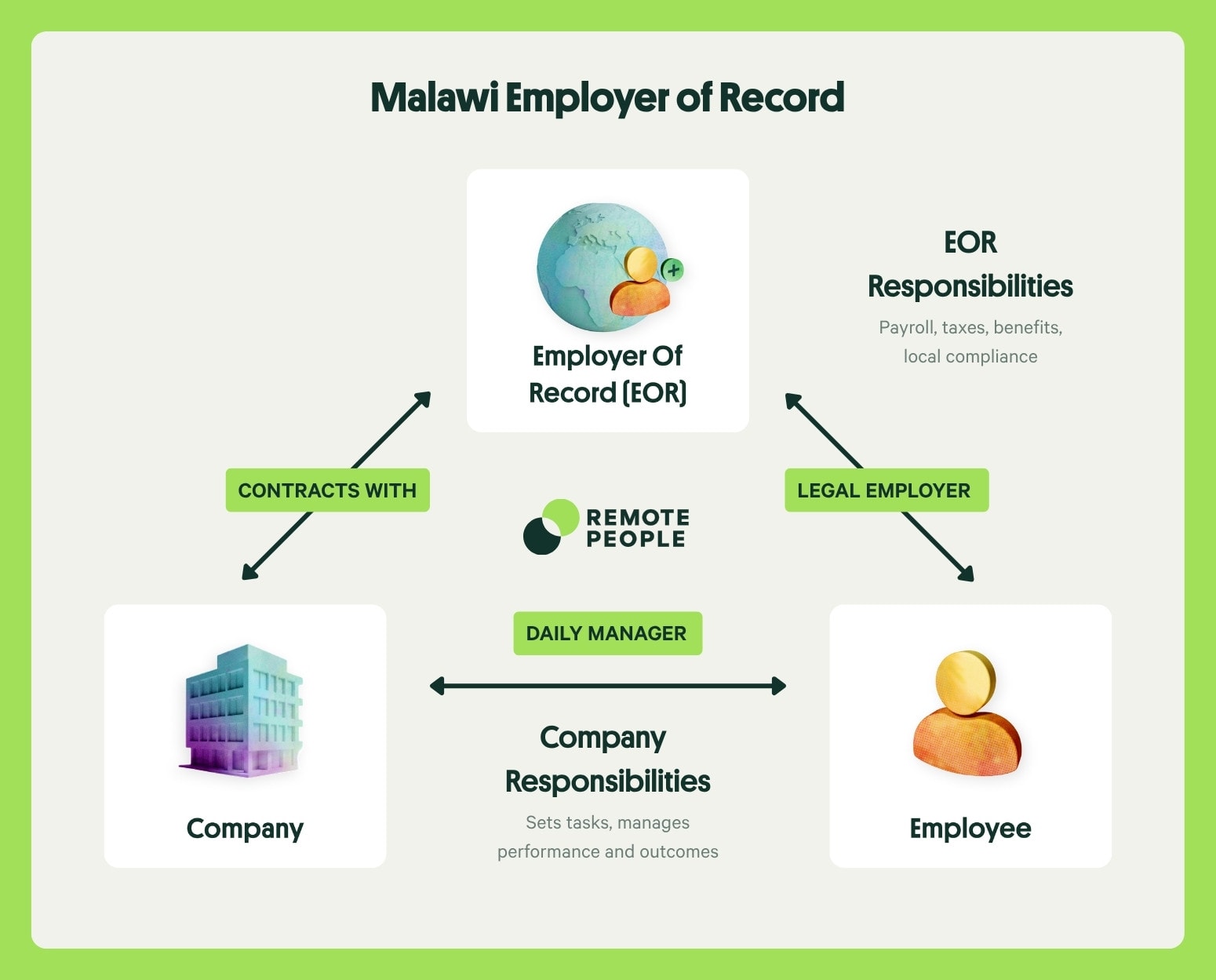
From the employee’s perspective, they work as a normal employee of the EOR entity. They receive an employment contract, are enrolled in the pension fund, receive statutory leave, and are covered by workers compensation insurance. The employee reports to you (the hiring company) on a day-to-day basis and receives direction from your management. The EOR handles behind-the-scenes administrative functions like payroll processing and tax filing. The employee’s payslip will show the EOR as the employer.
Yes, you can engage independent contractors for specific projects or short-term work. However, misclassification risk is high in Malawi. If the arrangement resembles employment (regular duties, ongoing work, management reporting, exclusivity), the Malawi Revenue Authority may reclassify the relationship retroactively, triggering back-pay claims for pension, PAYE, and severance. For ongoing, recurring work, the EOR employee model is substantially safer. If you do need to engage contractors, RemotePeople also offers a contractor management solution for Malawi that handles compliance, payments, and contract administration.
All employers in Malawi must provide: mandatory pension fund contributions (10% employer, 5% employee), annual paid leave (15–18 days depending on work week), sick leave (4 weeks full pay + 8 weeks half pay after 12 months), maternity leave (8 weeks full pay per 3 years), paternity leave (2 weeks per child), and workers compensation insurance. These benefits are non-waivable and are administered by the EOR automatically. Additional benefits (health insurance, meal allowances, transport allowances) are voluntary but common in the private sector.
Yes. As of June 1, 2025, the national minimum wage in Malawi is MWK 126,000 per month (approximately USD 123) for most formal private sector roles. Domestic workers have a lower minimum of MWK 72,800. Micro, small, and medium enterprises may apply a reduced rate of MWK 105,000.17. All salaries must meet or exceed the applicable minimum wage, and failure to comply can result in enforcement action by the Ministry of Labour. For current rates, visit the official minimum wage resource.
No — you do not need a registered Malawian entity to hire employees in Malawi when using an employer of record. RemotePeople acts as the legal employer on your behalf, holding the local TPIN tax registration, Malawi Revenue Authority compliance, and pension fund obligations. Setting up your own entity in Malawi typically takes 6–12 weeks and adds annual maintenance costs of $5,000–$15,000, all of which an EOR avoids while letting you onboard your first employee in 1–2 weeks.
An employer of record in Malawi handles full monthly payroll processing, including PAYE income tax withholding (0%–35% per the Malawi Revenue Authority), the mandatory 10% employer pension contribution, the 1% TEVET levy, 1% workers' compensation insurance, and direct salary deposits in Malawian Kwacha. The EOR also files monthly returns with the MRA and the National Pension Authority, issues compliant payslips under the Employment Act, and provides year-end tax certificates to employees.
Employer of Record in
Employer of Record in
Employer of Record in
Employer of Record in
Employer of Record in
Employer of Record in
Employer of Record in
Employer of Record in