
 Recruit
Employer of Record in Mozambique
-
 Drew Donnelly
- Published
- September 22, 2026
RemotePeople’s employer of record in Mozambique lets you hire employees in Mozambique without complex INSS requirements. We handle National Social Security Institute contributions of 4% from employers and 3% from employees, monthly online platform uploads, and payment by the 10th of each month.
Hire in Mozambique — book a free 30-minute demo
Tell us what you need. You'll get a tailored, transparent proposal within 24 hours, plus a free call to walk through it.
Tell us about your company
So we can match you with a specialist who knows your market — and unlock volume pricing tiers.
* All fields are required.
Where and when are you hiring?
Tell us the geography and timing and we'll quote each country line by line, with onboarding timelines.
* All fields are required.
Help us beat your current setup
We'll benchmark your current deal and send a line-by-line proposal in 24 hours — showing exactly where we cut cost, time, or risk. After you submit, you can book a call to walk through it together.
* All fields are required.
Thanks! Your proposal is on its way.
Expect a tailored, line-by-line proposal in your inbox within 24 hours. In the meantime…
Want to walk through it together?
Book a free 30-minute call with one of our specialists. We'll explain every line, answer your questions, and tailor the proposal further if you need.
No obligation. Pick a time that works for you.








- Hire in Mozambique — book a free 30-minute demo
- Tell us about your company
- Where and when are you hiring?
- Help us beat your current setup
- Thanks! Your proposal is on its way.
- How an Employer of Record Works in Mozambique
- Employment Laws and Regulations in Mozambique
- Work Permits and Visas in Mozambique
- Payroll, Taxes, and Social Security in Mozambique
- Cost of Hiring Through an EOR in Mozambique
- Benefits of Using an EOR in Mozambique
- Termination and Offboarding in Mozambique
- EOR vs. Other Hiring Models in Mozambique
- Public Holidays in Mozambique
- How to Get Started with an EOR in Mozambique
- Frequently Asked Questions
- Related EOR Destinations

Start hiring in Mozambique
Let RemotePeople handle payroll, compliance, and HR admin worldwide so you can focus on building your team.

Mozambique offers foreign employers access to Portuguese-speaking talent, one of Africa’s fastest-growing economies, and strategic ports linking Southern Africa to global shipping routes. For companies looking to hire employees in Mozambique, the new Labour Law 13/2023 (in force since 21 February 2024) has rewritten core rules on parental leave, work modalities, and fixed-term contracts, while INSS registration, IRPS withholding, and foreign worker quotas make direct hiring without a local entity impossible. An employer of record in Mozambique solves this by acting as the legal employer on paper, handling contracts under Law 13/2023, monthly INSS filings at the 7% combined rate, IRPS withholding across the five progressive brackets, and work permit sponsorship under the DIRE framework, priced as a flat USD 300–600 per employee per month, so a company can onboard its first Mozambican hire in one to two weeks with zero local incorporation, no Ministry of Labour filings, and no long-term real estate or banking obligations in Maputo.
This guide explains how an employer of record in Mozambique works in 2026, what Law 13/2023 changed, the full INSS and IRPS cost stack, every leave entitlement under the new code, the work permit catalog and quota rules, and a step-by-step path to a compliant first hire.
How an Employer of Record Works in Mozambique
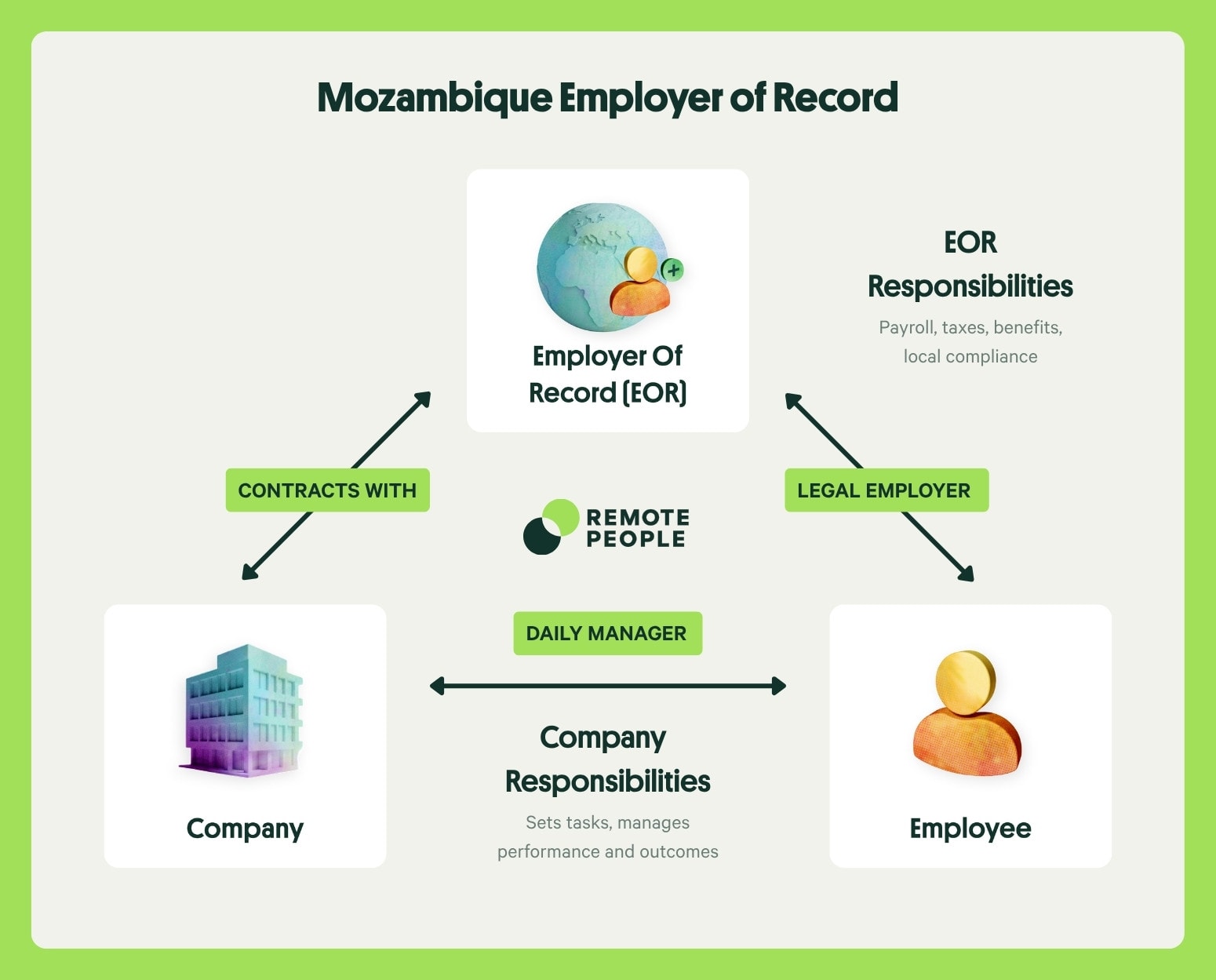
If you’d like to learn more about how Employer of Record (EOR) services work, read our What Is an Employer of Record (EOR)? guide for a complete overview of the model, its benefits, and when to use it.
If you’re comparing providers, our Best Employer of Record (EOR) Providers guide reviews the leading platforms to help you choose the right solution for your business.
Who Uses an EOR in Mozambique?
Mozambique EOR services are built for companies that need a compliant hire without an entity. The typical client profile spans market entrants, consolidators, and remote-first employers.
- Market testers: A company looking to validate Mozambique as a regional hub can hire one or two employees through an EOR before committing capital to a local subsidiary.
- Remote-first employers: Any business hiring a Mozambique-based remote worker (engineer, accountant, project manager, marketing lead) uses an EOR to avoid a costly corporate setup for a single headcount.
- Foreign national sponsors: Organizations bringing expatriate staff into Mozambique rely on the EOR to obtain the work permit, DIRE, and monthly tax filings that a foreign entity cannot manage from outside the country.
- Project-based builders: Groups running a short-term project (two to three years) use an EOR because unwinding a Mozambican entity takes months and costs more than the entity itself.
Companies already operating a Mozambican subsidiary typically do not need an EOR; they have their own INSS and NUIT registration. The EOR model is most valuable where local compliance would otherwise block a hire.
Typical Onboarding Timeline
Hiring through a Mozambique EOR compresses what would otherwise be a multi-month incorporation into about two weeks. The timeline varies based on whether the hire is Mozambican or a foreign national requiring a work permit.
- EOR agreement and employee details: 1–2 days to collect identification, tax number (NUIT), bank details, and role scope.
- Employment contract drafting and review: 2–3 days to prepare the Portuguese contract under Law 13/2023 and align salary, probation length, and working hours.
- INSS and tax registration: 3–7 days for employee enrollment with INSS and registration for IRPS withholding with the Autoridade Tributária.
- Payroll setup and benefits enrollment: 2–3 days to activate banking, pay slip templates, leave tracking, and any supplementary benefits.
- Employee onboarding and first day: 1 day for contract signature, orientation, and provisioning.
Most EOR providers can onboard a Mozambican national in one to two weeks. For foreign nationals, add four to twelve weeks for the work permit and DIRE application, because the Ministry of Labour must first authorise the hire against the company’s foreign worker quota before the visa is issued.
Hire in Mozambique
Portuguese-speaking talent, one of Africa’s fastest-growing economies, and strategic ports linking Southern Africa to global shipping make Mozambique a compelling expansion market.
We handle employment contracts, payroll, IRPS withholding, and INSS filings, with full Law 13/2023 compliance.
No local entity needed. Your first Mozambique hire can start in one to two weeks.
Employment Laws and Regulations in Mozambique
Employment Contracts
Employment in Mozambique is governed by Law 13/2023, of 25 August, which entered into force on 21 February 2024 and repealed the previous Law 23/2007 (DLA Piper Africa). The Ministry of Labour, Employment and Social Security enforces the code alongside the Autoridade Tributária and INSS. Written contracts are not always legally required for indefinite terms under 90 days, but every professional engagement handled through an EOR is formalised in writing to meet tax, social security, and immigration evidence standards. Contracts must be in Portuguese (bilingual versions are common) and include the parties’ identification, the role, the workplace, remuneration, working hours, probation length, and the applicable collective bargaining instrument if any. Fixed-term contracts are permitted under defined circumstances and, under Law 13/2023, small and medium-sized enterprises can freely enter into fixed-term contracts during their first eight years of activity (WTW).
Working Hours and Overtime
Standard working time in Mozambique is 8 hours per day and 48 hours per week under Articles 119 and following of Law 13/2023. The employer can extend the daily cap to 9 hours if the worker is granted an additional half day of rest per week, and every working day must include a break of between 30 minutes and 2 hours. Managerial and confidential-function staff may be exempt from overtime under the fixed-schedule exemption regime. Overtime is paid at a premium and capped at 200 hours per year, 96 hours per quarter, and 56 working hours per week including extensions (ABCC New Labour Law).
Mozambique overtime and premium pay rates · Per Labour Law 13/2023 |
|||
Hour type |
Rate multiplier |
Weekly/daily cap |
Notes |
|---|---|---|---|
Weekday overtime, before 20:00 |
150% (+50%) |
Max 56 hours/week including extensions |
Applied to each hour worked beyond the 8-hour daily normal period |
Weekday overtime, after 20:00 (night) |
200% (+100%) |
Counted within the 200-hour annual cap |
Night window in Mozambique is 20:00–07:00 for overtime premium calculation |
Weekly rest day (Sunday) work |
200% (+100%) |
Compensatory rest day within 3 days |
Classified as “exceptional hours” under the Labour Law |
Public holiday work |
200% (+100%) |
Compensatory rest day within 3 days |
Alternative is paid premium without rest day |
Annual overtime cap |
n/a |
200 hours/year · 96 hours/quarter |
Breaching the cap triggers administrative penalties |
Overtime cannot replace recruiting additional headcount to cover structural workload, and the 200-hour annual ceiling applies per employee regardless of business need. Exceptional hours (rest day and holiday work) trigger both the 100% premium and a compensatory rest day within the following three working days. Employers who routinely breach these limits expose themselves to Labour Inspectorate fines and to wage claims extending up to five years.
Minimum Wage
Mozambique does not apply a single national minimum wage in Mozambique. Instead, the Salary Commission negotiates sector-specific minimums every year, and the 2025 rates (effective retroactively from 1 July 2025 and current throughout 2026) were approved by ministerial decrees of 22 September 2025 (DLA Piper Africa: 2025 Minimum Wages). A hire’s applicable wage depends on the economic activity of the employer, not the employee’s occupation.
- Agriculture, livestock and forestry: MZN 6,688 per month.
- Manufacturing industry: MZN 10,147.50 per month.
- Construction: MZN 8,400 per month.
- Non-financial services: MZN 10,310 per month (MZN 9,700 for hotels, tourism and similar).
- Financial services (banks and insurance): MZN 19,043.61 per month; microfinance and micro-insurance MZN 16,764.
- Bakeries: MZN 7,200 per month.
In practice, most EOR hires in professional roles sit well above the applicable sector minimum, because market rates for engineers, accountants and managers in Maputo and Matola start several times higher than the floor.
Probation Period
Probation under Law 13/2023 lasts up to 90 days for ordinary roles and up to 180 days for positions of technical complexity or mutual trust (managerial, director, or highly specialised profiles). During probation, either party can terminate the contract without cause, provided at least seven days of written notice. Severance is not owed if the contract ends during probation; only salary earned up to the termination date must be paid. Annual leave continues to accrue during the probation period, though it cannot normally be taken until after confirmation.
Leave Entitlements
Mozambique’s leave framework sits inside Law 13/2023 and is split across annual leave, sick leave, maternity, paternity, and several shorter statutory absences. The new code kept the tiered annual leave structure from the 2007 law but substantially expanded parental rights.
Annual Leave
Annual leave in Mozambique is tiered by tenure. Workers receive 12 calendar days of paid annual leave during the first year of employment, then 30 calendar days per year from the second year onwards (Lockton Global Benefits). Leave accrues monthly and can be scheduled by agreement between employer and employee, with at least 10 consecutive days normally taken in one block. Unused leave carries into the following year but cannot accumulate indefinitely. Accrual continues during probation, although leave is typically taken only after confirmation.
Sick Leave
Employees may take up to 15 consecutive days of sick leave per year or 5 non-consecutive days per quarter. Sick leave is paid at 75% of the normal wage, and a medical certificate from a registered practitioner is required for absences beyond two days. After the statutory employer-paid period, the INSS sickness benefit can cover longer absences of up to 365 days subject to the health board’s confirmation of the condition.
Maternity Leave
Law 13/2023 extended maternity leave from 60 to 90 consecutive days, which can begin up to 20 days before the expected delivery date (Lockton Global Benefits). Maternity pay is funded by the INSS for workers registered with the social security system, at 100% of the insured reference earnings. Pregnant and breastfeeding workers cannot be dismissed from the start of pregnancy until one year after the end of maternity leave, except for expiry of a fixed term or disciplinary dismissal for just cause.
Paternity Leave
Paternity leave increased from 1 day to 7 consecutive days under Law 13/2023. The period extends to 60 days if the mother dies, becomes incapacitated, or otherwise cannot care for the newborn. Paternity leave is paid by the employer at the normal wage and must be taken around the date of birth.
Other Statutory Leave
Beyond annual, sick, maternity and paternity entitlements, Law 13/2023 recognises several shorter statutory absences.
- Bereavement leave: up to 5 consecutive days on the death of a spouse, child, parent, or other close relative.
- Marriage leave: 5 consecutive days around the wedding date.
- Judicial or administrative duty: time needed to respond to court summons or mandatory civic duties.
- Adoption leave: adoptive parents of a child under one year are entitled to 60 consecutive days of leave.
- Study leave: working students have time off for exam days and associated travel, per the Labour Law framework on education.
Under Law 13/2023, the table below summarises every statutory leave category with duration, pay source, and the most important eligibility note. The single biggest change from the 2007 code is the 90-day maternity period and the jump from 1 to 7 days of paternity leave, with a fallback up to 60 days for bereaved or incapacitated families.
Mozambique statutory leave entitlements · Per Labour Law 13/2023 |
||
Leave type |
Duration |
Eligibility and notes |
|---|---|---|
Annual leave (year 1) |
12 calendar days |
Paid by employer; accrues monthly from start of contract |
Annual leave (from year 2) |
30 calendar days/year |
Paid by employer; at least 10 consecutive days normally taken in one block |
Sick leave |
15 consecutive days/year or 5 non-consecutive days/quarter |
Paid at 75% by employer; medical certificate required; INSS sickness benefit extends up to 365 days |
Maternity leave |
90 consecutive days |
Paid by INSS at 100% of insured earnings; can start 20 days pre-delivery; dismissal protected to 1 year post-leave |
Paternity leave |
7 consecutive days (up to 60 in case of mother’s incapacity or death) |
Paid by employer at full wage; taken around the birth |
Adoption leave |
60 consecutive days |
Paid by INSS; available to adoptive parents of a child under one year |
Bereavement leave |
Up to 5 consecutive days |
Paid by employer; death of spouse, child, parent or close relative |
Marriage leave |
5 consecutive days |
Paid by employer; taken around the marriage date |
Statutory Employee Benefits
Beyond paid leave, employers in Mozambique must provide or fund several statutory benefits that go through the social security system and the tax code. These Mozambique employee benefits sit on top of gross salary and are covered by the EOR.
- INSS social security: Employer contributes 4% and employee 3% of monthly gross pay to the Instituto Nacional de Segurança Social, covering old-age pension, invalidity, survivor, sickness, maternity, and occupational injury benefits (PwC: Mozambique Other Taxes).
- Health insurance: Mozambique operates a public National Health Service, but private medical insurance is a common supplementary benefit in professional roles and is often expected at financial-sector or expatriate compensation levels.
- Work accident and occupational disease insurance: Employers must take out insurance covering work-related accidents and occupational diseases; the INSS covers the social security layer while private cover tops up salary replacement.
- Meal and transport allowances: Not mandatory at a national level, but market-standard in Maputo for salaried professional roles; commonly paid as a separate non-taxable allowance within legal limits.
- Municipal tax (Imposto Pessoal Autárquico): A small flat amount (MZN 510 in Maputo for 2024, reviewed annually) withheld by employers and remitted to the municipality alongside payroll taxes.
Exact INSS and IRPS rates are shown in the tax tables under H2 4 and do not need to be duplicated here. The EOR reconciles these contributions with the monthly cost invoice so the client sees one combined figure.
Recent Regulatory Updates (2026)
The biggest regulatory event for 2024–2026 is the full bedding-in of Law 13/2023. The new code came into force on 21 February 2024 and by 2026 the Ministry of Labour, Employment and Social Security has issued supplementary regulations clarifying the treatment of telework, intermittent work, and private employment agencies (WTW). Fixed-term contracts are now freely available to small and medium-sized enterprises in their first eight years of activity, and maternity and paternity leave expansions apply to all contracts regardless of hire date.
On the tax side, Law 11/2025 of 29 December amended the IRPS Code effective from 2026, removing the 180-day physical-presence test as the sole criterion for tax residency and extending taxable income to gains from the transfer of goods and to digital services used or performed in Mozambique; digital services and commissions paid to non-residents are now subject to a 10% final withholding rate (DLA Piper Africa: 2026 IRPS Changes). Minimum wages were updated in September 2025 with retroactive effect from 1 July 2025 across all major sectors, with increases ranging from 2.9% to 9% depending on the economic activity.
Work Permits and Visas in Mozambique
Work Permit Requirements
Who Needs a Work Permit
Any non-Mozambican national who takes up paid employment in Mozambique requires a work permit issued by the Ministry of Labour, Employment and Social Security, plus a corresponding work visa from a Mozambican consulate abroad. Citizens of SADC member states enjoy streamlined visa processes for short visits but still need a work permit for paid employment. Permanent residents with a valid DIRE (Documento de Identificação e Residência para Estrangeiros) may work without a separate work permit, provided their residence authorisation is current.
Eligibility and Required Documents
Eligibility is tied to the foreign worker quota: small companies (up to 10 employees) may employ up to 10% foreign nationals, medium companies up to 8%, and large companies up to 5% (Cliffe Dekker Hofmeyr: Mozambique Work Permits). Hires above the quota require out-of-quota authorisation supported by proof of local recruitment efforts and a skills transfer plan. The standard documentation package includes a valid passport (6+ months validity, 2 blank pages), employment contract, academic and professional qualifications (authenticated and translated into Portuguese), criminal record certificate, medical certificate, and a curriculum vitae.
Processing Time and Validity
Standard long-term work permits take 4 to 12 weeks to issue when the hire is within quota; out-of-quota applications routinely take 3 to 6 months because the Ministry of Labour must first evaluate the local recruitment effort. Short-term work permits for assignments of 90 days or less (180 days in mining, oil, and gas) can be issued in 2 to 4 weeks. Initial validity is typically one year and is renewable for the duration of the employment contract up to a maximum of five years, after which a new authorisation is required.
Renewal Process
Renewal files should be submitted at least 30 days before expiry and include updated tax clearance, INSS compliance certificates, the current employment contract, and evidence that the employer remains within its foreign worker quota. The employee may continue to work while the renewal is under review provided the application was filed before expiry and the receipt is presented to SENAMI on request.
Common Visa Types for Foreign Workers
Work authorisation in Mozambique is split between the Ministry of Labour (which issues the work permit) and the Ministry of Foreign Affairs together with SENAMI, which issues the entry visa and the DIRE residence document. The EOR can sponsor every category below except the investor and self-employment routes, which require direct personal registration.
Mozambique work visa types for foreign workers · 2026 |
||||
Visa type |
Duration |
Best for |
Leads to residency? |
Processing |
|---|---|---|---|---|
Long-term work permit and work visa |
Up to 1 year, renewable to 5 years |
Employed foreign nationals on local payroll |
Yes, via DIRE |
4–12 weeks (within quota) |
Short-term work permit |
Up to 90 days/year (180 in mining, oil, gas) |
Temporary assignments, project work, commissioning |
No |
2–4 weeks |
Intra-company transfer (within long-term regime) |
Up to 1 year, renewable |
Group transfers from a parent or affiliated company abroad |
Yes, via DIRE |
4–10 weeks |
Business visa (Visto de Negócios) |
30 or 60 days, single or multiple entry |
Meetings, negotiations, exploratory visits; no paid local employment |
No |
5–15 business days |
Investor and self-employment visa |
Up to 2 years, renewable |
Founders, investors, independent professionals |
Yes, via DIRE |
2–4 months |
DIRE (Residence Document) |
Up to 5 years, renewable |
Formal residence for workers, investors, and family reunification |
Already a residence status |
2–3 months after entry |
- Tourist visa: Grants entry for leisure for up to 30 days and does not permit any paid activity.
- Student visa: Allows enrolment in Mozambican educational institutions but not paid employment beyond limited part-time exceptions for tertiary students.
- Transit visa: Issued for travellers passing through Mozambique, typically up to 7 days, and does not permit employment.
How an EOR Handles Work Permits
The EOR acts as the sponsoring employer for the work permit application, filing against its own foreign worker quota and NUIT. It prepares the labour authorisation file, submits to the Ministry of Labour, requests the work visa through the consulate, and coordinates the DIRE application with SENAMI after the employee arrives in Mozambique. The employee must personally attend biometrics and medical exams. Because the work permit process adds 4 to 12 weeks, the total onboarding timeline for a foreign national extends from the 1–2 week Mozambican-national path to around 6 to 14 weeks end-to-end (see H3 1.4). The EOR model only works for hires where the EOR’s own company size leaves quota headroom; ultra-large expatriate teams may require a dedicated local entity even when an EOR is available.
Payroll, Taxes, and Social Security in Mozambique
Employer Contributions
Employer payroll costs in Mozambique are modest by regional standards, with INSS being the only mandatory payroll contribution. The table below shows employer-side costs on a monthly gross salary basis. Work accident insurance is mandatory but carried privately, so rates vary by insurer and risk class; the figure shown is a common market reference for office-based roles.
Mozambique employer social security contributions · 2026 rates |
||
Contribution |
Rate |
Notes |
|---|---|---|
INSS: social security |
4.00% |
Applied to gross monthly pay; covers pension, disability, survivor, sickness, maternity |
Work accident insurance (private, market reference) |
~1.00% |
Mandatory cover; premium depends on occupational risk class and insurer |
Total employer cost on top of gross salary |
~5.00% |
Excludes voluntary benefits (private health, meal vouchers, 13th month) |
Employee Contributions
On the employee side, only INSS is a mandatory social-security deduction; the balance of payroll tax is IRPS withholding, which is shown in the income tax table below. Both items are withheld monthly by the employer and remitted to the INSS and the Autoridade Tributária respectively.
Mozambique employee payroll deductions · 2026 monthly withholdings |
||
Deduction |
Rate |
Notes |
|---|---|---|
INSS: social security |
3.00% |
Applied to gross monthly pay; withheld by employer |
IRPS: income tax |
0%–32% (progressive) |
Withheld monthly per the national bracket schedule; see tax brackets table |
Municipal tax (Maputo example) |
MZN 510 per year |
Flat amount; varies by municipality, reviewed annually |
Total employee deduction on gross salary |
3% + IRPS by bracket |
INSS fixed; IRPS rises with income |
Income Tax
IRPS is Mozambique’s personal income tax, levied on residents’ worldwide income and on the Mozambican-source income of non-residents. Residents are taxed under the progressive bracket table below, with annual rates ranging from 10% to 32%. Non-residents are taxed at a flat 20% on earned income (PwC Mozambique: Personal Income Tax). Law 11/2025 tightened the residency test from 2026 and introduced a 10% final withholding on digital services and commissions paid to non-residents.
Mozambique income tax brackets · 2026 |
|
Annual taxable income (MZN) |
Tax calculation |
|---|---|
Up to MZN 42,000 |
10% of total |
MZN 42,001 – 168,000 |
15% of total, minus MZN 2,100 deduction |
MZN 168,001 – 504,000 |
20% of total, minus MZN 10,500 deduction |
MZN 504,001 – 1,512,000 |
25% of total, minus MZN 37,500 deduction |
Over MZN 1,512,000 |
32% of total, minus MZN 141,540 deduction |
Non-residents (flat) |
20% final withholding on earned income |
Payroll Cycle
Salaries are paid monthly in Mozambican metical (MZN) through a local bank account; cash payments are discouraged and not practical for professional roles. Pay slips must show gross remuneration, IRPS withheld, INSS contribution, and net pay. Employers file IRPS withholding with the Autoridade Tributária by the 20th of the month following payment, and INSS contributions to INSS by the 10th of the month following. Annual IRPS returns are due by 31 March of the year following the tax year; most employees whose income is fully PAYE-withheld are not required to file a personal return unless they have additional income.
13th Month Salary and Bonus Pay
A 13th-month salary is not legally mandatory in Mozambique’s private sector. Law 13/2023 does not oblige employers to pay an additional month at Christmas, although the practice is widespread in the public sector and in larger private companies as a contractual or collective-bargaining benefit. When offered, the 13th month is typically paid in December and equals one month of gross base salary; it is taxable as ordinary employment income and subject to IRPS and INSS withholding in the month of payment. Productivity bonuses and profit-sharing are equally at the employer’s discretion and are treated as taxable income when paid. For EOR hires, any 13th-month or discretionary bonus is written into the employment contract at the outset so there is no ambiguity around expectation.
Cost of Hiring Through an EOR in Mozambique
EOR Service Fees
RemotePeople’s EOR service fee in Mozambique is a flat monthly amount per employee, typically in the USD 300–600 range depending on employee headcount, role complexity, and whether work permit sponsorship is required. The fee covers employment contract drafting, monthly payroll run, INSS and IRPS filings, statutory leave tracking, payslip delivery, and compliance with Law 13/2023. It does not include gross salary, employer social security, work accident insurance, private health or supplementary benefits, or government fees for work permits and DIRE; those are pass-through costs shown separately on the monthly invoice.
Total Employment Cost Breakdown
The table below shows a worked example for a hypothetical mid-level professional role in Maputo on a USD 2,500 gross monthly salary. All figures are converted to USD at an indicative rate of 1 USD ≈ 64 MZN as of April 2026; MZN amounts are provided in text for the underlying legal thresholds. The example assumes a standard office-based role with no extra hazards, within the foreign worker quota, and no 13th-month bonus (the Mozambican norm for EOR hires unless contractually agreed).
Mozambique employer cost example · USD 2,500 gross · 2026 |
||
Employer cost |
Amount (USD) |
% of gross |
|---|---|---|
Gross monthly salary |
$2,500.00 |
100.00% |
INSS employer contribution (4%) |
$100.00 |
4.00% |
Work accident insurance (~1%) |
$25.00 |
1.00% |
EOR service fee (est.) |
$450.00 |
18.00% |
Total employer monthly cost |
$3,075.00 |
123.00% |
Exchange rate: 1 USD ≈ 64 MZN as of April 2026. Legal thresholds (income tax brackets, minimum wage, severance base) are defined by Mozambican law in MZN.
On this example, the total monthly cost is about 23% above the employee’s gross salary, most of which is the EOR service fee (18%); INSS and work accident insurance add a combined 5%. That is materially cheaper than running a Mozambican subsidiary at the same one-employee scale, where entity maintenance, accounting, and minimum capital alone typically cost USD 1,500–3,000 per month before headcount is added. Compare this against general benchmarks on the RemotePeople pricing page.
Ready to hire in Mozambique? Get started with RemotePeople: we handle employment contracts, payroll, INSS and IRPS filings, and full Law 13/2023 compliance. No local entity needed. Contact RemotePeople to scope your first Mozambique hire.
Benefits of Using an EOR in Mozambique
An EOR compresses the compliance stack into a single vendor relationship. For companies weighing a Mozambican entity against an EOR, the practical advantages show up in speed, cost, and risk reduction.
- Speed to market: Entity incorporation in Mozambique takes 3 to 6 months once the investment project is approved by APIEX; an EOR can onboard a Mozambican national in 1 to 2 weeks and a foreign national in 6 to 14 weeks. Hiring starts before the alternative path even reaches the ministry desk.
- Compliance assurance under Law 13/2023: The EOR is on the hook for every Labour Law obligation, from contract terms and leave tracking to INSS filings and termination formalities. Errors become the EOR’s problem, not the client’s.
- Cost efficiency at small scale: For 1 to 10 employees, the EOR fee is far cheaper than incorporating, maintaining a minimum share capital, renting office space, and paying a resident accountant in Maputo.
- Local expertise on the ground: Mozambique-specific rules like the foreign worker quota, SADC agreements, and sector minimum wages are baked into the EOR’s process; the client does not have to interpret them.
- Flexibility to scale and exit: Scaling up adds headcount at the marginal EOR fee; scaling down means ending the contract with no corporate dissolution, no long-term office lease, and no Ministry of Finance file to close.
- Risk mitigation: Misclassification, severance miscalculation, and unlawful dismissal claims in Mozambique can lead to back pay and compensation awards. The EOR absorbs that exposure as the legal employer of record.
- Employee experience: Employees get a compliant local contract, INSS enrollment, full leave entitlements, and local-currency payroll in MZN: identical to working for a domestic employer.
The EOR model is the default first move for any company whose Mozambique headcount is below 10 to 15 and whose time to first hire is measured in weeks, not quarters.
Termination and Offboarding in Mozambique
Notice Periods
Notice for unilateral termination of an indefinite contract is a minimum of 30 days under Law 13/2023; collective bargaining agreements and individual contracts can extend but not shorten this floor (CMS: Dismissals in Mozambique). During the probation period, either party may terminate with seven days’ written notice, and no severance is owed. Employers may pay salary in lieu of notice where the employee accepts or the employer chooses to release the worker from working out the notice period.
Mozambique statutory notice periods by position level · Per Labour Law 13/2023 |
|||
Position level |
Notice period |
During probation |
Notes |
|---|---|---|---|
All indefinite contracts (ordinary roles) |
30 calendar days |
7 days written notice |
Statutory floor; pay in lieu permitted |
Managerial and confidential-function staff |
30 calendar days minimum, often 60–90 by contract |
7 days written notice |
Longer notice common for director/executive roles |
Fixed-term contracts |
15 days before expiry |
7 days written notice |
Notice of non-renewal given 15 days before term end |
Collective dismissal (structural / economic) |
30 calendar days + Ministry of Labour notification |
n/a |
Requires prior procedure with worker representatives |
Termination for just cause (disciplinary dismissal) does not require notice, but the employer must follow a formal disciplinary procedure including written notice of the allegations, an opportunity for the employee to respond, and a reasoned decision. Mutual agreement terminations can waive the notice period but still require written documentation of the parties’ consent and any severance package paid.
Severance Pay
Severance in Mozambique is owed when an employee on an indefinite contract is dismissed for structural, technological, or market reasons (economic redundancy) outside the just-cause category. The calculation is tiered by salary band relative to the sector minimum wage, so lower-paid workers receive more generous severance per year of service than the highest earners.
Mozambique severance pay schedule by years of service · Per Labour Law 13/2023 |
|||
Years of service |
Severance amount |
Base salary |
Notes |
|---|---|---|---|
1 year (salary 1–7× sector min wage) |
30 days of base salary |
Gross monthly salary + seniority bonus |
Prorated for partial years |
3 years (salary 1–7× sector min wage) |
90 days (3 × 30 days) |
Gross monthly salary + seniority bonus |
Standard tier for most workers |
5 years (salary 1–7× sector min wage) |
150 days (5 × 30 days) |
Gross monthly salary + seniority bonus |
Common tier in professional roles |
10 years (salary 7–18× sector min wage) |
150 days (10 × 15 days) |
Gross monthly salary + seniority bonus |
Mid-tier salary band |
10 years (salary over 18× sector min wage) |
50 days (10 × 5 days) |
Gross monthly salary + seniority bonus |
Top-earner tier; significantly reduced per year |
During probation |
No severance |
n/a |
Only accrued salary and pro-rata leave |
Calculation Method
The formula is days-of-base-salary per year of service, where base salary is gross monthly pay plus the seniority bonus (antiguidade) if any. The per-year multiplier depends on the worker’s salary relative to the applicable sector minimum wage: 30 days per year for workers earning 1–7 times the minimum wage, 15 days per year for 7–18 times, and 5 days per year above 18 times. Severance is prorated for partial years of service and is tax-exempt up to the statutory amount. The worked examples in the table cover the most common tenure scenarios.
Caps and Exceptions
There is no hard statutory cap in absolute terms, but the tiered multiplier effectively compresses severance for high earners. Severance is not payable when the dismissal is for just cause (disciplinary), when the employee resigns voluntarily, or when a fixed-term contract ends at its agreed term, although end-of-fixed-term contracts trigger a separate termination payment. Severance is also not owed during the probation period. Employees dismissed without fair procedure may claim reinstatement or enhanced compensation through the Labour Tribunal, so process compliance matters as much as the final payment figure.
Grounds for Termination
Mozambican law recognises three main termination grounds: dismissal with just cause (serious employee fault after disciplinary procedure), dismissal for structural/technological/market reasons (economic redundancy, which triggers severance), and mutual agreement. Expiry of a fixed-term contract is a fourth, standalone ground with its own compensation rule. Protected categories: pregnant workers, workers on maternity leave until one year after return, elected worker representatives: can only be dismissed in very limited circumstances and usually only after Ministry of Labour authorisation. Unlawful dismissal exposes the employer to reinstatement orders plus back pay from the date of dismissal, which is why every EOR termination in Mozambique runs through a documented disciplinary or redundancy process before any payment is calculated.
EOR vs. Other Hiring Models in Mozambique
EOR vs. Setting Up a Local Entity
Establishing a Mozambican subsidiary requires APIEX investment project approval, registration with the Conservatória do Registo das Entidades Legais, INSS and NUIT enrollment with the Autoridade Tributária, and an in-country bank account, all in Portuguese (PwC Mozambique: Corporate Taxes). The table below compares an EOR with a local entity across the cost, time, and compliance dimensions that matter most when a company is hiring its first one to fifteen employees in Mozambique.
Mozambique EOR vs local entity comparison · Setup time, cost, risk and best-fit |
||
Comparison |
Employer of record |
Own Mozambican entity |
|---|---|---|
Setup time |
1–2 weeks |
3–6 months (incl. APIEX project approval) |
Upfront cost |
$0 |
$5,000–$20,000 (incorporation, legal, minimum capital, licences) |
Ongoing cost |
$300–$600 per employee per month |
$15,000–$40,000 per year maintenance (accounting, office, audit, filings) |
Local partner required |
No (EOR is the local entity) |
Legal representative required; local director recommended |
INSS and tax registration |
Handled by EOR |
You manage it directly with INSS and Autoridade Tributária |
Payroll and tax filing |
Handled by EOR |
You manage in-house or via a payroll bureau |
Best for team size |
1–15 employees |
15+ employees, long-term operations |
Scale down / exit |
Easy: no entity to unwind |
Costly: legal dissolution can take 6–12 months |
Government contracts |
Not eligible |
Eligible (requires local entity and NUIT) |
The EOR route is dominant when Mozambique headcount is small or the commitment is time-limited. A company hiring two engineers and a country manager does not recover the cost of incorporation and maintenance within a three-year horizon. The entity route becomes economic once total headcount passes 15 to 20 and local revenue supports the fixed compliance overhead, or when the business needs to bid for government tenders or hold specific industry licences in its own name.
There is also a staging path. Many firms start with an EOR for the first 6 to 12 months while they validate the market and hire the initial team, then transition to their own Mozambican entity once headcount, revenue, and operational complexity justify the switch. The EOR period also gives enough compliance history with INSS and the Autoridade Tributária for the subsequent entity to open bank accounts and credit lines without friction.
EOR vs. Hiring Independent Contractors
Mozambican labour authorities apply a substance-over-form test to contractor relationships under Law 13/2023; set hours, exclusive engagement, employer-supplied equipment, and a reporting line into the client company can trigger reclassification, back payment of IRPS and INSS, and administrative fines (Paul Hastings: Mozambique Employment). The table below contrasts EOR employment against an independent contractor engagement across compliance, payroll, IP, and termination.
Mozambique EOR vs independent contractors · Compliance, cost, and risk |
||
Comparison |
EOR (full-time employee) |
Independent contractor |
|---|---|---|
Legal relationship |
Employee of the EOR under Law 13/2023 |
Self-employed, no employment relationship |
Compliance risk |
Low: EOR ensures Law 13/2023 compliance |
High: misclassification risk if relationship resembles employment |
Payroll and tax |
EOR handles IRPS withholding, INSS, filings |
Contractor invoices you; they handle their own IRPS and INSS |
Benefits and leave |
Statutory leave, maternity, paternity, social security |
No entitlement to employee benefits |
IP protection |
Stronger: employment contract assigns IP by default |
Weaker: requires explicit IP assignment clause |
Termination |
Subject to 30-day notice and tiered severance |
Contract ends per its own terms |
Best for |
Long-term, core team roles |
Short-term projects, specialised tasks |
Cost structure |
Salary + employer contributions + EOR fee |
Contractor fee (typically higher gross, lower total cost) |
Mozambican labour authorities apply a substance-over-form test when reviewing independent contractor arrangements. If the worker has set hours, reports to a manager, uses company equipment, and works exclusively for one client, the Labour Inspectorate can reclassify the relationship as employment and demand back payment of IRPS, INSS, unpaid leave, and severance, plus fines. The contractor model is only appropriate for genuine project-based work with a defined deliverable, a fixed term, and autonomy over how the work is performed.
For long-term core roles, the EOR model gives both parties the same economics as a direct hire: the client pays salary, employer contributions, and a fee; the worker gets full statutory protection and INSS enrollment; and misclassification risk disappears because the EOR is the legal employer. RemotePeople’s contractor management solution supports genuine independent contractor engagements where the substance test is clearly met.
EOR vs. PEO (Professional Employer Organization)
Mozambique does not recognise a formal Professional Employer Organization (PEO) framework in Law 13/2023; the closest approximation is co-employment through a registered HR services provider, which still requires the client company to operate its own Mozambican entity for legal employer status. The table below maps the practical differences between an EOR (which removes the entity requirement entirely) and a PEO-style HR outsourcing arrangement that sits on top of an existing Mozambican subsidiary.
Mozambique EOR vs PEO comparison · Legal employer, liability, and setup |
||
Comparison |
Employer of record (EOR) |
PEO |
|---|---|---|
Legal employer |
EOR is the legal employer |
You remain the legal employer (co-employment) |
Local entity required |
No: the EOR is the local entity |
Yes: you must have your own entity in Mozambique |
Best for |
Companies without a local entity |
Companies that already have a Mozambican entity |
Compliance liability |
EOR assumes compliance responsibility |
Shared between you and the PEO |
Setup time |
1–2 weeks |
Depends on your entity setup (weeks to months) |
Control over HR policies |
EOR manages within Law 13/2023 framework |
More direct control; PEO advises |
Typical use case |
Market entry, small remote teams, testing new markets |
Established local operations needing HR outsourcing |
Mozambique does not have a distinct PEO regulatory framework; what is marketed as a PEO in the US is, in Mozambique, generally either payroll outsourcing (for clients with their own entity) or an EOR arrangement (for clients without). The practical distinction is legal employment: if the client company already has a Mozambican NUIT and INSS registration, a payroll bureau can file and administer payroll but the client remains the legal employer and carries the compliance liability.
For foreign companies entering Mozambique for the first time, the EOR is almost always the right answer because there is no entity to co-employ against. Once a Mozambican subsidiary is in place, the conversation shifts toward payroll outsourcing or in-house HR rather than a co-employment PEO.
Public Holidays in Mozambique
Mozambique observes nine national public holidays, all of which are paid days off under the Labour Law. When a national holiday falls on a Sunday, it is typically observed on the following Monday. Work on a public holiday triggers the 200% premium rate and a compensatory rest day (see H3 2.2).
Mozambique public holidays · 2026 calendar year |
||
Date |
Holiday |
Type |
|---|---|---|
Thu, 1 Jan 2026 |
New Year’s Day |
National |
Tue, 3 Feb 2026 |
Heroes’ Day |
National |
Tue, 7 Apr 2026 |
Women’s Day |
National |
Fri, 1 May 2026 |
Workers’ Day (Labour Day) |
National |
Thu, 25 Jun 2026 |
Independence Day |
National |
Mon, 7 Sep 2026 |
Lusaka Peace Agreement Day |
National |
Fri, 25 Sep 2026 |
Armed Forces Day |
National |
Mon, 5 Oct 2026 |
Peace and National Reconciliation Day (observed) |
National (Sun 4 Oct moved to Monday) |
Fri, 25 Dec 2026 |
Family Day / Christmas Day |
National |
Maputo City observes an additional local holiday on 10 November (Maputo Day) for employees working within the municipal boundary. Payroll cycles should account for the extra day of paid leave in Maputo-based contracts and for the Monday observance rule when dates fall on a Sunday.
How to Get Started with an EOR in Mozambique
The path from decision to first paycheque in Mozambique runs through five steps. The EOR shoulders the compliance execution; the client provides scope and confirms the hire.
- First, define the role and total compensation. Confirm job title, gross monthly salary in MZN (or USD for conversion), probation length, working hours, and whether the candidate is a Mozambican national or a foreign hire. This determines the contract type, sector minimum wage check, and whether a work permit is needed.
- Second, sign the EOR master services agreement. This is a one-off framework contract with RemotePeople covering fees, data protection, liability, and service levels. Onboarding the first employee does not require a new master agreement.
- Third, submit candidate details and documents. ID (passport or BI), NUIT (tax number), bank account, signed offer letter in Portuguese, and (for foreign hires) qualifications, criminal record, and medical certificate. The EOR prepares the employment contract under Law 13/2023 for signature.
- Fourth, register the hire with INSS and the Autoridade Tributária. The EOR handles this inside 3 to 7 days. For foreign nationals, the work permit application and DIRE begin in parallel; the employee may start work only after the work visa is issued.
- Fifth, run first payroll. On the agreed monthly cycle, the EOR pays the employee in MZN, withholds IRPS and INSS, files returns, and invoices the client in USD (or the agreed currency) for the consolidated employment cost plus the EOR fee.
Ready to hire in Mozambique? RemotePeople is a full-service EOR handling contracts, payroll, INSS filings, work permits, and Law 13/2023 compliance so a company can focus on the work, not the paperwork. Contact us to start scoping your first Mozambique hire.
Frequently Asked Questions
RemotePeople's EOR service fee in Mozambique is a flat USD 300 to USD 600 per employee per month, depending on headcount, role complexity, and whether work permit sponsorship is needed. That fee is in addition to gross salary, the 4% INSS employer contribution, and the roughly 1% work accident insurance. On a USD 2,500 gross monthly salary the total employer cost is around USD 3,075, or approximately 23% above gross, with most of that overhead sitting in the EOR fee rather than mandatory contributions (see PwC Mozambique and INSS for the statutory rates: PwC: Mozambique Other Taxes).
A Mozambican national can be onboarded in 1 to 2 weeks: 1 to 2 days to collect details, 2 to 3 days for the Portuguese-language employment contract, 3 to 7 days for INSS registration and NUIT confirmation with the Autoridade Tributária (Autoridade Tributária), and 1 day for first-day onboarding. A foreign national adds 4 to 12 weeks for the work permit and DIRE, which runs through the Ministry of Labour and SENAMI and must stay within the company's foreign worker quota.
No. A 13th-month salary is not mandated by Law 13/2023 for the private sector (ABCC New Labour Law). It is widespread in the public sector and in some private companies as a contractual or collective-bargaining benefit, typically paid in December as one month of base salary. When offered, it is fully taxable as employment income under IRPS and subject to INSS withholding. EOR contracts spell out whether a 13th month is payable so there is no ambiguity at year-end.
Employers contribute 4% of monthly gross pay to the Instituto Nacional de Segurança Social (INSS), covering old-age pension, invalidity, survivor, sickness, maternity, and occupational injury benefits. Employees contribute another 3%, bringing the combined INSS rate to 7% of gross pay (PwC: Mozambique Other Taxes). Work accident insurance is additionally mandatory but carried privately; premiums are approximately 1% for office-based roles and rise with occupational risk.
Mozambique applies a five-bracket progressive IRPS schedule to residents: 10% on annual income up to MZN 42,000, 15% from MZN 42,001 to MZN 168,000 (deduction MZN 2,100), 20% from MZN 168,001 to MZN 504,000 (deduction MZN 10,500), 25% from MZN 504,001 to MZN 1,512,000 (deduction MZN 37,500), and 32% above MZN 1,512,000 (deduction MZN 141,540). Non-residents are taxed at a flat 20% on earned income (PwC Mozambique: Personal Income Tax). Law 11/2025 amended the IRPS Code from 2026 to tighten residency rules and add a 10% final withholding on digital services.
Yes, through an employer of record. RemotePeople holds the Mozambican employment contract under Law 13/2023, files INSS and IRPS, and sponsors work permits, so a foreign company without a Mozambican subsidiary can hire fully compliantly. Direct hiring without an entity is not legally possible because both INSS and the Autoridade Tributária require a local employer registration and NUIT, and foreign nationals need a Mozambican sponsor for their work permit (DLA Piper Africa: New Labour Law).
Notice for unilateral termination of an indefinite contract is at least 30 calendar days, shortening to 7 days during probation (CMS: Mozambique Dismissals). Severance for dismissals on structural, technological, or market grounds is tiered by salary band: 30 days of base salary per year of service for workers earning 1–7 times the sector minimum wage, 15 days per year for 7–18 times, and 5 days per year above 18 times. Severance is not owed for just-cause dismissals, voluntary resignations, or terminations during probation.
For long-term core roles, the EOR route is safer. Mozambican labour authorities apply a substance-over-form test to contractor relationships; set hours, a reporting line, company equipment, and exclusive engagement can trigger reclassification, back payment of IRPS and INSS, and fines. RemotePeople's EOR handles long-term hires under Law 13/2023 with full statutory protection, while RemotePeople's contractor management solution supports genuine project-based engagements where the autonomy and deliverable tests are clearly met (Paul Hastings: Mozambique Employment).
Mozambique uses sector-specific minimum wages set by the Salary Commission. The 2025 rates (effective from 1 July 2025 and in force through 2026) include MZN 6,688 for agriculture, MZN 10,147.50 for manufacturing, MZN 8,400 for construction, MZN 10,310 for non-financial services, and MZN 19,043.61 for banks and insurance (DLA Piper Africa: 2025 Minimum Wages). The applicable rate depends on the employer's economic activity, not the employee's occupation. Most professional EOR hires sit well above the floor.
Employment contracts under Law 13/2023 typically assign work-related intellectual property to the client company (you), not to the EOR, through IP-assignment and moral-rights waiver clauses in the EOR's employment agreement. The EOR is the legal employer for payroll and compliance purposes, but the client directs the work and owns its output. This is materially stronger than a standard contractor engagement, where IP assignment requires a dedicated clause and can be contested if the relationship is later reclassified.
Yes. RemotePeople offers a separate contractor management solution for genuine project-based engagements in Mozambique, distinct from EOR employment. Mozambican law applies a substance-over-form test under Law 13/2023, so set hours, exclusive engagement, and a reporting line into the client can trigger reclassification, back IRPS and INSS, and fines (Paul Hastings: Mozambique Employment). For long-term core roles, the EOR route under Law 13/2023 is the safer compliant path; for short-term specialised projects, the contractor solution covers payment, contract templates, and IP assignment.
An EOR (employer of record) is the legal employer in Mozambique on paper, registers the worker with INSS and the Autoridade Tributária under its own NUIT, and removes the need for the client to incorporate locally. A PEO (professional employer organisation) is a co-employment model that requires the client company to already operate its own Mozambican entity, with the PEO providing payroll and HR services on top. Mozambique does not formally regulate PEOs in Law 13/2023, so most foreign companies hiring without a Mozambican subsidiary use an EOR rather than a PEO. The EOR carries the full compliance liability under Mozambican labour and tax law (DLA Piper Africa: New Labour Law).