
 Recruit
Employer of Record in Zambia
-
 Drew Donnelly
- Published
- September 22, 2026
RemotePeople’s employer of record in Zambia lets you hire employees in Zambia with NAPSA compliance. We handle National Pension Scheme Authority contributions at 5 percent employer share, National Health Insurance Fund contributions at 1 percent, and Employment Code compliance.
Hire in Zambia — book a free 30-minute demo
Tell us what you need. You'll get a tailored, transparent proposal within 24 hours, plus a free call to walk through it.
Tell us about your company
So we can match you with a specialist who knows your market — and unlock volume pricing tiers.
* All fields are required.
Where and when are you hiring?
Tell us the geography and timing and we'll quote each country line by line, with onboarding timelines.
* All fields are required.
Help us beat your current setup
We'll benchmark your current deal and send a line-by-line proposal in 24 hours — showing exactly where we cut cost, time, or risk. After you submit, you can book a call to walk through it together.
* All fields are required.
Thanks! Your proposal is on its way.
Expect a tailored, line-by-line proposal in your inbox within 24 hours. In the meantime…
Want to walk through it together?
Book a free 30-minute call with one of our specialists. We'll explain every line, answer your questions, and tailor the proposal further if you need.
No obligation. Pick a time that works for you.








- Hire in Zambia — book a free 30-minute demo
- Tell us about your company
- Where and when are you hiring?
- Help us beat your current setup
- Thanks! Your proposal is on its way.
- How an Employer of Record Works in Zambia
- Employment Laws and Regulations in Zambia
- Payroll and Taxes in Zambia
- Employee Benefits and Compensation in Zambia
- Work Permits and Visas in Zambia
- Termination, Notice, and Severance in Zambia
- EOR vs. Other Hiring Models in Zambia
- Common Compliance Pitfalls in Zambia
- Hiring in Key Zambian Cities and Sectors
- Choosing an Employer of Record in Zambia
- Where companies hiring in Zambia expand next
- Related EOR Destinations

Start hiring in Zambia
Let RemotePeople handle payroll, compliance, and HR admin worldwide so you can focus on building your team.

Hiring in Zambia through an Employer of Record (EOR) removes the friction of entity setup, PAYE administration, and statutory filings while you build teams in Lusaka, the Copperbelt, or remote provinces. RemotePeople’s EOR service acts as the legal employer of record in Zambia under the Employment Code Act No. 3 of 2019, managing contracts, payroll, NAPSA and NHIMA contributions, and work permits so your expansion stays fully compliant.
How an Employer of Record Works in Zambia
An Employer of Record (EOR) in Zambia takes on every legal duty tied to hiring a local employee, from drafting a compliant contract under the Employment Code Act No. 3 of 2019 to filing monthly PAYE returns with the Zambia Revenue Authority. For foreign companies, the EOR model unlocks hiring in Zambia without incorporating a subsidiary, registering for corporate tax, or navigating the Patents and Companies Registration Agency (PACRA). You retain day-to-day control of the work; the EOR handles the legal, tax, and payroll exposure.
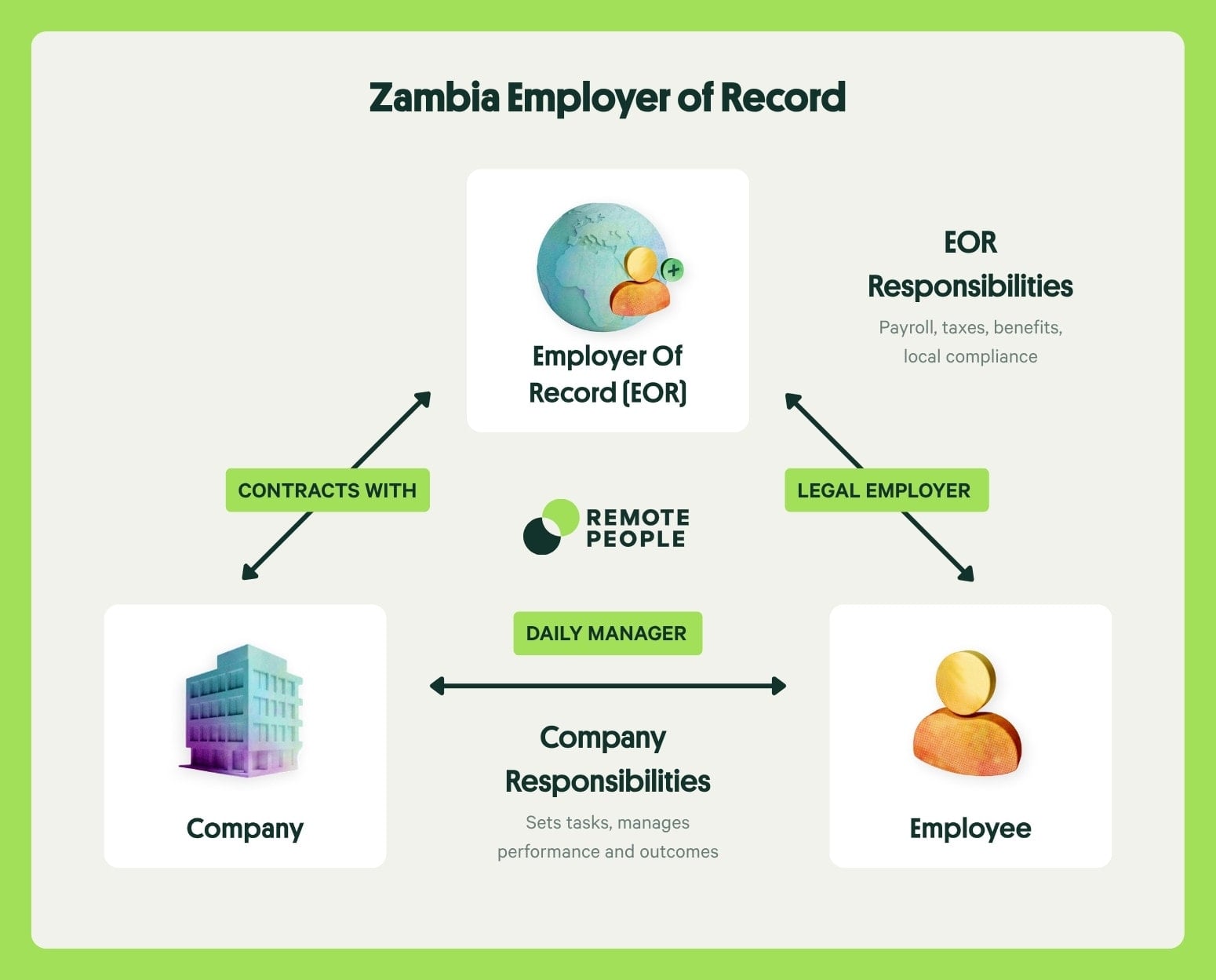
If you’d like to learn more about how Employer of Record (EOR) services work, read our What Is an Employer of Record (EOR)? guide for a complete overview of the model, its benefits, and when to use it.
If you’re comparing providers, our Best Employer of Record (EOR) Providers guide reviews the leading platforms to help you choose the right solution for your business.
Who Uses an Employer of Record in Zambia?
Mining technology vendors, renewable energy developers, global NGOs, SaaS companies, consulting firms, and agribusiness groups use EORs to hire in Zambia without standing up a local entity. Copper and cobalt demand has pulled a new wave of mining services companies into the Copperbelt and North-Western provinces, while the government’s drive toward a green minerals hub has attracted battery-materials and EV-supply-chain firms. Many of these employers want to place country managers, commercial leads, field engineers, or remote developers in Zambia before committing to an entity.
Smaller companies and scale-ups also rely on EORs during proof-of-market phases. Registering a private company limited by shares with PACRA, securing a Taxpayer Identification Number from the ZRA, opening a local bank account, and registering with NAPSA and NHIMA can take four to eight weeks even when paperwork is clean. An EOR compresses that timeline to a few days and eliminates the fixed cost of maintaining a dormant entity if the market hypothesis does not play out.
Typical Onboarding Timeline
- First, you provide the employee’s details, job description, salary in ZMW or USD, start date, and benefits package. The EOR reviews the role against Zambia’s minimum wage General Orders and local market bands. This step typically takes 2-3 business days.
- Second, the EOR issues an Employment Code-compliant written contract in English, including probationary terms, working hours, leave entitlements, notice, and termination grounds. The candidate signs electronically; this step takes 3-5 business days.
- Third, the EOR registers the employee with the ZRA (TPIN linkage for PAYE), NAPSA (pension), NHIMA (health), and the WCFCB (workers’ compensation), and initiates a work permit application if the hire is a non-Zambian. Local registrations take 5-10 business days; Employment Permits for foreign nationals typically take 6-10 weeks.
- Fourth, the first payroll cycle runs by the last working day of the month. The employee receives a compliant payslip, and the EOR remits PAYE by the 10th of the following month and NAPSA/NHIMA by the 10th as well.
- Fifth, the EOR delivers a monthly compliance pack covering contributions, filings, leave balances, and any regulatory updates. Your team engages an account manager for new hires, salary changes, and offboarding throughout the engagement.
Hire in Zambia
A young, English-speaking workforce, copper-belt expertise, predictable statutory costs of 6-9%, and growing remote talent in Lusaka and Ndola make Zambia an efficient Southern African hiring destination.
We handle employment contracts, payroll, PAYE withholding, NAPSA and NHIMA filings, and full Zambia compliance under the Employment Code Act No. 3 of 2019.
No local entity needed. Your first Zambian employee can start within a week.
Employment Laws and Regulations in Zambia
Zambia’s employment framework is anchored in the Employment Code Act No. 3 of 2019, which consolidated the Employment Act, the Minimum Wages and Conditions of Employment Act, the Employment of Young Persons and Children Act, and parts of the Industrial and Labour Relations Act into a single statute. Overlapping rules sit in the Industrial and Labour Relations Act (Cap. 269) for trade unions and collective bargaining, the Workers’ Compensation Act No. 10 of 1999, the National Pension Scheme Act, and the National Health Insurance Act of 2018. Non-compliance triggers penalties assessed by the Labour Commissioner, awards before the Industrial Relations Court, and back-duty assessments by the ZRA.
Employment Contracts
The Employment Code Act requires every employment contract of six months or longer to be in writing and signed by both parties. Required particulars include names and addresses of the parties, the job title and duties, the place of work, the date of commencement, the wage and method of calculation, hours of work, leave entitlements, notice periods, and any probation clause. Contracts may be for an indefinite period, a fixed term, a specific task, or a piecework basis, and must be in a language the employee understands, which is English by default for most formal employment in Zambia.
Working Hours and Overtime
The standard workweek in Zambia is 48 hours, typically structured as eight hours a day over six days, or nine hours a day over five days with a half-day on Saturday. The Employment Code Act caps ordinary working hours at 48 per week excluding meal breaks. Any hours worked beyond the agreed daily or weekly limit count as overtime and must be paid at 1.5 times the ordinary hourly rate on regular days.
Work performed on a Sunday or a gazetted public holiday is paid at twice the ordinary hourly rate. Overtime is not mandatory; the Act protects an employee’s right to refuse overtime that exceeds agreed contractual terms, and employees must receive at least one rest day of 24 consecutive hours every seven days.
Zambia Overtime and Premium Pay Rules (2026) | ||
Work Type | Pay Rate | Notes |
|---|---|---|
Ordinary Hours (up to 48/week) | 1.0 x hourly rate | Typically 8 hours/day over 6 days |
Overtime on Ordinary Day | 1.5 x hourly rate | Any hours beyond agreed daily or weekly limit |
Work on Sunday | 2.0 x hourly rate | Weekly rest day for most sectors |
Work on Public Holiday | 2.0 x hourly rate | In addition to ordinary holiday entitlement |
Night Shift Allowance | Subject to collective agreement | Negotiated through CBAs in mining, manufacturing |
Minimum Wage
Zambia’s minimum wage in 2026 is set through three General Orders rather than a single national rate. The Domestic Workers Order applies to housekeepers, gardeners, drivers, and other household staff; the Shop Workers Order applies to retail employees; and the General Workers Order applies to almost everyone else (cleaners, messengers, general hands). Each Order has multiple grades, and the rates for a General Worker Grade III typically combine a basic wage of ZMW 3,000, a housing allowance of ZMW 450, and a transport-and-lunch allowance of ZMW 350, reaching approximately ZMW 3,800 per month. Paying below the gazetted rate exposes the employer to enforcement action by the Labour Commissioner and criminal penalties under the Minimum Wages and Conditions of Employment Act (Cap. 276).
Probation Period
Probation in Zambia may run for up to three months under the Employment Code Act, and may be extended once by a further three months with the employee’s written consent. During probation either party may terminate with 24 hours’ notice, and the fair-reasons requirement is relaxed, though discrimination and retaliation protections still apply. At the end of probation, continued employment converts the engagement into a confirmed contract on the same terms, which materially changes notice, severance, and unfair-dismissal exposure.
Leave Entitlements
Zambia’s statutory leave framework covers annual leave, sick leave, maternity leave, paternity leave, and family responsibility leave. Entitlements accrue from the first day of employment and cannot be waived by contract, though employers may grant more generous terms. The table later in this section summarises every entitlement at a glance.
Annual Leave
Employees in Zambia are entitled to annual leave accrued at the rate of two days per month, producing 24 working days a year after 12 months of continuous service. The Employment Code Act requires that leave be granted within six months of becoming due, and untaken leave cannot be forfeited on termination without being paid out in cash.
Sick Leave
Zambia’s sick leave framework is unusually generous. An employee is entitled to three months on full pay and a further three months on half pay in any consecutive 36-month period, subject to medical certification from a recognised practitioner. After six months of cumulative absence, the employer may lawfully terminate on grounds of incapacity following the statutory procedure, including consultation and a fair hearing.
Maternity Leave
Female employees who have completed at least two years of continuous service with the same employer are entitled to 14 weeks of paid maternity leave at full pay. The Employment Code Act extends the leave to 18 weeks in the case of multiple births or a confirmed complication. Employers cannot dismiss an employee on grounds related to pregnancy, and returning employees have a statutory right to return to the same or a comparable role.
Paternity Leave
Fathers are entitled to five continuous working days of paid paternity leave after each child’s birth, provided the employee has completed at least 12 months of continuous service and the leave is taken within seven days of the birth.
Family Responsibility Leave
The Employment Code Act introduced a dedicated family responsibility entitlement of up to seven days per year for employees in long-term employment. This can be used for the illness of a child, a spouse’s illness, bereavement, or the care of an immediate family member. Employers may require reasonable proof of the event triggering the leave.
Statutory Leave Entitlements in Zambia (2026) | ||
Leave Type | Entitlement | Payment |
|---|---|---|
Annual Leave | 24 working days/year (2 days/month accrual) | Full pay |
Sick Leave | Up to 6 months per 36-month cycle | 3 months full pay, then 3 months half pay |
Maternity Leave | 14 weeks (18 weeks for multiple births or complications) | Full pay (2 years’ service required) |
Paternity Leave | 5 working days per birth | Full pay (12 months’ service required) |
Family Responsibility Leave | Up to 7 days/year | Full pay |
Public Holidays | 13+ gazetted days (2026) | Full pay; 2x if worked |
Public Holidays
Zambia gazettes public holidays each year under the Public Holidays Act (Cap. 68), and the President may proclaim additional days by notice. When a gazetted holiday falls on a Sunday, the following Monday is observed in lieu. The 2026 calendar is below.
Zambia Public Holidays 2026 | ||
Date | Day | Holiday |
|---|---|---|
January 1 | Thursday | New Year’s Day |
March 9 | Monday | International Women’s Day (observed) |
March 12 | Thursday | Youth Day |
April 3 | Friday | Good Friday |
April 4 | Saturday | Holy Saturday |
April 6 | Monday | Easter Monday |
April 28 | Tuesday | Kenneth Kaunda Day |
May 1 | Friday | Labour Day |
May 25 | Monday | Africa Freedom Day |
July 6 | Monday | Heroes’ Day |
July 7 | Tuesday | Unity Day |
August 3 | Monday | Farmers’ Day |
October 19 | Monday | National Prayer Day (observed) |
October 24 | Saturday | Independence Day |
December 25 | Friday | Christmas Day |
December 26 | Saturday | Boxing Day |
Source: Zambia Public Holidays 2026 | ||
Payroll and Taxes in Zambia
Payroll in Zambia runs on a monthly cycle, with salary paid on or before the last working day of each month. The employer deducts PAYE, NAPSA, and NHIMA at source, remits them to the relevant authorities by the 10th of the following month, and files the corresponding returns via the ZRA’s TaxOnline portal. Skills Development Levy at 0.5% and Workers’ Compensation at an industry-assessed rate are borne entirely by the employer. Getting this stack right is the single largest source of compliance risk for foreign companies hiring in Zambia.
Personal Income Tax (PAYE)
Zambia applies a progressive PAYE scale that was adjusted in the 2026 Budget to raise the tax-free threshold and preserve disposable income against inflation. The first ZMW 5,100 per month is tax-free, the next slices are taxed at 20% and 30%, and earnings above ZMW 9,200 a month are taxed at 37%. PAYE is withheld at source and reconciled annually through the ZRA.
Zambia Monthly PAYE Brackets (2026) | |
Monthly Taxable Income (ZMW) | PAYE Rate |
|---|---|
0 – 5,100 | 0% |
5,101 – 7,100 | 20% |
7,101 – 9,200 | 30% |
Above 9,200 | 37% |
Source: PwC Zambia Tax Summaries and Zambia Revenue Authority | |
Employer Social Security Contributions
Employers in Zambia contribute to four statutory schemes: the National Pension Scheme (NAPSA), the National Health Insurance Scheme (NHIMA), the Workers’ Compensation Fund (WCFCB), and the Skills Development Levy (SDL). NAPSA is capped monthly at contributions on a pensionable earnings ceiling of ZMW 34,164, so maximum employer NAPSA is ZMW 1,708.20 per employee per month in 2026. Workers’ Compensation premiums are risk-rated by industry, with low-risk office work near 1.5% and high-risk mining and construction approaching 3%.
Employer Statutory Contributions in Zambia (2026) | ||
Contribution | Rate (Employer) | Basis / Ceiling |
|---|---|---|
NAPSA Pension | 5% | Pensionable earnings; cap ZMW 34,164/month |
NHIMA Health | 0.5% | Gross basic earnings; no cap |
Skills Development Levy | 0.5% | Gross emoluments; tax-deductible |
Workers’ Compensation | 1.5% – 3.0% | Industry-rated by WCFCB |
Employee Social Security Contributions
Employees in Zambia contribute to NAPSA and NHIMA at the same rates as their employer, and pay PAYE on the balance. The combined employee statutory deduction before PAYE is therefore 5.5% of gross pay, capped at the NAPSA pensionable ceiling for the pension portion.
Employee Statutory Contributions in Zambia (2026) | ||
Contribution | Rate (Employee) | Basis / Ceiling |
|---|---|---|
NAPSA Pension | 5% | Pensionable earnings; cap ZMW 34,164/month |
NHIMA Health | 0.5% | Gross basic earnings; no cap |
PAYE | 0% – 37% | Progressive by bracket; see PAYE table |
Source: PwC Zambia Tax Summaries and Zambia Revenue Authority | ||
Payroll Deadlines and Filings
PAYE, NAPSA, NHIMA, and SDL returns are all filed monthly and due by the 10th of the month following the payroll cycle. The ZRA uses a self-assessment regime, with late-filing penalties starting at ZMW 1,800 per month and interest on unpaid tax. NAPSA applies a 20% surcharge on late pension contributions. Workers’ Compensation premiums are assessed annually and paid in a lump sum or installments. Missing a filing window is a routine trigger for a wider ZRA audit that looks at VAT, corporate tax, and PAYE history together.
Employee Benefits and Compensation in Zambia
Statutory benefits in Zambia set a floor, and the competitive market pushes well above that floor in mining, banking, telecoms, and the NGO sector. Employers that rely on the minimum legal package will routinely lose candidates in Lusaka, the Copperbelt, and Livingstone’s tourism corridor. Building an attractive package is about stacking statutory compliance with a handful of high-leverage benefits that Zambian professionals expect.
Mandatory Benefits
Mandatory benefits include NAPSA pension cover, NHIMA public health insurance accepted at government and accredited private facilities, WCFCB injury cover, paid annual leave, paid sick leave, maternity and paternity leave, family responsibility leave, and severance pay on redundancy where the Employment Code Act applies. Long-service contracts may also accrue a gratuity payable at the end of a fixed-term contract.
Common Supplementary Benefits
Beyond statute, the typical Zambian white-collar package includes private medical insurance on top of NHIMA, a housing allowance (often 20-30% of basic salary), a transport allowance or company car allowance, a lunch allowance, and in mining or fly-in-fly-out roles, an accommodation and rotation allowance. Finance, telecoms, and NGO employers often add additional leave days, funeral assistance, study assistance, and group life cover. Performance bonuses are common but non-mandatory and should be documented in writing to avoid an implied-term claim.
13th-Month Pay
Zambia has no statutory 13th-month pay requirement. However, many employers pay a discretionary Christmas bonus or a 13th cheque, and some collective bargaining agreements formalise it. Where a 13th-month payment is contractual or has been consistently paid, it can be treated as an implied term of employment and must be honoured.
Typical Cost Example
The table below illustrates the monthly all-in cost of hiring a mid-level professional on a ZMW 30,000 gross salary (roughly $1,100 USD at April 2026 exchange rates), using the EOR model with RemotePeople’s flat service fee. Statutory contributions shown are employer-side only.
Illustrative Monthly EOR Cost for a Zambian Hire (2026) | |
Component | Monthly (USD) |
|---|---|
Gross salary (ZMW 30,000) | $1,100 |
Employer NAPSA (5%, capped) | $55 |
Employer NHIMA (0.5%) | $5.50 |
Skills Development Levy (0.5%) | $5.50 |
Workers’ Compensation (est. 1.5%) | $16.50 |
RemotePeople EOR fee | $199 |
Total Monthly Employer Cost | $1,381.50 |
Exchange rate assumption: USD 1 = ZMW 27.3 (April 2026). Source: Bank of Zambia | |
Work Permits and Visas in Zambia
Foreign nationals working in Zambia must hold a valid work permit or approved exemption issued by the Department of Immigration under the Immigration and Deportation Act No. 18 of 2010. An EOR can sponsor most categories of permit on behalf of a foreign company, provided the applicant’s qualifications and compensation meet the published thresholds. Processing times vary between four weeks for business permits to 10 weeks or more for complex Employment Permits in regulated sectors.
Employment Permit
The Employment Permit is the main vehicle for a foreign national hired into a Zambian employer. It is issued for up to two years and is renewable for two further two-year terms, capped at a total of six years for most sectors. The applicant must show that the role cannot reasonably be filled by a Zambian, that the sponsoring employer is registered with the ZRA and NAPSA, and that the salary and qualifications align with the market. Document requirements include a certified passport copy, certificates of qualification, a police clearance certificate, and a medical certificate.
Investor and Self-Employment Permits
Investors establishing a business in Zambia can apply for an Investor Permit, which is granted against minimum investment thresholds and requires clearance from the Zambia Development Agency. Self-employment permits exist for professionals bringing specialised skills, such as medical specialists or senior academics, but are narrower in scope than the Employment Permit.
Temporary Employment Permit
A Temporary Employment Permit (TEP) is issued for short-term assignments of up to six months, and is generally used for project work, installation, training, or audit engagements. The TEP cannot be renewed beyond six months and does not convert to an Employment Permit without a fresh application.
Zambia Work Permit Options (2026) | |||
Permit Type | Validity | Renewal | Typical Use Case |
|---|---|---|---|
Employment Permit | Up to 2 years | 2 x 2-year renewals (max 6 years) | Full-time foreign employee |
Investor Permit | Up to 2 years | Renewable subject to investment thresholds | Foreign shareholder/director of Zambian entity |
Self-Employment Permit | Up to 2 years | Renewable | Specialist professional not tied to an employer |
Temporary Employment Permit (TEP) | Up to 6 months | Not renewable | Short-term project, installation, training |
Business Visa | 30-90 days | One renewal | Meetings, conferences, market visits (no work) |
Source: Zambia Department of Immigration | |||
Termination, Notice, and Severance in Zambia
Termination rules in Zambia are prescriptive. The Employment Code Act requires employers to show a fair reason (capacity, conduct, operational requirements) and to follow a fair procedure (notice, hearing, documentation) in any dismissal of a confirmed employee. Termination by mutual agreement is permitted. Dismissals that skip the procedure risk reinstatement or compensation of up to six months’ pay through the Industrial Relations Court.
Notice Periods
Notice in Zambia is tied to the frequency of pay. An employee paid monthly is entitled to 30 days’ notice in writing; weekly-paid employees to 14 days; those paid less than weekly (piecework or daily) to 24 hours. Contracts may require longer notice, and notice accepted after the fact does not cure a defective termination. Payment in lieu of notice is permitted and is common practice for redundancies.
Statutory Notice Periods in Zambia (2026) | |
Pay Frequency / Situation | Minimum Notice |
|---|---|
Monthly-paid employees | 30 days |
Weekly-paid employees | 14 days |
Paid less often than weekly (piecework, daily) | 24 hours |
Probation (either party) | 24 hours |
Summary dismissal for gross misconduct | No notice; fair hearing still required |
Severance and Redundancy Pay
Where an employer terminates by reason of redundancy, the Employment Code Act requires severance pay of at least two months’ basic pay for each completed year of service. The employee is also entitled to pay in lieu of notice if notice is not served, any accrued leave paid out in cash, and pro-rated benefits for the partial year. Employers must notify the Labour Commissioner at least 60 days before large-scale redundancies and must consult in good faith with affected employees or their representatives.
For fixed-term contracts of at least 12 months, the Employment Code Act introduced a gratuity of at least 25% of basic pay earned during the contract, payable at the end of the term. This gratuity is distinct from severance and is not payable on resignation before expiry, but it is a common element of senior contracts in mining and NGO sectors.
Severance and Gratuity in Zambia (2026) | ||
Scenario | Statutory Payment | Trigger |
|---|---|---|
Redundancy / Operational requirements | 2 months’ basic pay per completed year of service | Employer-initiated; 60-day notice to Labour Commissioner |
Fixed-term contract gratuity | Minimum 25% of basic pay earned | End of contracts of 12+ months |
Medical termination | 3 months’ basic pay + leave payout | Incapacity after exhausting sick leave |
Death in service | 2 months’ basic pay to estate | Death during active employment |
Unfair dismissal (Industrial Relations Court) | Up to 6 months’ pay or reinstatement | Court finding against employer |
Unfair Dismissal and the Industrial Relations Court
Employees who believe they have been dismissed unfairly may file a claim with the Industrial Relations Court (IRC), a division of the High Court with exclusive jurisdiction over collective disputes and unfair-dismissal claims. The IRC may order reinstatement, re-engagement, or compensation of up to six months’ basic pay, and can award costs against the employer. The procedure emphasises conciliation first, so a well-documented internal hearing often ends the matter before it reaches the bench.
EOR vs. Other Hiring Models in Zambia
Companies hiring in Zambia generally choose between four models: using an Employer of Record, engaging contractors, running a Professional Employer Organisation (PEO) arrangement alongside a local entity, or incorporating a subsidiary. The right answer depends on headcount, duration, the nature of the work, and how much compliance the HR and finance teams can absorb.
EOR vs. Independent Contractors
Engaging a Zambian as an independent contractor can look cheaper on paper. There is no PAYE, no NAPSA, no NHIMA, and no severance exposure. In reality, Zambian tax and labour authorities apply a substance-over-form test, and misclassified contractors are routinely reclassified as employees with back-dated PAYE, NAPSA, NHIMA, and penalties assessed against the engaging company. Contractors make sense for clearly-defined project work, autonomy in how the work is done, and multiple clients; they do not work well for ongoing, full-time, directed work.
EOR vs. Contractor Model in Zambia | ||
Dimension | EOR Employee | Independent Contractor |
|---|---|---|
Legal Employer | EOR entity | Self-employed individual |
PAYE / NAPSA / NHIMA | Employer withholds and remits | Contractor self-assesses |
Leave & Benefits | Full statutory entitlements | Negotiated in contract only |
Termination Risk | Governed by Employment Code Act | Governed by contract terms |
Misclassification Risk | None | High for full-time ongoing work |
Best For | Directed, full-time roles | Defined-scope, short-duration projects |
Source: Zambia Revenue Authority | ||
EOR vs. PEO
A Professional Employer Organisation is a co-employment model, widely used in the US, that does not cleanly map to Zambian law. In Zambia, the employer of record must be a single registered entity, so a foreign company using a PEO-style arrangement still needs a local subsidiary of its own. An EOR model replaces the subsidiary entirely; a PEO supplements it. Where a foreign company already has a Zambian entity but wants to offload HR administration, a PEO-style outsourced payroll bureau can work; where no local entity exists, only an EOR is truly compliant.
EOR vs. PEO in Zambia | ||
Dimension | EOR | PEO |
|---|---|---|
Legal Employer | EOR provider | Client’s own Zambian entity |
Requires Local Entity | No | Yes |
Payroll Administration | Handled by EOR | Handled by PEO on behalf of client |
Compliance Liability | EOR | Client entity |
Time to Hire | 5-10 business days | Weeks + entity setup |
Best For | Market entry, small teams, testing | Existing entity, larger teams |
Source: RemotePeople analysis based on Zambia’s Employment Code Act and Companies Act | ||
EOR vs. Setting Up a Local Entity
Setting up a subsidiary through PACRA takes four to eight weeks when documentation is clean and longer when apostilled shareholder paperwork is involved. On top of registration, the new entity needs a ZRA TPIN, NAPSA and NHIMA registration, a local bank account, audited accounts each year, a company secretary, and a registered office. Direct costs typically land in the USD 3,000-6,000 range for set-up and USD 12,000-25,000 per year for ongoing statutory accounting and tax work. For 1-5 employees and engagements under 18-24 months, an EOR is usually the clearly cheaper option. Above that scale, or where a local presence is strategic (bidding on government contracts, holding mineral rights, employing nationals in sensitive industries), a subsidiary starts to make sense.
EOR vs. Local Entity in Zambia | ||
Dimension | EOR | Local Entity |
|---|---|---|
Setup Time | 5-10 business days | 4-8 weeks |
Setup Cost | Service onboarding only | USD 3,000-6,000 |
Ongoing Cost | Flat monthly EOR fee | USD 12,000-25,000+ per year |
Compliance Liability | EOR | Client entity |
Hiring Headcount | Ideal for 1-25 employees | Economic above 20-30 employees |
Exit Flexibility | Terminate with short notice | Formal dissolution required |
Source: RemotePeople analysis; PACRA | ||
Common Compliance Pitfalls in Zambia
Foreign employers entering Zambia without local expertise tend to stumble on the same predictable compliance issues. The three that generate the bulk of penalty exposure are misclassification of contractors, under-reporting of NAPSA pensionable earnings, and failure to follow procedural fairness in dismissal. Each of these attracts back-duty assessments, civil awards, and in serious cases, criminal liability for directors.
Misclassifying Employees as Contractors
Zambia’s Employment Code Act looks at the substance of a working relationship, not its label. An engagement with fixed hours, direction and control, exclusivity, and use of the company’s tools will be treated as employment even if the contract says otherwise. Reclassification results in PAYE, NAPSA, NHIMA, and WCFCB arrears being assessed on the engaging company plus late-filing penalties and a 20% NAPSA surcharge. An EOR eliminates this risk entirely because every worker is engaged as a Zambian employee from day one.
Under-Reporting Pensionable Earnings
NAPSA audits routinely reveal that employers have calculated pension contributions on basic pay only while paying housing, transport, and lunch allowances outside the pensionable base. Under NAPSA rules, most regular cash allowances form part of pensionable earnings. Under-reporting is recoverable for up to six years with interest and penalties, and auditors will compare ZRA PAYE filings against NAPSA filings to find discrepancies.
Summary Dismissal Without a Hearing
A dismissal that skips the fair-procedure steps (charge, hearing, right to representation, documented decision, right of appeal) exposes the employer to an award of up to six months’ compensation at the Industrial Relations Court, even where the underlying misconduct is clear. Most Zambian IRC awards against employers hinge on procedural defects rather than the merits of the dismissal itself.
Failure to Register Foreign Employees
Employing a foreign national without the correct work permit exposes both the employee and the employer to deportation and criminal penalties under the Immigration and Deportation Act. The EOR handles the full permit application, biometric enrolment, and renewal schedule, and maintains an immigration calendar to prevent overrun.
Missing Payroll Filing Deadlines
All statutory filings are due by the 10th of the following month. Late submissions trigger automatic penalties from the ZRA and NAPSA, and frequently prompt a broader compliance review. An EOR runs a centralised filing calendar with electronic confirmations on every return, removing the risk of a missed deadline during staff turnover or leave.
Hiring in Key Zambian Cities and Sectors
Zambia’s labour market is concentrated in a handful of cities, and each has its own salary band, talent pool, and infrastructure profile. Hiring choices interact with local cost-of-living, the availability of skilled candidates, and the concentration of target sectors.
Lusaka
Lusaka is the capital and commercial centre, home to the headquarters of most banks, telecoms operators, insurers, and development-finance organisations. Salary bands are the highest in the country, and English-speaking graduates from the University of Zambia and private institutions are concentrated here. Technology, finance, consulting, and NGO roles dominate. Internet connectivity is strong across Lusaka’s central business district and the tech corridor along Great East Road, with reliable power in the better commercial areas even during load-shedding cycles.
The Copperbelt (Kitwe, Ndola, Chingola, Mufulira)
The Copperbelt is the industrial heartland, with copper and cobalt mining, smelting, and downstream processing anchored by Mopani, Konkola, First Quantum, and a growing cluster of battery-materials firms. Salary expectations in mining roles are benchmarked internationally, and specialist engineering, metallurgy, and health-and-safety talent is increasingly mobile between Zambia, the DRC, and Namibia. Expat rotations remain common for senior technical roles, and the EOR model is a clean fit for the first one to three hires in a new operation.
Livingstone and the Southern Province
Livingstone is Zambia’s tourism capital, anchored by Victoria Falls and the hospitality sector serving both domestic and international visitors. Seasonal employment is significant, and the EOR model suits fixed-term engagements in hospitality management, logistics, and conservation work. The Southern Province also hosts commercial agriculture around Mazabuka and Choma, with agribusiness roles in sugar, cotton, and livestock.
North-Western Province (Solwezi)
Solwezi has grown into a mining hub on the back of Kansanshi, Lumwana, and new nickel and manganese projects tied to the green minerals transition. The talent pool is thinner than the Copperbelt, so expat and fly-in-fly-out engagements are common. An EOR can cover rotational employees compliantly without requiring a full subsidiary until the operation is proven.
Remote and Hybrid Roles
Remote hiring is expanding rapidly in Zambia, particularly for software engineering, customer-success, and digital-marketing roles serving pan-African or global businesses. Lusaka and Ndola have the strongest fibre coverage, but Liquid Telecom, Zamtel, and MTN have extended capacity into secondary towns. RemotePeople’s EOR service supports fully remote hiring anywhere in Zambia where the employee has reliable connectivity.
Choosing an Employer of Record in Zambia
The EOR market in Zambia is still maturing, with a mix of global platforms that cover Zambia as part of an Africa roster and specialist providers with deep local expertise. The choice matters more than it looks: Zambia’s Employment Code Act is young (2019), and several provisions are still being tested in the Industrial Relations Court. A provider that understands the 60-day redundancy notification, the fixed-term gratuity rules, and the NAPSA pensionable earnings definition will save you meaningful exposure over a two- or three-year engagement.
Key Selection Criteria
- Local presence. Does the provider operate its own registered entity in Zambia, or does it rely on a third-party partner? Direct operation gives you a clearer chain of liability and a faster response on local issues.
- Scope of statutory coverage. Confirm that the EOR remits NAPSA, NHIMA, WCFCB, SDL, and PAYE, handles annual reconciliations, and manages immigration for foreign hires.
- Pricing model. Flat monthly fees are easier to forecast than percentage-of-salary models, particularly for higher-paid roles.
- Contract quality. Ask to review a sample Zambian contract. It should address probation, notice, severance, gratuity (for fixed-term roles), leave, working hours, IP assignment, confidentiality, and a dispute-resolution clause that aligns with the Industrial Relations Court.
- Payroll currency. Zambian employees must be paid in ZMW; a reputable EOR handles USD-to-ZMW conversion at a transparent rate and lets you fund in your preferred currency.
- Data protection. Check alignment with the Data Protection Act No. 3 of 2021, which imposes obligations on processors of personal data, including employee records.
- Offboarding support. The quality of an EOR shows most clearly at termination. Ask how the provider handles redundancy notifications, final-pay calculations, and IRC defence.
Why RemotePeople for Zambia
RemotePeople operates an in-country presence for Zambia, handles all four statutory contributions, files monthly and annual returns on schedule, manages the full work permit lifecycle for foreign hires, and provides indemnity for compliance failures attributable to the EOR. Our flat $199 per-employee-per-month fee means you can forecast hiring costs with precision, and our contract templates have been drafted specifically against the Employment Code Act and the Industrial Relations Act. Clients typically onboard their first Zambian employee within a week of signing.
Where companies hiring in Zambia expand next
Employers with staff in Zambia often extend across Southern Africa, drawing on shared SADC labor frameworks and cross-border mobility. Many companies add operations in Botswana first, drawing on aligned SADC labor rules. Mozambique follows as SADC-wide hiring and compliance parity, while hiring in South Africa offers SADC labor framework alignment. An EOR partner in Zimbabwe is often the fourth step, valued for shared SADC workforce mobility.
Employer of Record in
Employer of Record in
Employer of Record in
Employer of Record in
Employer of Record in
Employer of Record in
Employer of Record in
Employer of Record in




