
 Recruit
Employer of Record (EOR) in Botswana
-
 Drew Donnelly
- Published
- September 27, 2026
RemotePeople’s employer of record in Botswana lets you hire employees in Botswana without mandatory social security contributions. We handle voluntary pension contributions of 10% to 15%, mandatory 0.2% training levy for larger employers, and workers’ compensation insurance of 0.3% to 3%.
Hire in Botswana — book a free 30-minute demo
Tell us what you need. You'll get a tailored, transparent proposal within 24 hours, plus a free call to walk through it.
Tell us about your company
So we can match you with a specialist who knows your market — and unlock volume pricing tiers.
* All fields are required.
Where and when are you hiring?
Tell us the geography and timing and we'll quote each country line by line, with onboarding timelines.
* All fields are required.
Help us beat your current setup
We'll benchmark your current deal and send a line-by-line proposal in 24 hours — showing exactly where we cut cost, time, or risk. After you submit, you can book a call to walk through it together.
* All fields are required.
Thanks! Your proposal is on its way.
Expect a tailored, line-by-line proposal in your inbox within 24 hours. In the meantime…
Want to walk through it together?
Book a free 30-minute call with one of our specialists. We'll explain every line, answer your questions, and tailor the proposal further if you need.
No obligation. Pick a time that works for you.








- Hire in Botswana — book a free 30-minute demo
- Tell us about your company
- Where and when are you hiring?
- Help us beat your current setup
- Thanks! Your proposal is on its way.
- How an Employer of Record Works in Botswana
- Employment Laws and Regulations in Botswana
- Work Permits and Visas in Botswana
- Payroll, Taxes, and Social Security in Botswana
- Cost of Hiring Through an EOR in Botswana
- Benefits of Using an EOR in Botswana
- Termination and Offboarding in Botswana
- EOR vs. Other Hiring Models in Botswana
- Public Holidays in Botswana
- How to Get Started with an EOR in Botswana
- Where companies hiring in Botswana expand next
- Frequently Asked Questions
- Related EOR Destinations
Start hiring in Botswana
Let RemotePeople handle payroll, compliance, and HR admin worldwide so you can focus on building your team.

Botswana offers one of Africa’s most stable political environments, a mature mining and financial services sector, and an English-speaking workforce trained under a common-law legal system. For companies looking to hire employees in Botswana, the hurdles begin the moment an entity is required. Company registration, BURS tax accounts, workers’ compensation insurance, and local directors can take months to line up. An employer of record in Botswana removes that setup entirely by acting as the legal employer on paper while your team works for you day to day. The EOR runs payroll, withholds PAYE under the Income Tax Act (Chapter 52:01), administers leave under the Employment Act (Chapter 47:01), and takes on compliance liability so you can focus on the work.
How an Employer of Record Works in Botswana
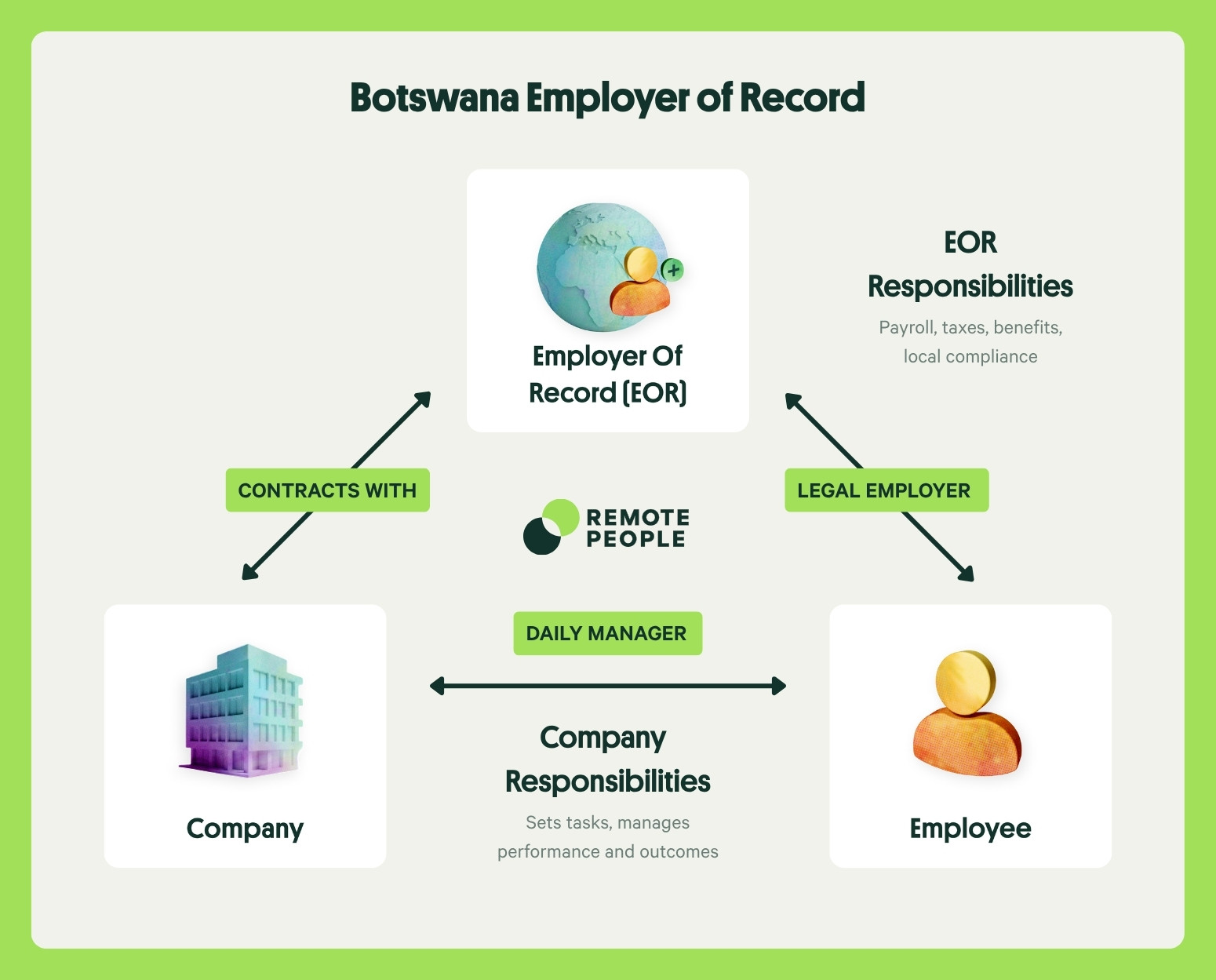
If you’d like to learn more about how Employer of Record (EOR) services work, read our What Is an Employer of Record (EOR)? guide for a complete overview of the model, its benefits, and when to use it.
If you’re comparing providers, our Best Employer of Record (EOR) Providers guide reviews the leading platforms to help you choose the right solution for your business.
Who Uses an EOR in Botswana?
Any business that wants to hire in Botswana without incorporating a local company benefits from an EOR. The model is built for teams that need speed and compliance without the cost of setting up a private limited company, opening a BURS account, and running local HR.
Typical situations where an EOR makes sense:
- Testing the Botswana market with one or two hires before committing to a full entity
- Building a small team of 1 to 15 employees where incorporation is not yet cost-effective
- Onboarding quickly, in weeks rather than the three to six months it takes to set up a local company
- Employing foreign nationals who need work permit sponsorship tied to a Botswana-registered employer
- Reducing exposure to labour disputes, wrongful dismissal claims, and PAYE penalties
Typical Onboarding Timeline
Most EOR providers can onboard a Botswana-based employee in 1 to 2 weeks. The sequence below reflects a local hire with no work permit required; a foreign hire adds 2 to 8 weeks for immigration processing.
- First, sign the EOR service agreement and share the employee’s full name, national ID (Omang), bank details, and offer terms (1 to 2 days).
- Second, the EOR drafts a compliant employment contract in English and sends it to the employee for signature (2 to 3 days).
- Third, BURS PAYE registration and workers’ compensation cover are arranged in parallel (3 to 5 days).
- Fourth, payroll is configured in pula, and voluntary benefits such as private medical aid are enrolled (2 to 3 days).
- Fifth, the employee starts work under the client’s day-to-day direction (1 day).
Work permit applications, Botswana Qualification Authority verification of foreign credentials, and background checks are the most common reasons the timeline stretches beyond two weeks.
Hire in Botswana
Employer costs just 1.2% above gross salary, one of the lowest statutory burdens in Africa, a stable English-speaking legal system, and an educated talent pool concentrated in Gaborone make Botswana an efficient African hiring base.
We handle employment contracts, payroll, PAYE withholding, and full Botswana Employment Act compliance.
No local entity needed. Your team can start in 1-2 weeks.
Employment Laws and Regulations in Botswana
Employment Contracts
The Employment Act (Chapter 47:01) is the principal labour statute in Botswana, supplemented by the Trade Disputes Act and the Workers’ Compensation Act. The Ministry of Labour and Home Affairs oversees enforcement, with the Commissioner of Labour handling disputes and inspections.
Written contracts are required for any employment expected to last more than six months, and they must be in English. The contract must specify the position, gross salary in pula, working hours, leave entitlements, probation period, notice period, and termination procedure. Contracts can be for an unspecified period (indefinite) or for a fixed term tied to a specific task or project. Verbal contracts are still recognised for shorter or casual engagements, but they leave both sides exposed in a dispute.
A comprehensive reform is working through parliament. The Employment and Labour Relations Bill (Bill No. 10 of 2025) was gazetted on 6 June 2025 and would consolidate the Employment Act, the Trade Unions and Employers’ Organisation Act, and the Trade Disputes Act into a single statute. Until the bill is passed and brought into force, the 1982 Employment Act (as amended) remains the governing law.
Working Hours and Overtime
The standard workweek in Botswana is 48 hours, typically spread as 8 hours a day over 6 days or 9 hours a day over 5 days. Employees are entitled to at least 24 consecutive hours of rest per week, usually on Sunday. Overtime is capped at 14 hours per week, paid at 150% of the normal hourly rate on weekdays and 200% on rest days and public holidays.
Botswana overtime and premium pay rates · Per Employment Act Chapter 47:01 | |||
Hour Type | Rate Multiplier | Weekly Cap | Notes |
|---|---|---|---|
Standard workweek | 100% (base) | 48 hours | 8 hours/day over 6 days or 9 hours/day over 5 days; Section 95 |
Weekday overtime | 150% | 14 hours | Combined overtime capped at 14 hours per week; Section 96 |
Rest day (Sunday) | 200% | Included in 14-hour cap | At least 24 consecutive hours of rest required each week |
Public holiday | 200% | Included in 14-hour cap | Applies to all 14 gazetted public holidays |
Managerial exemption | Not entitled | n/a | Employees in managerial or supervisory roles are excluded from overtime premiums |
Minimum Wage
Botswana’s statutory minimum wage in Botswana is BWP 9.06 per hour (approximately $0.68), effective 1 January 2025 under the Regulation of Minimum Wages Order, Statutory Instrument 7 of 2024. The rate applies to most private sector industries including construction, manufacturing, wholesale, retail, hotel and catering, security services, and watchmen.
Agricultural and domestic workers are paid on a monthly rather than hourly basis, with the most recent statutory minimum set at BWP 1,500 per month (approximately $112). The government reviews sectoral rates annually through the Minister of Labour and Home Affairs. Minimum wages in Botswana are set well below regional neighbours, reflecting the country’s low formal-sector wage floor and high unemployment rate of around 25%.
Probation Period
Probation in Botswana is tiered by skill level under Section 20 of the Employment Act. Unskilled employees can be placed on probation for up to 3 months, while skilled employees can be placed on probation for up to 12 months. During probation, either party can terminate the contract with 14 days’ written notice, and no reasons need to be given. The probation period, along with its length, must be stated in writing before employment begins or it will not apply.
Leave Entitlements
Botswana’s statutory leave framework is set out in Sections 96 through 121 of the Employment Act. Entitlements are modest compared with European standards but are enforced consistently by the Commissioner of Labour, and an EOR will track accrual monthly to keep the client compliant.
Annual Leave
Employees earn 15 working days of paid annual leave per year, accruing at 1.25 days per month of continuous service. Annual leave does not scale with tenure, so a new hire and a 20-year veteran accrue the same 15 days. At least 8 days must be taken within 6 months of the end of the leave year, and any unused balance can be carried forward for a maximum of 3 years before it must be taken or paid out. Leave accrues during probation and is paid out in full on termination.
Sick Leave
Sick leave is capped at 14 working days of paid leave per year under Section 96, provided the employee produces a medical certificate for any absence of more than one day. Pay is at the employee’s full ordinary rate, with the employer carrying the full cost. Botswana has no national social security scheme that reimburses sick pay. Extended absences beyond the statutory entitlement can be negotiated but are at the employer’s discretion.
Maternity Leave
Female employees are entitled to 12 weeks of maternity leave under Section 113 of the Employment Act, split as 6 weeks before confinement and 6 weeks after. The employer must pay at least 50% of the employee’s basic wage during the leave, with no contribution from the state. A medical certificate confirming the expected date of delivery is required. On return to work, the mother is entitled to one hour of nursing leave per working day until the child is one year old. The pending 2025 bill proposes extending maternity leave to 14 weeks and raising pay to 70%, but this has not yet come into force.
Paternity Leave
The Employment Act does not currently provide statutory paternity leave. Many employers offer 3 to 5 days of paid leave on a voluntary basis as part of their HR policy. The Employment and Labour Relations Bill 2025 introduces a statutory entitlement of 5 days of paid paternity leave at 100% of pay, but it remains in draft until parliament passes it.
Other Statutory Leave
Beyond the core leave categories, the Employment Act allows for a limited set of additional entitlements:
- Public holidays: 14 paid days per year, listed in the Public Holidays Act
- Compassionate leave: at the employer’s discretion, commonly 3 to 5 days for immediate family bereavement
- Religious leave: unpaid, granted where reasonable
- Study and examination leave: unpaid, granted at the employer’s discretion
Botswana statutory leave entitlements · Per Employment Act (Chapter 47:01) |
||
Leave Type |
Duration |
Eligibility & Notes |
|---|---|---|
Annual leave |
15 working days |
1.25 days accrued per month; carryover capped at 3 years; paid at full rate |
Sick leave |
14 working days |
Full pay, employer-funded; medical certificate required beyond 1 day |
Maternity leave |
12 weeks |
6 weeks pre- and 6 weeks post-birth; employer pays minimum 50% of basic wage |
Paternity leave |
Not statutory (typically 3–5 days voluntary) |
No statutory entitlement; 5 paid days proposed under the 2025 bill |
Nursing leave |
1 hour per working day |
Granted to mothers until child reaches 1 year of age |
Public holidays |
14 days |
Paid rest days under the Public Holidays Act; double pay for work on holidays |
Compassionate / bereavement |
Employer discretion |
No statutory minimum; typically 3–5 days for immediate family |
Statutory Employee Benefits
Botswana stands apart from most African countries in having no mandatory national social security or public pension contribution scheme for private sector workers. The Employment Act requires employers to provide paid leave and workers’ compensation cover for workplace injury, and that is the extent of the statutory benefit floor. Pension coverage is mandatory only for public servants under the Botswana Public Officers Pension Fund, where the government contributes 15% and employees contribute 5%.
In the private sector, most employers offer a voluntary benefits package in Botswana that includes private medical aid (through schemes such as BOMaid or BPOMaS), a group pension fund with a 10% to 15% employer contribution and 5% employee contribution, and group life cover. The Universal Old Age Pension, a non-contributory state benefit of BWP 350 per month (approximately $26), is available to residents from age 65 but is funded from general taxation rather than payroll deductions.
Recent Regulatory Updates (2026)
The most significant reform in progress is the Employment and Labour Relations Bill 2025 (Bill No. 10 of 2025), published in the government gazette on 6 June 2025 and currently moving through parliament. The bill would consolidate three existing statutes (the Employment Act, the Trade Unions and Employers’ Organisation Act, and the Trade Disputes Act) into a single modern framework.
Key proposed changes include extending maternity leave from 12 to 14 weeks with pay raised from 50% to 70%, introducing 5 days of paid paternity leave at full pay, creating a new 20-day hospitalisation leave separate from sick leave, capping probation periods at 6 months for all employees (replacing the current 3-month unskilled and 12-month skilled split), and limiting fixed-term contracts to 12 months unless objectively justified.
On the minimum wage side, Statutory Instrument 7 of 2024 raised the hourly floor to BWP 9.06 from BWP 7.34 effective 1 January 2025, a 23.4% increase. No further increase has been gazetted for 2026 as of this writing. Botswana also introduced digital filing for work permits and investor permits in 2026, shortening immigration processing times.
Work Permits and Visas in Botswana
Work Permit Requirements
Who Needs a Work Permit
All non-citizens must hold a valid work permit to take up employment in Botswana, regardless of nationality. Exemptions are limited to spouses of Botswana citizens with a dependant’s permit, diplomats, and holders of an Exemption Certificate issued for critical national-interest roles. SADC nationals enjoy visa-free entry for short stays but still require a work permit to be employed.
Eligibility and Required Documents
To qualify for a Botswana work permit, the employer must first prove that no qualified Botswana citizen is available for the role. This labour market test requires a job advertisement placed for at least 14 days, open exclusively to citizens during that period, and no older than 6 months at the time of application.
Required documents for the work permit application include:
- Copy of the advertised vacancy and proof of the citizen-only period
- Signed employment contract and application letter from the employer
- Applicant’s CV and certified copies of educational certificates (translated into English and verified by the Botswana Qualification Authority if issued in another language)
- Certified copy of the passport biographical page and two passport-size photographs
- Police clearance from the applicant’s country of residence for the past 12 months
- Medical certificate from an approved practitioner
Processing Time and Validity
Standard processing time for an Employment Permit is 14 to 21 working days following the 2026 digital filing rollout, with complex cases or regulated sectors (medical, education) taking 1 to 3 months. The Employment Permit is typically issued for 1 to 2 years initially and is tied to a specific employer and role. Temporary Work Permits are limited to 3 months with a possible 30-day extension. Fees range from about $110 to $220 depending on the permit category and duration.
Renewal Process
Applications for renewal of long-term permits must be submitted at least 3 months before expiry, and short-term permits at least 2 weeks before expiry. The employee can continue working during the renewal period only if the application was lodged before the current permit expired. Renewals require updated documentation and a new labour market test if the role has changed.
Common Visa Types for Foreign Workers
Botswana issues five main permit categories for foreign workers through the Department of Immigration and Citizenship. The Employment Permit is the default route for most EOR hires; the other categories cover short assignments, investors, critical-skills roles, and group transfers.
Botswana work visa types for foreign workers · 2026 | ||||
Visa Type | Duration | Best For | Leads to Residency? | Processing |
|---|---|---|---|---|
Employment Permit | Up to 5 years (renewable) | Skilled professionals in roles Botswana citizens cannot fill | Yes, after 10 years of continuous residence | 4–8 weeks (2026 digital filing) |
Temporary Work Permit | Up to 30 days | Short-term assignments, site visits, technical support | No | 1–2 weeks |
Intra-Company Transfer | Up to 3 years (extendable) | Managers and specialists relocating within a multinational | Yes, subject to investment criteria | 3–6 weeks |
Exemption Certificate | Up to 2 years | Spouses of citizens, SADC nationals, missionaries | Case-by-case | 2–4 weeks |
Investor Residence Permit | Up to 5 years (renewable) | Foreign investors committing BWP 1M+ in local business | Yes, fast-tracked under Vision 2036 | 6–10 weeks |
How an EOR Handles Work Permits
An EOR registered in Botswana acts as the sponsoring employer on the work permit application, which avoids the client needing its own local entity to file. The EOR compiles the labour market test evidence, drafts the employment contract that accompanies the application, and liaises with the Department of Immigration and Citizenship throughout the review. The client company provides the job description, salary, and any role-specific documentation.
Work permit timelines extend the standard 1 to 2 week onboarding described in Section 1.4 by 2 to 8 weeks depending on whether the case is routed through digital filing or requires additional sectoral clearance. For regulated professions such as medical, accounting, or engineering, the EOR also arranges registration with the relevant Botswana professional body before the permit can be issued.
Payroll, Taxes, and Social Security in Botswana
Employer Contributions
Botswana has one of the lightest employer payroll burdens in Africa. There is no mandatory social security contribution and no national pension scheme for private sector employers. Statutory employer costs are limited to workers’ compensation insurance and the Skills Development Levy, which together add roughly 1% to 1.5% on top of gross salary.
Botswana employer social security contributions · 2026 rates |
||
Contribution |
Rate |
Notes |
|---|---|---|
Workers’ Compensation Insurance |
0.3% – 3.0% |
Premium varies by industry risk under the Workers’ Compensation Act; office-based roles sit at the low end, mining and construction at the high end |
Skills Development Levy |
0.2% |
Paid by employers with annual taxable turnover above BWP 1 million; remitted monthly to BURS alongside VAT |
National social security |
0% |
Botswana has no mandatory national social security or public pension scheme for private sector employers |
Representative total |
~1.2% |
Based on 1% workers’ compensation (office-based) plus 0.2% Skills Development Levy |
Employee Contributions
Employees in Botswana are subject to PAYE income tax withheld by the employer, but there are no mandatory payroll deductions for social security, unemployment insurance, or health cover. Most employees who participate in a private pension scheme contribute around 5% of gross salary on a voluntary basis matched by the employer.
Botswana employee payroll deductions · 2026 monthly withholdings |
||
Deduction |
Rate |
Notes |
|---|---|---|
PAYE Income Tax |
0% – 25% |
Progressive tax withheld monthly by the employer and remitted to BURS by the 15th of the following month |
National social security |
0% |
No statutory contribution; Botswana has no national social security scheme for private sector workers |
Voluntary pension |
~5% (typical) |
Not mandatory; common in larger employers where a group pension fund is in place |
Statutory total |
PAYE only |
The only compulsory deduction is progressive PAYE income tax |
Income Tax
Botswana uses a progressive PAYE system with a top rate of 25% under the Income Tax Act (Chapter 52:01). Resident employees enjoy a tax-free threshold on the first BWP 48,000 (approximately $3,582) of annual taxable income, after which tax rises across four bands to the 25% top rate. Non-residents do not receive the tax-free threshold and pay 5% from the first pula. The brackets below are shown in approximate USD at the April 2026 exchange rate.
Botswana income tax brackets · 2026 |
|
Annual Taxable Income (USD) |
Tax Calculation |
|---|---|
$0 – $3,582 |
0% (tax-free) |
$3,582 – $6,269 |
5% of the amount over $3,582 |
$6,269 – $8,955 |
$134 + 12.5% of the amount over $6,269 |
$8,955 – $11,642 |
$470 + 18.75% of the amount over $8,955 |
Over $11,642 |
$974 + 25% of the amount over $11,642 |
USD figures above are approximate conversions from the pula brackets of BWP 0, 48,000, 84,000, 120,000, and 156,000 at $1 = BWP 13.40 (April 2026 rate). Non-residents pay 5% on the first BWP 84,000 and rise through the same upper brackets, and no exemption applies.
Payroll Cycle
Botswana runs on a monthly payroll cycle, with salaries paid into the employee’s pula bank account by the last working day of each month. Pay slips are required under Section 88 of the Employment Act and must show gross pay, PAYE withheld, any voluntary deductions, and net pay. PAYE withheld from employees must be remitted to BURS by the 15th of the following month along with the PAYE return (ITW7A). Employers must also issue each employee an annual ITW8 tax certificate by 31 March following the tax year end on 30 June. The annual PAYE reconciliation (ITW10) is due by 31 July.
13th Month Salary and Bonus Pay
A 13th month salary is not mandatory in Botswana. There is no statutory obligation for employers to pay a year-end bonus, Christmas bonus, or vacation bonus, and most collective agreements do not impose one either. Discretionary performance bonuses are common in mining, banking, and financial services, typically paid in December and worth between one and two months’ salary, but they remain a matter of contract rather than law. Where a bonus is written into the employment contract or offer letter, the employer must honour it and PAYE is withheld at the employee’s marginal rate in the month of payment.
Cost of Hiring Through an EOR in Botswana
EOR Service Fees
EOR service fees in Botswana typically range from $300 to $600 per employee per month, charged as a flat fee in USD rather than a percentage of salary. The fee covers employment contract drafting, monthly payroll processing, PAYE withholding and remittance, workers’ compensation enrolment, statutory leave tracking, payslip issuance, and ongoing compliance with the Employment Act. Work permit sponsorship, additional benefits enrolment, and complex termination cases may carry extra one-off fees.
Total Employment Cost Breakdown
The example below uses a gross monthly salary of $1,200 (approximately BWP 16,080) for a mid-level professional hire and reflects statutory employer contributions only, excluding voluntary pension and private medical aid.
Botswana employer cost example · $1,200/month gross · 2026 |
||
Employer Cost |
Amount (USD) |
% of Gross |
|---|---|---|
Gross monthly salary |
$1,200.00 |
100.0% |
Workers’ Compensation Insurance (1% representative) |
$12.00 |
1.0% |
Skills Development Levy (0.2%) |
$2.40 |
0.2% |
EOR service fee (flat) |
$400.00 |
33.3% |
Total monthly employer cost |
$1,614.40 |
134.5% |
Total employer cost for a $1,200 gross hire lands around $1,614 per month, roughly 34.5% above gross. The statutory burden in Botswana is just 1.2%, among the lowest in Africa, so almost all of the markup above salary is the EOR service fee itself. All USD amounts are approximate conversions at $1 = BWP 13.40 (April 2026 rate).
Ready to hire in Botswana? Get started with RemotePeople. We handle employment contracts, payroll, tax withholding, and full Botswana compliance. No local entity needed.
Benefits of Using an EOR in Botswana
Speed is the single biggest advantage of using an EOR in Botswana. A local entity setup runs through the Companies and Intellectual Property Authority, BURS tax registration, workers’ compensation cover, and a bank account opening, easily 3 to 6 months before the first employee can be paid legally. An EOR already has all of those in place, so a new hire can be contracted, onboarded, and running payroll in 1 to 2 weeks.
Compliance assurance is the second big reason. The Employment Act is detailed, the Commissioner of Labour takes disputes seriously, and the 2025 Employment and Labour Relations Bill will add another layer of rules once passed. A Botswana EOR tracks these changes, updates contracts and payroll, and absorbs the legal liability for payroll errors, wrongful termination claims, and PAYE penalties. Cost efficiency matters too. There is no reason to spend $5,000 to $15,000 on company formation, plus several thousand more per year in accountancy and registered office fees, for a team of one or two hires.
Beyond speed and compliance, an EOR brings local expertise on market pay, benefit expectations, and realistic work permit timelines for Gaborone and Francistown. It also offers scale flexibility: adding a second or third hire is a contract amendment, and winding down is as simple as serving notice, with no entity to dissolve, no final BURS returns, and no lingering liabilities on the balance sheet.
Termination and Offboarding in Botswana
Notice Periods
Notice periods in Botswana are tied to the wage period under Section 18 of the Employment Act. Employees paid monthly must receive at least one month’s written notice, employees paid weekly must receive at least one week, and employees paid daily must receive at least one day. During probation, either party can terminate with 14 days’ written notice. Payment in lieu of notice is permitted, and notice must be given on a working day in writing for monthly and longer wage periods. Longer notice periods can be agreed in the contract but never shorter than the statutory minimum.
Botswana statutory notice periods by position level · Per Employment Act Chapter 47:01 | |||
Position Level | Notice Period | During Probation | Notes |
|---|---|---|---|
Monthly-paid (salaried) | 1 month minimum | 14 days | Written notice required; pay in lieu permitted; Section 18 |
Weekly-paid | 1 week minimum | 14 days | Notice must start on a working day and be delivered in writing |
Daily-paid (casuals) | 1 day minimum | 14 days | Applies to hourly and piece-rate workers |
Managerial / executive | 1–3 months (contractual) | 14 days | Contracts may set longer notice but never below statutory minimum |
Fixed-term contract | As per contract | 14 days | Natural expiry needs no notice; early termination triggers wages to end of term |
Severance Pay
Severance pay in Botswana is governed by Section 28 of the Employment Act Chapter 47:01 and only becomes payable after 60 months of continuous service with the same employer. The statutory formula grants one day of basic pay for every month worked in the first 60 months, then two days of basic pay for every additional month beyond the 5-year threshold. Severance runs in parallel with notice and accrued leave payout, and an EOR administers it as part of a standard offboarding package.
Botswana severance pay schedule by years of service · Per Employment Act Chapter 47:01 | |||
Years of Service | Severance Amount | Base Salary Example | Notes |
|---|---|---|---|
Under 5 years | Generally not entitled | n/a | Section 28 severance triggers only after 60 months of continuous service |
5 years (60 months) | 60 days basic pay (≈2 months) | $2,400 on a $1,200/month salary | Formula: 1 day per month for the first 60 months |
10 years (120 months) | 180 days basic pay (≈6 months) | $7,200 on a $1,200/month salary | 60 days + (60 × 2) days for months 61–120 |
15 years (180 months) | 300 days basic pay (≈10 months) | $12,000 on a $1,200/month salary | 60 days + (120 × 2) days for months 61–180 |
20 years (240 months) | 420 days basic pay (≈14 months) | $16,800 on a $1,200/month salary | 60 days + (180 × 2) days for months 61–240 |
Calculation Method
Severance pay under Section 28 of the Employment Act is triggered after 60 months (5 years) of continuous service with the same employer. The formula is one day of basic pay for each month worked during the first 60 months, plus two days of basic pay for each additional month beyond 60 months. Basic pay excludes overtime, bonuses, and allowances unless the contract states otherwise. A 5-year employee qualifies for 60 days of severance, and a 10-year employee qualifies for 60 + 120 = 180 days.
Caps and Exceptions
Employees who receive a lump-sum pension payment or a gratuity at the end of employment are not entitled to severance on top. Summary dismissal for gross misconduct (theft, violence, wilful disobedience) removes the right to severance and notice. The Employment Act also provides proportional severance on termination before 5 years of service, though this interpretation has been tested in the Industrial Court and practice varies between employers. Fixed-term contracts that expire naturally do not trigger severance unless the contract says otherwise.
Grounds for Termination
The Employment Act recognises four main grounds for termination: mutual agreement, misconduct (including poor performance or ill health), operational requirements (redundancy or restructuring), and expiry of a fixed-term contract. The Code of Good Practice on Termination requires a valid reason and a fair procedure, which means a disciplinary hearing for misconduct cases and prior notification to the Commissioner of Labour for retrenchments affecting multiple workers. Summary dismissal without notice is only allowed for gross misconduct.
Certain categories are protected: pregnant employees cannot be dismissed on grounds related to pregnancy, and dismissal on grounds of race, sex, religion, tribe, or union membership is prohibited. Unfair dismissal claims are heard by the Industrial Court, which can order reinstatement or compensation of up to 6 months’ pay.
EOR vs. Other Hiring Models in Botswana
EOR vs. Setting Up a Local Entity
Choosing between an Employer of Record and setting up your own legal entity in Botswana comes down to timeline, upfront cost, ongoing administrative burden, and how quickly you can scale up or wind down. The table below lays out both paths side by side across setup time, cost, compliance risk, and flexibility so you can match the right model to the size and duration of your Botswana hiring plan.
Botswana EOR vs local entity comparison · Setup time, cost, risk and best-fit |
||
Comparison |
Employer of Record |
Own Entity |
|---|---|---|
Setup time |
1–2 weeks |
3–6 months |
Upfront cost |
$0 |
$5,000–$15,000 |
Ongoing cost |
$300–$600/employee/month |
$8,000–$20,000/year maintenance |
Local partner required |
No (EOR is the local entity) |
No, but a local director is often needed |
Social insurance registration |
Handled by EOR |
You manage it |
Payroll & tax filing |
Handled by EOR |
You manage it (or outsource) |
Best for team size |
1–15 employees |
15+ employees |
Scale down / exit |
Easy (no entity to unwind) |
Costly (legal dissolution required) |
Government contracts |
Not eligible |
Eligible (requires local entity) |
Setting up a private limited company in Botswana through the Companies and Intellectual Property Authority takes 3 to 6 months once BURS registration, workers’ compensation cover, and a corporate bank account are factored in. Upfront costs sit in the $5,000 to $15,000 range for company formation, local director or resident agent fees, and initial compliance filings. Ongoing maintenance adds $8,000 to $20,000 per year in accountancy, tax filings, and regulatory fees.
An EOR removes all of that. For a team of 1 to 15 employees, the math almost always favours the EOR. The break-even point typically sits around 15 to 20 employees, at which scale the per-employee EOR fee starts to exceed the fixed annual cost of an entity. Companies planning to bid on Botswana government contracts or tenders still need a local entity to qualify, since EOR-employed workers are not classed as direct employees of the client company for procurement purposes.
EOR vs. Hiring Independent Contractors
Classifying a Botswana-based worker as an independent contractor rather than an employee can expose you to back-taxes, unpaid social contributions, and reclassification penalties if the working relationship looks like employment in practice. The table below contrasts EOR employment with contractor engagement across legal relationship, tax and benefits treatment, IP ownership, and misclassification risk so you can pick the right model role by role.
Botswana EOR vs independent contractors · Compliance, cost, and risk |
||
Comparison |
EOR (Full-Time Employee) |
Independent Contractor |
|---|---|---|
Legal relationship |
Employee of the EOR |
Self-employed, no employment relationship |
Compliance risk |
Low (EOR ensures Employment Act compliance) |
Higher (misclassification risk if the engagement resembles employment) |
Payroll & tax |
EOR handles PAYE withholding, contributions, filings |
Contractor invoices you; they register and pay their own BURS tax |
Benefits & leave |
Statutory leave, workers’ compensation, voluntary medical aid |
No entitlement to employee benefits or paid leave |
IP protection |
Stronger (employment contract assigns IP by default) |
Weaker (requires explicit IP assignment clause) |
Termination |
Subject to Employment Act notice and severance |
Contract can be ended per agreement terms |
Best for |
Long-term, core team roles |
Short-term projects, specialised tasks |
Cost structure |
Salary + employer contributions + EOR fee |
Contractor fee (typically higher gross, lower total cost) |
Independent contractors can be a fit for short-term project work, specialised consulting, or roles where the worker operates with genuine autonomy and multiple clients. The arrangement keeps admin simple, since the contractor invoices, handles their own BURS registration, and takes care of personal tax filings.
The risk is misclassification. If a Botswana contractor works set hours, uses client equipment, reports to a manager, and has no other clients, the Industrial Court can reclassify the engagement as employment. The consequences include back PAYE, penalties, retroactive severance, and potentially a reinstatement order. The 2025 Employment and Labour Relations Bill adds a presumption of employment for anyone providing services unless specific contractor criteria are met, which will tighten the test further once enacted. For ongoing team roles, an EOR is the cleaner route. For genuine project work, RemotePeople also offers a contractor management solution in Botswana that handles compliant contracts, invoicing, and classification review.
EOR vs. PEO (Professional Employer Organization)
EORs and PEOs both simplify international hiring, but only an EOR becomes the legal employer of record in Botswana — a critical distinction when you don’t have a local entity of your own. The table below maps the practical differences across legal employer status, entity requirement, liability allocation, and scope of coverage.
Botswana EOR vs PEO comparison · Legal employer, liability, and setup |
||
Comparison |
Employer of Record (EOR) |
PEO |
|---|---|---|
Legal employer |
EOR is the legal employer |
You remain the legal employer (co-employment) |
Local entity required |
No (the EOR is the local entity) |
Yes (you must have your own entity in Botswana) |
Best for |
Companies without a local entity |
Companies that already have a local entity |
Compliance liability |
EOR assumes compliance responsibility |
Shared liability between you and the PEO |
Setup time |
1–2 weeks |
Depends on your entity setup (weeks to months) |
Control over HR policies |
EOR manages within Botswana law framework |
More direct control, PEO advises |
Typical use case |
Market entry, small remote teams, testing Botswana |
Established local operations needing HR outsourcing |
The core difference is the legal employer relationship. An EOR acts as the legal employer, meaning the client does not need a Botswana entity. A PEO operates in a co-employment arrangement where the client remains the legal employer and the PEO provides HR, payroll, and compliance services on top of the existing entity.
Botswana does not have a formal PEO regulatory framework. There is no specific statute recognising co-employment, no registration regime for PEOs, and the Employment Act assumes a single legal employer per contract. In practice, service providers describing themselves as “PEOs” in Botswana are usually either EORs with a different brand name or HR outsourcing firms supporting companies that already hold local entities. For a business entering the market fresh, the EOR route is almost always the right fit.
Public Holidays in Botswana
Botswana observes a defined set of official public holidays on which most private-sector employers must give staff a paid day off (Government of Botswana). The table below lists the statutory holidays employers need to build into payroll calendars and leave planning for the year, along with the date rule for each.
Botswana public holidays · 2026 calendar year |
||
Date |
Holiday |
Type |
|---|---|---|
1 January 2026 |
New Year’s Day |
National |
2 January 2026 |
New Year Holiday |
National |
3 April 2026 |
Good Friday |
Religious |
4 April 2026 |
Holy Saturday |
Religious |
6 April 2026 |
Easter Monday |
Religious |
1 May 2026 |
Labour Day |
National |
14 May 2026 |
Ascension Day |
Religious |
1 July 2026 |
Sir Seretse Khama Day |
National |
20 July 2026 |
President’s Day |
National |
21 July 2026 |
President’s Day Holiday |
National |
30 September 2026 |
Botswana Day |
National |
1 October 2026 |
Botswana Day Holiday |
National |
25 December 2026 |
Christmas Day |
Religious |
26 December 2026 |
Boxing Day |
National |
Source: Government of Botswana and Time and Date: Botswana 2026 |
||
Employees who work on a public holiday must be paid at 200% of the normal rate under the Employment Act, or be granted a substitute day off. Where a holiday falls on a Sunday, the following Monday is observed instead. Botswana’s calendar concentrates holidays around Easter, mid-year (Sir Seretse Khama Day and President’s Day), and late September (Botswana Day), so payroll schedules in those months need buffer time to avoid late payment.
How to Get Started with an EOR in Botswana
First, scope the role. Define the job title, salary in USD or pula, start date, and whether the employee is a Botswana citizen or a foreign national needing a work permit. Benchmark pay against the average salary in Botswana for the relevant industry before finalising the offer.
Second, choose an EOR partner. Compare providers on monthly fee, local presence, Botswana Employment Act expertise, and ability to sponsor work permits through the Department of Immigration and Citizenship.
Third, sign the service agreement. The EOR issues its master services agreement along with a country-specific addendum covering pula payroll and BURS compliance.
Fourth, onboard the employee. The EOR drafts the employment contract, confirms the probation period in Botswana, enrols the employee in workers’ compensation cover, and configures monthly payroll tax withholding.
Fifth, run and scale. Monthly payroll runs on autopilot, and adding new hires or terminating existing ones is a contract amendment rather than an entity restructure.
RemotePeople can have your first Botswana employee onboarded within 1 to 2 weeks, fully compliant with the Employment Act and BURS rules. Contact our team to get a free quote and timeline for your Botswana hiring plan.
Where companies hiring in Botswana expand next
Employers with staff in Botswana often extend across Southern Africa, drawing on shared SADC labor frameworks and cross-border mobility. Common expansion paths include operations in Mozambique (aligned SADC labor rules) and South Africa (SADC-wide hiring and compliance parity). Teams scaling further usually add hiring in Zambia for SADC labor framework alignment, with an EOR partner in Zimbabwe extending coverage through shared SADC workforce mobility.
Frequently Asked Questions
Beyond the employee's gross salary, employer statutory costs in Botswana add only about 1.2% on top (workers' compensation and Skills Development Levy). The EOR service fee is a flat amount, typically $300 to $600 per employee per month in USD, not a percentage of salary. For a $1,200 monthly gross hire, total employer cost is around $1,614 per month, or roughly 34.5% above gross.
Most EOR providers can onboard a Botswana-based employee within 1 to 2 weeks once the service agreement is signed. Foreign hires requiring a work permit add 2 to 8 weeks depending on whether the case goes through Botswana's 2026 digital filing system or requires additional sectoral clearance.
No. That is the whole point of an EOR. The EOR is already registered as a Botswana employer, holds a BURS PAYE account, and carries workers' compensation cover, so you can hire without incorporating a company or opening local bank accounts. A local entity is only required if you plan to bid on government tenders or hire more than 15 to 20 employees at scale.
You can, but only for genuine short-term or specialised work. Botswana's Industrial Court looks at control, integration, and economic dependence to test whether an engagement is really employment, and the pending 2025 Employment and Labour Relations Bill adds a statutory presumption of employment. Misclassification exposes you to back PAYE, penalties, and retroactive severance. RemotePeople offers a dedicated contractor management solution for Botswana that handles compliant contracts, payments, and classification review.
The employment contract assigns intellectual property to the client company (you), not the EOR. The EOR makes sure the contract contains proper IP assignment language so all work product, code, designs, and inventions flow directly to your business. This is a standard clause in any Botswana EOR engagement and should be confirmed in the service agreement.
The statutory minimum wage is BWP 9.06 per hour (approximately $0.68) effective 1 January 2025 under Statutory Instrument 7 of 2024. The rate applies to most private sector industries including construction, manufacturing, retail, hotel and catering, and security services. Agricultural and domestic workers are paid on a monthly basis at approximately BWP 1,500 per month (around $112).
No. Botswana has no statutory requirement for a 13th month salary, Christmas bonus, or vacation bonus. Discretionary year-end bonuses are common in mining, banking, and financial services, but they remain a matter of contract rather than law. Any bonus written into the employment contract must be honoured, and PAYE is withheld at the employee's marginal rate.
The EOR handles the termination under the Employment Act. Monthly-paid employees receive at least one month's written notice (or pay in lieu), plus accrued annual leave payout and any severance due under Section 28 (triggered after 5 years of continuous service). Summary dismissal is only possible for gross misconduct such as theft or violence. The EOR carries the legal risk for wrongful dismissal claims, which reduces your exposure significantly compared with handling termination through your own entity.
Employer of Record in
Employer of Record in
Employer of Record in
Employer of Record in
Employer of Record in
Employer of Record in
Employer of Record in
Employer of Record in