
 Recruit
Employer of Record in Namibia
-
 Drew Donnelly
- Published
- September 22, 2026
RemotePeople’s employer of record in Namibia lets you hire employees in Namibia without complex statutory burden. We handle Maternity Leave, Sick Leave and Death Benefit Fund contributions of 0.9% from each employer and employee, and occupational risk-based Employee Compensation Act contributions.
Hire in Namibia — book a free 30-minute demo
Tell us what you need. You'll get a tailored, transparent proposal within 24 hours, plus a free call to walk through it.
Tell us about your company
So we can match you with a specialist who knows your market — and unlock volume pricing tiers.
* All fields are required.
Where and when are you hiring?
Tell us the geography and timing and we'll quote each country line by line, with onboarding timelines.
* All fields are required.
Help us beat your current setup
We'll benchmark your current deal and send a line-by-line proposal in 24 hours — showing exactly where we cut cost, time, or risk. After you submit, you can book a call to walk through it together.
* All fields are required.
Thanks! Your proposal is on its way.
Expect a tailored, line-by-line proposal in your inbox within 24 hours. In the meantime…
Want to walk through it together?
Book a free 30-minute call with one of our specialists. We'll explain every line, answer your questions, and tailor the proposal further if you need.
No obligation. Pick a time that works for you.








- Hire in Namibia — book a free 30-minute demo
- Tell us about your company
- Where and when are you hiring?
- Help us beat your current setup
- Thanks! Your proposal is on its way.
- How to Hire Employees in Namibia
- Start hiring with an Namibia EOR
- Namibia EOR vs Legal Entity in Namibia
- Using an Employer of Record in Namibia
- How Much Does a Namibia EOR Cost?
- Employment and Labor Laws in Namibia
- Payroll and Employment Taxes in Namibia
- Work Permits and Visas in Namibia
- Time Off and Leave in Namibia
- Employee Benefits in Namibia
- Terminations and Severance in Namibia
- Expand into Namibia Easily with RemotePeople’s Employer of Record (EOR) Solution
- Frequently Asked Questions
- Related EOR Destinations

Start hiring in Namibia
Let RemotePeople handle payroll, compliance, and HR admin worldwide so you can focus on building your team.

Namibia has become a desirable location for foreign businesses to establish operations. It offers political stability, a strong regulatory environment, and a relatively low cost of hiring. English is the official language, and the country has a moderate cost of living.
This, in addition to its improving infrastructure and easy access to skilled workers at relatively low salaries, makes Namibia an option worth considering for businesses. Namibia has also established its first national minimum wage of N$18.00 per hour applicable in most sectors effective January 1, 2025, signifying a socio-economic step forward that continues to influence the labour market in 2026.
Employer of Record (EOR) services are becoming popular, as they ensure businesses can easily and compliantly hire employees. RemotePeople provides Namibia EOR services starting at $199 per month.
How to Hire Employees in Namibia
Setting Up a Local Entity
A company choosing to hire in Namibia on its own can set up a local subsidiary or branch. This requires company incorporation and registration with the tax and social security authorities, and compliance with employment law. It can take several months and requires fees for company registration, a local company director, bank account opening, and statutory filings.
Setup and ongoing administrative costs can be several thousand US dollars or more (US$10,000+), depending on complexity, legal and incorporation fees, and minimum capital.
The entity is the legal employer and must manage all the aspects of being an employer: payroll, filing taxes, employee benefits, and termination rules. This provides the most control but has the most administrative burden and legal compliance risk for the employer.
Working with an Employer of Record (EOR)
A company can also partner with an EOR to hire employees legally without establishing a local entity in Namibia. The EOR acts as the legal employer for tax, labor law, and administrative purposes, contracting with, paying, and managing employees on behalf of the company, and providing statutory employee benefits in compliance with Namibian laws, while the hiring company manages the employees’ day‑to‑day work.
An EOR can help companies manage compliance and reduce risk, and offer a faster way to enter the market. An EOR can be ideal for market testing or small numbers of hires, and offers more flexibility and speed, with predictable per‑employee fees.
Hiring Independent Contractors
In Namibia, you can hire independent contractors. Contract employees are a flexible and lower‑cost alternative to full‑time employees, as they are paid by invoice, and no payroll taxes or benefits are due. Furthermore, the employer does not need to fulfill the obligations to which they would be subject for employees.
Companies should note that if a contractor is classified incorrectly and is legally an employee, the company could face legal issues, including penalties and back pay.
Independent contractors are not entitled to the various leave, notice of termination periods, or other employment benefits that employees have. The employer is responsible for determining whether a worker is an employee or an independent contractor, and should take care to make this determination correctly.
If you’d like to learn more about how Employer of Record (EOR) services work, read our What Is an Employer of Record (EOR)? guide for a complete overview of the model, its benefits, and when to use it.
If you’re comparing providers, our Best Employer of Record (EOR) Providers guide reviews the leading platforms to help you choose the right solution for your business.
Start hiring with an Namibia EOR
A stable Southern African democracy with SSC contributions, Namibian Labour Act, and transparent employment regulations.
We handle employment contracts, payroll, social contributions, and full Namibian compliance.
No local entity needed. Your team can start in days.
Namibia EOR vs Legal Entity in Namibia
When it comes to deciding between an Employer of Record (EOR) and a legal entity in Namibia, there are differences in cost, level of control, and legal liability.
A legal entity can cost more than US$10,000 and take 3-6 months to establish and maintain. This option also requires managing payroll, taxes, employment contracts, and filings with Namibian authorities. The hiring company is solely responsible for meeting Namibian labor laws, which can be complex and risky.
An EOR, on the other hand, is a third-party service that allows companies to hire staff in Namibia without establishing a local entity, typically for a flat fee starting at $199 per month with RemotePeople. The EOR takes on employment contracts, payroll, benefits, and legal compliance.
An EOR’s rates are based on a one-time setup fee and a monthly fee per employee. You can also onboard employees in a matter of days. Legal liability for compliance also transfers to the EOR provider.
A legal entity provides the most control and stability in the long term, but takes time, cost, and legal liability. An EOR is a faster, more flexible, and lower-risk way to hire your first team members in Namibia. An EOR may be a better option for small teams.
Using an Employer of Record in Namibia
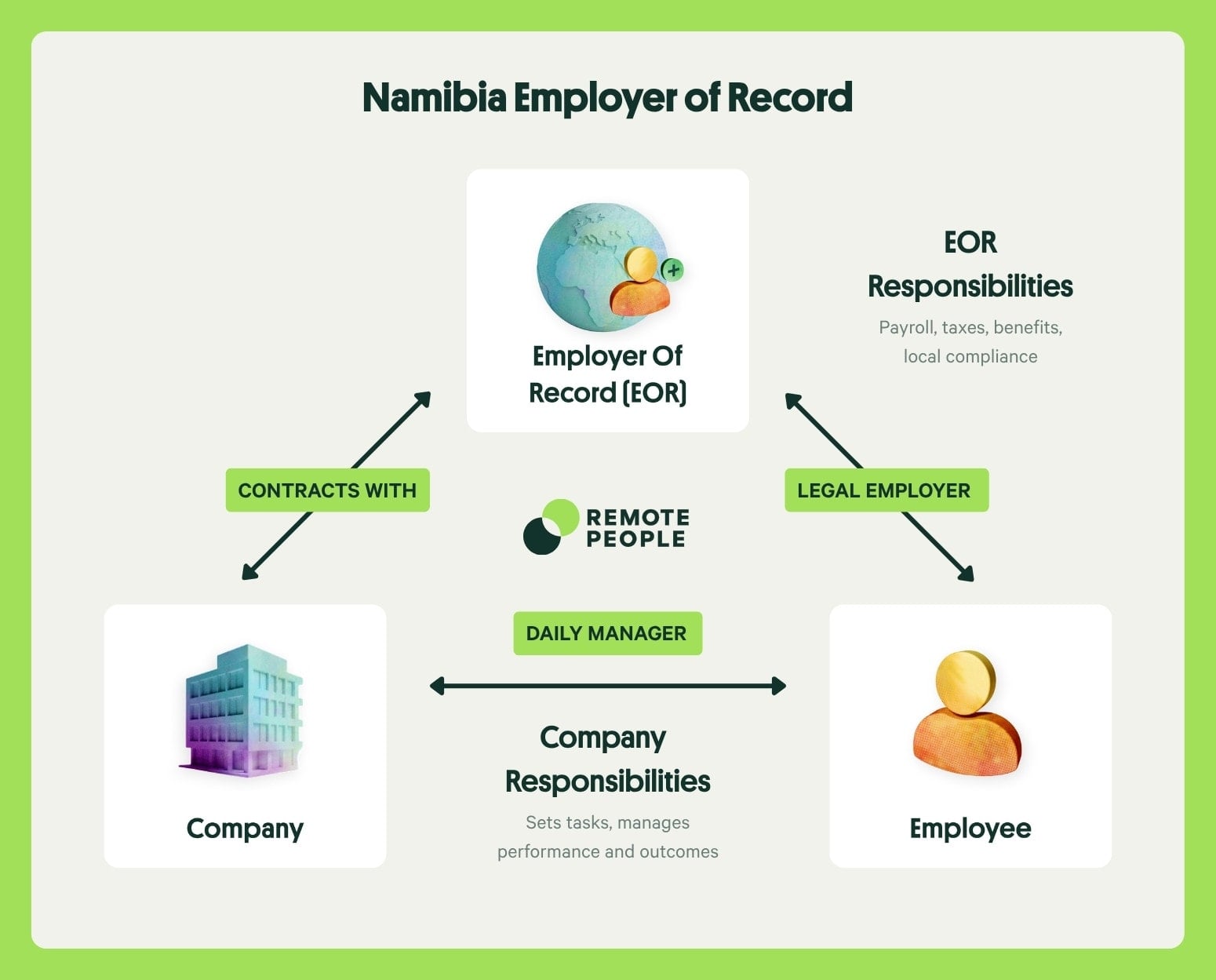
The Employer of Record in Namibia acts as the legal employer for each local or foreign national employee, while the original employer manages and instructs them in their day-to-day work. They must register employees with the Namibian authorities, operate compliant payroll, file taxes, and manage statutory benefits.
Namibia EOR services typically cover:
- Preparing and updating employment contracts following Namibian labour legislation
- Registration of employees with the tax and social security commission (SSC)
- Processing of payroll on a monthly or agreed cycle and disbursing salaries
- Withholding and remitting employees’ income tax and pension
- Remitting employer pension contributions
- Administration of statutory benefits (leave, insurance, and termination)
- Filing and reporting to Namibian authorities for full compliance
How Much Does a Namibia EOR Cost?
A Namibia EOR service provider typically charges a fixed monthly retainer (starts at $199 with RemotePeople) as well as a one-time onboarding fee for each new employee. Onboarding fees vary, but most EOR companies will charge between US$100 and US$500 per employee based on their role.
Add‑ons are optional and can include local health insurance packages, higher levels of HR support services, and recruitment support. All fees are transparent, based on volume and level of service.
Employment and Labor Laws in Namibia
Employment Contracts
Every employment relationship in Namibia must be backed by a written contract, issued within the first month of employment. Contracts must meet or exceed the statutory minimums set by the Labour Act. Any clause that attempts to waive or reduce an employee’s legal entitlements is void, regardless of whether the employee agreed to it.
Fixed-term contracts are permitted but closely scrutinised. Repeated renewal or use of fixed-term arrangements to avoid permanent employment obligations is a recognised compliance risk and can result in the employee being deemed permanently employed. Employers should ensure the fixed-term structure is genuinely justified by the nature of the work.
Working Hours
The standard working week is 45 hours, structured as 9 hours per day on a 5-day week or 7.5 hours per day on a 6-day week. Overtime is capped at 3 hours per day and 10 hours per week, compensated at 1.5 times the normal wage on weekdays and 2 times on Sundays and public holidays. Night work, defined as hours between 20:00 and 07:00, requires either additional compensation or reduced working hours.
Overtime
Employees must be paid at least 150% of their regular hourly rate for overtime. For work between 8 pm and 7 am, they must also be paid 6% more of their hourly rate for each hour. For work on Sundays and public holidays, the rate must be at least double.
Public Holidays
Namibia observes 12 statutory public holidays under the Public Holidays Act 26 of 1990. In 2026, 13 days are observed due to the substitute Monday rule, which applies when a public holiday falls on a Sunday.
Work performed on a public holiday must be compensated accordingly under the Labour Act.
- New Year’s Day (1 January)
- Independence Day (21 March)
- Good Friday (3 April)
- Easter Monday (6 April)
- Workers’ Day (1 May)
- Cassinga Day (4 May)
- Ascension Day (14 May)
- Africa Day (25 May)
- Heroes’ Day (26 August)
- Day of the Namibian Women & International Human Rights Day (10 December)
- Christmas Day (25 December)
- Family Day (26 December)
Social Security Contributions
All employees must be registered with the Social Security Commission’s Maternity, Sick Leave, and Death (MSD) Fund. This is an employer obligation and covers maternity benefits, sick leave benefits once employer-funded days are exhausted, and death benefits for survivors of deceased insured persons.
Contributions are set at 0.9% of basic wage for both employer and employee, subject to a monthly wage ceiling of N$11,000 (effective March 2025, up from N$9,000). The maximum monthly contribution per party is N$99, capping the combined total at N$198 per month.
Pension System
In addition to the SSC contributions, employers can offer their employees additional voluntary retirement savings plans. These are not compulsory and can be subject to tax as benefits‑in‑kind if treated as such. As statutory SSC contributions do not typically provide an adequate retirement income, many local employees also contribute to private pension funds.
Probation Periods
Probation periods are permitted under the Labour Act and should be reasonable relative to the nature of the role. There is no statutory maximum, though 3 to 6 months is standard practice.
During probation, employers are required to provide adequate training, instruction, and guidance, and must formally evaluate the employee’s performance. Dismissal during probation still requires a fair reason and a fair procedure. Probationary status does not exempt employers from unfair dismissal obligations.
Payroll and Employment Taxes in Namibia
Payroll Cycle
Employers are required to pay employees regularly (generally every month). The payroll should show the amount of wages, overtime, and (if any) bonuses and statutory deductions.
Minimum Wage
The national minimum wage is N$18 per hour for general workers, effective 1 January 2025. Sector-specific rates apply for 2026, with a phased increase toward the general rate by 2027.
| Sector | 2025 Rate | 2026 Rate | 2027 Target |
|---|---|---|---|
| General workers | N$18/hour | N$18/hour | N$18/hour |
| Domestic workers | N$12/hour | N$15/hour | N$18/hour |
| Agricultural workers | N$10/hour | N$14/hour | N$18/hour |
| Security workers | N$16/hour | N$16/hour | N$18/hour |
Employers must pay the full minimum wage in cash. In-kind benefits such as food or housing cannot be counted toward or deducted from the minimum wage obligation.
Note that the national minimum wage does not replace the 2023 farm worker minimum wage package. Agricultural workers remain entitled to all previously agreed fringe benefits, including housing, water, electricity, and food provision, in addition to the cash rate. Employers in the agricultural sector must comply with both the NMW and the 2023 fringe benefits framework.
Income Tax
Namibia operates a source-based personal income tax system. All employment income earned in Namibia is subject to tax, withheld by employers under the Pay-As-You-Earn (PAYE) system and paid to the Namibia Revenue Agency (NamRA). The first N$100,000 of annual income is exempt.
| Taxable Income (N$) | Tax Payable |
|---|---|
| 0 – 100,000 | Exempt |
| 100,001 – 150,000 | 18% of amount above N$100,000 |
| 150,001 – 350,000 | N$9,000 + 25% above N$150,000 |
| 350,001 – 550,000 | N$59,000 + 28% above N$350,000 |
| 550,001 – 850,000 | N$115,000 + 30% above N$550,000 |
| 850,001 – 1,550,000 | N$205,000 + 32% above N$850,000 |
| Above 1,550,000 | N$429,000 + 37% above N$1,550,000 |
Dividend Tax
A 10% dividend tax takes effect on 1 January 2026, applicable to dividends distributed by Namibian companies. Employers structuring equity compensation or profit-sharing arrangements through a Namibian entity should factor this into their planning.
Bonus Payments
Namibia has no statutory requirement for a 13th-month salary or annual bonus. Performance and annual bonuses are common in sectors such as mining, financial services, and the public sector, but remain discretionary. Any bonus arrangements should be clearly defined in the employment contract.
Tax Compliance and Payroll Reporting
NamRA requires the payroll to be submitted every month, along with the remittance of SSC contributions. Employers are required to keep records of each employee’s earnings, deductions, leave, and contributions. This is to allow for NamRA audits and labour inspections.
Work Permits and Visas in Namibia
Namibia’s work permit system is administered by the Ministry of Home Affairs, Immigration, Safety and Security. All foreign nationals require a valid permit before commencing work, and all applications are subject to mandatory labour market testing. Employers must demonstrate that the role cannot be filled by a Namibian citizen before a permit is approved.
Processing typically takes 3 to 5 months, so applications should be initiated well in advance of the intended start date.
- Long-Term Work Permit (Critical Skills): Used for foreign employees with specialist qualifications or skills unavailable locally. Valid for 1 to 2 years and renewable for up to two further periods. Requires role advertisement in at least 3 national newspapers for a minimum of 2 weeks, labour market testing through the Ministry of Labour, verified qualifications, medical and police clearance, and proof of financial means.
- Long-Term Work Permit (General Employment): The same permit applies to general employment roles. The application process and documentation requirements are identical to the critical skills route.
- Intra-Company Transfers: Namibia has no dedicated intra-company transfer category. Employees transferred from a foreign parent or affiliate are processed under the standard Long-Term Work Permit, with the same labour market testing and documentation requirements applying.
Given the complexity and lead times involved, employers should plan work permit applications well in advance and ensure all documentation is complete before submission. Incomplete applications are a frequent cause of delays and rejections.
Time Off and Leave in Namibia
Mandatory Leave Entitlements
Employees are entitled to 24 consecutive days of annual leave per 12-month cycle on a 6-day week, or 20 working days on a 5-day week. Leave accrues proportionally during the first year but cannot be taken until that year is completed.
Unused leave must be taken within 4 months of the cycle’s end unless the employee agrees in writing to an extension. Leave cannot be replaced with cash payment except upon termination, at which point any accrued unused leave must be paid out on a pro-rata basis.
Sick Leave
Sick leave operates on a 36-month cycle. Employees on a 5-day week are entitled to 30 working days of paid sick leave per cycle; those on a 6-day week receive 36 days. During the first year of employment, sick leave accrues at 1 day per 26 days worked.
The employer pays 100% of daily remuneration for the first 30 or 36 days depending on the work schedule. Once this entitlement is exhausted, the Social Security Commission steps in, paying 75% of maximum basic earnings for the first 12 months of extended illness, reducing to 65% for the following 12 months.
A medical certificate is required after 2 consecutive days of absence.
Maternity Leave
Employees with at least 6 months of continuous service are entitled to 12 weeks of maternity leave, taken as 4 weeks before and 8 weeks after confinement. The Social Security Commission pays 100% of the employee’s basic wage during this period, capped at N$15,000 per month.
In cases of birth complications, leave may be extended by 1 month or the employee’s accrued sick leave, whichever is greater. The employment contract remains in force throughout, and retrenchment during maternity leave is prohibited.
Paternity Leave
Namibian labour law does not provide a statutory paternity leave entitlement. Any paternity leave offered is at the employer’s discretion and subject to individual company policy.
It is worth noting that the Labour Act 2007 is currently under review, and the inclusion of statutory paternity leave is being considered as part of broader reforms.
Compassionate Leave
Employees are entitled to 5 working days of paid compassionate leave per 12-month period, granted in cases of the death or serious illness of a family member.
Employee Benefits in Namibia
In Namibia, employees are entitled to receive certain statutory entitlements from their employers. These include paid annual leave, sick leave, maternity leave, social security contributions, and notice/severance entitlements.
In addition, they may be provided with other benefits, such as private health insurance, transport allowance, or pension plans. Benefits‑in‑kind (e.g., company car, accommodation allowance, insurance) are generally subject to tax as part of total remuneration unless separately specified and valued in the employment contract.
Employers should consider the Taxation of Fringe Benefits implications under PAYE, and all non‑cash benefits should be disclosed as part of the employment contract value.
Terminations and Severance in Namibia
Termination
Employment in Namibia can be ended by mutual agreement, resignation, dismissal, or expiry of a fixed-term contract. Regardless of the method, employers must have a valid reason for dismissal and follow a fair procedure as set out in the Labour Act. Valid grounds include misconduct, incapacity, or retrenchment.
Notice or payment in lieu of notice is required in all cases except summary dismissal for serious misconduct. Severance pay of one week’s wages per completed year of continuous service applies where termination is due to retrenchment, or where a dismissal is found to be unfair.
An employment contract also terminates automatically one month after the death or sequestration of the employer, or the shutdown of the business, unless the contract or a collective agreement provides for a longer period, or the employer continues to carry on business in the interim.
Unfair Dismissal
Dismissal requires both a valid reason and a fair procedure, regardless of whether notice was given. This applies to all dismissals, including those during probation.
Employees who believe they have been unfairly dismissed may refer the dispute to the Labour Commissioner. Remedies include reinstatement or compensation of up to 12 months’ remuneration.
Notice Periods
Notice must be given in writing, stating the reasons for termination and the date of notice. Verbal notice is permitted only where the employee is illiterate. Payment in lieu of notice is allowed, calculated as the remuneration the employee would have earned during the notice period.
| Length of Service | Minimum Notice |
|---|---|
| 4 weeks or less | 1 day |
| More than 4 weeks up to 1 year | 1 week |
| More than 1 year | 1 month |
Severance Pay
Employees with at least 12 months of continuous service are entitled to 1 week’s remuneration per completed year of service. This applies on dismissal, resignation, or retirement at age 65. Remuneration includes basic wage or salary plus any regular cash or in-kind payments.
Severance is not payable in cases of fair dismissal for misconduct or poor performance, or where the employee unreasonably refuses an offer of reinstatement.
On the death of an employee, severance is paid in the following order of priority: surviving spouse, then children, then the estate.
Expand into Namibia Easily with RemotePeople’s Employer of Record (EOR) Solution
Our Namibia EOR service enables clients to legally and efficiently hire Namibian employees without the need to establish a local legal entity. For a fee starting from approximately USD 199/month plus an initial onboarding fee, we handle contracts, payroll, statutory deductions, annual leave, termination, and local HR support.
Partnering with us can help your business enter the Namibian market rapidly, minimize legal exposure, and avoid entity set-up hassles. This lets you concentrate on what matters strategically, while benefiting from local employment law expertise. Contact us today to get started.
Frequently Asked Questions
No. An Employer of Record allows you to hire compliantly in Namibia without registering a local entity. The EOR acts as the legal employer, managing contracts, payroll, taxes, and statutory benefits on your behalf.
Onboarding through an EOR typically takes 1 to 2 weeks, depending on how quickly documentation is provided. This is significantly faster than setting up a local entity, which can take several months.
Yes. An EOR with a registered local entity in Namibia can sponsor Long-Term Work Permit applications on behalf of foreign employees. However, all applications remain subject to mandatory labour market testing, and processing can take 3 to 5 months.
Namibian authorities take misclassification seriously. If a contractor works set hours, uses employer-provided equipment, or operates under direct supervision, they may be reclassified as an employee. This can result in retroactive tax and social security obligations, fines, and back pay.
Yes, provided they have completed at least 12 months of continuous service and the termination is not due to misconduct or poor performance. Severance is calculated at 1 week's remuneration per completed year of service.
Employer of Record in
Employer of Record in
Employer of Record in
Employer of Record in
Employer of Record in
Employer of Record in
Employer of Record in
Employer of Record in