
 Recruit
Employer of Record in Angola
-
 Drew Donnelly
- Published
- September 27, 2026
Hire employees in Angola without setting up a local entity. RemotePeople handles payroll, contracts, tax compliance, and benefits so you can build your Angola team in days, not months.
Hire in Angola — book a free 30-minute demo
Tell us what you need. You'll get a tailored, transparent proposal within 24 hours, plus a free call to walk through it.
Tell us about your company
So we can match you with a specialist who knows your market — and unlock volume pricing tiers.
* All fields are required.
Where and when are you hiring?
Tell us the geography and timing and we'll quote each country line by line, with onboarding timelines.
* All fields are required.
Help us beat your current setup
We'll benchmark your current deal and send a line-by-line proposal in 24 hours — showing exactly where we cut cost, time, or risk. After you submit, you can book a call to walk through it together.
* All fields are required.
Thanks! Your proposal is on its way.
Expect a tailored, line-by-line proposal in your inbox within 24 hours. In the meantime…
Want to walk through it together?
Book a free 30-minute call with one of our specialists. We'll explain every line, answer your questions, and tailor the proposal further if you need.
No obligation. Pick a time that works for you.








- Hire in Angola — book a free 30-minute demo
- Tell us about your company
- Where and when are you hiring?
- Help us beat your current setup
- Thanks! Your proposal is on its way.
- How an Employer of Record Works in Angola
- Start hiring with an Angola EOR
- Employment Laws and Regulations in Angola
- Work Permits and Visas in Angola
- Payroll, Taxes, and Social Security in Angola
- Cost of Hiring Through an EOR in Angola
- Benefits of Using an EOR in Angola
- Termination and Offboarding in Angola
- EOR vs. Other Hiring Models in Angola
- Public Holidays in Angola
- How to Get Started with an EOR in Angola
- Related EOR Destinations
Start hiring in Angola
Let RemotePeople handle payroll, compliance, and HR admin worldwide so you can focus on building your team.

Angola remains one of Sub-Saharan Africa’s largest economies, built historically on oil and diamonds but increasingly diversifying into agriculture, telecommunications, and financial services. For companies looking beyond the more saturated African hiring markets, Angola offers access to a young, growing workforce and a strategic position in Southern Africa, alongside strong trade ties to Portugal and the broader Lusophone world.
Hiring in Angola comes with practical realities employers need to understand early. Portuguese is the official language of business and government, and employment relationships are governed by Angola’s General Labour Law, which sets out rules on contracts, working hours, termination, and employee protections. Registering a local entity can be a lengthy process, and payroll must account for local tax withholding and mandatory social security contributions through the INSS.
For most companies, that entity-registration timeline is the real obstacle to hiring in Angola quickly. RemotePeople works with businesses navigating this, offering an established local presence so hiring doesn’t have to wait on a company’s own entity strategy.
This guide explains how an EOR works in Angola, what Angolan employment law requires, the real cost of hiring, and how EOR compares to setting up a local entity or hiring contractors.
How an Employer of Record Works in Angola
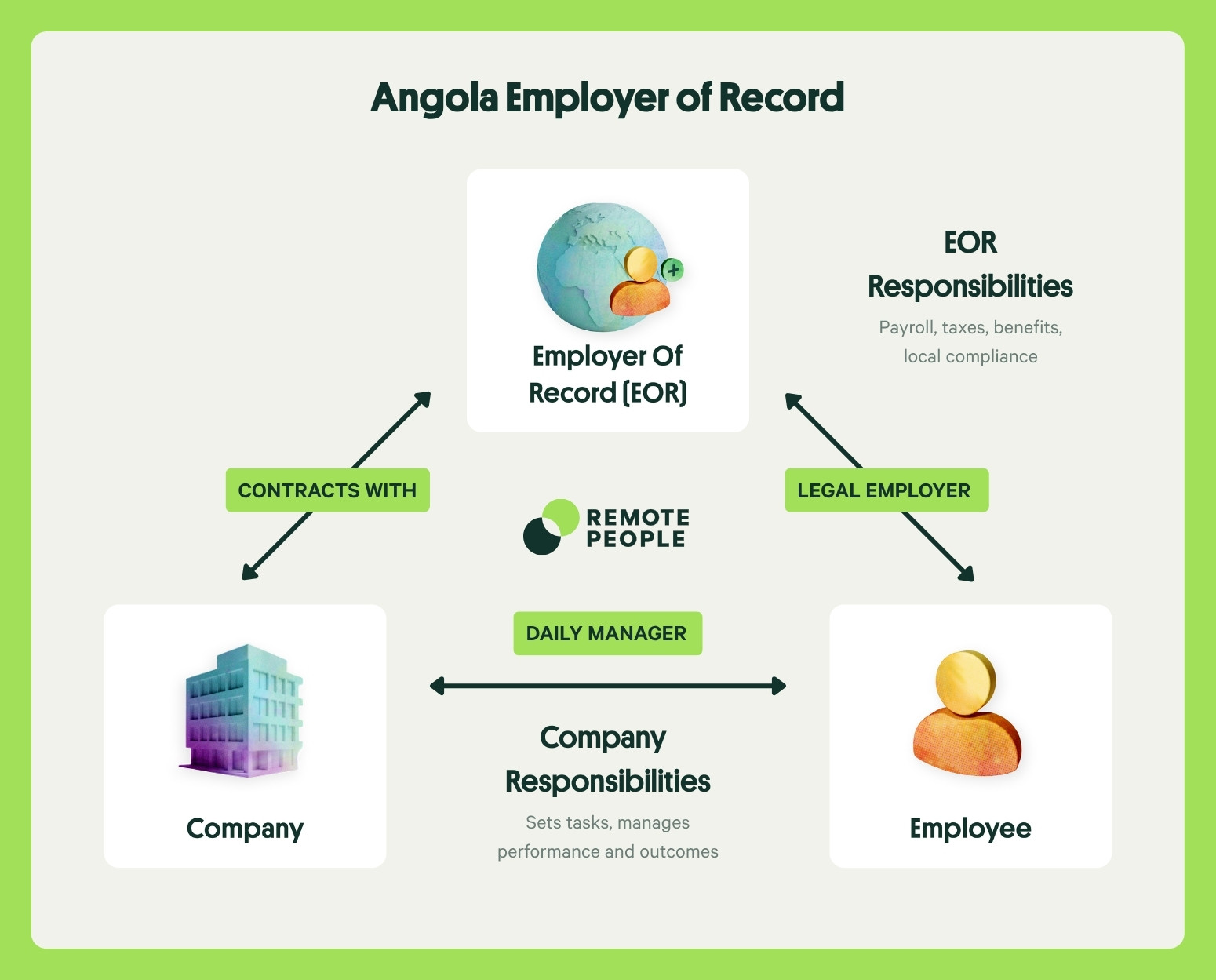
If you’d like to learn more about how Employer of Record (EOR) services work, read our What Is an Employer of Record (EOR)? guide for a complete overview of the model, its benefits, and when to use it.
If you’re comparing providers, our Best Employer of Record (EOR) Providers guide reviews the leading platforms to help you choose the right solution for your business.
Who Uses an Employer of Record in Angola?
Multinational firms, startups, and mid-sized companies use EORs to hire in Angola without a local subsidiary. Companies entering Angola for the first time benefit from outsourcing compliance, especially with the March 2024 labor law changes and January 2026 tax updates. Tech firms, consulting companies, and service providers commonly use EORs to rapidly expand in Angola.
Companies testing the market before full incorporation find an EOR cost-effective. Larger enterprises also use EORs for flexible staffing, scaling roles without subsidiary overhead.
Typical Onboarding Timeline
- First, you submit employee information, job descriptions, and proposed salary. This takes 2-3 business days.
- Second, the EOR drafts the employment contract in Portuguese, then gets employee sign-off. This takes 3-5 business days.
- Third, the EOR registers the employee with tax authorities and social security (INSS), handling work permits for non-citizens. Registration takes 5-10 business days, depending on complexity.
- Fourth, the first payroll cycle begins, with payment processed on the 25th for the prior month’s work. The employee gets their first paycheck with all statutory deductions.
- Fifth, the EOR sends you a monthly portal dashboard with payroll summaries, deductions, and compliance status. You stay in touch with the EOR account team for ongoing adjustments.
Start hiring with an Angola EOR
A resource-rich Southern African economy with INSS contributions, Angolan General Labour Law, and sector-specific compliance requirements.
We handle employment contracts, payroll, social contributions, and full Angolan compliance.
No local entity needed. Your team can start in days.
Employment Laws and Regulations in Angola
Angola’s employment framework follows the General Labor Law (Lei Geral do Trabalho, or NGLL) effective as of March 26, 2024, which modernizes protections and obligations for both employers and employees. Understanding these regulations is important for any company using an employer of record in Angola, as non-compliance carries penalties ranging from fines to operational restrictions. The law applies to all employment relationships in Angola regardless of employee nationality.Employment Contracts
Angola’s General Labor Law requires all employment relationships to be documented in a written contract signed by both employer and employee. The contract must specify job title, location, compensation, working hours, and duration (fixed-term or indefinite). It must be in Portuguese and include probation terms if applicable.Working Hours and Overtime
The standard workweek in Angola is 44 hours spread across five or six days, capped at 8 hours per day under the New General Labour Law (Lei 12/23). Overtime earns a 50% premium for the first 30 hours in a month and a 75% premium for hours worked beyond that tier, up to a combined ceiling of 40 hours per month and 200 hours per year. Night work performed between 20:00 and 06:00 carries a separate 25% premium on top of the base or overtime rate, and work on the weekly rest day, on Sundays, or on public holidays is paid at 200% with a minimum of three paid hours plus a compensatory rest day the following week. Managerial and senior trust positions are exempt from the overtime caps. Angola’s General Labour Law (Lei 12/23 of 27 December 2023), effective 26 March 2024, sets a standard workweek of 44 hours capped at 8 hours per day. Overtime is allowed only for urgent production or service needs and is strictly limited to 2 hours per day, 40 hours per month, and 200 hours per year. Premium rates escalate as an employee works beyond standard hours, with higher multipliers applying on rest days and public holidays.Overtime and Premium Pay Rates in Angola
Angola’s labour code caps the standard working week and sets the premium rates employers must pay for hours worked beyond it (Mercans Angola NGLL Alert). The table below lays out the statutory overtime multipliers for each shift type so you know what to budget for weekday, weekend, night, and public-holiday work.|
Angola overtime and premium pay rates · Per General Labour Law |
|||
|
Hour Type |
Rate Multiplier |
Limit or Cap |
Notes |
|---|---|---|---|
|
Standard workweek |
100% (base rate) |
8 hrs/day, 44 hrs/week |
Maximum daily and weekly hours under Lei 12/23 |
|
Overtime, first 30 hrs/month |
150% (+50%) |
2 hrs/day |
Tier 1 premium on regular workdays |
|
Overtime, 31 to 40 hrs/month |
175% (+75%) |
2 hrs/day |
Tier 2 premium once the 30-hour tier is exhausted |
|
Weekly rest day, Sunday, or public holiday |
200% (+100%) |
Minimum 3 hrs paid |
Plus a compensatory rest day during the following week |
|
Night work (20:00 to 06:00) |
125% (+25%) |
Separate from overtime caps |
Night premium stacks on top of the overtime rate when hours overlap |
|
Monthly and annual overtime ceiling |
n/a |
40 hrs/month, 200 hrs/year |
Managerial and senior trust positions are exempt from the cap |
Minimum Wage
Angola’s national minimum wage stands at AOA 100,000 (approximately $109 USD) per month as of January 2026, established by Presidential Decree 152/24. This rate applies to all unskilled workers and is the floor for compensation across industries. Employers must ensure all salaries meet or exceed this threshold to remain compliant.Probation Period
New employees in Angola typically serve a probation period of 60 days, during which either party may terminate employment without cause and with minimal notice. For managerial positions, the probation period may extend up to six months with employer and employee agreement. During probation, employees are entitled to all statutory benefits and protections except termination notice requirements.Leave Entitlements
Annual Leave
Employees in Angola accrue 22 days of paid annual leave after completing one year of service. During the first year, employees receive a pro-rata allocation based on months worked. The March 2024 General Labor Law established this standard, and annual leave must be taken within the calendar year or forfeited unless the employer agrees otherwise.Sick Leave
Employees receive paid sick leave for the first two months of absence due to illness, compensated at 100% of regular salary upon presentation of medical certification. For months three through twelve of continued illness, compensation reduces to 50% of salary. After twelve months of continuous sick leave, the employee may be terminated under disability provisions.Maternity Leave
Female employees are entitled to three months of paid maternity leave around childbirth, typically one month before and two months after delivery. This leave may be extended to four months if the mother requires additional recovery time, with permission from her physician. During maternity leave, the employee receives 100% of her regular salary.Paternity Leave
Male employees receive one day of paid paternity leave at full salary plus an additional seven days of unpaid leave following the birth of a child. This provision recognizes the need for fathers to be present during important early family moments. Paternity leave must be taken within 30 days of the child’s birth.Other Statutory Leave
Employees are entitled to eight days of paid leave for family matters such as marriage, death of a close relative, or family emergency upon provision of supporting documentation. Military service obligations and study leave are also protected under the General Labor Law, with specific terms varying by circumstance. Religious observance leave is also recognized in limited circumstances per employer policies.|
Leave Entitlements in Angola (2026) |
|||
|
Leave Type |
Duration |
Compensation |
Notes |
|---|---|---|---|
|
Annual Leave |
22 days after 1 year |
100% salary |
Pro-rata first year; must be taken in calendar year |
|
Sick Leave (Months 1-2) |
Up to 2 months |
100% salary |
Requires medical certification |
|
Sick Leave (Months 3-12) |
Months 3-12 |
50% salary |
Continued illness after 2 months |
|
Maternity Leave |
3 months (extendable to 4) |
100% salary |
1 month pre-delivery + 2 months post-delivery |
|
Paternity Leave |
1 day paid + 7 days unpaid |
100% for 1 day |
Must be taken within 30 days of birth |
|
Family Leave |
8 days |
100% salary |
For marriage, death, family emergencies |
|
Military Service Leave |
As required by law |
Protected employment |
Job protection guaranteed |
|
Study Leave |
As agreed with employer |
Varies by agreement |
For professional development |
|
Source: Angola General Labor Law 2023 and WTW Angola Labor Law |
|||
Statutory Employee Benefits
Angola requires employers to contribute to INSS, the social security system, which provides retirement, disability, survivor, and healthcare benefits. The employer contribution is 8% of the employee’s gross monthly salary, with employees also contributing 3% from their salary. These rates are set by PwC Worldwide Tax Summaries Angola and apply universally across all sectors. Health insurance is typically managed through the public INSS system, though some employers offer supplementary private coverage. Employees have the right to medical services, preventive care, and treatment of work-related injuries at no additional cost beyond their social security contributions. Many employers coordinate private health plans to supplement state coverage for senior staff. INSS handles pension contributions entirely; there’s no separate administration. Employees retire at age 60 (women) or 65 (men) and receive monthly benefits based on their contribution history. The system is mandatory and funded through ongoing employer-employee contributions.Recent Regulatory Updates (2026)
The New General Labor Law took effect on March 26, 2024, introducing significant changes to Angola’s employment framework. Key updates include enhanced employee protections, clearer probation rules, expanded leave entitlements, and stricter requirements for termination. The law also modernized contractual frameworks and dispute resolution procedures. Income tax rates changed on January 1, 2026, with new tax brackets reflecting inflationary adjustments and policy shifts. The minimum wage was simultaneously increased to AOA 100,000 per month. Decree 49/25 established updated requirements for foreign workers and work permit processing, tightening the 70% Angolization rule and documentation requirements.Work Permits and Visas in Angola
Non-Angolan employees hired through an employer of record in Angola require work permits to legally work in the country. The work permit process follows the Ministry of Interior and involves immigration, labor, and security clearances. Processing times vary, though legally the ministry must decide within 15 days; in practice, applications take two to three months to complete. Understanding visa categories and work permit requirements is important for international hires.Work Permit Requirements
Who Needs a Work Permit
All non-Angolan citizens need a work permit before starting work in Angola. The permit goes to the employee and ties them to a specific employer and position. Angola’s 70% Angolization rule requires employers to maintain a workforce that is at least 70% Angolan citizens, limiting the number of foreign workers that can be hired without special justification. Positions for which no qualified Angolan candidate exists receive exemptions, but documentation of the recruitment effort is required.Eligibility and Required Documents
Employers need a job description, employment contract in Portuguese, proof of recruitment efforts, and the applicant’s qualifications. The employee submits a police clearance, medical exam, passport, and application forms. Educational credentials must be certified or translated into Portuguese by an authorized translator. A job offer letter showing position, salary, and start date strengthens the application. You’ll need documentation showing the candidate’s experience and why they fill a skills gap. All documents need official seals and signatures; translations must be notarized.Processing Time and Validity
Legally 15 days, but expect 2-3 months due to background checks and ministry coordination. Once granted, the permit is valid for one year and ties the employee to the sponsoring employer. Extensions need renewed applications before expiration.Renewal Process
Renew the permit by submitting the same basic documents plus updated medical exams and police clearance before expiration. Start renewal at least 60 days before the permit expires. If an employee changes employers, the new employer must file a new application.Common Visa Types
Angola’s work authorization framework is administered jointly by the Ministry of External Relations and the Ministry of Public Administration, Labour and Social Security (MAPTSS). Employers sponsoring foreign nationals must select the correct visa category based on assignment duration, investment level, and whether the role qualifies as ordinary employment, technical assistance, or an investor engagement. All work-authorizing visas require a signed employment contract or a MAPTSS-approved investment commitment before entry into Angola.Work Visa Types for Foreign Workers in Angola
Foreign nationals typically need a work permit or employment-authorised visa to take up a job in Angola (Serviço de Migração e Estrangeiros (Angola)). The table below summarises the most common visa categories employers use when relocating international hires, along with typical eligibility requirements and permit durations.|
Angola work visa types for foreign workers · 2026 |
||||
|
Visa Type |
Duration |
Best For |
Leads to Residency? |
Processing |
|---|---|---|---|---|
|
Ordinary Work Visa |
1 year, renewable twice |
Long-term employment under a local contract |
No direct path |
30 to 60 days |
|
Short-Term Work Visa |
Up to 90 days |
Urgent or temporary assignments |
No |
15 to 30 days |
|
Technical Assistance Visa |
Up to 1 year, renewable |
Highly skilled consultants and project specialists |
No |
30 to 45 days |
|
Border Visa |
Up to 5 days, single entry |
Equipment assembly and after-sales technical service |
No |
Issued at port of entry |
|
Investor Visa Type A |
Up to 2 years, renewable |
Investments above US$50 million |
Yes, after renewals |
60 to 90 days |
|
Investor Visa Type B |
Up to 2 years, renewable |
Investments between US$5M and US$50M |
Yes, after renewals |
60 to 90 days |
|
Temporary Stay Visa |
Up to 1 year, renewable |
Family reunification and scientific missions |
Yes, after 5 years |
30 to 60 days |
How an EOR Handles Work Permits
An EOR manages the entire work permit process, compiling documentation and coordinating with the Ministry of Interior. They track status and ensure the 70% Angolization rule is met across your workforce and all permits stay current. If denied, the EOR advises on alternatives or appeals. They proactively start renewals before expiration to prevent gaps. The EOR updates payroll and compliance records to reflect permit status.Payroll, Taxes, and Social Security in Angola
Angola’s payroll system, managed by the employer of record on your behalf, combines employer and employee contributions to social security, progressive income tax, and various statutory deductions. The system is monthly, with salaries paid in Angolan Kwanza (AOA) by bank transfer. Understanding the tax brackets, contribution rates, and compliance requirements is important for accurate payroll management.Employer Contributions
Employers must contribute 8% of each employee’s gross salary to INSS (the national social security system). This is a fixed rate with no variations by employee category, industry, or salary. The employer contribution rate has remained stable at 8% per PwC Worldwide Tax Summaries Angola.|
Angola Employer Contribution Rates (2026) |
||
|
Contribution Type |
Rate |
Calculation Basis |
|---|---|---|
|
INSS (Social Security) |
8% |
Gross monthly salary |
|
Total Employer Contribution |
8% |
Gross monthly salary |
Employee Contributions
Employees contribute 3% of gross salary to INSS, deducted from each paycheck. They also pay income tax (IRT, or “Imposto sobre Rendimento do Trabalho”) on a progressive scale. The employee’s net pay is calculated by subtracting both INSS and IRT from gross salary.|
Angola Employee Deductions (2026) |
||
|
Deduction Type |
Rate |
Calculation Basis |
|---|---|---|
|
INSS (Social Security) |
3% |
Gross salary |
|
Income Tax (IRT) |
Varies by bracket |
Monthly income |
|
Total Employee Deductions |
3% + IRT |
Gross salary + bracket |
Income Tax
Angola’s PwC Worldwide Tax Summaries Angola uses progressive monthly brackets that took effect on January 1, 2026. The tax is calculated on each month’s earnings independently, with no annual aggregation. Employees earning below AOA 150,000 monthly pay no income tax, while those in higher brackets face rates from 16% to 25% on income above the threshold.|
Angola Income Tax Brackets (2026) – Monthly |
||
|
Monthly Income (AOA) |
Fixed Tax (AOA) |
Rate on Excess |
|---|---|---|
|
Up to 150,000 |
0 |
0% |
|
150,001 – 200,000 |
12,500 |
16% |
|
200,001 – 300,000 |
31,500 |
18% |
|
300,001 – 500,000 |
49,250 |
19% |
|
500,001 – 1,000,000 |
87,250 |
20% |
|
1,000,001 – 1,500,000 |
187,250 |
21% |
|
1,500,001 – 2,000,000 |
292,250 |
22% |
|
2,000,001 – 2,500,000 |
402,250 |
23% |
|
2,500,001 – 10,000,000 |
517,250 |
24% |
|
Over 10,000,000 |
2,342,250 |
25% |
Payroll Cycle
Payroll in Angola is processed on a monthly basis, with salaries paid on or before the 25th of each month for the prior month’s work. Payments are made by bank transfer to the employee’s designated account in Angolan Kwanza (AOA). An EOR manages all payroll processing, ensuring accurate tax calculations and timely payments. The payslip provided to each employee must itemize gross salary, INSS deduction, IRT deduction, any other allowances or deductions, and net pay. Employers retain payroll records for at least three years to support tax audits and social security verification. If an employee leaves mid-month, final pay must be processed within five working days of departure.13th Month Salary and Bonus Pay
Angola mandates that all employees receive a 13th month salary (also called the annual bonus) equal to one full month’s salary, paid typically in December. Additionally, the General Labor Law requires a 14th month bonus for certain circumstances or as negotiated in collective agreements. Both the 13th and 14th month payments are subject to the same income tax and social security deductions as regular pay. The 13th month is calculated on the average salary earned during the calendar year, so employees who joined mid-year receive a pro-rata amount. If employment ends before year-end, the accrued 13th month must be paid on the final paycheck. This represents a significant annual cost that must be budgeted when calculating total compensation expenses for Angolan employees.Cost of Hiring Through an EOR in Angola
EOR Service Fees
Employer of record service fees in Angola typically range from $300 to $600 per employee per month, depending on the provider’s service level and the complexity of payroll administration. These fees cover compliance, payroll processing, tax filing, and benefits administration, eliminating the need for a local HR department. The exact fee structure varies by provider but is generally charged as a flat monthly cost rather than a percentage of salary.Total Employment Cost Breakdown
The total cost of hiring through an EOR includes the gross salary, mandatory social security contributions, and the EOR service fee. Understanding this breakdown helps organizations budget accurately for remote hiring in Angola.|
Angola employer cost example · $1,200/month gross · 2026 |
||
|
Employer Cost |
Amount (USD) |
% of Gross |
|---|---|---|
|
Gross Salary |
$1,200 |
100% |
|
INSS Social Security (8%) |
$96 |
8% |
|
EOR Service Fee |
$400 |
33.3% |
|
Total Monthly Cost |
$1,696 |
141.3% |
|
Source: RemotePeople Payroll and PwC Angola Taxes |
||
Figures converted at 1 USD ≈ 919 AOA (April 2026). Monthly USD totals rounded to the nearest dollar.
Ready to simplify your hiring costs in Angola? Contact our team to receive a custom pricing proposal based on your team size and needs at https://remotepeople.com/contact/.Benefits of Using an EOR in Angola
Hiring through an employer of record eliminates the complexity of establishing a local legal entity while maintaining full employment compliance. Your organization gains immediate access to vetted talent without navigating Angola’s complex labour regulations, company registration requirements, or ongoing administrative overhead. An employer of record provider handles all payroll calculations, tax filings, and benefit administration, reducing your operational burden and allowing your internal team to focus on core business activities. You retain full control over hiring decisions, work assignments, and team management while the EOR manages the legal employment relationship. The flexibility to scale your team up or down without long-term financial commitments provides significant competitive advantage in emerging markets. You can test the Angola market, hire seasonal workers, or adjust headcount based on business needs without the time and expense required to close a local office.Termination and Offboarding in Angola
Notice Periods
Angola’s labour law, which your employer of record manages on your behalf, specifies different notice periods depending on the type of employment contract. For indefinite-term contracts, either party must provide 30 days’ written notice to terminate employment. Fixed-term contracts require 15 working days’ notice before expiration, while group terminations (affecting multiple employees) require 60 days’ notice and consultation with worker representatives. The notice period begins from the date the employer or employee receives written notice and continues through the last working day of employment. During the notice period, the employee remains employed and entitled to full wages and benefits unless suspended for cause. Notice periods under Angola’s General Labour Law depend on the contract type, the grounds for dismissal, and whether the termination is individual or collective. Indefinite contracts require longer lead time than fixed-term agreements, and collective redundancies must be preceded by formal consultation with works councils and with MAPTSS. Employers may substitute a payment in lieu of notice, but written notification remains mandatory in every scenario covered by the CMS Angola dismissal guide.Statutory Notice Periods in Angola by Termination Scenario
Under Angola labour law, employers must give written notice before terminating an indefinite employment contract, and the minimum period scales by either tenure or position level (CMS Angola Dismissal Guide). The table below sets out the statutory notice periods employers owe in each termination scenario, including how probation affects the minimum notice required.|
Angola statutory notice periods by termination scenario · Per General Labour Law |
|||
|
Termination Scenario |
Notice Period |
During Probation |
Notes |
|---|---|---|---|
|
Fixed-term contract (employer) |
15 working days |
Not applicable |
Served prior to contract expiry date |
|
Indefinite contract, individual (under 20 employees) |
30 days |
7 days minimum |
For objective grounds dismissal |
|
Indefinite contract, collective (20 or more employees) |
60 days |
Not applicable |
Requires MAPTSS notification and works council consultation |
|
Employee resignation, indefinite |
30 days |
7 days minimum |
Written notice from employee to employer |
|
Employee resignation, fixed-term |
15 working days |
7 days minimum |
Served before the contract end date |
|
Just-cause disciplinary dismissal |
Immediate, no notice |
Immediate |
Gross misconduct; no severance owed |
Severance Pay
Calculation Method
Severance pay in Angola is calculated based on tenure and the reason for termination. For terminations without cause, the employer must pay one month’s salary for each year of service during the first five years, then an additional 50% of monthly pay for each year of service beyond five years. This calculation uses the employee’s last gross monthly salary at the time of termination.Caps and Exceptions
No severance is required for termination during probation periods or for dismissal on disciplinary grounds (theft, gross misconduct, or repeated violations). Employees who voluntarily resign are not entitled to severance pay, and termination due to the employee’s own gross negligence may result in reduced or forfeited severance benefits. Angola’s 2024 General Labour Law introduced a uniform severance schedule that no longer varies by employer size. Severance applies to objective dismissals and redundancies, paying full monthly base salary for each of the first five years of service and 50% of monthly base salary for each additional year. Employees dismissed for just cause or during probation are not entitled to severance compensation, as confirmed by the WTW 2024 labour law analysis. The schedule below expresses each tenure milestone as months of monthly pay owed under the statutory formula.Severance Pay Schedule in Angola by Years of Service
Angola’s labour code entitles eligible employees to severance pay when an indefinite contract ends without cause, typically rising with years of service (WTW Angola Labour Law 2024). The table below lays out the statutory severance schedule so finance teams can budget end-of-service liabilities before a termination date is set.|
Angola severance pay schedule by years of service · Per General Labour Law |
|||
|
Years of Service |
Severance Amount |
Base Salary |
Notes |
|---|---|---|---|
|
1 year |
1.0 month of base salary |
1 month × 1 year |
Full monthly rate applies from year one |
|
3 years |
3.0 months of base salary |
1 month × 3 years |
Full-rate band continues through year five |
|
5 years |
5.0 months of base salary |
1 month × 5 years |
Last year paid at the full 100% rate |
|
8 years |
6.5 months of base salary |
5 + (0.5 × 3 years) |
Years 6 to 8 accrue at 50% of monthly pay |
|
10 years |
7.5 months of base salary |
5 + (0.5 × 5 years) |
Years 6 to 10 accrue at 50% of monthly pay |
|
15 years |
10.0 months of base salary |
5 + (0.5 × 10 years) |
Years 6 to 15 accrue at 50% of monthly pay |
|
20 years |
12.5 months of base salary |
5 + (0.5 × 15 years) |
Years 6 to 20 accrue at 50% of monthly pay |
|
Just cause or probation |
Not applicable |
0 |
No severance for disciplinary dismissal or probation termination |
|
Formula: first 5 years at full monthly base salary, years 6+ at 50% of monthly base salary. Sources: WTW Angola Labour Law 2024, Mercans NGLL Alert |
|||
Grounds for Termination
Employers may terminate employees for just cause, including repeated failure to meet job requirements despite warnings, serious violations of work rules, theft or fraud, or insubordination. Without-cause terminations are permitted but trigger severance obligations and notice period requirements. Angola’s dismissal rules prohibit termination based on discriminatory factors including race, gender, age, or union membership.EOR vs. Other Hiring Models in Angola
Choosing between an Employer of Record and setting up your own legal entity in Angola comes down to timeline, upfront cost, ongoing administrative burden, and how quickly you can scale up or wind down. The table below lays out both paths side by side across setup time, cost, compliance risk, and flexibility so you can match the right model to the size and duration of your Angola hiring plan.|
EOR versus establishing your own entity in Angola · 2026 |
||
|
Comparison |
Employer of Record |
Own Entity |
|---|---|---|
|
Setup Time |
1-2 weeks |
3-6 months |
|
Upfront Cost |
$0 |
$15,000-$40,000 |
|
Ongoing Cost (per employee) |
$300-$600/month |
$3,000-$8,000/month |
|
Local Partner Required |
No |
Yes |
|
Social Insurance Registration |
EOR handles |
Company handles |
|
Payroll & Tax Filing |
Included |
Must hire locally |
|
Best for Team Size |
1-20 employees |
20+ employees |
|
Scale Down/Exit |
Immediate |
Months of wind-down |
|
Government Contracts |
Limited eligibility |
Full eligibility |
|
EOR employment versus independent contractor engagement in Angola · 2026 |
||
|
Comparison |
EOR (Full-Time Employee) |
Independent Contractor |
|---|---|---|
|
Legal Relationship |
Employer-employee |
Self-employed service provider |
|
Compliance Risk |
Low (EOR handles) |
High (misclassification risk) |
|
Payroll & Tax |
EOR withholds, files returns |
Contractor handles own taxes |
|
Benefits & Leave |
Annual leave, public holidays, sick leave |
None (not entitled) |
|
IP Protection |
Work product owned by employer |
Contractor retains IP unless assigned |
|
Termination |
30-day notice, severance applies |
End contract per agreement |
|
Best for |
Core team, long-term roles |
Project work, specialized tasks |
|
Cost Structure |
Predictable monthly cost |
Variable (hourly/project rates) |
|
EOR versus PEO models in Angola · 2026 |
||
|
Comparison |
Employer of Record (EOR) |
PEO |
|---|---|---|
|
Legal Employer |
EOR company |
PEO company (co-employment) |
|
Local Entity Required |
No |
Yes |
|
Best for |
Cross-border remote hiring |
Expanding existing operations |
|
Compliance Liability |
EOR assumes full liability |
Shared between PEO and client |
|
Setup Time |
1-2 weeks |
4-8 weeks |
|
Control over HR Policies |
Client sets policies |
PEO-defined policies (limited customization) |
|
Typical Use Case |
Start remote hiring immediately |
Transition local staff to professional management |
Public Holidays in Angola
Angola observes a defined set of official public holidays on which most private-sector employers must give staff a paid day off (Angola Holidays 2026). The table below lists the statutory holidays employers need to build into payroll calendars and leave planning for the year, along with the date rule for each.|
Angola public holidays · 2026 |
||
|
Date |
Holiday |
Type |
|---|---|---|
|
January 1 |
New Year’s Day |
National |
|
February 17 |
Carnival |
National |
|
March 27 |
Armed Struggle Day |
National |
|
April 10 |
Good Friday |
Religious |
|
April 13 |
Easter Monday |
Religious |
|
May 1 |
Labour Day |
National |
|
May 25 |
Africa Day |
National |
|
August 17 |
Founding Day of MPLA |
National |
|
September 17 |
Heroes’ Day |
National |
|
November 2 |
All Souls’ Day |
Religious |
|
November 11 |
Independence Day |
National |
|
December 25 |
Christmas Day |
Religious |
|
Source: Angola Holidays 2026 and Angola General Labour Law 2023 |
||
How to Get Started with an EOR in Angola
- First: Define your hiring needs by identifying the role, required skills, and desired start date. Clarify team size, expected growth, and whether you need ongoing support or project-based talent to help your EOR provider prepare accurate pricing and compliance documentation.
- Second: Partner with an EOR provider by reviewing capabilities, pricing structures, and country-specific expertise. Confirm they handle Angola payroll, tax compliance, benefits administration, and have established relationships with local agencies for work visa processing if international relocation is involved.
- Third: Complete your provider’s client onboarding, which typically involves KYC verification, providing job descriptions, and setting compensation ranges. This process usually completes within 1-2 weeks and requires minimal back-and-forth documentation.
- Fourth: Begin recruitment either through your own networks or your EOR provider’s talent marketplace. Your EOR handles all employment contract creation, ensures compliance with Angola labour law, and establishes payroll processing from day one.
- Fifth: Onboard your first employee by providing work assignments, access credentials, and company policies. Your EOR provider manages the administrative setup including benefits registration and social security enrollment, allowing the employee to begin work immediately.
Termination requires 30 days' written notice for indefinite-term contracts, and severance pay is mandatory unless the dismissal occurs for disciplinary cause or during probation. Your EOR provider manages the notice period, calculates severance obligations, and handles all regulatory notifications required by Angola's labour authorities to ensure compliant separation.
Yes, independent contractor arrangements are possible in Angola, but they carry misclassification risk if the relationship resembles employment. Using a contractor platform specifically designed for Angola ensures proper structuring and compliance with labour law. Contractors suit project work or specialized expertise, while EOR employment provides better protection for ongoing team roles.
Your client company (you) owns all work product and intellectual property created by EOR employees as part of their regular job duties. This ownership is established through the employment contract and applies automatically unless specific provisions assign IP to the employee. Your EOR provider ensures IP ownership clauses appear in all employment agreements.
The typical timeline from contract signature to employee start date ranges from 1 to 3 weeks. Initial setup with your EOR provider completes within 1-2 weeks, including KYC verification and contract preparation. Recruitment timing depends on your hiring process, but many organizations find qualified candidates within this window.
Angola's General Labour Law (2023) governs employment relationships, requiring written contracts, statutory benefits, notice periods, and severance pay obligations. Your EOR provider handles all compliance requirements, but understanding minimum wage, working hours, annual leave entitlements, and termination procedures remains valuable. Current Angola minimum wage regulations apply to all sectors.
Employers must provide annual leave (22 days minimum), paid sick leave, 13th month bonus (prorated salary), maternity benefits, and social security contributions (8% INSS). Angola's statutory benefits framework is comprehensive, and your EOR provider ensures all mandated benefits are administered correctly.
Termination requires 30 days' written notice for indefinite-term contracts, and severance pay is mandatory unless the dismissal occurs for disciplinary cause or during probation. Your EOR provider manages the notice period, calculates severance obligations, and handles all regulatory notifications required by Angola's labour authorities to ensure compliant separation.
Employer of Record in
Employer of Record in
Employer of Record in
Employer of Record in
Employer of Record in
Employer of Record in
Employer of Record in
Employer of Record in