
 Recruit
Employer of Record in Zimbabwe
-
 Drew Donnelly
- Published
- September 22, 2026
RemotePeople’s employer of record in Zimbabwe lets you hire employees in Zimbabwe with NSSA Pension and Other Benefits Scheme compliance. We handle Pension and Other Benefits Scheme contributions at 4.5 percent employer share, PAYE income tax withholding, and statutory leave administration.
Hire in Zimbabwe — book a free 30-minute demo
Tell us what you need. You'll get a tailored, transparent proposal within 24 hours, plus a free call to walk through it.
Tell us about your company
So we can match you with a specialist who knows your market — and unlock volume pricing tiers.
* All fields are required.
Where and when are you hiring?
Tell us the geography and timing and we'll quote each country line by line, with onboarding timelines.
* All fields are required.
Help us beat your current setup
We'll benchmark your current deal and send a line-by-line proposal in 24 hours — showing exactly where we cut cost, time, or risk. After you submit, you can book a call to walk through it together.
* All fields are required.
Thanks! Your proposal is on its way.
Expect a tailored, line-by-line proposal in your inbox within 24 hours. In the meantime…
Want to walk through it together?
Book a free 30-minute call with one of our specialists. We'll explain every line, answer your questions, and tailor the proposal further if you need.
No obligation. Pick a time that works for you.








- Hire in Zimbabwe — book a free 30-minute demo
- Tell us about your company
- Where and when are you hiring?
- Help us beat your current setup
- Thanks! Your proposal is on its way.
- How an Employer of Record Works in Zimbabwe
- Start hiring with a Zimbabwe EOR
- Employment Laws and Regulations in Zimbabwe
- Work Permits and Visas in Zimbabwe
- Payroll, Taxes, and Social Security in Zimbabwe
- Cost of Hiring Through an EOR in Zimbabwe
- Benefits of Using an EOR in Zimbabwe
- Termination and Offboarding in Zimbabwe
- EOR vs. Other Hiring Models in Zimbabwe
- Public Holidays in Zimbabwe
- How to Get Started with an EOR in Zimbabwe
- Frequently Asked Questions
- Related EOR Destinations

Start hiring in Zimbabwe
Let RemotePeople handle payroll, compliance, and HR admin worldwide so you can focus on building your team.

Zimbabwe operates as a dual-currency economy, heavily dollarized in the private sector, where employment contracts are usually priced in USD even as tax authorities recognize both USD and ZWG (Zimbabwe Gold). Hiring in Zimbabwe is straightforward enough, but getting compliance right matters: the Labour Act mandates written contracts, statutory leave, notice periods from 1 day to 3 months based on tenure, and a severance formula that doubled in late 2024 – now 1 month per year of service instead of 1 month per 2 years. An employer of record handles that friction. It steps in as the legal employer, taking on contracts, payroll, tax withholding, and regulatory filings, while you keep full control over how your employee works day to day.
This guide walks you through everything needed to hire properly in Zimbabwe: the Labour Act [Chapter 28:01] and its 2023 amendment, statutory leave entitlements, income tax rules in both currencies, how payroll works, work permit options for foreign nationals, total cost of hiring, and how an EOR stacks up against incorporating a local company. All rates, formulas, and deadlines come directly from the Labour Act, Statutory Instrument 191 of 2024, or authoritative sources.
How an Employer of Record Works in Zimbabwe
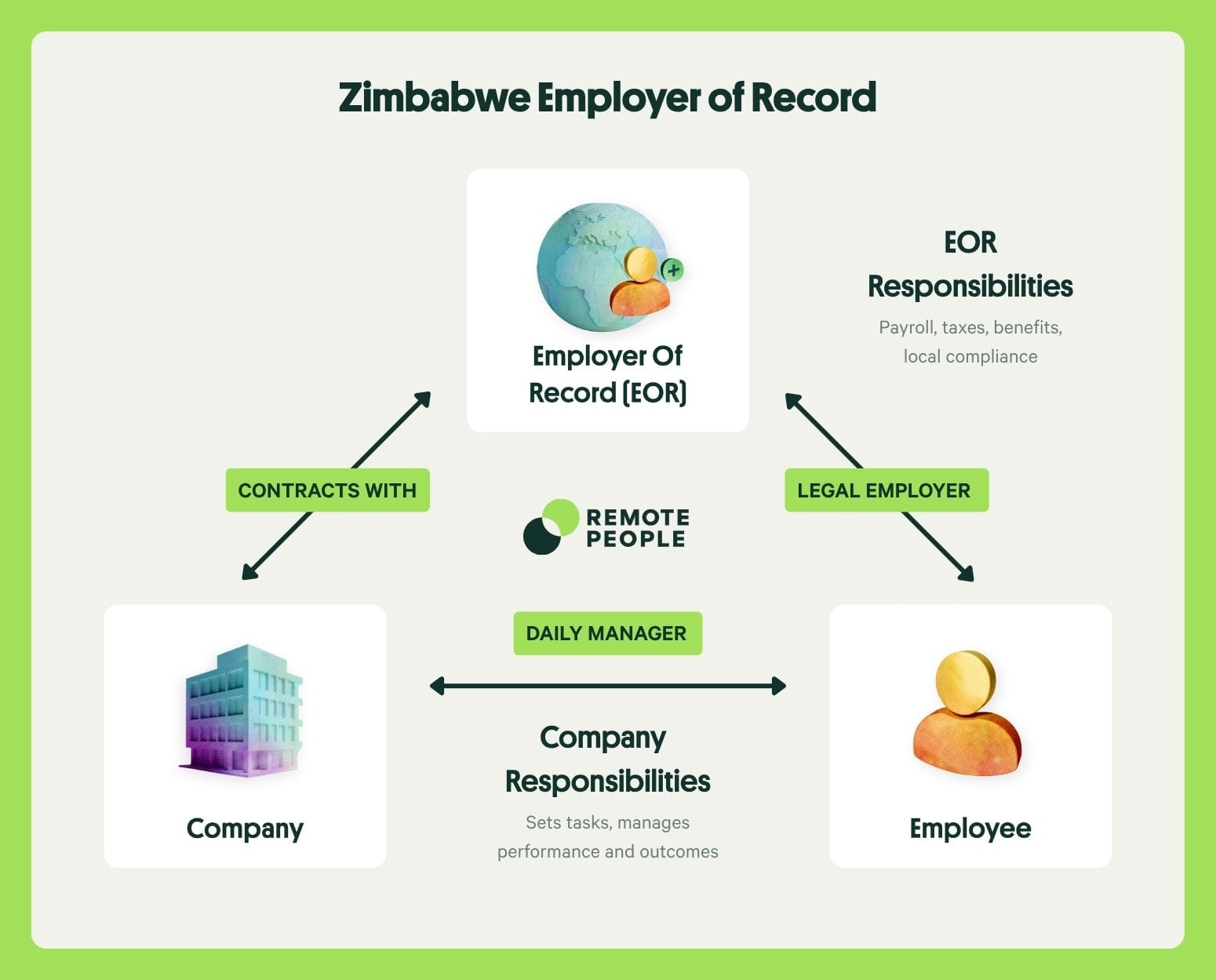
If you’d like to learn more about how Employer of Record (EOR) services work, read our What Is an Employer of Record (EOR)? guide for a complete overview of the model, its benefits, and when to use it.
If you’re comparing providers, our Best Employer of Record (EOR) Providers guide reviews the leading platforms to help you choose the right solution for your business.
Who Uses an EOR in Zimbabwe?
An EOR is the practical hiring route for companies that want to employ workers in Zimbabwe without setting up a local company. It’s a good fit if you’re testing the Zimbabwean market with a single hire, bringing in a country manager, or moving fast to fill a technical specialist role where incorporating a local entity would add months. For foreign companies hiring expatriate staff, it’s especially useful because the EOR can sponsor work permits and handle all the Department of Immigration paperwork.
- Companies entering Zimbabwe for the first time that need a compliant hiring vehicle before committing to incorporation
- NGOs, development organizations, and social enterprises hiring local staff for in-country programmes
- Teams of 1 to 10 employees where the overhead of running a local subsidiary is not justified
- Employers hiring foreign nationals who need work permit sponsorship and immigration liaison
- Organizations that need to onboard in weeks rather than the 4 to 8 months a full entity setup typically requires in Zimbabwe
Typical Onboarding Timeline
For locals, onboarding through an EOR usually takes 2 to 3 weeks. For foreign staff needing work permit sponsorship, plan for 8 to 12 weeks – the extra time comes from immigration review and labour market testing.
- First, sign the EOR service agreement and share the candidate’s full details, qualifications, intended start date, and preferred payroll currency (USD or ZWG) – 1 to 2 days.
- Second, the EOR drafts a written employment contract aligned with the Labour Act and sends it for your review and the employee’s signature – 3 to 5 days.
- Third, tax registration with ZIMRA and NSSA registration (POBS and APWCS) are processed alongside local salary bank account setup – 5 to 10 working days.
- Fourth, payroll is configured in your chosen currency, the onboarding pack is delivered, and the employee’s first-day logistics are agreed – 2 to 3 days.
- Fifth, the employee starts work. For foreign nationals, the EOR files the work permit (Temporary Employment Permit or TEP) application, which typically adds 6 to 10 weeks to the timeline before the legal start date.
Most EOR providers bring on a local employee in 2 to 3 weeks. Work permits, labour market testing, and vetting can slow things down for foreign hires, so add some buffer time and plan your start date with that in mind.
Employers with staff in Zimbabwe often extend across Southern Africa, drawing on shared SADC labor frameworks and cross-border mobility. Most teams start with operations in South Africa — SADC-wide hiring and compliance parity. Zambia typically follows, with SADC labor framework alignment. Hiring in Botswana is a natural addition for shared SADC workforce mobility, and an EOR partner in Mozambique completes the regional picture with aligned SADC labor rules.
Start hiring with a Zimbabwe EOR
A highly educated workforce with NSSA contributions, Zimbabwean Labour Act, and complex multi-currency payroll considerations.
We handle employment contracts, payroll, social contributions, and full Zimbabwean compliance.
No local entity needed. Your team can start in days.
Employment Laws and Regulations in Zimbabwe
Employment Contracts
The Labour Act [Chapter 28:01] governs employment in Zimbabwe, overseen by the Ministry of Public Service, Labour and Social Welfare. The Labour Amendment Act No. 11 of 2023 brought recent updates. Every employment agreement must be in writing and include the job title, description, workplace, start date, gross wage (in USD or ZWG), hours, probation terms, notice period, and benefits. Contracts are typically drafted in English, the standard language in government and business. You can use either fixed-term or indefinite contracts, but the labour inspectorate scrutinizes repeated renewals of the same role. If contracts are kept fixed-term without a pathway to permanent status, they may be reclassified as indefinite roles anyway.
Working Hours and Overtime
Zimbabwe’s standard workweek is either 48 hours (8 hours daily, 6 days) or 45 hours (9 hours daily, 5 days) – depending on industry and collective bargaining agreements. The Labour Act [Section 14C] guarantees at least 24 consecutive hours of weekly rest, typically on Sunday. Overtime pay follows premium rates (see Table below). Any work beyond the standard week must be voluntary unless there’s an emergency. Tracking and paying overtime correctly matters – it keeps you clear with labour inspectors and the NSSA.
Zimbabwe overtime and premium pay rates · Per Labour Act [Chapter 28:01] | |||
Hour Type | Rate Multiplier | Daily Cap | Notes |
|---|---|---|---|
Weekday overtime (ordinary rate) | 1.5x | 2 hours/day (by agreement) | Section 14D; applies to work beyond the standard 45–48 hours per week |
Sunday / weekly rest day work | 2.0x (200%) | No statutory cap | Double ordinary rate for work on the weekly rest day (Section 14E) |
Public holiday work | 2.0x (200%) | No statutory cap | Double ordinary rate for work on gazetted public holidays (Section 14E) |
Total regular hours + paid overtime cap | Varies by CBA | Typically 50–55 hrs/week | Collective bargaining agreements may impose weekly or monthly caps on total work hours including overtime |
Overtime sits on top of regular pay and is calculated based on the ordinary rate. While there’s no statutory annual cap, most collective bargaining agreements set limits, so check yours. Overtime must stay reasonable and be voluntary (except emergencies). One thing to note: 13th month bonuses (where they apply) are based on base salary only, not on overtime hours.
Minimum Wage
The national minimum wage is USD 150 per month (Statutory Instrument 186 of 2024). That said, many sectors have set higher minimums through their National Employment Council (NEC) agreements. You must pay at least the USD 150 floor, but professional services, finance, and skilled trades roles typically earn well above that. When you hire through an EOR, benchmark the salary against both the sectoral minimum (if one exists) and local market rates for that role.
Probation Period
Probation is capped at 3 months of continuous service [Section 4, Labour Act]. During this period, you can dismiss someone who isn’t working out with just 1 day’s notice and no severance pay. The employee can also resign with 1 day’s notice. Time the employer doesn’t provide work doesn’t count toward probation. Once those 3 months are up and the employee keeps working, they’re automatically confirmed and get full statutory protections – notice periods, severance, the whole package.
Leave Entitlements
The Labour Act [Chapter 28:01] sets out entitlements for annual leave, sick leave, maternity leave, and other special leave. The rules differ by type – accrual rates, pay rates, and who foots the bill all vary. Generally, employers cover most of the cost since the NSSA doesn’t reimburse leave pay in the private sector.
Annual Leave
Employees get 30 calendar days of paid annual leave per year, accrued at 1/12 per month after the first 12 months [Section 14A]. No leave accrues during probation. You can carry over up to 90 days; anything beyond that is lost at year-end unless you agree otherwise. Leave pay is the regular wage at the time taken. If someone leaves before using accrued leave, you pay out unused days at the termination rate.
Sick Leave
Once probation ends, employees are entitled to 180 days of sick leave in a 12-month period: 90 days at full pay and 90 days at half pay [Section 14]. The employee must notify you promptly and provide a medical certificate. You pay for this leave – the NSSA doesn’t reimburse. After those 180 days run out, the employee can take unpaid leave or may be dismissed if they’re unable to do the job.
Maternity Leave
Pregnant employees get 98 days of fully paid maternity leave [Section 18], available after 12 months on the job and limited to 3 pregnancies max with the same employer. The employee can take it before or after delivery. You can’t terminate anyone or give notice during maternity leave or pregnancy-related sick leave. The employee should provide a medical certificate with the expected delivery date so you can plan coverage.
Paternity Leave
The Labour Act doesn’t require paternity leave – fathers have no statutory right to paid time off when a child is born. Some employers offer a few days as a courtesy, and a few collective bargaining agreements cover it (usually 2–5 days), but it’s optional, not mandatory.
Other Statutory Leave
- Family events leave (paid): marriage or death of a spouse, parent, child, or close relative – typically 3–5 days per your CBA or discretion
- Public holiday leave (paid): 13 gazetted days in 2026, with double-time pay for any work on those days [Section 14E]
- Study leave (paid): approved vocational or tertiary study – typically 1–2 weeks per year depending on your CBA
- Compassionate leave (usually unpaid): for exceptional personal hardship, at your discretion
Zimbabwe statutory leave entitlements · Per Labour Act [Chapter 28:01] | ||
Leave Type | Duration | Eligibility & Notes |
|---|---|---|
Annual leave | 30 days per year | Paid at regular wage; accrues at 1/12 per month after first 12 months; max 90 days accumulation (Section 14A) |
Sick leave | 180 days per 12-month period | 90 days at 100% pay + 90 days at 50% pay; medical certificate required (Section 14) |
Maternity leave | 98 days fully paid | After 12 months service; max 3 times with same employer; employer-funded; Section 18 prohibits termination during leave |
Paternity leave | Not statutory | No legal entitlement; discretionary at employer level or per CBA |
Family events leave | Paid days for marriage or family bereavement | Covers own marriage, death of spouse, ascendant, descendant, or second-degree relative; duration per CBA |
Public holidays | 13 paid days (2026) | Work on a public holiday paid at 2x rate; list shown in Table 4 below (Section 14E) |
Study / vocational leave | Varies per CBA | Typically 1–2 weeks per year for approved training; paid or unpaid per agreement |
Statutory Employee Benefits
All employers must register employees with the NSSA and contribute to both the Pension and Other Benefits Scheme (POBS) and the Accident Prevention and Workers Compensation Scheme (APWCS). That’s it for legally mandated benefits – no mandatory private pension, health insurance, life insurance, or disability coverage. Anything beyond NSSA contributions (medical insurance, transport allowances, housing, education support) is optional and must be spelled out in the employment contract or CBA.
When you register someone with NSSA, make sure they understand the pension side (POBS) and work injury coverage (APWCS). The employee’s POBS contribution comes out of their paycheck, which you withhold and remit (see the rates table below). You also contribute separately. APWCS is on you and varies by industry risk.
Recent Regulatory Updates (2026)
The biggest recent change is Statutory Instrument 191 of 2024 (effective 6 December 2024), which doubled severance payments. Before, it was 1 month per 2 years of service; now it’s 1 month per 1 year of service. The Amendment Act No. 11 of 2023 also tightened protections for pregnant workers and tweaked notice and severance rules. As of April 2026, no further reforms have been announced, so the Labour Act [Chapter 28:01] with SI 191/2024 remains the law.
Work Permits and Visas in Zimbabwe
Work Permit Requirements
Who Needs a Work Permit
Every foreign national working for pay in Zimbabwe needs a work permit (Temporary Employment Permit – TEP) and a residence visa from the Department of Immigration. No exceptions based on passport, and no bilateral deals allow visa-free work. Short business trips under 30 days with no paid work can use a business visa; anything else requires a TEP.
Eligibility and Required Documents
Zimbabwe uses a labour market test – you can only hire a foreigner if no qualified local is available, and you have to show you tried to recruit locally first. You’ll need a passport valid for at least 12 months, the signed employment contract (naming the EOR as employer), degree certificates, a police clearance from the home country, and a medical certificate. Immigration handles processing and often asks for more documents if something’s missing, which can slow things down.
Processing Time and Validity
Initial processing typically takes 4 to 10 weeks – depends on role complexity, qualifications, and whether extra background checks are needed. A TEP is valid for 3 years and renewable up to 5 years total. It’s tied to one employer and role, so changing jobs means applying again. Start the work visa and permit process at least 10 weeks before your target start date to buffer for delays and document requests.
Renewal Process
Renewals must be filed before expiry, with the original documents plus proof of ongoing employment, current tax clearance (ZIMRA), and anything else Immigration asks for. If you apply on time, the employee can keep working during renewal. But if the permit expires before the new one comes through, that’s unauthorized employment and both of you face penalties.
Common Visa Types for Foreign Workers
Here are the main work permit options in Zimbabwe. Your EOR can sponsor and handle all of them for you.
Zimbabwe work visa types for foreign workers · 2026 | ||||
Visa Type | Duration | Best For | Leads to PR | Processing |
|---|---|---|---|---|
Temporary Employment Permit (TEP) | Up to 3 years, renewable to 5 years max | Standard employment where no qualified local is available; labour market test required | No, but renewable indefinitely up to 5-year max | 4–10 weeks; Department of Immigration sponsors through the EOR |
Intra-Company Transfer (ICT) | Up to 3 years, renewable | Executive, manager, or specialist transferring from a foreign office of the same multinational to the Zimbabwe branch | No, but renewable | 4–8 weeks; requires proof of employment history and corporate relationship |
Investor / Business Owner Permit | Typically 5 years, renewable | Foreign nationals establishing or investing in a Zimbabwe business | Yes – may lead to permanent residence after meeting investment and residency thresholds | 6–12 weeks; requires business plan, capital evidence, and investment documentation |
Permanent Residence Permit | Indefinite | Long-term expatriate residents, spouses of Zimbabwean citizens, and investors meeting criteria | Yes – PR is indefinite; does not require renewal | 3–6 months; requires application to the Department of Immigration and approval by higher authority |
Business Visit Visa | 30 days (non-renewable) | Short commercial visits, conferences, training, or site visits with no local payroll | No – employment not permitted | 1–3 weeks; standard tourism/business visa process |
The TEP is the standard work permit for foreign employees. Short business trips use a regular business visa, but paid work – whether consulting, temp projects, or part-time – needs a TEP or ICT permit. Your EOR handles all documents and talks to Immigration for you.
How an EOR Handles Work Permits
The EOR steps in as the sponsor for foreign staff and manages the whole work permit process with Immigration and the Ministry of Labour. It writes the justification letter (labour market test), gathers documents, files the application, and follows up directly with Immigration. The employee provides their passport, degrees, police clearance, medical certificate, and contract – the EOR authenticates these and submits them all.
A work permit application adds 6 to 10 weeks on top of the 2 to 3 weeks for local hiring – so plan on 8 to 13 weeks total for foreign staff. Since Zimbabwe requires formal sponsorship to grant a TEP, using an EOR with a local entity is the only practical way for foreign companies to hire non-Zimbabweans without setting up their own company.
Payroll, Taxes, and Social Security in Zimbabwe
Employer Contributions
Employers must contribute to the NSSA (National Social Security Authority), which runs two main schemes: Pension and Other Benefits Scheme (POBS) and Accident Prevention and Workers Compensation Scheme (APWCS). You also pay the Manpower Levy (ZIMDEF) for skills development.
Zimbabwe employer social security contributions · 2026 rates | ||
Contribution | Rate | Notes |
|---|---|---|
NSSA POBS (Pension and Other Benefits Scheme) | 4.5% | Employer share of 9% total; capped on insurable earnings of USD 700/month (or ZWG equivalent). NSSA sources |
NSSA APWCS (Accident Prevention & Workers Compensation) | ~2% (range 1.38% – 11%) | Employer-only; varies by industry risk classification. Office/professional roles typically ~1.38–2%; high-risk sectors higher. No insurable earnings cap. NSSA scheme details |
ZIMDEF / Manpower Levy | 1.0% | Employer-paid; used for skills development and apprentice training programs |
Total employer contribution | ~7.5% | POBS 4.5% + APWCS ~2% (average) + ZIMDEF 1%; APWCS varies by sector |
About 7.5% total is the ballpark for professional and office roles, though APWCS rates swing based on industry. Check the exact rate with NSSA for your role’s classification. The EOR sends all contributions to NSSA monthly and these amounts are deductible for your taxes.
Employee Contributions
Zimbabwe employee payroll deductions · 2026 monthly withholdings | ||
Deduction | Rate | Notes |
|---|---|---|
NSSA POBS (employee share) | 4.5% | Withheld from gross salary; capped on insurable earnings of USD 700/month (or ZWG equivalent). Capped earnings: USD 700/month × 4.5% = max USD 31.50/month POBS contribution per employee |
PAYE income tax | 0% – 40% | Progressive; withheld at source by employer for remittance to ZIMRA monthly (see Table 3 for brackets) |
AIDS Levy | 3.0% | Applied to PAYE income tax (i.e. 3% of the tax payable, not 3% of salary). Remitted alongside PAYE to ZIMRA |
Total employee deduction (excl. income tax) | 4.5% + 3% of tax | NSSA POBS 4.5% capped + income tax at progressive rates + 3% AIDS levy on the tax |
The AIDS Levy is a national health levy applied at 3% of PAYE income tax and sent to ZIMRA with the tax. It raises the overall tax rate slightly. If an employee owes USD 100 in PAYE, they also owe USD 3 in AIDS Levy – total USD 103.
Income Tax
Zimbabwe uses progressive income tax with different tables for USD and ZWG earners. Since most work happens in USD, those brackets are the main ones. ZIMRA sets both tables each year.
Zimbabwe income tax brackets · 2026 (USD-denominated) | |
Annual Taxable Income (USD) | Tax Calculation |
|---|---|
Up to $1,200 | Tax-free |
$1,201 – $3,600 | 20% minus $240 |
$3,601 – $12,000 | 25% minus $420 |
$12,001 – $24,000 | 30% minus $1,020 |
$24,001 – $36,000 | 35% minus $2,220 |
Above $36,000 | 40% minus $4,020 |
Zimbabwe publishes separate ZWG brackets too. The ZWG tax-free threshold is ZWG 33,600 per year (ZWG 2,800/month), with a top rate of 40% above ZWG 1,008,000 per year. Pick one currency for each employee and stick with it – don’t split between USD and ZWG to reduce tax. With the AIDS Levy factored in, the top rate is 41.2%.
Payroll Cycle
Payroll runs monthly. The EOR figures gross, withholds NSSA POBS (capped), applies the tax brackets, and deducts the AIDS Levy. Net pay goes to a local bank account or cash in USD if agreed. You get a pay slip each month with gross, deductions, and net. The EOR files all tax, levy, and NSSA money to the authorities in the first 10 working days of the next month. Year-end reconciliation and PAYE summaries go to ZIMRA by end of February.
13th Month Salary and Bonus Pay
The Labour Act doesn’t require a 13th month salary. No law mandates an annual bonus, holiday bonus, or year-end payment. That said, many CBAs and contracts do offer one – typically one month’s salary in December. If you pay a 13th month, it’s taxable and subject to standard PAYE plus the AIDS Levy. The EOR can process it with regular payroll or as a separate bonus, depending on your contract.
Cost of Hiring Through an EOR in Zimbabwe
EOR Service Fees
EOR service fees run $300 to $600 per employee per month (in USD). That includes contract drafting, monthly payroll processing (USD or ZWG), NSSA setup and contributions, tax withholding and ZIMRA filing, statutory reports, leave tracking, and your share of the cost to run the local entity. Work permits and severance handling are usually billed separately since they involve direct Immigration costs.
Total Employment Cost Breakdown
Zimbabwe employer cost example · USD 2,500/month gross · 2026 | ||
Employer Cost | Amount (USD) | % of Gross |
|---|---|---|
Gross monthly salary (employee payment) | $2,500.00 | 100.0% |
NSSA POBS employer share (4.5%, capped at $700/mo insurable earnings) | $31.50 | 1.3% |
NSSA APWCS (2% average, office role) | $50.00 | 2.0% |
ZIMDEF Manpower Levy (1%) | $25.00 | 1.0% |
EOR service fee (mid-range) | $450.00 | 18.0% |
Total monthly employer cost | $3,056.50 | 122.3% |
Source: NSSA – Contributions page and ZIMRA – Tax authority | ||
For USD 2,500 gross, total employer cost is around USD 3,056.50 per month – about 22% above gross. Statutory contributions run about 4.3% at this salary since NSSA POBS caps at USD 700 of insurable earnings. The EOR fee makes up the rest. All amounts are in USD as of April 2026; if you prefer, budget in ZWG at the official rate.
Ready to start hiring? Connect with RemotePeople. We handle contracts, payroll in USD or ZWG, tax withholding, NSSA setup, and full compliance – no local company required.
Benefits of Using an EOR in Zimbabwe
An EOR can get you hiring in 2 to 3 weeks instead of the 4 to 8 months it takes to incorporate locally. Since the EOR already has a local entity, ZIMRA and NSSA registrations, and relationships with Immigration and the Ministry of Labour, you skip incorporation, deposits, and slow government filing. That speed matters – Zimbabwean candidates won’t wait months for you to set up a local company.
- Speed to Market: Hire your first employee in 2–3 weeks with no entity setup, bank accounts, or government filings. Foreign nationals take 6–10 weeks more for work permits, but the EOR manages the whole sponsorship.
- Compliance Assurance: The Labour Act and SI 191/2024 rules are complex – get severance, leave accrual, or notice periods wrong and you face liability. An EOR stays on top of changes, keeps your pay slips and contracts compliant, and handles terminations by the book.
- Dual-Currency Flexibility: Zimbabwe uses separate tax tables for USD and ZWG, different NSSA ceilings in each, and exchange rates shift. An EOR runs payroll in your chosen currency and gets the tax math right both ways.
- Cost Efficiency and Scalability: For 1 to 10 employees, an EOR fee of USD 300–600/month is cheaper than a full subsidiary. It scales with headcount. If you wind down or restructure, closing an EOR is simple – no legal dissolution, no tax deregistration, no sunk costs.
- Local Expertise and Relationships: The EOR knows ZIMRA, NSSA, Immigration, and the Ministry of Labour. It understands local timelines, which documents slow things down, and can fix issues fast without you having to walk into government offices yourself.
- Risk Mitigation: The EOR takes on legal employment liability, shields you from misclassification, and calculates severance and terminations correctly to avoid disputes and back-pay under the new rules.
Termination and Offboarding in Zimbabwe
Notice Periods
Section 12(4) of the Labour Act sets notice periods based on how long someone has worked. These apply to indefinite contracts once probation ends. During probation, either party needs only 1 day’s notice.
Zimbabwe statutory notice periods by position level · Per Labour Act [Chapter 28:01] | |||
Length of Service | Notice Period Required | During Probation | Notes |
|---|---|---|---|
Less than 3 months / Casual or seasonal | 1 day | 1 day | Shortest period applies to casual workers and those in the first 3 months (includes remainder of probation) |
3 months – less than 6 months | 2 weeks | 1 day during probation | After probation ends, 2 weeks’ notice applies until 6-month mark |
6 months – less than 12 months | 1 month | 1 day during probation | Escalates to 1 month at the 6-month mark of service |
1 year – less than 2 years | 2 months | 1 day during probation | Escalates to 2 months at the 1-year mark (Section 12(4)) |
2 years or more / Indefinite contract | 3 months | 1 day during probation | Highest period applies to all indefinite contracts after 2 years of service (Section 12(4)) |
You or the employee can pay wages instead of working the notice period [Section 12]. So instead of making someone work 3 months’ notice, you can pay 3 months’ salary in lieu. For just cause (theft, gross misconduct, willful disobedience), you can dismiss without notice or severance – as long as you follow Section 12 procedures.
Severance Pay
Severance applies when you retrench someone (for economic reasons, not cause) after probation. Statutory Instrument 191 of 2024 (effective 6 December 2024) doubled it: now 1 month per year of service (was 1 month per 2 years). Anyone with less than 1 year gets a pro-rata amount.
Zimbabwe severance pay schedule by years of service · Per Statutory Instrument 191 of 2024 | |||
Years of Service | Severance Formula | Worked Example (USD 2,000/mo base) | Notes |
|---|---|---|---|
Less than 1 year | Pro-rata: 1 month per year | 6 months service = USD 1,000 | Calculated as (months worked / 12) × 1 month salary |
1 year | 1 month salary | USD 2,000 | Effective 6 December 2024; SI 191/2024 doubled the prior formula |
3 years | 3 months salary | USD 6,000 | 1 month × 3 years |
5 years | 5 months salary | USD 10,000 | 1 month × 5 years |
10 years | 10 months salary | USD 20,000 | 1 month × 10 years; no statutory cap |
Calculation Method
It’s simple: take the gross monthly salary at termination, multiply by years of service. For less than 1 year, use: (months worked / 12) × 1 month’s salary. Base salary is the ordinary monthly wage including regular allowances but not overtime or random bonuses (unless they’re guaranteed in the contract). SI 191/2024 has no cap, so long-service employees (10, 15, 20 years) rack up serious severance.
Caps and Exceptions
SI 191/2024 has no numeric cap on severance. Probation-period dismissals for unfitness: no severance, just accrued leave. Dismissals for cause (theft, misconduct, willful disobedience, 5 consecutive unexcused days) earn no severance but accrued leave is still owed and notice is waived. Fixed-term contracts ending on schedule: no severance. Severance only kicks in for retrenchment or non-cause dismissal. Whether it’s “no cause” or “business retrenchment,” severance is owed and can’t be waived by contract.
Grounds for Termination
You can terminate for cause or without. Section 12 spells out the grounds and process. Cause includes: breach of contract, forged documents, theft, breach of trust or crimes, 5 unexcused absences in a row or 10 in a year, and disclosing confidential information. No notice or severance if it’s for cause. For anything else (restructuring, retrenchment, poor performance, contract end), notice periods and severance apply.
EOR vs. Other Hiring Models in Zimbabwe
EOR vs. Setting Up a Local Entity
Zimbabwe EOR vs local entity comparison · Setup time, cost, risk and best-fit | ||
Comparison | Employer of Record | Own Entity |
|---|---|---|
Setup time | 2–3 weeks | 4–8 months |
Upfront cost | $0 | $5,000–$15,000 |
Ongoing cost | $300–$600/employee/month | $5,000–$10,000/year maintenance |
Local partner required | No (EOR is the local entity) | No (Zimbabwe allows 100% foreign ownership in most sectors; check mining indigenization rules) |
Tax registration (ZIMRA) | Handled by EOR | You manage it |
Payroll & tax filing | Handled by EOR | You manage it (or outsource) |
Best for team size | 1–10 employees | 10+ employees |
Scale down / exit | Easy – no entity to unwind | Costly – legal deregistration required |
Government contracts | Not eligible | Eligible (requires local entity) |
Incorporating a local subsidiary in Zimbabwe is a 4 to 8 month effort. You need to register with the Registrar of Companies (now part of the Ministry of Justice), register with ZIMRA, set up NSSA, and open a bank account. Upfront costs run USD 5,000–USD 15,000 (legal, translation, fees), plus USD 5,000–USD 10,000 yearly maintenance. Zimbabwe allows 100% foreign ownership in most sectors, except mining (which has indigenization rules – check locally if that applies to you).
An EOR cuts through that completely. You can sign your first employee in 2 to 3 weeks, zero upfront cost, with fees that scale with headcount. A local entity makes sense only if your team grows beyond about 10 people, if you need to bid on Zimbabwean government contracts, or if you need a physical Harare office. Below that, an EOR wins on speed, cost, and risk.
Exit is where the gap is really stark. Ending an EOR is simple – notice and final payroll. Closing a local company involves deregistering with the Registrar, getting tax clearance from ZIMRA, labour clearance, and weeks of back-and-forth to fully wind down.
EOR vs. Hiring Independent Contractors
Zimbabwe EOR vs independent contractors · Compliance, cost, and risk | ||
Comparison | EOR (Full-Time Employee) | Independent Contractor |
|---|---|---|
Legal relationship | Employee of the EOR | Self-employed, no employment relationship |
Compliance risk | Low – EOR ensures Labour Act compliance | Higher – misclassification risk if relationship resembles employment |
Payroll & tax | EOR handles withholding, NSSA contributions, ZIMRA filings | Contractor invoices you; they handle their own taxes and NSSA registration |
Benefits & leave | Statutory leave (annual, sick, maternity), severance, notice protections under Labour Act | No entitlement to employee benefits, leave, or severance |
IP protection | Stronger – employment contract assigns IP by default | Weaker – requires explicit IP assignment clause in contract |
Termination | Subject to Section 12 notice periods and SI 191/2024 severance | Contract can be ended per agreement terms |
Best for | Long-term, core team roles | Short-term projects, specialized consulting tasks |
Cost structure | Salary + employer contributions (~7.5%) + EOR fee | Contractor fee (typically higher gross, lower total cost if short-term) |
Contractors work only for short-term projects, specialized consulting, or where they genuinely control their schedule and methods. The Labour Act defines employees by control, integration, and economic dependence – so if someone works full-time for you, on your schedule, under your direction, the labour inspectorate will treat them as an employee regardless of what the contract says. Misclassification lands you with back pay on leave, severance, and withheld tax, plus a formal ruling that they should have been employees all along.
If a role looks like ongoing employment, use a compliant contractor agreement or full EOR – don’t risk a basic bilateral contract. RemotePeople can hire and pay contractors in Zimbabwe and advise which route makes sense for your role.
EOR vs. PEO (Professional Employer Organization)
Zimbabwe EOR vs PEO comparison · Legal employer, liability, and setup | ||
Comparison | Employer of Record (EOR) | PEO |
|---|---|---|
Legal employer | EOR is the legal employer | You remain the legal employer (co-employment) |
Local entity required | No – the EOR is the local entity | Yes – you must have your own entity in Zimbabwe |
Best for | Companies without a local entity | Companies that already have a local entity |
Compliance liability | EOR assumes compliance responsibility | Shared liability between you and the PEO |
Setup time | 2–3 weeks | Depends on your entity setup (4–8 months) |
Control over HR policies | EOR manages within Labour Act framework | More direct control; PEO advises on compliance |
Typical use case | Market entry, small remote teams, testing new markets, NGO and project hires | Established local operations needing HR outsourcing |
Zimbabwe’s Labour Act doesn’t recognize PEO or co-employment – it treats employment as a two-party relationship between one legal employer and the worker. So the PEO option only works if you already have a local subsidiary and just want someone to handle payroll and HR.
For everyone else, an EOR is the only compliant option short of incorporating. The EOR becomes the legal employer, files tax and contributions under its own ZIMRA number, manages leave and notice, and sponsors work permits. A PEO can’t do any of that – it can’t sponsor permits, hold a ZIMRA registration alone, or file returns without an existing Zimbabwe company.
If you already have a local subsidiary, you can use a PEO-style arrangement, but most providers deliver this the same way they do EOR – as a payroll and HR backoffice rather than the legal employer.
Public Holidays in Zimbabwe
Zimbabwe public holidays · 2026 calendar year | ||
Date | Holiday | Type |
|---|---|---|
Thu Jan 1 | New Year’s Day | National |
Sat Feb 21 | Robert Gabriel Mugabe National Youth Day | National |
Fri Apr 3 | Good Friday | Religious |
Sat Apr 4 | Easter Saturday | Religious |
Mon Apr 6 | Easter Monday | Religious |
Sat Apr 18 | Zimbabwe Independence Day | National |
Fri May 1 | Workers’ Day | National |
Mon May 25 | Africa Day | National |
Mon Aug 10 | Heroes’ Day | National |
Tue Aug 11 | Defence Forces Day | National |
Tue Dec 22 | National Unity Day | National |
Fri Dec 25 | Christmas Day | Religious |
Sat Dec 26 | Boxing Day | National |
There are 13 public holidays in 2026. Work on any of them pays 2x the regular rate [Section 14E]. Employees get the day off paid; if you need them to work, they get double pay on top of regular wages. These are mandatory – plan your staffing around them.
How to Get Started with an EOR in Zimbabwe
- Sign an EOR service agreement with RemotePeople – nail down scope, start date, team size, roles, and payroll currency (USD or ZWG).
- Share the candidate’s details, salary, job description, location, and any extra benefits (medical, transport, housing).
- Review and approve the draft Labour Act-compliant contract in English before the employee signs – it covers tenure, notice, severance, and leave rights.
- The EOR registers the employee with ZIMRA and NSSA (POBS and APWCS), sets up a bank account if needed, and configures payroll – usually 5–10 working days.
- The employee starts on day one. The EOR handles ongoing payroll, tax, leave, and compliance while you manage day-to-day work.
Ready to hire? Reach out to our team for a free call and a fixed USD quote. RemotePeople handles contracts, payroll (USD or ZWG), tax withholding, NSSA setup, work permits, and full compliance with the Labour Act and SI 191/2024 – no local company required.
Frequently Asked Questions
You pay the employee's gross salary plus statutory contributions (NSSA POBS 4.5% capped at USD 700 insurable earnings, APWCS ~2% average, ZIMDEF 1% – roughly 7.5% total uncapped, or 4.3% on a USD 2,500 salary with the POBS cap), plus an EOR fee of USD 300–600/month. For USD 2,500 gross, total cost is around USD 3,056.50/month – about 22% above gross. Exact fees depend on the provider, role complexity, and whether work permits are involved.
For locals: 2–3 weeks end to end (contract, ZIMRA, NSSA, payroll, first day). For foreign nationals needing a work permit: add 6–10 weeks for Immigration review, so 8–13 weeks total. RemotePeople starts the immigration file in parallel with contract drafting to compress the overall timeline.
As of 6 December 2024, severance is 1 month per year of service (was 1 month per 2 years). Example: 5 years of service at USD 2,000/month = USD 10,000 in severance. No cap, so long-service employees build up serious amounts (SI 191/2024).
Yes for short-term projects where the contractor controls their schedule and methods, not integrated into your team. No for ongoing roles that look like employment – the Labour Act will flag misclassification and hit you with back pay on leave, severance, and tax. RemotePeople handles compliant contractor agreements through its Zimbabwe contractor solution so you avoid that risk. For core team roles, EOR employment is the safer bet.
You do. Even though the EOR is the legal employer, the employment contract assigns intellectual property to the client company (you), not the EOR. The contract includes IP assignment, confidentiality and non-compete language so all work, code, designs and inventions go straight to your company.
The national minimum is USD 150/month under Statutory Instrument 186 of 2024. Many sectors have higher minimums through National Employment Council (NEC) agreements. Professional and skilled roles earn well above the floor. EORs apply the higher of the statutory floor and the sector NEC grade rate (RemotePeople Zimbabwe minimum wage guide).
Section 14A of the Labour Act provides 30 calendar days per year, accrued at 2.5 days per month after the first 12 months of service (no accrual during probation). Maximum carry-over is 90 days; anything beyond that is lost at year-end unless you agree otherwise. On termination, unused leave is paid at the ordinary wage rate (Labour Act [Chapter 28:01]).
Yes. The EOR sponsors the full Temporary Employment Permit (TEP) application through the Department of Immigration. It usually takes 6–10 weeks and needs the employment contract, degrees, police clearance from home country, and a medical certificate. The EOR files everything and follows up with Immigration (Department of Immigration Zimbabwe).
Employer of Record in
Employer of Record in
Employer of Record in
Employer of Record in
Employer of Record in
Employer of Record in
Employer of Record in
Employer of Record in




