
 Recruit
Employer of Record in Mayotte
-
 Drew Donnelly
- Published
- September 22, 2026
Mayotte follows French overseas labor law, including social charges and strict employment protections, and a Mayotte EOR handles payroll and full compliance with no local entity needed.
Hire in Mayotte — book a free 30-minute demo
Tell us what you need. You'll get a tailored, transparent proposal within 24 hours, plus a free call to walk through it.
Tell us about your company
So we can match you with a specialist who knows your market — and unlock volume pricing tiers.
* All fields are required.
Where and when are you hiring?
Tell us the geography and timing and we'll quote each country line by line, with onboarding timelines.
* All fields are required.
Help us beat your current setup
We'll benchmark your current deal and send a line-by-line proposal in 24 hours — showing exactly where we cut cost, time, or risk. After you submit, you can book a call to walk through it together.
* All fields are required.
Thanks! Your proposal is on its way.
Expect a tailored, line-by-line proposal in your inbox within 24 hours. In the meantime…
Want to walk through it together?
Book a free 30-minute call with one of our specialists. We'll explain every line, answer your questions, and tailor the proposal further if you need.
No obligation. Pick a time that works for you.








- Hire in Mayotte — book a free 30-minute demo
- Tell us about your company
- Where and when are you hiring?
- Help us beat your current setup
- Thanks! Your proposal is on its way.
- How an Employer of Record Works in Mayotte
- Employment Laws and Regulations in Mayotte
- Work Permits and Visas in Mayotte
- Payroll, Taxes, and Social Security in Mayotte
- Cost of Hiring Through an EOR in Mayotte
- Benefits of Using an EOR in Mayotte
- Termination and Offboarding in Mayotte
- EOR vs. Other Hiring Models in Mayotte
- Public Holidays in Mayotte
- How to Get Started with an EOR in Mayotte
- Where companies hiring in Mayotte expand next
- Frequently Asked Questions
- Related EOR Destinations

Let RemotePeople handle payroll, compliance, and HR admin worldwide so you can focus on building your team.

Mayotte became France’s 101st department in 2011 and, since then, its labour and social security rules have been converging with those of mainland France under a special statute that applies the Code du travail applicable à Mayotte rather than the full metropolitan Code. For companies looking to hire employees in Mayotte, that hybrid framework brings both opportunity and complexity: employers deal with French-style contributions, French tax brackets, and a French-issued work permit regime, but every rate, ceiling and threshold has its own Mayotte-specific decree. An employer of record in Mayotte acts as the legal employer on the ground, signing the French-law contract, running payroll through the Caisse de Sécurité Sociale de Mayotte (CSSM), and keeping your team compliant with the 2012 convergence decree that governs rates through 2036.
This guide walks through exactly how that works: the contributions employers pay to CSSM and URSSAF, the 40% income tax reduction Mayotte residents receive, notice periods and severance under the Mayotte labour code, work permit routes for non-EU hires, and a full worked cost example so you can compare the EOR model against setting up a local entity. Every figure cites the French government source it was verified against.
How an Employer of Record Works in Mayotte
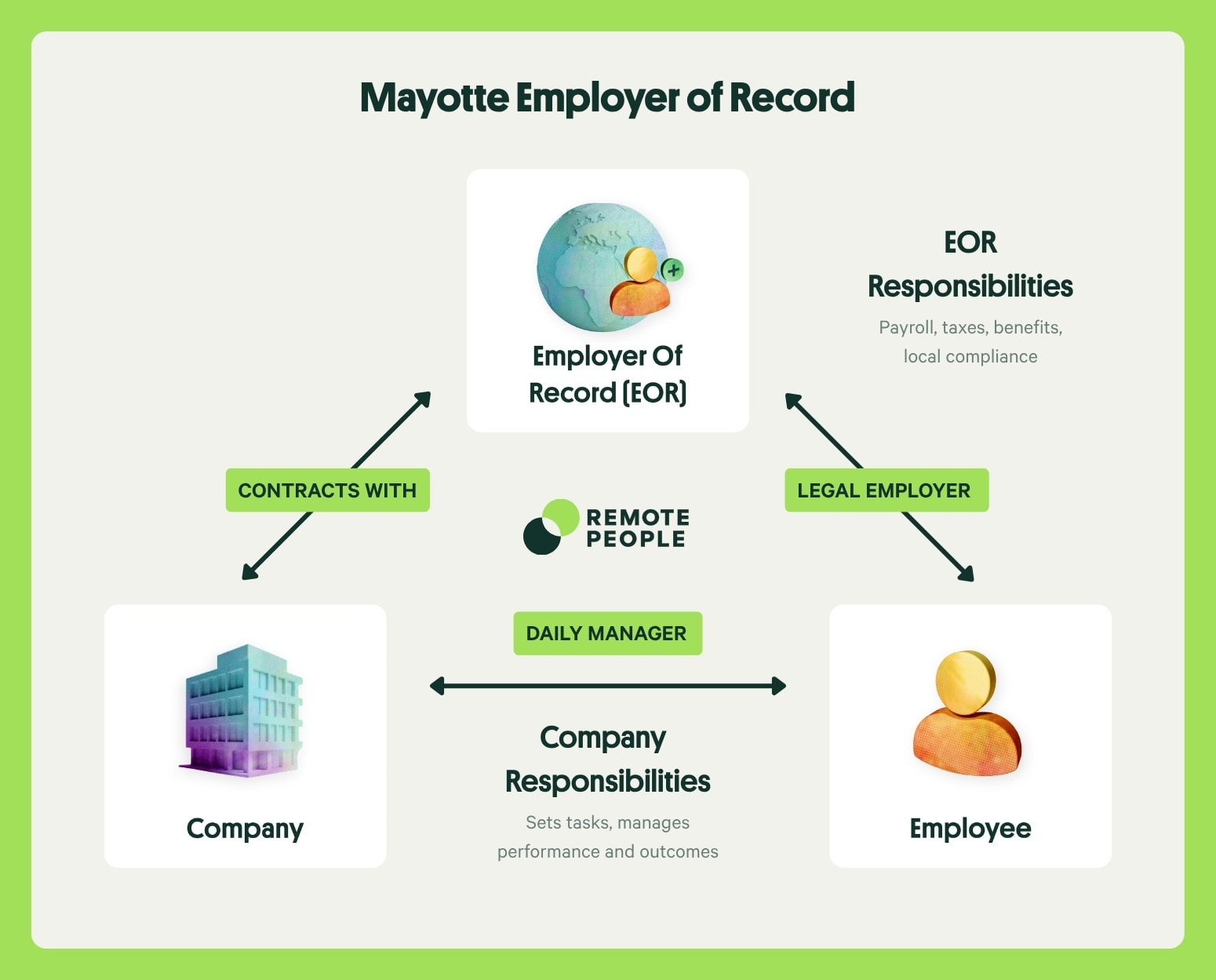
If you’d like to learn more about how Employer of Record (EOR) services work, read our What Is an Employer of Record (EOR)? guide for a complete overview of the model, its benefits, and when to use it.
If you’re comparing providers, our Best Employer of Record (EOR) Providers guide reviews the leading platforms to help you choose the right solution for your business.
Who Uses an EOR in Mayotte?
Mayotte is a small market, roughly 320,000 residents and high unemployment, so most international hiring happens for specific reasons: a single key hire, a post-cyclone reconstruction project, tourism or agriculture roles, or remote work for an EU parent that needs a French-law contract. The EOR model fits all of these because it avoids the cost of registering a French SARL or SAS for a single employee.
- Testing Mayotte before committing to an entity: Companies that want to hire one or two people in Mamoudzou or Dzaoudzi before investing in a French legal presence use the EOR as a compliant trial vehicle.
- Small teams without entity overhead: Any business hiring fewer than 10 employees in Mayotte can run the full headcount through an EOR and skip the Kbis registration, bank account, and accountant fees that come with a local SARL.
- Rapid onboarding for project work: For organisations expanding into Mayotte on short timelines, such as infrastructure or post-Chido reconstruction contracts, the EOR can onboard staff in one to two weeks rather than the months needed to incorporate.
- Non-EU nationals needing a Mayotte work permit: Because a work permit issued in Mayotte is only valid in Mayotte, companies hiring from Comoros, Madagascar, or elsewhere use an EOR to sponsor the long-stay visa and titre de séjour correctly the first time.
Firms with an established French entity in metropolitan France sometimes still prefer an EOR in Mayotte because the Mayotte contribution schedule, SMIC, and working time rules differ from those of the metropolitan parent and require a dedicated payroll stream that the EOR already runs.
Typical Onboarding Timeline
Because Mayotte uses French electronic payroll channels (DSN, Net-Entreprises) and the CSSM processes registrations digitally, onboarding an EU citizen is usually quick. Non-EU hires add a visa layer that can extend the total timeline significantly.
- EOR agreement and employee details: 1–2 days to sign the service agreement and collect the employee’s passport, RIB, and prior employment history.
- Employment contract drafting and review: 2–3 days to draft the French-language contract referencing the relevant convention collective and the Code du travail applicable à Mayotte.
- CSSM and DGFiP registration: 3–7 days for the déclaration préalable à l’embauche (DPAE), CSSM enrolment, and prélèvement à la source rate request.
- Payroll setup and benefits enrolment: 2–3 days to register the employee with the mutuelle, AGIRC-ARRCO, and prévoyance carriers.
- Employee onboarding and first day: 1 day to complete the visite d’information et de prévention (VIP) scheduling and issue the first pay cycle.
Most EOR providers can onboard an EU or French national employee in Mayotte within 1–2 weeks. Non-EU hires requiring a visa long séjour valant titre de séjour typically add 6–12 weeks for the Préfecture de Mayotte process, so plan the total timeline around the immigration file rather than the payroll setup.
Hire in Mayotte
A French legal framework with special Mayotte rates, a 40% income tax reduction for residents, and CSSM-managed social security make Mayotte a distinct hiring environment in the Indian Ocean.
We handle employment contracts, payroll, tax withholding, and full Mayotte compliance.
No local entity needed. Your team can start in days.
Employment Laws and Regulations in Mayotte
Employment Contracts
Employment in Mayotte is governed by the Code du travail applicable à Mayotte, a distinct code maintained on Légifrance that mirrors the metropolitan Code with timing and scope adaptations (Légifrance). The competent regulator is the Direction de l’économie, de l’emploi, du travail et des solidarités (DEETS) of Mayotte, which enforces the labour inspection regime on the island. Contracts must be written in French, identify the collective bargaining agreement (convention collective) covering the role, and state the gross salary in euros, the working time reference, the job classification, and the probation clause. Indefinite contracts (CDI) are the default; fixed-term contracts (CDD) are permitted only for the specific grounds listed in Article L122-1 of the Mayotte code, such as replacement of an absent employee, temporary increase in activity, or seasonal work. A CDD that does not meet those grounds can be requalified as a CDI by the Conseil de prud’hommes.
Working Hours and Overtime
Since 1 January 2019, the legal working time in Mayotte has been 35 hours per week for all employers, regardless of headcount, aligning the department with metropolitan France (Cleiss). Daily working time is capped at 10 hours, weekly hours at 48, and the 12-week rolling average cannot exceed 44 hours. Employees are entitled to 11 consecutive hours of daily rest and 24 consecutive hours of weekly rest, usually taken on Sunday. Management-level cadres on a forfait-jours convention are excluded from the weekly hour caps but remain entitled to the 11-hour daily rest. Overtime is calculated on the weekly 35-hour reference and must be compensated at the premium rates set out in the Mayotte labour code or the applicable convention collective.
The table below summarises the statutory overtime and premium-pay rates that apply as the legal floor. A convention collective can set more generous multipliers, so always check the branch agreement that covers the role.
Mayotte overtime and premium pay rates · Per Code du travail applicable à Mayotte | |||
Hour Type | Rate Multiplier | Cap | Notes |
|---|---|---|---|
Weekday overtime (hours 36–43) | 125% of hourly rate | 220 hours/year default quota | First 8 overtime hours per week. Convention can raise multiplier. |
Weekday overtime (hour 44+) | 150% of hourly rate | Daily cap 10h, weekly cap 48h | Hours above 43 in the same week. |
Night work (9pm–6am) | Premium or compensating rest per convention collective | 8 hours/night max; 40h/week average | Multiplier set by sectoral agreement; no fixed statutory floor. |
Weekly rest day (Sunday) | Premium under convention; commonly 100% surcharge | Exceptional authorisation required | Sunday work permitted only in listed activities or with prefectural authorisation. |
Public holiday work (except 1 May) | Ordinary rate unless convention higher | Hours still count toward 35h/48h caps | Holiday pay usually doubled by collective agreement. |
1 May (Labour Day) | 200% of hourly rate | Only May Day carries a statutory double rate | Double pay is mandatory for all workers required to work on 1 May. |
Total overtime within the statutory contingent annuel is capped at 220 hours per year per employee unless a collective agreement sets a different quota. Hours beyond the contingent trigger an additional contrepartie obligatoire en repos (mandatory compensating rest), and overtime premiums are included in base pay when calculating severance, notice pay in lieu, and the 13th-month bonus where that bonus is set by convention.
Minimum Wage
Mayotte has its own SMIC value, lower than the metropolitan SMIC but converging toward it under a multi-year plan. From 1 January 2026 the gross hourly SMIC in Mayotte is EUR 9.33, equivalent to EUR 1,415.05 per month on the 35-hour legal week, a 3.9% increase over the 2025 level of EUR 8.98 per hour / EUR 1,361.97 per month (Cleiss). The government has committed to bring the Mayotte net minimum wage to 87.5% of the metropolitan net SMIC by the end of the current convergence cycle. Employers cannot pay below the SMIC under any circumstance; a convention collective may set a conventional minimum that is higher, and the branch minimum applies if it is more favourable than the SMIC. Public-sector trainees, apprentices, and youth hires under specific state-aided contracts can be paid at a percentage of the SMIC set by the scheme’s decree.
Probation Period
The probation period (période d’essai) in Mayotte follows the Code du travail applicable à Mayotte and any convention collective. The statutory maxima for a CDI are two months for employees (ouvriers and employés), three months for technicians and supervisors (agents de maîtrise et techniciens), and four months for cadres, with one renewal of equal length possible if the convention collective authorises it and the employee consents in writing. For a CDD, the period cannot exceed one day per week of contract up to two weeks (for contracts under six months) or one month (for contracts of six months or more). During probation either party may terminate without cause, subject to a short délai de prévenance of 24 hours to 1 month depending on how much time has been served.
Leave Entitlements
Mayotte’s statutory leave regime largely mirrors metropolitan France with timing adaptations introduced by the département’s convergence decrees and by CSSM indemnisation rules. The key leave types every employer needs to track are set out in the sub-sections below.
Annual Leave
Employees acquire 2.5 working days of paid annual leave (congés payés) for each full month of work, producing a statutory entitlement of 30 working days , five weeks , per complete reference year (Légifrance). The reference year runs from 1 June to 31 May. Leave begins accruing from the first day of work and continues during probation. Unused leave at the end of the reference period is generally lost unless the employer prevented the employee from taking it, in which case it must be carried over or paid out. Pay during leave is calculated under the règle du maintien de salaire or the règle du dixième (10% of the remuneration earned during the reference period), whichever is more favourable to the employee.
Sick Leave
Sick leave (arrêt maladie) requires a medical certificate sent to CSSM within 48 hours. CSSM pays indemnités journalières (IJ) equal to 50% of the daily reference wage from day four onward, subject to a statutory ceiling tied to the Mayotte plafond de la sécurité sociale (CSSM). The employer tops up pay under the Mayotte legal maintenance of salary rules or a more favourable convention collective, typically to 90% of gross pay for the first 30 days and 66.66% for the next 30 days, after one year of service. Coverage duration is 360 days over a rolling three-year period.
Maternity Leave
Maternity leave (congé de maternité) in Mayotte is 16 weeks for a first or second child: 6 weeks prenatal and 10 weeks postnatal. It extends to 26 weeks for a third child and to 34 weeks for twins. CSSM pays the indemnités journalières de maternité at 100% of the capped daily reference wage for the whole period, and employment protection prevents termination from the start of the medically certified pregnancy through the end of the ten weeks following return (CSSM). Dismissal during this period is void unless the employer can prove serious misconduct unrelated to pregnancy, or impossibility to maintain the contract for unrelated reasons.
Paternity Leave
Paternity and birth-partner leave (congé de paternité et d’accueil de l’enfant) in Mayotte is 25 calendar days for a single birth and 32 days for multiple births, structured as a mandatory 4-day segment immediately following the 3-day birth leave, plus an elective 21 days (or 28 for multiples) to be taken within the six months after birth. CSSM pays the indemnité journalière at the capped daily rate, and employment protection applies for 10 weeks after birth in the same way as for the mother (Service Public).
Other Statutory Leave
Beyond the headline entitlements, the Mayotte code and the main conventions collectives provide several shorter leaves. These are paid by the employer unless indicated, and may be topped up by the branch agreement.
- Marriage or PACS: 4 days for the employee’s own marriage or PACS, 1 day for a child’s marriage.
- Bereavement: 5 days for the death of a child (7 if the child was under 25), 3 days for the death of a spouse or parent.
- Parental leave: Up to 3 years unpaid following a birth or adoption, with job protection on return.
- Child’s illness: 3 unpaid days per year (5 if the child is under one or if the employee has three or more children under 16).
- Training and CPF: Unpaid leave for training actions outside working hours under the Compte Personnel de Formation.
The table below consolidates every statutory leave entitlement a Mayotte employer must recognise, drawing directly on the Code du travail applicable à Mayotte and CSSM indemnisation rules. The single most important takeaway is that annual leave accrues from day one of employment, before probation ends, so even short-tenure staff build up entitlement that becomes payable on exit.
Mayotte statutory leave entitlements · Per Code du travail applicable à Mayotte | ||
Leave Type | Duration | Eligibility and Notes |
|---|---|---|
Annual leave (congés payés) | 2.5 working days per month, up to 30 days/year | Accrues from first day of work. Reference year 1 June–31 May. Paid by employer. |
Sick leave | Up to 360 days over 3 years | CSSM pays IJ at 50% from day 4; employer top-up per convention after 1 year service. |
Maternity leave | 16 weeks (1st/2nd child); 26 weeks (3rd+); 34 weeks (twins) | 6 weeks prenatal, 10 postnatal. CSSM pays 100% capped. Dismissal protected period. |
Paternity / birth-partner leave | 25 days (single) / 32 days (multiple) | 3-day birth leave + 4-day mandatory segment + 21/28 elective days within 6 months. |
Marriage or PACS leave | 4 days own / 1 day child’s | Paid by employer. Must be taken at the time of the event. |
Bereavement leave | 3–7 days depending on relationship | 5 days for death of child (7 if under 25); 3 days for spouse or parent. Paid by employer. |
Child’s illness leave | 3 days/year (5 if child under 1 or 3+ children) | Unpaid unless convention states otherwise. Medical certificate required. |
Parental leave | Up to 3 years | Unpaid. Job protection. Possible PreParE benefit from CSSM/CAF. |
Statutory Employee Benefits
On top of paid leave and CSSM social contributions, Mayotte employers must provide a short list of mandatory benefits. Because the regime is converging toward metropolitan France, more benefits have become compulsory in the last five years and the 2012 convergence decree will continue to add items through 2036.
- Mandatory complementary health insurance (mutuelle): Employers must offer and co-fund a complementary health scheme for all employees, paying at least 50% of the premium. This is additional to the basic CSSM coverage.
- Complementary pension (AGIRC-ARRCO): Enrolment in the national AGIRC-ARRCO scheme is mandatory for all private-sector employees in Mayotte, with contributions shared roughly 60% employer / 40% employee on top of the basic CSSM pension.
- Provident cover (prévoyance) for cadres: Cadres must be enrolled in a prévoyance scheme funded by a 1.50% employer contribution on the tranche A portion of pay, covering death, disability, and long-term illness.
- AGS employer guarantee: The 0.25% AGS contribution funds the wage guarantee fund that pays employees in case of employer insolvency; see Table 1 for the exact rate.
- Occupational health: Employers must register with a service de santé au travail for pre-employment medical checks (visite d’information et de prévention) and ongoing occupational health follow-up.
Exact contribution percentages for CSSM-managed items are shown in Table 1 (employer) and Table 2 (employee) below. AGIRC-ARRCO rates are set nationally by the scheme and apply identically to Mayotte.
Recent Regulatory Updates 2026
The most significant 2026 change is the 3.9% increase to the Mayotte SMIC from 1 January, bringing the gross hourly minimum to EUR 9.33 and confirming the convergence path set out in the government’s multi-year plan. The Mayotte plafond de la sécurité sociale, which caps the base on which several contributions are calculated, was also revalued on 1 January 2026 in line with the metropolitan plafond plus the 5.1 point Mayotte uplift provided for in Décret n° 2010-1326.
Beyond the minimum wage and social security ceiling, the broader context is the continued post-cyclone reconstruction: Cyclone Chido caused severe disruption in December 2024, and a dedicated exceptional unemployment scheme and a targeted reduction of employer charges (les-aides.fr) remain in force for 2026. The AT-MP net average rate for Mayotte for 2025 was set at 2.12% by the arrêté of 29 April 2025, and no formal change has been published for 2026 as of April 2026 , the 2025 rate therefore continues to apply until a new arrêté is taken.
Work Permits and Visas in Mayotte
Work Permit Requirements
Who Needs a Work Permit
French and EU/EEA/Swiss nationals do not need a work permit to work in Mayotte; they benefit from free movement and free access to the Mayotte labour market. All other nationals, including citizens of the neighbouring Comoros and Madagascar, need a long-stay visa valant titre de séjour with a work authorisation annotation. Critically, a titre de séjour issued by any overseas department is territorially limited: a permit delivered for Mayotte is not valid for work in mainland France, and vice versa (Légifrance Art. L330-3).
Eligibility and Required Documents
To obtain a Mayotte work permit the employer must file an authorisation request with DEETS Mayotte supported by the signed CDI, proof that the role was posted unsuccessfully on Pôle emploi or is on the Mayotte shortage occupation list, and the employer’s up-to-date URSSAF/CSSM registrations. The employee provides a valid passport, a medical certificate from OFII, criminal background check, and apostilled qualifications where the role requires them. For Passeport Talent candidates (highly skilled hires), salary must exceed the threshold set nationally (1.8 times the SMIC for most categories).
Processing Time and Validity
A standard VLS-TS salarié or travailleur temporaire file takes 8–12 weeks from DEETS submission to visa delivery at the French consulate. The initial permit is valid for one year and the employee must validate it with OFII within 3 months of arrival to convert it into a residence permit. Delays are caused most often by incomplete convention collective justifications, missing proof of local recruitment attempts, or backlogs at the Préfecture de Mayotte during peak season.
Renewal Process
Renewal applications must be filed at the Préfecture de Mayotte no later than two months before the permit expires. The employer provides a renewal attestation of ongoing employment, the latest URSSAF/CSSM attestations, and proof that wages remain at or above the regulated floor. The employee can continue working during the renewal processing if a récépissé is issued, which is standard practice. Multi-year permits (up to 4 years) become available after the first renewal for Passeport Talent holders.
Common Visa Types for Foreign Workers
The French authority competent for Mayotte visas is the French consulate in the employee’s country of residence, working in cooperation with DEETS Mayotte for labour authorisations and the Préfecture de Mayotte for residence permits. An EOR can sponsor the VLS-TS salarié, the VLS-TS travailleur temporaire and the VLS-TS Passeport Talent categories in its name; it cannot sponsor intra-company transfer (ICT) permits for its clients because the ICT visa requires the sending group and receiving employer to be part of the same corporate group.
Mayotte work visa types for foreign workers · 2026 | ||||
Visa Type | Duration | Best For | Leads to APT? | Processing |
|---|---|---|---|---|
VLS-TS Salarié (CDI/long CDD) | 1 year, renewable | Standard CDI hires paid above SMIC | Yes, after 5 years | 8–12 weeks |
VLS-TS Travailleur Temporaire | Up to 12 months | CDD or fixed-term project work | No (not a pathway) | 8–10 weeks |
Passeport Talent – Salarié Qualifié | Up to 4 years | Highly skilled hires paid > 1.8× SMIC | Yes, fast-track to APT | 6–10 weeks |
Passeport Talent – Salarié en Mission | Up to 4 years | Intra-group secondment with group affiliation | Yes | 8–12 weeks |
ICT (Salarié Détaché ICT) | Up to 3 years (1 for trainees) | Intra-company transfer from a non-EU group entity | No (specific route) | 10–12 weeks |
- Short-stay Schengen visa (type C): Not valid for employment; business meetings only.
- Visitor visa (VLS-TS Visiteur): Does not authorise employment.
- Student visa (VLS-TS Étudiant): Permits only limited student work (964 hours per year), not full-time employment.
How an EOR Handles Work Permits
For VLS-TS Salarié, VLS-TS Travailleur Temporaire and most Passeport Talent categories the EOR can act as the sponsoring employer: it files the DEETS authorisation, provides the employment contract the employee will rely on in the consulate, and supports the OFII medical and validation process on arrival. The EOR holds the titre de séjour file, runs the renewal at month 10, and handles any change of address or contract amendment that must be notified to the Préfecture. Because the permit is Mayotte-specific, any relocation off the island requires a new regional work authorisation, which the EOR cannot process if its entity is not registered there. As noted in H3 1.4, a visa file adds 6–12 weeks to the onboarding timeline set out for EU/French hires.
Payroll, Taxes, and Social Security in Mayotte
Employer Contributions
Employer contributions in Mayotte are set by Décret n° 2012-1168 and the annual arrêtés for AT-MP and unemployment. The schedule below reflects rates in force on 1 January 2025 as published by Cleiss and URSSAF, and continues to apply in 2026 absent a new published arrêté.
Mayotte employer social security contributions · 2026 rates | ||
Contribution | Rate | Notes |
|---|---|---|
Old-age pension (Vieillesse) | 9.90% | On earnings up to the Mayotte plafond (EUR 2,821/month in 2025). |
Health-maternity, invalidity-death | 5.10% | On total gross salary. |
Family allowances | 5.40% | On earnings up to Mayotte plafond. |
AT-MP (work accidents) | Variable, 2.12% national average | Rate set per activity by annual arrêté; 2025 arrêté dated 29 April 2025. |
Unemployment insurance | 2.80% | On earnings up to EUR 4,728/month. |
AGS (wage guarantee) | 0.25% | Funds salary guarantee in employer insolvency cases. |
Versement mobilité | 0.60%–1.50% | Transport tax, varies by local authority. |
Dialogue social | 0.016% | Funds employer-union dialogue bodies. |
FNAL (housing fund) | 0.10% (<50 staff) / 0.50% (50+) | <50 capped at Mayotte plafond; 50+ on total salary. |
Vocational training | 0.55% (<11) / 1.00% (11+) | Funds CPF and branch training. |
Apprenticeship tax (part + solde) | 0.59% + 0.09% | Main part finances apprenticeship; solde finances initial tech education. |
Total employer contributions | 28.016% – 29.366% | Excludes AGIRC-ARRCO and sector-specific prévoyance. |
Employee Contributions
Employee deductions in Mayotte are lighter than in mainland France because the department does not yet apply the full CSG/CRDS rate schedule and the unemployment employee contribution has been abolished since 2019. The effective total is 10.30% before AGIRC-ARRCO.
Mayotte employee payroll deductions · 2026 monthly withholdings | ||
Deduction | Rate | Notes |
|---|---|---|
Old-age pension (Vieillesse) | 5.43% | Capped at Mayotte plafond (EUR 2,821/month in 2025). |
Health-maternity contribution | 0.75% | On total gross salary. |
Additional Mayotte contributions (CSG/CRDS equivalent) | 4.12% | On total gross salary, included in the 4.87% health/invalidity line. |
Unemployment insurance (employee) | 0.00% | Abolished from 1 January 2019. |
Total employee deductions | 10.30% | Excludes AGIRC-ARRCO (approx. 4% employee share). |
Income Tax
Mayotte applies the French national income tax (impôt sur le revenu) using the same progressive brackets as mainland France, as confirmed by the Bulletin officiel des finances publiques (BOFiP). Mayotte residents then benefit from a 40% reduction of the calculated tax, capped at EUR 4,050 per household, which is more generous than the 30% reduction available in Guadeloupe, Martinique and Réunion. Income tax is collected monthly through prélèvement à la source (PAS) at the rate communicated to the employer by the DGFiP.
Mayotte income tax brackets · 2026 (2025 income, French national barème) | |
Bracket | Tax Calculation |
|---|---|
Up to EUR 11,497 | 0% (tax-free allowance) |
EUR 11,498 – EUR 29,315 | 11% |
EUR 29,316 – EUR 83,823 | 30% |
EUR 83,824 – EUR 180,294 | 41% |
Over EUR 180,294 | 45% |
Mayotte resident reduction | −40% of tax, capped at EUR 4,050 |
Payroll Cycle
Payroll in Mayotte is monthly and settled in euros by SEPA transfer. Pay slips (bulletin de paie) must comply with the simplified bulletin format in use across France since 2018, listing gross pay, every CSSM/URSSAF contribution line, the PAS withholding, and the net-to-pay. DSN filings are due monthly via Net-Entreprises, with the CSSM contribution payment deadline on the 15th of the following month for employers with under 50 staff and the 5th for larger employers. Declaration préalable à l’embauche (DPAE) must be filed at the latest 8 days before the first day of work. Paper payslips are permitted but electronic delivery is the default unless the employee opts out in writing.
13th Month Salary and Bonus Pay
There is no universal statutory 13th-month salary (prime de treizième mois) in Mayotte or in metropolitan France; it is only mandatory where the convention collective or an individual contract provides for it. Several major conventions covering Mayotte employers, such as banking, insurance, and pharmacy retail, include a 13th-month payment by industry practice. Where it applies, the 13th month is typically equal to one month’s base salary, paid in full in December or split into two instalments in June and December, and is subject to ordinary social contributions and PAS. Prorata rules for new joiners and leavers are defined in each convention. Profit-sharing (participation) is mandatory for employers with 50 or more staff, and intéressement is optional but widespread.
Cost of Hiring Through an EOR in Mayotte
EOR Service Fees
EOR service fees in Mayotte typically range from USD 300 to USD 600 per employee per month, covering employment contract drafting, monthly payroll through CSSM and URSSAF, French tax withholding, benefits enrolment, leave tracking, and termination support. Higher-end fees usually include work permit sponsorship for non-EU hires and convention collective research where the sector is heavily regulated. Providers quoting below USD 200 per employee often exclude visa support, prévoyance setup, or termination handling, so compare scope carefully.
Total Employment Cost Breakdown
The table below takes a USD 4,000 monthly gross example and layers on the CSSM/URSSAF employer contributions at the mid-point of the 28.016%–29.366% range, the AGIRC-ARRCO complementary pension employer share (approx. 6%), and a mid-range EOR fee. All figures are in USD at an indicative rate of USD 1.00 ≈ EUR 0.92. Actual payroll is paid in euros.
Mayotte employer cost example · USD 4,000 gross · 2026 | ||
Employer Cost Line | Amount (USD) | % of Gross |
|---|---|---|
Gross monthly salary | $4,000.00 | 100.00% |
Old-age pension employer (9.90%) | $396.00 | 9.90% |
Health-maternity-invalidity (5.10%) | $204.00 | 5.10% |
Family allowances (5.40%) | $216.00 | 5.40% |
AT-MP (2.12%) | $84.80 | 2.12% |
Unemployment + AGS (2.80% + 0.25%) | $122.00 | 3.05% |
Versement mobilité, FNAL, dialogue social, formation, apprentissage | $102.40 | 2.56% |
AGIRC-ARRCO employer share (~6%) | $240.00 | 6.00% |
EOR service fee (est.) | $450.00 | 11.25% |
Total monthly employer cost | $5,815.20 | 145.38% |
Figures converted at USD 1.00 ≈ EUR 0.92, April 2026. AGIRC-ARRCO employer share estimated at 6% on tranche 1.
At the mid-range, total employer cost in Mayotte lands at roughly 45% above the gross salary once CSSM/URSSAF contributions, AGIRC-ARRCO, and an EOR fee are included. This is meaningfully lower than the 55–58% all-in cost typical in metropolitan France, reflecting the reduced Mayotte schedule. Ready to hire in Mayotte? Get started with RemotePeople and we will handle employment contracts, payroll, CSSM registration, tax withholding, and full Mayotte compliance , no local entity needed.
Benefits of Using an EOR in Mayotte
Mayotte’s French-law framework is familiar on paper but differs in dozens of Mayotte-specific decrees, rates, and dates. An EOR converts that complexity into a monthly invoice and a single service contract. The five to seven benefits below are the ones that come up most often in client scoping conversations.
- Speed to market: Hire your first Mayotte employee in 1–2 weeks rather than the 3–6 months required to register a French SARL, open a bank account, and enrol with URSSAF and CSSM from scratch.
- Compliance assurance: The EOR keeps the monthly DSN filings, the CSSM registrations, the AT-MP annual rate updates, and the PAS tax withholding running correctly under the Code du travail applicable à Mayotte so your team is not exposed to URSSAF audits.
- Cost efficiency vs local entity: Avoid the EUR 15,000–EUR 30,000 setup cost and recurring accountant, audit, and tax counsel fees that come with running a SARL in Mamoudzou for a small headcount.
- Local expertise on Mayotte derogations: Mayotte’s SMIC, plafond, AT-MP rate, and AGS contribution each follow distinct arrêtés every year. The EOR tracks those updates so you do not have to learn the convergence calendar.
- Scale up or down without restructuring: Hire a single employee for a project, scale to ten for a reconstruction contract, then wind down without dissolving a French legal entity.
- Risk mitigation on terminations: The EOR runs the entretien préalable, the statutory notice, and the severance calculation so you avoid the dommages-intérêts claims that follow procedural errors at the Conseil de prud’hommes.
- Consistent employee experience: Employees receive a French-law contract, a standard bulletin de paie, access to mutuelle and AGIRC-ARRCO benefits, and paid leave at the same cadence they would get from any local employer.
For most companies hiring one to fifteen people in Mayotte, the EOR model is the only option that combines 1–2 week onboarding with full French-law compliance. Talk to RemotePeople to scope your hire.
Termination and Offboarding in Mayotte
Notice Periods
Notice periods (délai-congé or préavis) in Mayotte are set by the Code du travail applicable à Mayotte and by the applicable convention collective (Légifrance). The statutory floor applies when the convention is silent or less favourable. Notice may be paid in lieu (indemnité compensatrice de préavis) if the employer asks the employee to leave immediately, and the period is identical for dismissal and resignation unless the convention differs. Employees dismissed for gross misconduct (faute grave) or gross negligence (faute lourde) lose their right to notice and severance.
Mayotte statutory notice periods by tenure · Per Code du travail applicable à Mayotte | |||
Tenure | Notice Period | During Probation | Notes |
|---|---|---|---|
Less than 6 months | Per convention collective (often 1–2 weeks) | 24h to 2 weeks (prévenance) | No statutory floor; defaults to branch agreement or usages professionnels. |
6 months to 2 years | 1 month (calendar) | Not applicable (probation ended) | Statutory floor under Mayotte code. |
2 years or more | 2 months (calendar) | Not applicable | Statutory floor; many conventions set 3 months for cadres. |
Cadres (managerial) | 3 months (per Syntec, most cadre conventions) | Up to 1 month prévenance during probation | Set by cadre convention; applies regardless of tenure. |
Collective redundancy (PSE) | Per tenure tier above | Not applicable | Additional consultation and DEETS notification obligations apply. |
Termination by mutual agreement (rupture conventionnelle) bypasses the notice period and requires a homologation by DEETS. Fixed-term contracts (CDD) cannot be terminated before term except for gross misconduct, force majeure, mutual agreement, incapacity, or the employee finding a CDI elsewhere. Early termination by the employer outside these grounds entitles the employee to compensation equal to the remaining wages until the end of the CDD.
Severance Pay
Severance (indemnité légale de licenciement) is owed to any employee on a CDI dismissed for personal or economic reasons (other than faute grave or lourde) who has at least 8 months of continuous service with the same employer (Service Public). The formula is set directly in the Mayotte labour code and in the national service public reference. Collective agreements frequently set higher floors, so the convention collective should always be consulted first. Severance is exempt from income tax and social contributions up to a cap defined by the tax code; amounts above the cap are taxed.
Mayotte severance pay schedule by years of service · Per Code du travail applicable à Mayotte | |||
Years of Service | Severance Amount | Base Salary | Notes |
|---|---|---|---|
Less than 8 months | None | N/A | Eligibility threshold not met; convention may differ. |
1 year | ¼ month salary = 0.25 × salaire de référence | Higher of last 12m average or last 3m average | At EUR 2,500 base: approx. EUR 625. |
3 years | ¾ month salary = 0.75 × base | Same base definition | At EUR 2,500 base: approx. EUR 1,875. |
5 years | 1.25 months salary | Same base definition | At EUR 2,500 base: approx. EUR 3,125. |
10 years | 2.5 months salary (¼ × 10) | Same base definition | At EUR 2,500 base: approx. EUR 6,250. |
15 years | 4.17 months salary (¼ × 10 + ⅓ × 5) | Same base definition | At EUR 2,500 base: approx. EUR 10,417. |
20 years | 5.83 months salary | Same base definition | At EUR 2,500 base: approx. EUR 14,583. |
Calculation Method
The legal formula pays ¼ month of salary per year of service for the first 10 years, then ⅓ month per year from year 11 onward. Partial years are pro-rated to the nearest month. The reference salary (salaire de référence) is the higher of the average of the last 12 months’ gross pay or one third of the last three months’ gross pay, with one-off premiums counted pro rata. Table 13 shows the worked examples across standard tenure tiers.
Caps and Exceptions
There is no hard statutory cap on legal severance, but the tax and social exemption has limits set annually by the finance law. Faute grave and faute lourde eliminate entitlement entirely. Fixed-term contracts ending at their term instead generate a precarity indemnity (indemnité de fin de contrat) equal to 10% of total gross earnings during the CDD, unless the contract is transformed into a CDI or the employee refuses a CDI offered at the same conditions.
Grounds for Termination
Dismissal in Mayotte requires a cause réelle et sérieuse, either personal (faute, insuffisance professionnelle, inaptitude) or economic (difficultés économiques, mutations technologiques, reorganisation needed to safeguard competitiveness). The procedure always includes a written summons to an entretien préalable, the interview itself at least 5 working days after the summons, and a dismissal letter sent at least 2 working days after the interview. Protected categories , pregnant employees, employees on sick leave for work accidents, staff representatives , have additional barriers and often require DEETS authorisation. Redundancies of 10+ employees within 30 days trigger the plan de sauvegarde de l’emploi (PSE) regime with consultation and DEETS homologation obligations.
EOR vs. Other Hiring Models in Mayotte
EOR vs. Setting Up a Local Entity
Mayotte EOR vs local entity comparison · Setup time, cost, risk and best-fit | ||
Comparison | Employer of Record | Own Entity (SARL / SAS) |
|---|---|---|
Setup time | 1–2 weeks | 3–6 months |
Upfront cost | $0 | $15,000–$30,000 |
Ongoing cost | $300–$600/employee/month | $8,000–$15,000/year maintenance |
Local partner required | No (EOR is the local entity) | No (but local accountant and registered office required) |
CSSM / URSSAF registration | Handled by EOR | You manage it |
Payroll and tax filing (DSN) | Handled by EOR | You manage it or outsource to a cabinet comptable |
Best for team size | 1–15 employees | 15+ employees |
Scale down / exit | Easy , no entity to unwind | Costly , dissolution and radiation process |
Government contracts | Not eligible | Eligible (requires Kbis and local entity) |
Source: URSSAF Mayotte and Service Public – IR | ||
For companies expecting fewer than ten hires in Mayotte over the next 24 months, the EOR is almost always the cheaper option once entity setup, accountant fees, and the time value of delayed hiring are included. The break-even point shifts in favour of a local SARL once headcount exceeds roughly 15 employees and the company plans to stay long-term.
A local entity is the only route when bidding for Mayotte government contracts, operating a physical retail presence, or when the parent company has strategic reasons to hold French IP through a Mayotte-domiciled vehicle. In those cases, many clients still start with an EOR to hire the first few people during the 3–6 months needed to register the SARL, then migrate staff to the entity once it is ready.
EOR vs. Hiring Independent Contractors
Mayotte EOR vs independent contractors · Compliance, cost, and risk | ||
Comparison | EOR (Full-Time Employee) | Independent Contractor |
|---|---|---|
Legal relationship | Employee of the EOR under French law | Self-employed, no employment relationship |
Compliance risk | Low , EOR ensures Mayotte labour compliance | Salariat déguisé risk if the relationship looks like employment |
Payroll and tax | EOR handles withholding, CSSM, URSSAF, PAS | Contractor invoices; handles own auto-entrepreneur or micro-entreprise |
Benefits and leave | Mutuelle, AGIRC-ARRCO, paid leave, CSSM coverage | None entitled; self-funds personal insurance |
IP protection | Stronger , contract assigns IP to client company by default | Weaker , requires explicit IP assignment clause |
Termination | Subject to Mayotte notice and severance rules | Contract ends per its terms |
Best for | Long-term, core roles with set schedule | Short-term projects with defined deliverables |
Cost structure | Salary + ~35% employer contributions + EOR fee | Contractor fee (usually higher gross, lower total) |
France’s test for misclassification (salariat déguisé) uses the three criteria of subordination, integration into the workforce, and exclusivity. Mayotte courts apply the same test, and the Conseil de prud’hommes can requalify a contractor relationship as a CDI with retroactive effect. Consequences include back-payment of the full contribution differential over the last three years, damages for the absence of paid leave and notice, and criminal penalties under the dissimulation d’emploi salarié regime.
Contractors are only appropriate in some cases such as short, project-based engagements with measurable deliverables, independent freelancers serving multiple clients, or specialist roles that genuinely lack subordination. For long-term, full-time arrangements, the EOR route is the compliant path. RemotePeople can set up either under our contractor management or employer of record solutions.
EOR vs. PEO (Professional Employer Organization)
Mayotte EOR vs PEO comparison · Legal employer, liability, and setup | ||
Comparison | Employer of Record (EOR) | PEO |
|---|---|---|
Legal employer | EOR is the legal employer | You remain the legal employer (co-employment) |
Local entity required | No , the EOR is the local entity | Yes , you must have your own entity in Mayotte |
Best for | Companies without a local entity | Companies that already have a French SARL / SAS in Mayotte |
Compliance liability | EOR assumes Mayotte compliance responsibility | Shared liability between you and the PEO |
Setup time | 1–2 weeks | Depends on your entity setup (3–6 months for new SARL) |
Control over HR policies | EOR manages within Mayotte law framework | More direct control; PEO advises |
Typical use case | Market entry, small remote teams, testing new markets | Established local operations needing HR outsourcing |
The PEO model does not exist as a formal regulated category in France, including Mayotte. What international buyers call a PEO in Mayotte is, in practice, a payroll-and-HR outsourcing service (tiers déclarant or cabinet de paie) on top of a client-owned SARL. It only works if you have already invested the 3–6 months to register that SARL and open a CSSM/URSSAF account.
The EOR model is the route for companies without a Mayotte entity who want to hire immediately. The two models can also be sequenced: start with an EOR to hire during the months the SARL is being registered, then migrate staff to your own entity and outsource payroll to a tiers déclarant.
Public Holidays in Mayotte
Mayotte observes the eleven French national public holidays plus an additional department-specific holiday on 27 April commemorating the abolition of slavery, enacted in Mayotte in 1847, a year before other French colonies. Muslim religious holidays (Eid al-Fitr, Eid al-Adha, Mawlid) are widely observed locally but are not statutory public holidays under the French public holiday regime , they are commonly recognised by convention collective and by employer custom, with dates that move each year with the Islamic calendar.
Mayotte public holidays · 2026 calendar year | ||
Date | Holiday | Type |
|---|---|---|
Thursday, 1 January 2026 | New Year’s Day (Jour de l’An) | National |
Monday, 6 April 2026 | Easter Monday (Lundi de Pâques) | National (movable) |
Monday, 27 April 2026 | Abolition of Slavery in Mayotte | Department-specific |
Friday, 1 May 2026 | Labour Day (Fête du Travail) | National – paid double if worked |
Friday, 8 May 2026 | Victory in Europe Day | National |
Thursday, 14 May 2026 | Ascension Day | National (movable) |
Monday, 25 May 2026 | Whit Monday (Lundi de Pentecôte) | National (movable) |
Tuesday, 14 July 2026 | Bastille Day (Fête Nationale) | National |
Saturday, 15 August 2026 | Assumption (Assomption) | National |
Sunday, 1 November 2026 | All Saints’ Day (Toussaint) | National |
Wednesday, 11 November 2026 | Armistice Day 1918 | National |
Friday, 25 December 2026 | Christmas Day (Noël) | National |
Only 1 May is statutorily paid double if worked. Other holidays falling on a working day are paid but can be worked where the convention collective allows. Bridge days (faire le pont) between a holiday and the weekend are negotiable with the employer and do not count as statutory rest.
How to Get Started with an EOR in Mayotte
- First, define the role and the employee: Confirm the job description, gross monthly salary in euros, start date, and whether the hire is an EU national, a French citizen, or a non-EU candidate who will need a Mayotte work permit.
- Second, request a Mayotte quote: Share the gross salary and benefits expectation. The EOR returns a fully loaded monthly cost including CSSM/URSSAF contributions, AGIRC-ARRCO, and the service fee.
- Third, sign the EOR service agreement: Once commercial terms are agreed, the EOR issues the service contract and collects your authorisation to draft the employee’s French-law contract.
- Fourth, onboard the employee: The EOR drafts the CDI or CDD, runs the DPAE with CSSM, enrols the employee with the mutuelle and AGIRC-ARRCO, and files any work permit request with DEETS Mayotte.
- Fifth, manage the ongoing relationship: The EOR runs monthly payroll, DSN filings, PAS withholding, leave tracking, and any termination or renewal procedures. You manage day-to-day direction of the work.
Ready to hire in Mayotte without setting up a local entity? Get in touch with RemotePeople for a same-day quote and 1–2 week onboarding.
Where companies hiring in Mayotte expand next
Hiring in Mayotte frequently leads to recruitment across East Africa’s English-speaking cluster and the wider Indian Ocean corridor. Many companies add a team in Tanzania first, drawing on the regional East African talent pool. Operations in Rwanda follows as aligned East African English-first hiring profile, while Kenya offers shared East African workforce norms. Hiring in Uganda is often the fourth step, valued for overlapping East African talent profile.
Frequently Asked Questions
EOR services in Mayotte typically cost between USD 300 and USD 600 per employee per month, depending on scope. The fee covers French-law contract drafting, monthly payroll through CSSM and URSSAF, PAS income tax withholding, mandatory mutuelle and AGIRC-ARRCO enrolment, leave tracking, and termination support. Higher tiers add work permit sponsorship for non-EU hires. This is on top of the employee's gross salary and the ~28–29% CSSM/URSSAF employer contributions plus AGIRC-ARRCO.
For French or EU nationals, onboarding usually takes 1–2 weeks from signed service agreement to first day of work, covering contract drafting, DPAE, CSSM registration, and benefits enrolment. For non-EU hires who need a long-stay work visa, add 6–12 weeks for the DEETS labour authorisation, consulate processing, and OFII validation on arrival.
Yes. A Mayotte EOR operates under the Code du travail applicable à Mayotte, registered with CSSM and URSSAF, and issues French-law CDI or CDD contracts that comply with the department's specific rules. Compliance scope covers working time, SMIC, leave entitlements, notice periods, severance calculation, and termination procedure. Penalties for non-compliance stay with the EOR, not the end client.
Mayotte applies France's progressive income tax brackets: 0% up to EUR 11,497, 11% from EUR 11,498 to EUR 29,315, 30% from EUR 29,316 to EUR 83,823, 41% from EUR 83,824 to EUR 180,294, and 45% above. Mayotte residents then receive a 40% tax reduction capped at EUR 4,050 per household. Income tax is withheld at source (prélèvement à la source) by the employer each month at the rate the DGFiP communicates.
Total employer contributions in Mayotte run between 28.016% and 29.366% of gross pay depending on headcount and versement mobilité rate, according to URSSAF Mayotte and Cleiss. Major lines are old-age pension at 9.90%, health-maternity at 5.10%, family allowances at 5.40%, AT-MP averaging 2.12%, unemployment at 2.80% and AGS at 0.25%. AGIRC-ARRCO complementary pension adds roughly 6% on top for most roles.
Not by statute. A 13th-month payment is only mandatory in Mayotte where a convention collective or individual contract provides for it. Several sectoral agreements, such as banking, insurance, and parts of retail, do include it, typically equal to one month's base salary paid in December. Where it applies, the payment is subject to ordinary social contributions and income tax withholding.
Under French law, which applies in Mayotte, IP created by an employee in the course of their duties is assigned by default to the client company (you), not the EOR. The employment contract contains the standard clause de cession de droits required to make the assignment watertight, and the EOR structures the commercial agreement so that the client company (you), not the EOR, holds all software, design, and creative rights.
You can, but only where the relationship is genuinely independent. French misclassification law (salariat déguisé) applies in Mayotte, and the Conseil de prud'hommes can requalify a contractor into a CDI with three years of back contributions plus damages. For long-term full-time roles, the EOR route is the compliant option. RemotePeople offers a dedicated contractor management solution for cases where a contractor arrangement genuinely fits – get in touch to scope the right structure.
Employer of Record in
Employer of Record in
Employer of Record in
Employer of Record in
Employer of Record in
Employer of Record in
Employer of Record in
Employer of Record in