
 Recruit
Employer of Record in Rwanda
-
 Drew Donnelly
- Published
- September 22, 2026
RemotePeople’s employer of record in Rwanda lets you hire employees in Rwanda with streamlined RSSB compliance. We handle Rwanda Social Security Board pension contributions, medical insurance contributions, and occupational hazard coverage.
Hire in Rwanda — book a free 30-minute demo
Tell us what you need. You'll get a tailored, transparent proposal within 24 hours, plus a free call to walk through it.
Tell us about your company
So we can match you with a specialist who knows your market — and unlock volume pricing tiers.
* All fields are required.
Where and when are you hiring?
Tell us the geography and timing and we'll quote each country line by line, with onboarding timelines.
* All fields are required.
Help us beat your current setup
We'll benchmark your current deal and send a line-by-line proposal in 24 hours — showing exactly where we cut cost, time, or risk. After you submit, you can book a call to walk through it together.
* All fields are required.
Thanks! Your proposal is on its way.
Expect a tailored, line-by-line proposal in your inbox within 24 hours. In the meantime…
Want to walk through it together?
Book a free 30-minute call with one of our specialists. We'll explain every line, answer your questions, and tailor the proposal further if you need.
No obligation. Pick a time that works for you.








- Hire in Rwanda — book a free 30-minute demo
- Tell us about your company
- Where and when are you hiring?
- Help us beat your current setup
- Thanks! Your proposal is on its way.
- How an Employer of Record Works in Rwanda
- Employment Laws and Regulations in Rwanda
- Work Permits and Visas in Rwanda
- Payroll, Taxes and Social Security in Rwanda
- Cost of Hiring Through an EOR in Rwanda
- Benefits of Using an EOR in Rwanda
- Termination and Offboarding in Rwanda
- EOR vs. Other Hiring Models in Rwanda
- Public Holidays in Rwanda
- How to Get Started with an EOR in Rwanda
- Where companies hiring in Rwanda expand next
- Frequently Asked Questions
- Related EOR Destinations

Start hiring in Rwanda
Let RemotePeople handle payroll, compliance, and HR admin worldwide so you can focus on building your team.

An employer of record in Rwanda is a local entity that legally employs workers on your behalf so you can hire in Rwanda without setting up a subsidiary. Total monthly cost runs approximately $1,375 for an $800 gross salary, including statutory employer contributions of 15.8 percent to the Rwanda Social Security Board and an EOR service fee of $349 to $599 per employee per month. Typical onboarding takes 2 to 3 weeks for Rwandan nationals and 6 to 11 weeks for foreign hires requiring an H-class work permit.
Rwanda has become one of Africa’s most dynamic hiring destinations, with a pro-business government, a stable single-digit inflation environment, and a labour market that continues to add qualified knowledge-economy talent in Kigali and the secondary cities. For companies looking to hire employees in Rwanda, however, the cost and time of incorporating a local entity can outweigh the near-term benefits of a small team: registering with the Rwanda Development Board, enrolling with the Rwanda Social Security Board, opening a Rwanda Revenue Authority taxpayer file, and sponsoring work permits for foreign staff typically takes three to six months. An employer of record in Rwanda removes that friction by becoming the legal employer on your behalf and administering every payroll, tax and statutory filing while you retain day-to-day control of the employee’s work.
This guide explains how an EOR works in Rwanda, what the 2018 Labour Law and 2023 amendments require, how much hiring actually costs in 2026, and where an EOR fits against alternatives like local incorporation or independent contracting. Every rate, formula and source is verified against Rwandan government publications, the RSSB, the RRA and major professional services firms. Use it as a practical blueprint for your first Rwandan hire or as a due-diligence document before expanding your existing team.
How an Employer of Record Works in Rwanda
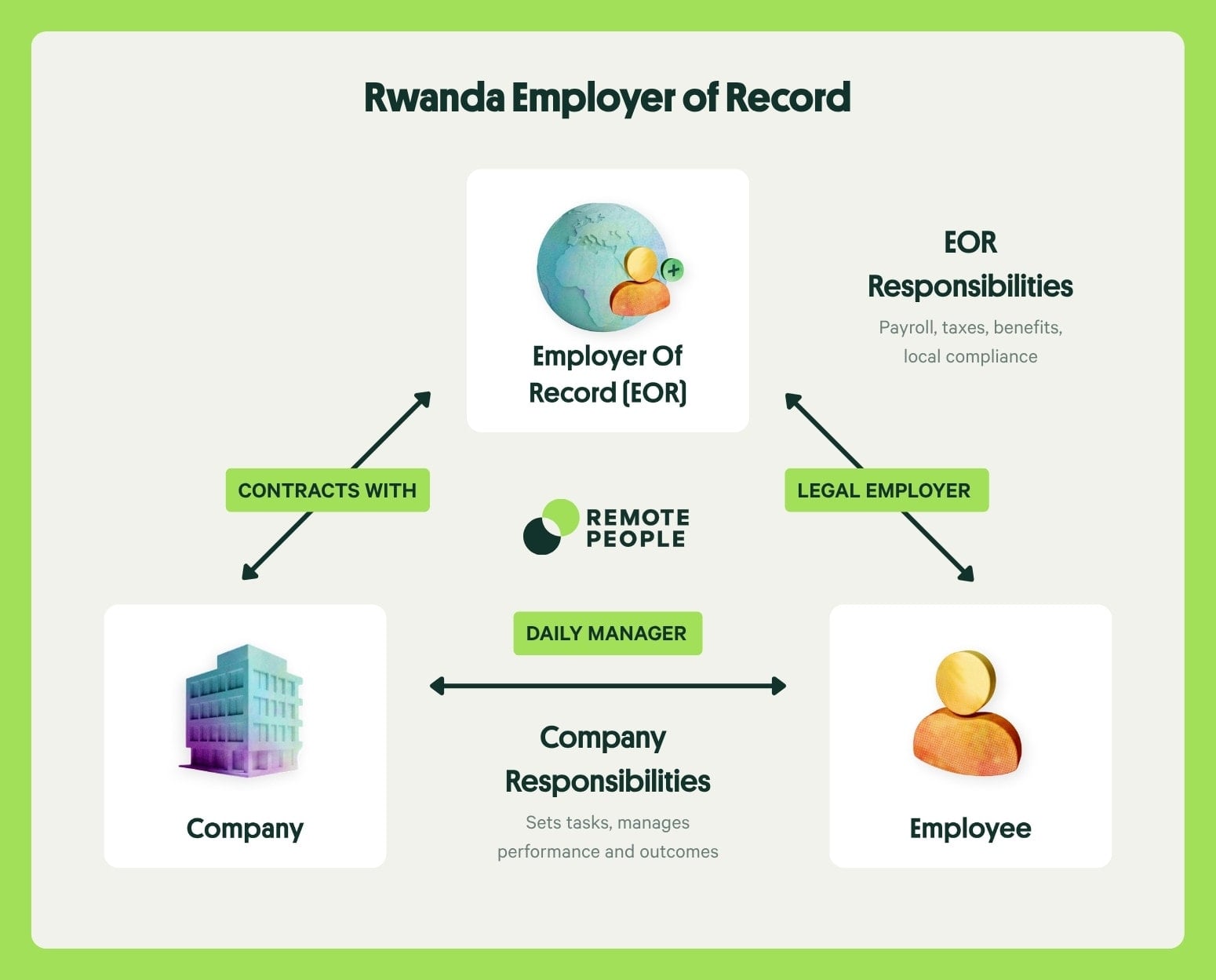
If you’d like to learn more about how Employer of Record (EOR) services work, read our What Is an Employer of Record (EOR)? guide for a complete overview of the model, its benefits, and when to use it.
If you’re comparing providers, our Best Employer of Record (EOR) Providers guide reviews the leading platforms to help you choose the right solution for your business.
Who Uses an EOR in Rwanda?
An EOR is the practical hiring route for any company that wants to employ workers in Rwanda without investing in a local entity. It suits organizations testing the Rwandan market with a small team, hiring one to five specialists for a remote-first role, or moving quickly on an urgent hire where entity setup would take several months. It is also the default choice for foreign companies bringing in expatriate managers or technical staff, because the EOR can sponsor H-class work permits and absorb the immigration paperwork burden.
- Companies entering Rwanda for the first time that need a compliant hiring vehicle before deciding whether to incorporate a subsidiary
- Teams of 1 to 15 employees where the overhead of running a local entity is not justified by the payroll size
- Employers hiring foreign nationals who need work permit sponsorship and immigration support from day one
- Organizations that want to hire quickly, onboarding in 2 to 3 weeks rather than the 3 to 6 months a local entity setup typically requires
- Companies concerned about compliance exposure given the 2023 pension rate changes and ongoing RSSB reform roadmap
Typical Onboarding Timeline
Onboarding a Rwandan employee through an EOR typically takes 2 to 3 weeks for citizens and 6 to 10 weeks for foreign nationals who need work permit sponsorship. The extended timeline for foreign hires reflects the sequential review by the Directorate General of Immigration and Emigration and the biometric capture step required before a Class H permit is issued.
- First, sign the EOR service agreement and share the candidate’s full details, qualifications and intended start date (1 to 2 days).
- Second, the EOR drafts a Labour Law compliant employment contract and sends it for your review and the employee’s signature (2 to 3 days).
- Third, RSSB registration, RRA taxpayer number issuance and local bank account validation are processed in parallel (3 to 5 working days).
- Fourth, payroll is configured, the onboarding pack is delivered and the employee signs supporting policies like IP assignment and confidentiality (2 to 3 days).
- Fifth, the employee starts work. For foreign nationals, the EOR files the H-class work permit application in parallel, which adds approximately 4 to 8 weeks before the legal start date.
Most EOR providers can onboard a Rwandan national within 2 to 3 weeks. Work permits for foreign hires and background-check heavy roles can push the timeline further, so plan target start dates with a realistic buffer for DGIE processing.
Hire in Rwanda
A stable pro-business climate, single-digit inflation, and a growing Kigali talent pool in tech, finance and development make Rwanda one of Africa’s most compliant hiring destinations.
We handle employment contracts, RSSB registration, PAYE withholding, and full Rwandan Labour Law compliance.
No local entity needed. Your team can start in 2 to 3 weeks.
Employment Laws and Regulations in Rwanda
Employment Contracts
Rwanda’s employment framework is governed by Law N° 66/2018 of 30/08/2018 regulating labour in Rwanda, as amended by Law N° 027/2023 of 18/05/2023, and administered by the Ministry of Public Service and Labour. All employment relationships require a written contract in a language understood by both parties, typically English or Kinyarwanda, though French is also widely used. Fixed-term contracts are permitted and may be renewed, but repeated renewal of the same role can cause the relationship to be reclassified as indefinite-term. Required contract terms include the job title and description, workplace, start date, gross salary, working hours, probation period (if any), notice period, and a reference to the applicable sectoral collective agreement where one exists.
Working Hours and Overtime
The standard working week in Rwanda was reduced from 45 to 40 hours by Ministerial Order in 2023, typically arranged as 8 hours per day from Monday to Friday. Employees are entitled to a weekly rest period of at least 24 consecutive hours, usually Sunday. Overtime is permitted where operationally necessary and must be agreed in advance between the employer and the employee.
The statutory overtime premium is 1.5 times the regular hourly rate for work beyond 40 hours in a normal week, and 2 times the regular hourly rate for work performed on a public holiday or a weekly rest day. Overtime totals across any given reference period must remain within limits set by sectoral collective agreements where they exist.
Overtime in Rwanda is regulated by Article 54 of Law 66/2018 and relevant sectoral Ministerial Orders. Work beyond the standard 40-hour weekly limit on a normal working day is paid at 150 percent of the regular hourly rate, and work performed on a weekly rest day or public holiday is paid at 200 percent. Night work, defined as hours worked between 8pm and 5am, attracts an additional premium where agreed in the collective agreement or individual contract. Overtime pay is subject to PAYE and counts as gross salary for RSSB contribution purposes, so it should be calculated gross-of-tax when budgeting total employment cost.
Rwanda overtime and premium pay rates · Per Law 66/2018 | ||
Overtime Scenario | Premium Rate | Notes |
|---|---|---|
Beyond 40 hours on a normal working day | 150% of regular hourly rate | Must be agreed in advance between parties. |
Work on weekly rest day | 200% of regular hourly rate | Usually Sunday. Compensatory day off may be offered instead. |
Work on public holiday | 200% of regular hourly rate | Applies to all 14 gazetted public holidays. |
Night work (8pm to 5am) | Premium per sectoral agreement | Rate varies, typically 15 to 25% additional. |
Source: Law 66/2018 regulating labour in Rwanda and RemotePeople Rwanda Working Hours Guide | ||
Minimum Wage
Rwanda does not have a general statutory minimum wage set by gazetted order in 2026. The Supreme Court of Rwanda has previously referenced a figure of RWF 3,000 per day (approximately $2.40 USD) as an interpretive benchmark in wage disputes, but this is not a binding floor enforced through labour inspections. Market wages for professional roles in Kigali begin at roughly RWF 500,000 per month (approximately $400 USD) for entry-level positions and rise substantially for qualified specialists, mid-level managers and senior engineers.
Employers hiring through an EOR should pay the going market rate for the role rather than anchoring to the historical court reference. Our Rwanda minimum wage guide covers practical salary bands by job family.
Probation Period
Probation periods in Rwanda are capped at three months and may be renewed once for a further three months, for a maximum total of six months per Article 9 of Law 66/2018. During probation either party may terminate the employment contract with a 15-day written notice. Performance evaluations should be documented in writing so that any decision to confirm, extend or terminate is defensible if contested before the Labour Inspector. Once probation ends, the full statutory notice periods apply based on tenure.
Leave Entitlements
Rwanda’s statutory leave framework under Law 66/2018 covers annual leave, sick leave, maternity leave, paternity leave, and circumstantial or special leave for family and civic events. Accrual rules, pay rates and who funds each leave type vary by category, with RSSB contributing to maternity leave costs and the employer bearing most other paid leave obligations.
Annual Leave
Employees in Rwanda are entitled to annual paid leave accruing at 1.5 days per month of effective service, giving a minimum of 18 working days per year after 12 months of continuous employment. Annual leave accrues during probation and is taken after agreement on scheduling with the employer.
An additional day of leave is added for every three years of service, up to a ceiling set by collective agreement where one applies. Unused leave may be carried over for up to one year beyond the accrual period by mutual agreement, after which it is forfeited. Payment in lieu is permitted only when the employment contract ends.
Sick Leave
Employees unable to work due to illness or injury are entitled to paid sick leave on the basis of a medical certificate issued by a registered practitioner. Under Law 66/2018, the first 15 days of certified sickness in a given year are paid at the employee’s full regular salary by the employer. From the 16th day up to three months, salary is paid at 50 percent, and beyond three months the contract may be suspended without pay until recovery. Work-related injuries and occupational illnesses are covered separately under the RSSB Occupational Hazards scheme, which compensates the employee independently of the ordinary sick leave entitlement.
Maternity Leave
Female employees are entitled to 12 consecutive weeks of paid maternity leave, of which at least six weeks must be taken after birth. During the first six weeks, the employee receives 100 percent of her regular salary, funded by the RSSB Maternity Leave Benefit Scheme introduced in 2016. For the remaining weeks, the salary continues subject to the scheme’s rules and the employer’s top-up where applicable. The employee’s job is protected throughout the leave, and dismissal during pregnancy or maternity leave is prohibited except for serious misconduct unrelated to the pregnancy.
Paternity Leave
Fathers are entitled to four consecutive working days of paid paternity leave under Article 52 of Law 66/2018, to be taken within the first fifteen days following the birth of the child. Paternity pay is fully borne by the employer and is in addition to the employee’s annual leave entitlement. Some collective agreements or employer policies extend this to seven or more days, but the statutory minimum remains four working days.
Circumstantial and Other Statutory Leave
- Marriage leave: four working days paid for the employee’s own wedding, to be taken at or near the event
- Bereavement leave: six working days paid on the death of a spouse or child, and three working days paid on the death of a parent or sibling
- Civic leave: paid time off for employees summoned as witnesses or jurors, on presentation of the court summons
- Personal and family event leave: up to three days per year for documented events such as a child’s wedding or serious family illness, where agreed with the employer
Rwanda statutory leave entitlements · Per Law 66/2018 and Law 027/2023 | ||
Leave Type | Duration | Eligibility and Notes |
|---|---|---|
Annual Leave | 18 working days/year | Accrues at 1.5 days/month. Additional day per 3 years of service. Carry-over up to 1 year. |
Sick Leave | Up to 3 months | First 15 days at 100% salary, then 50% up to 3 months. Medical certificate required. |
Maternity Leave | 12 weeks | RSSB Maternity Scheme pays 100% for first 6 weeks. Job protection throughout. |
Paternity Leave | 4 working days | Fully employer-paid. Must be taken within 15 days of birth. |
Marriage Leave | 4 working days | Paid. Own marriage only. Employer-funded. |
Bereavement Leave | 3 to 6 working days | Paid. 6 days for spouse or child, 3 days for parent or sibling. |
Public Holidays | 14 days (2026) | Paid. Work on public holidays compensated at 200% premium. |
Source: Law 66/2018 regulating labour in Rwanda (RSSB) and RemotePeople Rwanda Employee Benefits Guide | ||
Statutory Employee Benefits
Mandatory benefits in Rwanda extend beyond paid leave to include social security coverage, medical insurance, maternity benefits and occupational hazards cover, all administered by the Rwanda Social Security Board. Employers must enroll every employee with the Rwanda Social Security Board, which consolidates four schemes: pension, medical insurance, maternity benefits and occupational hazards. A separate Community-Based Health Insurance (Mutuelle de Santé) enrollment is required for employees whose employer does not offer private medical cover. There is no statutory unemployment insurance scheme in Rwanda, and terminated workers rely on severance pay instead.
Beyond the statutory schemes, many employers voluntarily provide transport allowances, housing assistance, meal subsidies and private supplemental health insurance to attract qualified candidates in Kigali’s competitive talent market. These benefits are not legally required but have become market standard for professional roles. Airtime allowances and laptop provision are near-universal for office-based knowledge workers. Specific contribution rates for RSSB, CBHI and the maternity scheme appear in the payroll section below.
Recent Regulatory Updates (2026)
The most significant recent development is the staged increase of RSSB pension contributions, implemented by Law N° 054/2024 of 20/06/2024 and its supporting Ministerial Orders. Contribution rates moved from 3 percent employer and 3 percent employee to 5 percent and 5 percent on 1 January 2025, and again to 6 percent and 6 percent on 1 January 2026. A further increase to 7 percent and 7 percent is scheduled for 1 January 2027, bringing the combined pension contribution to 14 percent of gross salary. The phase-in is designed to strengthen long-term pension adequacy while giving employers time to adjust payroll budgets.
Law N° 027/2023 of 18/05/2023 amended Law 66/2018 to refine provisions on sick leave, certain leave entitlements and dispute resolution procedures, and a 2023 Ministerial Order reduced the standard working week from 45 to 40 hours. The Rwanda Revenue Authority personal income tax brackets remained at 0 percent, 10 percent, 20 percent and 30 percent for the 2026 fiscal year, with the same monthly thresholds in place since the 2023 tax reform. Employers hiring through an EOR benefit from the provider’s automatic adjustment to each rate change, with no internal reconfiguration required at year-end.
Work Permits and Visas in Rwanda
Work Permit Requirements
Who Needs a Work Permit
Any foreign national who is not a Rwandan citizen and intends to work for a Rwandan employer must obtain a work permit before starting employment. The rule applies regardless of role seniority, contract duration or whether the worker is physically based in Rwanda or working remotely under a Rwandan contract. Citizens of the East African Community partner states enjoy preferential processing under the EAC Common Market Protocol and are eligible for a six-month job search visa, but still require a work permit to take up formal employment.
Eligibility and Required Documents
Foreign nationals must demonstrate relevant qualifications and professional experience for the role, and the employer must provide a justification for the hire. Required documents include a valid passport with at least six months of remaining validity, the signed employment contract, academic and professional certificates with notarized translations where applicable, a criminal record certificate from the applicant’s country of origin, a medical certificate showing fitness to work, passport photographs, and the completed application form filed online with the Directorate General of Immigration and Emigration.
Processing Time and Validity
Rwanda’s Directorate General of Immigration and Emigration processes work permits through the Irembo online portal, with standard turnaround of 4 to 8 weeks from complete submission. The most common H-class permits are issued for one or two years and are renewable. Class H1 covers investors and shareholders, H2 senior managers and qualified professionals, H3 qualified workers with specific skills, H4 religious and humanitarian workers, H5 retired workers with sufficient means, and H6 researchers and academics. Employees may not legally begin work until the permit is issued, so hiring timelines should include a realistic processing buffer.
Renewal Process
Work permit renewals must be filed at least 15 days before the current permit expires, with the same documentation as the initial application plus proof of continued employment and RRA tax compliance. The renewal process typically takes 2 to 4 weeks. The employee may continue working during the renewal window if the application was submitted on time. An EOR handles the renewal filing on behalf of the client and the employee, monitors expiration dates and submits complete documentation well in advance of the deadline.
Common Visa Types for Foreign Workers
Rwanda offers several immigration routes for foreign nationals, each matched to a specific hiring scenario. The H-class work permit is the workhorse route for a standard EOR employment relationship, while the H3 investor permit and EAC short-stay pass cover separate use cases. The table below summarises the main options, the typical duration, and the documentation each one requires.
Rwanda work permit and visa categories · DGIE 2026 | ||
Permit Class | Who It Covers | Validity |
|---|---|---|
H1 Investor Permit | Foreign investors and company shareholders with at least $250,000 invested | 2 years, renewable |
H2 Professional Permit | Senior managers and qualified professionals on a local employment contract | 2 years, renewable |
H3 Skilled Worker Permit | Qualified technical workers and specialists hired by a local employer | 1 to 2 years, renewable |
H4 Humanitarian Permit | Religious, humanitarian and NGO workers | 1 to 2 years, renewable |
H6 Academic Permit | Researchers, academics and university staff | 1 to 2 years, renewable |
EAC Job Search Visa | EAC nationals seeking employment in Rwanda | 6 months, single-entry |
How an EOR Handles Work Permits
A Rwanda EOR sponsors H-class work permits for foreign hires on behalf of the client company, absorbing the labour justification, document collection, online filings and liaison with the Directorate General of Immigration and Emigration. The EOR acts as the legal employer and signatory on the permit application, meaning the foreign national is tied to the EOR (not the client) for immigration purposes, which simplifies compliance and reduces client exposure. The EOR also handles renewals and reports any employment changes to DGIE as required. Work permit processing typically adds 4 to 8 weeks to the onboarding timeline described in Section 1.4, so start dates should be planned with this buffer.
Payroll, Taxes and Social Security in Rwanda
Employer Contributions
Employers in Rwanda must contribute to four statutory schemes administered by the Rwanda Social Security Board: pension, medical insurance, maternity benefits and occupational hazards. The combined employer rate for 2026 is 15.8 percent of gross salary, reflecting the 1 January 2026 pension increase from 5 to 6 percent.
Rwanda employer social security contributions · 2026 rates | ||
Contribution | Rate | Notes |
|---|---|---|
RSSB Pension | 6.0% | Scheduled to rise to 7% on 1 Jan 2027. Paid to RSSB monthly. |
RSSB Medical Insurance | 7.5% | Covers public sector employees by default; private sector where enrolled. |
RSSB Maternity Leave Benefit | 0.3% | Funds 100% of first 6 weeks of maternity pay. |
RSSB Occupational Hazards | 2.0% | Employer-only contribution. Covers workplace accidents and illnesses. |
Total Employer Contribution | 15.8% | Of gross monthly salary, remitted by the 15th of the following month |
Source: Rwanda Social Security Board (RSSB) and RemotePeople Rwanda Payroll Tax Guide | ||
Employee Contributions
Employees contribute 14.3 percent of gross salary to statutory RSSB schemes and the Community-Based Health Insurance fund, withheld monthly by the employer and remitted alongside the employer’s share. These contributions are deductible from taxable income before the progressive PAYE brackets are applied.
Rwanda employee payroll deductions · 2026 monthly withholdings | ||
Deduction | Rate | Notes |
|---|---|---|
RSSB Pension | 6.0% | Scheduled to rise to 7% on 1 Jan 2027. Tax-deductible from gross. |
RSSB Medical Insurance | 7.5% | Covers the employee and dependents where enrolled. |
RSSB Maternity Leave Benefit | 0.3% | Funds the employee’s 100% maternity pay during first 6 weeks. |
Community-Based Health Insurance (CBHI) | 0.5% | Where the employee is not on a private medical scheme. |
Total Employee Contribution | 14.3% | Deducted monthly from gross salary before PAYE is calculated |
Source: Rwanda Social Security Board (RSSB) and RemotePeople Rwanda Payroll Tax Guide | ||
Income Tax
Personal income tax in Rwanda is administered by the Rwanda Revenue Authority and withheld monthly by the employer through Pay-As-You-Earn. The system is progressive with four brackets applied to monthly taxable income after social security deductions. The first RWF 60,000 is exempt, the next RWF 40,000 is taxed at 10 percent, the following RWF 100,000 at 20 percent, and income above RWF 200,000 at 30 percent. Thresholds are set by the 2023 tax reform and are applied uniformly to residents and non-residents working in Rwanda.
Rwanda PAYE income tax brackets · 2026 monthly | |
Monthly Taxable Income (RWF) | Tax Rate |
|---|---|
0 to 60,000 | 0% (exempt) |
60,001 to 100,000 | 10% on income above 60,000 |
100,001 to 200,000 | 20% on income above 100,000 (plus RWF 4,000) |
Above 200,000 | 30% on income above 200,000 (plus RWF 24,000) |
Payroll Cycle
Payroll in Rwanda is processed monthly, with salaries typically paid on or before the last working day of each month by bank transfer to the employee’s local account. Each employee must receive a monthly pay slip showing gross salary, itemized RSSB and CBHI deductions, PAYE withheld and net pay.
PAYE and RSSB contributions withheld at source must be remitted to the Rwanda Revenue Authority and the Rwanda Social Security Board by the 15th of the following month, with filings submitted electronically through the RRA and RSSB online portals. Annual PAYE reconciliation is due by 31 March for the preceding tax year. Employers who miss deadlines face late payment penalties, interest and a surcharge calculated at the statutory RRA rate.
13th Month Salary and Bonus Pay
A 13th month salary is not mandatory in Rwanda. Some employers offer a discretionary end-of-year bonus, typically equivalent to a fraction of monthly salary paid in December, but there is no statutory requirement in Law 66/2018. Collective agreements in specific sectors may introduce a contractual year-end bonus, so employers should check the applicable sectoral agreement before offering. Performance bonuses, housing allowances, transport allowances and airtime are common voluntary additions and are subject to PAYE unless specifically exempted by RRA guidance.
Cost of Hiring Through an EOR in Rwanda
EOR Service Fees
EOR service fees in Rwanda typically range from $349 to $599 per employee per month, paid in USD regardless of the employee’s local salary. The fee covers employment contract drafting and compliance, monthly payroll processing, PAYE and RSSB filings, statutory benefits administration, HR support and work permit sponsorship for foreign hires. Some providers charge a one-time setup fee for the first employee and discount the per-employee fee at higher headcounts.
Total Employment Cost Breakdown
A practical example clarifies the total cost of hiring a Rwanda-based employee through an EOR. The table below shows the approximate breakdown for a mid-range professional hire with a gross salary of $800 USD per month, with employer contributions calculated at the 2026 statutory rates.
Rwanda employer cost example · $800/month gross · 2026 | ||
Employer Cost | Amount (USD) | % of Gross |
|---|---|---|
Gross salary | $800.00 | 100.0% |
RSSB Pension (6%) | $48.00 | 6.0% |
RSSB Medical Insurance (7.5%) | $60.00 | 7.5% |
RSSB Maternity Benefit (0.3%) | $2.40 | 0.3% |
RSSB Occupational Hazards (2.0%) | $16.00 | 2.0% |
EOR service fee | $449.00 | 56.1% |
Total monthly cost | $1,375.40 | 171.9% |
Source: Rwanda Social Security Board (RSSB) and RemotePeople Rwanda Payroll Guide | ||
The total monthly cost of hiring an $800 gross Rwanda employee through an EOR is approximately $1,375, of which $800 is salary, $126 covers statutory employer contributions, and $449 is the EOR service fee. Employer contributions amount to 15.8 percent of gross, and because RSSB pension and medical rates are scheduled to rise to 7 percent pension in 2027, employers should budget for incremental increases each year through the end of the phase-in. All USD amounts use an indicative conversion of $1 = RWF 1,250 (April 2026 rate). Private medical top-ups, transport allowances and end-of-year bonuses, where offered, are additional to the totals above.
Ready to hire in Rwanda? Get started with RemotePeople. We handle employment contracts, payroll, tax withholding and full Rwanda compliance. No local entity needed.
Benefits of Using an EOR in Rwanda
Hiring through an EOR in Rwanda eliminates the months of setup work and ongoing compliance overhead that come with running a local entity. Speed is the immediate benefit: a compliant hire can be onboarded in 2 to 3 weeks compared with 3 to 6 months to register a subsidiary at the Rwanda Development Board, open commercial bank accounts, obtain a Tax Identification Number, and complete RSSB enrollment. The EOR’s existing relationships with the RRA, RSSB and DGIE mean filings are submitted correctly on the first attempt, avoiding the rework loops that are common for foreign entities unfamiliar with the Irembo online platform.
Cost efficiency is the second major benefit. Running a Rwandan subsidiary requires recurring accounting, tax filings, board governance and statutory audits that typically cost $12,000 to $25,000 per year in professional fees, before any staff are hired. An EOR consolidates all of that into a single per-employee monthly fee of $349 to $599, which is far more economical for teams of fewer than 15 employees. Compliance assurance flows from this model: the EOR assumes responsibility for labour law compliance, meaning misclassification risk, incorrect withholding or missed RSSB filings sit with the provider rather than the client.
Local expertise matters in Rwanda because recent regulatory changes, including the staged pension rate increases and the 2023 working-week reform, require close tracking to keep payroll accurate. An EOR provides on-the-ground HR support in English, Kinyarwanda and French, guides clients on appropriate salary bands drawing from Rwanda average salary data, and manages local cultural nuances during hiring and termination. Scale flexibility is the final advantage: companies can add or remove employees as business needs shift, without any entity unwind costs. For organizations testing the Rwandan market or building small remote teams, an EOR is the practical and lowest-risk route to compliant employment.
Termination and Offboarding in Rwanda
Notice Periods
Notice periods in Rwanda depend on the employee’s length of service, as set out in Article 27 of Law 66/2018. Employers terminating an indefinite-term contract must provide written notice of 15 working days for employees with less than one year of service, and 30 working days for those with one year or more of service. The same notice periods apply where the employee resigns.
During probation, either party may terminate with 15 days’ written notice. Payment in lieu of notice is permitted, in which case the employee receives the gross salary that would have been earned during the notice period, calculated on the 30-day month convention used for statutory pay.
Rwanda statutory notice periods · Per Article 27 of Law 66/2018 | ||
Length of Service | Employer Notice | Employee Notice |
|---|---|---|
During probation | 15 working days | 15 working days |
Less than 1 year | 15 working days | 15 working days |
1 year or more | 30 working days | 30 working days |
Serious misconduct | Immediate, no notice | Not applicable |
Source: Law 66/2018 regulating labour in Rwanda and RemotePeople Rwanda Termination Guide | ||
Severance Pay
Calculation Method
Severance pay under Article 34 of Law 66/2018 is required for employees terminated without just cause after completing at least one year of continuous service. The formula is a multiplier of the employee’s average monthly gross salary from the 12 months preceding termination. The schedule rises in tenure tiers, with longer-service employees receiving progressively larger payouts to reflect loyalty and the harder transition to new employment.
Rwanda severance allowance schedule · Per Article 34 of Law 66/2018 | |
Length of Service | Severance Entitlement |
|---|---|
Less than 5 years | 1 month of average gross salary |
5 to less than 10 years | 2 months of average gross salary |
10 to less than 15 years | 3 months of average gross salary |
15 to less than 20 years | 4 months of average gross salary |
20 to less than 25 years | 5 months of average gross salary |
25 years or more | 6 months of average gross salary |
Source: Law 66/2018 regulating labour in Rwanda and RemotePeople Rwanda Termination Guide | |
Caps and Exceptions
Severance pay is not owed in cases of dismissal for serious misconduct, voluntary resignation, end of fixed-term contracts that run to their natural conclusion, or termination during probation. The statutory formula tops out at six months of average salary for employees with 25 or more years of service, and collective agreements may set higher severance levels for specific sectors. Payments are taxed as ordinary employment income under PAYE.
Grounds for Termination
Employers may terminate employment for just cause, which covers proven misconduct, repeated poor performance after formal warnings, or economic and restructuring reasons. Just-cause terminations for serious misconduct may proceed without notice or severance, but the employer must document the misconduct, issue prior written warnings where relevant, and follow the disciplinary procedure set out in the contract or applicable collective agreement. Collective redundancies require notification to the Labour Inspector and may trigger additional consultation requirements. Protected categories include pregnant employees, employees on maternity leave, trade union representatives and workers on long-term medical leave; dismissal of a protected employee requires specific justification and is subject to heightened scrutiny by the Labour Inspector.
EOR vs. Other Hiring Models in Rwanda
EOR vs. Setting Up a Local Entity
Setting up a local entity in Rwanda involves registering a commercial company with the Rwanda Development Board, opening corporate bank accounts, registering with the Rwanda Revenue Authority for tax, enrolling with RSSB for social security, and securing any sector-specific licenses. The RDB’s one-stop-shop is one of the faster company registration processes in Africa, yet the full setup including bank account opening, tax registration and staffing typically takes 3 to 6 months. An EOR achieves the same legal outcome, which is a compliant local hire, without any of these steps.
Rwanda EOR vs local entity comparison · Setup time, cost, risk and best-fit | ||
Comparison | Employer of Record | Own Entity |
|---|---|---|
Setup time | 2 to 3 weeks | 3 to 6 months |
Upfront cost | $0 | $6,000 to $15,000 |
Ongoing cost | $349 to $599/employee/month | $12,000 to $25,000/year maintenance |
Local partner required | No (EOR is the local entity) | Often useful for banking and tax steps |
RSSB registration | Handled by EOR | You manage it |
Payroll and tax filing | Handled by EOR | You manage it (or outsource) |
Best for team size | 1 to 15 employees | 15+ employees |
Scale down or exit | Easy, no entity to unwind | Costly, legal dissolution required |
Government contracts | Not eligible | Eligible (requires local entity) |
Source: RemotePeople EOR Solutions and Rwanda Development Board | ||
An EOR wins on speed, upfront cost and compliance risk for any team under 15 employees, making it the default choice for most foreign hirers entering Rwanda. A local entity becomes attractive at larger team sizes, where the fixed costs of running a subsidiary are amortized across enough payroll to bring the per-employee cost below the EOR fee. Government contracts, local procurement tenders and operations that require a physical commercial presence also favor the entity route.
The other consideration is strategic intent. Companies hiring in Rwanda to test the market, build a remote-first team or support a specific client typically favor the EOR model because it avoids the multi-year commitment of a local entity. Companies that view Kigali as a permanent regional hub often start with an EOR and transition to a subsidiary once the team reaches the 15 to 20 employee threshold and the RDB license adds strategic value beyond employment.
EOR vs. Hiring Independent Contractors
Independent contractors offer short-term flexibility in Rwanda, but they carry classification risk when used for roles that resemble employment. An EOR removes that risk by putting the worker under a compliant employment contract, while a contractor engagement shifts payroll and benefits responsibility to the worker. The table below compares the two models on legal structure, compliance exposure and best-fit use cases.
Rwanda EOR vs independent contractors · Compliance, cost, and risk | ||
Comparison | EOR (Full-Time Employee) | Independent Contractor |
|---|---|---|
Legal relationship | Employee of the EOR | Self-employed, no employment relationship |
Compliance risk | Low, EOR ensures local labour law compliance | Higher, misclassification risk if relationship resembles employment |
Payroll and tax | EOR handles withholding, contributions, filings | Contractor invoices you, handles their own RRA obligations |
Benefits and leave | Statutory benefits, paid leave, RSSB cover | No entitlement to employee benefits |
IP protection | Stronger, employment contract assigns IP by default | Weaker, requires explicit IP assignment clause |
Termination | Subject to local notice periods and severance | Contract can be ended per agreement terms |
Best for | Long-term, core team roles | Short-term projects, specialized consulting |
Cost structure | Salary + employer contributions + EOR fee | Contractor fee (typically higher gross, lower total cost) |
Source: Law 66/2018 regulating labour in Rwanda and RemotePeople Rwanda Contractor Guide | ||
Independent contractors in Rwanda are a legitimate route for short-term projects, specialized consulting assignments and roles with genuine autonomy over how and when the work is delivered. The key consideration is classification: if the contractor works set hours, uses company equipment, reports to a manager and is integrated into the client’s operations, the Rwandan Labour Inspector may reclassify the relationship as employment. The consequences of reclassification include back-dated RSSB contributions, PAYE liabilities, unpaid leave entitlements and potential penalties from the Rwanda Revenue Authority.
For long-term core team members, the EOR route is the more protective and scalable choice because it locks in compliance from day one and guarantees IP ownership flows to the client company. For legitimate short-term projects or specialized freelance work, independent contracting remains a valid option provided the relationship is documented properly. RemotePeople’s contractor solution manages compliant contractor onboarding, payment and classification review for companies that need to engage Rwandan freelancers without taking on direct classification risk.
EOR vs. PEO (Professional Employer Organization)
PEO and EOR are often confused but serve different buyers. An EOR is the legal employer on behalf of the client and removes the need for a local entity, whereas a PEO operates under a co-employment model that requires the client to keep its own Rwandan registration. The table below maps how each model handles legal liability, local entity requirements and day-to-day HR control.
Rwanda EOR vs PEO comparison · Legal employer, liability, and setup | ||
Comparison | Employer of Record (EOR) | PEO |
|---|---|---|
Legal employer | EOR is the legal employer | You remain the legal employer (co-employment) |
Local entity required | No, the EOR is the local entity | Yes, you must have your own entity in Rwanda |
Best for | Companies without a local entity | Companies that already have a local entity |
Compliance liability | EOR assumes compliance responsibility | Shared liability between you and the PEO |
Setup time | 2 to 3 weeks | Depends on your entity setup (weeks to months) |
Control over HR policies | EOR manages within local law framework | More direct control, PEO advises |
Typical use case | Market entry, small remote teams, testing new markets | Established local operations needing HR outsourcing |
Source: RemotePeople EOR Services and Rwanda Development Board | ||
Rwanda does not have a formal PEO regulatory framework of the kind found in the United States. International HR providers sometimes market PEO services in Rwanda, but these arrangements typically operate as managed payroll or HR outsourcing rather than formal co-employment. For any foreign company without a Rwanda entity, the EOR model is the only legally clean way to employ workers; a PEO arrangement would still require the client to have its own Rwandan registration, which defeats the purpose of the model for first-time entrants.
Companies that already operate a Rwandan subsidiary but want to reduce HR administration can engage a local HR services firm for outsourced payroll, RRA filings and RSSB reporting. This is functionally similar to a PEO but sits outside a formal co-employment structure. For companies that want the legal employer role to be handled entirely by a third party, the EOR remains the appropriate choice.
Public Holidays in Rwanda
Rwanda observes 14 to 15 public holidays each calendar year, covering national commemorations, Christian observances and two Islamic festivals whose dates shift by the lunar calendar. Employers must either grant the day off with regular pay or compensate work on a holiday at 200 percent under Law 66/2018. The calendar below lists the official 2026 dates and the type of each holiday.
Rwanda public holidays · 2026 calendar year | ||
Date | Holiday | Type |
|---|---|---|
January 1 | New Year’s Day | National |
January 2 | Day After New Year’s Day | National |
February 1 | National Heroes’ Day | National |
March 20 | Eid al-Fitr | Religious (date approximate) |
April 3 | Good Friday | Religious |
April 6 | Easter Monday | Religious |
April 7 | Genocide Against the Tutsi Memorial Day | National |
May 1 | Labour Day | National |
May 27 | Eid al-Adha | Religious (date approximate) |
July 1 | Independence Day | National |
July 4 | Liberation Day | National |
August 7 | Umuganura (Harvest Day) | National (first Friday of August) |
August 15 | Assumption of Mary | Religious |
December 25 | Christmas Day | Religious |
December 26 | Boxing Day | Religious |
Rwanda observes a rolling list of 14 to 15 public holidays per year, combining national commemorations, Christian observances, and Islamic festivals whose dates vary by lunar calendar. Employees working on a public holiday are entitled to 200 percent premium pay under Law 66/2018, or to a compensatory rest day where agreed. Islamic holidays follow the lunar calendar and the Rwanda Muslim Council typically confirms exact dates close to each observance; payroll processing schedules should account for these dates when planning monthly salary runs and benefit payments.
How to Get Started with an EOR in Rwanda
- First, choose your EOR provider and share the role profile, target salary in USD or RWF, and expected start date with their account team.
- Second, sign the EOR service agreement and collect candidate documents including a valid national ID or passport, qualifications, and bank account details for payroll.
- Third, the EOR drafts a compliant employment contract aligned with Law 66/2018 and sends it for your review and the employee’s signature.
- Fourth, the EOR registers the employee with RSSB and the Rwanda Revenue Authority, configures payroll, and prepares the first pay cycle.
- Fifth, the employee starts work, and the EOR runs monthly payroll, files PAYE and RSSB contributions, and provides ongoing HR support.
Ready to hire your first Rwandan employee? Contact RemotePeople and we will match you with a compliant employment solution in 2 to 3 weeks. Our team handles every step from contract drafting to monthly payroll, so you can focus on building your Rwanda team.
Where companies hiring in Rwanda expand next
Hiring in Rwanda frequently leads to recruitment across East Africa’s English-speaking cluster and the wider Indian Ocean corridor. Most teams start with an EOR partner in Tanzania — the regional East African talent pool. Ethiopia typically follows, with aligned East African English-first hiring profile. A team in Kenya is a natural addition for shared East African workforce norms, and operations in Uganda completes the regional picture with overlapping East African talent profile.
Frequently Asked Questions
Beyond the employee's gross salary, you will pay statutory employer contributions totaling 15.8 percent of gross (RSSB pension, medical, maternity and occupational hazards), plus an EOR service fee of $349 to $599 per employee per month. For an $800 gross monthly salary, the total monthly cost works out to approximately $1,375 including the EOR fee. The exact fee depends on your provider and the complexity of the role.
Onboarding a Rwandan national typically takes 2 to 3 weeks from signed EOR agreement to first day of work. Foreign nationals who need an H-class work permit add another 4 to 8 weeks to the timeline, because the Directorate General of Immigration and Emigration processes permit applications through its Irembo online portal with standard turnaround in that range.
No, a 13th month salary is not mandatory under Law 66/2018. Some employers offer a discretionary end-of-year bonus, and certain sectoral collective agreements may require one. Performance bonuses, transport allowances and airtime are common voluntary additions and are subject to PAYE under the standard rules.
Independent contractors are appropriate for short-term projects and specialized consulting where the worker has genuine autonomy. For long-term core roles, misclassification risk means an EOR is the safer route. RemotePeople's contractor solution manages compliant contractor engagement, payment and classification review if you need to work with Rwandan freelancers without taking on direct classification exposure.
The employment contract assigns IP to the client company (you), not the EOR. The EOR makes sure the contract has proper IP assignment language so all intellectual property created during the employment flows directly to your business. This is a standard provision in EOR employment contracts and mirrors the IP assignment clauses used in direct employment.
Rwanda does not have a gazetted general minimum wage in 2026. The Supreme Court has referenced RWF 3,000 per day as an interpretive benchmark in past wage disputes, but the rate is not enforced through labour inspections. Market salaries for professional roles begin around RWF 500,000 per month and rise with qualifications. See our Rwanda minimum wage guide for sector rates.
Notice periods under Article 27 of Law 66/2018 are 15 working days for employees with less than one year of service and 30 working days for those with one year or more. Severance pay is required for terminations without just cause after one year of service, rising from one month of average salary under five years of service to six months at 25 years or more.
Yes. RemotePeople acts as the sponsoring employer for H-class work permits, handling document collection, online filings on the Irembo portal and liaison with the Directorate General of Immigration and Emigration. Processing typically takes 4 to 8 weeks. The EOR model is the most practical route for foreign companies bringing expatriate staff into Rwanda because no local subsidiary is required.
No. An employer of record lets you hire in Rwanda without setting up a local entity. The EOR acts as the legal employer, handles RSSB registration, PAYE filings with the Rwanda Revenue Authority, and sponsors H-class work permits for foreign hires. Setting up your own Rwandan subsidiary typically takes 3 to 6 months, versus 2 to 3 weeks to hire your first employee through an EOR.
Employers pay statutory contributions totaling 15.8 percent of gross salary to the Rwanda Social Security Board: 8 percent for pension, 7.5 percent for medical insurance (RAMA or CBHI depending on the employee category), and 0.3 percent for occupational hazards. Maternity insurance adds another 0.3 percent split equally between employer and employee. See our Rwanda employee benefits guide for the full breakdown.
Yes, but the two models serve different use cases. A contractor of record (COR) engages the worker as an independent contractor under a services agreement, while an EOR employs them directly under Rwandan labour law with full benefits. COR fits short-term or project-based work where the worker controls how and when the work is delivered. EOR fits long-term roles with statutory leave, RSSB coverage and termination protection. Misclassifying a long-term contractor as independent can trigger back-pay and penalties under Law 66/2018.
Employer of Record in
Employer of Record in
Employer of Record in
Employer of Record in
Employer of Record in
Employer of Record in
Employer of Record in
Employer of Record in