
 Recruit
Employer of Record in Tanzania
-
 Drew Donnelly
- Published
- September 22, 2026
RemotePeople’s employer of record in Tanzania lets you hire employees in Tanzania with NSSF expertise. We handle National Social Security Fund contributions at 10 percent employer share, Skills Development Levy at 3.5 percent, and Workers Compensation Fund at 0.5 percent.
Hire in Tanzania — book a free 30-minute demo
Tell us what you need. You'll get a tailored, transparent proposal within 24 hours, plus a free call to walk through it.
Tell us about your company
So we can match you with a specialist who knows your market — and unlock volume pricing tiers.
* All fields are required.
Where and when are you hiring?
Tell us the geography and timing and we'll quote each country line by line, with onboarding timelines.
* All fields are required.
Help us beat your current setup
We'll benchmark your current deal and send a line-by-line proposal in 24 hours — showing exactly where we cut cost, time, or risk. After you submit, you can book a call to walk through it together.
* All fields are required.
Thanks! Your proposal is on its way.
Expect a tailored, line-by-line proposal in your inbox within 24 hours. In the meantime…
Want to walk through it together?
Book a free 30-minute call with one of our specialists. We'll explain every line, answer your questions, and tailor the proposal further if you need.
No obligation. Pick a time that works for you.








- Hire in Tanzania — book a free 30-minute demo
- Tell us about your company
- Where and when are you hiring?
- Help us beat your current setup
- Thanks! Your proposal is on its way.
- How an Employer of Record Works in Tanzania
- Employment Laws and Regulations in Tanzania
- Work Permits and Visas in Tanzania
- Payroll, Taxes, and Social Security in Tanzania
- Cost of Hiring Through an Employer of Record in Tanzania
- Termination and Offboarding in Tanzania
- EOR vs. Other Hiring Models in Tanzania
- Public Holidays in Tanzania
- How to Get Started with an EOR in Tanzania
- Frequently Asked Questions
- Related EOR Destinations

Let RemotePeople handle payroll, compliance, and HR admin worldwide so you can focus on building your team.

On 1 January 2026, Tanzania reset every private-sector minimum wage at once, lifting the floors by an average of 33.4% across 15 sectors. Ten months earlier, Parliament had rewritten the rules on fixed-term contracts, unpaid leave and unfair-termination awards. If you hired a Tanzanian employee in 2024 on the old assumptions, your contract is already out of date.
That pace of change is why companies looking to hire employees in Tanzania increasingly choose an employer of record in Tanzania rather than opening a branch. Tanzania is East Africa’s second-largest economy, growing 5.9% in 2025 with the region’s lowest inflation, and its English-speaking professional talent in Dar es Salaam, Arusha, Dodoma and Mwanza is in demand across mining, fintech, energy, telecom and development work. The compliance load, however, is real: the Employment and Labour Relations Act (ELRA) 2004, monthly PAYE, NSSF, Skills Development Levy and Workers Compensation filings, sector-specific wage orders and a two-permit immigration system for foreign staff.
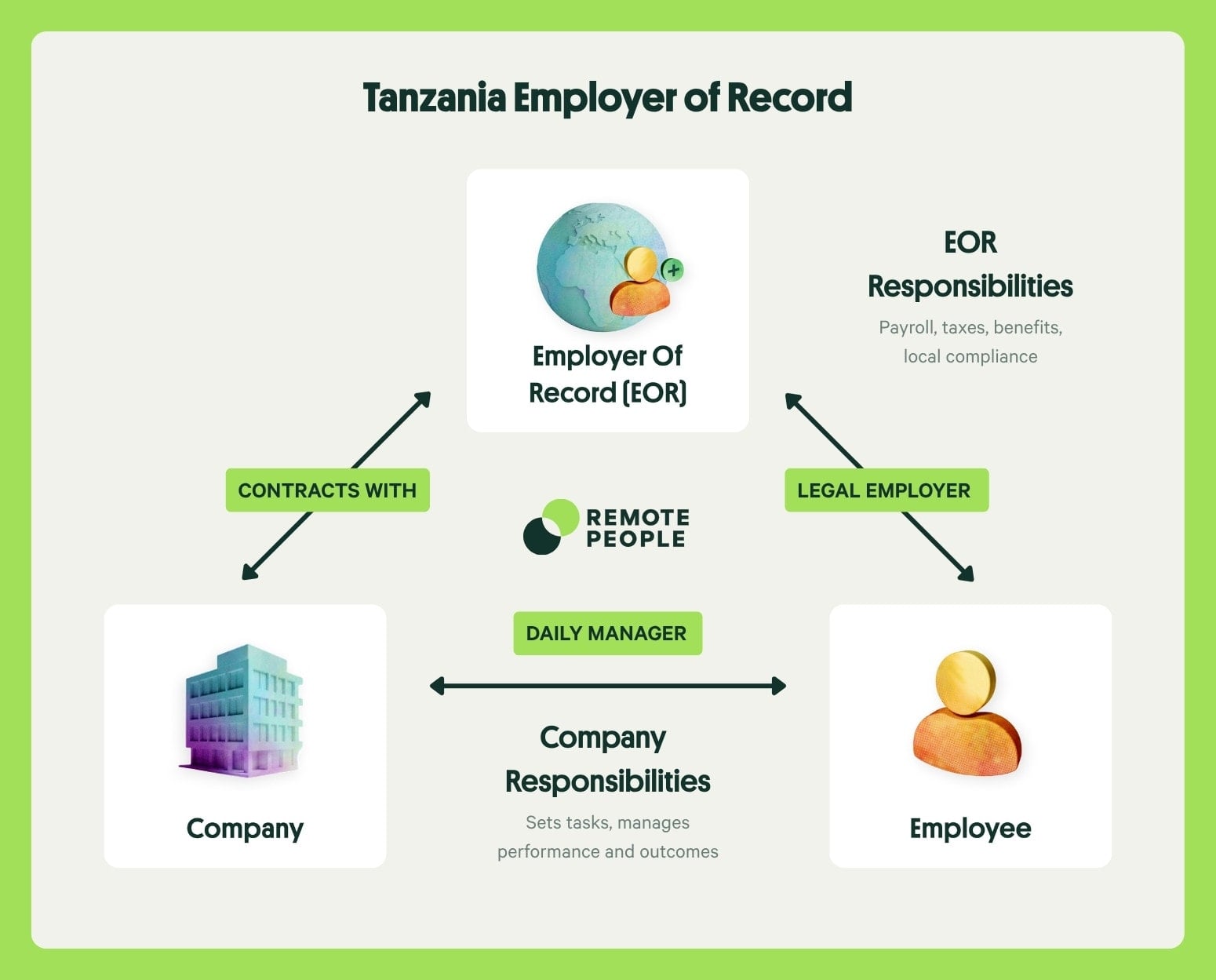
RemotePeople acts as the legal employer in Tanzania on your behalf. We draft the ELRA-compliant contract, register the employee with the Tanzania Revenue Authority (TRA), NSSF and WCF, run monthly payroll in Tanzanian shillings, remit every statutory contribution on time and manage work and residence permits for expatriates. You direct the work; we carry the employer obligations. This guide covers what that involves in 2026, from the 45-hour week to the 7-days-per-year severance formula, with every figure verified in September 2026.
How an Employer of Record Works in Tanzania
An employer of record (EOR) in Tanzania is a locally registered company that becomes the legal employer of your Tanzanian staff. The EOR signs the employment contract, holds the employer registrations with TRA, NSSF and WCF, and is the entity that Tanzanian labour inspectors, the Commission for Mediation and Arbitration (CMA) and the Labour Court recognise as the employer. Your company keeps day-to-day control: you set the role, manage performance, approve leave and decide on pay.
This arrangement lets you hire professionals anywhere in Tanzania without incorporating a subsidiary through the Business Registrations and Licensing Agency (BRELA), obtaining a business licence, registering for corporate tax at 30% or filing annual returns. It also puts a compliance specialist between you and a legal framework that changed materially in 2025 and again in January 2026.
If you’d like to learn more about how Employer of Record (EOR) services work, read our What Is an Employer of Record (EOR)? guide for a complete overview of the model, its benefits, and when to use it.
If you’re comparing providers, our Best Employer of Record (EOR) Providers guide reviews the leading platforms to help you choose the right solution for your business.
Who Uses an EOR in Tanzania?
Multinationals, SaaS companies, consultancies, NGOs and mid-sized businesses use an EOR in Tanzania to hire without a local subsidiary. The model suits several situations in particular.
- Testing the Tanzanian market: A company that wants to validate demand in Dar es Salaam before committing to a BRELA-registered entity can hire one or two people through the EOR and incorporate later, once revenue justifies it.
- Placing a regional lead in East Africa: Tanzania sits at the centre of the East African Community, and a country manager or regional sales lead based in Dar es Salaam is a common first hire for companies covering Kenya, Uganda, Rwanda and the wider Indian Ocean corridor.
- Mining, energy and infrastructure projects: Gold exports, the USD 42 billion Likong’o-Mchinga LNG project, the EACOP pipeline and the standard-gauge railway all draw specialist contractors and service firms that need compliant local staff for a defined project term.
- Development and NGO programmes: Externally funded positions are now an expressly permitted fixed-term category under the 2025 amendments, which makes EOR employment a clean fit for grant-funded roles.
- Converting contractors: The Labour Institutions Act presumes that anyone working an average of 45 hours a month for one client over three months is an employee. Long-running freelance arrangements in Tanzania carry misclassification risk that an EOR resolves.
Consider a Nairobi-headquartered payments company that won a Tanzanian bank as a client in early 2026 and needed an implementation manager in Dar es Salaam within the quarter. Incorporating a Tanzanian subsidiary, opening a bank account and registering with NSSF and WCF would have pushed the start date past the contract go-live. Through an EOR, the manager signed an ELRA-compliant contract in week one, was registered for PAYE and NSSF in week two and was on payroll before the bank’s project kicked off.
Typical Onboarding Timeline
Most EOR providers can onboard a Tanzanian national within one to two weeks. Foreign nationals need a combined work and residence permit, which adds roughly six to eight weeks.
- First, EOR agreement and employee details: You sign the EOR service agreement and provide the job description, start date and gross salary in Tanzanian shillings. This takes one to two business days.
- Second, employment contract drafting: The EOR prepares a written statement of particulars that meets ELRA section 15, in English or Kiswahili, references the Code of Good Practice and sets out the probation, leave and notice terms. The employee reviews and signs. This takes two to three business days.
- Third, statutory registration: The EOR registers the employee for PAYE with the TRA, with NSSF for pension and with the Workers Compensation Fund, and applies for a TIN where the employee does not already hold one (a TIN must now be obtained within 15 days of starting employment). This takes three to seven business days. For expatriates, the work and residence permit application is filed in parallel through the e-permit portal.
- Fourth, payroll setup: The EOR configures monthly payroll, links the employee’s bank account and confirms the PAYE, NSSF and SDL calculations. This takes one to two business days.
- Fifth, first day and first payroll: The employee starts on the agreed date. Salary is paid on the agreed pay day, normally the last working day of the month, with a payslip showing gross pay, PAYE, NSSF and any other deductions. PAYE and SDL are remitted by the 7th of the following month, NSSF and WCF within the following month.
Hiring in Tanzania frequently leads to recruitment across East Africa’s English-speaking cluster. Teams often add operations in Kenya for the regional talent pool, Uganda for an aligned hiring profile, Rwanda for shared East African workforce norms and an EOR partner in Ethiopia to round out the regional footprint.
Hire in Tanzania. East Africa’s second-largest economy, with NSSF, SDL and WCF contributions and Employment and Labour Relations Act compliance. We handle employment contracts, payroll, social contributions, work permits and full Tanzanian compliance. No local entity needed. Your team can start in days. Get Started
Hire in Tanzania
East Africa’s commercial heartbeat with NSSF/NHIF contributions and Tanzanian Employment and Labour Relations Act compliance.
We handle employment contracts, payroll, social contributions, and full Tanzanian compliance.
No local entity needed. Your team can start in days.
Employment Laws and Regulations in Tanzania
Employment Contracts
Employment on Tanzania Mainland is governed by the Employment and Labour Relations Act, 2004 (ELRA, Cap. 366) and the Labour Institutions Act, 2004, supported by the Employment and Labour Relations (Code of Good Practice) Rules (GN 42 of 2007) and the General Regulations of 2017. Zanzibar has its own Employment Act (2005), social security fund and minimum wage, so the rules below apply to Mainland hires unless stated otherwise.
Every employer must give the employee a written statement of particulars under ELRA section 15. It must record the employee’s name, age, permanent address and sex; the place of recruitment; the job description; the start date; the form and duration of the contract; the place of work; hours of work; and remuneration, how it is calculated and any benefits in kind. If the employee does not understand the document, the employer must explain it in a language they do understand, and the particulars must be kept for five years after termination. There is no statutory contract language; English and Kiswahili are both used, and bilingual contracts are common for international employers.
ELRA recognises three contract types: unspecified period (the default), specified period (fixed-term) and specific task. Fixed-term contracts must run for at least 12 months under regulation 11 of the 2017 General Regulations, and the Labour Court has voided shorter terms and awarded pay for the balance of a 12-month period. Since 4 March 2025, the Labour Laws (Amendments) Act No. 4 of 2025 has widened the categories that may be hired on fixed terms beyond professionals and managers. Nine cases now qualify: a temporary increase in work not expected to exceed 12 months, graduate trainees (up to 24 months), seasonal work, a specific project, non-citizens (aligned to permit validity), public schemes, externally funded positions, retirees and tender-based work. Non-renewal of a fixed-term contract where the employee reasonably expected renewal counts as a termination under section 36 and can be challenged as unfair.
Working Hours and Overtime
ELRA section 19 caps ordinary hours at 45 per week, nine per day, over a six-day week. Including overtime, no employee may work more than 12 hours in any day or more than 50 overtime hours in a four-week cycle. Employees are entitled to a meal break of at least 60 minutes after five continuous hours, a daily rest of at least 12 consecutive hours and a weekly rest of at least 24 consecutive hours. The 2025 amendments confirm that any 24-hour rest day, not only Sunday, attracts the rest-day premium.
Overtime and Premium Pay Rates
Tanzania sets statutory overtime premiums in ELRA itself, which makes them simpler to administer than in many jurisdictions but leaves no room for lower contractual rates.
Tanzania overtime and premium pay rates · Per Employment and Labour Relations Act 2004 | |||
Hour Type | Rate Multiplier | Daily Cap | Notes |
|---|---|---|---|
Standard overtime (beyond 45 hrs/week or 9 hrs/day) | 150% of basic wage | Up to 12 hours in any day | Section 19(5). Capped at 50 overtime hours per 4-week cycle; must be agreed with the employee. |
Night work (20:00 to 06:00) | Basic wage plus 5% per hour | Within the 12-hour daily cap | Section 20. Additional to any overtime premium earned in the same hours. |
Weekly rest day work | 200% of basic hourly wage | Normal daily working hours | Section 24. A rest day is any continuous 24-hour period, not limited to Sunday, following the 2025 amendment. |
Public holiday work | 200% of basic wage per hour | Normal daily working hours | Section 25. Holiday pay is due even if the holiday is not worked. |
Saturday | 100% (ordinary day) | Standard daily hours apply | Part of the six-day statutory week. Premium applies only if Saturday is the employee’s designated rest day. |
Source: Employment and Labour Relations Act, 2004 (NATLEX) and Labour Laws (Amendments) Act No. 4 of 2025 | |||
Minimum Wage
Tanzania does not have a single national minimum wage. The Labour Institutions (Minimum Wage for Private Sector) Order, 2025 (GN No. 605A), published on 13 October 2025 and effective from 1 January 2026, sets a separate floor for each of 15 sectors and replaces the 2022 Order. The default rate for sectors not otherwise specified rose from TZS 150,000 to TZS 175,000 per month; the government describes the reset as an average 33.4% increase.
Sector floors relevant to most international employers include commercial banks (TZS 733,000), insurance (TZS 699,700), international energy companies (TZS 765,900, the highest in the Order), large-scale mining (TZS 695,000), telecommunications (TZS 644,000), call centres (TZS 380,000), aviation (TZS 498,000), international private security (TZS 292,000) and general trade (TZS 200,500). The lowest floor is TZS 80,000 for domestic workers. Employees already paid above the new minimum keep their rate. Our minimum wage in Tanzania page carries the full sector table. Zanzibar sets its own private-sector minimum of TZS 347,000 per month.
Probation Period
ELRA does not fix a probation period. Rule 10 of the Code of Good Practice requires probation to be “of a reasonable time, not more than 12 months”, extendable only after consulting the employee and only where competence could not be assessed in the initial term. Six months is the most common contractual term. Two points matter for foreign employers. First, ELRA section 35 excludes employees with fewer than six months’ service from the unfair-termination provisions, so the first six months carry lower litigation risk. Second, completing probation does not confirm the employee automatically; the Labour Court has held that a written confirmation letter is required, and the employer must monitor, give feedback and follow the rule 10 procedure before ending probation. Statutory notice still applies during probation: seven days in the first month, then 28 days for monthly-paid staff. See our probation period in Tanzania guide for the full procedure.
Leave Entitlements
Tanzania runs leave on cycles rather than calendar years: a 12-month cycle for annual leave and a 36-month cycle for sick and maternity leave. All entitlements below are ELRA minimums; contracts and collective agreements may improve on them.
Annual Leave
Employees are entitled to at least 28 consecutive days of paid annual leave per 12-month leave cycle, inclusive of any public holidays that fall within the leave period (ELRA s.31). Leave is normally taken after six months’ service and must be granted within the cycle; pay for leave is due before the employee goes on leave.
Sick Leave
Employees receive at least 126 days of sick leave per 36-month cycle: the first 63 days at full pay and the next 63 days at half pay (ELRA s.32). A medical certificate from a registered practitioner is required. The employer funds sick pay directly; there is no state sickness benefit for private-sector employees.
Maternity Leave
Female employees are entitled to at least 84 days of paid maternity leave per 36-month cycle, or 100 days for a multiple birth (ELRA s.33), on three months’ notice of the intended leave. The employer’s obligation to pay is limited to four maternity leaves with the same employer. Since March 2025, an employee whose child is born prematurely receives additional paid leave from the birth until the child would have reached 40 weeks of gestation, before ordinary maternity leave begins.
Paternity Leave
Fathers are entitled to at least three days of paid paternity leave, taken within seven days of the birth, once per leave cycle (ELRA s.34). For a premature birth the entitlement is seven days under the 2025 amendments. Several competitor guides omit paternity leave entirely; it is statutory in Tanzania.
Other Statutory Leave
The Labour Laws (Amendments) Act 2025 introduced a right to request up to 30 days of unpaid leave on written application, extendable by agreement. Compassionate leave is not a statutory entitlement for private-sector employees; most employers grant three to four days by contract or policy. Public holidays are paid, and work on a public holiday is paid at 200%.
Leave Entitlements Summary
Tanzania statutory leave entitlements · Per ELRA 2004 as amended in 2025 | ||
Leave Type | Duration | Eligibility & Notes |
|---|---|---|
Annual leave | 28 consecutive days per 12-month cycle | Paid; inclusive of public holidays falling within the leave. |
Sick leave | 126 days per 36-month cycle | First 63 days on full pay, next 63 days on half pay; medical certificate required. |
Maternity leave | 84 days (100 days for multiple births) per 36-month cycle | Paid; 3 months’ notice required; up to 4 leaves with the same employer; extra paid leave for premature births (2025 amendment). |
Paternity leave | 3 days (7 days for premature birth) | Paid; must be taken within 7 days of the birth; once per leave cycle. |
Unpaid leave | Up to 30 days | On written application; extendable by agreement (new in 2025). |
Compassionate leave | Not statutory | Commonly 3 to 4 days, granted by contract or company policy. |
Public holidays | 17 dates in 2026 | Paid; 200% of basic wage if worked; no substitute day given for holidays falling on a weekend. |
Statutory Employee Benefits
Tanzania’s statutory benefits are funded through three employer contributions plus the employee’s share of pension. The National Social Security Fund (NSSF) covers retirement, invalidity, survivors’ and maternity benefits and takes 20% of gross wages, split 10% employer and 10% employee; the employer must register within one month of taking on its first employee (NSSF). The Workers Compensation Fund (WCF) insures against work injuries and occupational disease at 0.5% of earnings, paid by the employer only (WCF). The Skills Development Levy (SDL) is a payroll tax of 3.5% of gross emoluments payable by employers with ten or more employees, reduced from 4% on 1 July 2023 (TRA).
Health insurance is in transition. The Universal Health Insurance Act 2023 requires every formal-sector employer to enrol employees in a health scheme within 30 days of hiring, and the national scheme went live on 26 January 2026, but as of September 2026 no mandatory private-sector payroll rate has been prescribed. Most international employers enrol staff in the NHIF corporate scheme (3% employer, 3% employee) or a private medical plan, which RemotePeople can administer as a supplementary benefit.
Recent Regulatory Updates (2026)
Employers in Tanzania have absorbed four significant changes in the past 18 months.
The Labour Laws (Amendments) Act No. 4 of 2025, assented on 4 March 2025, expanded the fixed-term contract categories and introduced 30 days’ unpaid leave and premature-birth leave. It re-tiered compensation for unfair termination to 6–24 months’ pay depending on whether the reason, the procedure or both were unfair. It also barred employers from starting or continuing disciplinary action while a related dispute is before the CMA, and required work-permit renewals to be lodged 60 days before expiry.
The Foreign Exchange (Amendment) Regulations 2025 (GN 198), effective 28 March 2025 with a one-year transition, require goods and services in Tanzania to be priced and paid in Tanzanian shillings. The regulations do not expressly address wages, so RemotePeople denominates salaries in TZS, with USD-indexed amounts converted at payment where a client wants currency stability.
GN 605A reset every private-sector minimum wage from 1 January 2026, and the Universal Health Insurance scheme launched on 26 January 2026. The Finance Act 2026, effective 1 July 2026, left PAYE bands, SDL, NSSF and WCF rates unchanged but now requires a TIN within 15 days of starting employment.
Work Permits and Visas in Tanzania
Work Permit Requirements
Who Needs a Work Permit
Every non-citizen employed in Tanzania needs two documents: a work permit issued by the Labour Commissioner under the Non-Citizens (Employment Regulation) Act 2015, and a residence permit issued by the Immigration Department under the Immigration Act 1995. Since October 2022 both are filed through a single online application on the e-permit portal. East African Community nationals pay reduced residence-permit fees but still need both permits. Working on a tourist or business visa is illegal and exposes the employer to a fine of not less than TZS 10 million.
Eligibility and Required Documents
The employer must show that the skill is not available locally and file a succession plan describing how knowledge will be transferred to Tanzanian staff; renewals require a progress report against that plan. Standard documents include a justification letter, the employee’s passport (six months’ validity), photographs, academic and professional certificates (translated where necessary), CV, signed employment contract and job description, plus the employer’s certificate of incorporation, TIN, VAT and tax clearance certificates, business licence and NSSF and WCF registrations (e-permit portal guidelines). Because the EOR is the employer, its registrations satisfy the employer-side requirements.
Processing Time and Validity
The Regulations require the Labour Commissioner to decide within 14 days, but the combined work and residence permit realistically takes six to eight weeks from a complete application. Permits are issued for up to two years and are renewable. The 2015 Act capped a non-citizen’s total working time in Tanzania at five years; the 2021 amendment extended this to eight years, and the Minister may grant exemptions beyond that. A permit lapses if the holder does not enter Tanzania within 90 days of issue.
Renewal Process
Renewal applications must be lodged at least 60 days before expiry, a requirement codified by the 2025 amendments. The employer resubmits the core documents together with the succession-plan progress report and pays the class fee again; fees are valid within the government financial year (1 July to 30 June) and are non-refundable.
Common Visa Types for Foreign Workers
Tanzania work permit classes for foreign workers · 2026 | ||||
Permit Class | Who It Covers | Government Fee | Validity | Processing |
|---|---|---|---|---|
Class A | Investors and self-employed non-citizens (shareholders; BRELA share proof required) | USD 1,000 | Up to 2 years, renewable | 6 to 8 weeks combined with residence permit |
Class B | Prescribed professions in short supply: medical and health, oil and gas, science and mathematics teachers, technical specialists | USD 500 | Up to 2 years, renewable | 6 to 8 weeks |
Class C | All other professions — the standard class for expatriate employees | USD 1,000 | Up to 2 years, renewable | 6 to 8 weeks |
Class D | Approved religious and charitable activities | USD 500 | Up to 2 years, renewable | Around 3 months |
Class E | Refugees | Free | For the duration of refugee status (2025) | Varies |
Short Term Permit (STP) | Assignments of up to 6 months | USD 500 | Up to 6 months, non-renewable | 1 to 2 weeks |
Source: Ministry of Labour e-permit portal and Clyde & Co, Tanzania work and residence permit process | ||||
The matching residence permit is issued by the Immigration Department: Class B (employees) costs USD 2,050 (USD 550 for EAC nationals), Class A (investors) USD 1,050–3,050 and Class C (students, researchers, volunteers) USD 250–550. A business visa (USD 250, up to 90 days) permits meetings but not paid work. Full details are on our Tanzania work visa and permit page.
How an EOR Handles Work Permits
An employer of record in Tanzania sponsors the work permit as the legal employer. RemotePeople prepares the justification letter and succession plan, assembles the employer-side documents from its own registrations, files the combined application on the e-permit portal and tracks it through the Labour Commissioner and Immigration Department. The employee supplies personal documents and, where required, attends biometric capture. Expect the permit stage to add six to eight weeks to the standard onboarding timeline, or one to two weeks for a Short Term Permit on assignments under six months. Because renewals must now be filed 60 days before expiry, the EOR diarises the renewal at month 20 of a two-year permit.
Payroll, Taxes, and Social Security in Tanzania
Employer Contributions
Employer statutory costs on Tanzania Mainland total 14% of gross salary for employers with ten or more employees, or 10.5% for smaller employers who fall outside the Skills Development Levy. Because the EOR is the employer of record for many clients’ staff, SDL applies to EOR-employed workers.
Tanzania employer social security contributions · 2026 rates | ||
Contribution | Rate | Notes |
|---|---|---|
National Social Security Fund (NSSF) | 10% | Employer share of the 20% total; due within one month after month-end; 5% monthly penalty for late payment. |
Skills Development Levy (SDL) | 3.5% | Employers with 10 or more employees; on gross emoluments including bonuses and allowances; due by the 7th of the following month. |
Workers Compensation Fund (WCF) | 0.5% | Employer-only; due by the end of the following month; 2% late interest. |
Health insurance (NHIF corporate scheme) | 3% (where enrolled) | Not yet a prescribed universal payroll levy; matched by a 3% employee share. |
Total statutory employer contributions | 14.0% | 10.5% for employers with under 10 staff; add 3% if NHIF corporate cover is provided. |
Employee Contributions
Tanzania employee payroll deductions · 2026 monthly withholdings | ||
Deduction | Rate | Notes |
|---|---|---|
NSSF (employee share) | 10% | Deducted from gross; deductible from taxable income for PAYE purposes. |
PAYE income tax | 0 to 30% progressive | Withheld monthly by the employer; see brackets below. |
NHIF (where enrolled) | 3% | Corporate scheme only. |
Other deductions | Capped | Total deductions for debts limited to one-quarter of remuneration (Section 28). |
Total statutory employee deductions | 10% + PAYE | Plus 3% NHIF where applicable. |
Income Tax
Tanzania taxes employment income through monthly Pay As You Earn (PAYE) withheld by the employer. Residents (present for 183 days in the year, or 122 days on average over three years) pay progressive rates; non-residents pay a flat 15% final tax on Tanzanian-source employment income. The bands have been unchanged since 2020 and were confirmed for 2026/27 by the Finance Act 2026.
Tanzania PAYE income tax brackets · Monthly, resident employees, 2026 | |
Monthly Taxable Income (TZS) | Tax Calculation |
|---|---|
0 to 270,000 | 0% |
270,001 to 520,000 | 8% of the amount above 270,000 |
520,001 to 760,000 | TZS 20,000 plus 20% of the amount above 520,000 |
760,001 to 1,000,000 | TZS 68,000 plus 25% of the amount above 760,000 |
Above 1,000,000 | TZS 128,000 plus 30% of the amount above 1,000,000 |
Source: PwC Tanzania, Taxes on personal income and TRA | |
Bonuses, commissions, allowances and gratuities are employment income taxed at marginal rates and count toward SDL. The employee’s NSSF contribution is deductible before PAYE is calculated. The tax year is the calendar year.
Payroll Cycle
Payroll in Tanzania runs monthly. ELRA section 27 requires wages to be paid on the agreed pay day during working hours, by bank transfer where the employee agrees, with a written payslip for every payment. PAYE and SDL returns and payments are due by the 7th of the following month through the TRA’s IDRAS e-filing system; NSSF contributions are due within one month after the month they relate to, and WCF contributions by the end of the following month. Salaries are denominated in Tanzanian shillings following the 2025 foreign-exchange regulations; the shilling traded at roughly TZS 2,650 to the US dollar in September 2026.
13th Month Salary and Bonus Pay
Tanzania has no statutory 13th-month salary or annual bonus. Performance bonuses, commissions and leave travel allowances are contractual, and the 2025 minimum-wage Order provides for a leave travel allowance once every two years of continuous service in covered sectors. Any bonus paid is subject to PAYE at the employee’s marginal rate and to NSSF and SDL as part of gross emoluments.
Cost of Hiring Through an Employer of Record in Tanzania
EOR Service Fees
EOR fees in Tanzania published by providers range from about USD 199 to USD 600 per employee per month. RemotePeople charges a flat USD 199 per employee per month with no salary markup, covering contract drafting under ELRA, monthly TZS payroll, PAYE, NSSF, SDL and WCF filings, leave tracking, statutory reporting and offboarding. Work-permit government fees and any supplementary health cover are passed through at cost. See our employer of record cost guide for how fees compare across providers.
Total Employment Cost Breakdown
The table below shows the full monthly cost of employing one worker in Tanzania through an EOR, using a hypothetical gross salary equivalent to USD 5,000 (about TZS 13.2 million) at an employer with ten or more staff.
Tanzania employer cost example · $5,000 gross · 2026 | ||
Employer Cost | Amount (USD) | % of Gross |
|---|---|---|
Gross monthly salary | $5,000 | 100.0% |
NSSF employer contribution (10%) | $500 | 10.0% |
Skills Development Levy (3.5%) | $175 | 3.5% |
Workers Compensation Fund (0.5%) | $25 | 0.5% |
EOR service fee (RemotePeople, flat) | $199 | 4.0% |
Total monthly employer cost | $5,899 | 118.0% |
Source: PwC Tanzania, Other taxes and TRA Skills Development Levy; EOR fee per RemotePeople published pricing | ||
Employing a worker on USD 5,000 gross therefore costs about USD 5,899 per month, roughly 18% above salary. Statutory contributions account for 14 points of that premium and the EOR fee for four. Adding NHIF corporate cover would add USD 150 (3%). Employer on-costs in Tanzania have been stable at 14% since the SDL cut in July 2023, which makes budgeting predictable; the variable that moves most from year to year is the sector minimum-wage floor, not the contribution rates.
Ready to hire in Tanzania? Get started with RemotePeople: we handle employment contracts, payroll, NSSF, SDL and WCF filings and full Tanzanian compliance. No local entity needed.
Benefits of Using an EOR in Tanzania
Tanzanian employment law is protective and procedural. The Code of Good Practice prescribes how probation, discipline and retrenchment must be run. The CMA hears unfair-termination claims referred within 30 days of dismissal, and the 2025 amendments raised the compensation ceiling to 24 months’ pay where both the reason and the procedure were unfair. Foreign employers who treat a Tanzanian hire like a US or UK hire tend to discover these rules at the CMA. An employer of record in Tanzania applies them from the first contract.
Using an EOR removes the need to incorporate through BRELA, obtain a business licence, register for corporate income tax at 30%, appoint local directors and file annual returns and audited accounts. A first hire can be on payroll within one to two weeks instead of the two to three months it takes to make a new subsidiary payroll-ready. The EOR also absorbs the fixed costs of an entity, which matters for teams of one to fifteen people or for project-based headcount that may scale down when a mining or infrastructure contract ends.
There is a compliance dividend as well. When GN 605A reset sector minimum wages in January 2026, when SDL fell to 3.5% in 2023 and when the 2025 amendments changed fixed-term rules, RemotePeople updated contracts and payroll without clients having to monitor the Government Gazette. The same applies to the annual work-permit cycle, where a missed 60-day renewal window now creates a statutory breach.
For companies that want to build a team in Tanzania without the complexity and fixed costs of a local entity, an EOR is the fastest compliant route. Contact RemotePeople to discuss your Tanzania hiring plans.
Termination and Offboarding in Tanzania
Notice Periods
ELRA section 41 sets minimum notice that either party must give, in writing, stating the reason and the date. Notice may be replaced by payment in lieu.
Tanzania statutory notice periods · Per ELRA section 41 | |||
Situation | Notice Period | During Probation | Notes |
|---|---|---|---|
Within the first month of employment | 7 days | 7 days | Applies to all pay frequencies. |
Monthly-paid employees after the first month | 28 days | 28 days | Standard for professional and office staff. |
Daily or weekly-paid employees after the first month | 4 days | 4 days | Manual and casual categories. |
Contractual notice | Longer period permitted | Must be reciprocal | Employer’s notice may not be shorter than the employee’s. |
Fixed-term expiry | No notice | — | Contract ends by effluxion of time; a reasonable expectation of renewal can make non-renewal a termination. |
Summary dismissal without notice is permitted only for serious misconduct proven through a fair disciplinary hearing under the Code of Good Practice. Since March 2025 an employer may not start or continue disciplinary proceedings while a related dispute is pending before the CMA or a court.
Severance Pay
Severance pay is a statutory entitlement in Tanzania under ELRA section 42 and is owed on any employer-initiated termination of an employee with at least 12 months’ continuous service, unless an exclusion applies.
Tanzania severance pay schedule by years of service · Per ELRA section 42 | |||
Years of Service | Severance Amount | Base | Notes |
|---|---|---|---|
Under 1 year | Not payable | — | 12 months’ continuous service required. |
1 year | 7 days’ basic wage | Basic wage (excluding allowances) | Minimum statutory formula. |
3 years | 21 days’ basic wage | Basic wage | 7 days per completed year. |
5 years | 35 days’ basic wage | Basic wage | Paid on termination with final wages. |
10 or more years | 70 days’ basic wage | Basic wage | Statutory cap at 10 years’ service. |
Source: ELRA 2004 (ILO NATLEX) and WageIndicator Tanzania | |||
Calculation Method
Severance is calculated at seven days’ basic wage for each completed year of continuous service, counting only basic wage rather than gross pay with allowances. It is paid together with the final wage, accrued annual leave and notice pay under ELRA section 44, and the employer must issue a certificate of service. Where the employee was recruited from a different location, section 43 also requires the employer to pay transport for the employee and their personal effects back to the place of recruitment.
Caps and Exceptions
Severance is capped at ten years of service, so the maximum statutory award is 70 days’ basic wage. It is not payable where the termination is a fair dismissal for misconduct, where the employee unreasonably refuses alternative employment in a capacity, compatibility or operational case, on reaching retirement age or on expiry of a fixed-term contract. Collective agreements and contracts frequently provide more generous terms, particularly in mining and banking.
Grounds for Termination
ELRA section 37 makes any termination unfair unless the employer proves a valid and fair reason related to the employee’s conduct, capacity or compatibility or to the employer’s operational requirements, and shows the termination was carried out fairly under the Code of Good Practice. Misconduct cases require an investigation, written notice of a hearing, the right to be heard and represented, a written outcome and an appeal route. Retrenchment under section 38 requires early notice, disclosure of the reasons, consultation with the union or affected employees on alternatives, selection criteria, timing and severance, and referral to the CMA if consultation deadlocks.
Remedies for unfair termination were re-tiered by the 2025 amendments: reinstatement or re-engagement, or compensation of 6–12 months’ pay where only the procedure was unfair, 12–18 months where only the reason was unfair and 12–24 months where both were unfair. Employees with under six months’ service are outside these provisions. Unfair-termination disputes must be referred to the CMA within 30 days.
EOR vs. Other Hiring Models in Tanzania
EOR vs. Setting Up a Local Entity
Companies hiring in Tanzania choose between registering a subsidiary or branch with BRELA and using an EOR. The table compares the two on time, cost and obligations.
Tanzania EOR vs local entity comparison · Setup time, cost, risk and best-fit | ||
Comparison | Employer of Record | Own Entity (Private Limited Company or Branch) |
|---|---|---|
Setup time | 1 to 2 weeks for a Tanzanian national | 2 to 3 weeks to incorporate; 2 to 3 months to be payroll-ready (TIN, VAT, business licence, NSSF/WCF, bank account) |
Upfront cost | $0 | Registration, business licence and professional fees; no statutory minimum share capital |
Ongoing cost | $199/employee/month flat | Corporate income tax at 30%, annual returns, audited accounts, local accounting and secretarial support |
Local presence required | No (the EOR is the local entity) | Two shareholders and two directors; registered office |
Statutory registrations | Held by the EOR | You register with TRA, NSSF, WCF and OSHA |
Payroll and filings | Handled by the EOR | You manage or outsource PAYE, SDL, NSSF and WCF filings |
Work-permit sponsorship | EOR sponsors | Your entity sponsors, with its own succession plan |
Best for team size | 1 to 15 employees | 15+ employees or a permanent operating presence |
Scale down / exit | Easy; no entity to wind up | Deregistration, final tax clearance and audit |
Government tenders | Not eligible | Eligible |
For teams of one to fifteen, the EOR avoids the fixed overhead of a Tanzanian entity: a 30% corporate tax regime with an alternative minimum tax after three loss-making years, annual audited accounts, a business licence and the administrative burden of four separate statutory registrations. An entity becomes worthwhile when headcount grows, when the business needs to bid for government or parastatal contracts, or when it must hold licences, land or bank facilities in its own name. RemotePeople supports the transfer of employees from the EOR to a new local entity when clients reach that point; our Tanzania company registration page covers the incorporation route.
EOR vs. Hiring Independent Contractors
Tanzania EOR vs independent contractors · Compliance, cost and risk | ||
Comparison | EOR (Full-Time Employee) | Independent Contractor |
|---|---|---|
Legal relationship | Employee of the EOR under ELRA | Self-employed; service contract |
Compliance risk | Low; EOR ensures ELRA and payroll compliance | High; Labour Institutions Act section 61 presumes employment where control, integration, 45+ hours a month or economic dependence exist |
Payroll and tax | EOR withholds PAYE, remits NSSF, SDL, WCF | Contractor invoices; 5% withholding tax on resident service fees (15% for non-residents) |
Benefits and leave | 28 days’ annual leave, sick, maternity, paternity, NSSF, WCF | None |
IP protection | Employment contract assigns IP | Requires an explicit assignment clause |
Termination | ELRA notice, severance and fair-procedure rules | Per contract terms |
Best for | Ongoing, integrated roles | Genuine project work with defined deliverables |
Cost structure | Salary plus 14% contributions plus EOR fee | Fee only, but back-contributions and penalties apply if reclassified |
Tanzania’s presumption of employment is broad. Any one of seven factors triggers it: the person works under another’s control or direction, their hours are set by that person, they form part of the organisation, they averaged at least 45 hours a month over the past three months, they are economically dependent, they are supplied with tools, or they work only for that person. Once triggered, the person is presumed to be an employee until the contrary is proved. A Dodoma-based developer who has invoiced one foreign client monthly for 18 months on a fixed schedule meets most of those tests. If reclassified, the client faces back NSSF contributions at 20% plus a 5% monthly penalty, unpaid SDL, WCF and PAYE with interest, and exposure to leave, notice, severance and unfair-termination claims at the CMA. RemotePeople offers contractor management in Tanzania for genuinely independent engagements and the EOR model for everything else.
EOR vs. PEO (Professional Employer Organization)
Tanzania EOR vs PEO comparison · Legal employer, liability and setup | ||
Comparison | Employer of Record (EOR) | PEO |
|---|---|---|
Legal employer | EOR | You remain the legal employer |
Local entity required | No | Yes; you need a BRELA-registered entity with TRA, NSSF and WCF registrations |
Compliance liability | EOR carries employer obligations | Stays with your entity; PEO advises and processes |
Setup time | 1 to 2 weeks | Depends on your entity |
Work-permit sponsorship | EOR | Your entity |
Typical use case | Market entry, small or remote teams, project hires | Established local operations outsourcing HR and payroll |
Tanzania has no PEO or co-employment statute. Any arrangement where a third party supplies workers is treated as labour hire, with the supplier as the sole legal employer, and private employment agencies must be registered with the Labour Commissioner under the National Employment Promotion Service Act. For a company without a Tanzanian entity, the EOR is therefore the only compliant third-party employment model. For a company that already has an entity, a PEO or payroll outsourcing service in Tanzania handles HR administration while the entity remains the employer.
Public Holidays in Tanzania
Tanzania Mainland observes 16 named public holidays under the Public Holidays Act, with Eid al-Fitr gazetted as two days, giving 17 holiday dates in 2026. Islamic holidays are fixed by moon sighting and confirmed by the National Muslim Council (BAKWATA); holidays that fall on a weekend are not moved to a weekday.
Tanzania public holidays · 2026 calendar year | ||
Date | Holiday | Type |
|---|---|---|
1 January (Thu) | New Year’s Day | Nationwide |
12 January (Mon) | Zanzibar Revolution Day | Nationwide |
20 to 21 March (Fri to Sat) | Eid al-Fitr (2 days) | Nationwide; moon-sighting dependent |
3 April (Fri) | Good Friday | Nationwide |
6 April (Mon) | Easter Monday | Nationwide |
7 April (Tue) | Karume Day | Nationwide |
26 April (Sun) | Union Day | Nationwide; falls on a weekend |
1 May (Fri) | Labour Day | Nationwide |
27 May (Wed) | Eid al-Adha | Nationwide; moon-sighting dependent |
7 July (Tue) | Saba Saba (International Trade Fair Day) | Nationwide |
8 August (Sat) | Nane Nane (Farmers’ Day) | Nationwide; falls on a weekend |
25 August (Tue) | Maulid Day | Nationwide; moon-sighting dependent |
14 October (Wed) | Nyerere Day | Nationwide |
9 December (Wed) | Independence Day | Nationwide |
25 December (Fri) | Christmas Day | Nationwide |
26 December (Sat) | Boxing Day | Nationwide; falls on a weekend |
Employees who work on a public holiday must be paid double their basic wage for each hour worked under ELRA section 25. Three 2026 holidays (Union Day, Nane Nane and Boxing Day) fall on weekends without substitution, so the effective number of paid weekday holidays this year is 14.
How to Get Started with an EOR in Tanzania
- First, define your hiring needs: Identify the roles, the sector (which determines the applicable minimum-wage floor under GN 605A), the expected salary in Tanzanian shillings and whether candidates are Tanzanian nationals or will need a Class B or C work permit. This determines the onboarding timeline.
- Second, select your EOR provider: Confirm the provider employs through its own Tanzanian entity registered with TRA, NSSF and WCF, that it can sponsor work and residence permits, and that pricing is published rather than quoted per country. Ask how the provider handled the January 2026 wage reset and the 2025 amendments.
- Third, finalise employment terms: Work with the EOR to draft the section 15 written particulars, set a probation period within the 12-month ceiling, and add any supplementary benefits such as medical cover, a transport or housing allowance or additional leave.
- Fourth, onboard your employee: The EOR registers the employee with TRA, NSSF and WCF, obtains a TIN where needed, files any permit application and sets up monthly TZS payroll. The employee receives the contract, a payslip template and their leave and holiday calendar.
- Fifth, manage and scale your team: The EOR runs monthly payroll, remits PAYE and SDL by the 7th, NSSF and WCF within the following month, tracks leave cycles and handles offboarding under ELRA sections 41–44. As headcount grows, you can add employees through the EOR or transition to your own entity when the numbers justify it.
Ready to hire your first employee in Tanzania? Contact RemotePeople to get started. We handle the entire employment process from contract to payroll to compliance, so you can focus on building your team.
Frequently Asked Questions
An employer of record in Tanzania costs from about USD 199 to USD 600 per employee per month depending on the provider. RemotePeople charges a flat USD 199 per employee per month with no salary markup. On top of the fee, employer statutory contributions add 14% of gross salary (NSSF 10%, SDL 3.5%, WCF 0.5%), so an employee on USD 5,000 gross costs about USD 5,899 per month in total. Work-permit fees and any private medical cover are additional.
Yes. An employer of record in Tanzania is the legal employer of your staff. It holds the TRA, NSSF and WCF registrations that a foreign company without a Tanzanian TIN cannot obtain. Your company directs the work under a service agreement with the EOR. Direct employment by an unregistered foreign entity is not possible in Tanzania because PAYE, NSSF and WCF registration all require a locally registered employer.
A Tanzanian national can be onboarded in one to two weeks, covering the section 15 contract, TRA, NSSF and WCF registration and payroll setup. A foreign national needs a combined work and residence permit, which realistically takes six to eight weeks through the e-permit portal, or one to two weeks for a Short Term Permit on assignments of up to six months.
Employers on Tanzania Mainland pay NSSF at 10% of gross wages (matched by 10% from the employee), the Skills Development Levy at 3.5% of gross emoluments where they have ten or more employees, and Workers Compensation Fund contributions at 0.5%. That is 14% in total. NHIF corporate cover at 3% employer and 3% employee is optional pending regulations under the Universal Health Insurance Act 2023. PAYE is withheld from the employee at 0–30%.
Tanzania sets minimum wages by sector. Under GN 605A, effective 1 January 2026, the default private-sector floor is TZS 175,000 per month, rising to TZS 733,000 in commercial banking, TZS 695,000 in large-scale mining, TZS 644,000 in telecommunications and TZS 765,900 for international energy companies. Zanzibar applies its own minimum of TZS 347,000. An EOR checks the sector classification before setting pay.
No. Mainland Tanzania applies the Employment and Labour Relations Act 2004 and NSSF; Zanzibar applies its own Employment Act 2005, the Zanzibar Social Security Fund (14% employer, 7% employee), a separate minimum wage and its own work permits issued by the Zanzibar Labour Commission. Only income tax (PAYE) is a Union matter shared by both. Employers hiring in Zanzibar City need the Zanzibar framework applied, which RemotePeople handles as part of the EOR service.
Yes. As the legal employer, the EOR files the combined work and residence permit application, prepares the justification letter and succession plan required under the Non-Citizens (Employment Regulation) Act 2015 and supplies the employer-side documents from its own registrations. Class C permits (USD 1,000) cover most expatriate professionals and Class B permits (USD 500) cover prescribed shortage professions; the residence permit costs USD 2,050. A non-citizen may work in Tanzania for up to eight years in total unless the Minister grants an exemption.
Termination must be for a fair reason (conduct, capacity, compatibility or operational requirements) and follow a fair procedure under the Code of Good Practice. Notice is seven days in the first month of employment and 28 days thereafter for monthly-paid staff, or pay in lieu. Employees with at least 12 months' service receive severance of seven days' basic wage per year of service, capped at ten years. Since 2025, unfair-termination compensation ranges from 6 to 24 months' pay depending on whether the reason, the procedure or both were unfair, and disputes go to the Commission for Mediation and Arbitration within 30 days.
Employer of Record in
Employer of Record in
Employer of Record in
Employer of Record in
Employer of Record in
Employer of Record in
Employer of Record in
Employer of Record in