
 Recruit
Employer of Record in Sudan
-
 Drew Donnelly
- Published
- September 13, 2026
RemotePeople’s employer of record in Sudan lets you hire employees in Sudan with NSSF compliance. We handle National Social Security Fund contributions at 17 percent, health insurance contributions at 6 percent, and mandatory employment protections.
Hire in Sudan — book a free 30-minute demo
Tell us what you need. You'll get a tailored, transparent proposal within 24 hours, plus a free call to walk through it.
Tell us about your company
So we can match you with a specialist who knows your market — and unlock volume pricing tiers.
* All fields are required.
Where and when are you hiring?
Tell us the geography and timing and we'll quote each country line by line, with onboarding timelines.
* All fields are required.
Help us beat your current setup
We'll benchmark your current deal and send a line-by-line proposal in 24 hours — showing exactly where we cut cost, time, or risk. After you submit, you can book a call to walk through it together.
* All fields are required.
Thanks! Your proposal is on its way.
Expect a tailored, line-by-line proposal in your inbox within 24 hours. In the meantime…
Want to walk through it together?
Book a free 30-minute call with one of our specialists. We'll explain every line, answer your questions, and tailor the proposal further if you need.
No obligation. Pick a time that works for you.








- Hire in Sudan — book a free 30-minute demo
- Tell us about your company
- Where and when are you hiring?
- Help us beat your current setup
- Thanks! Your proposal is on its way.
- How to Hire Employees in Sudan
- Using an Employer of Record in Sudan
- Employment and Labor Laws in Sudan
- Payroll and Employment Taxes in Sudan
- Time Off and Leave in Sudan
- Termination and Severance in Sudan
- Why Hire in Sudan with an Employer of Record?
- How to Choose an Employer of Record in Sudan
- Expand into Sudan Easily with RemotePeople’s Employer of Record in Sudan
- Frequently Asked Questions
- Related EOR Destinations

Start hiring in Sudan
Let RemotePeople handle payroll, compliance, and HR admin worldwide so you can focus on building your team.

Sudan is a large country in North Africa, bordering Egypt, Eritrea, Ethiopia, Chad, Libya, and South Sudan, which broke away from the country in 2011. Even with this separation, Sudan is Africa’s third-largest country by land area, and with more than 50.418 million people, is the 30th most-populated country in the world. Sudan’s economy is the 109th-largest in the world, reaching $31.51 billion in 2025. Sudan is known for producing agricultural products like oily seeds, nuts, goats, sheep, gum Arabic, and cotton, as well as gold and crude petroleum. The country largely trades with the UAE, Saudi Arabia, China, Malaysia, India, and Egypt.
Despite its great population, Sudan’s formal labor force is estimated at only around 10.95 million workers. This is largely due to a very large percentage of people working in the informal sector, as well as disruptions due to conflict and low rates of female participation in the labor force. Of these nearly 11 million formal sector workers, roughly 40% work in agriculture, while another 14% work in the industrial sector, particularly in mining, food processing, and textile production. Employment in both these sectors has declined, while the service sector now employs 46% of workers in banking, telecommunications, trade, health, education, transport, and other services.
This guide will examine how you can hire and manage HR for Sudanese workers efficiently and cost-effectively by partnering with a Sudan EOR.
How to Hire Employees in Sudan
Sudan offers a cost-competitive labor market by global standards. At the current rate of approximately 600 SDG per USD, general professionals earn roughly SDG 20,000–50,000 per month (USD 33–83), while skilled workers in fields like IT or engineering can earn significantly more. Unskilled workers earn at or near the minimum wage of SDG 12,000 (approximately USD 20/month).
Salary figures in SDG carry limited practical meaning given ongoing currency depreciation. Many international organizations and foreign employers pay in USD or index salaries to USD to protect employees against inflation.
The formal labor market has been severely disrupted since the outbreak of armed conflict in April 2023. Displacement, business closures, and collapsed institutions mean pre-conflict labor data should be treated with caution. Employers should verify current conditions on the ground before committing to hiring.
Once they’ve chosen their workers, employers can choose one of the following methods to hire them:
Entity Incorporation
Registering a business entity in Sudan is an appropriate choice for investors who expect to hire large numbers of workers, do business directly in the Sudanese market, and work in the country long-term. Having a legal entity greatly facilitates all of these things and gives you direct control over your employees.
The most common types of entities that investors choose to incorporate are public limited companies (PLCs or sharikat musahamah ‘aamah in Arabic), limited liability companies (LLCs or sharakah dhat masyuwlih mahduduh), or branch offices (maktab firei) of companies registered elsewhere. All three types can be 100% foreign-owned in Sudan, though they require at least one resident director in the country.
Incorporating in Sudan is a significant undertaking. In the final World Bank Doing Business report (2020), Sudan ranked 157th globally for ease of starting a business. The index was discontinued in 2021 and replaced by the World Bank’s B-READY assessment, though Sudan has not yet been included in the new rankings.
Beyond incorporation, employers must navigate tax compliance, HR management, and ongoing legal obligations, all of which typically require local expert support. These challenges have been compounded by the armed conflict that began in April 2023, which has severely disrupted business infrastructure and regulatory enforcement across much of the country.
Working with an EOR
If you don’t want to use up your time and resources setting up an entity in Sudan but still want to hire Sudanese employees, you have another option.
Working with a Sudan Employer of Record, or EOR, allows you to hire workers in Sudan without having to own an entity in the country.
The EOR takes on the responsibility of hiring employees for you and managing compliance with Sudanese law. It also manages HR for you, so you don’t need to learn how to perform this crucial function internally. Instead, you can focus on how your employees will create value for your Sudanese venture.
Hiring Independent Contractors
An alternative to incorporating a business and hiring permanent employees is to work with independent contractors in Sudan. You can hire them through an established company in another part of the world and work with them remotely, dealing with projects and payments online. Working with contractors can help you access people with special skills that may otherwise be hard to find or too costly to keep on your payroll permanently. You can save money by only hiring contractors when you need them for specific projects. Contractors also manage their own tax and social security payments, which means you’ll have less administration to do compared to hiring employees.
On the other hand, hiring contractors also comes with challenges. The contractors you want to work with may not always be available when you need them, as they work for multiple clients. This can mean that you have to train or at least give orientations to new people often. You also don’t have direct control over their working hours and methods, since they work independently. If you do try to control their work, you can risk being penalized for worker misclassification.
In the rest of this guide, we’ll look in depth at how a partnership with an EOR works and the advantages it can create for both employers and employees.
Hire in Sudan
A North African market with NSSF contributions, Sudanese Labour Act, and specialist compliance requirements.
We handle employment contracts, payroll, social contributions, and full Sudanese compliance.
No local entity needed. Your team can start in days.
Using an Employer of Record in Sudan
If you don’t own an entity in Sudan and don’t plan on incorporating one, you may have thought that you can’t hire local employees in the country. However, this isn’t the case if you partner with an EOR. An EOR partner can hire your employees directly through its own entity and manage the following core functions for you over the long term:
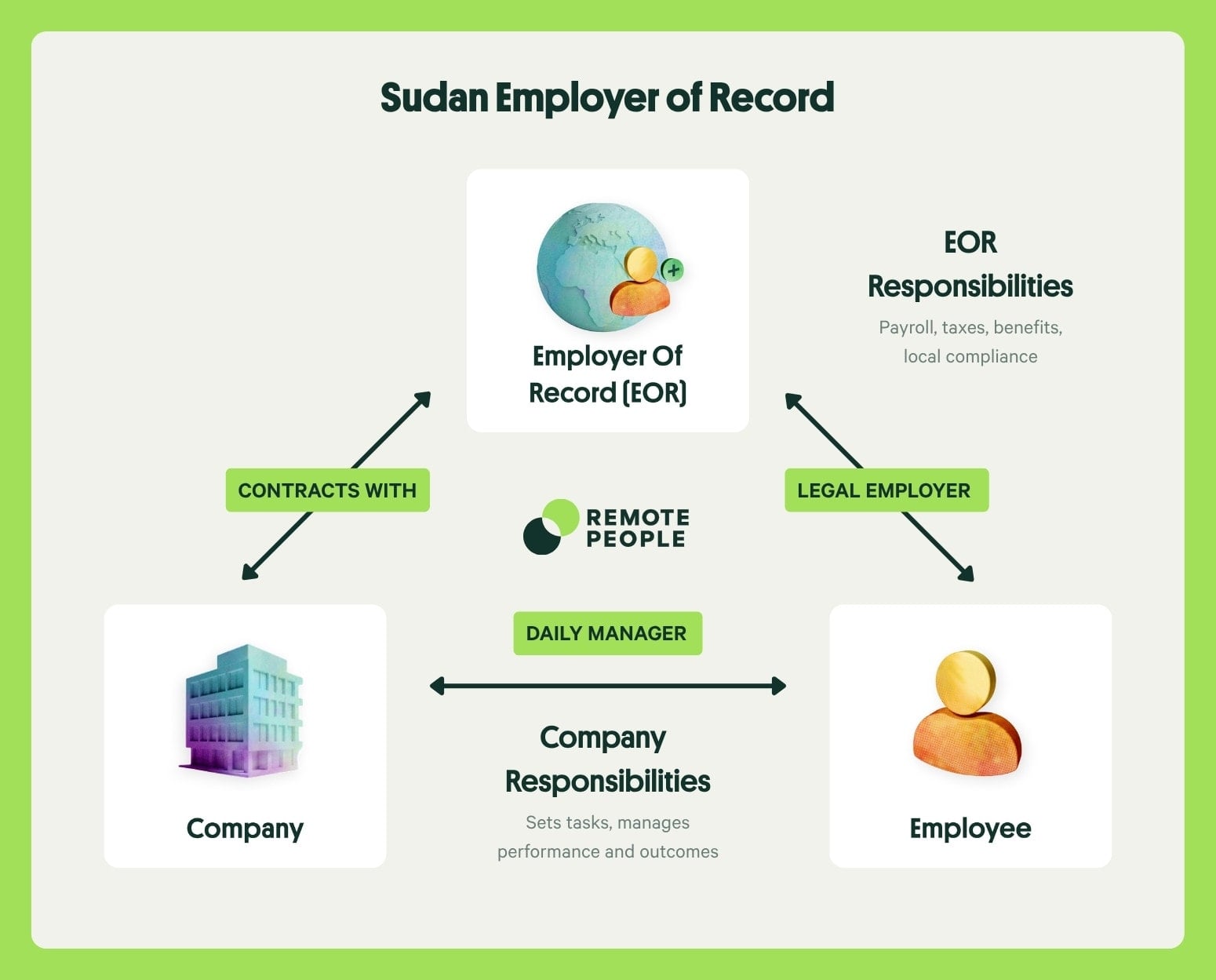
- Onboarding: Whether you find workers on your own or with the help of a recruitment agency or EOR that offers recruitment services, an EOR partner can help you onboard them efficiently. You’ll need to focus on providing them with orientations, job-specific training, and access to the tools and data they need to do their jobs. At the same time, your EOR partner will handle most administrative duties. This will include collecting their information and documents, adding them to your payroll, setting up their salary calculations, and registering them with the authorities. Most EORs can onboard new workers in just hours or days, depending on how prepared the workers are.
- Payroll: Instead of learning how to perform complicated payroll management on your own, your EOR will handle this function for you. It will add each new employee to your payroll and set up a unique calculation for them based on their income, benefits, and income tax rates. You’ll need to collect and share their time and attendance data with the EOR, either with your own tools or those built into the EOR’s platform. With this data, the EOR can run payroll for each pay period, calculating your employees’ earnings and deductions. It will then pay their net salaries on your behalf.
- Taxes: Sudanese workers must pay taxes on their salaries. The EOR takes care of the necessary calculations and withholding on your behalf. It also remits the collected tax payments to the Sudan Taxation Chamber (the tax authority) every month.
- Benefits administration: Sudanese employees must be provided with a range of mandatory benefits that include maternity leave, paid annual leave, and public holidays, as well as health and old age benefits through social security schemes. Your EOR will manage these benefits for your workers and deduct contributions from their salaries as necessary. As with taxes, it will remit the funds it collects to the social security authorities. Some EORs also help you offer additional benefits to your employees.
- Contracts: With its expertise in local employment law, your EOR partner will normally generate contracts for your Sudanese workers. It will ensure they’re complete and compliant, manage signatures, and keep the contracts on file for future reference.
- Terminations: Your EOR will enter into contracts directly with your employees in Sudan, and this makes it their legal employer. If you want to terminate any of them, you must communicate this to the EOR, which will assess your reasons and calculate and provide notice periods and severance pay as needed.
- Compliance: As their legal employer, the EOR is also fully responsible for maintaining compliance with all local labor and tax laws in Sudan. Its experts will also monitor changes in this dynamic country and will adjust workers’ contracts, benefits, and working conditions in response. This will ensure that your employees always get everything they’re entitled to.
- Recruitment: Only some EORs provide recruitment services, but these can be valuable when searching for talent in a foreign country. A few EORs professional recruiters who can actively search for top talent to fill your vacancies. Others only offer recruitment tools through their platforms. These tools, including access to talent pools, connections to job sites, and applicant tracking systems (ATSs), can help you recruit on your own much more effectively.
If you’d like to learn more about how Employer of Record (EOR) services work, read our What Is an Employer of Record (EOR)? guide for a complete overview of the model, its benefits, and when to use it.
If you’re comparing providers, our Best Employer of Record (EOR) Providers guide reviews the leading platforms to help you choose the right solution for your business.
Employment and Labor Laws in Sudan
Sudan’s legal system is heavily influenced by British common law, Islamic law, and local traditions. Many legal instruments help to define and regulate employment in the country, including the Constitution of Sudan 2019, the Sudan Labor Act 1997, and the Trade Unions Act 2010. Your EOR will ensure that your contracts are compliant with these regulations, but it’s also useful for you to know the obligations you have to your employees.
Employment Contract Requirements
Contracts in Sudan can be verbal, but written agreements in Arabic are strongly recommended. Under the Sudan Labour Act, a contract must identify both parties, describe the work and place of employment, state the start date, wages, payment terms, and notice period for termination.
The Labour Act recognises three contract types. An indefinite contract has no fixed end date and continues until either party terminates it. A fixed-term contract is for a specific period, with a maximum initial duration of 2 years, renewable once for up to another 2 years – giving a total maximum of 4 years. A task-based contract is tied to the completion of a specific piece of work rather than a time period.
For fixed-term contracts, if employment continues beyond the 4-year maximum, the arrangement is treated as indefinite by law. This is important for EOR clients who begin with fixed-term arrangements – exceeding the limit triggers indefinite employment status and the full termination protections that come with it.
Standard Working Hours
The standard workweek in Sudan is 48 hours, typically 8 hours per day across 6 days. Workers are entitled to a minimum 30-minute paid break per day for rest and meals.
During Ramadan, working hours are reduced to 36 hours per week (6 hours per day). This applies to Muslim employees and is widely observed across most workplaces. In 2026, Ramadan ran from approximately 18 February to 19 March. As the Islamic calendar is lunar, the dates shift by around 10 days earlier each year. International employers should plan for reduced output during this period and adjust project timelines accordingly.
Overtime
Overtime in Sudan is capped at 4 hours per day and 12 hours per week, keeping total daily hours within 12. Compensation rates are:
| When Worked | Rate |
|---|---|
| Weekday overtime | 150% of normal wage |
| Weekly rest day | 200% of normal wage |
| Public holidays | 250% of normal wage |
Overtime must be agreed between employer and employee and cannot be imposed unilaterally, except in cases of impending accidents or force majeure.
Under the Sudan Labour Act, mandatory overtime obligations differ between male and female employees. Women are also subject to restrictions on night work in certain industries under current Sudanese law. International employers should be aware these provisions may conflict with their own gender equality policies and the standards of their home jurisdiction.
Public Holidays
- Independence Day (January 1)
- Coptic Christmas (January 7)
- Eid al-Fitr (varies, end of Ramadan)
- Coptic Easter (varies)
- Eid al-Adha / Feast of the Sacrifice (varies)
- Islamic New Year / Hijri New Year (varies)
- Birthday of the Prophet / Al-Mowlid (varies)
- Christmas Day (December 25)
Both Eid al-Fitr and Eid al-Adha are typically observed over multiple days, which brings the total number of non-working days above the base list. The Sudanese government releases the confirmed holiday calendar for each year through an official gazette. Employers should verify the current year’s schedule as dates and inclusions can change.
Employees required to work on a public holiday must be paid at least double their normal wage, provided they have completed at least three months of service.
Probation Periods
Probation periods are allowed in Sudan and are widely used across most industries. They may last as long as three months and cannot be extended or renewed. During probation, both employers and employees have the right to terminate their agreements if they’re not seen to be working out. However, they must provide notice to the other party when doing so. This notice can range from one day to one month, depending on the frequency of the employee’s pay.
Payroll and Employment Taxes in Sudan
Fiscal Year
The fiscal year in Sudan follows the calendar year, starting on 1 January and ending on 31 December.
Payroll Cycles
Employers can pay workers on daily, weekly, semi-monthly, or monthly schedule. They must pay their workers their wages at their workplace during working hours and within three days of the end of the pay period in which they are earned.
Minimum Wage
Sudan’s most recently cited official minimum wage is SDG 12,000 per month, equivalent to approximately USD 20 at current exchange rates (around 600 SDG per USD).
The previous private sector figure of SDG 425 dates from 2008 and is entirely obsolete. The public sector minimum was raised to SDG 3,000 in 2020, with further adjustments since.
In practice, these figures carry limited weight. Since the outbreak of armed conflict in April 2023, formal payroll infrastructure has been severely disrupted across much of the country. Wage enforcement is largely suspended in conflict-affected areas, and many workers are paid through informal arrangements. Employers should treat all statutory figures as indicative only.
Social Security Contributions
Both employers and employees in Sudan are required to contribute to two mandatory social insurance schemes, calculated on gross monthly earnings.
| Scheme | Employer Rate | Employee Rate |
|---|---|---|
| National Pension and Social Insurance Fund (NPIF) | 17% | 8% |
| National Health Insurance Fund (NHIF) | 5.15% | 4% |
| Total | 22.15% | 12% |
The NPIF covers old age, disability, work injuries, and survivor benefits. The NHIF provides access to health services through contracted public and private providers. Employee contributions are withheld from salary by the employer and remitted alongside the employer’s share.
Since the outbreak of armed conflict in April 2023, collection and enforcement of social security contributions has been severely disrupted across much of the country. Employers should verify which government authorities are currently operational and accepting payments before remitting contributions.
Individual Income Tax Contributions
Employers in Sudan are responsible for withholding personal income tax from employee salaries and remitting it to the Sudan Taxation Chamber.
Sudan uses a progressive income tax system with a top marginal rate of 15%. The specific SDG bracket thresholds referenced in the 1986 Income Tax Act are effectively obsolete due to decades of hyperinflation — the full bracket structure covers less than USD 1 at current exchange rates. Updated thresholds have not been reliably published or enforced in recent years.
Personal allowances, family allowances, and dependent deductions are available under Sudanese tax law, which can reduce the taxable base. Given the near-collapse of formal tax administration since the outbreak of armed conflict in April 2023, employers should seek current guidance from a local tax adviser before attempting to apply any specific bracket structure.
Bonus Payments
A 13th-month salary is neither required in Sudan nor is it traditional. However, employers may choose to offer this bonus as an extra incentive for their employees.
Time Off and Leave in Sudan
Mandatory Leave Entitlement
After working continuously for one year, employees become entitled to annual paid leave. They get 20 days per year for their first three years of work, 25 days for the next 12 years, and 30 days if they’ve worked for more than 15 years for their employers. This leave can be carried over for only one year.
Sick Leave
Employees are entitled to up to nine months of sick leave in Sudan after they have worked for their employers for at least three months. Their employers must provide them with full pay for the first three months, half pay for the next three months, and 25% pay for the last three months.
Maternity Leave
Female employees in Sudan are entitled to 12 weeks of paid maternity leave under the Labour Act 1997, structured as 6 weeks before delivery and 6 weeks after. During this period, the employee is paid at half her regular wage.
This falls below the ILO’s recommended minimum of 14 weeks. Job protection applies during maternity leave, and an employee cannot be dismissed on grounds of pregnancy or childbirth.
Paternity Leave
There are no statutory provisions for paternity leave in Sudan. Fathers may receive leave at employer discretion or as agreed in the employment contract, but this is not a legal entitlement.
Bereavement Leave
Bereavement leave is not mandatory in Sudan, though some employers may offer it as an additional benefit.
Termination and Severance in Sudan
Termination
Employees in Sudan can be summarily dismissed for gross misconduct, and they can also resign if they are being mistreated or not properly shielded from risks to their health and safety. Other reasons for termination require the terminating party to give notice.
Notice Periods
Notice periods in Sudan are based on both the employees’ length of service (seniority) and the frequency with which they are paid.
| Worker Type | Length of Service | Notice Period |
|---|---|---|
| Daily paid workers | Less than 3 months | 1 day’s notice |
| Less than 3 years | 1 week’s notice | |
| Longer than 3 years | 1 month’s notice | |
| Weekly and semi-monthly paid workers | Less than 5 years | 2 weeks’ notice |
| Longer than 5 years | 1 month’s notice | |
| Monthly paid workers | Any length of service | 1 month’s notice |
Severance Pay
Employees with at least 3 years of continuous service are entitled to gratuity upon dismissal, except where dismissal is for gross misconduct. The payment is calculated on the employee’s last drawn basic salary as follows:
| Years of Service | Rate per Year |
|---|---|
| 3 to 10 years | 1 month’s basic salary |
| 10 to 15 years | 1.5 months’ basic salary |
| More than 15 years | 1.75 months’ basic salary |
Gratuity is not payable where an employee is dismissed for gross misconduct. For production workers, the calculation is based on average income over the last three years rather than the final basic salary.
Why Hire in Sudan with an Employer of Record?
There are numerous reasons why hiring employees through a Sudan EOR is an advantageous activity for investors, including:
- Reduced risk: When you hire with an EOR, it takes on the role of your employees’ legal employer in Sudan. This means that it also shields you from the risks of non-compliance, as the EOR, and not you, is responsible for following all applicable labor and tax laws.
- Low costs: Workers in Sudan receive very low wages, so it’s easy to attract top talent by offering higher salaries while still saving a lot on labor costs. You can also save money by using an EOR instead of setting up an HR team and paying their salaries long-term.
- Extensive opportunities: Sudan’s market is underdeveloped, and there are untold opportunities there for businesses to operate with little competition for resources and markets. Agriculture, mining, food processing, cement manufacture, and construction are just some of the industries that are currently growing in the country.
How to Choose an Employer of Record in Sudan
While Sudan has a relatively small economy, its large labor force has encouraged an increasing number of EORs to start providing services in the country. To help you choose the best partner from among them, consider these important factors:
Price
Set a budget for hiring and HR management, then see which providers can offer you the full range of services you require without breaking that budget.
Services
While all EORs will offer core services like payroll, benefits administration, and leave management, you may want to find a partner that offers more. If you need help with functions like supplementary benefits administration or recruitment, make sure the providers you’re considering can offer everything you need at a price you can afford.
Reputation
Excellent online ratings and reviews demonstrate that a provider can take care of your employees well, ensure compliance, and work effectively with the Sudanese authorities.
Expand into Sudan Easily with RemotePeople’s Employer of Record in Sudan
Sudan’s labor laws are complex, and the current operating environment adds an additional layer of risk for international employers. From social security compliance and gratuity calculations to navigating termination rules under a conflict-affected regulatory framework, getting it right requires local expertise.
RemotePeople’s Employer of Record service handles employment contracts, payroll, statutory contributions, and full labor law compliance on your behalf, with no local entity required. Whether you are hiring a single specialist or building a team, we manage the complexity so you can focus on your business.
Get in touch with RemotePeople to discuss your hiring needs in Sudan.
Frequently Asked Questions
It depends heavily on location. Operations in Port Sudan and some other regions outside the conflict zone have continued with relative stability, and some international organizations maintain active workforces there. However, much of central Sudan, including Khartoum, remains severely affected. Employers should conduct thorough due diligence on the specific region before hiring and have contingency plans in place.
In practice, many international organizations and foreign employers pay in USD or index salaries to USD to protect against currency depreciation. While the legal tender for wages is the Sudanese Pound, USD-denominated arrangements are common, particularly for roles serving international clients or organizations. Employers should seek local legal advice on how to structure this compliantly.
This is one of the most complex compliance challenges in Sudan at present. With NPIF and NHIF operations disrupted in conflict-affected areas, employers should document their attempts to comply and seek guidance from a local legal adviser on how to handle contributions where remittance is not currently possible. Maintaining records is critical for future compliance once normal operations resume.
Yes. Redundancy due to economic circumstances is a recognized ground for termination under the Labour Act 1997. It entitles affected employees to gratuity based on years of service and requires proper notice periods. Employers cannot use redundancy as a pretext for dismissals that would otherwise require cause, and affected employees can challenge the termination through labor courts.
Generally yes. The Labour Act applies to all employees working in Sudan regardless of nationality, entitling foreign workers to the same minimum standards on wages, working hours, leave, and termination protections. Foreign nationals still require a valid work permit, which the employer is responsible for sponsoring.
This is not explicitly addressed in the Labour Act for conflict situations. In practice, many employers treat extended displacement as a form of force majeure and handle leave entitlements on a case-by-case basis. Seeking local legal advice and documenting all decisions clearly is strongly recommended to avoid future disputes.
Employer of Record in
Employer of Record in
Employer of Record in
Employer of Record in
Employer of Record in
Employer of Record in
Employer of Record in
Employer of Record in




