Recruit
Employer of Record in South Sudan
-
 Drew Donnelly
- Published
- July 21, 2026
RemotePeople’s employer of record in South Sudan lets you hire employees in South Sudan with NSSF management. We handle National Social Security Fund contributions at 17 percent employer share, pension benefits, and disability coverage.
Hire in South Sudan — book a free 30-minute demo
Tell us what you need. You'll get a tailored, transparent proposal within 24 hours, plus a free call to walk through it.
Tell us about your company
So we can match you with a specialist who knows your market — and unlock volume pricing tiers.
* All fields are required.
Where and when are you hiring?
Tell us the geography and timing and we'll quote each country line by line, with onboarding timelines.
* All fields are required.
Help us beat your current setup
We'll benchmark your current deal and send a line-by-line proposal in 24 hours — showing exactly where we cut cost, time, or risk. After you submit, you can book a call to walk through it together.
* All fields are required.
Thanks! Your proposal is on its way.
Expect a tailored, line-by-line proposal in your inbox within 24 hours. In the meantime…
Want to walk through it together?
Book a free 30-minute call with one of our specialists. We'll explain every line, answer your questions, and tailor the proposal further if you need.
No obligation. Pick a time that works for you.








- Hire in South Sudan — book a free 30-minute demo
- Tell us about your company
- Where and when are you hiring?
- Help us beat your current setup
- Thanks! Your proposal is on its way.
- How to Hire Employees in South Sudan
- Start hiring with a South Sudan EOR
- Using an Employer of Record in South Sudan
- Employment and Labor Laws in South Sudan
- Payroll and Employment Taxes in South Sudan
- Time Off and Leave in South Sudan
- Termination and Severance in South Sudan
- Why Hire in South Sudan with an Employer of Record?
- How to Choose an Employer of Record in South Sudan
- Expand into South Sudan Easily with RemotePeople’s Employer of Record in South Sudan
- Related EOR Destinations

Start hiring in South Sudan
Let RemotePeople handle payroll, compliance, and HR admin worldwide so you can focus on building your team.

South Sudan, which gained independence in 2011, is the world’s youngest nation. It’s a mid-sized, landlocked country bordered by Ethiopia, the Democratic Republic of the Congo, Uganda, Kenya, the Central African Republic, and Sudan, the country it separated from. South Sudan is the world’s 74th-largest country by population, as it’s home to 15.896 million people. However, the country’s economy is still developing and is only the 165th-largest in the world, with a GDP of $4.0 billion in 2025. The economy is dominated by oil production, and crude and refined petroleum are its top exports. It also exports gold and produces agricultural products that include sorghum, maize, sugarcane, coffee, sesame, and cotton. South Sudan largely trades with China, Singapore, the UAE, Uganda, Germany, Kenya, and the US.
South Sudan has a very young population, so that, of its nearly 16 million people, only 5.091 million are workers in its labor force. While numbers have decreased steadily, 59% of these workers are still employed in agriculture, both in subsistence and commercial production. Around 14% of the country’s workers are employed in the industrial sector, especially in hydrocarbon extraction and mining. The remaining 27% of the labor force is employed in services like government services, trade, transport, and hospitality.
If you want to hire workers in this market, working with a South Sudan EOR may be your best option. This guide will explore how this partnership works and the advantages it can create for both you and your employees.
What Is an EOR?
How to Hire Employees in South Sudan
South Sudan workers earn relatively low salaries and can therefore be highly affordable for foreign investors. The country’s per capita GDP is only $251.49 a year, and many workers earn only around 450 SSP (South Sudan pounds) per day, or around 3.45 USD. Monthly salaries for skilled workers can be much higher, but are still very low compared to salaries in developed countries. Unemployment in the country is also fairly high at 12.5% in general, and up to 18% for young workers. Together, these conditions create a market with lots of available and affordable workers.
At the same time, attracting, hiring, and managing HR for workers in South Sudan can be difficult. Foreign investors typically work with professional recruiters to help them overcome the challenges created by different languages and cultures in this labor market. Once workers have been selected, employers can choose from these different options to hire them:
Entity Incorporation
One common choice for investors is to set up a legal business entity in South Sudan. This option makes sense for investors who expect to work directly in the South Sudanese market, hire large numbers of local workers, and operate in the country long term. Registering an entity also lets you have direct control over the hours and methods of your workers in the country.
Most investors choose to incorporate limited liability companies (LLCs), limited partnerships, or branch offices. All of these types of entities can be completely foreign-owned, and no government approval is required for foreign owners.
However, according to the World Bank, South Sudan is one of the most difficult places in the world to set up a business. The country is ranked 172nd out of over 180 countries for ease of starting a business, a task that requires 12 steps and at least 13 days to accomplish. Getting electricity, paying taxes, getting credit, and trading across borders are also very challenging. Once you’re incorporated, you’ll still need to set up an HR department and work with legal and tax experts to help you stay compliant.
Working with an EOR
Instead of struggling to set up an entity or dealing with the risks of working with contractors, you can also choose to hire employees in South Sudan without needing an entity. Partnering with a South Sudan EOR, or Employer of Record, allows you to hire local workers and have their HR needs professionally managed. The EOR hires employees for you and manages them compliantly, so you can focus on how they’ll create value for your business.
Hiring Independent Contractors
If you don’t want to go through the trouble of setting up an entity in South Sudan, another option is to hire independent contractors, also known as freelancers. You can hire them remotely through an entity you own in another country and manage their work and payments online. Hiring contractors lets you save costs by only hiring people when you need them, as opposed to permanent employees. You can also access special skills and knowledge that may otherwise be hard to find or prohibitively expensive. You can also reduce your administrative burden as contractors manage their own tax and social security payments.
Not everything about working with contractors is positive, however. You don’t have direct control over when and how they work, and if you try to exercise this control, you could end up being penalized for worker misclassification. Contractors work for multiple clients and may not be available when you need them, or may even be busy working for your competitors. You may need to hire multiple contractors to continue, and this can mean wasting time training new people often.
Next, we’ll look in-depth at what an EOR does and the competitive advantages it can create for your business in South Sudan.
Start hiring with a South Sudan EOR
Let us handle the complexities of hiring, compliance, and payroll in South Sudan while you focus on growing your team.
- Hire employees in South Sudan with a South Sudan EOR
- No local entity is needed
- Pricing starts at USD 199 per employee
- RemotePeople can also help you find the best talent in South Sudan
Using an Employer of Record in South Sudan
Incorporating an entity in South Sudan is not only difficult and time-consuming, but it may also be unnecessarily resource-intensive for businesses that want to hire smaller numbers of workers for shorter periods.
Instead, you can partner with an EOR, which will hire employees through its own entity, so you don’t need one. It will also manage these core functions for you over the long term:
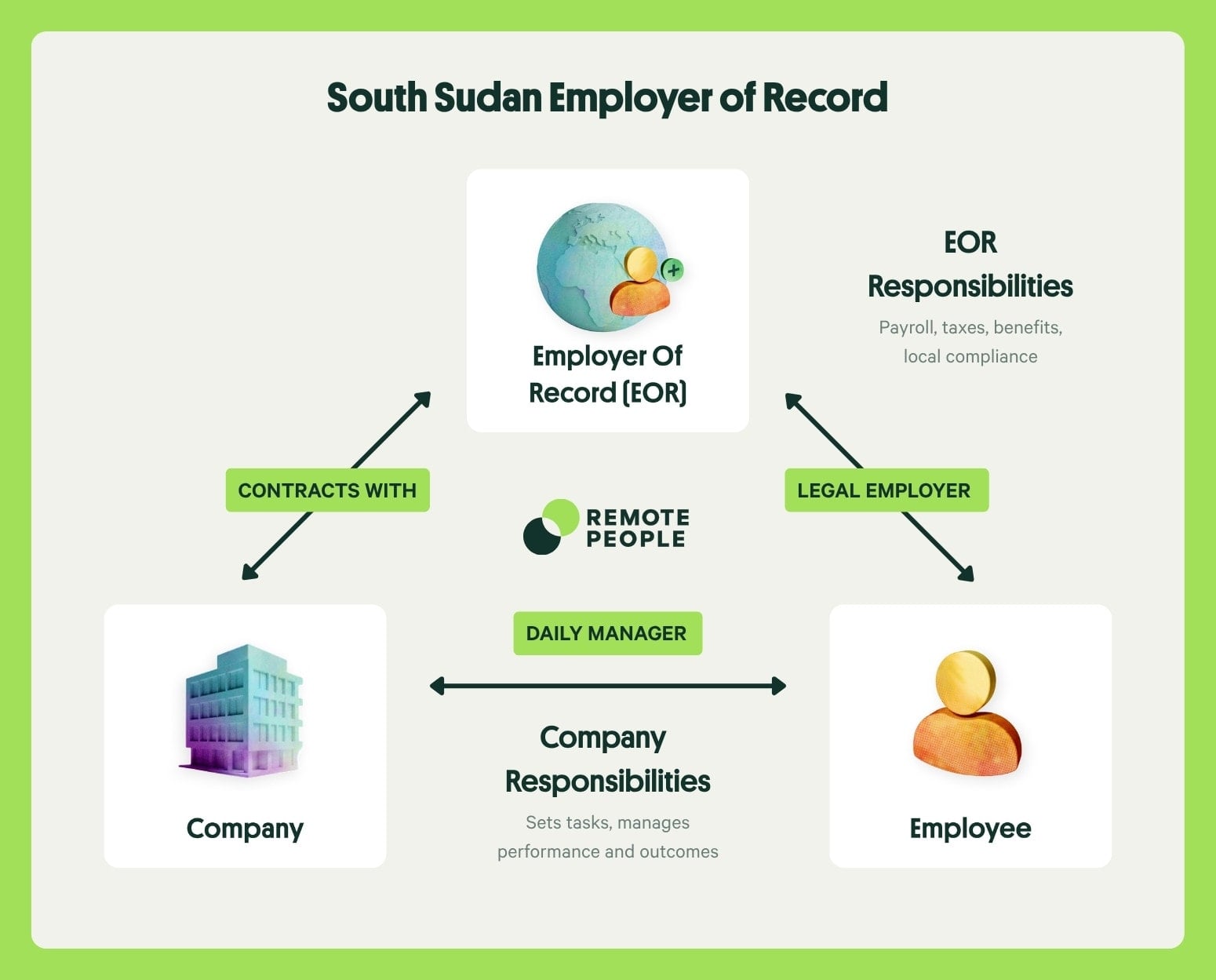
- Onboarding: You may be able to find South Sudanese talent on your own, or with the help of a professional recruitment agency. Once you’ve sourced workers, your EOR partner will help you to onboard them. It will handle the administration needed for onboarding new workers, including collecting their documents and information, adding them to payroll, and registering them with the authorities. As their worksite employer, you’ll also need to do some onboarding activities that normally include providing your workers with orientations, job-specific training, and access to the tools and systems they’ll need to do their work. EORs can typically onboard workers in a few hours to a few days at most, helping them start working for you as soon as possible.
- Payroll: Managing payroll in a different country can be tremendously challenging because of all the tax and labor laws you need to become familiar with. When you partner with an EOR, it takes on this complicated function for you, helping you to pay your workers accurately and compliantly. The EOR will need to add each new worker to its payroll. It will also set up a unique calculation for them based on their salary, deductions, and income taxes. You’ll be responsible for tracking their time and attendance, then sharing this data with the EOR for each pay period. This lets the EOR run payroll and calculate your employees’ earnings and deductions. Finally, it will pay their net salaries for you, normally by bank transfer.
- Taxes: South Sudanese workers have to pay taxes on their employment income. Your EOR will calculate these taxes and withhold them from your employees’ salaries. It will then remit the funds it collects to the South Sudan Revenue Authority regularly.
- Benefits administration: Employers in South Sudan need to provide their employees with several mandatory benefits, including paid annual leave, maternity leave, and public holidays. They also need to manage contributions to the country’s social security schemes. Your EOR partner will administer these benefits for your workers, often allowing them access to their information through employee portals in its platform. It will handle employee deductions and your employer contributions as well. Many EORs also connect you with additional benefits such as private health insurance and pension plans that you can offer your employees.
- Contracts: EORs employ legal and HR experts who have extensive experience in creating compliant contracts in South Sudan. They help the EOR generate contracts that include your workers’ specific conditions. They normally also manage the signing of contracts and their storage for future use.
- Terminations: Since your EOR enters into contracts directly with your employees on your behalf, it is their legal employer and the only party that can legally terminate them. To terminate workers, you need to let the EOR know so it can assess your reasons. It will then calculate and provide notice and severance pay if required.
- Compliance: As the legal employer of your employees in South Sudan, your EOR is responsible for maintaining compliance with local labor and tax laws. It should also continuously monitor changes to the law and adjust your workers’ working conditions and contracts accordingly. In this way, it ensures that you provide your employees with everything they’re entitled to by South Sudanese law.
- Recruitment: Some EORs can help you find local and even international talent through recruitment tools and services. They may provide platform tools, like connections to job sites and applicant tracking systems (ATSs), which can help you perform recruitment on your own more effectively. A small number of EORs employ professional recruiters who can be engaged to actively search out the top talent you need to fill your vacancies.
Employment and Labor Laws in South Sudan
South Sudan’s legal system comes from a mix of traditional law and English Common Law. The main legislative tools that regulate employment include the Constitution of South Sudan 2011, the Labor Act 2017, and the Social Insurance Act 1990 (amended 2008). While your EOR partner will ensure that you stay compliant with these regulations, they’re still important to understand so you know what you’re obligated to provide for your South Sudanese employees.
Employment Contract Requirements
Contracts in South Sudan can be verbal, but the employer must still provide the employee with the written particulars of any contract. They should be made in English, the country’s official language. Employment contracts must also include the following:
- Identification of the parties
- Place of work
- Work description
- Duration of employment
- Wages
- Notice period for termination
- Benefits for the employee and their dependents
Fixed-term contracts are legal in South Sudan according to the Labor Act, but their durations are not limited by law. If an employee continues to be employed for two years after their contract expires, however, they will be considered to be employed on an indefinite contract.
Standard Working Hours
The regular workweek for employees in South Sudan is 49 hours. While this normally means six days of eight hours each, regular hours can be extended to nine hours on some days and reduced on others. Shift workers, however, can only work a maximum of 40 hours a week, averaged over a three-week period.
Overtime
Overtime must be by consent of the employee and is limited to three hours a day and ten hours a week. Employees must be paid 150% of their normal wages for overtime hours, or be granted leave in lieu of this premium payment.
Probation Periods
Probation periods are legal in South Sudan and are used across most industries to assess workers’ abilities. They can last as long as three months, but can be extended to give the employee a chance to improve if necessary. Employees can be terminated without cause during this time, though only at the end of each month of the probation period.
Payroll and Employment Taxes in South Sudan
Fiscal Year
The fiscal year in South Sudan follows the calendar year, and most companies follow this operational year for tax reasons.
Payroll Cycles
Employees in South Sudan can be paid daily, weekly, bi-weekly, or monthly. They must be paid on the last day of their pay periods at their workplace and during working hours, or into their bank accounts.
Minimum Wage
South Sudan does not mandate a minimum wage for workers. Instead, their wages are set by individual contracts or in collective agreements for some industries.
Employer Tax Contributions
In South Sudan, all employers must contribute to a social security scheme that provides their employees with pensions and both disability and survivors’ benefits. Employers pay 17% of each employee’s salary into the South Sudan Social Insurance Fund (SSSIF) every month.
Employee Payroll Tax Contributions
Employees must also contribute to the SSSIF. Their employers deduct 8% of their salaries and remit this money to the fund regularly.
Individual Income Tax Contributions
Employees in South Sudan pay personal income tax on their earnings. Employers, or EORs working on their behalf, have to calculate how much they need to pay, withhold these funds from their salaries, and remit them to the South Sudan Revenue Authority. Income tax rates are progressive and follow this schedule:
| Monthly Income (SSP) | Tax Rate |
|---|---|
| 0 to 2,000 | 0% |
| 2,001 to 5,000 | 5% |
| 5,000 to 10,000 | 10% |
| 10,001 to 15,000 | 15% |
| More than 15,000 | 20% |
Bonus Payments
A 13th-month salary is not mandatory or traditional in South Sudan. Employers can choose to offer this bonus as an extra benefit for their employees.
Time Off and Leave in South Sudan
Mandatory Leave Entitlement
After working for one year, South Sudanese employees become entitled to annual paid leave. They receive 21 days each year for their first three years of service, 25 days each year for 4-14 years of service, and 30 days each year after they’ve worked for more than 15 years for their employer. This leave can be carried over to the next year and, if it is unused by the end of that year, half of the leave can be paid out in cash.
Public Holidays
South Sudan normally celebrates 14 public holidays per year, and these are paid days off for workers. If they are made to work on these days, they must be paid double their normal wages. Public holidays in South Sudan include:
- New Year’s Day (January 1)
- Good Friday (date varies)
- Holy Saturday (date varies)
- Easter Sunday (date varies)
- Easter Monday (date varies)
- Labor Day (May 1)
- SPLA Day (May 16
- Eid al Fitr (date varies)
- Independence Day (July 9)
- Martyrs’ Day (July 30)
- Eid al Adha (date varies)
- Christmas Eve (December 24)
- Christmas Day (December 25)
- Boxing Day (December 26)
Sick Leave
Employees can take up to 12 days of fully paid sick leave per year. Employers pay for this leave, and can require that their employees provide them with medical certificates.
Parental Leave
Pregnant mothers in South Sudan are entitled to 90 days of maternity leave. This leave is paid by the employer. When they return to work, they are allowed to work 45 days at half-pay so that they can breastfeed their babies. New fathers can take two weeks of paternity leave within three days of the birth of a child. This leave is also fully paid by the employer.
Bereavement Leave
Once an employee has worked for their employer for at least three months, they become entitled to three days of compassionate leave per year. This leave can be used to care for a sick family member or to mourn a deceased loved one.
Termination and Severance in South Sudan
Termination
South Sudanese employees can be summarily dismissed for gross misconduct. They may also be let go for an inability to perform their work to an appropriate standard.
Notice Periods
After completing probation, workers become entitled to notice if they are dismissed, and they must also give notice to their employers if they choose to resign. The notice periods in South Sudan are one week for employees who’ve worked less than six months, two weeks for employees who’ve worked for six months to one year, and one month for over a year’s service.
Severance Pay
Employers must pay their employees severance pay if they terminate them unfairly. Severance rates are agreed on in collective agreements and individual contracts.
Employees are also entitled to “gratuity” pay after working for one year, according to this schedule:
| Period of Service | Gratuity |
|---|---|
| 1 to 10 years | 1 month’s pay per year |
| 11 to 15 years | 1.5 months’ pay per year |
| Over 15 years | 1.5 months’ pay per year |
Why Hire in South Sudan with an Employer of Record?
Hiring employees in South Sudan can be advantageous for several reasons, including:
- Low costs: Wages are low in South Sudan, allowing you to hire skilled workers while saving on labor costs. Working with an EOR can also be more affordable than employing an in-house HR department, especially for smaller numbers of workers.
- Reduced risk: When you partner with an EOR, it becomes the legal employer of your workers in South Sudan. As such, it’s responsible for keeping compliant with all local labor and tax laws, and this shields you from risk in the country.
- Extensive opportunities: South Sudan is the world’s youngest country and has an underdeveloped economy that’s full of potential. Industries that are currently expanding in South Sudan include infrastructure development, agriculture, and food processing, while tourism is another area with lots of potential.
How to Choose an Employer of Record in South Sudan
South Sudan is a small and developing market, but there are still several EORs working actively in the country. To help you choose a partner from among them, we recommend that you focus on these main factors:
Price
Price is always important. Set your budget, then look for EORs that can provide all the services you need without becoming overly expensive.
Services
Essentially, all EORs will manage payroll, benefits administration, and leave management for you. If you also want to obtain additional services like supplementary benefits administration or recruitment, look at EORs that can provide these within your budget.
Reputation
Look at ratings and reviews on sites you trust. An EOR with a great reputation should be able to keep your employees happy by managing their needs correctly and compliantly.
Expand into South Sudan Easily with RemotePeople’s Employer of Record in South Sudan
RemotePeople’s Employer of Record (EOR) services in South Sudan help you hire and manage HR efficiently and compliantly. Contact RemotePeople today to connect with the top EOR in South Sudan.