
 Recruit
Employer of Record (EOR) in Burundi
-
 Drew Donnelly
- Published
- September 27, 2026
RemotePeople’s employer of record in Burundi lets you hire employees in Burundi with mandatory social security enrollment. We handle 6% employer contributions to the National Social Security Institute (capped at approximately $153 per month), accident risk fund contributions of 3% (capped at approximately $0.81 per month), and registration within 30 days.
Hire in Burundi — book a free 30-minute demo
Tell us what you need. You'll get a tailored, transparent proposal within 24 hours, plus a free call to walk through it.
Tell us about your company
So we can match you with a specialist who knows your market — and unlock volume pricing tiers.
* All fields are required.
Where and when are you hiring?
Tell us the geography and timing and we'll quote each country line by line, with onboarding timelines.
* All fields are required.
Help us beat your current setup
We'll benchmark your current deal and send a line-by-line proposal in 24 hours — showing exactly where we cut cost, time, or risk. After you submit, you can book a call to walk through it together.
* All fields are required.
Thanks! Your proposal is on its way.
Expect a tailored, line-by-line proposal in your inbox within 24 hours. In the meantime…
Want to walk through it together?
Book a free 30-minute call with one of our specialists. We'll explain every line, answer your questions, and tailor the proposal further if you need.
No obligation. Pick a time that works for you.








- Hire in Burundi — book a free 30-minute demo
- Tell us about your company
- Where and when are you hiring?
- Help us beat your current setup
- Thanks! Your proposal is on its way.
- How an Employer of Record Works in Burundi
- Hire in Burundi
- Employment Laws and Regulations in Burundi
- Work Permits and Visas in Burundi
- Payroll, Taxes, and Social Security in Burundi
- Cost of Hiring Through an EOR in Burundi
- Benefits of Using an EOR in Burundi
- Termination and Offboarding in Burundi
- EOR vs. Other Hiring Models in Burundi
- Public Holidays in Burundi
- How to Get Started with an EOR in Burundi
- Where companies hiring in Burundi expand next
- Frequently Asked Questions
- Related EOR Destinations
Start hiring in Burundi
Let RemotePeople handle payroll, compliance, and HR admin worldwide so you can focus on building your team.

Burundi offers one of East Africa’s lowest employer tax burdens, with total statutory employer contributions capped at 13% of gross salary and effective rates often far lower because of contribution ceilings. For companies looking to hire employees in Burundi, the entry barriers are significant: incorporating a local entity requires capital deposits, tax registration with the Office Burundais des Recettes, social security enrollment with the Institut National de Sécurité Sociale, and navigation of French-language compliance documents under the 2020 Labour Code. An employer of record in Burundi removes those barriers by acting as the legal employer on your behalf, handling contracts, payroll, tax, and social security while you retain full operational control of the employee’s work.
This guide covers everything a company needs to hire compliantly in Burundi: the 2020 Labour Code framework, statutory leave, social security contributions, income tax brackets, work permit routes for foreign nationals, total cost of employment, and how an EOR compares to setting up a subsidiary. Every rate, formula, and deadline is verified against government or international institution sources.
How an Employer of Record Works in Burundi
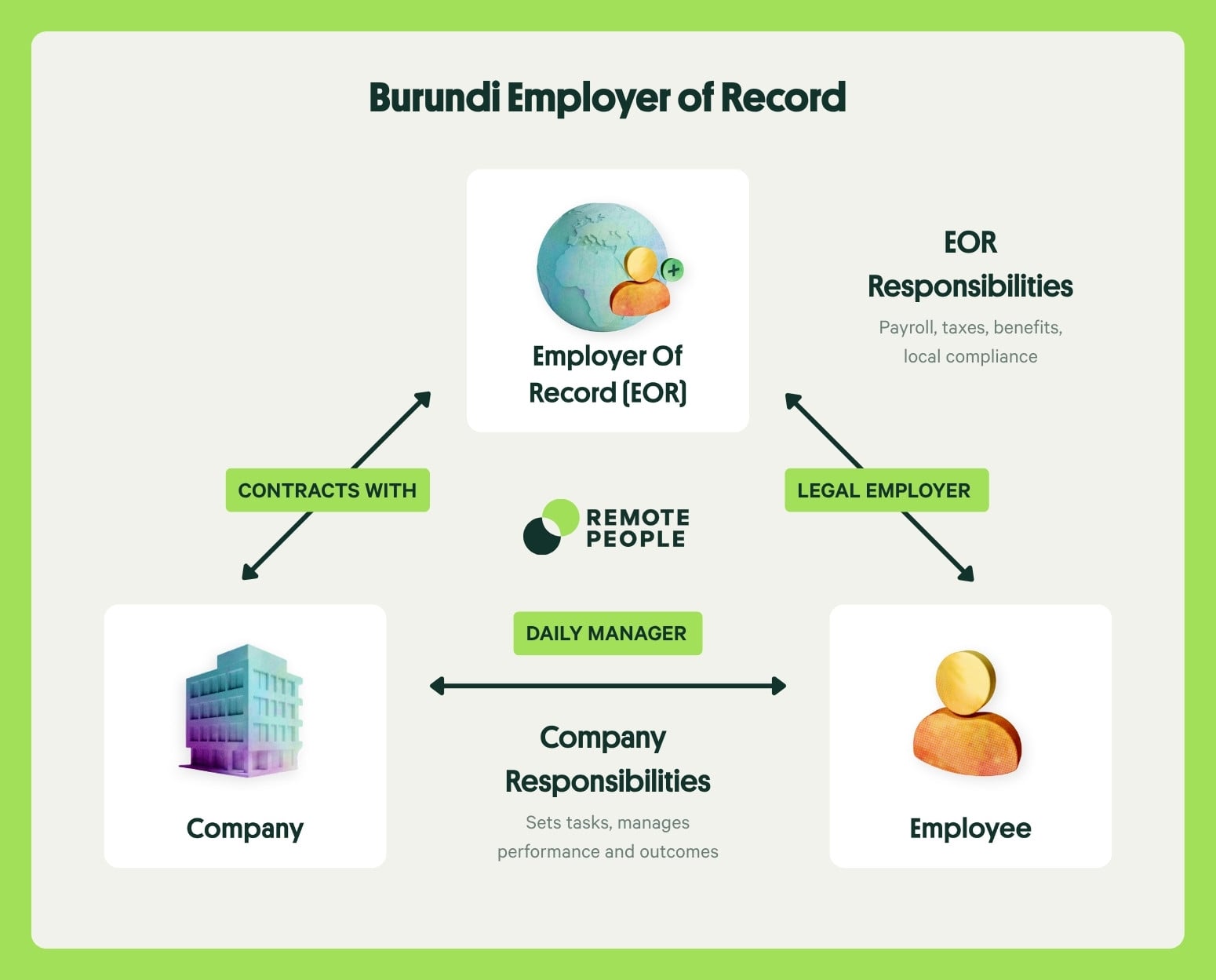
If you’d like to learn more about how Employer of Record (EOR) services work, read our What Is an Employer of Record (EOR)? guide for a complete overview of the model, its benefits, and when to use it.
If you’re comparing providers, our Best Employer of Record (EOR) Providers guide reviews the leading platforms to help you choose the right solution for your business.
Who Uses an EOR in Burundi?
An EOR is the practical hiring route for any company that wants to employ workers in Burundi without investing in a local entity. It suits organizations testing the Burundian market with a small team, hiring one to five specialists for a remote-first role, or moving quickly on an urgent hire where entity setup would take several months. It is also the default choice for foreign companies bringing in expatriate managers or technical staff, because the EOR can sponsor Class B work permits and absorb the paperwork burden.
- Companies entering Burundi for the first time that need a compliant hiring vehicle before deciding whether to incorporate
- Teams of 1 to 15 employees where the overhead of running a local subsidiary is not justified
- Employers hiring foreign nationals who need work permit sponsorship and immigration support
- Organizations that want to hire quickly, onboarding in 2 to 3 weeks rather than the 3 to 6 months a local entity setup typically requires
- Companies concerned about compliance exposure given the 2020 Labour Code’s detailed statutory requirements
Typical Onboarding Timeline
Onboarding a Burundian employee through an EOR typically takes 2 to 3 weeks for citizens and 8 to 12 weeks for foreign nationals who need work permit sponsorship. The extended timeline for foreign hires reflects the sequential review by the Ministry of Labour and the Immigration Department.
- First, sign the EOR service agreement and share the candidate’s full details, qualifications, and intended start date (1 to 2 days).
- Second, the EOR drafts a French-language employment contract aligned with the Labour Code and sends it for your review and the employee’s signature (2 to 3 days).
- Third, INSS registration and CNAM enrollment are processed in parallel with tax registration at the Office Burundais des Recettes (3 to 5 working days).
- Fourth, payroll is configured, a bank account validation is completed, and the employee receives their onboarding pack (2 to 3 days).
- Fifth, the employee starts work. For foreign nationals, the EOR files the Class B work permit application, which adds approximately 2 to 4 months to the timeline before legal start date.
Most EOR providers can onboard a Burundian national within 2 to 3 weeks. Work permits for foreign hires and background-check heavy roles can push the timeline further, so plan start dates accordingly.
Hire in Burundi
Burundi offers East Africa’s lowest employer tax burden, with statutory contributions capped at 13% nominal and effective rates often closer to 6% thanks to INSS earnings ceilings.
We handle employment contracts, payroll, tax withholding, and full Burundi compliance.
No local entity needed. Your team can start in 2 to 3 weeks.
Employment Laws and Regulations in Burundi
Employment Contracts
Burundi’s employment framework is governed by Law No. 1/11 of 24 November 2020 on the Labour Code, administered by the Ministry of Public Service, Labour and Employment. All employment relationships in the private sector require a written contract in French (the official working language), though contracts may also be provided in Kirundi or English as reference copies. Fixed-term contracts are permitted but capped at a maximum cumulative duration of 24 months before they automatically convert to indefinite-term status. Required contract terms include the job title and description, place of work, start date, gross salary, working hours, probation period (if any), notice period, and applicable collective agreement if the sector has one.Working Hours and Overtime
The standard workweek in Burundi is 45 hours, typically arranged as 8 hours per day over 5.5 or 6 days, per the 2020 Labour Code. Employees are entitled to a weekly rest of at least 24 consecutive hours (usually Sunday). Overtime is capped at 15 hours per week and 150 hours per year. The first two overtime hours per week are paid at 135% of the regular hourly rate, and any overtime beyond that is paid at 160%. Work on Sundays, public holidays, or at night attracts additional premiums set in sectoral collective agreements.|
Burundi overtime and premium pay rates · Per Law No. 1/11 of 24 November 2020 (Labour Code) |
|||
|
Hour Type |
Rate Multiplier |
Weekly or Daily Cap |
Notes |
|---|---|---|---|
|
First two overtime hours (46th and 47th) |
135% of regular hourly rate |
Counts toward the 15 hr/week and 150 hr/year overtime cap |
Applies to the first two hours worked beyond the 45 hour statutory workweek |
|
Overtime beyond two hours (48th hour onward) |
160% of regular hourly rate |
Counts toward the 15 hr/week and 150 hr/year overtime cap |
Applies from the third overtime hour per week onward |
|
Sunday or public holiday work (daytime) |
200% of regular hourly rate |
Weekly rest of 24 consecutive hours must still be granted |
Day shift worked on a statutory rest day or official public holiday |
|
Night work (roughly 9 PM to 5 AM) |
Premium set by sectoral collective agreements |
Same 15 hr/week cap if the hours qualify as overtime |
The Labour Code defers night shift pay to sector level collective bargaining |
Minimum Wage
Burundi’s statutory minimum wage is set at $1.95 per day in the urban areas of Bujumbura and Gitega, and $1.28 per day in rural areas, under Ministerial Order No. 650/11/88 of 30 April 1988. These statutory figures have not been revised since 1988 and are effectively symbolic; market wages for professional roles begin at roughly $150 to $300 per month and rise sharply for qualified staff. In April 2025, the Ministry of Public Service, Labour and Employment held stakeholder consultations on updating the SMIG, but no new rates have been gazetted as of the latest review. Employers hiring through an EOR should pay the going market rate for the role rather than anchoring to the statutory minimum.Probation Period
Probation periods in Burundi are capped at 6 months for standard roles and 12 months for management, executive, and supervisory positions, per the 2020 Labour Code. Fixed-term contracts may include a probation period of up to one-third of the contract duration, whichever is shorter. During the first month of probation, either party may terminate the employment contract immediately without notice. After the first month through the end of probation, a notice of three days is required. Once probation ends, the full statutory notice periods apply based on tenure.Leave Entitlements
Burundi’s statutory leave framework under the 2020 Labour Code covers annual leave, sick leave, maternity leave, paternity leave, and special leave for family events. Accrual rules, pay rates, and who funds each type of leave vary by category, with INSS contributing to maternity leave costs and the employer bearing most other paid leave obligations.Annual Leave
Employees in Burundi are entitled to annual paid leave accruing at 1 and 2/3 days (1.67 days) per full month of service, which works out to 20 working days per year after 12 months of continuous employment. Annual leave entitlement increases with tenure: employees with 5 or more years of service receive an additional day, and the entitlement continues to grow modestly at longer tenure milestones. Unused leave may be carried over for up to 12 months, after which it is forfeited unless the employer and employee agree otherwise. Leave accrues during probation and can typically be taken once the 12-month qualifying period is complete.Sick Leave
Employees who are unable to work due to illness or injury are entitled to paid sick leave of up to 3 months at 66.67% of regular salary, with the employer bearing the cost. A medical certificate issued by a registered practitioner is required for absences of more than 2 consecutive days. Work-related injuries and occupational illnesses are covered separately under the INSS work injury insurance scheme, which compensates the employee independently of the sick leave entitlement.Maternity Leave
Female employees are entitled to 12 weeks of paid maternity leave, extendable to 14 weeks in the case of medical complications or multiple births. The leave must include at least 6 weeks of post-natal rest. Maternity pay is shared equally: the employer pays 50% of the employee’s regular salary, and the Institut National de Sécurité Sociale pays the remaining 50% as a maternity benefit. The employee’s job is protected throughout the leave, and dismissal during pregnancy or maternity leave is prohibited except for serious misconduct unrelated to the pregnancy.Paternity Leave
Fathers are entitled to 4 days of paid paternity leave under the 2020 Labour Code, to be taken within the first 15 days following the birth of the child. Paternity pay is fully borne by the employer. Some collective agreements or employment contracts may provide more generous paternity leave, but 4 days is the statutory minimum.Other Statutory Leave
- Marriage leave: 4 days of paid leave for the employee’s own marriage
- Bereavement leave: 3 days paid for the death of a spouse, child, or parent; 1 day for other close relatives
- Family event leave: 1 to 3 days for childbirth (non-maternity), child’s marriage, or similar family milestones
- Court and civic duty leave: unpaid time off for employees summoned as witnesses or jurors, with wage protection during the absence
|
Burundi statutory leave entitlements · Per Labour Code Law No. 1/11 of 2020 |
||
|
Leave Type |
Duration |
Eligibility and Notes |
|---|---|---|
|
Annual Leave |
20 working days/year |
Accrues at 1.67 days/month. Available after 12 months service. Increases with tenure. |
|
Sick Leave |
Up to 3 months |
66.67% of salary, paid by employer. Medical certificate required after 2 days. |
|
Maternity Leave |
12 weeks (14 if complications) |
50% paid by employer, 50% paid by INSS. Job protection throughout. |
|
Paternity Leave |
4 days |
Fully paid by employer. Must be taken within 15 days of birth. |
|
Marriage Leave |
4 days |
Paid. Own marriage only. Employer-funded. |
|
Bereavement Leave |
1 to 3 days |
Paid. Based on relationship to deceased. Employer-funded. |
|
Public Holidays |
14 days (2026) |
Paid. Work on holidays compensated at premium rate. |
Statutory Employee Benefits
Mandatory benefits in Burundi extend beyond paid leave to include social security coverage, health insurance, and vocational training contributions. Employers must enroll every employee with the Institut National de Sécurité Sociale (INSS), which administers pension, work injury, and maternity benefits. A separate enrollment with the National Health Insurance Fund (CNAM) provides medical coverage, and contributions to the National Employment and Vocational Training Fund (FNEF) support workforce development. There is no statutory unemployment insurance scheme in Burundi; laid-off workers rely on severance pay instead. Beyond the statutory scheme, many employers voluntarily provide transportation allowances, meal vouchers, housing assistance, and private supplemental health insurance to attract qualified candidates in a competitive labour market. These benefits are not legally required but have become market standard for professional roles in Bujumbura and Gitega. Specific contribution rates for INSS, CNAM, and FNEF appear in the payroll section below.Recent Regulatory Updates (2026)
The most significant recent development is the 2020 Labour Code (Law No. 1/11 of 24 November 2020), which replaced the 1993 Code du Travail and modernized provisions on fixed-term contracts, working hours, overtime, and termination procedures. The 2020 code remains the principal reference for all private-sector employment in Burundi and has not been substantively amended since its enactment. In April 2025, the Ministry of Public Service, Labour and Employment initiated technical consultations on revising the guaranteed interprofessional minimum wage (SMIG), which has remained unchanged since 1988. While no new statutory minimum has been gazetted as of 2026, employers should monitor the ministry’s announcements for any rate updates that would affect low-wage sectors. Tax and social security rates administered by the Office Burundais des Recettes and INSS have remained stable in recent years, with the progressive income tax brackets (0%, 20%, 30%) and contribution ceilings unchanged for the 2026 fiscal year. Employers hiring through an EOR benefit from the provider’s ongoing monitoring of regulatory changes and automatic adjustment to any new thresholds or rates.Work Permits and Visas in Burundi
Work Permit Requirements
Who Needs a Work Permit
Any foreign national who is not a citizen of Burundi and plans to work for a Burundian employer must obtain a work permit before starting employment. The rule applies regardless of role seniority, contract duration, or whether the worker is physically based in Burundi or working remotely under a Burundian contract. Citizens of the East African Community partner states (Kenya, Uganda, Tanzania, Rwanda, South Sudan, DR Congo) receive preferential processing under EAC regional agreements but still require a work permit for formal employment.Eligibility and Required Documents
Foreign nationals must demonstrate relevant qualifications and professional experience for the role, and the employer must show that the position cannot reasonably be filled by a qualified Burundian citizen. Required documents include a valid passport with at least 12 months of remaining validity, the signed employment contract, academic and professional certificates, a police clearance certificate from the applicant’s country of origin, a medical certificate showing fitness to work, passport photographs, and the completed application form filed with the Ministry of Labour. Translations into French are required for any documents issued in other languages.Processing Time and Validity
Work permit processing typically takes 2 to 4 months from submission to issuance, with the longer end of the range reflecting incomplete documentation or background check delays. The initial permit is valid for 1 to 3 years depending on the employment contract length and role category. Class B work permits, which cover most professional and technical hires, are typically issued for 2 years. The employee may not legally begin work until the permit is issued, so employers should plan hiring timelines to account for the processing window.Renewal Process
Work permit renewals must be filed at least 30 days before the current permit expires, with the same documentation as the initial application plus proof of continued employment and tax compliance. The renewal process typically takes 4 to 6 weeks. The employee may continue working during the renewal period if the application was submitted on time. An EOR handles the renewal filings on behalf of the client and the employee, monitoring expiration dates and submitting complete documentation well in advance of the deadline.Common Visa Types for Foreign Workers
Burundi issues several permit classes based on the foreign worker’s role and employer type. The table below summarizes the main permit categories relevant to private-sector employment through an EOR.|
Burundi work visa types for foreign workers · 2026 |
||||
|
Visa Type |
Duration |
Best For |
Leads to Residence? |
Processing |
|---|---|---|---|---|
|
Class A Work Permit |
Up to 2 years, renewable |
Foreign investors and company shareholders establishing or running a Burundian entity |
Yes, linked to the investment holding period |
Approximately 4 to 6 weeks from a complete file |
|
Class B Work Permit |
Up to 2 years, renewable |
Foreign expatriates with specialised or rare skills hired by a Burundian employer (the common EOR route) |
No direct path, the employer must renew each cycle |
Approximately 4 to 8 weeks pending Labour Inspection review |
|
Class C Work Permit |
Typically 1 to 2 years, case by case |
Missionaries, volunteers, researchers, students and retired persons |
No, category specific and temporary |
Approximately 4 to 8 weeks, assessed individually |
How an EOR Handles Work Permits
A Burundi EOR sponsors Class B work permits for foreign hires on behalf of the client company, absorbing the labour market test, document collection, ministerial filings, and liaison with the Immigration Department. The EOR acts as the legal employer and signatory on the permit application, meaning the foreign national is tied to the EOR (not the client) for immigration purposes, which simplifies compliance and reduces client exposure. The EOR also handles renewals and reports any employment changes to the Ministry of Labour as required. The work permit processing window extends the onboarding timeline described in section 1.4 by 2 to 4 months for foreign hires, so timelines should be planned accordingly. A local EOR entity is required to sponsor the permit, which is precisely what the EOR provides as a service; clients do not need their own Burundi presence.Payroll, Taxes, and Social Security in Burundi
Employer Contributions
Employers in Burundi must contribute to four statutory funds administered by INSS, CNAM, and the Ministry of Labour: pension, health insurance, vocational training, and work injury insurance. The combined nominal rate is 13% of gross salary, though effective rates are lower in practice because the INSS pension and work injury contributions are capped at monthly earnings ceilings of approximately $153 and $27 respectively.|
Burundi employer social security contributions · 2026 rates |
||
|
Contribution |
Rate |
Notes |
|---|---|---|
|
INSS Pension (Old Age, Disability, Survivors) |
6.0% |
Monthly earnings ceiling of $153 USD. Paid to INSS. |
|
National Health Insurance (CNAM) |
3.0% |
No earnings ceiling. Covers employee medical care. |
|
Vocational Training Fund (FNEF) |
1.0% |
No ceiling. Supports national workforce training programs. |
|
Work Injury Insurance |
3.0% |
Monthly earnings ceiling of $27 USD. Covers work-related accidents. |
|
Total Employer Contribution |
13.0% |
Nominal rate before ceilings are applied |
Employee Contributions
Employees contribute 8% of gross salary to statutory social security and health insurance schemes, withheld monthly by the employer and remitted to INSS and CNAM. These contributions are deductible from taxable income before the progressive income tax brackets are applied.|
Burundi employee payroll deductions · 2026 monthly withholdings |
||
|
Deduction |
Rate |
Notes |
|---|---|---|
|
INSS Pension |
4.0% |
Monthly earnings ceiling of $153 USD. Tax-deductible from gross. |
|
National Health Insurance (CNAM) |
3.0% |
No ceiling. Covers medical care for employee and dependents. |
|
National Pension Supplement |
1.0% |
Additional contribution to the pension fund. No ceiling. |
|
Total Employee Contribution |
8.0% |
Deducted monthly from gross salary before income tax |
Income Tax
Personal income tax in Burundi is administered by the Office Burundais des Recettes (OBR) and withheld monthly by the employer at source. The system is progressive with three brackets: 0% on the first $610 USD of annual income, 20% on income between $611 and $1,220, and 30% on income above $1,220. Thresholds are reviewed annually and applied uniformly to residents and non-residents.|
Burundi income tax brackets · 2026 |
|
|
Annual Taxable Income (USD) |
Tax Calculation |
|---|---|
|
$0 to $610 |
0% (exempt) |
|
$611 to $1,220 |
20% on income above $610 |
|
Above $1,220 |
$122 + 30% on income above $1,220 |
|
Source: Burundi Tax Tables 2025 and Office Burundais des Recettes |
|
Payroll Cycle
Payroll in Burundi is processed monthly, with salaries typically paid on the last working day of each month by bank transfer to the employee’s local account. Cash payments are permitted but discouraged for documentation and compliance purposes. Each employee must receive a monthly pay slip showing gross salary, itemized deductions (INSS, CNAM, income tax), and net pay. Income tax withheld at source must be remitted to the Office Burundais des Recettes by the 15th of the following month, and INSS and CNAM contributions are due by the end of the month following the payroll period. Annual tax reconciliation filings are due by 31 March for the preceding fiscal year. Employers who miss deadlines face late payment penalties and interest calculated at the statutory OBR rate.13th Month Salary and Bonus Pay
A 13th month salary is not mandatory in Burundi. Some employers offer it voluntarily as an end-of-year bonus, typically equivalent to one month of gross salary paid in December, but there is no statutory requirement in the 2020 Labour Code. Collective agreements in certain sectors, including banking and telecommunications, may require a year-end bonus, so employers should check the applicable sectoral agreement before hiring. A statutory seniority bonus is payable under Ministerial Ordinance No. 570/512 and calculated as a percentage of actual remuneration tied to years of service; most employers hiring through an EOR include this in the monthly gross salary calculation rather than as a separate annual payment. Performance bonuses, housing allowances, and transport allowances are common voluntary additions but are not statutory.Cost of Hiring Through an EOR in Burundi
EOR Service Fees
EOR service fees in Burundi typically range from $300 to $600 per employee per month, paid in USD regardless of the employee’s local salary. The fee covers employment contract drafting and compliance, monthly payroll processing, tax and social security filings, statutory benefits administration, HR support, and work permit sponsorship for foreign hires. Some providers charge a one-time setup fee for the first employee and discount the per-employee fee at higher headcounts.Total Employment Cost Breakdown
A practical example clarifies the total cost of hiring a Burundi-based employee through an EOR. The table below shows the approximate breakdown for a mid-range professional hire with a gross salary of $600 USD per month, with employer contributions calculated using the statutory ceilings for INSS pension and work injury insurance.|
Burundi employer cost example · $600/month gross · 2026 |
||
|
Employer Cost |
Amount (USD) |
% of Gross |
|---|---|---|
|
Gross salary |
$600.00 |
100.0% |
|
INSS Pension (6%, capped at $153) |
$9.15 |
1.5% |
|
CNAM Health Insurance (3%) |
$18.00 |
3.0% |
|
FNEF Vocational Training (1%) |
$6.00 |
1.0% |
|
Work Injury Insurance (3%, capped at $27) |
$0.81 |
0.1% |
|
EOR service fee |
$400.00 |
66.7% |
|
Total monthly cost |
$1,033.96 |
172.3% |
Benefits of Using an EOR in Burundi
Hiring through an EOR in Burundi eliminates the months of setup work and ongoing compliance overhead that come with running a local entity. Speed is the immediate benefit: a compliant hire can be onboarded in 2 to 3 weeks compared with 3 to 6 months to register a subsidiary, open bank accounts, and secure tax and INSS registrations. The EOR’s existing relationships with the Office Burundais des Recettes, INSS, and the Ministry of Labour mean filings are submitted correctly on the first attempt, avoiding the rework loops that are common for foreign entities unfamiliar with French-language administrative processes. Cost efficiency is the second major benefit. Running a Burundi subsidiary requires recurring accounting, tax filings, board governance, and statutory audits that typically cost $15,000 to $30,000 per year in professional fees, before any staff are hired. An EOR consolidates all of that into a single per-employee fee of $300 to $600 per month, which is far more economical for teams of fewer than 15 employees. Compliance assurance flows naturally from this model: the EOR assumes responsibility for labour law compliance, meaning misclassification risk, incorrect withholding, or missed social security filings sit with the provider rather than the client. Local expertise matters more in Burundi than in many comparable markets because the 2020 Labour Code is administered in French and draws on civil law traditions unfamiliar to many foreign hirers. An EOR provides on-the-ground HR support in French, guides clients on appropriate salary bands drawing from Burundi average salary data, and handles local cultural nuances during hiring and termination. Scale flexibility is a final advantage: companies can add or remove employees as business needs shift, without any entity unwind costs. For organizations testing the Burundian market or building small remote teams, an EOR is the practical and lowest-risk route to compliant employment.Termination and Offboarding in Burundi
Notice Periods
Notice periods in Burundi depend on the employee’s length of service, as set out in the 2020 Labour Code. Employers terminating an indefinite-term contract must provide written notice of 1 month for employees with less than 3 years of service, 45 days for those with 3 to 5 years, 2 months for those with 5 to 10 years, and 3 months for employees with more than 10 years of service. If the employee initiates the termination, the notice requirement is half of the employer’s obligation. During probation, the first month requires no notice, and the period after the first month requires 3 days’ notice.|
Burundi statutory notice periods by position level · Per Law No. 1/11 of 24 November 2020 (Labour Code) |
|||
|
Seniority Tier |
Notice Period |
During Probation |
Notes |
|---|---|---|---|
|
Less than 3 years of service |
1 month |
Not required during probation |
Employee initiated notice equals half of the employer figure |
|
3 to 5 years of service |
45 days |
Not required during probation |
Notice may be waived and replaced with pay in lieu |
|
5 to 10 years of service |
2 months |
Not required during probation |
Same tier applies to managerial and technical staff |
|
More than 10 years of service |
3 months |
Not required during probation |
Longest statutory tier, common for senior employees |
Severance Pay
Calculation Method
Severance pay is required for employees terminated without just cause after completing at least 3 years of continuous service. The formula scales with tenure: employees with 3 to 5 years of service receive one average monthly salary, those with 5 to 10 years receive two average monthly salaries, and employees with more than 10 years receive three average monthly salaries. The average monthly salary is calculated using the 12 months preceding termination and includes base salary plus regular allowances.Caps and Exceptions
Severance pay is not owed in cases of dismissal for serious misconduct (faute lourde), voluntary resignation, end of fixed-term contracts that run to their natural conclusion, or termination during probation. There is no statutory cap on severance in absolute terms, but the formula inherently limits payouts to a maximum of three months’ salary regardless of tenure above 10 years. Collective agreements may set higher severance levels for specific sectors.|
Burundi severance pay schedule by years of service · Per Law No. 1/11 of 24 November 2020 (Labour Code) |
|||
|
Years of Service |
Severance Amount |
Base Salary |
Notes |
|---|---|---|---|
|
Less than 3 years |
0.5 month of average salary |
Average gross monthly salary, basic pay plus regular allowances |
Nil when the dismissal is on economic, financial or technical grounds |
|
3 to 5 years |
1 month of average salary |
Average gross monthly salary, basic pay plus regular allowances |
Paid as a lump sum on final settlement |
|
5 to 10 years |
2 months of average salary |
Average gross monthly salary, basic pay plus regular allowances |
Applies to both individual and collective dismissals |
|
More than 10 years |
3 months of average salary |
Average gross monthly salary, basic pay plus regular allowances |
Highest statutory tier, excludes gross misconduct cases |
Grounds for Termination
Employers may terminate employment for just cause (justified dismissal for performance, misconduct, or economic reasons) or without cause subject to the required notice and severance. Just-cause terminations for serious misconduct may proceed without notice or severance, but the employer must document the misconduct and follow the disciplinary procedure set out in the contract or applicable collective agreement. Collective redundancies require notification to the Ministry of Labour and may trigger additional consultation requirements. Protected categories include pregnant employees, employees on maternity leave, trade union representatives, and workers on long-term medical leave; dismissal of a protected employee requires ministerial authorization.EOR vs. Other Hiring Models in Burundi
EOR vs. Setting Up a Local Entity
Setting up a local entity in Burundi involves registering a commercial company with the Agence de Promotion des Investissements, opening corporate bank accounts, registering with the Office Burundais des Recettes for tax, enrolling with INSS and CNAM, and securing any sector-specific licenses. The process typically takes 3 to 6 months, requires capital deposits, and generates ongoing professional fees for accounting, legal, and statutory audit work. An EOR achieves the same legal outcome (a compliant local hire) without any of these steps.|
Burundi EOR vs local entity comparison · Setup time, cost, risk and best-fit |
||
|
Comparison |
Employer of Record |
Own Entity |
|---|---|---|
|
Setup time |
2 to 3 weeks |
3 to 6 months |
|
Upfront cost |
$0 |
$8,000 to $20,000 |
|
Ongoing cost |
$300 to $600/employee/month |
$15,000 to $30,000/year maintenance |
|
Local partner required |
No (EOR is the local entity) |
Often required for legal and banking steps |
|
Social insurance registration |
Handled by EOR |
You manage it |
|
Payroll and tax filing |
Handled by EOR |
You manage it (or outsource) |
|
Best for team size |
1 to 15 employees |
15+ employees |
|
Scale down or exit |
Easy, no entity to unwind |
Costly, legal dissolution required |
|
Government contracts |
Not eligible |
Eligible (requires local entity) |
EOR vs. Hiring Independent Contractors
Classifying a Burundi-based worker as an independent contractor rather than an employee can expose you to back-taxes, unpaid social contributions, and reclassification penalties if the working relationship looks like employment in practice. The table below contrasts EOR employment with contractor engagement across legal relationship, tax and benefits treatment, IP ownership, and misclassification risk so you can pick the right model role by role.|
Burundi EOR vs independent contractors · Compliance, cost, and risk |
||
|
Comparison |
EOR (Full-Time Employee) |
Independent Contractor |
|---|---|---|
|
Legal relationship |
Employee of the EOR |
Self-employed, no employment relationship |
|
Compliance risk |
Low, EOR ensures local labor law compliance |
Higher, misclassification risk if relationship resembles employment |
|
Payroll and tax |
EOR handles withholding, contributions, filings |
Contractor invoices you, handles their own taxes |
|
Benefits and leave |
Statutory benefits, paid leave, social security |
No entitlement to employee benefits |
|
IP protection |
Stronger, employment contract assigns IP by default |
Weaker, requires explicit IP assignment clause |
|
Termination |
Subject to local notice periods and severance |
Contract can be ended per agreement terms |
|
Best for |
Long-term, core team roles |
Short-term projects, specialized tasks |
|
Cost structure |
Salary + employer contributions + EOR fee |
Contractor fee (typically higher gross, lower total cost) |
EOR vs. PEO (Professional Employer Organization)
EORs and PEOs both simplify international hiring, but only an EOR becomes the legal employer of record in Burundi — a critical distinction when you don’t have a local entity of your own. The table below maps the practical differences across legal employer status, entity requirement, liability allocation, and scope of coverage.|
Burundi EOR vs PEO comparison · Legal employer, liability, and setup |
||
|
Comparison |
Employer of Record (EOR) |
PEO |
|---|---|---|
|
Legal employer |
EOR is the legal employer |
You remain the legal employer (co-employment) |
|
Local entity required |
No, the EOR is the local entity |
Yes, you must have your own entity in Burundi |
|
Best for |
Companies without a local entity |
Companies that already have a local entity |
|
Compliance liability |
EOR assumes compliance responsibility |
Shared liability between you and the PEO |
|
Setup time |
2 to 3 weeks |
Depends on your entity setup (weeks to months) |
|
Control over HR policies |
EOR manages within local law framework |
More direct control, PEO advises |
|
Typical use case |
Market entry, small remote teams, testing new markets |
Established local operations needing HR outsourcing |
Public Holidays in Burundi
Burundi observes a defined set of official public holidays on which most private-sector employers must give staff a paid day off (Ministry of Foreign Affairs Burundi). The table below lists the statutory holidays employers need to build into payroll calendars and leave planning for the year, along with the date rule for each.|
Burundi public holidays · 2026 calendar year |
||
|
Date |
Holiday |
Type |
|---|---|---|
|
January 1 |
New Year’s Day |
National |
|
February 5 |
Unity Day |
National |
|
March 20 |
Eid al-Fitr |
Religious (date approximate) |
|
April 5 |
Easter Sunday |
Religious |
|
April 6 |
President Ntaryamira Day |
National |
|
May 1 |
Labour Day |
National |
|
May 14 |
Ascension Day |
Religious |
|
May 28 |
Eid al-Adha |
Religious (date approximate) |
|
July 1 |
Independence Day |
National |
|
August 15 |
Assumption of Mary |
Religious |
|
October 12 |
Prince Louis Rwagasore Day |
National |
|
October 21 |
President Ndadaye Day |
National |
|
November 1 |
All Saints’ Day |
Religious |
|
December 25 |
Christmas Day |
Religious |
How to Get Started with an EOR in Burundi
- First, choose your EOR provider and share the role profile, target salary in USD, and expected start date with their account team.
- Second, sign the EOR service agreement and collect candidate documents including a valid ID, qualifications, and bank account details for payroll.
- Third, the EOR drafts a compliant French-language employment contract aligned with Labour Code Law No. 1/11 of 2020 and sends it for your review and the employee’s signature.
- Fourth, the EOR registers the employee with INSS, CNAM, and the Office Burundais des Recettes, and configures payroll for the first pay cycle.
- Fifth, the employee starts work, and the EOR runs monthly payroll, files statutory contributions, and provides ongoing HR support.
Where companies hiring in Burundi expand next
Hiring in Burundi frequently leads to recruitment across East Africa’s English-speaking cluster and the wider Indian Ocean corridor. Teams frequently add hiring in Rwanda for overlapping East African talent profile; an EOR partner in Kenya often follows for the regional East African talent pool; Uganda is a common next step, offering aligned East African English-first hiring profile; and a team in Tanzania rounds out the regional footprint with shared East African workforce norms.Frequently Asked Questions
Beyond the employee's gross salary, you will pay statutory employer contributions totaling 13% nominally (typically 4 to 6% effectively after contribution ceilings are applied), plus an EOR service fee of $300 to $600 per employee per month. For a $600/month gross salary, the total monthly cost works out to approximately $1,034 including the EOR fee. The exact fee depends on your provider and the complexity of the role.
Onboarding a Burundian national typically takes 2 to 3 weeks from signed EOR agreement to first day of work. Foreign nationals who need a Class B work permit add another 2 to 4 months to the timeline, because the Ministry of Labour and Immigration Department process permit applications sequentially.
No, a 13th month salary is not mandatory under the 2020 Labour Code. Some employers offer an end-of-year bonus voluntarily, and certain collective agreements in banking and telecommunications may require one.
A statutory seniority bonus under Ministerial Ordinance 570/512 is payable based on years of service and is normally included in the monthly gross.
Independent contractors are appropriate for short-term projects and specialized consulting where the worker has genuine autonomy. For long-term core roles, misclassification risk means an EOR is the safer route. RemotePeople's contractor solution manages compliant contractor engagement, payment, and classification review if you need to work with Burundian freelancers without taking on direct classification exposure.
The employment contract assigns IP to the client company (you), not the EOR. The EOR makes sure the contract has proper IP assignment language so all intellectual property created during the employment flows directly to your business. This is a standard provision in EOR employment contracts and mirrors the IP assignment clauses used in direct employment.
Burundi has a statutory minimum wage set in 1988 that converts to approximately $1.95 per day in urban areas and $1.28 per day in rural areas, under Ministerial Order 650 of 1988. These figures have not been updated and are effectively symbolic.
Market rates for professional roles start at $150 to $300 per month and rise with qualifications. Employers hiring through an EOR should pay competitive market rates rather than the statutory minimum, and our Burundi minimum wage guide covers sector rates.
Notice periods scale with tenure under the 2020 Labour Code: 1 month for less than 3 years of service, 45 days for 3 to 5 years, 2 months for 5 to 10 years, and 3 months for more than 10 years. Severance pay is required for terminations without just cause after 3 years of service, ranging from 1 to 3 months of average salary depending on tenure.
Yes. RemotePeople acts as the sponsoring employer for Class B work permits, handling labour market documentation, ministerial filings, and liaison with the Immigration Department. Processing typically takes 2 to 4 months. The EOR model is the most practical route for foreign companies bringing expatriate staff into Burundi because no local subsidiary is required.
Employer of Record in
Employer of Record in
Employer of Record in
Employer of Record in
Employer of Record in
Employer of Record in
Employer of Record in
Employer of Record in