
 Recruit
Employer of Record in Somalia
-
 Drew Donnelly
- Published
- September 13, 2026
RemotePeople’s employer of record in Somalia lets you hire employees in Somalia with simplified social arrangements. We handle 5 percent pension contributions per labor law, employment contracts, and private sector benefit administration.
Hire in Somalia — book a free 30-minute demo
Tell us what you need. You'll get a tailored, transparent proposal within 24 hours, plus a free call to walk through it.
Tell us about your company
So we can match you with a specialist who knows your market — and unlock volume pricing tiers.
* All fields are required.
Where and when are you hiring?
Tell us the geography and timing and we'll quote each country line by line, with onboarding timelines.
* All fields are required.
Help us beat your current setup
We'll benchmark your current deal and send a line-by-line proposal in 24 hours — showing exactly where we cut cost, time, or risk. After you submit, you can book a call to walk through it together.
* All fields are required.
Thanks! Your proposal is on its way.
Expect a tailored, line-by-line proposal in your inbox within 24 hours. In the meantime…
Want to walk through it together?
Book a free 30-minute call with one of our specialists. We'll explain every line, answer your questions, and tailor the proposal further if you need.
No obligation. Pick a time that works for you.








- Hire in Somalia — book a free 30-minute demo
- Tell us about your company
- Where and when are you hiring?
- Help us beat your current setup
- Thanks! Your proposal is on its way.
- How to Hire Employees in Somalia
- Somalia EOR vs Somalia Entity
- What Is a Somalia Employer of Record?
- What Is the Difference Between a Somalia Employer of Record and a Somalia PEO?
- How Does a Somalia Employer of Record Work?
- Somalia Labor Laws
- Payroll and Employment Taxes in Somalia
- Time Off and Leave in Somalia
- Terminations and Severance in Somalia
- What Are the Benefits of a Somalia Employer of Record?
- What Are the Downsides of a Somalia Employer of Record?
- How to Choose a Somalia Employer of Record
- Engage a Somalia Employer of Record, with RemotePeople
- Frequently Asked Questions
- Related EOR Destinations

Start hiring in Somalia
Let RemotePeople handle payroll, compliance, and HR admin worldwide so you can focus on building your team.

Somalia is located on Africa’s east coast, also known as the Horn of Africa. Its strategic position supports ease of trade and security regionally and globally. Somalia has attracted international businesses for expansion based on its economic growth, investment opportunities, and supportive business reforms.
The African country’s economic resilience and positive trajectory are driven by the agricultural and service sectors. Economic reforms, such as the Heavily Indebted Poor Countries (HIPC) Initiative, provide financial sustainability by addressing Somalia’s debt burden. Somalia’s GDP reached 12.11 billion in 2024, with a real GDP growth rate of 4%.
International employers can find skilled job candidates in the infrastructure, education, and healthcare sectors. The combination of its untapped market potential and economic restructuring has attracted corporations and entrepreneurs alike.
How to Hire Employees in Somalia
Somalia’s economic strength is attributed to a higher demand for exports, improved fiscal management, and advancements in its digital and technological infrastructure.
Somalia’s gold exports reached $315 million in 2023, with the UAE being a major trade partner. Its most significant export consists of livestock. Livestock exports average $300 million annually. Crustaceans are another worthy export from Somalia, contributing to its economic growth and success.
For companies interested in hiring in Somalia, the country offers access to a growing pool of talented employees. A significant youth population is motivated to join the active workforce.
To streamline and strengthen your hiring efforts, use an Employer of Record, or an EOR, in Somalia. An EOR can connect you to top talent while maintaining compliance. Learn more about the benefits of an EOR, the services provided, and the steps you can take to partner with a trusted agency.
Hire in Somalia
One of the most complex employment environments on the continent, requiring deep specialist compliance expertise.
We handle employment contracts, payroll, social contributions, and full Somali compliance.
No local entity needed. Your team can start in days.
Somalia EOR vs Somalia Entity
Establishing a legal entity in Somalia is possible but comes with substantial practical challenges. Beyond the standard registration requirements, foreign companies must navigate limited banking infrastructure, complex bureaucratic processes, and significant security considerations depending on the region. Entity setup can take anywhere from 3 to 6 months, with estimated costs ranging from $5,000 to $15,000 or more, plus ongoing compliance and administrative overhead.
For companies looking to hire quickly, test the market, or maintain flexibility, partnering with an Employer of Record is a far more practical path. RemotePeople is already legally established and can employ your team in Somalia on your behalf, handling payroll, tax filings, PAYE remittance, pension contributions, and full Labor Code compliance from day one. There is no need to set up a local bank account, navigate government registration offices, or retain local legal counsel for routine employment matters.
A local entity may make sense for companies with a long-term, large-scale commitment to Somalia and the resources to manage ongoing compliance in a challenging environment. For most international employers, however, an EOR offers a faster, lower-risk, and significantly more cost-effective route to building a compliant workforce in Somalia, starting from $199 per employee per month.
What Is a Somalia Employer of Record?
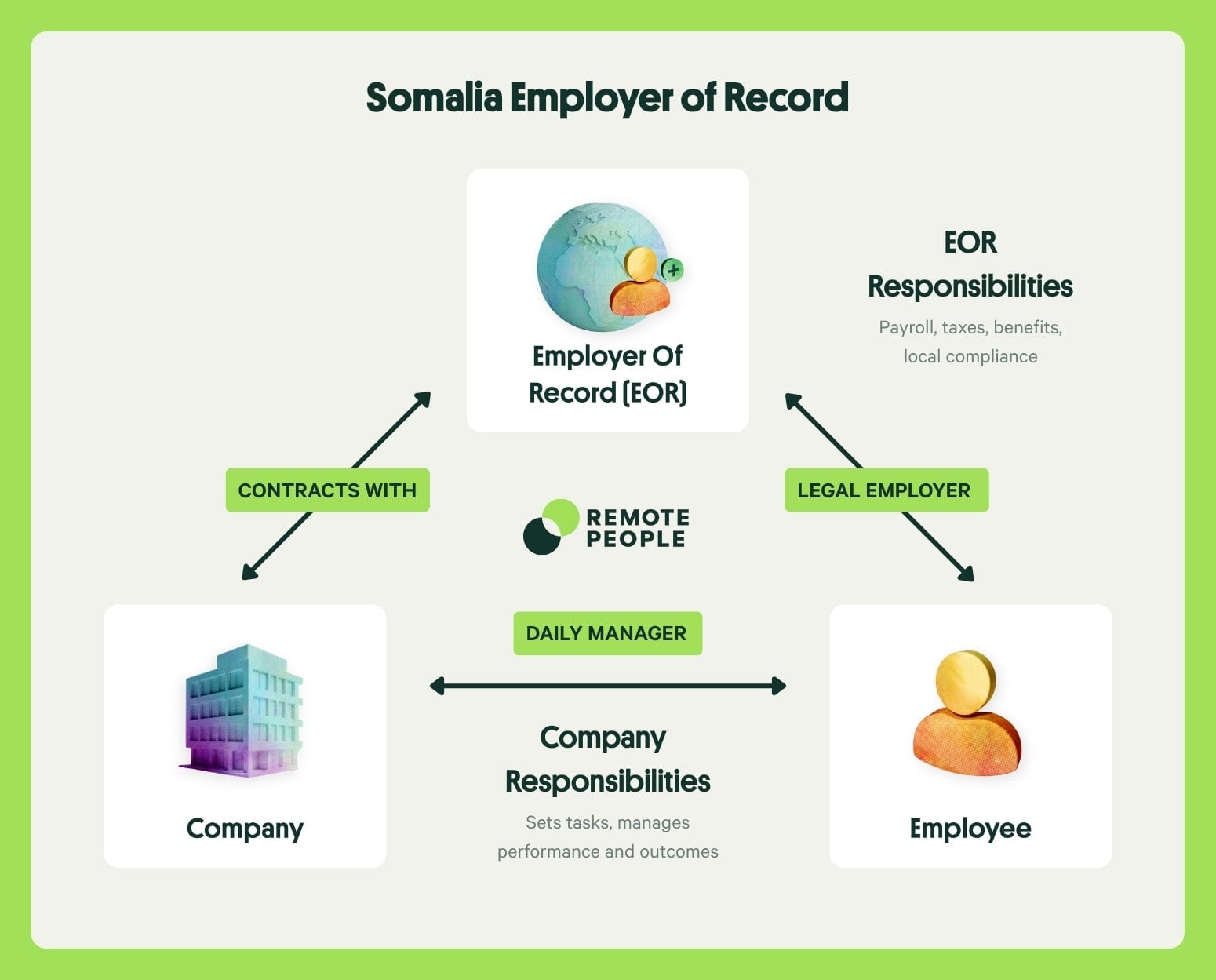
In Somalia, an EOR acts as the legal employer of your labor force. With an EOR, it’s possible to hire employees without a legal entity. This means that you are not required to register a business to expand your workforce in the African country, provided you work with an Employer of Record.
The role of an EOR is to manage compliance as they assume liability for your employees. Furthermore, the service provider processes payroll, onboards new employees, withholds tax, and terminates employment contracts.
The Somalia EOR Maintains Compliance
The Somalia Labor Code details employment requirements from contracts and working conditions to working hours and anti-discrimination provisions. Every business hiring employees in the country must adhere to the local labor laws to avoid non-compliance penalties. Partnering with an EOR simplifies this process, as professionals are experienced in the Somalian legal framework and can advise employers on employee rights, wages, and conflict resolution.
The Somalian EOR Simplifies Hiring
Hiring in Somalia can be challenging if you aren’t familiar with recruitment platforms and labor laws. Connecting with top talent and presenting compliant contracts is simplified with the expertise of an EOR. The service provider will advise on the probation period, which is typically six months, depending on the employee’s role. The EOR agency onboards new hires quickly and protects you from penalties for violating labor law.
If you’d like to learn more about how Employer of Record (EOR) services work, read our What Is an Employer of Record (EOR)? guide for a complete overview of the model, its benefits, and when to use it.
If you’re comparing providers, our Best Employer of Record (EOR) Providers guide reviews the leading platforms to help you choose the right solution for your business.
What Is the Difference Between a Somalia Employer of Record and a Somalia PEO?
A Somalia EOR is often referred to as a Professional Employer Organization, or PEO, but these entities are not the same. A closer look at the differences can help you choose the right professional partner:
Somalia Employer of Record (EOR)
The role of an EOR service is to hire workers on behalf of the employer. By partnering with an EOR agency in Somalia, you don’t need a legal entity to enter the market or hire employees. The Employer of Record becomes the legal employer of the workforce and will handle onboarding, tax withholding, social security contributions, and employee deductions. Medium-to large-sized companies and those without a registered business in Somalia can benefit from an Employer of Record.
Finding a suitable EOR firm in Somalia is made easier and more efficient with RemotePeople’s EOR broker services. Based on your business’s specific hiring needs, an EOR broker service connects you to affordable and valuable providers.
Somalia Professional Employer Organization (PEO)
A Somalian PEO hires a workforce for employers who have an established business or legal entity. While a PEO delivers similar types of services to an EOR, the PEO acts as a co-employer of the workforce. The Professional Employer Organization provides HR functions, payroll management, tax withholding, and drafting of employment contracts. A PEO is sought by small businesses and those expanding in Somalia without an in-house HR department.
How Does a Somalia Employer of Record Work?
An Employer of Record in Somalia helps all-sized businesses hire employees under the labor code. In addition to hiring a talented workforce, a Somalian EOR delivers the following services:
- Employment contract: The Somalian EOR agency will draft permanent contracts, fixed-term contracts, and temporary contracts when hiring employees. The EOR presents an employment contract in Somali or English as per the labor law. The service provider advises on the terms and conditions to include in employment contracts, such as probation periods, working hours, salaries, and annual leave.
- Onboarding: An experienced EOR in Somalia can onboard employees in 24 hours on behalf of the employer. They will collect personal information, including full names and banking details, to add new hires to the payroll for timely payment of salaries and deductions.
- Payroll: Somalia’s payroll cycle is monthly or fortnightly, which is managed by the EOR service provider. An EOR agency will calculate employee salaries, taxes, and benefits, such as annual leave and sick leave. As the employer, you will provide attendance information that the EOR uses to process payroll. Employers must issue payslips to all employees each pay period, detailing gross salary, deductions such as PAYE and pension contributions, and net pay. As a legal requirement, a trusted EOR ensures that payslips are correctly recorded and stored.
- Compliance: Many businesses interested in expanding in Somalia struggle with the local labor laws. Without awareness of the country’s legal framework when hiring employees, employers are at risk of non-compliance and penalties, such as harsh fines. Working with an EOR guarantees compliance with these laws. Not only can the service provider protect the employer and employee rights, but also ensuring that wages are paid on time and benefits are accurately processed can retain a motivated workforce.
Somalia Labor Laws
Employers must comply with the labor laws listed below:
Employment Contract
Under the Somali Labor Code, employment contracts may be oral or written. However, any contract for a period exceeding 3 months must be in writing. Written contracts should include the employee’s job title and duties, salary and payment terms, working hours, leave entitlements, notice period, and probation terms where applicable.
Contracts are primarily required in Somali as the official legal language, though English may be used for international employees. Employers bear the responsibility of ensuring the terms are clearly communicated and understood by both parties.
Working Hours
The standard workweek in Somalia is 48 hours, structured as 8 hours per day across 6 working days. Standard working hours are typically 8:00 AM to 4:00 PM or 8:00 AM to 5:00 PM, inclusive of a lunch break.
The weekend in Somalia is Thursday and Friday, not Saturday and Sunday. This is an important consideration for international employers coordinating schedules, meetings, and deadlines across different time zones and regions.
Working Hours and Overtime
Overtime in Somalia is capped at 2 hours per day and 12 hours per week. All overtime must be pre-authorized and compensated in the same pay period. Forced overtime beyond legal limits is prohibited under the Labor Code. The following premium rates apply:
Work Type |
Premium Rate |
|---|---|
Weekday overtime |
150% of regular wage |
Rest day / weekly day off |
150% of regular wage (higher rates may apply by agreement) |
Public holidays (standard) |
150% of regular wage |
Major public holidays (Labour Day, Republic Day, Independence Day) |
200% of regular wage |
Specific statutory rates for night work are not explicitly defined in the current Labor Code and may be subject to employer policy or collective agreement. Employers are advised to confirm current rates with local legal counsel, particularly for night shift operations.
Public Holidays
Somalia observes public holidays based on both the Gregorian and Islamic lunar calendars. The standard weekend is Thursday and Friday. Islamic holiday dates are estimated and may shift by one day depending on moon sighting.
- New Year’s Day (1 January)
- Labour Day (1 May)
- Independence Day (26 June)
- Republic Day (1 July)
Islamic Public Holidays (dates vary annually)
- Isra and Mi’raj
- Eid al-Fitr
- Eid al-Adha
- Islamic New Year
- Mawlid al-Nabi
Social Security Contributions
Somalia’s social security system is governed by the Somali Social Security Law and covers retirement, disability, and survivor benefits. Both employers and employees contribute 5% each of the employee’s pensionable salary, for a combined total of 10%. The precise definition of pensionable salary, whether it refers to basic salary only or total compensation, should be confirmed with the Ministry of Labor and Social Affairs, as this is not consistently defined across available sources.
Employers are required to register employees with the Ministry of Labor and Social Affairs before contributions commence. It is worth noting that Somalia’s social security infrastructure remains limited and enforcement can vary significantly by region. Beyond the pension contribution, there are no other mandatory employer social contributions in Somalia. There is no statutory health insurance fund or unemployment insurance scheme.
Probation Period
The standard probation period in Somalia is 3 months, though some roles may allow an extension of up to 6 months depending on the nature of the position and employer discretion. Probation terms must be clearly stated in the written employment contract. During probation, either party may terminate the contract with a shorter notice period than what applies after probation ends. Employees on probation retain core labor protections under the Labor Code, including entitlement to wages, rest periods, and protection from unlawful treatment.
Employee Protections
Employee protections are outlined in the Somali Labor Code. This includes an employee’s right to a fair wage, a safe working environment, and freedom of association. The latest regulations focus on fair recruitment practices and strategies to protect against worker exploitation.
Employment contracts in Somalia can be terminated by mutual agreement, dismissal, or an employee’s resignation. The notice period for contract termination depends on the worker’s length of service. Somalia does not have a specific national law that mandates notice periods for the termination of employment contracts; however, they can be negotiated through collective bargaining.
Once an employment contract is terminated, any outstanding wages must be paid within 14 days, with an extension of up to 30 days.
Payroll and Employment Taxes in Somalia
Minimum Wage
Somalia does not have a statutory or national minimum wage.
Income Tax
Somalia operates a Pay As You Earn (PAYE) income tax system, governed by the Income Tax Act 2025 (ITA 2025), which replaced the previous 1966 Direct Taxation Law. Tax is calculated on gross monthly salary including allowances and commissions, and withheld by the employer monthly.
The system applies a progressive rate from 0% to 18%. Monthly income up to $200 is exempt. Income above this threshold is taxed progressively up to a maximum of 18%. Employers must register with the Inland Revenue Department (IRD) and obtain a Tax Identification Number (TIN). PAYE must be remitted to the Somali Revenue Agency (SRA) by the 15th of the following month. There is currently no mandatory national social security contribution system in Somalia.
Time Off and Leave in Somalia
Mandatory Annual Leave
Employees in Somalia are entitled to paid annual leave after completing one full year of continuous service. The statutory minimum is 15 days per year, paid at the employee’s regular salary. Leave accrues throughout the year and can be accumulated up to a maximum of two years’ worth of entitlement. Higher entitlements may apply under collective bargaining agreements or individual employment contracts.
The specific tiered accrual structure by length of service (1–3 years, 4–10 years, 10+ years) cited in some sources could not be verified against the Labor Code and should be confirmed with local legal counsel before being relied upon for payroll planning. Upon termination, any accrued but unused annual leave must be paid out to the employee as part of their final settlement.
Sick Leave
Employees in Somalia are entitled to paid sick leave under the Labor Code. The first 7 days of absence are paid at 100% of salary, followed by a further 7 days at 50%. If sick leave exceeds 15 days, any additional days are deducted from the employee’s annual leave entitlement.
For extended illness of up to 3 months, the employer is required to pay full salary for the first month and half salary for the following two months, and must cover related medical expenses. Employees must notify their employer of illness as soon as possible and provide a medical certificate for absences exceeding 2 to 3 days.
Maternity Leave
Female employees in Somalia are entitled to 14 weeks of paid maternity leave, split between pre-natal and post-natal periods. A minimum of 6 weeks must be taken after delivery. Maternity leave is paid at 50% of the employee’s regular wages, funded by the employer. To qualify, the employee must have completed at least 6 months of continuous service and provide a medical certificate confirming the expected delivery date.
Paternity Leave
Fathers are typically entitled to 2 weeks of paid paternity leave, to be taken following the birth of the child. This is not strictly defined in the Labor Code but is widely recognized in practice.
Bereavement Leave
Employees are entitled to 3 days of paid leave for the death of a close family member such as a spouse, child, or parent. Eligibility requires at least 6 months of continuous service with the employer.
Terminations and Severance in Somalia
Notice Period
Under the Somali Labor Code, notice periods are mandatory and must be given in writing. The required notice period varies by employee category:
- Manual workers are entitled to a minimum of 10 days’ written notice.
- Non-manual workers are entitled to a minimum of 30 days’ written notice.
- During the probation period, which is typically 3 months, a shorter notice period applies.
Employers who fail to provide the required notice may be liable for payment in lieu of notice, and terminations without proper notice may give rise to wrongful termination claims.
Severance Pay
Employees in Somalia who are terminated due to redundancy or reasons other than misconduct are entitled to severance pay based on their length of service. Severance does not apply to terminations for cause or employee-initiated resignations. The following benchmarks apply based on length of service:
Length of Service |
Approximate Severance |
|---|---|
1 year |
~4.3 weeks’ pay |
5 years |
~21.7 weeks’ pay |
10 years |
~43.3 weeks’ pay |
Employers should verify the precise calculation method and any applicable caps against the current Labor Code, as specific provisions may vary by employment category or sector.
What Are the Benefits of a Somalia Employer of Record?
A Somalia Employer of Record provides the following benefits:
- Quick market entry: Working with an EOR service in Somalia prevents setting up a legal entity, which means faster market entry. In addition to hiring employees on your behalf, an Employer of Record is familiar with the labor laws and unique Somali culture, overcoming potential obstacles and delays.
- Avoid entity setup costs: As an EOR eliminates having to set up your own entity, you can save on registration and overhead costs.
- Management of HR and tax: Most EORs oversee your HR administration and tax requirements to maintain compliance. HR services include handling payroll and drafting employment contracts, which frees up a fair amount of time for businesses to focus on productivity and growth. Tax services include registration with the Somalia Revenue Directorate and tax filing and reporting.
- Overcome language and cultural barriers: The official languages in Somalia include Arabic and Somali. Understandably, international employers may not be familiar with the language and the local culture, hindering recruitment efforts and compliance with labor regulations. The EOR firm can facilitate communication between employers and employees and guide clients on the legal framework.
What Are the Downsides of a Somalia Employer of Record?
Hiring a reliable EOR in Somalia requires careful consideration of their reputation and the types of services provided. The following tips will prevent costly mistakes when selecting an EOR:
- Pricing: A reputable Employer of Record should always be upfront about their service fees. Read the agreement very carefully before accepting a quotation to avoid hidden costs at a later stage.
- Employer involvement: Employers are less involved in the administration of their business as processes, such as payroll, HR, and onboarding, are handled by the EOR agency. However, employers are still involved in daily employee management.
- Compliance: A lack of awareness or understanding of the Somali Labor Code increases the risk of non-compliance. Whether misclassifying employees or incorrectly calculating taxes, employers could face fines and legal action. The expertise of an EOR guarantees compliance from recruitment and onboarding to paying employee salaries and benefits on time.
How to Choose a Somalia Employer of Record
Steps to hire a Somalia Employer of Record can help you find the best possible provider for expansion in Africa:
Market Expertise
The EOR service must provide proof of its expertise in local labor law. They should understand tax requirements, payroll cycles, and anti-discrimination laws. In consultation with the EOR, ask about specific laws and requirements to gauge their overall awareness.
Transparent Pricing
EORs in Somalia should not issue hidden fees. They must provide a transparent fee model.
References and Track Records
Before hiring a service provider, research their former client reviews. The agency must have positive client testimonials that you can find online.
Engage a Somalia Employer of Record, with RemotePeople
Hiring in Somalia opens the door to a large, youthful talent pool and competitively priced labor. However, expanding into the Somali market can be challenging without a solid understanding of local labor laws, recruitment norms, and cultural expectations. Partnering with an EOR in Somalia streamlines the process, ensures full compliance, and allows businesses to hire qualified employees without the cost and complexity of establishing a local entity.
RemotePeople supports companies in hiring and managing talent in Somalia through reliable EOR services tailored to your operational needs. Our team helps you stay compliant, onboard employees efficiently, and navigate local employment requirements with confidence.
If you’re ready to grow your team in Somalia, RemotePeople provides the trusted EOR support you need for long-term success.
Frequently Asked Questions
Yes. Many companies use an EOR as an entry point while assessing the market, then transition to a local entity once operations are established. RemotePeople can support this transition, ensuring continuity of employment and compliance throughout the process.
As the legal employer, the EOR manages employment disputes in accordance with the Somali Labor Code, including handling grievance procedures, termination processes, and any interactions with the Ministry of Labor and Social Affairs. This shields the client company from direct legal exposure.
Somalia's federal structure means labor law enforcement can vary by region. RemotePeople works with local expertise to ensure compliance across different federal member states, including Somaliland and Puntland, where regional regulations and practices may differ.
Yes. While RemotePeople ensures full compliance with mandatory entitlements such as pension contributions and statutory leave, we can also structure supplementary benefits including private health coverage, housing allowances, and transport stipends to help clients attract and retain talent competitively.
The EOR manages the full offboarding process in line with the Labor Code, including serving the correct notice period, calculating and paying any accrued leave and severance entitlements, and handling final payroll. This ensures the termination is legally compliant and minimizes risk for the client.
Employer of Record in
Employer of Record in
Employer of Record in
Employer of Record in
Employer of Record in
Employer of Record in
Employer of Record in
Employer of Record in




