
 Recruit
Employer of Record in Myanmar
-
 Drew Donnelly
- Published
- September 22, 2026
RemotePeople’s employer of record in Myanmar lets you hire employees in Myanmar with full Social Security Board compliance. We handle mandatory social security contributions of 3% from employers and 2% from employees (capped at MMK 15,000), health and work injury insurance coverage, and monthly contribution remittance.
Hire in Myanmar — book a free 30-minute demo
Tell us what you need. You'll get a tailored, transparent proposal within 24 hours, plus a free call to walk through it.
Tell us about your company
So we can match you with a specialist who knows your market — and unlock volume pricing tiers.
* All fields are required.
Where and when are you hiring?
Tell us the geography and timing and we'll quote each country line by line, with onboarding timelines.
* All fields are required.
Help us beat your current setup
We'll benchmark your current deal and send a line-by-line proposal in 24 hours — showing exactly where we cut cost, time, or risk. After you submit, you can book a call to walk through it together.
* All fields are required.
Thanks! Your proposal is on its way.
Expect a tailored, line-by-line proposal in your inbox within 24 hours. In the meantime…
Want to walk through it together?
Book a free 30-minute call with one of our specialists. We'll explain every line, answer your questions, and tailor the proposal further if you need.
No obligation. Pick a time that works for you.








- Hire in Myanmar — book a free 30-minute demo
- Tell us about your company
- Where and when are you hiring?
- Help us beat your current setup
- Thanks! Your proposal is on its way.
- How an Employer of Record Works in Myanmar
- Employment Laws and Regulations in Myanmar
- Work Permits and Visas in Myanmar
- Payroll, Taxes, and Social Security in Myanmar
- Cost of Hiring Through an EOR in Myanmar
- Benefits of Using an EOR in Myanmar
- Termination and Offboarding in Myanmar
- EOR vs. Other Hiring Models in Myanmar
- Public Holidays in Myanmar
- How to Get Started with an EOR in Myanmar
- Where companies hiring in Myanmar expand next
- Frequently Asked Questions
- Related EOR Destinations

Start hiring in Myanmar
Let RemotePeople handle payroll, compliance, and HR admin worldwide so you can focus on building your team.

Myanmar offers a young, fast-growing workforce with competitive wage levels and expanding services, manufacturing, and technology sectors. For companies looking to hire employees in Myanmar, the regulatory environment covers the Employment and Skill Development Law 2013, Factories Act 1951, Leave and Holidays Act 1951, Social Security Law 2012, and the annual Union Tax Law, and missing any of these creates payroll, visa, or termination risk.
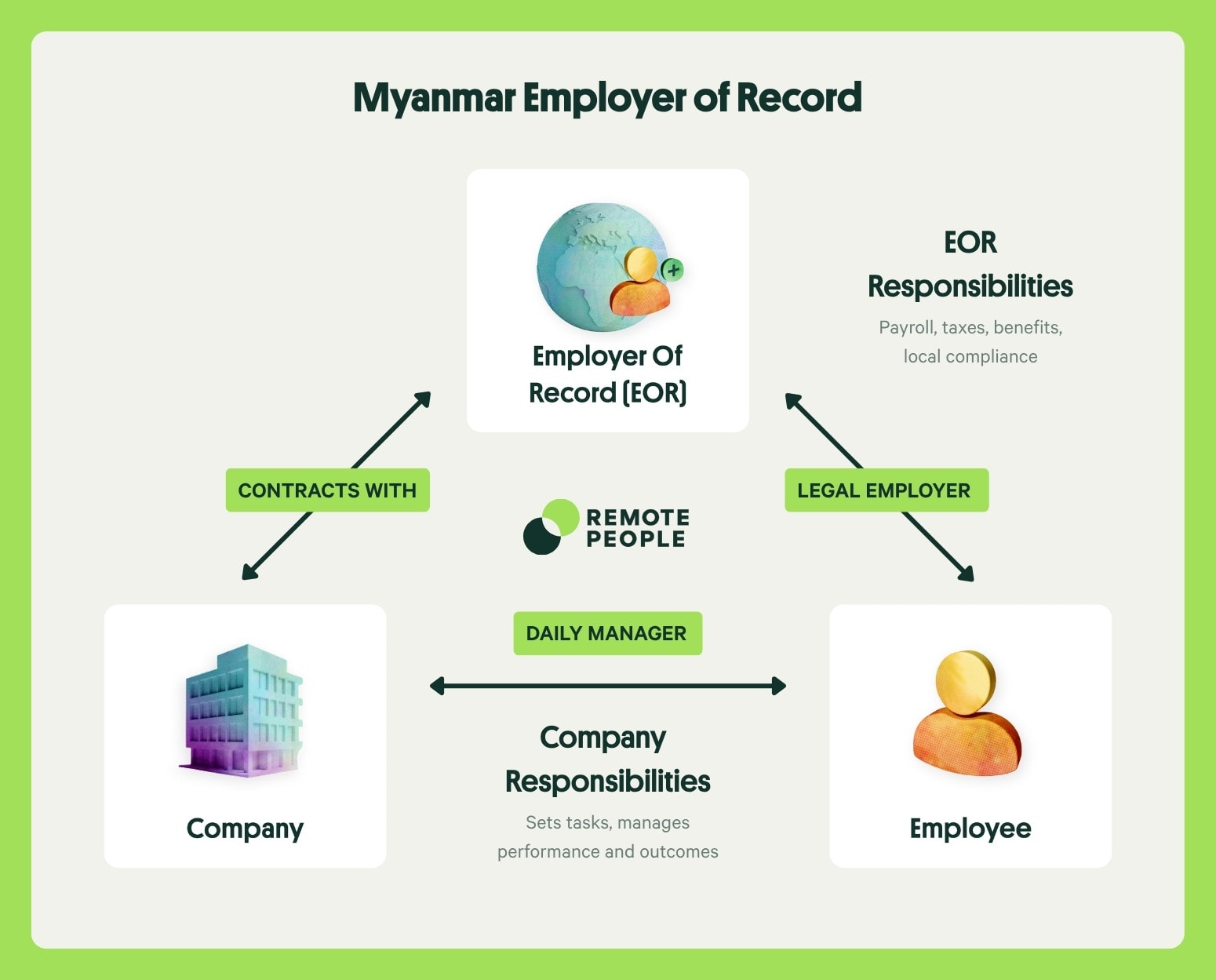
An employer of record in Myanmar handles the local employment contract, monthly payroll in kyat, Social Security Board registration, income tax withholding, and Ministry of Labour filings so a foreign company can onboard staff in weeks rather than spending six to nine months setting up a local company. This guide covers how the EOR model works, the full 2026 employment law stack, work permit and visa pathways, payroll and tax mechanics, cost benchmarks, termination rules, and a comparison with setting up a local entity, hiring contractors, and using a PEO.
How an Employer of Record Works in Myanmar
If you’d like to learn more about how Employer of Record (EOR) services work, read our What Is an Employer of Record (EOR)? guide for a complete overview of the model, its benefits, and when to use it.
If you’re comparing providers, our Best Employer of Record (EOR) Providers guide reviews the leading platforms to help you choose the right solution for your business.
Who Uses an EOR in Myanmar?
The EOR model is used by foreign companies that need a compliant Myanmar employer without the cost, time, and political exposure of registering a local entity under the Myanmar Companies Law 2017. Typical scenarios include:
- Testing the Myanmar market before committing: A company exploring demand in Yangon or Mandalay can hire one or two employees through an EOR, validate the opportunity, and only register a subsidiary once revenue justifies the fixed cost.
- Hiring a small distributed team: For teams of one to ten employees, an EOR avoids the Directorate of Investment and Company Administration (DICA) company registration, DICA annual filings, audited statements, and the MMK-denominated tax compliance that accompany a local entity.
- Onboarding quickly during time-sensitive projects: EOR onboarding takes 1–2 weeks once KYC and contract terms are agreed, compared with 3–6 months to register and operationalise a Myanmar company.
- Hiring foreign nationals needing work permits: The EOR is the legal sponsor for the business visa, employment stay permit, and FRC, so the client does not need its own DICA registration to bring expatriate staff into the country.
RemotePeople provides EOR services in Myanmar for companies that want compliant hiring with no local setup, no DICA registration, and predictable monthly costs.
Typical Onboarding Timeline
Most EOR providers can onboard a local hire in Myanmar within 1–2 weeks once the employment terms and employee documents are confirmed. The stages typically run as follows:
- EOR agreement and employee details: 1–2 business days to finalise scope, salary, benefits, and collect the employee’s National Registration Card (NRC), labour registration card, and bank details.
- Employment contract drafting and review: 2–3 business days to prepare the bilingual contract under the Ministry of Labour template and obtain employee sign-off.
- Social Security Board and tax registration: 3–5 business days to register the employee with SSB and the Internal Revenue Department.
- Payroll setup and benefits enrolment: 2–3 business days to configure kyat payroll, apply tax codes, and issue the first payslip.
- Employee onboarding and first day: 1 day for systems access, policy acknowledgement, and the township labour office filing.
Foreign hires who also require an employment visa and FRC add another 2–4 weeks, as Myanmar’s Ministry of Immigration and Population processes work-related stay permits separately from the employment contract.
Hire in Myanmar
Low employer social contributions (capped at MMK 9,000/month), a statutory 3% SSB rate, and a young, cost-competitive workforce make Myanmar an attractive entry point for Southeast Asia expansion.
We handle bilingual employment contracts, kyat payroll, SSB and income tax filings, and full Myanmar compliance.
No local entity needed. Your team can start in 1–2 weeks.
Employment Laws and Regulations in Myanmar
Employment Contracts
The Employment and Skill Development Law 2013 (enforced by the Ministry of Labour) requires every employer to sign a written employment contract with any worker hired for more than 30 days. The contract must be submitted to the Township Labour Office within 30 days, and must follow the standard template issued under Notification 140/2015. Required terms include job title and duties, workplace, wage and payment date, probation period, working hours, overtime rules, leave entitlements, social security enrolment, dispute resolution, and termination conditions. Contracts can be open-ended (indefinite) or fixed-term; fixed-term contracts generally run 1–3 years and converting to indefinite after renewal is best practice. Myanmar language is the official version for any dispute with authorities, so bilingual drafting (Myanmar + English) is standard.
Working Hours and Overtime
Standard working hours in Myanmar depend on the sector governing the workplace. Under the Factories Act 1951, factory workers are capped at 44 hours per week (or 48 hours for continuous-process factories) and 8 hours per day. The Shops and Establishments Act 1951 (as amended) sets the same 44-hour weekly ceiling for retail, services, and office staff. Employees are entitled to one weekly rest day (typically Sunday) and a 30-minute break after 5 continuous hours of work. Overtime is permitted with prior approval from the Factories and General Labour Laws Inspection Department, and it is capped at 12 hours per week for continuous-process factories and 16 hours per week otherwise.
Under the Payment of Wages Act 2016 and the Factories Act, overtime is paid at twice the basic hourly wage, and night work between 10 p.m. and 6 a.m. attracts a premium under specific sector notifications. Work on a weekly rest day or public holiday is paid at twice the normal rate, and employees who work on a rest day are still entitled to a substitute day off within three days.
Myanmar overtime and premium pay rates · Per Factories Act 1951 and Payment of Wages Act 2016 | |||
Hour Type | Rate Multiplier | Weekly Cap | Notes |
|---|---|---|---|
Weekday overtime (factory non-continuous) | 2.0× | 16 hrs/week | Factories Act §59; requires inspector approval for sustained use |
Weekday overtime (continuous-process factory) | 2.0× | 12 hrs/week | 48-hour standard week instead of 44 |
Shops and establishments overtime | 2.0× | 16 hrs/week | Shops and Establishments Act 1951 as amended |
Night work (10 p.m.–6 a.m.) | 2.0× (if classed as overtime) | Included in overtime cap | Separate sectoral notifications may add a night allowance |
Weekly rest day work | 2.0× | Counts toward overtime cap | Substitute rest day must be given within 3 days |
Public holiday work | 2.0× | Counts toward overtime cap | Leave and Holidays Act 1951 · paid in addition to statutory holiday pay |
Overtime is excluded from the salary base used to calculate severance pay under Notification 84/2015, which limits the downstream impact of overtime on separation costs. The Ministry of Labour also enforces an informal practice that total working hours (including overtime) should not exceed 60 hours per week, and prolonged non-compliance can trigger a factory inspection and fines.
Minimum Wage
Myanmar’s statutory minimum wage is MMK 7,800 per 8-hour working day (roughly USD 3.71 at April 2026 exchange rates), effective 1 October 2025. The rate is built from a MMK 4,800 base set in 2018 plus three MMK 1,000 allowances added in 2023, 2024, and 2025. The increase was announced on 14 October 2025 by the National Committee for Setting the Minimum Wage (Tilleke & Gibbins). Key application rules:
- Scope: applies to all employees, regardless of industry, job title, or nationality, whose employer has 10 or more permanent workers.
- Exemptions: family-owned businesses and employers with fewer than 10 staff are outside the statutory minimum wage regime.
- Probation rate: probationary employees are entitled to at least 75% of the minimum wage.
- Apprentices: apprentices in registered training receive at least 50% of the minimum wage.
Probation Period
The Employment and Skill Development Law 2013 allows a probation period of up to 3 months. During probation, either party can terminate with 30 days’ written notice or 30 days’ pay in lieu of notice (probation rules in Myanmar). Probationary employees earn casual leave and medical leave on a pro-rata basis, accrue social security coverage from day one, and must receive at least 75% of the statutory minimum wage. Severance under Notification 84/2015 does not apply before the employee reaches six months of service, so a dismissal within probation does not trigger a severance payment.
Leave Entitlements
Myanmar’s statutory leave framework combines the Leave and Holidays Act 1951, the Social Security Law 2012, and implementing notifications from the Ministry of Labour. Each leave type has its own accrual rule, pay source, and medical certificate requirement, so the EOR has to track them separately on the payslip.
Annual Leave
Employees earn 10 working days of paid earned leave per year after completing 12 months of continuous service with a minimum of 20 days worked per month. Earned leave is paid at full salary and can be carried forward for up to 3 years by agreement. On termination, any accrued but unused earned leave must be paid out in the final payroll. Leave does not accrue during the first 12 months, so new hires rely on casual leave for any time off during their first year.
Sick Leave
Medical leave is capped at 30 days per year and is available only after 6 months of continuous service. A medical certificate from a registered practitioner is required for any absence. Once the employee is registered with the Social Security Board, sick pay is reimbursed by SSB at 60% of the insurable salary for up to 26 weeks; the employer funds the gap between 60% and full salary if the employment contract or company policy provides for full pay.
Maternity Leave
Female employees are entitled to 14 weeks of paid maternity leave, split as 6 weeks before delivery and 8 weeks after. Mothers of twins or triplets receive an additional 4 weeks, and 6 weeks of paid leave is available in the event of miscarriage. Payment comes from the Social Security Board at 70% of the average insurable salary for the 12 months before the leave, provided the employee has contributed for at least 6 of the 12 months preceding the claim (ISSA Myanmar country profile). Employees outside SSB coverage receive maternity pay from the employer at the same rate.
Paternity Leave
Fathers are entitled to 15 days of paid paternity leave under the 2014 amendment to the Social Security Law. Payment is 70% of average insurable salary, funded by SSB for registered members. The leave must be taken within 6 months of the child’s birth, and it is single-use per child (not per calendar year).
Other Statutory Leave
Beyond the four core categories, Myanmar law recognises several additional paid leave entitlements:
- Casual leave: 6 working days per year, available from day one, capped at 3 consecutive days per request and non-carryover.
- Public holiday leave: paid day off on each gazetted public holiday (see Table 4 below).
- Funeral and bereavement leave: not explicitly codified; typically granted as casual leave or by collective agreement.
- Religious leave: 3 days per year for Buddhist religious observance under the Leave and Holidays Act, with equivalent accommodation for other faiths in practice.
Under the Leave and Holidays Act 1951, the table below summarises every statutory leave entitlement a Myanmar employer must grant. The most important takeaway is that earned leave only begins accruing after 12 months of service, so first-year absences must be covered by the 6 days of casual leave plus medical leave if certified by a doctor.
Myanmar statutory leave entitlements · Per Leave and Holidays Act 1951 and Social Security Law 2012 | ||
Leave Type | Duration | Eligibility and Notes |
|---|---|---|
Earned (annual) leave | 10 working days/year | After 12 months continuous service with 20 working days/month; full pay; carryover up to 3 years |
Casual leave | 6 working days/year | Available from day one; max 3 consecutive days; no carryover |
Medical (sick) leave | 30 days/year | After 6 months service; medical certificate required; 60% pay via SSB |
Maternity leave | 14 weeks (6 pre + 8 post) | 70% of insurable salary via SSB; +4 weeks for twins; 6 weeks for miscarriage |
Paternity leave | 15 days | 70% of insurable salary via SSB; taken within 6 months of birth |
Public holiday leave | 25–32 days/year | Full pay; double pay if worked; no substitution if falls on rest day |
Religious observance leave | 3 days/year | For Buddhist religious practice; equivalent accommodation in practice for other faiths |
Statutory Employee Benefits
Myanmar employers fund a lean but legally mandated benefit package on top of salary. The core items for any employer hiring locally include:
- Social Security Board enrolment: Mandatory for any employer with 5 or more employees under the Social Security Law 2012; provides health, maternity, work-injury, and survivor benefits on insurable salary up to MMK 300,000/month.
- Health and social care insurance: Funded 2% by employer and 2% by employee; covers inpatient and outpatient treatment at SSB hospitals and approved clinics.
- Employment injury insurance: Funded 1% by employer only; covers workplace accidents, occupational disease, and related disability payments.
- Public holiday pay: Paid time off for the gazetted holidays in Table 4 below; work performed on these days is paid at 2× the daily rate.
- Severance fund accrual: Employers do not pay into a severance fund, but Notification 84/2015 severance is a statutory liability that must be reserved for accounting purposes.
Private supplementary benefits , additional private health insurance, life cover, meal and transport allowances, or pension top-ups , are not mandatory but are common in multinationals and in professional roles in Yangon. Reference Table 1 (employer contributions) for the exact SSB line-item rates.
Recent Regulatory Updates (2026)
Three regulatory changes shape the 2026 hiring environment in Myanmar. First, the Union Taxation Law 2025 was enacted on 31 March 2025 and applies to the tax year starting 1 April 2025 (DFDL). It retained the 0–25% personal income tax schedule and the MMK 4.8 million annual tax-free salary threshold, while updating commercial tax thresholds. Second, the minimum wage increase to MMK 7,800 per day took effect on 1 October 2025, raising daily pay for around 3 million employees in firms of 10 or more workers. Third, the Union Taxation Law 2026 (effective 1 April 2026) raised the start-up MSME tax exemption threshold from MMK 15 million to MMK 20 million of annual turnover, which is relevant for EOR clients whose Myanmar operations remain below that ceiling.
Work Permits and Visas in Myanmar
Work Permit Requirements
Who Needs a Work Permit
Any foreign national working in Myanmar needs a combination of an employment visa (also called a business visa used for employment) and an employment stay permit issued by the Ministry of Immigration and Population. Nationals of every country, including ASEAN member states, require the permit; only short commercial trips under 70 days without paid employment can rely on a standard business visa. Foreign employees earning income in Myanmar are tax-resident after 183 days in any fiscal year and are subject to Myanmar personal income tax.
Eligibility and Required Documents
The sponsoring employer must be registered with the Directorate of Investment and Company Administration (DICA) or operate through an EOR that is DICA-registered. The application package typically includes a passport valid for at least 6 months, a recent photo, an invitation letter from the Myanmar employer on official letterhead, a copy of the employer’s company registration certificate, the employment contract, qualifications and CV, and , for stay permit issuance , an FRC application form. Some professional roles also require sectoral pre-approval from the Ministry of Labour or the relevant line ministry.
Processing Time and Validity
A single-entry business visa is typically issued within 3–5 business days through the Myanmar eVisa portal, valid for 70 days. The employment stay permit for a first-time foreign employee takes 2–4 weeks from arrival, and the FRC usually follows within another 1–2 weeks. Total lead time from offer acceptance to a fully permitted foreign hire is usually 4–6 weeks, which is why EOR onboarding for foreign hires takes longer than for local staff.
Renewal Process
Stay permits are renewable for 3 months, 6 months, or 1 year depending on the employer’s category (local company, foreign branch, or EOR). Renewals must be filed at least 2 weeks before the existing permit expires, and the employee can continue working while the renewal is in progress as long as the application was filed before expiry. Multiple re-entry permits, paired with the stay permit, allow the employee to leave and return to Myanmar during the permit’s validity , the multi re-entry permit is valid for 1 year and is essential for expatriates who travel internationally for work.
Common Visa Types for Foreign Workers
Myanmar’s immigration framework is administered by the Ministry of Immigration and Population through the eVisa and eStay portals. Work-related entry generally uses the employment business visa plus a stay permit, but several other categories cover executives, investors, and short-term project staff. The table below summarises the main visa paths an EOR can sponsor on the client’s behalf, and indicates which of them eventually support long-term residency.
Myanmar work visa types for foreign workers · 2026 | ||||
Visa Type | Duration | Best For | Leads to APT? | Processing |
|---|---|---|---|---|
Business visa (single entry) | 70 days | Short-term project work, site visits, contract negotiation | No | 3–5 business days (eVisa) |
Employment stay permit (3-month) | 3 months, renewable | New hires on probation or short assignment | No | 2–4 weeks from arrival |
Employment stay permit (1-year) | 1 year, renewable | Full-time expatriate hires | Yes (after multi-year renewal) | 4–6 weeks including FRC |
Multi re-entry permit | 1 year | Expatriates with frequent international travel | No (add-on to stay permit) | 1–2 weeks after stay permit issued |
Foreigner Registration Certificate (FRC) | Matches stay permit | Any foreign national staying >90 days | Prerequisite for APT | 1–2 weeks after stay permit |
Investor / company director visa | Up to 3 years | Directors of DICA-registered or MIC-approved companies | Yes | 4–6 weeks |
Visa categories that do not permit employment include the tourist visa (28 days, leisure only), the social visa (for family visits), the education visa (for enrolled students), and transit visas (24–72 hours). An EOR cannot sponsor these categories because they explicitly prohibit paid work.
How an EOR Handles Work Permits
The EOR acts as the Myanmar-registered sponsor for the business visa, employment stay permit, multi re-entry permit, and FRC. Its role includes preparing the invitation letter, signing the employment contract that immigration reviews, filing applications via the eVisa and eStay portals, collecting biometric and medical documents, and renewing permits ahead of expiry. The employee still provides passport, photographs, qualification certificates, and the police clearance certificate required for the FRC. When a work permit is needed, the onboarding timeline (see H3 1.4) extends by 4–6 weeks beyond the standard 1–2 weeks because the immigration clock only starts once the employee arrives in Myanmar. Myanmar does not currently permit remote sponsorship for foreign nationals who plan to work from outside the country; the EOR can sponsor only employees physically present in Myanmar for residency-triggering durations.
Payroll, Taxes, and Social Security in Myanmar
Employer Contributions
Myanmar employers with five or more employees must register with the Social Security Board within 30 days of hiring and contribute monthly on each worker’s insurable salary, capped at MMK 300,000/month. The contributions are remitted to SSB by the 15th of the following month, alongside the monthly payroll return to the Internal Revenue Department.
Myanmar employer social security contributions · 2026 rates | ||
Contribution | Rate | Notes |
|---|---|---|
Health and social care insurance | 2.0% | Funds maternity, sickness, and funeral benefits; capped at MMK 300,000 insurable salary |
Employment injury benefit insurance | 1.0% | Covers workplace accidents, occupational disease, disability; employer only |
Total employer contribution | 3.0% | Maximum MMK 9,000/month (MMK 300,000 × 3%) |
Employee Contributions
Employees contribute a flat 2% of insurable salary to the health and social care component of SSB. The contribution is withheld by the employer and remitted with the employer share. The same MMK 300,000 ceiling applies, so the maximum employee deduction is MMK 6,000 per month (MMK 72,000 per year).
Myanmar employee payroll deductions · 2026 monthly withholdings | ||
Deduction | Rate | Notes |
|---|---|---|
Health and social care insurance | 2.0% | Mandatory for employers with 5+ staff; capped at MMK 300,000 insurable salary |
Personal income tax (withholding) | 0–25% | Progressive per Union Tax Law 2025; MMK 4.8M salary income is tax-free |
Total employee statutory deduction (SSB only) | 2.0% | Maximum MMK 6,000/month (MMK 300,000 × 2%) |
Income Tax
Personal income tax in Myanmar is levied under the Income Tax Law 1974 (as amended) and the annual Union Taxation Law. Salary income is taxed progressively from 0% to 25% on taxable income above the MMK 4.8 million annual basic allowance. Residents (those present in Myanmar for 183+ days per fiscal year) are taxed on worldwide employment income; non-residents are taxed only on Myanmar-source income. Married taxpayers can claim a spouse allowance of MMK 1 million and a child allowance of MMK 500,000 per unmarried child.
Myanmar personal income tax brackets · 2026 (FY starting 1 April 2025) | |
Taxable Income Bracket (MMK) | Tax Rate |
|---|---|
MMK 1 – MMK 2,000,000 | 0% |
MMK 2,000,001 – MMK 10,000,000 | 5% |
MMK 10,000,001 – MMK 30,000,000 | 10% |
MMK 30,000,001 – MMK 50,000,000 | 15% |
MMK 50,000,001 – MMK 70,000,000 | 20% |
Above MMK 70,000,000 | 25% |
Employees with total annual salary income below MMK 4,800,000 pay no personal income tax. Rates apply to taxable income after deducting the MMK 4.8 million basic relief (20% of salary is also deductible, capped at MMK 10 million), spouse and child allowances, and approved social security contributions.
Payroll Cycle
Payroll in Myanmar is monthly, with salaries typically paid on the last working day of the month into a local kyat bank account. The Payment of Wages Act 2016 requires wages to be paid within 5 days of the end of the wage period for small employers and within 10 days for larger firms. Payslips must itemise gross pay, SSB deduction, income tax withholding, and net pay in Myanmar kyat. The monthly payroll return and tax remittance are due to the Internal Revenue Department by the 15th of the following month, and the SSB contribution must be paid by the same date. Annual personal income tax returns are filed by 30 June each year for the fiscal year ending 31 March.
13th Month Salary and Bonus Pay
Myanmar law does not mandate a 13th month salary or statutory annual bonus. Any year-end bonus, Thingyan (New Year) bonus, or performance incentive is entirely voluntary and based on company policy or collective agreement. In practice, many multinationals in Yangon pay a Thingyan bonus of one month’s base salary in April to align with the traditional Myanmar new year, and banks often pay two months to retain staff. Voluntary bonuses are treated as salary income and are subject to the same progressive income tax rates and SSB contributions as regular pay.
Cost of Hiring Through an EOR in Myanmar
EOR Service Fees
EOR service fees in Myanmar typically run between USD 300 and USD 600 per employee per month, depending on service tier, number of employees, and whether visa sponsorship is included. The fee covers the local employment contract, kyat payroll processing, income tax and SSB filings, leave and benefits administration, township labour office registrations, and first-line HR support. Fees are usually charged as a flat USD amount and invoiced monthly so the client can budget predictably.
Total Employment Cost Breakdown
The table below models the total monthly employer cost for a USD 1,500 gross salary in Myanmar (roughly MMK 3.15 million at April 2026 rates, well above the SSB contribution ceiling). Because Myanmar’s employer social contribution is capped at MMK 9,000 per month, the employer-side statutory cost is very low in percentage terms compared with most Asian jurisdictions.
Myanmar employer cost example · USD 1,500 gross · 2026 | ||
Employer Cost | Amount (USD) | % of Gross |
|---|---|---|
Gross salary | $1,500.00 | 100.00% |
Health and social care insurance (capped) | $2.86 | 0.19% |
Employment injury benefit (capped) | $1.43 | 0.10% |
EOR service fee (flat, est.) | $450.00 | 30.00% |
Total monthly employer cost | $1,954.29 | 130.29% |
Figures converted at 1 USD ≈ 2,100 MMK (April 2026). Employer SSB contributions are capped at MMK 300,000 insurable salary, so the absolute contribution is capped at roughly USD 4.29 per month regardless of salary level.
Ready to hire in Myanmar? Get started with RemotePeople , we handle employment contracts, payroll, tax withholding, and full Myanmar compliance. No local entity needed. Book a call with our team.
Benefits of Using an EOR in Myanmar
Using an employer of record in Myanmar converts a multi-month entity project into a two-week hire, and shifts compliance risk onto a provider that already knows DICA, SSB, and the Ministry of Labour filing cadence. For companies that want a small Myanmar team without committing capital and time to a subsidiary, the advantages compound quickly.
- Speed to market: Onboard a local Myanmar employee in 1–2 weeks versus 3–6 months to register a company, open a kyat bank account, and complete DICA and IRD filings.
- Compliance assurance: The EOR signs the Ministry of Labour template contract, files with the Township Labour Office, remits SSB and income tax on the 15th of each month, and tracks Notification 84/2015 severance accruals, reducing your exposure to labour fines and back-tax assessments.
- Cost efficiency vs a local entity: Avoid USD 3,000–8,000 in DICA incorporation and legal fees, plus USD 500–1,500 in monthly accounting and audit retainer, in exchange for a flat USD 300–600 EOR fee.
- Local expertise in a complex environment: Myanmar’s political situation, sanctions considerations, and currency controls are non-trivial. An EOR with Yangon-based HR and legal teams monitors the latest Ministry of Labour notifications and SSB circulars on your behalf.
- Flexibility to scale: Hire one employee, scale to ten, or reduce headcount without having to dissolve a company, which in Myanmar can take 12–18 months of winding-up procedures with DICA.
- Risk mitigation on termination: The EOR administers the 30-day notice, the Notification 84/2015 severance schedule, and the final SSB contribution, which protects the client from wrongful-dismissal claims at the Township Conciliation Committee.
- Employee experience: Employees get a kyat payslip, SSB card, paid leave tracking, and local HR support in Myanmar language, which improves retention in a competitive hiring market.
If these benefits align with your Myanmar hiring plans, contact RemotePeople to scope the solution.
Termination and Offboarding in Myanmar
Notice Periods
Employers and employees must give at least 30 days’ written notice to terminate an indefinite employment contract under Notification 140/2015 and the Ministry of Labour template. The same 30-day notice applies during probation, and either side may replace notice with 30 days’ pay in lieu. For fixed-term contracts, notice rules vary by the contract terms, but the Ministry enforces a 30-day minimum. Dismissal for serious misconduct (documented, after three warnings) can occur without notice or severance; in all other cases, severance is triggered alongside notice.
Myanmar statutory notice periods by position level · Per Notification 140/2015 | |||
Employment Stage | Notice Period | During Probation | Notes |
|---|---|---|---|
Probation (first 3 months) | 30 days | 30 days | Either party; pay in lieu allowed |
Indefinite contract (after probation) | 30 days | n/a | Same notice for employer and employee |
Fixed-term contract (natural expiry) | 0 days | n/a | Ends on contract date; no notice required |
Fixed-term contract (early termination) | 30 days | n/a | Plus compensation equal to salary for remaining term |
Serious misconduct (post-warnings) | 0 days | 0 days | Requires 3 written warnings; no severance |
Mutual termination by written agreement is permitted at any time and is a common path for sensitive separations. For any dismissal that does not qualify as serious misconduct, the employer must also pay the statutory severance described in the next section, plus accrued but unused earned leave and any due final commissions.
Severance Pay
Severance pay in Myanmar is mandatory for employees terminated without serious misconduct after completing at least 6 months of service. The obligation is set by the Ministry of Labour’s Notification No. 84/2015, and the amount is calculated from the last monthly salary (including allowances but excluding overtime). Severance is due within the final payroll cycle, and the employer must issue a severance statement that the employee signs at termination.
Myanmar severance pay schedule by years of service · Per Notification 84/2015 | |||
Years of Service | Severance Amount | Base Salary | Notes |
|---|---|---|---|
Less than 6 months | 0 months | Not applicable | No severance owed |
6 months to less than 1 year | 0.5 month | Last monthly salary (incl. allowances, excl. overtime) | Paid in final payroll |
1 to 2 years | 1 month | Last monthly salary | Worked example: MMK 500,000 × 1 = MMK 500,000 |
2 to 3 years | 1.5 months | Last monthly salary | Worked example: MMK 500,000 × 1.5 = MMK 750,000 |
3 to 4 years | 3 months | Last monthly salary | Worked example: MMK 500,000 × 3 = MMK 1,500,000 |
4 to 6 years | 4 months | Last monthly salary | Worked example: MMK 500,000 × 4 = MMK 2,000,000 |
6 to 8 years | 5 months | Last monthly salary | Worked example: MMK 500,000 × 5 = MMK 2,500,000 |
8 to 10 years | 6 months | Last monthly salary | Worked example: MMK 500,000 × 6 = MMK 3,000,000 |
10 to 20 years | 8 months | Last monthly salary | Worked example: MMK 500,000 × 8 = MMK 4,000,000 |
20 to 25 years | 10 months | Last monthly salary | Long-tenure bracket |
25 years or more | 13 months | Last monthly salary | Statutory maximum |
Calculation Method
Severance equals the last monthly salary (basic pay plus allowances, excluding overtime and one-off bonuses) multiplied by the month factor in Table 13. For mid-month separations, severance is computed using the most recent full month’s salary rather than a pro-rated final month. Commissions and variable pay are excluded unless the employment contract makes them part of base salary. Accrued but unused earned leave is paid separately from severance.
Caps and Exceptions
The statutory maximum under Notification 84/2015 is 13 months’ salary at 25 or more years of service. No cap applies per employer, so a long-tenured senior employee can receive more than a year’s pay. Exceptions where no severance is owed include: dismissal for serious misconduct after three written warnings, resignation by the employee, natural expiry of a fixed-term contract, and mutual termination by written agreement. Employers cannot unilaterally reduce or waive severance, and the Township Conciliation Committee will enforce the schedule if an employee files a complaint within 3 months of separation.
Grounds for Termination
Myanmar recognises just-cause, without-cause, and mutual terminations. Just-cause termination (no severance) requires documented serious misconduct such as theft, violence, or repeated absenteeism after written warnings. Without-cause termination is permitted on 30 days’ notice plus severance under Notification 84/2015. Collective redundancies of 5 or more workers must be notified to the Township Labour Office in advance. Protected categories , pregnant employees, employees on maternity leave, trade union officers, and employees absent due to work-injury , have additional protection and cannot be dismissed without Ministry of Labour approval.
EOR vs. Other Hiring Models in Myanmar
EOR vs. Setting Up a Local Entity
Myanmar EOR vs local entity comparison · Setup time, cost, risk and best-fit | ||
Comparison | Employer of Record | Own Entity |
|---|---|---|
Setup time | 1–2 weeks | 3–6 months (DICA registration, bank account, tax ID) |
Upfront cost | $0 | $3,000–$8,000 (incorporation, legal, translation) |
Ongoing cost | $300–$600/employee/month | $6,000–$18,000/year (accounting, audit, DICA filings) |
Local partner required | No (EOR is the local entity) | Not required for 100% foreign ownership, but strongly recommended for regulatory access |
Social insurance registration | Handled by EOR | You manage SSB registration within 30 days of first hire |
Payroll & tax filing | Handled by EOR | You manage it (or outsource) |
Best for team size | 1–15 employees | 15+ employees |
Scale down / exit | Easy , no entity to unwind | Costly , DICA deregistration takes 12–18 months |
Government contracts | Not eligible | Eligible (requires local entity) |
A Myanmar subsidiary is the right structure once headcount, revenue, or government-contract ambitions justify the fixed overhead. For small teams, the EOR path avoids the DICA registration, the annual audit requirement under the Myanmar Companies Law 2017, and the kyat-denominated regulatory filings. Entity setup is also sensitive to sanctions and counterparty due diligence; using an EOR lets a foreign company test Myanmar without making the strategic commitment of a registered branch or subsidiary.
For a company planning to scale beyond 15 staff or pursue Myanmar government or State-Owned Economic Enterprise contracts, migrating from an EOR to a DICA-registered entity is a well-trodden path. RemotePeople supports this transition by porting employees from the EOR payroll to the client’s new entity at their pace.
EOR vs. Hiring Independent Contractors
Myanmar EOR vs independent contractors · Compliance, cost, and risk | ||
Comparison | EOR (Full-Time Employee) | Independent Contractor |
|---|---|---|
Legal relationship | Employee of the EOR | Self-employed, no employment relationship |
Compliance risk | Low , EOR ensures Myanmar labour law compliance | Moderate , misclassification risk if relationship resembles employment |
Payroll & tax | EOR handles withholding, contributions, filings | Contractor invoices you; they handle their own taxes |
Benefits & leave | Statutory benefits, paid leave, social security | No entitlement to employee benefits |
IP protection | Stronger , employment contract assigns IP by default | Weaker , requires explicit IP assignment clause |
Termination | Subject to Notification 84/2015 severance and 30-day notice | Contract can be ended per agreement terms |
Best for | Long-term, core team roles | Short-term projects, specialised tasks |
Cost structure | Salary + employer contributions + EOR fee | Contractor fee (typically higher gross, lower total cost) |
Myanmar does recognise independent contractor relationships, and contractors pay their own 0–25% personal income tax. However, if a contractor works exclusively for one client, follows the client’s schedule, uses the client’s equipment, and is paid monthly in fixed amounts, the Township Labour Office may reclassify the relationship as employment. Reclassification triggers back-payment of SSB contributions, overtime, paid leave, and potentially severance under Notification 84/2015. Contractors are only appropriate for discrete, project-based scopes with defined deliverables. For long-term core roles, RemotePeople’s Myanmar contractor solution or EOR employment provides stronger compliance coverage.
EOR vs. PEO (Professional Employer Organization)
Myanmar EOR vs PEO comparison · Legal employer, liability, and setup | ||
Comparison | Employer of Record (EOR) | PEO |
|---|---|---|
Legal employer | EOR is the legal employer | You remain the legal employer (co-employment) |
Local entity required | No , the EOR is the local entity | Yes , you must have your own entity in Myanmar |
Best for | Companies without a local entity | Companies that already have a Myanmar subsidiary |
Compliance liability | EOR assumes compliance responsibility | Shared liability between you and the PEO |
Setup time | 1–2 weeks | Depends on your entity setup (3–6 months) |
Control over HR policies | EOR manages within Myanmar law framework | More direct control; PEO advises |
Typical use case | Market entry, small remote teams, testing new markets | Established Myanmar operations needing HR outsourcing |
Myanmar does not have a formal statutory PEO framework; the PEO concept exists only as a contractual HR outsourcing arrangement between a client and an HR services firm, with the client remaining the legal employer. An EOR is the appropriate choice for companies that do not yet have a DICA-registered subsidiary. A PEO arrangement makes sense only once you have your own Myanmar entity and want to outsource day-to-day HR administration, payroll, and compliance filings. The key distinction is legal employer status: under EOR, the EOR signs the employment contract; under PEO, you sign it.
Public Holidays in Myanmar
Myanmar observes around 30 public holidays in 2026, with dates for Thingyan (Myanmar New Year), Thadingyut, and Tazaungdaing set by the lunar calendar. The Ministry of Home Affairs publishes the official holiday list each year; Thingyan alone accounts for five consecutive days in mid-April, during which most payroll cycles are adjusted.
Myanmar public holidays · 2026 calendar year | ||
Date | Holiday | Type |
|---|---|---|
1 Jan 2026 | New Year’s Day | Public |
4 Jan 2026 | Independence Day | National |
12 Feb 2026 | Union Day | National |
2 Mar 2026 | Peasants’ Day | National |
3 Mar 2026 | Full Moon of Tabaung | Religious (Buddhist) |
27 Mar 2026 | Armed Forces Day | National |
13–16 Apr 2026 | Thingyan (Water Festival) | National (4 days) |
17 Apr 2026 | Myanmar New Year | National |
1 May 2026 | Labour Day | National |
1 May 2026 | Full Moon of Kason | Religious (Buddhist) |
19 Jul 2026 | Martyrs’ Day | National |
29 Jul 2026 | Full Moon of Waso (Start of Buddhist Lent) | Religious (Buddhist) |
26 Oct 2026 | Thadingyut (End of Buddhist Lent) | Religious (3 days) |
24 Nov 2026 | Tazaungdaing Festival | Religious (2 days) |
10 Dec 2026 | National Day | National |
25 Dec 2026 | Christmas Day | Religious (Christian) |
Dates marked “religious” follow the Myanmar lunar calendar and are confirmed by the Ministry of Home Affairs each year. Payroll schedules in April are usually brought forward or split to accommodate the Thingyan and Myanmar New Year cluster, and many businesses close for the full week.
How to Get Started with an EOR in Myanmar
Getting up and running with an EOR in Myanmar is a five-step process that typically completes in under two weeks for local hires. Follow these steps to move from offer acceptance to first payroll:
- First, scope the role and salary. Define the job title, responsibilities, base salary in kyat or USD, target start date, and any supplementary benefits such as private health insurance or a Thingyan bonus.
- Second, select and onboard RemotePeople as your EOR. Review the service agreement, confirm monthly fees, and share the employee’s passport or NRC, bank details, and any required background documents.
- Third, sign the Myanmar employment contract. RemotePeople issues a bilingual contract compliant with Notification 140/2015, enrols the employee with SSB and the Internal Revenue Department, and files with the Township Labour Office.
- Fourth, run the first payroll cycle. Payroll runs on the last working day of the month in kyat, with income tax and SSB remitted to the authorities by the 15th of the following month.
- Fifth, scale and manage on an ongoing basis. Add hires, track leave, approve expenses, and receive monthly compliance reports. RemotePeople handles renewals, severance, and offboarding when the engagement ends.
Want to see how an employer of record in Myanmar fits your hiring plan? Contact RemotePeople for a tailored proposal covering local employees, expatriate hires needing work permits, and contractors transitioning into full-time roles.
Where companies hiring in Myanmar expand next
Teams hiring in Myanmar typically expand across ASEAN, where cross-border mobility and diverse multilingual talent make regional coverage natural. Many companies add Vietnam first, drawing on the ASEAN single-market trade framework. A team in Thailand follows as overlapping ASEAN labor and mobility rules, while operations in Singapore offers ASEAN-wide talent flows and shared hiring norms. Indonesia is often the fourth step, valued for ASEAN integration and cross-border mobility.
Frequently Asked Questions
EOR services in Myanmar typically cost between $300 and $600 per employee per month, depending on service tier, number of employees, and whether visa sponsorship is included. This is a flat USD fee on top of salary and the roughly 3% employer social security contribution (capped at MMK 9,000/month). See the PwC Myanmar · Other taxes summary for the underlying contribution rules.
Local hires can be onboarded in 1–2 weeks once salary, contract, and personal documents are agreed. Foreign hires who need an employment visa, stay permit, and Foreigner Registration Certificate add 4–6 weeks to the timeline because immigration processing at the Ministry of Immigration and Population runs separately from the payroll set-up.
The statutory minimum wage is MMK 7,800 per 8-hour working day, effective 1 October 2025. This is built from a MMK 4,800 base rate plus MMK 3,000 in additional allowances, and applies to employers with 10 or more employees under the National Committee for Setting the Minimum Wage notification.
Myanmar personal income tax is progressive from 0% to 25% under the Union Taxation Law 2025. Income up to MMK 2,000,000 is taxed at 0%, MMK 2,000,001–10,000,000 at 5%, MMK 10,000,001–30,000,000 at 10%, MMK 30,000,001–50,000,000 at 15%, MMK 50,000,001–70,000,000 at 20%, and income above MMK 70,000,000 at 25%. Salary income below MMK 4,800,000 annually is exempt (PwC Myanmar).
The employer must give at least 30 days' written notice (or 30 days' pay in lieu) under Notification 140/2015. Severance under Ministry of Labour Notification 84/2015 starts at 0.5 month's salary for 6–12 months of service and rises to 13 months' salary for 25+ years of tenure, based on the last monthly salary (excluding overtime). See the ILO Myanmar termination guide for the full schedule.
No. Myanmar does not require a 13th month salary or statutory annual bonus. Many employers pay a voluntary Thingyan (Myanmar New Year) bonus in April equivalent to one month's salary, but this is a market practice rather than a legal obligation. Any voluntary bonus is taxed as salary income under the Union Tax Law 2025.
When employees are hired through an EOR, the employment contract assigns intellectual property and work product to the client company (you), not the EOR. The EOR is the legal employer for payroll and compliance purposes only; the underlying services agreement between you and the EOR specifies that IP developed during the engagement is your property. The same structure applies under Myanmar's Industrial Design Law and Copyright Law (WIPO Lex Myanmar).
Independent contractors are permitted for discrete, project-based scopes, but any contractor who works exclusively for one client, follows the client's schedule, and is paid monthly risks being reclassified as an employee by the Township Labour Office. Reclassification triggers back-payment of SSB contributions, income tax, leave, and severance. For long-term roles, RemotePeople's Myanmar contractor solution and compliant EOR employment both reduce misclassification exposure.
Employer of Record in
Employer of Record in
Employer of Record in
Employer of Record in
Employer of Record in
Employer of Record in
Employer of Record in
Employer of Record in