
 Recruit
Average Salary in South Africa
-
 Drew Donnelly
- Published
- September 21, 2026
Curious about salaries in South Africa? This guide breaks down the average wages, compares professions, highlights minimum wage figures, and explores how South Africa’s earnings measure up internationally.
- 5 ★ on G2








Let RemotePeople handle payroll, compliance, and HR admin worldwide so you can focus on building your team.
South Africa’s skilled workforce, cost-effective labor, and robust infrastructure make it a desirable outsourcing destination. Employers seeking remote opportunities may wonder, What is the average salary in South Africa? This information will help them prepare a fair job offer.
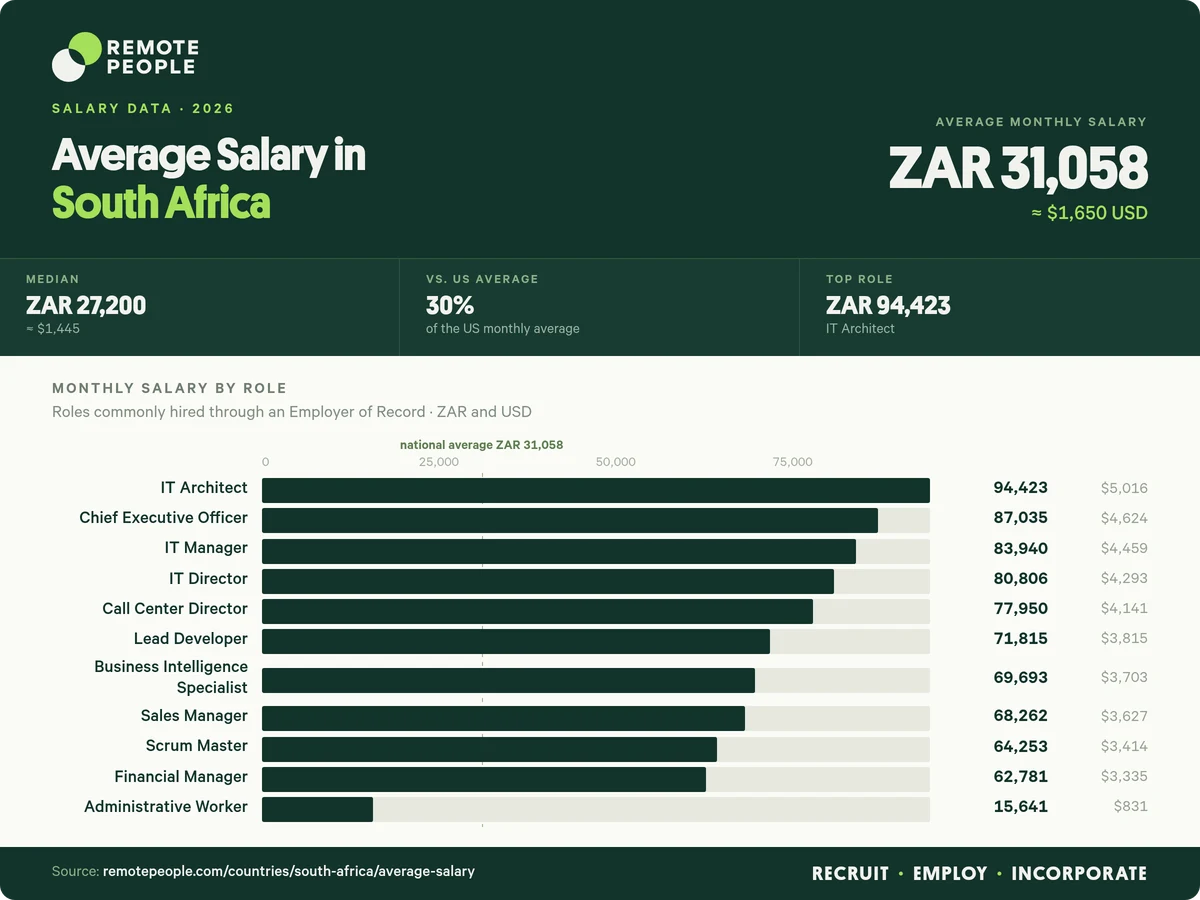
The monthly average salary in South Africa is ZAR 31,058, approximately USD 1650. However, wages vary depending on factors such as education, experience, location, position, and industry. You must also consider how salaries in the country compare to wages worldwide.
This guide will explore all aspects of salaries in South Africa to provide in-depth insight.
What is the Average Salary in South Africa?
The average salary in South Africa is 31,058 ZAR, approximately $1650. Salaries in the country are low due to high unemployment rates, which make wage negotiations challenging for workers. Low business confidence, due to poor economic output, is another contributing factor.
Median Income
The median salary in South Africa is approximately ZAR 27,200, equivalent to $1,445. Half of the workers in the country earn lower salaries, while the other half earn higher wages. When comparing median vs average salary, average salaries are substantially higher due to income inequality in the country.
Salary Range
Average salaries in South Africa generally range from ZAR 12,087 ($642) to ZAR 52,371 (approximately $2,782) per month.
Salary Comparisons in South Africa
Average salaries in South Africa provide some insight. However, you must also consider how wages vary based on factors such as education, experience, location, industry, and position. The following sections will explore how these factors impact wages.
Salary by Profession
This salary comparison chart illustrates the variation in wages by profession.
Position | Average Monthly Wages (ZAR) |
|---|---|
IT Architect | 94,423 |
Chief Executive Officer | 87,035 |
IT Manager | 83,940 |
IT Director | 80,806 |
Call Center Director | 77,950 |
Lead Developer | 71,815 |
Business Intelligence Specialist | 69,693 |
Sales Manager | 68,262 |
Scrum Master | 64,253 |
Financial Manager | 62,781 |
General Laborer | 15,776 |
Administrative Worker | 15,641 |
Packer | 15,546 |
Seamstress | 14,843 |
Data Entry Operator | 14,469 |
Porter | 14,340 |
Medical Records Clerk | 14,298 |
Tailor | 14,187 |
Receptionist | 11,899 |
Average Salary in South Africa by Education
High levels of education are typically associated with higher salaries. In South Africa, workers with a high school diploma (matric) can earn about twice as much as someone who did not graduate from high school. Those with bachelor’s degrees can earn close to 67% more than non-graduates.
However, many people in South Africa have low levels of education, rendering them unemployable.
Salary Comparison by Experience
Experience is a significant factor in wage determination as experienced workers earn more than entry-level workers and become eligible for higher wages with tenure in their field. This situation is generally accurate in South Africa. For example, an entry-level auditor earns an average salary of ZAR 42,000, while mid-level auditors earn closer to ZAR 500,000, and experienced auditors earn as much as ZAR 788,000.
Additionally, workers in South Africa are eligible for a 13th-month salary, meaning they earn an additional month’s pay for every year they complete at their company.
Salary Comparison by Location
Location plays a significant role in wage determination, with workers in urban areas earning more than those in rural areas due to a higher cost of living and proximity to large companies that offer more job opportunities. This situation is particularly evident in South Africa, where workers in economic hubs such as Gauteng and the Western Cape tend to earn more than those residing in Limpopo and the Eastern Cape.
What is the Minimum Wage in South Africa?
The minimum wage in South Africa is ZAR 28.79 per hour (approximately US$1.53), effective 1 March 2025, up from ZAR 27.58 per hour. The next adjustment is scheduled for 1 March 2026, when the minimum wage is expected to increase to ZAR 30.23 per hour, pending final government approval. An exception applies to workers in the Expanded Public Works Programme (EPWP), who currently earn ZAR 15.83 per hour, increased from ZAR 15.16, with their rate also expected to rise to ZAR 16.62 per hour in 2026.
Average Salary in South Africa vs. the Rest of the World
The following charts compare salaries in South Africa to those in developed, developing, and least developed countries, providing further insight.
South Africa vs. Developed Countries
Country | Average Salary | Comparison to Average South Africa Salary |
|---|---|---|
United Kingdom | 3,000 euros (approx. $3,116) | 87% |
United States | $5,677 | 245% |
Norway | 50,790 kroner (approx. $4,700) | 184% |
Germany | 4,300 euros (approx. $4,467) | 172% |
Austria | 3,500 euros (approx. $3,636) | 118% |
South Africa vs. Developing Countries
Country | Average Salary | Comparison to Average South Africa Salary |
|---|---|---|
Romania | 4,000 RON (approx. $835) | 96% |
Russia | 73,709 Rubles (approx. $700) | 135% |
Albania | 1,500 Euros (approx. $1,550) | 6% |
Kazakhstan | 342,082 Tenge (approx. $645) | 153% |
Ukraine | 18,000 Hryvnia (approx. $500) | 230% |
South Africa vs. Undeveloped Countries
Country | Average Salary | Comparison to Average South Africa Salary |
|---|---|---|
Thailand | 97,500 Baht (approx. $2,772) | 69% |
Philippines | 18,423 PHP (approx. $875) | 87% |
Vietnam | 8.5 million dong (approx. $360) | 358% |
Egypt | 13,244 EGP (approx. $263) | 534% |
Pakistan | 45,000 PKR (approx. $150) | 1,000% |
South Africa is a developing country with an upper-middle income economy. However, despite being the largest economy in Africa, it faces numerous challenges, including poverty, unemployment, and inequality. Issues such as crime, corruption, and limited access to basic services result in restricted education and skills training opportunities.
Although low salaries plague the country, they lead to cost savings for companies seeking remote partnerships. The country offers a skilled workforce with high proficiency in the English language. Dominant sectors include BPO, finance, legal, communications, energy, and transportation.
What are the Most Common Outsourced Industries in South Africa?
Customer Service
South Africa is an excellent source of customer service outsourcing. Customer service agents in the country are known for their deep sense of empathy and understanding. Cost-effective pricing makes it an attractive solution for businesses.
Customer service representatives in South Africa earn around ZAR 15,000, approximately $796, while their American counterparts earn closer to $ 3,000, resulting in significant cost savings.
IT and Software Development
The country’s IT industry shows signs of significant growth. The sector focuses on software development, Fintech, cybersecurity, telecommunications, and digital services. The government supports the industry, with a special focus on e-commerce.
IT workers in South Africa earn around ZAR 50,000, approximately ZAR 2,656, while American workers earn closer to $ 5,000, giving companies that outsource significant bargaining power.
BPO
South Africa boasts a thriving BPO industry, with annual growth rates of around 3%. The sector is projected to triple by 2030, creating over 775,000 jobs, with many catering to international markets. Government initiatives and a robust infrastructure support the industry.
With BPO encompassing numerous sectors, it’s challenging to calculate specific cost savings; however, there is little doubt that employers who hire remotely can reduce expenses.
Conclusion
South Africa’s low average salary, cost-effective labor, and skilled workforce make it a highly attractive destination for outsourcing. Employers who hire in the area can benefit from reduced expenses and access to quality products and services, while helping the country overcome its poverty issues, resulting in a win-win situation for everyone involved.