Recruit
Average Salary in Colombia
-
 Drew Donnelly
- Published
- September 21, 2026
Wondering what people earn in Colombia? Below you will find average wages by profession, current minimum wage figures, and how Colombia’s pay compares with other markets. Employers hiring locally often work with an Employer of Record (EOR) in Colombia to handle payroll and stay compliant without registering a business.
- 5 ★ on G2








Let RemotePeople handle payroll, compliance, and HR admin worldwide so you can focus on building your team.
Colombia is an ideal outsourcing destination due to its skilled workforce, cost-effective labor, and near-shoring opportunities for U.S. employers. But what is the average salary in Columbia? This information will help you prepare a fair offer.
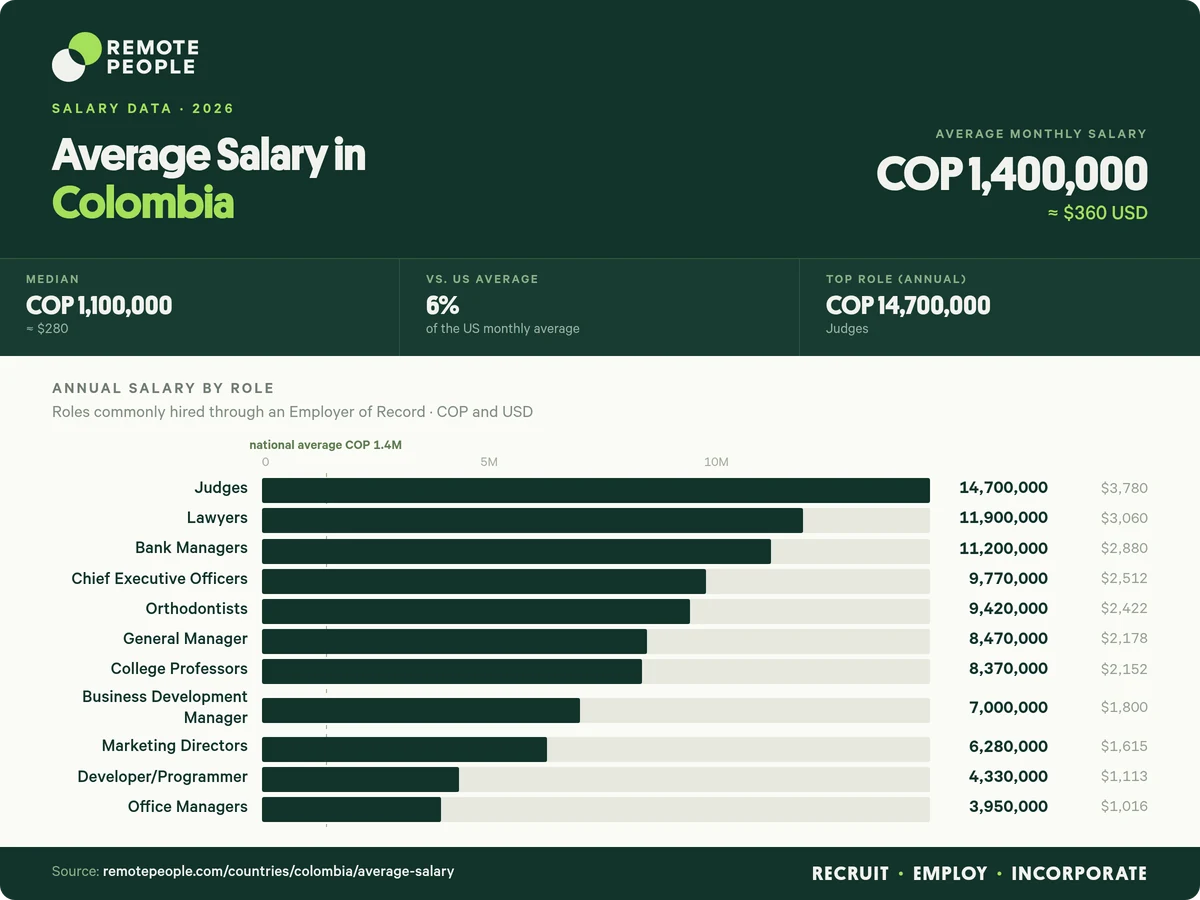
The average salary in Colombia is 1,400,000 pesos per month or approximately USD 360. However, salaries vary according to experience, profession, location, industry, and education. To gain deeper insights, consider average vs median salary and salary range.
This guide will examine all aspects of Colombian salaries to provide a comprehensive view.
What is the Average Salary in Colombia?
To calculate the average salary, you must add salaries from across the country and divide them by the total number of workers. The average salary in Colombia is 1,400,000 pesos a month (approximately $360). Low wages are directly related to the low cost of living and the unregulated economy.
Median Income
The median salary can also be considered the middle salary. Colombia’s median monthly income is 1,100,000 COP (approximately $280). Fifty percent of workers earn higher wages, and the other half earn lower wages.
Salary Range
The salary range spans from the lowest to the highest in the country. Low-paid workers make as little as 900,000 COP (approximately $230), while high-paid workers can make as much as 8,000,000 COP (roughly $2,050).
Salary Comparison by Profession
Salaries vary by profession. Workers in highly skilled roles tend to make more than manual laborers. This salary comparison chart will reveal how much workers in different professions earn.
Profession | Average Yearly Salary (COP) |
|---|---|
Surgeons/Doctors | 17,400,000 |
Judges | 14,700,000 |
Lawyers | 11,900,000 |
Bank Managers | 11,200,000 |
Chief Executive Officers | 9,770,000 |
Orthodontists | 9,420,000 |
College Professors | 8,370,000 |
General Manager | 8,470,000 |
Business Development Manager | 7,000,000 |
Pilots | 6,980,000 |
Marketing Directors | 6,280,000 |
Office Managers | 3,950,000 |
Developer/Programmer | 4,330,000 |
Accountants | 3,080,000 |
Customer Service Rep | 2,752,000 |
Health and Safety Officer | 2,160,000 |
Cashier | 1,584,000 |
Average Wage in Colombia by Education
Education plays a huge role in the salaries of Colombian workers. Here’s a breakdown of how much you can earn based on your level of completed education.
- High school graduates earn an average of 17% less than those with some secondary education.
- Workers with a Bachelor’s Degree earn 24% more than workers with a high school diploma.
- Individuals with a Master’s Degree earn 29% more than those with a Bachelor’s Degree.
- PhD holders earn 23% more than those with a Master’s Degree.
Salary Comparison by Experience
Experienced workers tend to make more than their inexperienced counterparts. This chart breaks down salaries by experience.
Years of Experience | Salary Increase |
|---|---|
2-5 years | 32% more than individuals with less than 2 years of experience |
5-10 years | 36% more than those with 2-5 years of experience |
10-15 years | 21% more than those with 5-10 years of experience |
15-20 years | 14% more than those with 10-15 years of experience |
20+ years | 9% more than those with 15-20 years of experience |
Salary Comparison by Location
Location plays a crucial role in earnings. Workers in urban communities tend to earn more than workers in rural communities due to a higher cost of living, proximity to larger companies, and more job opportunities. This chart will break down earnings by region.
City | Average Salary (COP) |
|---|---|
Barranquilla | 4,840,000 |
Bello | 4,470,000 |
Bogotá | 5,440,000 |
Bucaramanga | 4,590,000 |
Buenaventura | 4,360,000 |
Cartagena | 4,800,000 |
Cúcuta | 4,760,000 |
Ibagué | 4,690,000 |
Manizales | 4,260,000 |
Medellín | 5,390,000 |
Montería | 4,380,000 |
Neiva | 4,210,000 |
Pereira | 4,370,000 |
Santa Marta | 4,510,000 |
Soacha | 4,680,000 |
Soledad | 4,760,000 |
Valledupar | 4,470,000 |
Villavicencio | 4,590,000 |
How Much is Minimum Wage in Colombia?
As of January 2026, the minimum wage in Colombia is COP 1,750,905 (Colombia minimum wage USD approx. $450) monthly, a 23% increase from the previous year’s COP 1,423,500. The latest increase will help workers better manage expenses.
Average Salary in Colombia vs. the Rest of the World
Comparing Colombian wages to other countries can provide more insight into their salaries. The following sections will analyze how Colombia’s earnings compare to those of developed, developing, and undeveloped countries.
Colombia vs. Developed Countries
Country | Average Salary | Comparison to Average Colombia Salary |
|---|---|---|
United Kingdom | £3,000 (approx. $4,100) | − 91% |
United States | $5,220 | − 93% |
Norway | 50,000 NOK (approx. $4,700) | − 92% |
Germany | €4,300 (approx. $4,470) | − 92% |
Austria | €3,700 (approx. $4,050) | − 91% |
Colombia vs. Developing Countries
Country | Average Salary | Comparison to Average Colombia Salary |
|---|---|---|
Romania | 4,000 RON (approx. $835) | − 57% |
Russia | 73,700 RUB (approx. $700) | − 49% |
Albania | 83,330 ALL (approx. $860) | − 139% |
Kazakhstan | 342,000 KZT (approx. $645) | − 44% |
Ukraine | 18,000 UAH (approx. $500) | − 28% |
Colombia vs. Undeveloped Countries
Country | Average Salary | Comparison to Average Colombia Salary |
|---|---|---|
Thailand | 15,000 Baht (approx. $420) | − 14% |
Philippines | 15,000 PHP (approx. $265) | 36% |
Vietnam | 7.5 million Dong (approx. $300) | 20% |
Egypt | 3,900 EGP (approx. $125) | 188% |
Pakistan | 60,000 PKR (approx. $210) | 71% |
Colombia is a developing country. However, it does not lag far behind developing countries in terms of the Human Development Index (HDI) and per capita GDP. Although it shows potential, the government is plagued by income inequality, violence, and development challenges.
The country’s work economy is focused on the service sector, which includes retail, finance, and tourism. It also has strong agriculture, mining, and petroleum industries. Due to its skilled workforce, cost-effective labor, multilingual capabilities, and nearshoring advantages for United States and European employers, it is an ideal outsourcing destination.
What are the Most Common Outsourced Industries in Colombia?
Companies outsourcing Colombian talent may consider hiring for the following positions.
Customer Support
Companies seeking Colombian customer service support reps can benefit from multilingual workers and optimal efficiency. The country is quickly adopting technology into its customer service suite and offers the highest communication skills. The nearshoring advantage allows providers to scale up or down quickly.
Customer service reps in the country generally earn around COP 3,029,340 (approx. $780). Meanwhile, reps in the United States make about $3,306 monthly, allowing employers to take advantage of significant savings.
IT Services
Colombia is an ideal destination for IT services, with a strong focus on software development. Its tech sector has grown by 24.5% since 2010, backed by the government’s vision of transforming the country into Latin America’s Silicon Valley.
Depending on the position, you can expect to pay a Colombian tech worker between $18,000 and $45,000. Meanwhile, workers in America earn between $80,000 and $120,000.
Manufacturing
Companies often turn to Colombia for its manufacturing abilities, focusing on automotive, packaging, construction materials, textiles, mining, and agriculture. The country offers access to raw materials and is close to shipping ports in America and Europe. Its economy is growing rapidly.
Manufacturing in Colombia can save companies between 20% and 40% in labor costs.
Conclusion
Colombia is an ideal destination for outsourcing due to its highly skilled workforce, low labor costs, and nearshoring convenience. Employers outsourcing to Colombia help workers earn more money, reducing income inequality. The arrangement benefits everyone involved.