
 Recruit
Average Salary in Lithuania
-
 Drew Donnelly
- Published
- September 21, 2026
Curious about salaries in Lithuania? This guide breaks down the average wages, compares professions, highlights minimum wage figures, and explores how Lithuania’s earnings measure up internationally.
- 5 ★ on G2








Let RemotePeople handle payroll, compliance, and HR admin worldwide so you can focus on building your team.
Lithuania’s skilled workforce, competitive business environment, and cost-effective labor make it an excellent outsourcing destination. Employers seeking remote partnerships in the country may wonder, what is the average salary in Lithuania? This information will help them prepare a competitive job offer.
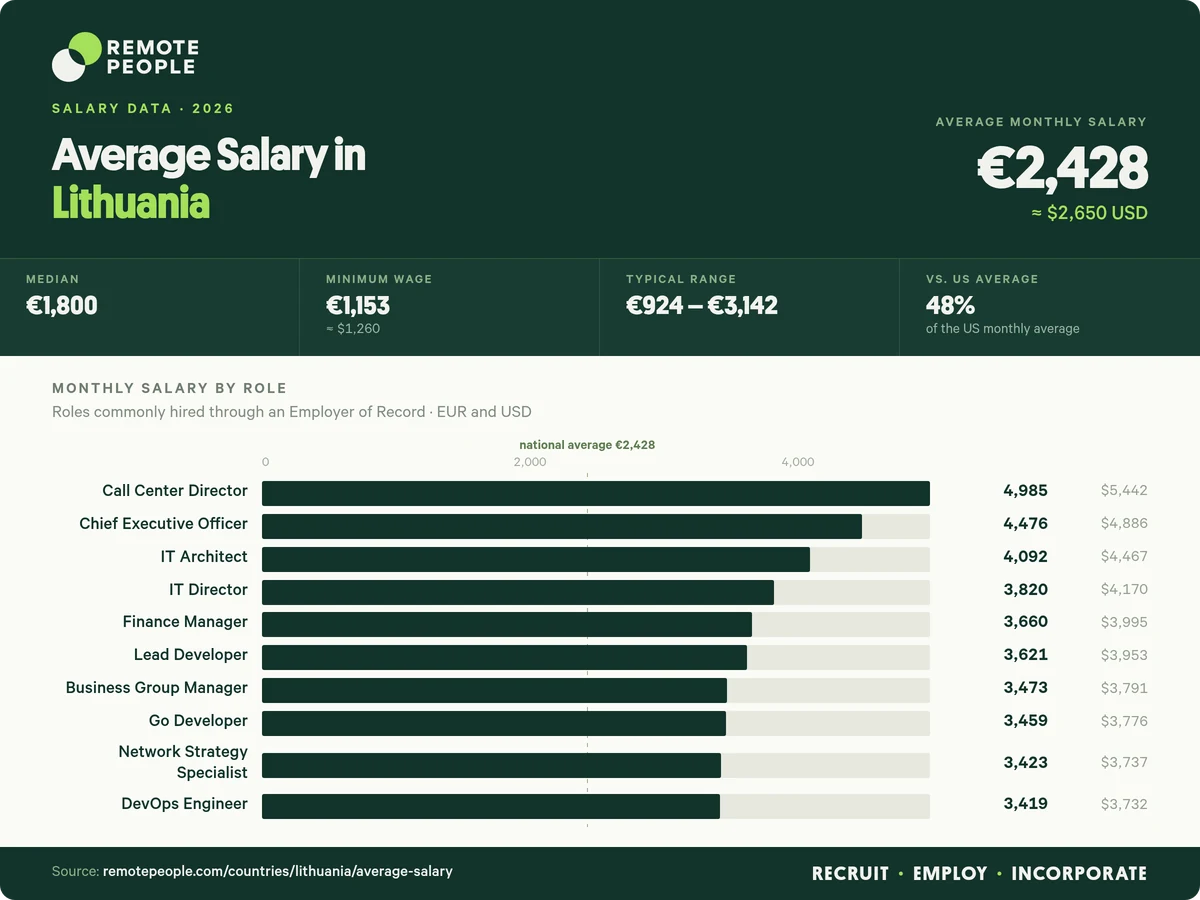
The average monthly salary in Lithuania is €2,427.6, about USD 2,650. However, wages vary based on education, experience, location, industry, and position. Comparing Lithuanian salaries to wages worldwide will also provide additional insight.
This guide will explore all aspects of salaries in Lithuania to provide a complete picture.
What is the Average Salary in Lithuania?
The average salary in Lithuania is €2,427.6, which translates to about $2,650. Wages in the country are relatively low compared to others in the EU due to the lower cost of living. The government is also still developing and addressing income inequality.
Median Income
The median monthly income in Lithuania is €1,800, about $1,960. Half the people in the country earn higher salaries; the other half earn lower wages.
Salary Range
The salary range spans the lowest to highest earnings in the country. Low earners make close to the minimum wage of €924 (about $1,010), while high earners make closer to €3,142 (about $3,425).
Salary Comparison by Profession
The average salary provides some insight, but you must consider how wages are impacted by education, experience, position, location, and industry. The following sections will explore those factors and their relation to earnings:
Position | Average Monthly Salary (€) |
|---|---|
Call Center Director | 4,985 |
Chief Executive Officer | 4,476 |
IT Architect | 4,092 |
IT Director | 3,820 |
Finance Manager | 3,660 |
Lead Developer | 3,621 |
Business Group Manager | 3,473 |
Go Developer | 3,459 |
Network Strategy Specialist | 3,423 |
DevOps Engineer | 3,419 |
Cobbler | 1,049 |
Fabric Cutter | 1,020 |
Clothing Technologist | 1,014 |
Seamstress | 976 |
Tailor | 960 |
General Laborer | 952 |
Porter | 915 |
Average Wage in Lithuania by Education
Education is a significant factor in wage determination and employment rates. 54% of Lithuanian workers without upper secondary qualifications are employed, compared to 79% of those with an upper secondary, post-secondary, or non-tertiary qualification.
Twenty percent of 25-—to 64-year-olds without a secondary qualification receive earnings below the median income, compared to 17% of those with an upper secondary, post-secondary, or non-tertiary qualification and 12% of workers with a tertiary qualification.
Salary Comparison by Experience
Salary also impacts wages as follows:
Experience Level | Salary Increase Compared to Previous Level |
|---|---|
2–5 years | 32% |
5–10 years | 36% |
10–15 years | 21% |
15–20 years | 14% |
20+ years | 9% |
Salary Comparison by Location
In Lithuania, urban workers who live close to the capital city of Vilnius earn more than rural workers due to a higher cost of living and proximity to large companies offering high-paying job opportunities.
How Much is Minimum Wage in Lithuania?
The minimum wage in Lithuania is €1,153 (about $1,260 USD) monthly. The wage increased on January 1, 2026, from the previous rate of €1,038, marking a roughly 11% boost. The decision aligns with the country’s ongoing efforts to improve living standards and reduce income inequality.
Average Salary in Lithuania vs. the Rest of the World
The following charts will compare Lithuanian salaries to wages worldwide to provide deeper insight.
Lithuania vs. Developed Countries
Country | Average Salary | Comparison to Average Lithuania Salary |
|---|---|---|
United Kingdom | £3,000 (approx. $4,100) | − 55% |
United States | $5,220 | − 97% |
Norway | 50,000 NOK (approx. $4,700) | − 77% |
Germany | €4,300 (approx. $4,470) | − 69% |
Austria | €3,700 (approx. $4,050) | − 53% |
Lithuania vs. Developing Countries
Country | Average Salary | Comparison to Average Lithuania Salary |
|---|---|---|
Romania | 4,000 RON (approx. $835) | 69% |
Russia | 73,700 RUB (approx. $700) | 74% |
Albania | 83,330 ALL (approx. $860) | 68% |
Kazakhstan | 342,000 KZT (approx. $645) | 76% |
Ukraine | 18,000 UAH (approx. $500) | 81% |
Lithuania vs. Undeveloped Countries
Country | Average Salary | Comparison to Average Lithuania Salary |
|---|---|---|
Thailand | 15,000 Baht (approx. $420) | 84% |
Philippines | 15,000 PHP (approx. $265) | 90% |
Vietnam | 7.5 million Dong (approx. $300) | 89% |
Egypt | 14,317 EGP (approx. $284) | 89% |
Pakistan | 60,000 PKR (approx. $210) | 92% |
Lithuania is a developed country with a high income and advanced economy. Its work sector is stable, diversified, and growing. While traditional industries like food processing and textile remain dominant, the country is diversifying into electronics, machinery, technology, and fintech sectors.
The country is a good outsourcing destination due to its skilled workforce, cost-effective labor, and competitive business environment. It also offers a nearshoring advantage to companies in Western Europe. While it may not be as developed as other EU countries, its economy is growing rapidly.
What are the Most Common Outsourced Industries in Lithuania?
Employers wishing to partner with Lithuania for remote opportunities will benefit significantly in the following industries.
IT Services
Lithuania’s IT sector is growing in leaps and bounds, demonstrating 7 times growth between 2018 and 2023. It boasts a skilled workforce backed by government support. Key sectors include engineering and software development.
IT workers in the country earn around €3,500 (about $3,815), while American workers earn closer to $5,500. This difference amounts to significant cost savings for employers.
Manufacturing
Lithuania is a popular manufacturing source, specifically for food processing, which accounts for 11% of the country’s total exports. The country produces many dairy products, meat, fish, vegetables, fruits, baked goods, grains, spices, and herbs. Other significant manufacturing activities include chemical and food production.
Financial Services
The Bank of Lithuania operates eight international bank branches and nine commercial banks, but what may be more impressive is the country’s advancement in FinTech. Establishing itself as the FinTech hub of the EU, its advanced technology allows potential investors to gain operational licenses within 3 months rather than the standard year. It has actively attracted financial companies looking for other investments after Brexit.
Conclusion
Lithuania’s highly skilled workforce, cost-effective labor, and competitive business environment make it an attractive outsourcing destination. Employers that hire in the area can benefit from cost savings and quality products and services while helping the country overcome its income inequality issues.