
 Recruit
Average Salary in Australia
-
 Drew Donnelly
- Published
- September 21, 2026
Curious about salaries in Australia? This guide breaks down the average wages, compares professions, and explores how Australia’s earnings measure up internationally.
- 5 ★ on G2








Let RemotePeople handle payroll, compliance, and HR admin worldwide so you can focus on building your team.
Australia is an ideal outsourcing destination due to its stable political environment and skilled workforce. If you are considering hiring Australian remote workers, you may wonder, what is the average salary in Australia? This article will tell you everything you need to know.
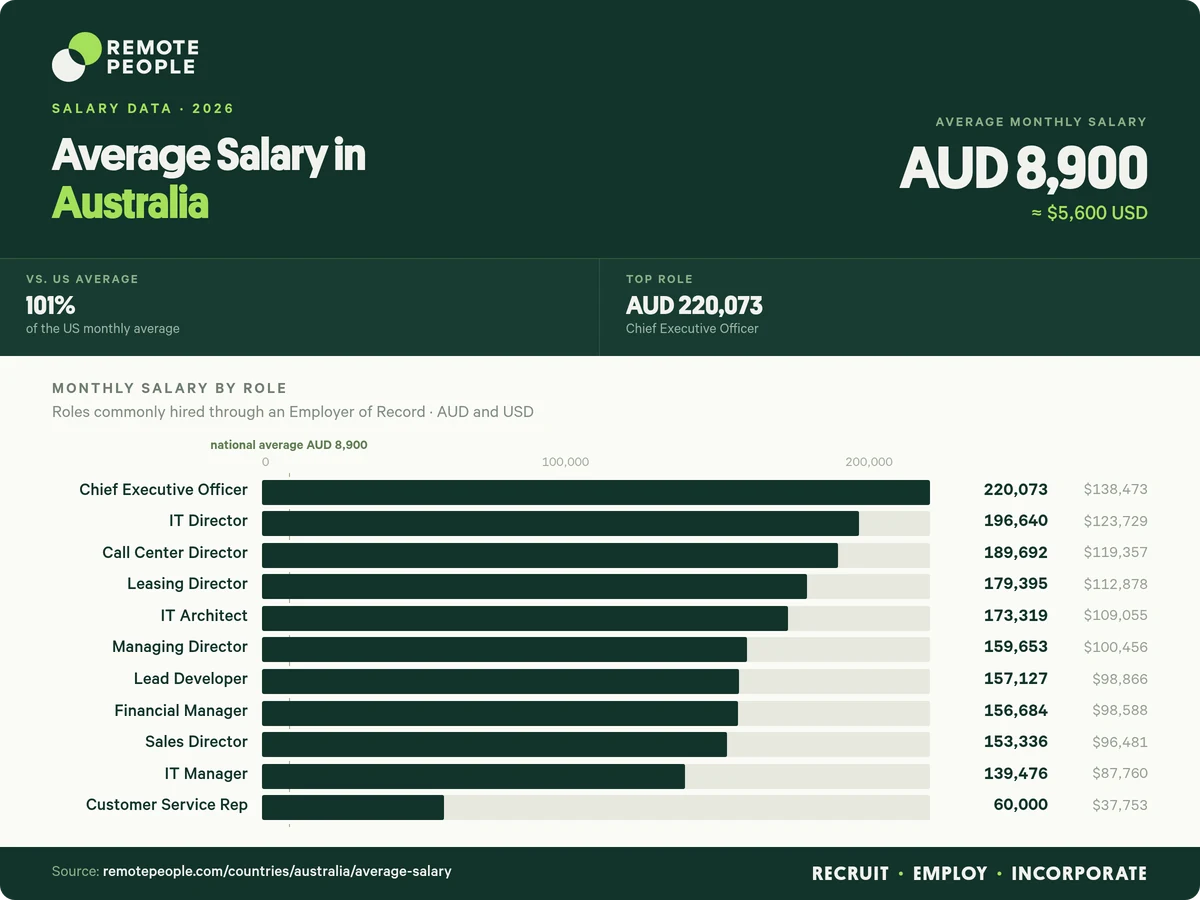
The average salary Australia is about 8,900 AUD, about $5,600 USD. However, wages vary depending on the profession, experience, education, and location. Median salary and salary wages must also be considered.
This guide will provide extensive insights into preparing a reasonable outsourcing offer.
What is the Average Salary in Australia?
The average salary is calculated by dividing all salaries in the country by the total number of workers. Australia’s average salary is 8,900 Australian dollars (AUD), equivalent to 5,600 American dollars.
Median Income
The median salary can also be considered the ‘middle salary.’ Australia’s median income is about 1,436 AUD per week, which translates to approximately 6,224 AUD per month or $4,110 USD per month. Fifty percent of workers make more than this amount, and fifty percent make less.
Salary Range
The salary range spans from the lowest to the highest in the country. Salaries in Australia typically start at around 4,500 AUD and go up to 10,500 AUD.
Salary Comparison by Profession
Salaries vary by profession. Highly skilled workers tend to make more than manual laborers. This salary comparison chart offers some data to consider.
Profession | Salary (AUD) |
|---|---|
Chief Executive Officer | 220,073 |
IT Director | 196,640 |
Call Center Director | 189,692 |
Leasing Director | 179,395 |
IT Architect | 173,319 |
Plant Manager | 168,839 |
Managing Director | 159,653 |
Lead Developer | 157,127 |
Financial Manager | 156,684 |
Sales Director | 153,336 |
IT Manager | 139,476 |
Customer Service Rep | 60,000 |
Data Entry Specialist | 60,000 |
Cashier | 39,201 |
Clothing Technologist | 38,626 |
Packer | 37,832 |
Assistant Teacher | 37,599 |
Medical Records Clerk | 34,795 |
Nursery School Teacher | 30,439 |
Average Wage in Australia by Education
Education Level | Income (AUD) |
|---|---|
Year 11 and below | 38,281 – 47,318 |
Year 12 | 43,967 – 53,929 |
Certificate III-IV | 48,000 – 61,208 |
Diploma | 50,000 – 60,605 |
Undergraduate | 63,805 – 76,731 |
Masters | 72,768 – 84,072 |
Doctorate | 88,486 – 102,977 |
Salary Comparison by Experience
|
Years of Experience
|
Salary Increase Compared to Less Experienced
|
|---|---|
2-5 years |
32% |
Over 5 years |
36% |
10 years |
21% |
Over 15 years |
14% |
Salary Comparison by Location
Location impacts salary, as workers in urban areas tend to be paid more than rural workers due to the higher cost of living and greater access to high-paying jobs. Four in ten Australian employers use a two-tier system, assigning different salaries to rural and urban employees.
Employers likely to use this system will be located in Sydney, Australia’s most expensive city. Two-tier systems may also be integrated in Perth, which is experiencing increasing living costs. Queensland and Western Australian employers may also pay in varied tiers.
However, employees in Victoria, home to large regional sections not far from recreational areas, are less likely to use this system.
Average Salary in Australia vs. the Rest of the World
Australia vs. Developed Countries
Country | Average Salary | Comparison to Average Australia Salary |
|---|---|---|
United Kingdom | £3,000 (approx. $4,100) | 1% |
United States | $5,220 | − 21% |
Norway | 50,000 NOK (approx. $4,700) | − 12% |
Germany | €4,300 (approx. $4,470) | − 7% |
Austria | €3,500 (approx. $3,636) | 14% |
Australia vs. Developing Countries
|
Country
|
Average Salary
|
Comparison to Average Australia Salary
|
|---|---|---|
Romania |
4,000 RON (approx. $835) |
397% |
Russia |
73,700 RUB (approx. $700) |
493% |
Albania |
83,330 ALL (approx. $860) |
85% |
Kazakhstan |
342,000 KZT (approx. $645) |
544% |
Ukraine |
18,000 UAH (approx. $500) |
730% |
Australia vs. Undeveloped Countries
Country | Average Salary | Comparison to Average Australia Salary |
|---|---|---|
Thailand | 15,000 Baht (approx. $420) | 888% |
Philippines | 15,000 PHP (approx. $265) | 1,467% |
Vietnam | 7.5 million Dong (approx. $300) | 1,283% |
Egypt | 3,900 EGP (approx. $125) | 3,220% |
Pakistan | 60,000 PKR (approx. $210) | 1,876% |
Australia has high wages and a high cost of living. However, it may offer affordable help to American companies with slightly higher salaries and expenses.
The country also makes an attractive outsourcing destination because its political climate is relatively stable, and its weather differs from that of Northern Hemisphere countries. Therefore, it may be an effective alternative to other outsourcers experiencing disruption due to weather or political distress.
Australia’s work economy mainly focuses on the service sector and mining industry. However, the country also has a thriving tech industry. It also has one of the lowest unemployment rates of all developed countries.
What are the Most Common Outsourced Industries in Australia?
IT Workers
Although most Australian workers are service-oriented, the country has a thriving tech industry. It is valued at around AUD 160 billion, making it a prime driver of the Australian economy. Cities like Melbourne and Sydney are considered significant tech hubs.
Tech workers in the country tend to make between 75,000 AUD (approximately $49,000) and 210,000 AUD (roughly $138,000) per year. These salaries are comparable to American wages, but remote workers may be a reliable alternative when disruptions occur.
Customer Service
Australia’s service-oriented workforce makes it an ideal destination for hiring customer service reps. The country prioritizes friendliness, honesty, and communication. Technology is often integrated for optimal efficiency.
Customer service reps in the country tend to make between 4,800 AUD (approx. $3,170) and 6,500 AUD (approx. $4,290) per month. This salary range compares to an average of $3,148 in America.
Data Entry Specialists
Data entry is a popular Australian profession. Many people in the country are employed in this field, which means it’s a good place to find skilled workers.
Specialists in the country typically make between 4,166 AUD (approximately $2,750) and 5,000 AUD (approximately $3,300) per month. These salaries are comparable to those of American data entry specialists, who make about $3,508 monthly.