
 Recruit
Average Salary in Finland
-
 Drew Donnelly
- Published
- September 21, 2026
Curious about salaries in Finland? This guide breaks down the average wages, compares professions, highlights minimum wage figures, and explores how Finland’s earnings measure up internationally. Partnering with an Employer of Record (EOR) in Finland lets you employ staff there without establishing a legal entity of your own.
- 5 ★ on G2








Let RemotePeople handle payroll, compliance, and HR admin worldwide so you can focus on building your team.
Finland’s high craftsmanship and specialization make it an ideal outsourcing destination. Employers considering hiring Finnish workers may wonder, what is the average salary in Finland? This information will help them make a fair offer.
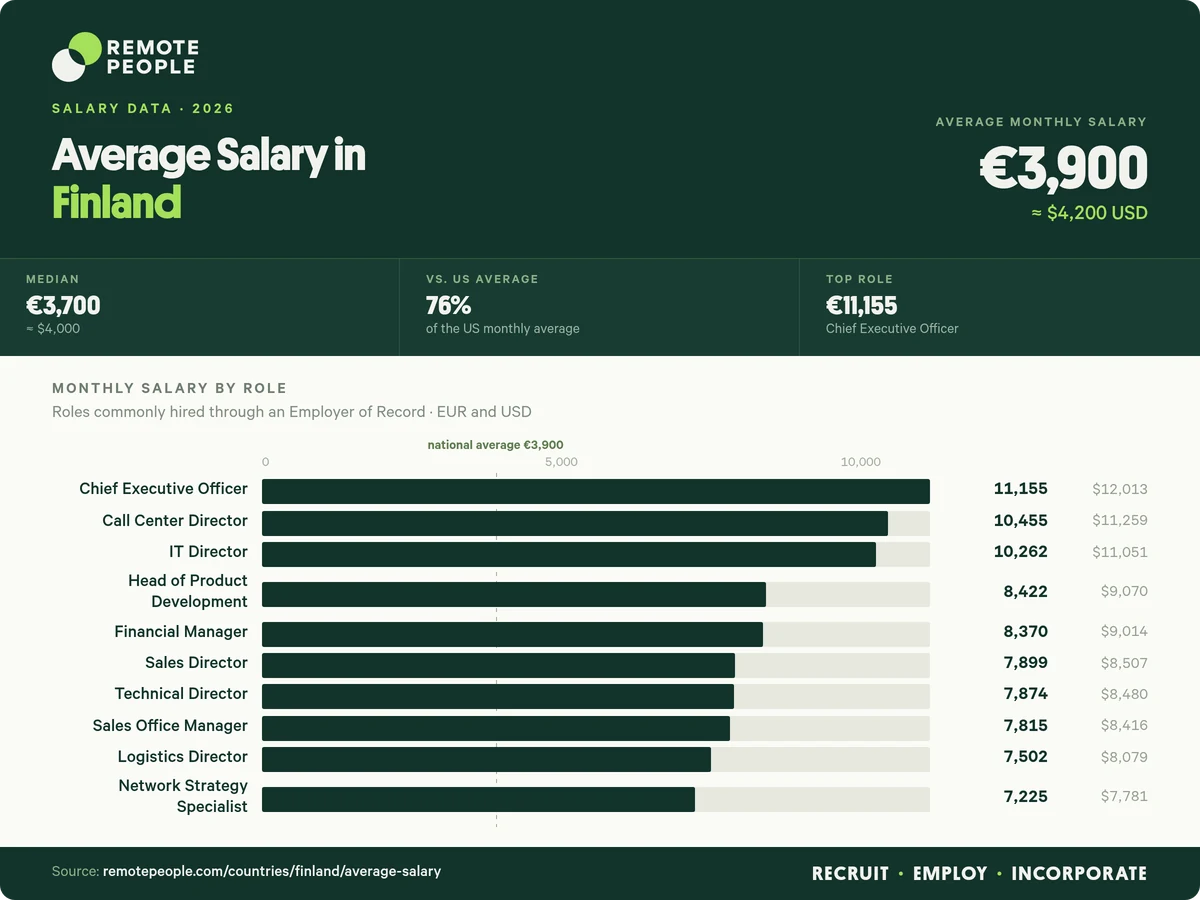
The average salary in Finland is €3,900 (approximately USD 4,200) per month. However, experience, position, industry, education, and location can also impact salary. The median income and salary range provide further insight.
This guide will review all aspects of Finnish salaries, giving you all the information you need to hire.
What is the Average Salary in Finland?
The average monthly salary in Finland is €3,900, which translates to about $4,200. The country’s wages are relatively high due to its strong social welfare system and highly educated workforce. Employers who outsource to the government may not see substantial cost savings but will receive high-quality, specialized output.
Median Income
The median salary can also be considered the ‘middle salary.’ Finland’s median monthly income is €3,700 (approximately $4,000). Half the country’s people make more than this amount, and the other half earn less.
Salary Range
The salary range spans from the lowest to the highest earnings in the country. Low-earners in Finland earn around €1,800 per month, while high-earners can make close to €20,000.
Salary Comparison by Profession
Industry and position impact salary, with highly skilled workers being paid more than unskilled workers. This salary comparison chart lists the average wages of Finnish workers based on position.
Position | Monthly Salary (€) |
|---|---|
Chief Executive Officer | 11,155 |
Call Center Director | 10,455 |
IT Director | 10,262 |
Head of Product Development | 8,422 |
Financial Manager | 8,370 |
Sales Director | 7,899 |
Technical Director | 7,874 |
Sales Office Manager | 7,815 |
Logistics Director | 7,502 |
Network Strategy Specialist | 7,225 |
Fabric Cutter | 2,136 |
Clothing Technologist | 2,127 |
General Laborer | 2,114 |
Packer | 2,083 |
Seamstress | 1,989 |
Porter | 1,922 |
Medical Records Clerk | 1,916 |
Tailor | 1,910 |
Social Counselor | 1,715 |
Average Wage in Finland by Education
Education is a driving factor in Finland’s salary consideration and employment rates. Only 46% of 25-34-year-olds without an upper secondary education are employed compared to 76% of those with an upper secondary, post-secondary, or non-tertiary education.
People without an upper secondary education are also at risk of earning low wages. Thirty-one percent of 25 to 64-year-olds without a secondary education earn wages below the median income, compared to 22 percent of workers with an upper secondary or post-secondary education and 12 percent with a tertiary qualification.
Salary Comparison by Experience
Experience is another factor that impacts salary. Workers generally earn more as they gain experience in their industry. After years at their company, they also become eligible for raises.
The following chart demonstrates how wages increase as you gain experience in your industry.
Experience | Salary Increase |
|---|---|
Less than 2 years | Base salary |
2–5 years | +32% |
5–10 years | +36% |
10–15 years | +21% |
15–20 years | +14% |
20 years or more | +9% |
Salary Comparison by Location
Workers in urban areas tend to make more than workers in rural areas due to a higher cost of living, proximity to larger companies, and more job opportunities. For example, workers in Helsinki earn an average of €4,200 per month, considerably more than the national average.
How Much is Minimum Wage in Finland?
Finland does not have a statutory minimum wage. Instead, wages are set through collective agreements between employers and trade unions. However, wages are rarely below €1500.
The country’s strong labor protections ensure workers earn fair salaries.
Average Salary in Finland vs. the Rest of the World
Comparing Finnish salaries to those of other countries can provide perspective. The following charts compare Finland’s average wages to those of developed, developing, and undeveloped countries.
Finland vs. Developed Countries
Country | Average Salary | Comparison to Average Finland Salary |
|---|---|---|
United Kingdom | £3,000 (approx. $4,100) | 2% |
United States | $5,220 | − 24% |
Norway | 50,000 NOK (approx. $4,700) | − 12% |
Germany | €4,300 (approx. $4,470) | − 6% |
Austria | €3,700 (approx. $4,050) | 4% |
Finland vs. Developing Countries
Country | Average Salary | Comparison to Average Finland Salary |
|---|---|---|
Romania | 4,000 RON (approx. $835) | 80% |
Russia | 73,700 RUB (approx. $700) | 83% |
Albania | 83,330 ALL (approx. $860) | 80% |
Kazakhstan | 342,000 KZT (approx. $645) | 85% |
Ukraine | 18,000 UAH (approx. $500) | 88% |
Finland vs. Undeveloped Countries
Country | Average Salary | Comparison to Average Finland Salary |
|---|---|---|
Thailand | 15,000 Baht (approx. $420) | 90% |
Philippines | 15,000 PHP (approx. $265) | 94% |
Vietnam | 7.5 million Dong (approx. $300) | 93% |
Egypt | 3,900 EGP (approx. $125) | 97% |
Pakistan | 60,000 PKR (approx. $210) | 95% |
Finland is a developed country with a highly industrialized economy and a high standard of living. The service sector dominates its work economy. However, it also focuses on technology, manufacturing, and the public sector.
The country’s high salaries may not make it the most economic outsourcing destination. However, it offers a highly skilled workforce with specialized software development, engineering, and design skills. Its robust infrastructure and political stability also mean it can be a solution when disruptions occur.
What are the Most Common Outsourced Industries in Finland?
Employers interested in outsourcing to Finland may consider partnering for the following services:
IT Services
Finland has a remarkable IT industry, contributing about 15% to its GDP, and is home to over 6,000 innovative companies. The sector focuses on information and communications, AI, R&D, smart buildings, electronics, and software development.
Gaming
Finland’s gaming industry is one of the largest in Europe. It is known for its mobile games and developers. The country has produced popular games like Clash of the Clans, Candy Crush, Minecraft, Call of Duty, Angry Birds, and Grand Theft Auto.
Manufacturing
Manufacturing is the backbone of Finland’s work economy. Dominant sectors include electronics, machinery, automotive, metal products, wood products, and chemicals. The country’s high investment in research and development gives it a competitive edge in the market.
Conclusion
Finland may not be the most affordable outsourcing destination, but its high-quality, specialized services could give businesses a competitive advantage. Employers considering partnering with workers in the country now have the information they need to make a fair offer. Good luck with your profitable venture.




