
 Recruit
Average Salary in Kuwait
-
 Drew Donnelly
- Published
- September 21, 2026
Curious about salaries in Kuwait? This guide covers average wages, salary by profession, minimum wage figures, and how Kuwait’s earnings measure up internationally. Companies hiring in the country commonly use an Employer of Record (EOR) in Kuwait to manage contracts, payroll, and local employment law.
- 5 ★ on G2








Let RemotePeople handle payroll, compliance, and HR admin worldwide so you can focus on building your team.
Kuwait’s business-friendly policies, strategic location, and skilled workforce make it an excellent outsourcing destination. Employers who wish to outsource to the area may wonder, what is the average salary in Kuwait? This information will help them prepare a fair job offer. When hiring in Kuwait, employers may also consider employee background checks in Kuwait to help verify candidates’ identities, employment history, and qualifications.
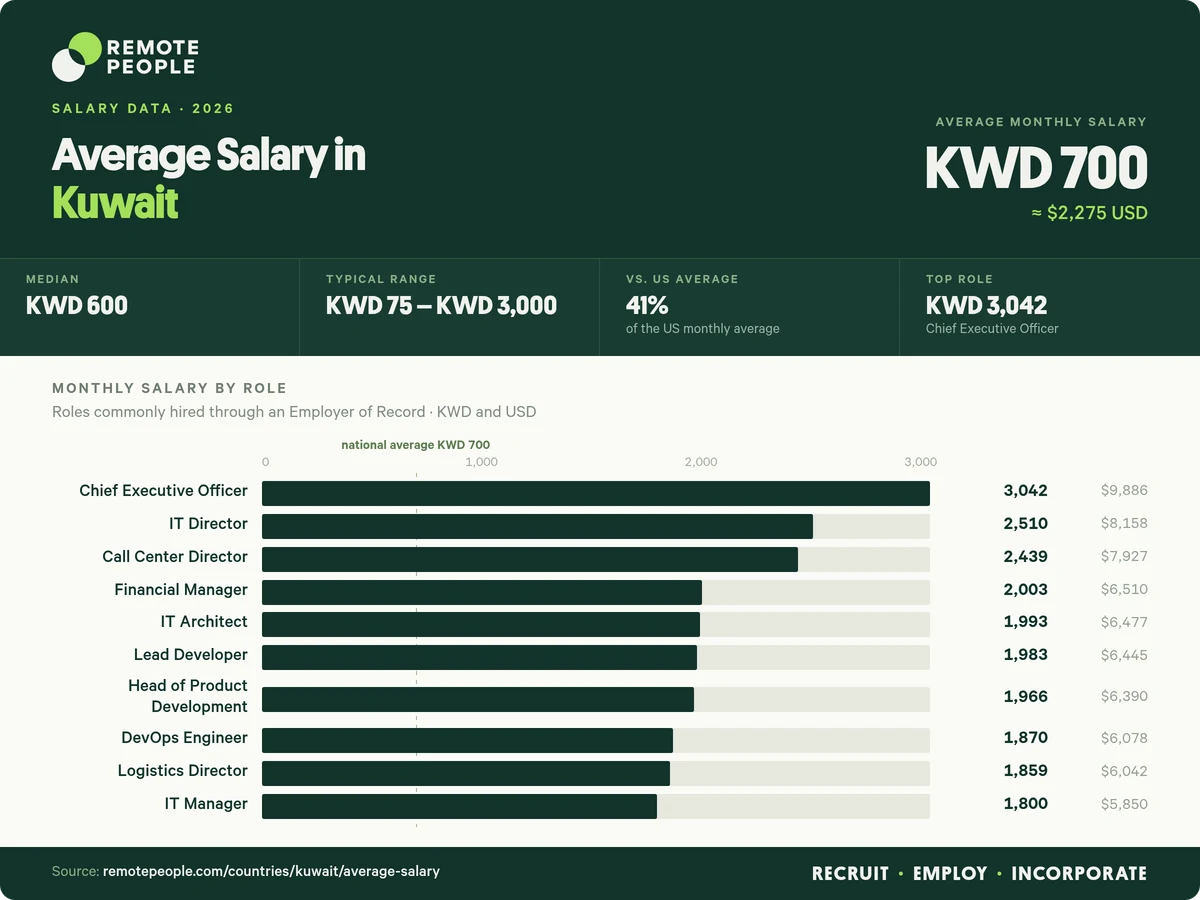
The average monthly salary in Kuwait is 700 Kuwaiti Dinar (KWD), which translates to around USD 2,275. However, several factors, such as location, experience, education, industry, and position, impact earnings. You must also determine how Kuwaiti salaries compare to earnings worldwide.
This guide will provide a complete picture of all aspects of Kawaiti salaries, giving you all the information you need to start hiring.
What is the Average Salary in Kuwait?
Kuwait’s average monthly salary is KWD 700, or about $2,275. The country’s high salaries are due to its booming oil-based economy. The political system also prioritizes wealth distribution among citizens, which can further impact earnings.
Median Income
The median salary can also be considered the middle salary. Kuwait’s median monthly income is about 600 KWD (about $1,950). Half the country’s population earns higher salaries, and the other half earns lower salaries.
Salary Range
The salary range spans the lowest to highest salaries in the country. Low earners make a minimum wage of 75 KWD (about $244) monthly, while high earners make closer to 3,000 KWD (around $9,750) monthly.
Salary Comparison by Profession
Average salaries in Kuwait provide some insight, but you must also consider how education, experience, location, position, and industry impact wages. The following sections will explore those factors.
Profession | Average Monthly Salary (KWD) |
|---|---|
Chief Executive Officer | 3,042 |
IT Director | 2,510 |
Call Center Director | 2,439 |
Financial Manager | 2,003 |
IT Architect | 1,993 |
Lead Developer | 1,983 |
Head of Product Development | 1,966 |
DevOps Engineer | 1,870 |
Logistics Director | 1,859 |
IT Manager | 1,800 |
Commerce Cashier | 490 |
Packer | 486 |
Seamstress | 464 |
General Laborer | 462 |
Banking Cashier | 454 |
Porter | 449 |
Tailor | 444 |
Social Counselor | 434 |
Medical Records Clerk | 431 |
Average Wage in Kuwait by Education
Education significantly impacts salaries in Kuwait. Educated workers are more likely to qualify for private-sector jobs, which pay more than public-sector positions. Additionally, full-time workers with tertiary degrees (a bachelor’s, master’s, or doctoral degree) earn more than employees with lower education levels.
Schooling is beneficial in several career fields. For example, nurses who hold certifications earn more money and have better job security than their uncertified counterparts. Teachers with advanced credentials are more likely to find opportunities in international and private schools that offer higher salaries and benefits.
Salary Comparison by Experience
Experience also impacts salaries. Here are some variations in earnings based on experience in the nursing and IT Industries.
Profession | Experience Level | Monthly Salary (KWD) |
|---|---|---|
Nurses | Entry level (0–2 years) | 300–400 |
Nurses | Mid level (3–5 years) | 400–550 |
Nurses | Experienced (5+ years) | 600+ |
Cybersecurity Analysts | Entry level (1–3 years) | 500–750 |
Cybersecurity Analysts | Seasoned (5–10 years) | 1,000–3,000 |
Salary Comparison by Location
Location is another factor to consider in wage determination. Workers in urban areas near Kuwait City earn more than workers in rural areas due to the higher cost of living and proximity to major companies offering higher-paying job opportunities.
How Much is Minimum Wage in Kuwait?
Kuwait’s minimum wage is KWD 75 (about $244 Kuwait minimum wage USD), which has remained unchanged since 2017. However, wages are more contingent on negotiations between employers and employees.
Average Salary in Kuwait vs. the Rest of the World
Comparing Kuwait salaries to worldwide wages provides more insight. The following tables will compare earnings in the country to those in developed, developing, and underdeveloped nations.
Kuwait vs. Developed Countries
Country | Average Salary | Comparison to Average Kuwait Salary |
|---|---|---|
United Kingdom | £3,000 (approx. $4,100) | − 80% |
United States | $5,220 | − 129% |
Norway | 50,000 NOK (approx. $4,700) | − 107% |
Germany | €4,300 (approx. $4,470) | − 97% |
Austria | €3,700 (approx. $4,050) | − 78% |
Kuwait vs. Developing Countries
Country | Average Salary | Comparison to Average Kuwait Salary |
|---|---|---|
Romania | 4,000 RON (approx. $835) | 63% |
Russia | 73,700 RUB (approx. $700) | 69% |
Albania | 83,330 ALL (approx. $860) | 62% |
Kazakhstan | 342,000 KZT (approx. $645) | 72% |
Ukraine | 18,000 UAH (approx. $500) | 78% |
Kuwait vs. Undeveloped Countries
|
Country
|
Average Salary
|
Comparison to Average Kuwait Salary
|
|---|---|---|
Thailand |
15,000 Baht (approx. $420) |
82% |
Philippines |
15,000 PHP (approx. $265) |
88% |
Vietnam |
7.5 million Dong (approx. $300) |
87% |
Egypt |
14,317 EGP (approx. $284) |
88% |
Pakistan |
60,000 PKR (approx. $210) |
91% |
Kuwait is a developed country with a high-income economy and robust infrastructure. Most of its wealth comes from its large oil reserves. Other dominant sectors include financial services and real estate.
The country can be a good outsourcing destination for some companies. However, the talent is specialized, and the infrastructure may not meet all business needs. The cost of labor is also high. However, businesses seeking specific types of partnerships can embark on successful relationships.
What are the Most Common Outsourced Industries in Kuwait?
Organizations seeking remote partnerships in Kuwait will benefit most by focusing on the following industries:
IT Services
Kuwait’s IT industry is growing rapidly due to Vision 2035, a digital transformation plan, and other incentives. Its ICT market is projected to reach $39.83 billion by 2028, growing at 10% annually. Emerging technologies include AI, IoT, and cloud computing.
Banking Services
Kuwait has a strong and stable banking sector and is experiencing growth in the fintech sector. Kuwaiti banks hold a significant portion of the world’s Islamic banking assets. The Central Bank of Kuwait (CBK) supervises and regulates the banking sector and supports the development of financial products and digitalization.
Oil Production
Although Kuwait’s oil industry is state-controlled, businesses can outsource through joint ventures, consulting services, refining technologies, drilling services, engineering, procurement, and construction. Companies wishing to partner with the country for oil opportunities must undergo an application process. Several United States organizations have investments in the Kuwaiti oil market and are viewed favorably in the industry.
Conclusion
Kuwait’s highly skilled workforce, strategic location, and business-friendly policies make it an attractive outsourcing destination. Organizations that partner with the country can find specialized services that make their company a leader in its field.




