
 Recruit
Average Salary in Spain
-
 Drew Donnelly
- Published
- September 21, 2026
Curious about salaries in Spain? This guide breaks down the average wages, compares professions, highlights minimum wage figures, and explores how Romania’s earnings measure up internationally.
- 5 ★ on G2








- Spain Services
- What is the Average Salary in Spain?
- Wage Growth Trends in Spain
- Salary Comparisons in Spain
- How Much is Minimum Wage in Spain?
- Gender Pay Gap in Spain
- Cost of Living and Purchasing Power in Spain
- Average Salary in Spain vs. the Rest of the World
- What are the Most Common Outsourced Industries in Spain?
- Conclusion

Let RemotePeople handle payroll, compliance, and HR admin worldwide so you can focus on building your team.
Spain’s low-cost labor, skilled workforce, and strategic location make it an ideal destination for outsourcing. Employers seeking remote partnerships may wonder, What is the average salary in Spain? This information will help them make informed hiring decisions.
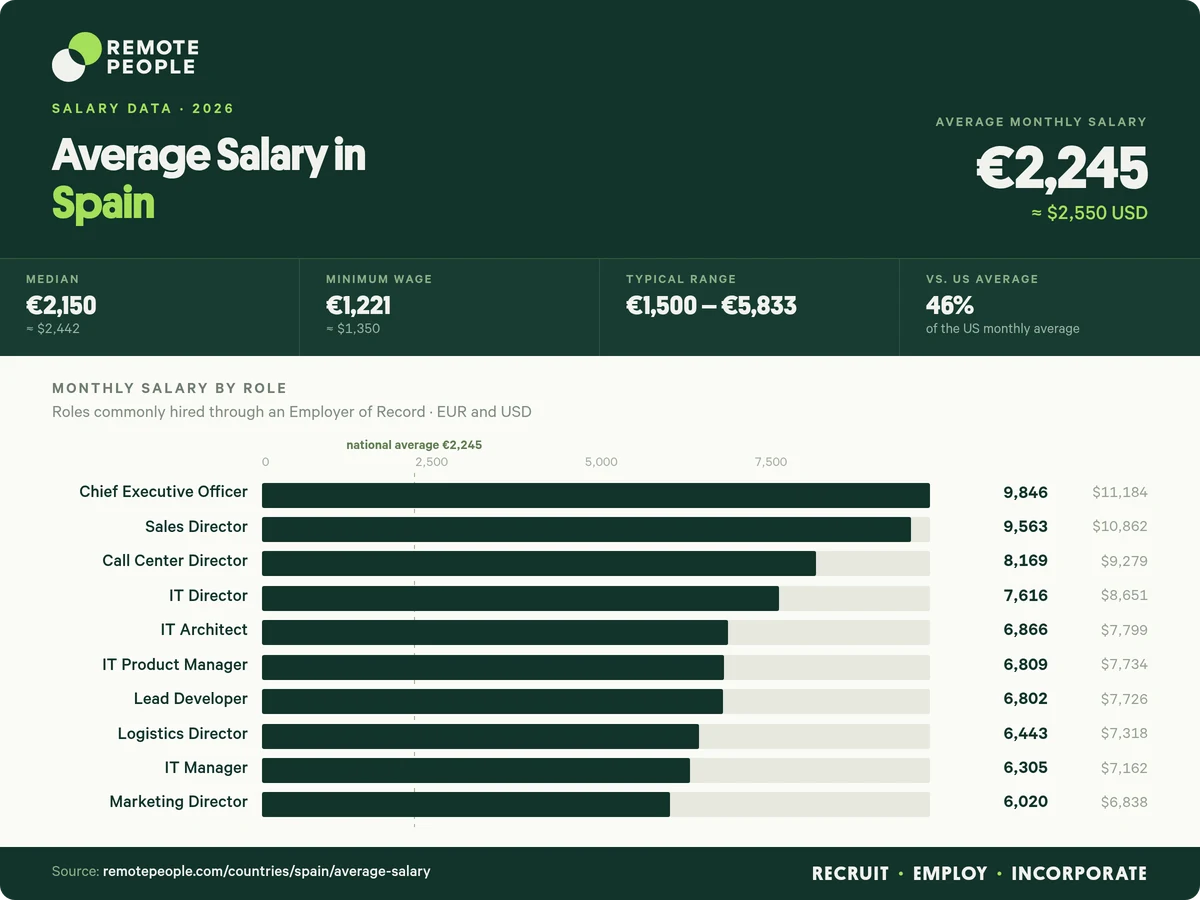
The average monthly salary in Spain is approximately € 2,245, or USD 2,550. However, salaries vary depending on location, education, experience, position, and industry. You must also consider how wages in Spain compare to earnings worldwide.
This guide will explore all aspects of salaries in Spain, preparing you for your hiring journey.
What is the Average Salary in Spain?
The average salary in Spain is approximately €2,245, or $2,550. Wages are low due to a work economy dominated by low-paying jobs in the service sector. Spain also has low productivity rates compared to other European countries.
Median Income
The median salary in Spain is approximately €2,150, or $2,442. Half of the country earns higher salaries, while the other half earns lower wages.
Salary Range
The salary range spans from the lowest to the highest salaries in the country. In Spain, low earners earn approximately €1,500, equivalent to $1,704, while high earners earn €5,833, equivalent to $6,627.
Wage Growth Trends in Spain
Since peaking in 2008, Spain’s economic growth slowed and then reversed, and the country’s GDP has only started to increase again in the past two years. Wage growth has also stayed low and relatively even, ever since a major increase of 14.43% in the second quarter of 2021. This increase helped reduce unemployment to its lowest rates in over a decade and helped to greatly stimulate the country’s economy.
After that large increase, wage growth has been relatively consistent, ranging from 3.53% to 5.98% for each quarter between 2021 and 2024. These increases were largely driven by collective agreements with the COOO (Comisiones Obreras) and the UGT (Unión General de Trabajadores), Spain’s two largest trade unions. These unions negotiated wage increases with employers of 4% in 2023, 3% in 2024, and 3% in 2025.
In 2025, Spain’s minimum wage also increased by 4.4%, which helped to maintain the ongoing pattern of growth and contributed to an increase of 3.83% in overall wages in the first quarter of 2025. The country’s economy grew by 0.7% in the second quarter of 2025, and wages grew by another 0.6% quarter on quarter.
Even with these steady increases in wages, however, real wage growth has been hindered by inflation. Average consumer prices increased to 8.3% in 2022 due to global pandemic supply issues. While this peak has been greatly reduced, Spain is still experiencing 2.2% inflation in 2025. While inflation is falling, real wages have remained essentially steady in Spain for decades, keeping up with rising consumer prices and only slightly increasing in the past year. Inflation is expected to decrease to 1.9% in 2026, which should help to increase real wages.
At the same time, employers are now required to cover a new cost, known as climate leave. Following devastating floods in eastern Spain in 2024, employers are now required to cover wages for up to four days of leave on days when it’s too dangerous for employees to commute to work. This cost is expected to slow wage growth slightly.
Overall projections for wages are influenced by slowing growth in the economy. The IMF expects only 1.8% growth in 2026 and 1.7% in 2027. Likewise, wage growth is expected to slow, with 3.31% growth expected in 2026 and just 2.56% in 2027. Naturally, economic shocks or further natural disasters could cause further slowing.
Salary Comparisons in Spain
Average salaries provide some insight, but you must also consider how wages vary by experience, education, location, profession, and industry. The following sections will explore how these factors impact earnings.
Salary by Profession
Position | Average Monthly Salary (€) |
|---|---|
Chief Executive Officer | 9846 |
Sales Director | 9563 |
Call Center Director | 8169 |
IT Director | 7616 |
IT Architect | 6866 |
IT Product Manager | 6809 |
Lead Developer | 6802 |
Logistics Director | 6443 |
IT Manager | 6305 |
Marketing Director | 6020 |
Banking Cashier | 1654 |
Fabric Cutter | 1651 |
Clothing Technologist | 1644 |
General Laborer | 1643 |
Packer | 1610 |
Seamstress | 1538 |
Porter | 1485 |
Medical Records Clerk | 1481 |
Tailor | 1470 |
Average Wage in Spain by Education
Statistics show education has a significant impact on wage determination in Spain.
Education Level | Returns for Men | Returns for Women |
|---|---|---|
Upper Secondary or Vocational Training | 18% | 26% |
University Education | 10% | 23% |
Higher Vocational Training | 16% | 4% |
Salary Comparison by Experience
Experience also affects earnings as follows:
Experience Level | Earnings Increase |
|---|---|
2–5 years | 32% more than entry-level workers |
5–10 years | 36% more than workers with 2–5 years of experience |
10+ years | 21% more than workers with 5–10 years of experience |
Salary by Location
Location is another significant factor in wage determination, as urban workers typically earn more than rural workers due to higher living costs and proximity to large companies that offer higher salaries. In Spain, workers in the Basque Country (the region with the highest wages), Madrid, and Barcelona earn salaries exceeding €28,000 annually. Other high-paying regions include Asturias, Cantabria, and Castilla-La Mancha.
However, wage increases have been greater in areas with low salaries. For example, Asturias has experienced an annual wage increase of 1.6%, while Cantabria and Castilla-La Mancha have seen yearly wage increases of 1.8%. Meanwhile, low-paying regions such as the Community of Valencia and Catalonia have seen annual wage increases of 2.5% and 2.4%, respectively.
How Much is Minimum Wage in Spain?
The minimum wage in Spain increased to €1,221 per month, approximately $1,350 Spain minimum wage USD, on January 1, 2026, up from the previous €1,184. The wage is paid in 14 installments throughout the year, totaling approximately €17,094, or about $18,900, annually.
Gender Pay Gap in Spain
The gender pay gap in Spain has been narrowing for decades, but it still has a long way to go. While it was over 20% a decade ago, great strides have been made by the country to close this divide. However, it still remains a major barrier to wage equality.
In 2022, the gender pay gap was finally reduced to under 10%, with that year showing only a 9.4% difference between men’s and women’s wages. However, while further reductions were expected, a recent study has shown that conditions have reversed and the gap has again started to grow. In the first half of 2025, the gap had increased to 12.9%.
Traditional roles are still a significant factor in Spain’s pay inequality. However, the recent expansion of the gender pay gap is largely attributed to growth in certain industries like manufacturing and technology. As these traditionally male-dominated industries expand, female representation in them continues to stay consistent, leading to more higher-paid jobs for male workers.
At the same time, female representation in leadership roles in the country has been growing steadily for decades. Women are well represented in high-level jobs in the communications, human resources, and marketing industries. Politically, Spain has effectively reached gender parity with an equal number of men and women found in ministerial positions and other top-level roles.
Despite making great strides in the past few decades, Spain still has far to go. As a member of the European Union (EU), Spain will be affected by the implementation of the EU Pay Transparency Directive, which will be implemented in 2026. This directive will require all countries with gender pay gaps over 5% to be far more transparent and share information on salaries. If Spain continues on its current trend, it will also be forced to institute a system of compensation for workers who face discrimination in hiring and pay, including potential fines for employers.
Cost of Living and Purchasing Power in Spain
Changes in average consumer prices in Spain have fluctuated a lot in the past two decades. From 2008 until the global pandemic period, prices see-sawed with moderate annual increases being offset by small decreases in prices. After the COVID pandemic spike, inflation has again decreased, though it remains high relative to the previous decade at 2.2% in 2025.
Workers’ real wages have largely kept up with inflation, meaning that workers have about as much purchasing power in Spain as they have for the past 20 years. The cost of living in Spain is lower than the EU average, and relatively low for a high-income country. Average household consumption is just 91% of the EU average, making Spain much more affordable than the most expensive country, Switzerland, with 184% of the EU average.
The cost of living in Spain also depends strongly on the region and whether people are living in rural or urban areas. Rents exceed 30% of income in nearly all of the country, though they’re higher in major urban centers like Barcelona and Madrid. A one-bedroom apartment can be rented for $450 in smaller cities and even less in small towns, while this can shoot up to $1,200 in the center of Madrid. Food and transportation are, however, generally more affordable than in many other high-income countries. Still, workers in Spain currently have less purchasing power than in other developed countries. Their average net-adjusted household income per capita is $27,155, which is well below the OECD average of $30,490.
Average Salary in Spain vs. the Rest of the World
You can gain a better understanding of salaries in Spain by comparing them to wages in developed, developing, and least developed regions. The following charts will provide these variances.
Spain vs. Developed Countries
Country | Average Salary | Comparison to Average Spain Salary |
|---|---|---|
United Kingdom | 3000 euros (approx. $3116) | – 19% |
United States | $5677 | – 119% |
Norway | 50,790 kroner (approx. $4700) | – 80% |
Germany | 4300 euros (approx. $4467) | – 73% |
Austria | 3500 euros (approx. $3636) | – 38% |
Spain vs. Developing Countries
Country | Average Salary | Comparison to Average Spain Salary |
|---|---|---|
Romania | 4000 RON (approx. $835) | 209% |
Russia | 73,709 Rubles (approx. $700) | 271% |
Albania | 1500 Euros (approx. $1550) | 67% |
Kazakhstan | 342,082 Tenge (approx. $645) | 300% |
Ukraine | 18,000 hryvnia (approx. $500) | 420% |
Spain vs. Undeveloped Countries
Country | Average Salary | Comparison to Average Spain Salary |
|---|---|---|
Thailand | 97,500 Baht (approx. $2772) | -7% |
Philippines | 18,423 PHP (approx. $875) | 195% |
Vietnam | 8.5 million dong (approx. $360) | 622% |
Egypt | 13,244 EGP (approx. $263) | 900% |
Pakistan | 45,000 PKR (approx. $150) | 1633% |
Spain is a developed country with a high-income mixed economy. Its workforce is characterized by a dual structure of temporary and permanent contracts, although the government is trying to reduce temporary work to boost employment. Dominant industries include manufacturing, tourism, and energy.
The country is considered an ideal outsourcing destination due to its skilled workforce, low labor costs, and strategic location. The BPO industry has seen significant growth over the last few years. There are regulations for businesses operating in Spain, but a solid plan will help companies navigate their partnerships.
What are the Most Common Outsourced Industries in Spain?
Employers will see the most significant benefits when outsourcing in the following industries:
IT Services
Spain’s IT industry is thriving with rapid growth in AI, cybersecurity, and digital transformation. The ICT sector is experiencing a boom, projected to reach $80.56 billion by 2029. Major tech hubs include Valencia, Malaga, and Barcelona.
IT workers in Spain typically earn around € 2,750 monthly, approximately $ 3,124, while workers in America earn closer to $ 50,000, leading to significant cost savings for companies that outsource.
BPO
The country’s BPO industry is developing rapidly with an exceptional focus on call center outsourcing. Other dominant sectors include technical support and IT development. Spain’s robust legal framework, strong infrastructure, and adherence to human rights and labor laws make it an ideal partner in this industry.
Call center workers in Spain earn around € 1,920 monthly (approximately $ 2,181), while American workers earn closer to $ 3,500. Employers that outsource can save substantially on human resources (HR) expenses.
Manufacturing
Spain boasts a thriving manufacturing industry, with a focus on automotive, food and beverages, textiles, chemicals, and metalworking. Its advances in digitalization and automation have made processes more efficient. The increasing global demand for Spanish-made products presents significant growth opportunities.
Conclusion
Spain’s low average salaries make it a cost-effective outsourcing destination. Companies that invest in remote partnerships will benefit from high-quality products and services, while helping the country become more competitive with other European nations, benefiting all parties involved.