
 Recruit
Average Salary in the US Virgin Islands
-
 Drew Donnelly
- Published
- September 21, 2026
Curious about salaries in the US Virgin Islands? This guide breaks down the average wages, compares professions, highlights minimum wage figures, and explores how the US Virgin Islands’ earnings measure
- 5 ★ on G2








- US Virgin Islands Services
- What is the Average Salary in US Virgin Islands?
- Salary Comparisons in the US Virgin Islands
- Salary by Position
- How Much is Minimum Wage in US Virgin Islands?
- Average Salary in US Virgin Islands vs. the Rest of the World
- What are the Most Common Outsourced Industries in the US Virgin Islands
- Conclusion

Let RemotePeople handle payroll, compliance, and HR admin worldwide so you can focus on building your team.
The US Virgin Islands’ cost-effective labor, skilled workforce, and strategic location make it an excellent outsourcing destination. Employers looking to hire in the territory may wonder, What is the average salary in the US Virgin Islands? This information will help them make a competitive hiring offer.
The average salary in the US Virgin Islands is USD 3166 per month. However, you must consider how wages are impacted by education, experience, position, industry, and location. Comparing earnings in the territory to wages worldwide provides additional insight.
This guide will explore all aspects of salaries in the US Virgin Islands, preparing you for your hiring journey.
What is the Average Salary in US Virgin Islands?
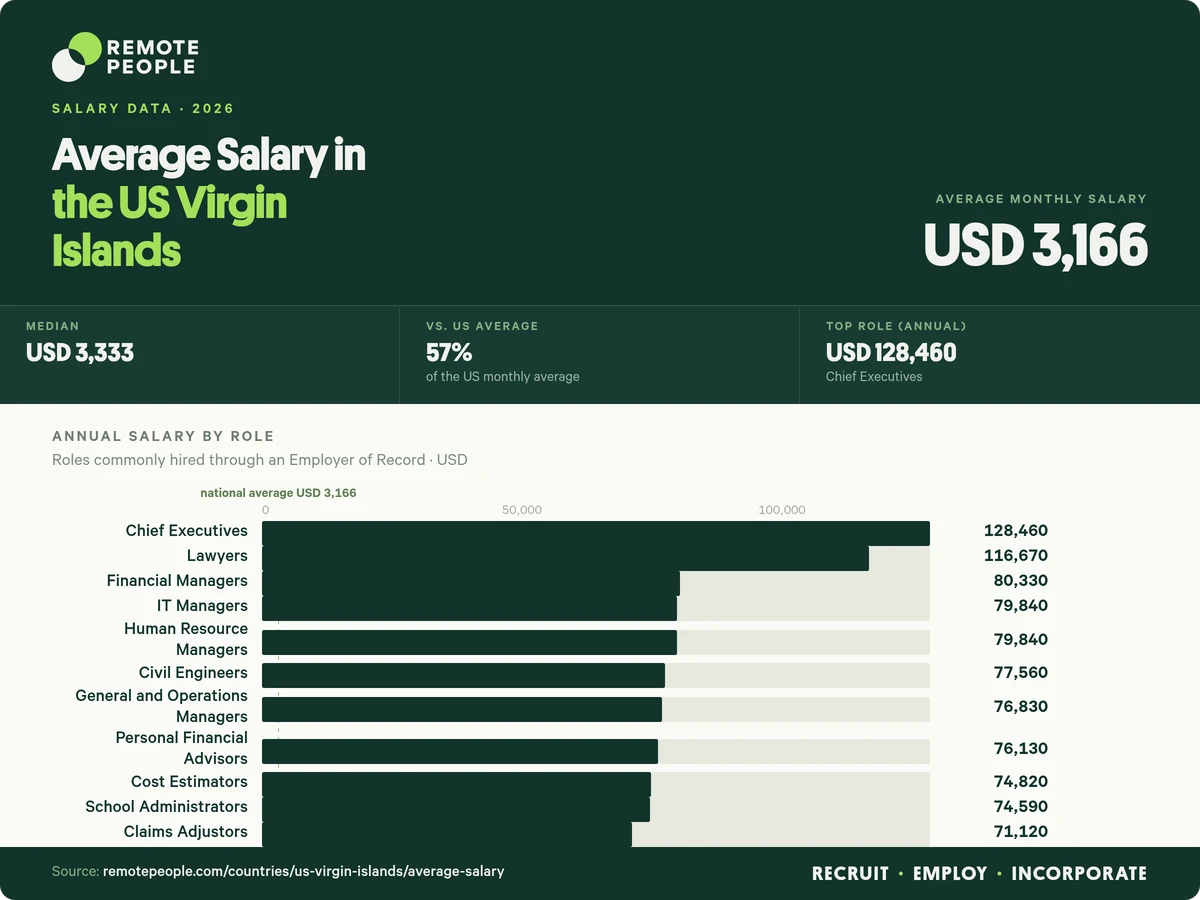
The average salary in the US Virgin Islands is $3166 per month. Although salaries are high compared to other countries worldwide, they are lower than most wages in the United States. The economy is driven by low-paying sectors like administration, tourism, and retail, which limits growth.
Median Income
The median monthly income in the US Virgin Islands is $3333. Half the people in the territory earn higher salaries, and the other half earn lower wages.
Salary Range
Salary ranges span from the lowest to the highest wages in the country. In the US Virgin Islands, low earners make about $13,000 while high earners make closer to $52,000.
Salary Comparisons in the US Virgin Islands
Average salary information provides some insight. However, you must consider how wages vary based on education, location, experience, position, and industry. The following sections will explore how these factors impact earnings.
Salary by Position
This salary comparison chart reveals how wages vary by profession based on the highest-paying jobs in the region.
Position | Average Annual Salary ($) |
|---|---|
Chief Executives | 128,460 |
Pharmacists | 120,910 |
Lawyers | 116,670 |
Construction Managers | 99,040 |
Medical and Health Services Managers | 94,360 |
Financial Managers | 80,330 |
IT Managers | 79,840 |
Human Resource Managers | 79,840 |
Civil Engineers | 77,560 |
General and Operations Managers | 76,830 |
Electricians | 76,610 |
Crane and Tower Operators | 76,600 |
Personal Financial Advisors | 76,130 |
Cost Estimators | 74,820 |
Registered Nurses | 74,710 |
School Administrators | 74,590 |
Claims Adjustors | 71,120 |
Average Wage in US Virgin Islands by Education
Education impacts salaries in the US Virgin Islands. A USVI workforce assessment reveals that 20% of the population did not receive a high school diploma, which could significantly impact their ability to attain employment. Most industries require at least a high school education, though college and university educations and additional skills training could provide a competitive edge.
A Ministry of Education, Youth Affairs, and Sports statement noted that education is one of the most significant factors in the territory’s economy.
Salary Comparison by Experience
Experience also plays a role in wage determination, as experienced workers earn more than entry-level employees. Workers who have held their positions for a long time are also eligible for raises.
Salary Comparison by Location
Rather than traditional cities, the Virgin Islands are divided into districts on each Island. Workers on the three main islands, St. Croix, St. Thomas, and St. John, earn the highest salaries due to a high cost of living and proximity to large companies offering high-paying job opportunities. Workers on smaller islands earn less.
Income is as follows:
Island | Average Salary (USD/year) |
|---|---|
St. John | $40,664 |
St. Thomas | $38,232 |
St. Croix | $36,042 |
How Much is Minimum Wage in US Virgin Islands?
The minimum wage in the US Virgin Islands is $10.50 per hour, and it has remained unchanged since June 1, 2018. However, many argue that salaries don’t keep up with the cost of living, and there is a push to increase the minimum wage in the territory.
Average Salary in US Virgin Islands vs. the Rest of the World
To provide more insight, the following charts compare wages in the US Virgin Islands to those in developed, developing, and least developed countries.
US Virgin Islands vs. Developed Countries
Country | Average Salary | Comparison to the Average US Virgin Islands Salary |
|---|---|---|
Japan | 379,434 Yen (approx. $2,635) | 18% |
United States | $5,677 | – 78% |
Norway | 50,790 kroner (approx. $4,700) | – 46% |
Germany | 4,300 euros (approx. $4,467) | – 40% |
Austria | 3,500 euros (approx. $3,636) | – 12% |
US Virgin Islands vs. Developing Countries
Country | Average Salary | Comparison to the Average US Virgin Islands Salary |
|---|---|---|
Romania | 4,000 RON (approx. $835) | 280% |
Russia | 73,709 Rubles (approx. $700) | 357% |
Albania | 1,500 Euros (approx. $1,550) | 106% |
Kazakhstan | 342,082 Tenge (approx. $645) | 392% |
Ukraine | 18,000 Hryvnia (approx. $500) | 540% |
US Virgin Islands vs. Undeveloped Countries
Country | Average Salary | Comparison to the Average US Virgin Islands Salary |
|---|---|---|
Afghanistan | 30,000 Afghanis (approx. $419) | 114% |
Philippines | 18,423 PHP (approx. $875) | 661% |
Vietnam | 8.5 million dong (approx. $360) | 788% |
Egypt | 13,244 EGP (approx. $263) | 1130% |
Pakistan | 45,000 PKR (approx. $150) | 2033% |
The US Virgin Islands is a developed territory with a robust infrastructure. Its primary industries include tourism, renewable energy, and health sciences. Its Economic Development Authority (USVIEDA) actively promotes economic development through Enterprise Zones and tax incentives.
The territory is a good outsourcing destination offering nearshore opportunities and an English-speaking workforce. As part of the U.S. system, the territory offers access to the U.S. infrastructure and familiar legal frameworks and banking systems. Although cost savings are not as dramatic as in some Asian countries, Western employers that outsource to the US Virgin Islands can reduce expenses.
What are the Most Common Outsourced Industries in the US Virgin Islands
Employers who outsource to the US Virgin Islands will see the most benefits when focusing on the following industries:
Financial Services
The territory has an established financial service sector with expertise in banking, financial management, and other financial activities. Its attractive tax incentives and stable economic climate make it a desirable location for businesses looking to outsource. USVI’s 14 designated Opportunity Zones offer tax advantages to U.S. firms and individuals who invest in these areas.
BPO
The USVI is emerging as a BPO hub for office operations, customer service, and financial services. Its proximity to the U.S. and Canada offers nearshoring advantages, and the territory’s modern infrastructure supports efficient back office operations.
Technology
The US Virgin Islands’ IT industry is experiencing rapid growth. The territory offers access to Tier-1 fiber optic networks and is developing an RTPark (research and technology park) to support tech expansion in the area. Vibrant sectors include cybersecurity, artificial intelligence, health tech, and e-commerce.
Conclusion
The US Virgin Islands’ strategic location and skilled workforce make it an ideal outsourcing destination. Although the average salary in the US Virgin Islands is high compared to Asian countries, it can still provide cost savings for Western employers. It offers high-quality products and services that could make some organizations leaders in their fields.




