
 Recruit
Employer of Record in the US Virgin Islands
-
 Drew Donnelly
- Published
- September 22, 2026
Hire in US Virgin Islands — book a free 30-minute demo
Tell us what you need. You'll get a tailored, transparent proposal within 24 hours, plus a free call to walk through it.
Tell us about your company
So we can match you with a specialist who knows your market — and unlock volume pricing tiers.
* All fields are required.
Where and when are you hiring?
Tell us the geography and timing and we'll quote each country line by line, with onboarding timelines.
* All fields are required.
Help us beat your current setup
We'll benchmark your current deal and send a line-by-line proposal in 24 hours — showing exactly where we cut cost, time, or risk. After you submit, you can book a call to walk through it together.
* All fields are required.
Thanks! Your proposal is on its way.
Expect a tailored, line-by-line proposal in your inbox within 24 hours. In the meantime…
Want to walk through it together?
Book a free 30-minute call with one of our specialists. We'll explain every line, answer your questions, and tailor the proposal further if you need.
No obligation. Pick a time that works for you.








- Hire in US Virgin Islands — book a free 30-minute demo
- Tell us about your company
- Where and when are you hiring?
- Help us beat your current setup
- Thanks! Your proposal is on its way.
- What Is a US Virgin Islands Employer of Record?
- What Is the Difference Between a US Virgin Islands Employer of Record and a US Virgin Islands PEO?
- Hire in the US Virgin Islands
- How Does a US Virgin Islands Employer of Record Work?
- Employment and Labor Laws in the US Virgin Islands
- Payroll and Employment Taxes in the US Virgin Islands
- Time Off and Leave in the US Virgin Islands
- Termination and Severance in the US Virgin Islands
- Practical Considerations in Hiring in US Virgin Islands
- What Are the Benefits of a US Virgin Islands Employer of Record?
- What Are the Downsides of a US Virgin Islands Employer of Record?
- How to Choose a US Virgin Islands Employer of Record?
- Engage a US Virgin Islands Employer of Record with RemotePeople
- Frequently Asked Questions
- Related EOR Destinations

Start hiring in US Virgin Islands
Let RemotePeople handle payroll, compliance, and HR admin worldwide so you can focus on building your team.

Key Takeaways
- A U.S. Virgin Islands Employer of Record (EOR) enables companies to hire local employees without establishing a legal entity, handling payroll, compliance, taxes, and benefits on their behalf.
- EORs differ from PEOs in that EORs become the legal employer, while PEOs require the client to already have a local entity and only share HR responsibilities.
- Choosing the right EOR requires evaluating local expertise, service scope, and pricing transparency to ensure compliance and efficient business expansion in the USVI.
The U.S. Virgin Islands (USVI), comprising the main islands of St. Thomas, St. John, and St. Croix, is an unincorporated territory of the United States located in the Caribbean. Its economy is predominantly driven by tourism, trade, and services, which collectively account for nearly 60% of the territory’s Gross Domestic Product (GDP) and approximately half of its civilian employment. The islands attract millions of tourists annually, drawn by their picturesque beaches and vibrant culture. This economic climate creates an attractive location for conducting business.
Companies looking to expand to the USVI can benefit from the services of an Employer of Record (EOR). Read on to learn more about partnering with an EOR to expand into the region.
What Is a US Virgin Islands Employer of Record?
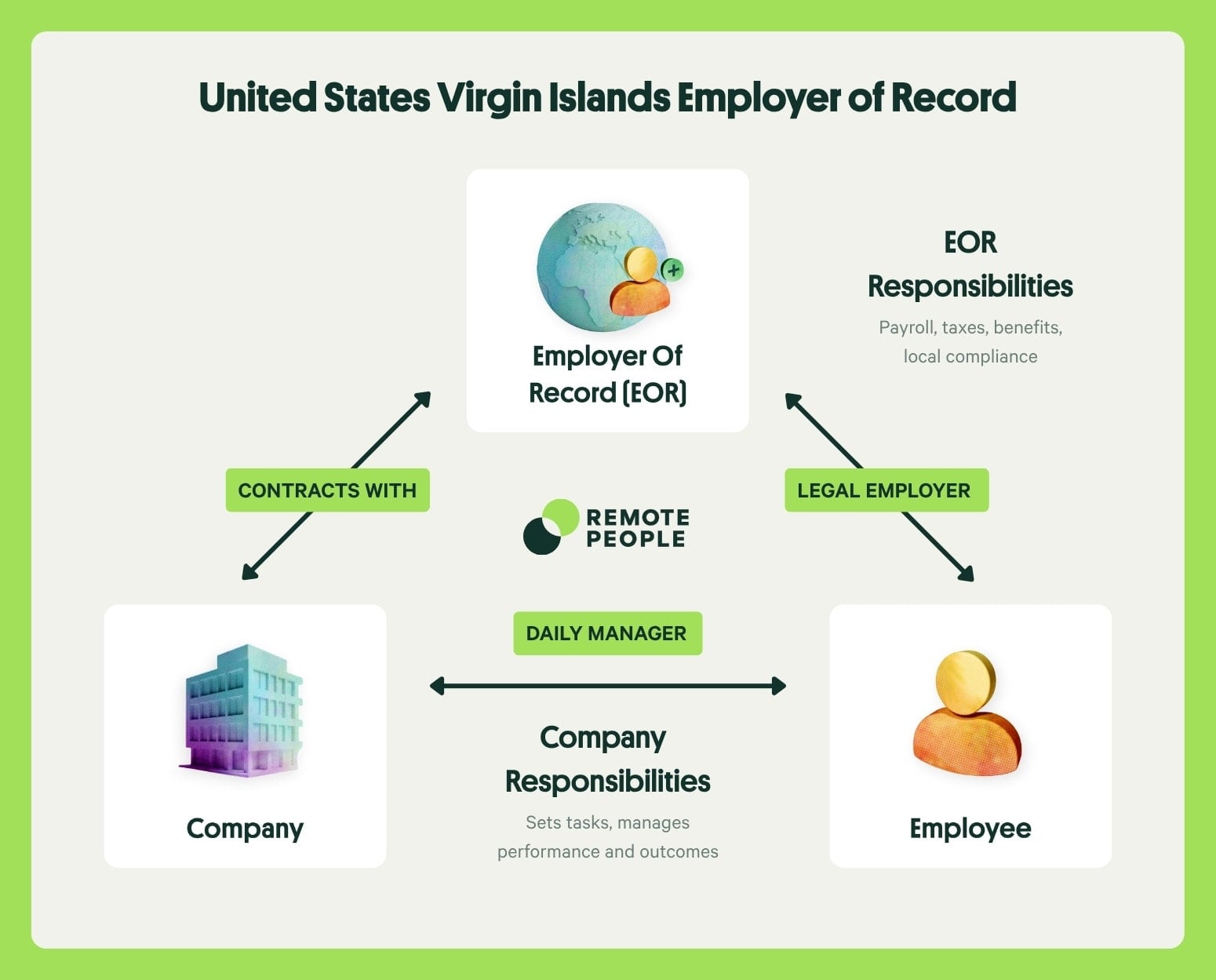
A U.S. Virgin Islands EOR allows businesses to hire employees in the USVI without establishing a legal entity there. The EOR hires the workforce on behalf of the client company and assumes responsibility for essential employment functions, including payroll processing, tax withholding, benefits administration, and ensuring compliance with local labor laws and regulations.
By partnering with an EOR, companies can efficiently manage their workforce in the USVI, focusing on core business operations while the EOR handles the complexities of employment compliance.
If you’d like to learn more about how Employer of Record (EOR) services work, read our What Is an Employer of Record (EOR)? guide for a complete overview of the model, its benefits, and when to use it.
If you’re comparing providers, our Best Employer of Record (EOR) Providers guide reviews the leading platforms to help you choose the right solution for your business.
What Is the Difference Between a US Virgin Islands Employer of Record and a US Virgin Islands PEO?
An EOR company offers a comprehensive employment management service. It hires the workforce, manages employer responsibilities, and ensures compliance with labor laws. This setup allows client companies to operate without establishing a local entity, as the EOR manages all employment obligations.
A PEO, on the other hand, enters into a co-employment arrangement where both the PEO and the client company share employer responsibilities. The client company must have a legal entity in the USVI, as the PEO does not become the legal employer but rather assists with HR functions such as payroll and benefits administration. In this model, the client company retains ultimate legal responsibility for compliance with employment laws.
Your company’s needs will determine which option is best suited between an EOR and a PEO. If your company doesn’t have an existing presence in the USVI and you’re seeking to hire local employees, the EOR model can be ideal. Companies with an established entity in the USVI may opt for a PEO to manage HR functions while they (the client company) maintain direct control over their employees.
Hire in the US Virgin Islands
A US Caribbean territory with federal FLSA standards, territorial unemployment insurance, mandatory severance for layoffs, and Social Security contributions at 7.65%.
We handle employment contracts, payroll, tax withholdings, and full USVI compliance.
No local entity needed. Your team can start in days.
How Does a US Virgin Islands Employer of Record Work?
A US Virgin Islands EOR manages several responsibilities, including:
- Hiring and Onboarding: The EOR oversees the recruitment process, ensuring that employment contracts comply with local laws and that new hires are onboarded in accordance with USVI regulations.
- Payroll Management: The EOR handles payroll processing, ensuring that employees are paid accurately and on time. This includes calculating wages, withholding appropriate taxes, and managing any other statutory deductions.
- Compliance with Labor Laws: The EOR ensures adherence to local labor laws, including regulations on minimum wage, working hours, overtime, and mandatory benefits.
- Tax Administration: The EOR manages tax obligations, including income tax withholding and social security contributions, ensuring that both employer and employee comply with USVI tax laws.
- Benefits Administration: The EOR administers employee benefits such as health insurance, retirement plans, and other statutory or optional benefits, aligning with local customs and legal requirements.
Employment and Labor Laws in the US Virgin Islands
Employment Contracts
Employment contracts in the U.S. Virgin Islands are governed by Virgin Islands Code Title 24 and applicable U.S. federal laws. While written contracts are not legally required, they are strongly recommended—especially in an EOR setup—to ensure compliance and reduce risk, particularly given the strict termination rules under the Wrongful Discharge Act.
Working Hours
Working hours in the U.S. Virgin Islands are governed by Virgin Islands Code Title 24, with a standard limit of 8 hours per day and 40 hours per week. Any work beyond these limits must be compensated at an overtime rate of 1.5× the regular pay. To ensure compliance, working hours and overtime terms should be clearly defined in the employment contract.
Overtime
The standard workweek in the U.S. Virgin Islands is 40 hours, typically 8 hours per day. Overtime is required at 1.5 times the regular rate for hours worked over 8 hours in a day, over 40 hours in a week, or on the 6th or 7th consecutive day of work, whichever calculation provides the greatest compensation.
Certain industries (e.g., tourism and restaurants) may apply modified rules for the 6th consecutive day. The law does not mandate double-time pay or night shift differentials; such benefits are determined by employer policy or collective agreements.
| Year | Minimum Wage |
|---|---|
| 2027 | $12.00/hour |
| 2028 | $14.00/hour |
| 2029 | $15.00/hour |
Social Security Contributions
Employers and employees in the USVI are required to contribute to the Social Security system, providing benefits for retirement, disability, and other support. Both parties are to contribute 7.65% of the employees’ monthly earnings to this scheme.
| Contribution Type | Employer Rate | Employee Rate |
|---|---|---|
| Social Security | 6.2% | 6.2% |
| Medicare | 1.45% | 1.45% |
Probation Periods
In the U.S. Virgin Islands, a probationary period is not strictly required by law, but it is widely recognized under employment practice and linked to the Wrongful Discharge Act. Most employees are effectively subject to a 90-day probationary period, during which employers may assess performance and terminate employment with greater flexibility.
During this period, employers typically evaluate the employee’s suitability for the role, including performance, conduct, and overall fit. After the probationary period ends, employees gain stronger protection under the Wrongful Discharge Act, meaning termination must be based on legally defined grounds.
Payroll and Employment Taxes in the US Virgin Islands
Minimum Wage
The current minimum wage in the U.S. Virgin Islands is $10.50 per hour, as set by the Virgin Islands Department of Labor. While the federal minimum wage remains $7.25 per hour under the Fair Labor Standards Act (FLSA), the USVI applies a higher territorial rate.
The USVI minimum wage is set to increase in phases:
| Year | Minimum Wage |
|---|---|
| 2027 | $12.00/hour |
| 2028 | $14.00/hour |
| 2029 | $15.00/hour |
Income Tax
In the U.S. Virgin Islands (USVI), bona fide residents are required to file their income tax returns with the Virgin Islands Bureau of Internal Revenue (BIR) using Form W-2 (VI) (also called W-2VI), not the IRS. To qualify, individuals must generally meet the 183-day presence test, maintain a tax home in the territory, and demonstrate a closer connection to the USVI.
Bona fide residents are taxed on worldwide income under the USVI’s mirror tax system. Non-residents with USVI-source income must file with the BIR and may also have U.S. federal obligations. The USVI imposes income tax under its local system, although certain incentive programs may reduce tax liability.
The U.S. Virgin Islands Economic Development Commission (EDC) program provides approved businesses with up to a 90% reduction in income tax liability under USVI law. While this can result in an effective corporate tax rate of approximately 2%–4%, the rate is not fixed by statute.
To qualify, companies must apply through the U.S. Virgin Islands Economic Development Authority (EDA).
- Minimum Investment: Must invest at least $100,000 (excluding inventory) in a qualifying business.
- Local Hiring: Must employ 5–10 full-time USVI residents, depending on the business category. Employees are generally required to have resided in the USVI for at least one year.
- Residency Ratio: Approximately 80% of employees must be USVI residents, subject to program requirements or possible waivers.
- Sector Eligibility: Business must fall within approved industries (e.g., financial services, technology, manufacturing) or receive special approval.
- Application & Approval: Must apply through the U.S. Virgin Islands Economic Development Authority (EDA) and obtain formal government approval.
- Legal & Tax Compliance: Must comply with IRC §§ 934 and 937 and all applicable local and federal laws.
- Community Contributions: Required to support local economic and community initiatives, with obligations defined in the approval agreement (amounts vary).
To qualify, companies must apply through the U.S. Virgin Islands Economic Development Authority (EDA). The benefit applies to qualifying income connected to a USVI trade or business and is granted for an initial period of up to 20 years, subject to renewal and ongoing compliance.
Time Off and Leave in the US Virgin Islands
Leave Policy (Voluntary)
The U.S. Virgin Islands does not require employers in the private sector to provide paid vacation, sick leave, or holidays; these benefits are set by company policy or employment contracts. Eligible employees may take up to 12 weeks of unpaid, job-protected leave under the Family and Medical Leave Act (FMLA).
In practice, many employers offer competitive benefits, typically ~15 days annual leave, 5–10 days sick leave, and around 8 weeks of paid maternity leave (non-statutory).
Public sector employees receive more structured benefits, including up to 26 days of annual leave. Because leave is largely discretionary in the private sector, employers and EOR providers should clearly define policies in employment contracts.
Termination and Severance in the US Virgin Islands
Termination Requirements
Employment termination in the U.S. Virgin Islands is governed by the Wrongful Discharge Act, which limits the traditional at-will doctrine. Employers may only terminate employees for specific legally recognized reasons, such as misconduct, poor performance, dishonesty, or economic necessity (e.g., layoffs or business closure).
Any termination outside these permitted grounds may be considered wrongful discharge, and employees can file a complaint with the Virgin Islands Department of Labor within 30 days of termination.
Notice Period
There is no statutory notice period required under U.S. Virgin Islands law; instead, notice requirements are typically defined in employment contracts or based on company policy or customary practice, and while employers may choose to provide notice or pay in lieu of notice, this is not mandated by law.
Severance Pay
The US Virgin Islands requires employers to provide severance pay to workers who have been laid off from their jobs for at least 30 days, whether temporarily or permanently.
Workers are entitled to one week’s pay for each year of employment, calculated at their final rate of pay. This severance must be provided as a lump sum payment and doesn’t replace unemployment or workers’ compensation benefits, which workers can apply for separately without exhausting their severance pay first.
Employers cannot require employees to waive these benefits as a condition of employment.
Practical Considerations in Hiring in US Virgin Islands
Hiring in the U.S. Virgin Islands requires careful planning due to its unique multi-island structure, tourism-driven economy, and high cost of living. Employers should consider local labor dynamics, operational challenges, and competitive benefits strategies when building their workforce.
- Three-Island Jurisdiction: St. Thomas, St. John, and St. Croix each have distinct labor markets
- Tourism-Driven Economy: Hospitality dominance influences wage expectations and hiring trends
- Limited Professional Talent: Shortage of skilled professionals in specialized sectors
- High Housing Costs: Impacts compensation packages and employee affordability
- Inter-Island Coordination: Travel between islands adds operational complexity
- Flexible Leave Policies: No statutory leave allows employers to offer competitive voluntary benefits
- Cost of Living Consideration: Salaries should be adjusted to reflect high living expenses
What Are the Benefits of a US Virgin Islands Employer of Record?
Partnering with an EOR offers several advantages for companies looking to expand into the US Virgin Islands. An EOR company takes full responsibility for maintaining compliance with local labor laws and tax regulations. This reduces the legal and financial risks involved in managing employment contracts, handling payroll, or administering employee benefits. Given that labor regulations in the territory include specific rules around overtime, severance, and maternity leave, working with an EOR removes the guesswork and ensures every legal obligation is met.
Cost-efficiency is another notable benefit. Establishing a local company comes with expenses like registration fees, office space, legal consultation, and ongoing administrative overhead. An EOR enables companies to bypass most of these costs, making it a financially smart option.
What Are the Downsides of a US Virgin Islands Employer of Record?
First, there’s the matter of control. Since the EOR is the legal employer, the client company may have limited authority over some HR decisions, especially around termination procedures or disciplinary actions. While most EORs work closely with clients to maintain alignment, this can still create friction if expectations aren’t clearly defined from the outset.
Also, not all EOR providers offer the same level of service. Some may have limited local expertise, while others may not offer a comprehensive scope of services.
How to Choose a US Virgin Islands Employer of Record?
To choose the right EOR provider in the US Virgin Islands, you need to consider certain factors, starting with their local expertise. Your chosen EOR company must understand the territory’s unique legal and employment requirements. Ask potential providers about their experience in the region and the scope of their services.
Transparency around costs is also important. Look for providers that offer clear pricing structures with no hidden fees. Flat-rate models can be easier to budget for as percentage-based fees may fluctuate depending on employee salaries and benefits packages. Either way, you should understand exactly what you’re paying for.
Another consideration is the range of services offered. Some EOR providers limit their support to payroll and compliance, while others offer end-to-end HR services, including employee benefits, onboarding, performance management, and even offboarding. The right provider should align with your company’s operational goals and growth plans.
Engage a US Virgin Islands Employer of Record with RemotePeople
If you’re planning to expand into the U.S. Virgin Islands and want the confidence of a compliant, cost-effective employment model, partner with RemotePeople.
We provide expert EOR services that make it easy to hire, manage, and support your workforce—without the burden of setting up a legal entity. Contact us today to find a tailored solution for your business expansion in the USVI.
Frequently Asked Questions
Yes. Employers must register with VIDOL for labor compliance, including unemployment insurance and workforce reporting requirements.
Yes. Misclassification is governed by U.S. federal standards (IRS and Department of Labor tests), and incorrect classification can result in penalties.
Employers must comply with U.S. immigration laws, including securing appropriate work visas (e.g., H-1B, H-2B) through federal agencies.
No statutory requirement exists, but government guidance strongly encourages written policies to ensure compliance and reduce disputes.
Employees may file complaints with the Virgin Islands Department of Labor (VIDOL), which investigates labor law violations.
Yes. Employees have the right to unionize under the U.S. National Labor Relations Act (NLRA).
Employer of Record in
Employer of Record in
Employer of Record in
Employer of Record in
Employer of Record in
Employer of Record in
Employer of Record in
Employer of Record in




