Recruit


Let RemotePeople handle payroll, compliance, and HR admin worldwide so you can focus on building your team.
If you’re an employer with staff scattered worldwide, you’ve probably explored various solutions to manage HR, payroll, and benefits administration—all while staying compliant with local laws where your employees work.
Today, many companies are turning to Employer of Record (EOR) services as software-based solutions that handle these complexities and more.
In this review, we’ll put two leading EOR providers head-to-head: Deel vs Oyster. We’ll examine where each service excels and where they might fall short, providing a detailed comparison to help you determine which is the better fit for your business needs.
What You’ll Discover:
- In-Depth Feature Analysis: A thorough breakdown of the features and usability of both platforms.
- Pricing Comparison: A detailed look at the costs associated with each service to assist with effective budgeting.
- Pros and Cons: Unbiased assessments of the strengths and limitations of Deel and Oyster.
By the end of this article, you’ll clearly understand which EOR service is the ideal choice to support your global team effectively.
Deel vs Oyster Overview
| Feature | Deel | Oyster | Explanation |
|---|---|---|---|
| User Reviews |
G2: 4.8/5 Trustpilot: 4.9/5 |
G2: 4.4/5 Trustpilot: 4.6/5 |
Deel’s reviews are excellent. Oyster has received very good reviews. |
| Pricing |
$599/employee per month $49/contractor per month |
$599/employee per month $29/contractor per month |
Both service providers post their basic fees online. Their EOR fees are the same, but Oyster’s is much cheaper for contractors. |
| User-friendliness | Very good | Very good | Both companies feature easy-to-use platforms. |
| Customer Support | 24/7 live chat support | 24/7 live chat support | Both Deel and Oyster offer 24/7 live chat support through their platforms. |
| Integrations | Very good | Good | Deel has an API and integration with over 90 major HR and accounting apps like Ashby, QuickBooks, and Xero. Oyster also has an API and can integrate with 15 apps, including Bamboo, Greenhouse, and Slack. |
| Data security | Excellent | Excellent | Deel is GDPR and SOC 1,2, and 3 compliant and ISO 27001 certified. Oyster is compliant with GDPR and SOC 2 standards. |
| International hiring (EOR) | Excellent | Excellent | Deel provides support for hiring employees and contractors in 150+ countries. Oyster extends that reach to over 180 countries worldwide. |
| Recruitment | Not offered | Not offered | Neither Deel nor Oyster offers recruitment services or assistance. |
| Benefits administration | Good | Very good | Deel manages standard benefits like PTO, bonuses, and social security. Oyster offers insurance packages in 165+ countries. |
| Payroll | Excellent | Very good | Both providers offer extensive global payroll services. Deel offers clients more payment options than Oyster. |
Main Differences: Deel vs Oyster
Deel and Oyster are two prominent players in the global employment platform (GEP) space, both providing services that allow organizations to hire employees in countries where they don’t have registered entities.
Their primary focus is on Employer of Record (EOR) services, managing everything from hiring to payroll on behalf of their clients. Let’s break down the key similarities and differences between these two providers.
Deel
Deel positions itself as a comprehensive global hiring platform, supporting businesses in more than 150 countries. Whether you need to hire full-time employees, manage contractors, or run global payroll, Deel provides a robust solution that streamlines compliance, simplifies payments, and integrates with a wide range of software tools.
Services offered by Deel
- Employer of Record (EOR): Hire and manage employees in over 150 countries without the need to establish local entities.
- Contractor Management: Manage independent contractors globally, ensuring compliance and offering various payment options.
- Payroll: Global payroll services across 100+ countries, handling taxes, social security, and benefits administration.
- Equity Management: Assistance with Employee Stock Ownership Plans (ESOPs) to incentivize and retain top talent.
- Software Integrations: Seamless integration with over 90 software solutions for HR, accounting, and project management.
Oyster
Oyster is another strong contender in the GEP market, boasting operations in over 180 countries. Known for its cost-effective contractor management and flexible benefits packages, Oyster offers a versatile solution for businesses that want to balance cost-efficiency with comprehensive employee support. Oyster’s focus on providing add-on benefits and health insurance options sets it apart from many other platforms.
Services offered by Oyster
- Employer of Record (EOR): Employ talent in over 180 countries, handling local compliance, payroll, and HR tasks.
- Contractor Management: Manage contractors at a competitive price point, with additional compliance monitoring.
- Payroll: Global payroll services that cover taxes, social security, and local legal requirements.
- Benefits Administration: Optional health insurance packages and employee equity plans to create attractive compensation structures.
- Software Integrations: Supports integration with 15 major platforms, including accounting and HR software.
Deel Pricing
| Plan | Price per employee/contractor per month |
|---|---|
| Deel EOR Services | $499 per employee per month and up |
| Deel PEO Services | $79 per employee per month and up |
| Deel Contractor Management | $49 per contractor per month and up |
| Deel Payroll | $29 per person per month and up for global payroll or $19 per person per month and up for US payroll |
Oyster Pricing
| Plan | Price per employee/contractor per month |
|---|---|
| Oyster HR EOR | Starting at $599 per employee per month, up to $699 based on country selection |
| Oyster HR Global Payroll | $25 per employee/month |
| Oyster HR Contractor | $29 per contractor/month |
| Oyster HR Scale | On request |
Key Differences
Service Expansion
- Deel: Extensive software integrations with over 90 tools, making it ideal for businesses with complex workflows.
- Oyster: Focuses more on enhancing employee compensation with health insurance and equity plans.
Global Reach
- Deel: Operates in 150+ countries with strong compliance management.
- Oyster: Covers over 180 countries, giving it a broader global reach.
Pricing Transparency
- Deel: Offers fixed pricing for its services but charges higher contractor management fees.
- Oyster: More cost-effective for contractor management, with transparent add-ons for benefits.
Choosing between Deel and Oyster comes down to your specific business needs. If you prioritize software integrations and need a platform that meshes seamlessly with your existing tech stack, Deel’s wide range of integrations could be a significant advantage.
On the other hand, if cost-efficiency and offering comprehensive employee benefits like health insurance are your top priorities, Oyster’s contractor pricing and benefits add-ons make it a strong contender.
Deel Pros and Cons
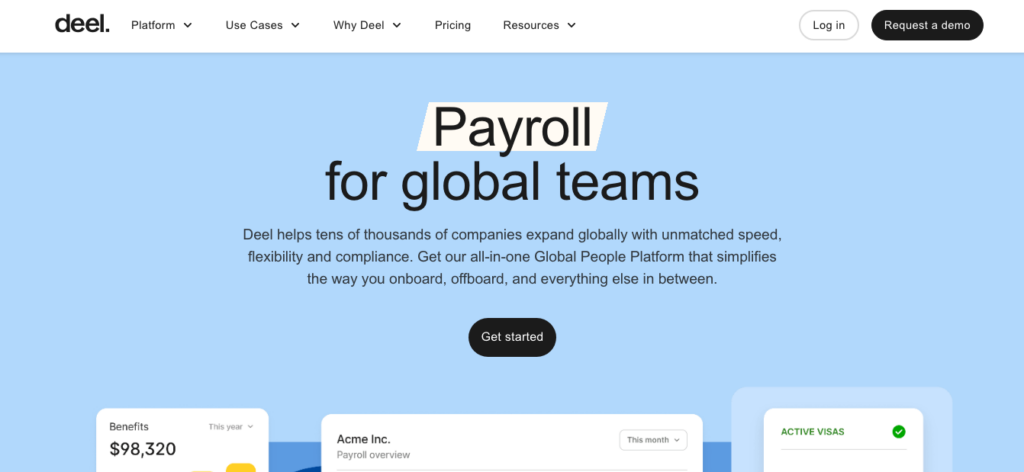
Each service provider in the GEP space has unique characteristics, which include pros and cons specific to it. Deel’s include:
- Pros
Convenient onboarding
When clients want to onboard employees and contractors, Deel’s system is quick and easy to use. It automatically generates legally compliant contracts and lets workers sign them and upload their documents through a simple self-serve portal for increased speed and efficiency.
Data security
Deel is compliant with SOC 1, 2, and 3 and GDPR standards and is ISO 27001 certified. It provides additional security for users’ data by using encryption protocols and 2FA (two-factor authentication).
Easy payments
In compliance with labor laws around the world, Deel pays employees in 120 different local currencies. Contractors are also paid in their currencies of choice through direct deposits, Deel Cards (debit cards), or online services like Payoneer, Wise, and Revolut. Clients can choose to be billed in any one of 24 global currencies.
Free HR offering
Deel has a basic human resources information system (HRIS) that it offers for free use to small and medium enterprises (SMEs) with under 200 employees. Clients interested in trialing Deel can use Deel HR to try out the system.
Stateside benefits
In the US, Deel works as a professional employment organization (PEO), co-hiring and managing US employees for its clients. Deel looks after HR, payroll, taxes, and benefits for US workers. It also provides health, vision, dental, critical illness, life, and hospital indemnity insurance, as well as 401(k) retirement plans as optional add-ons.
- Cons
Lacks features
As a basic HRIS, Deel doesn’t include recruitment management, applicant tracking, analytics, workflow, and headcount features. Deel also doesn’t have a mobile app to help users access the platform on the go.
Complex pricing
While Deel’s prices are listed online, these are just its basic starting prices. They may vary by the country of service or by adding on extra features. It can be difficult to estimate costs without requesting a quote from Deel.
Contractor management price
Deel’s contractor management price starts at $49/person per month, which is much more than what many of its competitors charge.
Difficult to master
Deel’s platform is relatively user-friendly, intuitive, and convenient. However, it features extensive functionality, which can make it very complicated, confusing, and difficult for new users to master.
Oyster Pros and Cons
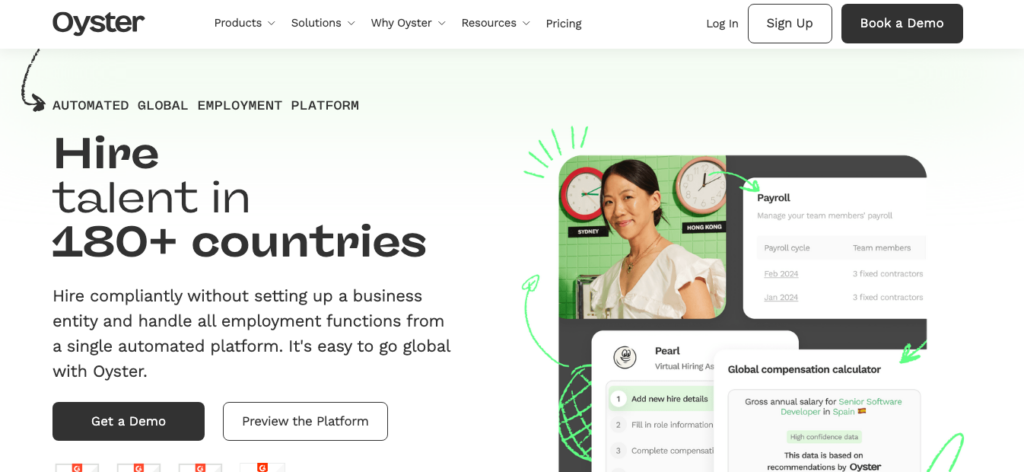
Oyster is another global employment platform focused on EOR, contractor, and payroll services. Oyster’s pros and cons include:
- Pros
Data security
Oyster is compliant with GDPR and SOC 2 standards. It uses Amazon Web Services and institutes 2FA for the protection of data and privacy.
Benefits packages
Oyster offers some benefits packages that employers can add on to their employees’ compensation packages. These include equity plans and health insurance plans, which are legally compliant in the countries where they’re offered (165+ countries).
Contractor price
Oyster’s price for contract management, starting at just $29/person per month, is very affordable even for the smallest of businesses and opens up this service to a wide range of businesses.
- Cons
Limited integration
Oyster has an API to allow developers to build custom integrations with other software. However, its out-of-the-box integrations are very limited. It only allows integration with 15 other apps. While one of these is Zapier, which allows integration with 6000 other tools, more direct integrations would increase this platform’s convenience significantly.
International focus
While Oyster is a global employment platform, it focuses entirely on international hiring and doesn’t provide support, like PRO services, domestically.
Lacks features
Like Deel, Oyster doesn’t offer the comprehensive suite of features that could make it useful as a standalone HRIS. For example, it’s missing recruitment management, applicant tracking, analytics, workflow, and reporting features. It also doesn’t offer a mobile app for convenient access to its platform.
Head to Head Comparison: Deel vs Oyster Features
The advantages and disadvantages of each platform are useful to know. However, we shouldn’t stop at examining these service providers independently. Instead, we’re going to compare Deel vs Oyster directly based on several use criteria. These comparisons should help you make an informed choice as to which of the platforms would be better suited to your organization’s specific needs.
User-friendly platform: Deel Wins
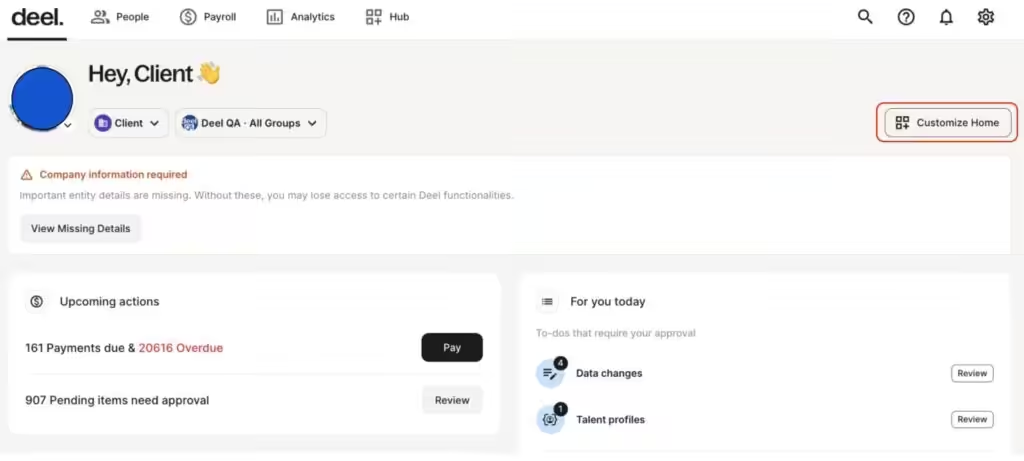
Both of these platforms are highly intuitive, and that helps new users start using them quickly. However, both include complexity that can create a steep learning curve for mastering these systems. Users rate Deel as easier to use and better for quality and attentiveness of support, so Deel wins in this category.
Resources: It’s a tie
Deel features an ongoing blog, educational webinars, a global employment comparison tool, and a global benefits tool for calculating the costs of employees in different countries. Oyster offers a blog, employee cost calculation tools, and educational resources like webinars and self-study courses.
Integration with other software: Deel Wins
Deel’s platform, though not comprehensive on its own, can be integrated with over 90 software solutions, including Ashby, Asana, BambooHR, Greenhouse, HiBob, Lever, Quickbooks, Slack, Workable, Workday, and Zapier. It includes an API developers can use to build new integrations. Oyster also has an integratable API, but it only has 15 apps. While this list includes big names like Bamboo, HiBob, Personio, Quickbooks, Salesforce, Slack, and Workday, it may prevent convenient workflow with the tech stacks of large organizations.
International hiring (EOR): Oyster Wins
Both Oyster and Deel offer services as employers of record to hire employees on behalf of their clients. These providers offer contract management, hiring, onboarding, payroll, benefits administration, and tax and social security management services. Neither of them has recruitment services, and their prices are the same, so it comes down to their coverage. While Deel works in over 150 countries, Oyster offers 180+ and, therefore, takes the upper hand.
Contractor Solution: It’s a tie
Deel and Oyster both possess very distinct advantages when it comes to contractor management. For Oyster, it comes down to money. This platform’s services are much cheaper at only $29/contractor per month compared to $49 for Deel. On the other hand, Deel has a wide variety of payment methods that allow you to pay contractors in the most convenient ways for them. Deel offers online payments, direct deposits, and the Deel Card, a debit-style card that contractors can use to access their funds in major currencies.
Employee Benefits: Oyster Wins
Deel handles employee benefit management for mandatory benefits like time off and social security, but that’s where its benefits provision stops. Oyster also handles these mandatory benefits as all EOR providers do, but it also offers add-on health insurance packages for employees. These may also be mandatory in some countries, so it’s convenient to have them on offer within the platform.

Payroll Management: Deel Wins
Like all global employment platforms, Deel and Oyster both make paying salaries and deducting taxes and social contributions easy. They also offer easy contractor invoice management. However, Deel wins in this category because it offers more payment options for contractors and billing its clients. Clients can pay Deel in one of 24 global currencies, while Oyster only lets clients pay in only three currencies: USD, GBP, and EUR.
Our Verdict: Deel vs Oyster
By now, we’ve examined each service provider’s specific advantages and disadvantages separately and compared them to each other. Instead of simply judging an overall winner, however, our goal is to indicate the use cases where each of these professional services excels.
When to choose Deel
Deel is a great choice for a global employment platform for companies that want a user-friendly platform with high functionality and extensive integration. When ease of running payroll and convenience for contractor payments is important, choose Deel.
When to choose Oyster
Oyster provides EOR services in almost every country in the world and charges less for contractor management. If you want to hire a diverse international team and provide them with extra benefits in one platform, Oyster is a good choice.