Recruit


Converting a contractor to an employee looks like a paperwork exercise and turns into a financial, legal, and emotional decision. Get it right and you lock in a key person, eliminate misclassification risk, and clean your org chart. Get it wrong and you trigger back-tax exposure, an offer dispute with someone you wanted to keep, and a year of cleanup with the IRS, DOL, or a state labor board.
This is the practical 1099-to-W2 conversion playbook we use with clients converting US contractors to full-time employees, and international contractors to fully employed status through an Employer of Record. It covers when conversion is the right call, how to price the offer using real burden math, the paperwork that matters, the federal and state classification tests that decide whether you have a choice, and the conversion mistakes that cost the most.
Quick answer | Detail |
|---|---|
Cost increase US | About 14–20% above gross contractor rate after FICA, FUTA, SUTA, and benefits |
Cost increase international | UK ~19%, Germany ~29%, Brazil ~48% in employer burden alone |
Best timing | January 1 for US conversions to avoid mid-year SS wage base double withholding |
Paperwork (US) | Offer letter, W-4, I-9 within 3 days of start, state withholding form, IP refresh |
International path | Employer of Record in 3 weeks vs 6–9 months and $30K–$150K to set up an entity |
Compliance test | DOL six-factor economic-realities test (effective March 11, 2024) plus IRS 20-factor common-law test |
When Converting A Contractor To An Employee Makes Sense (And When It Doesn't)
Convert when the contractor has worked full-time hours on your tools with no other clients for more than six months, when sensitive IP or regulated data is involved, or when you are raising capital and contractor liabilities will surface in due diligence. Don’t convert if the work is genuinely project-based, the contractor has multiple clients, or the worker prefers to remain self-employed and the relationship genuinely meets contractor criteria.
Most conversion decisions are reactive. Someone in finance ran a misclassification audit and got nervous, or a contractor said they’re leaving for a competitor with a salary offer. Both are valid triggers, but the cleaner question is whether the working relationship has actually become an employment relationship in everything but the W-9.
Three Patterns Where Conversion Is The Right Call
The first is when the contractor has been working full-time hours, on your tools, on your roadmap, for more than six months and has no other clients. At that point any reasonable application of the IRS or DOL classification tests would put the worker on the W-2 side of the line. Continuing as 1099 is just deferred risk. The IRS published its current position on this in Independent Contractor (Self-Employed) or Employee?.
The second is when there’s sensitive IP, customer data, or regulated information involved. Employment law gives you stronger contractual control over confidentiality, IP assignment, and post-termination obligations than independent contractor agreements typically do, and courts enforce employee non-disclosure terms more readily than contractor ones. The Microsoft permatemp settlement (Vizcaino v. Microsoft, $97 million in 1996) remains the leading reminder that long-term contractors with full benefits-equivalent integration can produce class-action exposure when reclassified retroactively.
The third is when you’re raising capital, preparing for acquisition, or undergoing audit. Investors and acquirers pull contractor lists during diligence. A 1099 worker who looks like an employee is a flagged liability, and resolving it under deal pressure costs more than resolving it on your own timeline.
Two Patterns Where You Shouldn't Convert
If the work is genuinely project-based with a defined scope and end date, and the contractor has other clients, you don’t have a misclassification problem and you don’t need to convert. The cost would go up, the worker would lose flexibility, and nothing real changes.
If the contractor wants to stay 1099 (most do, for the deductions and the higher gross rate), forcing conversion creates resentment that often ends in resignation. We’ve seen companies convert a top contractor only to lose them six months later because the after-tax math no longer worked. Better to have the conversation first, then the offer.
The Classification Tests That Decide Whether You Have A Choice
Two federal tests apply. The IRS uses a 20-factor common-law test for tax purposes. The DOL uses a six-factor economic-realities test under its 2024 final rule for FLSA wage-and-hour purposes. State law adds a third layer. California’s ABC test under AB5 is much stricter than federal and presumes employee status unless all three prongs are satisfied.
The DOL six-factor test (effective March 11, 2024)
The 2024 DOL final rule on independent contractor classification replaced the Trump-era simplified test with a six-factor economic-realities analysis. Under this rule no single factor is determinative; you weigh all six together to decide whether the worker is economically dependent on your business (employee) or genuinely in business for themselves (contractor). The full rule text is in the Federal Register.
The six factors the DOL applies are listed in this comparison table, with the version of each factor that points toward employee status (so you can spot-check your own contractor relationships).
|
The classification tests that decide whether you have a choice
|
||
Factor |
Points to employee |
Points to contractor |
|---|---|---|
1. Opportunity for profit/loss |
Worker can’t increase profit through skill or judgment |
Worker sets prices, hires help, takes financial risk |
2. Investment in the work |
Company supplies tools, software, equipment |
Worker invests in own equipment and operations |
3. Permanence of relationship |
Indefinite, exclusive, or continuous |
Project-based, finite, or non-exclusive |
4. Degree of control |
Company sets schedule, methods, supervision |
Worker controls how and when work is done |
5. Integral to business |
Work is core to what the company does |
Work is peripheral or specialized one-off |
6. Skill and initiative |
Skills used are general, company-directed |
Specialized skill plus business judgment |
Score four or more factors on the employee side and conversion isn’t optional, it’s a compliance fix.
The IRS 2-Factor Common-Law Test
For federal tax purposes the IRS still applies its long-standing common-law test, organized into three categories: behavioral control (does the company set hours, methods, training?), financial control (who supplies tools, can the worker make a profit or loss?), and relationship type (written contract, benefits, indefinite duration?). When in doubt, either party can file IRS Form SS-8 to request an official IRS determination, though the process takes six months or longer.
State-Level Tests
State law adds another layer. California’s ABC test under AB5 presumes employee status unless the worker is free from control, performs work outside the company’s usual business, and is customarily engaged in an independent trade. New Jersey, Massachusetts, and Connecticut use similar three-prong ABC tests. The Department of Labor maintains a directory of state labor agencies that can confirm the test applicable in any specific state.
How To Calculate The True Cost Of Conversion
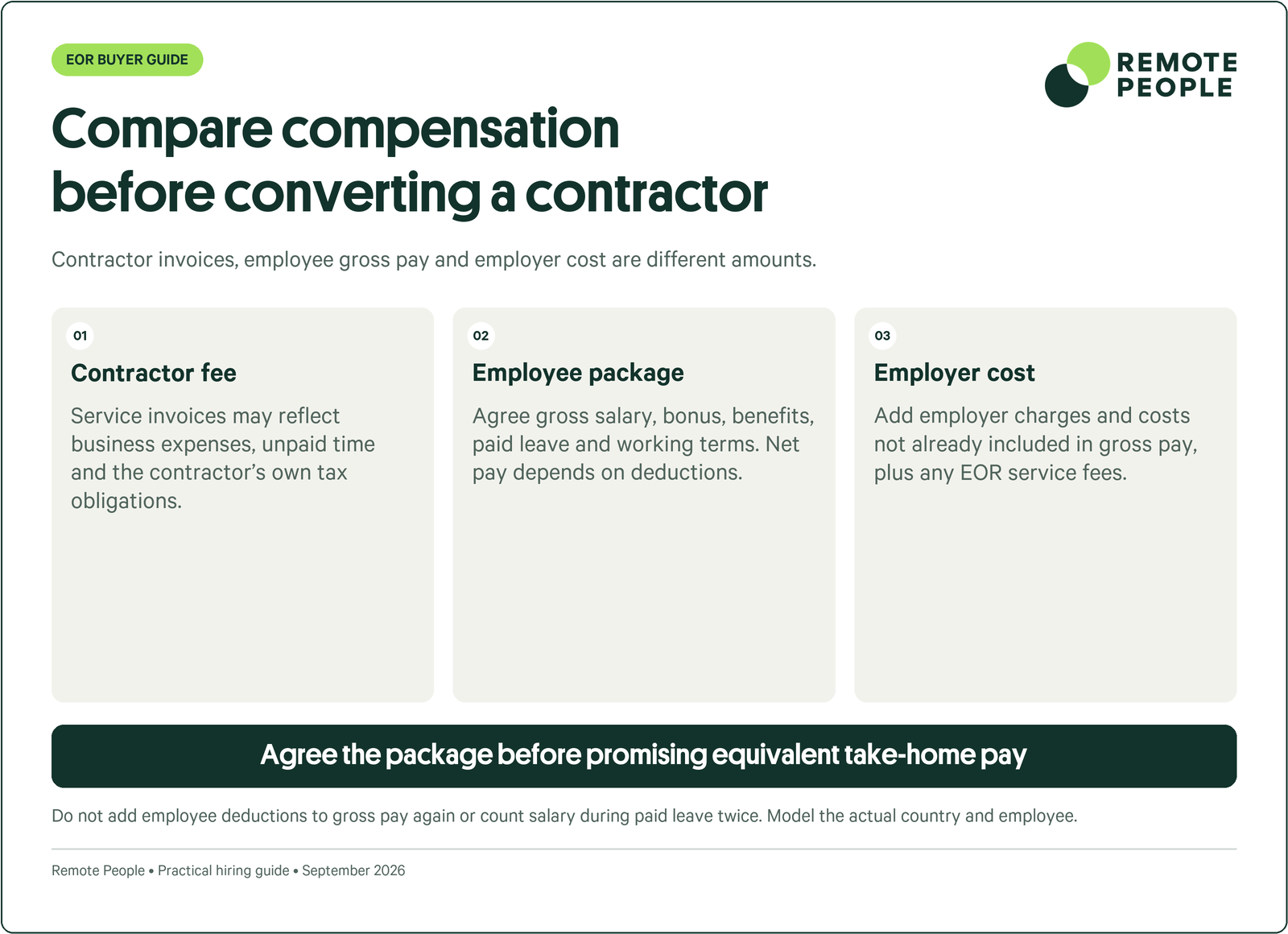
A US contractor billing $100/hour for 2,000 hours/year ($200,000 gross) corresponds to roughly a $172,000 W-2 salary at the same total company cost, before benefits. Add health insurance ($8,000–$15,000 per employee per year per the 2024 KFF Employer Health Benefits Survey) and 401(k) match (3–6% of base) and the all-in cost lands within 5% of the contractor cost in the US. International conversions are 19%–48% higher in employer burden alone.
The conversation that derails most conversions is the comp conversation. Contractors quote their hourly rate in pre-tax, pre-burden dollars. Employees quote their salary in pre-tax, post-burden dollars. The two numbers are not directly comparable, and the gap is bigger than most people expect.
The US Employer Burden Breakdown
For a US W-2 employee, the employer pays statutory contributions on top of the salary itself. The components, all sourced from current federal and average state rates:
FICA: 6.2% Social Security up to the 2025 wage base of $176,100, plus 1.45% Medicare on all wages (employer share). FUTA: 0.6% on the first $7,000 per employee. SUTA: state-specific, typically 1%–6% on the first $7,000–$45,000 depending on state experience rating. Workers’ compensation: 0.5%–3% of payroll depending on state and occupation classification, per BLS employer cost data. Total US statutory burden lands around 10%–16% of base salary depending on state.
The Conversion Math, Four Countries
The table below shows what a contractor billing $100/hour actually costs your company once converted to a W-2 (or local employment equivalent) at full-time hours, using employer burden rates from the four highest-volume hiring countries we serve. Burden rates exclude the worker’s salary itself; they cover statutory employer contributions only.
|
How to calculate the true cost of conversion
|
|||
Country |
Annualized contractor cost (2,000 hrs) |
Equivalent salary at same total cost |
Effective employer burden |
|---|---|---|---|
United States |
$200,000 |
$172,400 |
~16% (FICA, FUTA, SUTA, workers comp) |
United Kingdom |
$200,000 |
$167,500 |
~19.4% (Employer NI 13.8%, pension 3%, Apprenticeship Levy) |
Germany |
$200,000 |
$155,000 |
~29% (pension, unemployment, health, long-term care) |
Brazil |
$200,000 |
$135,000 |
~48% (INSS 20%, FGTS 8%, vacation 1/12, 13th salary) |
The Contractor-Side Tax Math (Worker Perspective)
From the worker’s point of view, the conversion changes their tax picture. As a 1099 contractor they paid 15.3% self-employment tax (the full FICA, both employee and employer halves), but could deduct half of that against income tax, plus business expenses, home office, retirement contributions through SEP-IRA up to 25% of net SE income, and so on. As a W-2 employee they pay only 7.65% FICA (the employee share), get health insurance pre-tax, but lose most business deductions. The crossover point varies, but for most service workers the after-tax delta is within a few percent. Show the math to your converting contractor, don’t just send the offer letter.
The Conversion Paperwork (US 1099 to W-2)
US conversion requires six day-one items from the new employee (offer letter signed, Form W-4, Form I-9 within three days of start, state withholding form, direct deposit, IP/confidentiality refresh) and three same-week company actions (payroll system setup with effective date, state UI/withholding registration if first employee in state, benefits enrollment window). Issue a final 1099-NEC for the contractor period at year-end.
New-Employee Day-One Packet
- An offer letter signed and countersigned, with a W-2 start date that matches the conversion date. Avoid gaps or overlapping work periods between contractor and employee status.
- Form W-4 for federal withholding, completed and signed.
- Form I-9 with valid documentation, completed within three business days of the employee’s start date.
- The applicable state withholding form, depending on the employee’s work location.
- A completed direct deposit authorization form.
- An updated IP assignment and confidentiality agreement aligned with employee terms and obligations.
Same-Week Company-Side Actions
File the worker in your payroll system with effective date matching the offer letter. Register with the state for unemployment insurance and withholding if you don’t already employ in that state, using the state labor agency directory for filing instructions. Add the worker to your benefits enrollment window. Close out the contractor relationship cleanly: issue a final payment for any outstanding invoiced contractor work and confirm the year-end Form 1099-NEC will only cover the contractor period, not any post-conversion W-2 wages.
The Piece Most Companies Miss
State unemployment registration. If this is your first employee in a given state, you usually have 30–90 days from the first payroll to register, and missing the deadline triggers penalties plus retroactive contributions. Treat state registration as a parallel workstream the moment the offer is signed, not a follow-up task. Some states (Washington, California, New York) require pre-registration before you can run any payroll at all. The DOL state contacts directory has the official link for each state agency.
Sample Offer Letter Language For A Contractor Conversion
The offer letter for a converted contractor should include four conversion-specific clauses that a standard offer letter typically lacks: an effective conversion date that ends the contractor agreement on the prior business day, a comp section that explicitly notes the salary equivalent of the prior contractor rate (helps if a dispute arises later), a benefits eligibility paragraph naming the actual waiting period and effective date, and a fresh IP assignment that supersedes the contractor agreement’s IP terms. The standard offer letter also includes the at-will employment statement, the state-specific required disclosures (California, New York, Massachusetts, and others have different posting and disclosure requirements), and the response deadline.
Converting An International Contractor (The EOR Path)
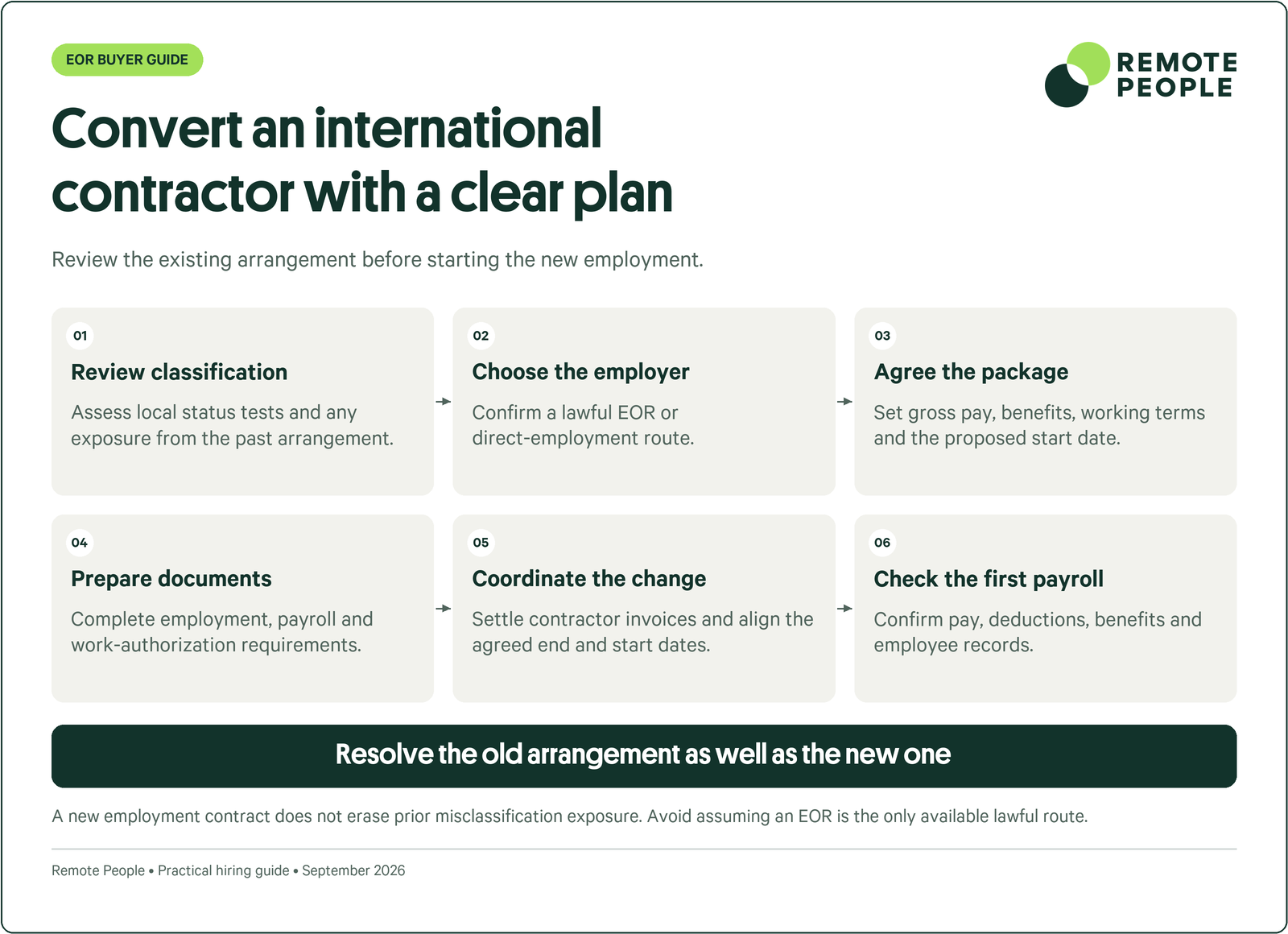
Most US companies don’t have a foreign legal entity in the contractor’s country, which means direct W-2-equivalent conversion isn’t an option without setting up a subsidiary or branch (six to nine months and $30K–$150K depending on country). For a single conversion, EOR is the only practical path. The Employer of Record becomes the legal employer in-country, runs local-currency payroll, enrolls the worker in statutory benefits, and handles termination compliance. EOR fees run $199–$700 per worker per month plus salary and statutory burden.
Why Direct Hire Isn't An Option
Without a registered legal entity in the contractor’s country, you cannot legally employ them as a W-2-equivalent. Paying through your US payroll for a foreign worker creates immediate compliance problems on three fronts: the worker isn’t paying into the country’s mandatory social security system (a violation of host-country employment law), your US payroll has no mechanism for the host country’s mandatory withholdings, and the worker’s tax residence creates personal income tax obligations that won’t be properly settled.
The IRS’s Foreign Persons guidance documents the US side of this; the host country’s side is enforced separately by their tax and labor authorities.
The EOR Conversion Timeline
Three weeks is the typical international conversion timeline through an Employer of Record. Week one is the comp recalculation and offer presentation, accounting for the country’s local burden and benefits expectations. Week two is local-employment-contract drafting, EOR onboarding paperwork, and any required document apostille or translation. Week three is the contractor termination, the EOR start date, and the first local-currency payroll. Compare this to the six-month, $30K-minimum process of standing up your own foreign entity. For a single hire, EOR is the only sensible path.
Want the full fee math by provider tier and country?
Our EOR cost breakdown covers what every provider tier actually charges across different markets, including the fees that rarely appear on a pricing page.
Country-Specific Quirks Worth Flagging
Brazil requires a 13th-month salary plus one-third vacation premium. Germany has a six-month statutory probation period (Probezeit) that conversion offers can use to manage notice periods. The UK requires automatic pension enrollment within 12 weeks via the auto-enrollment regime. India requires PF (provident fund) contributions of 12% from both employer and employee. France caps the trial period at four months for executive-level (cadre) hires. Don’t copy a US offer template into a foreign hire; the EOR provides the local-law-compliant template.
Common Conversion Mistakes
The five conversion mistakes that cost the most are mid-year conversions that retrigger Social Security wage-base withholding, promising day-one benefits without checking the plan’s waiting period, forgetting state unemployment insurance registration, leaving an unprocessed contractor invoice that mixes 1099 and W-2 accounting, and skipping the IP assignment refresh.
- Mid-Year Conversion Without Recalculating The SS Wage Base: If a contractor converted to W-2 in July has already paid self-employment tax up to the SS wage base ($176,100 for 2025) for the contractor period, your payroll system will start withholding employee SS again from dollar one of W-2 wages. The worker won’t get a refund until they file their personal return the following April. They will feel double-taxed for six months. Year-end is cleaner; January 1 is cleanest.
- Promising Day One Benefits Without Checking The Plan’s Waiting Period: Most group health plans have 30–90 day eligibility waiting periods, and the maximum permitted under the ACA is 90 days. A contractor converting on May 15 with a 90-day waiting period won’t have employer-sponsored coverage until August 15. If they have been on a marketplace ACA plan, the gap creates a real coverage problem. Either bridge with COBRA-equivalent (if they had any prior employer coverage), pre-pay the marketplace premium for the gap, or accelerate eligibility by amending the plan with the carrier. Don’t leave it unmanaged.
- Forgetting State UI Registration: Already covered above, worth repeating. Most missed-deadline penalties we see come from a same-state conversion where the company assumed they were already registered because they had other contractors there. Contractors don’t require state UI registration; employees do. The two systems are independent.
- Leaving A Final Invoice Unprocessed: The contractor often has 1–2 weeks of work that is billed after the conversion date. Process those invoices in the contractor period, not as employee comp. Mixing them creates messy 1099/W-2 accounting and can trigger an IRS notice the following year because the totals on Form 1099-NEC won’t reconcile to your accounts payable records.
- Skipping The IP Assignment Refresh: Independent contractor agreements typically have weaker IP assignment language than employee agreements. Some assign only the deliverables, not derivative work product. Some have carve-outs that wouldn’t survive in an employment context. The conversion is the moment to issue a fresh, employment-grade IP assignment that retroactively covers the contractor period and prospectively covers all employee work product.
Conversion Timeline (4 Weeks Out To Day 1)
The cleanest conversions follow a four-week timeline. Anything shorter than two weeks usually leaves a registration or paperwork gap that surfaces three to six months later as either a state agency notice or a benefits coverage problem.
Conversion timeline (4 weeks out to day 1) | |
Timing | Action |
|---|---|
4 weeks out | Comp recalculation complete, offer drafted, conversation with the contractor about pay structure change, classification audit documented for compliance file |
3 weeks out | Offer signed, state UI/withholding registration started if first employee in state, benefits enrollment timing checked, equity admin notified |
2 weeks out | I-9, W-4, state forms sent, payroll system setup, IP assignment refresh signed, COBRA or marketplace bridge confirmed if benefits gap exists |
1 week out | Final contractor invoice received and processed, equity grant prepared (if applicable), benefits enrollment window confirmed, contractor account access transitioned to employee credentials |
Day 1 (W-2) | First payroll runs on new schedule, employee handbook acknowledged, benefits enrollment opens, contractor agreement formally terminated, all access transitions complete |
When An EOR Is The Cleaner Path Even For US conversions
Use an Employer of Record for international conversions, for first-employee-in-a-state US conversions, or for any conversion where the worker spans multiple jurisdictions. It can also have the benefit of managing contractor permanent establishment risk. Use in-house payroll only when you already employ in the worker’s state and have established benefits and registration infrastructure.
For US-only conversions where you already have employees in the state, in-house payroll handles the conversion fine. The complexity stays manageable because you have the registrations, the benefits plan, the workers’ comp policy, and the payroll cadence already running.
For international conversions, first-employee-in-a-state US conversions, or any conversion where the worker spans multiple jurisdictions, an EOR removes the entity-setup, registration, benefits-broker, and ongoing payroll-tax compliance work that turns a clean conversion into a multi-month project. We see most growth-stage companies use an EOR for the first three to five conversions in any new country or state, then evaluate whether to bring it in-house once volume justifies the fixed-cost build-out.
If you’re weighing whether to convert through an EOR or set up your own entity, our EOR vs direct hire comparison walks through the break-even math by employee count. For the broader cost picture across providers and burden rates by country, the EOR cost guide has the full numbers. And if you’re still deciding whether the worker should be 1099 or W-2 in the first place, the 1099 vs W-2 breakdown covers the classification math before you get to conversion. For onboarding the converted employee in a new country, our global onboarding checklist covers the first-30-days workflow.
If you want to talk through a specific conversion, including international cases or first-state US conversions, our team helps companies move contractors to fully employed status through our Employer of Record service in over 150 countries. We handle the paperwork, the registrations, and the local employment contracts so you can focus on retaining the person you are converting.
Related Reading
Internal guides that go deeper on specific parts of the conversion decision:
- 1099 vs W-2 employee: the classification math before you decide whether to convert
- EOR vs direct hire: break-even math for entity setup vs Employer of Record by employee count
- Employer of Record cost guide: fully-loaded EOR pricing by provider tier and country
- Global onboarding checklist: the first-30-days workflow for a newly-converted international employee
- EOR vs foreign employer registration: what to do when you can’t use an EOR but won’t set up an entity
- RemotePeople EOR service: employment in 150+ countries with no entity setup
Article References
Primary government and authoritative sources cited above, in the order they appear:
- IRS, Independent Contractor (Self-Employed) or Employee? — the IRS’s canonical classification page (cited for the contractor vs. employee determination criteria).
- US Department of Labor, Employee or Independent Contractor Classification Under the Fair Labor Standards Act, 2024 Final Rule — landing page for the rulemaking.
- Federal Register, 2024 Final Rule full text (89 FR 1638, January 10, 2024) — the legally operative text and effective date (March 11, 2024).
- IRS, About Form SS-8 — request for determination of worker classification.
- California DLSE, Independent Contractor versus Employee FAQ — AB5 / ABC test guidance for California employers.
- US Department of Labor, State Labor Office Contacts Directory — index of state agencies for unemployment insurance and withholding registration.
- KFF, 2024 Employer Health Benefits Survey — employer-sponsored health coverage costs ($8,000–$15,000 per employee per year cited).
- Social Security Administration, Contribution and Benefit Base — the official annual Social Security wage base ($176,100 for 2025 cited).
- US Bureau of Labor Statistics, Employer Costs for Employee Compensation — benchmark data for benefits and statutory employer costs.
- IRS, Self-Employment Tax (Social Security and Medicare Taxes) — the 15.3% SE tax breakdown cited in the worker-side tax math section.
- IRS, About Form W-4 — federal employee withholding form required at conversion.
- USCIS, Form I-9, Employment Eligibility Verification — required within 3 business days of W-2 start.
- IRS, About Form 1099-NEC — year-end reporting form for the contractor period of a converted worker.
- IRS, Foreign Persons — US tax treatment guidance referenced for the international conversion section.
Frequently Asked Questions
Convert when the contractor has worked full-time hours, on your tools, with no other clients, for more than six months. Also convert when sensitive IP or regulated data is involved (employee NDAs are stronger), or when you're raising capital or preparing for acquisition (investors flag long-term 1099s as misclassification liabilities). Don't convert if the work is genuinely project-based with a defined end date and the contractor has multiple clients. The 2024 DOL six-factor test is the practical guide: score four or more factors on the employee side and conversion isn't optional, it's a compliance fix.
The IRS uses a 20-factor common-law test grouped into three categories: behavioral control (does the company set hours, methods, training?), financial control (who supplies tools, can the worker make a profit or loss?), and relationship type (is there a written contract, benefits, indefinite duration?). The DOL applies a separate six-factor economic-realities test under the March 2024 final rule. State law adds a third layer: California's ABC test under AB5 is much stricter than federal, and New Jersey, Massachusetts, and Illinois apply their own variations.
In the US, expect roughly 14-20% more in total company cost once you add employer FICA (7.65%), federal and state unemployment, workers comp, plus benefits (health insurance $8K-15K/yr per employee, 401(k) match 3-6%). A US contractor billing $100/hour at 2,000 hours/yr ($200K) corresponds to roughly a $172K W-2 salary at the same total cost before benefits. International conversions are higher: Germany adds ~29% employer burden, Brazil ~48%. Walk through the gross-up math explicitly when presenting the conversion offer.
No special IRS form for the conversion itself. You'll issue a final 1099-NEC for the contractor period (covering payments through the conversion date) at year end, and a W-2 for the employee period. The worker reports both on their personal return. If this is your first employee in a state, you must register for state unemployment insurance and withholding within 30-90 days of first payroll, depending on the state. Missing the registration deadline triggers penalties plus retroactive contributions.
If you don't have a foreign legal entity in the contractor's country, your two options are: set up a subsidiary or branch ($30K-150K and 6-9 months), or use an Employer of Record. For a single conversion, EOR is the only practical path. The EOR becomes the legal employer in-country, runs local-currency payroll, enrolls the worker in statutory benefits, and handles termination compliance. EOR fees run $199-$700 per worker per month plus salary and statutory burden. Total conversion timeline through an EOR is typically three weeks.
Yes. You can't force someone into employment status if they prefer to stay 1099. Many contractors prefer the higher gross rate, the deductions (home office, equipment, retirement contributions through SEP-IRA), and the flexibility. If the worker refuses and the relationship genuinely meets contractor criteria under the IRS and DOL tests, you can continue as 1099. If the relationship clearly fails those tests and the worker still refuses, you have a misclassification problem and the practical answer is to end the engagement and replace with a properly classified hire.
The DOL final rule that took effect March 11, 2024 replaced the simplified two-factor test with a six-factor economic-realities analysis: opportunity for profit/loss, investment in the work, permanence of relationship, degree of control, integral nature to business, and skill plus initiative. No single factor decides; you weigh all six together. The rule applies to FLSA wage-and-hour cases, including overtime and minimum-wage claims. Contractors who fail the six-factor test under the new rule are at higher exposure for back wage claims, which is why most companies are auditing long-term 1099s and converting where the risk is clear.
Self-employment taxes already paid for the contractor period stay with the worker. They get filed on Schedule SE of their personal return covering the contractor period, and they don't get refunded just because the relationship converted. The trickier issue is mid-year Social Security wage base. A contractor converted to W-2 in July who has already paid SE tax up to the SS wage base ($168,600 in 2024) will have employee SS withheld again from dollar one of W-2 wages, and won't get the refund until they file the following April. Year-start conversions avoid this entirely.