
 Recruit


Hiring someone in another country can quickly become complicated when your company doesn’t have a local legal entity there. Setting one up can take significant time and money, especially if you are only looking to hire one or two people.
An Employer of Record (EOR) offers a simpler solution. The EOR acts as a legal employer for the worker on your behalf, handling local contracts, payroll, taxes, benefits and employment compliance while you continue to manage their day-to-day work.
For companies looking to build an international team without establishing an entity in every country, this can be a considerably faster and easier approach. However, it isn’t the right solution in every situation, so it’s important to understand how the model works, its costs, and where its limitations lie.
What does an Employer of Record do?
An Employer of Record manages the employment relationship on your behalf in a country where your business does not have a legal entity. Its name appears on the employment contract, meaning that the Employer of Record is legally recognized as the worker’s employer in that country.
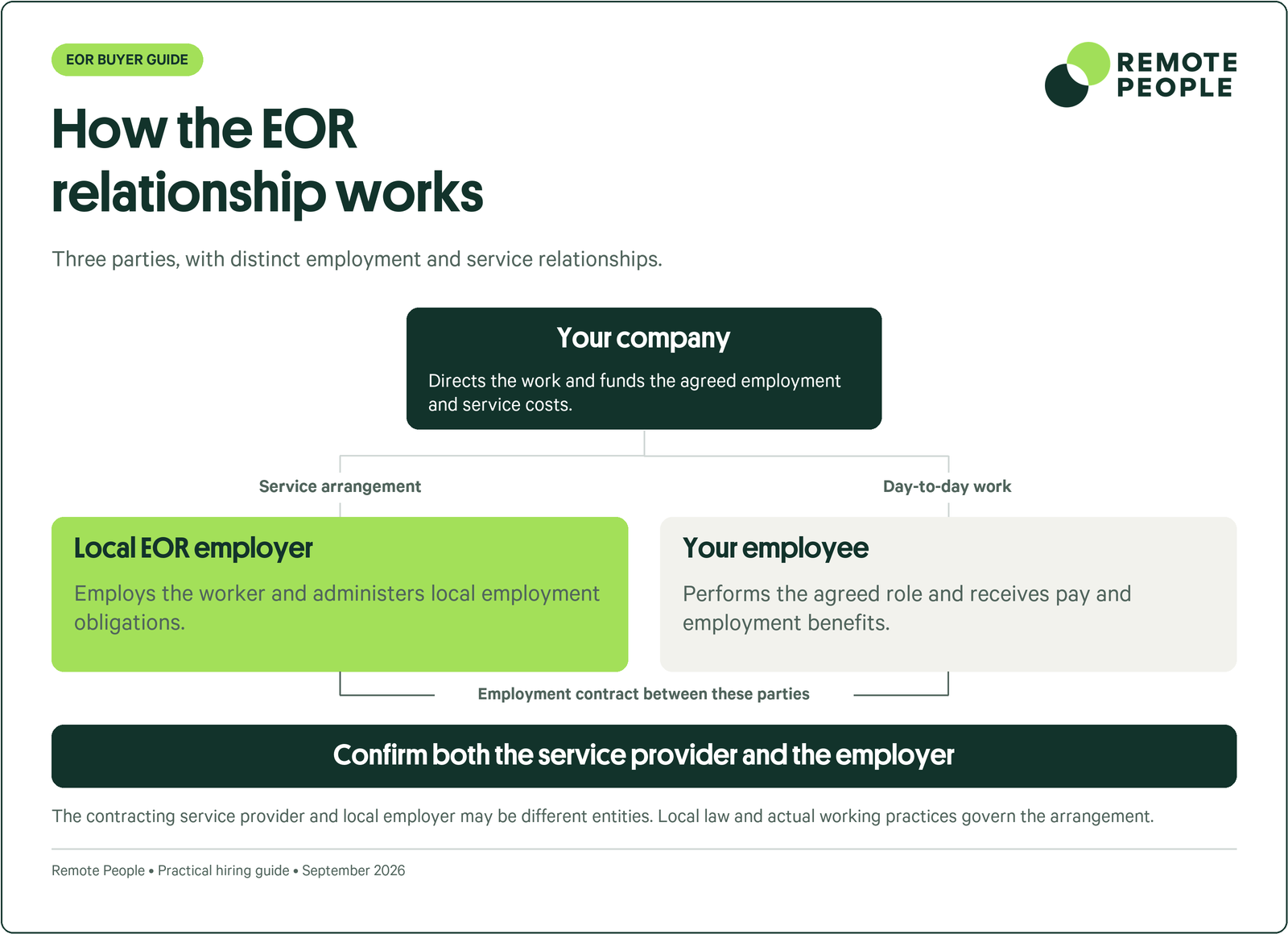
Core Responsibilities
The Employer Of Record begins the hiring process by preparing and signing a locally compliant employment contract. This should correctly reflect the country’s rules on areas such as probation periods, working hours, annual leave entitlement, notice periods, and termination.
Once the employee begins their employment, the EOR is in charge of running payroll in the local currency, withholding the correct amount of income tax and paying the relevant social security, pension and other statutory contributions. It also accounts for mandatory employee benefits such as health insurance, paid leave, sick pay, and parental leave.
In countries where additional salary payments or end-of-year bonuses are required, the EOR handles these too.
Other core EOR responsibilities include:
- Compliance and reporting. The EOR files the necessary returns with tax, employment and immigration authorities and maintans required working-time and payroll records.
- Employee documentation. The EOR keeps track of payslips, tax forms, benefits information and other employment records for the required retention period.
- Termination and offboarding. The EOR will manage notice periods, severance calculations, final payments and the local procedures for ending employment.
Note: EOR services are sometimes confused with co-employment, but the two models are quite different. Under an EOR arrangement, the EOR is the legal employer, while your company remains responsible for managing the employee’s day-to-day work. In co-employment, the legal responsibility for employment is shared between the professional co-employer (often called a Professional Employer Organization or PEO) and the company that directly supervises the employee.
What an EOR doesn’t do
An EOR handles the legal and administrative side of hiring, but it doesn't replace your internal recruitment or management teams. You are still responsible for finding and selecting the employee, setting their responsibilities and managing their day-to-day work. Some EOR providers offer recruitment as an additional service, but this is not included in the standard EOR fee.
Using an EOR also does not diminish every compliance risk. Your company still needs to follow appropriate working practices and provide accurate information about the employee’s role, location and responsibilities. The provider can manage local employment compliance, however it cannot protect you from risks created by incorrect or incomplete information.
An EOR arrangement does not automatically remove Permanent Establishment risk (PE risk) either. This is the risk that the coompany's operations in a country are considered to be a real or permanent extension of the parent company in that country, making the operations there subject to corporate income tax. Whether a PE risk is created to depends on an employee’s seniority, responsibilities and authority to negotiate or sign contracts on behalf of your company. If there is any uncertainty, it is worth seeking country-specific tax and legal advice.

How Does an EOR Work? Step by Step
Once you have chosen an EOR provider and found the right candidate, the hiring process is usually fairly straightforward from there. The EOR takes over the legal and administrative side of the employment agreement, while you manage the employee’s role and day-to-day tasks.
Here is what you can typically expect from making the initial employment offer to completing the employee’s first payroll cycle:
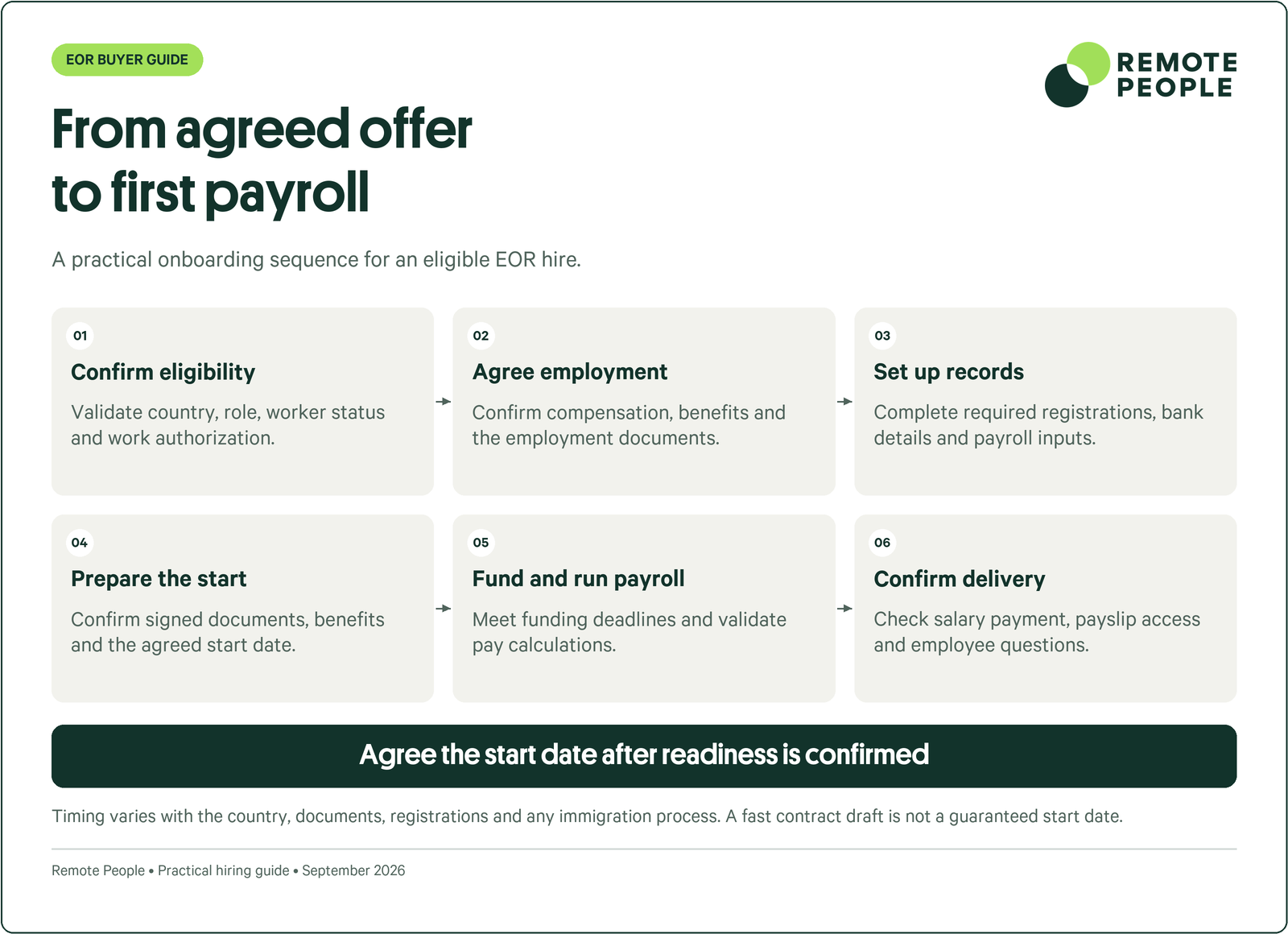
The EOR process from candidate to onboarded employee:
| Step | Who does it | Typical timeline | What can go wrong |
|---|---|---|---|
| 1. You select a candidate | You | Your usual hiring process | Choosing someone in a country your EOR doesn’t directly serve |
| 2. EOR drafts the local employment contract | EOR | 2–5 business days | Generic template instead of country-specific terms |
| 3. Candidate signs, EOR collects documents | EOR | 3–10 business days | Candidate slow with proof of address / bank info / tax ID |
| 4. Benefits enrollment activates | EOR | 30–90 days (varies by country) | Health insurance gap if the EOR uses a low-coverage plan by default |
| 5. First payroll cycle runs | EOR | Per country’s pay cycle | Misclassified deductions in the first cycle (very common, fixable) |
| 6. Ongoing compliance monitoring | EOR | Continuous | EOR misses a statutory change (rare with top-tier providers) |
Onboarding timeline: In practice, onboarding can take as little as 24 hours or as long as six weeks, depending on the country and whether the EOR uses its own local entity.
The most common cause of delays is the candidate’s documentation, not the EOR itself. This may include gathering proof of address, bank details, tax information and, in some countries, certified qualifications. A well-organized EOR will collect these documents while preparing the employment contract to keep the onboarding process moving.
EOR vs PEO vs Staffing Agency vs AOR vs Contractor of Record
I mentioned earlier that EOR is not to be confused with co-employment or PEO services. Here it is worth setting out in a bit more detail the difference between EOR and various other similar, but distinct, operating models. As mentioned, a Professional Employer Organization (PEO) is a company that handles the payroll and employee benefits of employees on behalf of a client company. They are not an Employer of Record, however, as they do not become the legal employer of the employees (though they may be authorized by the IRS to handle tax withholding). The PEO model is especially common in the United States, with well-known providers (besides us at RemotePeople) including ADP, Trinet and Paychex.
A staffing agency (or staffing company), like an EOR, is often the legal employer of staff that are assigned to other companies. However they usually supply the employees to the client company, and it is usually not on an ongoing or permanent basis. Staffing companies are often also called ‘temp’ agencies, and after a period of time, it is expect that the employee be hired directly by the client company.
“Agent of Record” is a term with more than one industry meaning. In the hiring context, it usually means a professional services company that helps a business engage, classify, onboard and pay independent contractors. In insurance, an Agent of Record is the appointed agent or broker servicing specified policies. Obviously, neither is the same as EOR. They do not involve legal employment by a professional third party firm. Check the provider’s contract for its exact role, responsibilities and any limits on protection against misclassification.
‘Contractor of Record’ is a relatively new hiring mechanism pioneered by Deel and RemotePeople, where an independent contractor is directly hired by the professional services company (who may also be an EOR), and that individual is then assigned to the client company. It is different from EOR because it concerns contractors, not employees. And it is distinct from simple contractor management as the COR company takes legal responsibility for potential employee misclassification.
EOR vs PEO
| Employer of Record (EOR) | Professional Employer Organization (PEO) | |
|---|---|---|
| Geographic scope | International (any country where the EOR has entities) | US-only typically |
| Legal employer | The local EOR entity is named as employer in the employment contract; the client’s responsibilities depend on local law and the arrangement. | The client remains an employer; the PEO shares specified employment and administrative responsibilities under the arrangement. |
| Liability | The EOR handles its employer obligations. The client can retain liability for its own conduct and obligations imposed by local law; contractual indemnities have limits. | Responsibilities and liability depend on the applicable law, PEO arrangement and contract. |
| State unemployment / workers comp | EOR handles, in country | PEO pools across clients for better rates |
| Setup time | 2-4 weeks to first hire | 4-8 weeks (state registrations) |
| When it’s right | Hiring in a country without your own entity | You have a US entity and want to outsource HR + benefits + payroll |

For the full breakdown including the PEO vs EOR vs Staffing Agency comparison, see our dedicated guide.
EOR vs Staffing Agency
| Employer of Record | Staffing Agency | |
|---|---|---|
| Worker type | Permanent employees | Temporary / contract workers |
| Duration | Long-term, usually open-ended | Short-term, project-based |
| Employee assignment | Works exclusively for one client (you) | May rotate between clients |
| Cost model | Monthly per-employee fee | Markup on hourly rate (often 40–80%) |
| Recruiting included | No (you find the candidate) | Yes (agency sources) |
EOR vs Agent of Record (AOR)
| Employer of Record | Agent of Record — contractor services | |
|---|---|---|
| Worker type | Full-time employees | Independent contractors |
| Tax classification | W-2 / equivalent in country | Independent contractor; tax and reporting treatment depends on the country (1099 is US terminology). |
| Benefits | Statutory + voluntary | None (contractor handles their own) |
| Misclassification risk | Low (proper employment) | High if worker meets employee test |
| Use case | Long-term role, exclusivity, training | Project-based, multiple clients, autonomy |
EOR vs Contractor of Record (CoR)
| Employer of Record | Contractor of Record | |
|---|---|---|
| Worker is | An employee | A contractor |
| Compliance focus | Employment law, payroll tax | Contractor classification + payment rails |
| Risk being managed | Wrongful termination, unpaid statutory | Misclassification, unpaid tax |
| Pricing | $199-$999/month per employee | $30-$200/month per contractor |
A useful rule of thumb: if the worker would meet your country’s “employee” classification test under an audit, you need an EOR. If they’re genuinely independent (own equipment, multiple clients, set their own hours), a Contractor of Record is sufficient. The IRS classification test is the US framework – most other countries have similar tests with their own twists.
When Should You Use an EOR?
Common Use Casees
An EOR is particularly suited when a company wants to expand internationally without committing to setting up a local entity. For example, you might want to test the demand in a new market by hiring one or two local employees before committing to a larger, more permanent investment.
This can also be a practical solution for when the right candidate lives in a country where you have no existing presence. So rather than limiting the role to applicants in countries where your business already operates, an Employer Of Record allows you to hire the person and employ them locally.
An EOR can also suit companies building permanently distributed teams, as the provider manages local contracts, payroll, benefits and compliance for employees working across different countries.
Other common situations include:
Expanding across several countries: An EOR allows you to hire employees in multiple locations without managing a separate entity in each one.
Bridging a temporary gap: Companies can use an EOR to employ workers during an acquisition, relocation or while their own local entity is being established.
Waiting for a visa or relocation: An employee may be able to work from their home country through an EOR while waiting for their visa or relocation process to be completed.
When not to Use an EOR
An EOR is not always the most practical or cost-effective option for every business. If your business already has a legal entity in the employee’s country, you can usually employ them directly and use a local payroll provider instead.
The cost may also be difficult to justify when hiring someone in a lower-cost market, particularly if the monthly EOR fee represents a significant percentage of their salary.
Likewise, as your team in one country grows, establishing your own entity may become more economical than paying a separate fee for every employee.
An EOR may not be the most suitable option for your business when:
- You already have a local entity and can employ the worker directly.
- The cost is too high relative to the employee’s salary, reducing the financial benefit of hiring in that market.
- You plan to build a larger team in one country, as setting up an entity may offer better long-term value.
- The role requires a license that the EOR cannot hold, such as certain legal, medical, or regulated financial positions.
There is no universal point at which setting up a local entity becomes the better option. The decision depends on the country, cost of entity setup, ongoing administrative requirements, and finally, the number of employees you intend to hire.
Review the EOR-versus-entity decision when your expected headcount, hiring period or operating needs change. There is no universal employee threshold. Compare country-specific setup, payroll, accounting, compliance, internal administration and eventual closure or transfer costs over the same period, alongside the EOR’s service fees and any additional charges.
Illustrative Administration Costs: EOR vs Direct Entity
This hypothetical example shows how assumptions change the comparison; it is not a country quote or market benchmark. Over 24 months, assume an EOR service fee of US$750 per employee per month. For a direct entity, assume US$15,000 setup, US$1,000 monthly fixed administration and US$100 monthly payroll administration per employee. Hold headcount constant. Salary, employer contributions, benefits, internal staff time, tax advice, financing, closure and employee-transfer costs are excluded from both columns and must be considered separately for a real decision.
| Team size | EOR service fees, 24 months | Entity setup and stated administration, 24 months | Lower amount in this illustration |
|---|---|---|---|
| 1 employee | US$18,000 | US$41,400 | EOR |
| 3 employees | US$54,000 | US$46,200 | Entity |
| 5 employees | US$90,000 | US$51,000 | Entity |
| 10 employees | US$180,000 | US$63,000 | Entity |
| 20 employees | US$360,000 | US$87,000 | Entity |
The EOR column equals US$750 × employees × 24. The entity column equals US$15,000 + (US$1,000 × 24) + (US$100 × employees × 24). These chosen assumptions produce a crossover between two and three employees. Different quotes, staffing needs and operating periods can move that point substantially. Replace every assumption with a current country-specific cost before making a decision.
Pros and Cons of Using an EOR
An Employer of Record can make international hiring faster and easier, but that convenience comes at a cost. Before choosing this model, it is worth considering how the advantages and disadvantages apply to your hiring plans.
Advantages of using an EOR
- Faster international hiring: An EOR can often onboard an employee within a few weeks, rather than the several months it may take to establish a local entity.
- Lower upfront costs: You avoid the legal, registration and administrative expenses involved in setting up a separate company in every country where you want to hire.
- Local compliance support: The EOR manages employment contracts, payroll, tax deductions, statutory benefits and reporting according to local requirements.
- Greater flexibility: You can test a new market or hire a small local team without committing to a permanent entity. If your plans change, leaving the market is generally easier too.
- Easier international expansion: Using one EOR to manage employees across several countries can reduce the number of local providers and processes your internal team has to coordinate.
Disadvantages of using an EOR
- Ongoing monthly fees: EORs charge for every employee, so the total cost can rise quickly as your team grows. At a certain point, establishing your own entity may become more economical.
- Dependence on the provider: Payroll, benefits and compliance are managed by the EOR. Poor service or administrative mistakes can therefore have a direct impact on your employees.
- Less control over employment terms: Contracts, benefits and termination procedures may need to follow the EOR’s standard processes, making extensive customisation more difficult or expensive.
- Potential additional costs: Services such as visa sponsorship, voluntary benefits, equity administration and off-cycle payments may not be included in the advertised monthly fee.
- Possible employee confusion: Employees may be unsure why another company’s name appears on their contract or payslip. Explaining the arrangement clearly during onboarding can help prevent this.
How Much Does an EOR Cost?
Most EOR providers charge between $199 and $999 per employee per month; bear in mind the exact amount depends on the country, provider, and services included.
The most common pricing model is a fixed monthly fee for each employee. This makes your final bill relatively predictable, as costs increase with the number of people you hire.
Alternatively, some providers charge a percentage of the employee’s salary, usually between 10% and 20%. This can become considerably more expensive when hiring senior or highly paid employees.
Location also significantly affects price. Fees tend to be lower in countries where payroll and employment administration are less costly, including parts of Asia-Pacific, Latin America, and Eastern Europe. Hiring through an EOR in Western Europe, North America, or countries with more complex visa and employment requirements will generally cost more.
See the table below to see how monthly EOR costs can vary by region:
Typical EOR Cost Ranges by Region (2026)
| Region | Monthly EOR fee per employee | Common reasons for variance |
|---|---|---|
| United States & Canada | $599–$999 | State-by-state regulatory complexity |
| Western Europe (UK, DE, FR, NL) | $499–$899 | Heavy statutory benefits administration |
| Eastern Europe (PL, RO, ES) | $349–$599 | Lower compliance burden, lower local labor costs |
| Latin America (MX, BR, AR) | $299–$499 | 13th-month pay and complex termination law |
| Asia-Pacific (IN, PH, ID) | $199–$499 | Lower in-country admin cost |
| Asia-Pacific (SG, AU, JP, HK) | $499–$899 | High statutory contributions, work permit overhead |
| Middle East & Africa | $399–$799 | Visa sponsorship complexity in GCC; rural infrastructure cost in Africa |
RemotePeople starts at $199 per employee per month with transparent flat pricing – no setup fees, no off-cycle fees, no percentage-of-salary tiers regardless of country.
For a deeper breakdown including total-cost-of-ownership comparisons and country-by-country pricing details, see our complete EOR cost guide.
Talk to a specialist. Want a custom EOR quote for your specific countries and team size? Book a free 30-minute consultation — we’ll show you exact pricing for your scenario, no commitment.
How to Choose an EOR Provider
After evaluating dozens of EOR providers, the differences come down to twelve criteria. Use this checklist when comparing vendors:
Essential Evaluation Criteria
- Owned entities vs partner network — does the EOR own a legal entity in every country you need, or do they resell a third party’s? Owned entities mean direct compliance control and faster issue resolution; partners mean an extra layer of finger-pointing when something goes wrong.
- Country coverage — at least your current 5 countries plus 3-5 you might expand to in the next 18 months
- Pricing transparency — flat per-employee monthly fee with no setup, off-cycle, or FX markup fees, ideally published on their website
- Average support response time — under 2 hours for high-tier providers; over 24 hours is a red flag. Ask for last-30-day data, not the SLA
- Dedicated account manager that doesn’t rotate every quarter — confirm in writing
- Documented onboarding timeline with country-specific SLAs (not “typically 2-4 weeks” — actual ranges per country)
- Compliance certifications — at minimum SOC 2 Type II, ISO 27001, and a published GDPR Data Processing Agreement; in some industries you’ll also want HIPAA, ISO 27701, or country-specific certifications
- Insurance — misclassification insurance, errors & omissions coverage, and a real EPLI policy (Employment Practices Liability Insurance) with named amounts, not “we have insurance”
- Benefits depth — locally competitive packages, not just statutory minimums. Ask for sample benefits packages in your top 3 countries
- Termination process clarity — published notice requirements per country, severance handling, and offboarding documentation
- Client references — talk to 2-3 customers in countries similar to yours; reputable EORs will introduce you to actual customers, not curated testimonials
- Financial stability — a 4-month-old startup or a struggling incumbent both create platform risk; prefer 5+ years of operation, profitable or well-funded, transparent about financial health
Questions to ask an EOR provider (Top 6)
Before choosing an EOR, ask the provider the following questions:
What is your all-in monthly price per employee?
Ask for a full breakdown of the standard fee and any additional charges, including setup costs, currency conversion, benefits administration, off-cycle payments and termination fees.Which countries do you serve through your own entities?
Some EORs rely on third-party partners in certain countries. This can add another layer of communication and affect how quickly problems are resolved.What are your typical onboarding and support response times?
Ask for recent, country-specific data rather than general estimates or advertised service levels.Can I review a sample employment contract and benefits package?
Check that the contract is specific to the employee’s country and that the benefits are competitive, not limited to the statutory minimum.How do you handle termination and offboarding?
Ask about local notice requirements, severance calculations, internal processing times, and any additional fees charged by the provider.What protection and accountability do you provide if something goes wrong?
Request details of relevant insurance coverage and ask to speak with existing clients who employ people in the countries you are considering.
Established EOR Providers in 2026
The market has roughly a dozen serious global providers and several dozen regional specialists. The major players:
| Provider | Strength | Starting price | Best for |
|---|---|---|---|
| RemotePeople | Owned entities in 150+ countries, 24-hour onboarding, transparent pricing, dedicated account managers, sub-2-hour support | $199/mo | Companies prioritizing speed, transparency, and human support |
| Deel | Largest network, broad self-serve product, strong contractor side | $599/mo | Companies wanting a self-serve experience at scale |
| Remote.com | EOR platform with local payroll, benefits and dedicated onboarding support; Remote states it owns the entities used for its EOR product. | Standard EOR management fee: US$699 per employee/month; contractual discounts may vary. | Teams evaluating an integrated employment platform across Remote’s supported countries. |
| Papaya Global | Payroll-first heritage, deep payroll engine, multi-currency | $700/mo | Enterprise teams with complex payroll requirements |
| Globalization Partners (G-P) | Long-tenure incumbent, large enterprise focus, strong compliance | Custom quote | Large enterprises with complex compliance needs |
| Oyster HR | Sustainability brand, strong UX | $599/mo | Smaller teams hiring 1-10 internationally |
Remote pricing and product details checked 22 September 2026 against its official pricing and management-fee guidance. Service fees exclude salary and statutory employment costs; confirm the current agreement.
For a side-by-side comparison of the 18 best EOR providers with pricing, country coverage, support models, and customer reviews, see our dedicated guide.
Skip the comparison. If you’d rather just talk to one provider that owns entities in 150+ countries with no setup fees and 24-hour onboarding, book a free consultation with RemotePeople.
EOR Compliance Risks and Limitations
An EOR administers local employment and takes on obligations as the contractual employer. Your business still has responsibilities, and the allocation of risk depends on local law, the agreements and how the arrangement operates. The following areas deserve separate review:
1. Misclassification risk on your end. If you treat an EOR-employed worker as a contractor in your management practices (refusing benefits, paying through invoices, treating them as project-based), you can create misclassification risk regardless of the EOR’s contract. The US DOL’s misclassification framework applies to your conduct, not just the paperwork. Similar tests exist in the UK (IR35), France (presumption of employment for managed workers), Germany (Scheinselbständigkeit), and most other major economies.
2. Industry-specific licensing. Lawyers, accountants, doctors, financial advisors, and other licensed professionals must hold their own licenses in each jurisdiction. The EOR can hire them but cannot license them on your behalf. If your regulated activity requires a licensed worker, verify the candidate’s license is current in the country where you’re employing them.
3. Export control and sanctions compliance. If your work involves US ITAR, EAR, or OFAC sanctions, you remain responsible for determining whether employees in certain countries can legally access your technology. The EOR doesn’t manage this — you must apply your own export-control policy to the EOR-employed worker.
4. Visa sponsorship and work permits. An EOR can hire local citizens without sponsorship. For work-visa hires, sponsorship costs and processing typically fall on you or the employee. The EOR facilitates the employment relationship; it doesn’t sponsor the visa unless explicitly contracted to.
5. Permanent Establishment risk in edge cases. If you exercise unusually direct control over an EOR-employed worker (daily management, exclusive work, on-site office space registered in your name, contract negotiation authority), tax authorities in some countries may argue you’ve created a Permanent Establishment — a taxable presence that triggers corporate tax liability in that country. The EOR mitigates this risk significantly but doesn’t eliminate it. The OECD Model Tax Convention is the framework most countries use to determine PE.
Drew’s note on PE risk
In eight years of audits, I’ve seen exactly two cases where an EOR-employed worker triggered a PE claim. Both involved companies that had an actual office in the country (not just a remote employee) and both companies had ignored their EOR’s recommendation against the office setup. If you follow your EOR’s guidance and don’t establish physical operations in the country, PE risk is genuinely small.
When to Switch From EOR to Direct Entity
A direct entity may become worthwhile as your team and local operations grow, but headcount alone does not decide the result. Build a country-specific comparison using your hiring forecast, expected operating period, setup and closure costs, recurring administration, local payroll costs and internal management time. Compare like-for-like salary and benefit packages, and include employee-transfer requirements. A lower administration cost does not by itself establish that an entity is the right legal or operational choice. If you are considering a change, our guide on how to switch from an EOR to a direct entity walks through the migration process step by step, including timing the transition around payroll cycles and preserving employee tenure.
Top Countries Where Companies Use EORs
These are the countries where EOR adoption is highest in 2026, with typical pricing, direct entity setup costs, and the most common reason companies hire there:
| Country | Typical EOR cost per employee/mo | Direct entity setup | Most common use case |
|---|---|---|---|
| United Kingdom | £499–£899 | £8K + 8 weeks | Hiring software talent post-Brexit |
| Germany | €549–€999 | €15K + 12 weeks | EU expansion. Germany’s BMAS has strict employer obligations |
| India | $199–$399 | ₹5L + 16 weeks | Cost-effective engineering teams |
| Philippines | $249–$449 | $7K + 10 weeks | Customer support and ops scale-up |
| Canada | C$649–C$899 | C$5K + 6 weeks | Bridging US+Canada hybrid teams |
| France | €599–€999 | €18K + 14 weeks | Avoiding France’s complex CDI termination rules |
| Brazil | $399–$699 | R$30K + 16 weeks | Latin America regional hub |
| Mexico | $349–$549 | MX$60K + 12 weeks | Nearshore engineering for US firms |
| Australia | A$799–A$1,099 | A$10K + 8 weeks | APAC regional hub |
| Spain | €499–€799 | €12K + 10 weeks | EMEA expansion at lower cost than UK/DE |
| Portugal | €399–€699 | €10K + 10 weeks | Tech talent at EU rates without UK/DE cost |
| Poland | €399–€699 | €8K + 8 weeks | Strong engineering talent, EU compliance |
For other countries, browse our full directory of 150+ country-specific EOR guides.
EOR Compared to Global Payroll, GEO and Umbrella Companies
People sometimes shop for an EOR when they actually need something different. Quick distinctions:
| Service | What it is | When it’s the right choice instead of an EOR |
|---|---|---|
| Global Payroll Provider | Runs payroll across multiple countries, but YOU’re the legal employer | You already have entities in each country and just want consolidated payroll |
| Global Employment Organization (GEO) | Largely a synonym for EOR; some firms differentiate by claiming GEO does more strategic HR | Effectively the same; pick by service quality, not the label |
| Umbrella Company | UK/EU contractor structure where the umbrella employs the contractor | You’re hiring contractors (not employees) primarily in the UK or EU |
| EOR Aggregator / Broker | Reseller that picks an EOR for you per country from a pool | You want a single point of contact but don’t care which actual EOR runs each country |
Umbrella companies are a UK and EU phenomenon for contractors and freelancers, not permanent employees. They simplify invoicing and tax for self-employed workers but don’t constitute true employment.
Is an Employer of Record right for your business?
An EOR can be a practical way to hire internationally without establishing a legal entity in every country. It is particularly useful when hiring a small number of employees, testing a new market or expanding across several locations at once.
However, it is not always the most economical long-term option. If you expect to build a larger permanent team in one country, establishing your own entity may give you more control and better value over time.
Not sure whether you need an EOR or your own entity?
Tell us where you want to hire and how many employees you expect to have there, and we can help you compare the options.
How RemotePeople Handles EOR
RemotePeople is an EOR with owned legal entities in 150+ countries – which means we directly handle compliance, payroll, and employment in every market we serve, rather than reselling someone else’s infrastructure. The key things our customers value:
- Transparent flat pricing from $199 per employee per month, no setup fees, no off-cycle fees, no FX markups, no percentage-of-salary tiers
- 24-hour onboarding available in supported countries
- Dedicated account manager that doesn’t rotate quarterly — you work with the same person who knows your team, your countries, and your priorities
- Sub-2-hour support response time with real humans, not chatbots, measured weekly and reported transparently
- 150+ countries directly served through our owned entity network
- Locally competitive benefits in every market — not statutory minimums
- Misclassification insurance and EPLI coverage with named policy limits
If you’re considering an EOR for the first time or evaluating whether to switch from your current provider, we’ll cover up to one year of your current EOR contract fees when you switch to RemotePeople.
Book a free 30-minute consultation — we’ll walk through your specific countries, headcount, and budget, and tell you honestly whether an EOR is right for your situation. No commitment, no pressure.
Related Glossary Terms
- Co-employment — the shared employment liability model used by US PEOs
- Permanent Establishment — the corporate-tax presence concept that EORs help mitigate
- PEO (Professional Employer Organization) — US-only co-employment alternative to EOR
- Global Payroll — multi-country payroll for companies with their own entities
- Contractor of Record — equivalent of EOR for independent contractors
Frequently Asked Questions
Yes, in every country where established EORs operate. The EOR model relies on standard employer-employee labor law in the country of hire — the EOR is just a third-party employer of the worker. Some countries (notably Germany under AÜG, and France under prêt de main d’œuvre rules) regulate EOR-style arrangements explicitly; others treat them under general staffing or employment law. A reputable EOR will operate within its own published list of supported countries precisely because they’ve validated the legal model in each.
No. Outsourcing typically means the work itself is done by an external company (e.g., a BPO firm). With an EOR, the work is done by your employee — you direct it, manage it, set their objectives, and own the output. The EOR only owns the legal employment relationship, not the work.
The five highest-leverage use cases: testing a new market with 2-3 hires before committing to an entity; hiring a single specialist in a country where you’ll have only one person; rapid multi-country scaling where entity setup is the bottleneck; avoiding the co-employment complexity that comes with a US PEO; and bridging during a relocation or acquisition where you need legal employment but don’t yet have your own entity.
A staffing agency provides temporary workers who may rotate between clients; the agency typically sources the candidate. An EOR employs your permanent full-time employee, dedicated to working only for you; you source the candidate yourself. Different worker types, different durations, different cost models (hourly markup vs monthly per-employee fee).
Yes. An EOR administers the statutory benefits required in the employee’s country and may offer additional benefits. Benefits administration may be included in the service fee, but the actual cost of employer contributions, insurance premiums, paid leave and mandatory bonuses is part of the employment cost funded by the client. It is not automatically covered by the advertised monthly EOR fee. Voluntary benefits and their administration may carry additional charges. Ask for an itemized quote separating salary, employer contributions, benefits, the EOR service fee and optional services. See our EOR cost guide for a fuller breakdown.
2-4 weeks is typical from offer acceptance to first day of work. The fastest providers offer 24-hour onboarding in some countries (mostly EU member states with simple statutory frameworks). The slowest can take 6+ weeks in complex jurisdictions like Argentina, Russia, or Saudi Arabia with extensive document apostille requirements. The single biggest variable is whether the EOR owns its own legal entity in the country versus relying on a third-party partner.
The EOR is responsible for its obligations as the employer named in the local employment contract, including payroll and statutory employment administration. That does not automatically remove the client’s liability. The client may remain responsible for its workplace decisions, conduct and other duties imposed by local law. Which parties can face an employment claim or audit depends on the jurisdiction and facts. Check the employment and service agreements, any indemnities and the country-specific rules before relying on a particular allocation of responsibility.
You can, but you usually shouldn’t. If you have a local entity, direct employment is cheaper (no per-employee EOR fee) and gives you more control over benefits, contract terms, and termination procedures. The exceptions: if your local entity is dormant or specifically structured for non-employer activities (e.g., a sales-only entity, a single-purpose holding company), you might still use an EOR to avoid changing the entity’s classification.
Their employment contract names the EOR as the employer. Their payslips show the EOR’s name. Their tax forms and benefits enrollment list the EOR. From a legal/admin perspective, they work for the EOR. From a day-to-day work perspective, they work for you — they have your email address, they sit in your meetings, their manager is your manager. Most employees adapt to this dual reality quickly; it matters most when they apply for things like mortgages or visas, where they need a verifiable employment letter from the EOR. A good EOR will provide these letters within 24-48 hours.
You — the company hiring the employee. Fees are not deducted from the employee’s salary. The EOR invoices you monthly (or per pay cycle) and you remit the funds. The total amount you pay = employee gross salary + employer-side statutory contributions + EOR service fee. The employee receives their net pay (gross minus their employee-side deductions) directly from the EOR.
Many providers offer a single-employee or single-country pilot to validate fit before scaling up. Most contracts have 30-60 day notice periods so you can exit if it’s not working. Avoid providers that require 12-month minimum commitments — that’s a sign they don’t expect to earn ongoing trust through service quality.
This is the platform risk question and it’s worth taking seriously. If your EOR fails, your employees are technically still employed by the bankrupt entity until you can transfer them — usually a 4-8 week scramble involving emergency contracts with a new EOR or accelerated entity setup. Mitigation: choose financially stable providers (5+ years of operation, profitable or well-funded, transparent on financial health), spread risk if you’re large by using two providers across regions, and ensure your contract has clean exit terms with employee data portability clauses.
Yes — and this is one of the highest-value services an EOR provides. Terminations in many countries (France, Germany, Brazil, Mexico, Italy) are highly procedural and expensive if done wrong: missing a notice period or skipping a required performance review can cost you 6-12 months of severance. The EOR handles notice periods, severance calculation, final settlement, social security closeout, and offboarding paperwork to comply with local law. You decide to terminate; they execute it correctly.
Most EORs can administer existing equity grants (issued by your parent company) but few provide equity infrastructure themselves. If equity is core to your compensation, ask the EOR specifically about their equity admin support — it’s an area with significant variation. Some providers (Deel, RemotePeople, Globalization Partners) have built equity administration directly into the platform; others handle it through third-party providers like Carta.