
 Recruit


Every CFO of a US company expanding internationally hits the same conversation: a Big Four firm has quoted €30,000 to €60,000 to incorporate a German subsidiary, the timeline is 5 to 7 months, and the first hire was supposed to start in 4 weeks. The other option on the table is an Employer of Record at $400 to $800 per employee per month, no setup fee, operational in 10 days. The CFO wants to know what the company actually gives up by skipping the subsidiary.
This is the structural decision behind every international hiring program. A foreign subsidiary is a legal entity you own in the target country. An EOR is a third party that legally employs your worker in that country on your behalf. Both let you hire compliantly. The cost, control, speed, and legal exposure differ enormously, and the right answer depends almost entirely on team size and time horizon.
EOR vs Subsidiary: The 30-Second Answer
|
Aspect |
Foreign subsidiary |
Employer of Record (EOR) |
|---|---|---|
|
What it is |
A legal entity you incorporate and own in the foreign country |
A third-party legal entity that employs your worker on your behalf |
|
Setup time |
3 to 9 months (longer in Brazil, China, India) |
5 to 14 days |
|
Setup cost |
$20,000 to $60,000 (legal, registration, notarization, capital) |
$0 |
|
Ongoing cost |
$1,500 to $5,000/month (local accounting, legal, payroll) |
$300 to $800 per worker per month, all in |
|
Legal employer |
Your subsidiary |
The EOR |
|
Bank account |
You open a local one (often the longest delay) |
EOR uses theirs |
|
Wind-down if you exit |
$5K to $15K legal + 6 to 12 month closure timeline |
$0 (terminate the EOR engagement) |
|
Best for |
20+ employees in one country, multi-year commitment |
1 to 10 employees, fast deployment, market testing |
The crossover where subsidiary starts winning on cost usually sits at 4 to 8 employees per country at a 3-year horizon. Below that, EOR is cheaper. Above that, subsidiary is cheaper.
What Setting Up a Foreign Subsidiary Actually Involves
A subsidiary is a separate legal entity (typically a private limited company) that you own and operate in the target country. The setup process varies by jurisdiction but usually includes incorporating the entity with the local company registry, registering with the tax authority, registering with social security and pension authorities, opening a local bank account, appointing local directors (required in many countries), drafting articles of incorporation in the local language, registering for VAT or GST, and setting up local payroll.
The timeline ranges from 3 months in faster jurisdictions (UK, Singapore, Estonia, Ireland) to 9 months or more in slower ones (Brazil, India, China, Argentina). Costs run $20,000 to $60,000 in setup including legal, registration, and bank-account fees. Ongoing costs include local accounting (typically $1,500 to $3,500 per month), local legal counsel (variable but expect a few thousand per quarter), and the operational overhead of running payroll in-country.
Once the subsidiary is operational, you have full control: you set policies, you choose benefits providers, you negotiate office leases, you bank locally, you can claim local R&D tax credits and special economic zone incentives. The trade-off is the upfront capital and the slower pace.
What an EOR Actually Does
An Employer of Record holds a registered local entity in the target country. The EOR signs the local employment contract with your worker, runs local payroll under their entity, manages statutory benefits, and handles compliance with local labor authorities. You direct the work day-to-day. You decide on hires, pay levels, performance, and termination. You pay a flat per-employee monthly fee.
The fastest path: you complete a short intake form (worker info, salary, start date), the EOR drafts the country-compliant employment contract, the worker signs it, country-specific paperwork clears in a few days, and the worker is on payroll. Operational in 5 to 14 days from signed contract to first day of work. No upfront capital, no entity wind-down risk, no local legal counsel needed for routine compliance.
For our deeper EOR coverage, see EOR services.
True Cost Comparison at Three Team Sizes
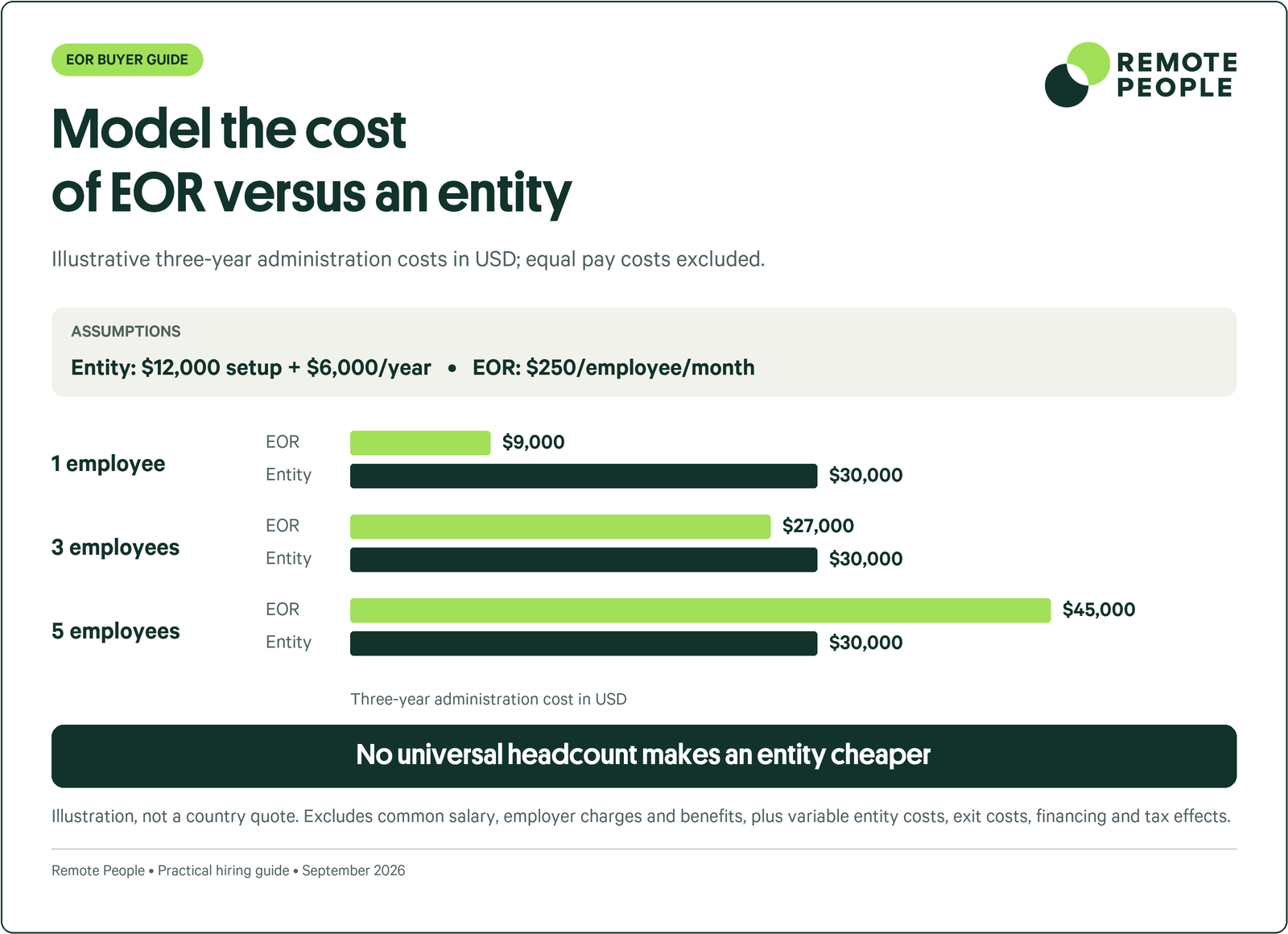
The headline numbers often mislead because the comparison shifts dramatically with scale. Below is a side-by-side cost model for a German team over a 3-year horizon at 2, 8, and 25 employees, using mid-market salary assumptions and standard local accounting overhead.
Scenario (Germany, 3 years) | 2 employees | 8 employees | 25 employees |
|---|---|---|---|
Subsidiary setup (one-time) | $30,000 | $30,000 | $30,000 |
Subsidiary ongoing accounting + legal (3 yrs) | $54,000 | $72,000 | $108,000 |
Subsidiary 3-year overhead | $84,000 | $102,000 | $138,000 |
EOR setup | $0 | $0 | $0 |
EOR fees over 3 years ($600/mo per worker) | $43,200 | $172,800 | $540,000 |
EOR 3-year overhead | $43,200 | $172,800 | $540,000 |
Cheaper option | EOR by $40K | Subsidiary by $71K | Subsidiary by $402K |
Three takeaways from the numbers. First, the crossover lands around 4 to 6 workers in one country at the 3-year mark. Second, above 8 workers the per-employee EOR fee compounds quickly while the subsidiary’s costs are largely fixed. Third, the math shifts country by country: in Brazil or India where setup costs are higher and accounting cheaper, the crossover happens later (closer to 8 to 10 workers); in the UK or Singapore where setup is faster and cheaper, it happens earlier (3 to 5 workers).
When to Pick Each Model
|
Situation |
Pick |
Why |
|---|---|---|
|
1 to 5 employees in country, market still being tested |
EOR |
Speed and capital efficiency outweigh per-employee fees |
|
5 to 15 employees, market proven, multi-year commitment |
Subsidiary (or transition planned) |
Crossover already passed; setup investment pays back inside year 2 |
|
20+ employees in one country |
Subsidiary |
EOR fees are now the largest line item; subsidiary saves six figures annually |
|
Need country-specific tax incentives (R&D credits, SEZ status) |
Subsidiary |
EORs cannot claim those on your behalf; only registered entities qualify |
|
Need local banking, real estate ownership, or to sign in your name |
Subsidiary |
EOR cannot sign in your company’s name; only their entity |
|
Time pressure (need first hire in 60 days) |
EOR |
Subsidiary timeline doesn’t fit; even fast jurisdictions take 90+ days |
|
Cannot afford $25K to $60K upfront |
EOR |
Capital constraint; EOR is monthly opex with no upfront capital outlay |
|
Want a clean exit option if the market fails |
EOR |
EOR engagement terminates in 30 days; subsidiary closure takes 6 to 12 months and $5K to $15K |
The Hybrid Strategy: EOR First, Then Subsidiary
The fastest international expansion strategy used by mature SaaS and services companies is to use EOR for the first 6 to 18 months while you confirm market fit, then transition to your own subsidiary once the team stabilizes above 5 to 8 employees. This avoids the capital risk of premature entity setup while preserving the cost advantage of subsidiary ownership at scale.
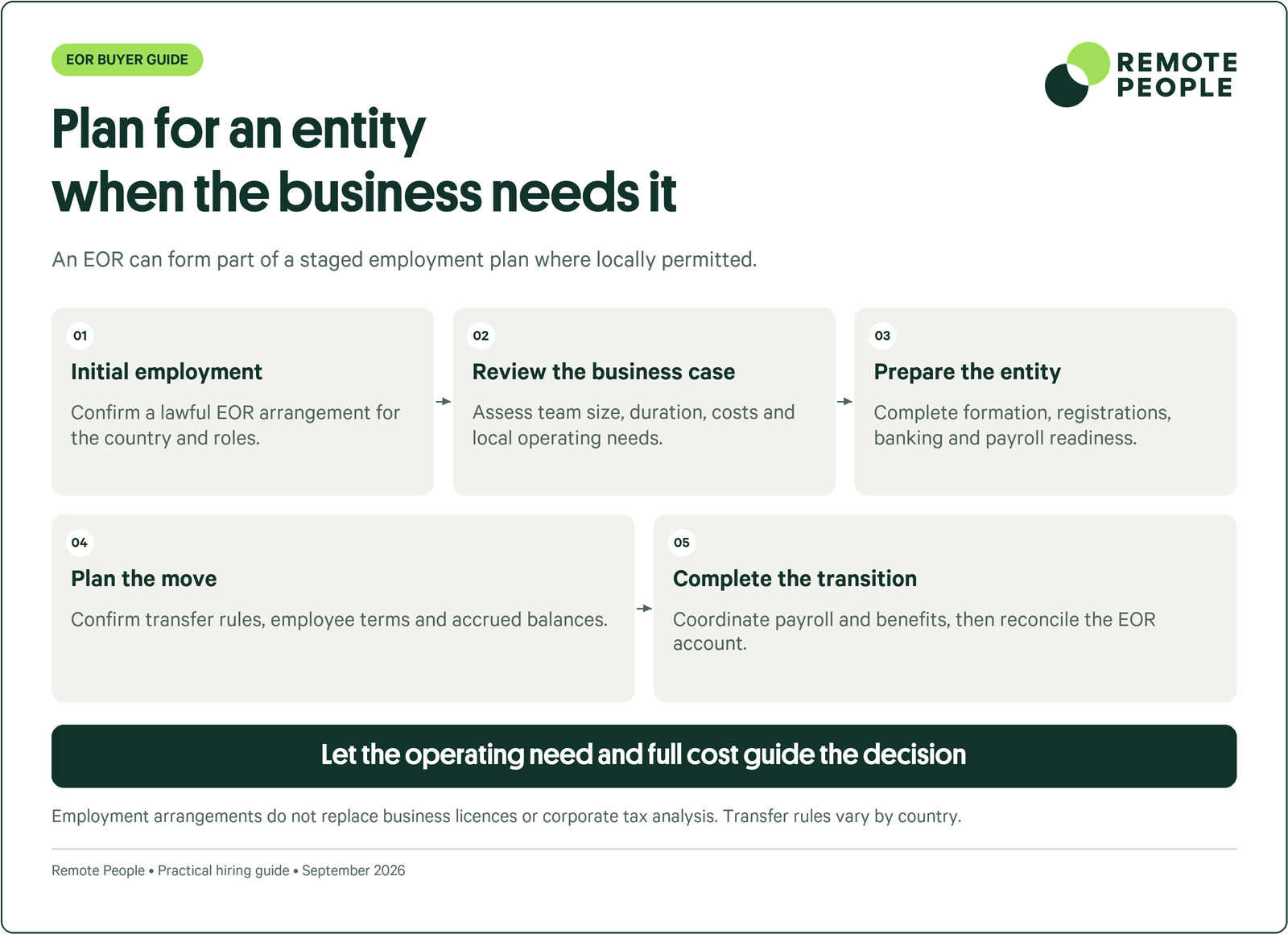
The transition usually works like this:
- You hire 1 to 3 employees through EOR, validate the market and refine roles
- The team grows to 5 to 8 employees and shows multi-year stability
- You incorporate a subsidiary in parallel (3 to 9 month process)
- EOR-employed workers transfer to the new subsidiary on a coordinated date
- EOR engagement winds down with no asset cleanup
Most EOR providers worth working with help facilitate the transition: the local entity is set up while EOR-employed workers continue uninterrupted, then a coordinated cutover moves contracts, payroll, and benefits from the EOR’s entity to your new subsidiary. Continuity-of-service language in the new contracts protects the worker’s accrued rights.
Common Subsidiary Setup Mistakes
- Setting up the subsidiary before you’ve hired anyone. A subsidiary with no workers in it still owes annual filings, registered office fees, and accounting. Don’t incorporate until you have at least one offer accepted and a clear path to 3+ workers within 12 months. The intervening “we have no one yet but the entity is ready” phase costs $10K to $30K of dead overhead.
- Not budgeting for ongoing accounting and legal. The recurring $1,500 to $5,000 per month overhead is the largest cost most CFOs forget. Build it into the 3-year ROI model upfront, not after the first invoice arrives.
- Choosing the wrong entity type. Some entity forms don’t qualify for tax incentives or limit liability the way you’d expect. Local counsel should confirm the entity type before you incorporate; the Big Four firms frequently default to the most-common structure rather than the optimal one for your scenario.
- Underestimating wind-down cost. Closing a subsidiary takes 6 to 12 months and $5K to $15K in legal fees. Don’t open a subsidiary you might close within 3 years. If commitment is uncertain, stay on EOR.
- Ignoring transfer-pricing rules. Transactions between the new subsidiary and the parent (cost allocations, IP licensing, management fees) can trigger transfer-pricing audits. Have local tax counsel set up an arms-length pricing structure before the first invoice flows.
What to Do Next
Three concrete next steps depending on where you are:
- Run the cost math for your specific country and team size. The crossover is around 4 to 8 employees in most markets but varies. Use mid-market salary assumptions and a 3-year horizon.
- For 1 to 10 employees per country, default to EOR. Speed and capital efficiency outweigh the per-employee fee at small scale.
- Plan the EOR-to-subsidiary transition before you hit 15 employees in country. Subsidiary setup takes 3 to 9 months; start it before you actually need it.
If you’re hiring 1 to 10 employees in a new country and don’t want a 6-month entity setup process, see how RemotePeople’s EOR works in 150+ countries. Operational in 5 to 14 days, no setup cost, owned entities everywhere we operate.
Already considering subsidiary transition or evaluating other entry vehicles? See Market Entry Comparison for the full subsidiary vs branch vs rep office vs EOR breakdown, or EOR vs Foreign Employer Registration for a third option that sits between the two.
Frequently Asked Questions
The crossover usually sits between 4 and 8 employees per country at a 3-year horizon. Below that, EOR is cheaper because subsidiary setup ($20K to $60K) plus ongoing accounting ($1,500 to $5,000/month) outweighs EOR per-employee fees. Above that, the math flips: subsidiary fixed costs are stable while EOR fees grow linearly with headcount. Most companies switch when a country team stabilizes above 5 to 8 workers and shows multi-year commitment.
Typically 3 to 9 months end to end, depending on the country. Faster jurisdictions: UK, Singapore, Estonia, Ireland (3 to 4 months). Slower jurisdictions: Brazil, India, China, Argentina (6 to 9+ months). The longest single delay is usually local bank account opening, which can take 30 to 90 days after entity formation. Add another 30 to 60 days to set up local payroll and benefits providers before the entity can hire.
Setup runs $20,000 to $60,000 in legal, registration, notarization, capital deposit, and bank-account fees. Ongoing costs: local accounting $1,500 to $3,500 per month, local legal counsel a few thousand per quarter (variable), plus statutory annual filings and audit costs in some countries. Budget the 3-year ROI carefully; the ongoing line items are easy to under-estimate.
Yes, this is common during the transition phase. New hires onboard onto the subsidiary while EOR-employed workers either stay on EOR (often for tax-year continuity) or transfer over on a coordinated cutover date. Some companies keep an EOR for one or two countries and run subsidiaries elsewhere indefinitely; the two models coexist cleanly.
For most countries at a 3-year horizon: 4 to 8 employees. Higher-cost subsidiary jurisdictions (Brazil, India) push the crossover later (8 to 10 workers). Lower-cost jurisdictions (UK, Singapore, Estonia) push it earlier (3 to 5 workers). Higher worker salaries also push the crossover earlier because EOR fees are partly percentage-of-payroll in some pricing models.
They transfer to the new subsidiary on a coordinated date. The EOR drafts a release, the subsidiary issues new local employment contracts with continuity-of-service language preserving accrued benefits and tenure, payroll moves to the subsidiary's payroll system, and statutory benefits transfer to the subsidiary's plans. The transition is usually handled by the EOR provider as part of the wind-down service.
Yes, but it costs $5,000 to $15,000 in legal and administrative fees and takes 6 to 12 months for the entity to be fully struck off. Some countries (Brazil, India, China) have longer wind-down timelines. The 6 to 12 month closure overhead is one of the strongest arguments for staying on EOR while market commitment is uncertain; EOR engagements terminate in 30 days with no entity wind-down.
Yes. R&D tax credits, special economic zone incentives, local hiring grants, and most country-specific tax benefits require a registered local entity. EORs cannot claim these on your behalf. If the country's incentive structure is meaningful for your business (UK R&D credit, Singapore EDB programs, Brazilian tax-zone benefits), the subsidiary's incentive access alone can justify earlier setup despite the higher overhead.




