
 Recruit
Average Salary in Bahrain
-
 Drew Donnelly
- Published
- September 21, 2026
Curious about salaries in Bahrain? This guide breaks down the average wages, compares professions, highlights minimum wage figures, and explores how Bahrain’s earnings measure up internationally.
- 5 ★ on G2








Let RemotePeople handle payroll, compliance, and HR admin worldwide so you can focus on building your team.
Bahrain’s skilled workforce, cost-effective labor, and strategic location make it an excellent outsourcing destination. Employers looking to hire in the area may wonder, “What is the average salary in Bahrain?” This information will help them prepare a competitive hiring offer.
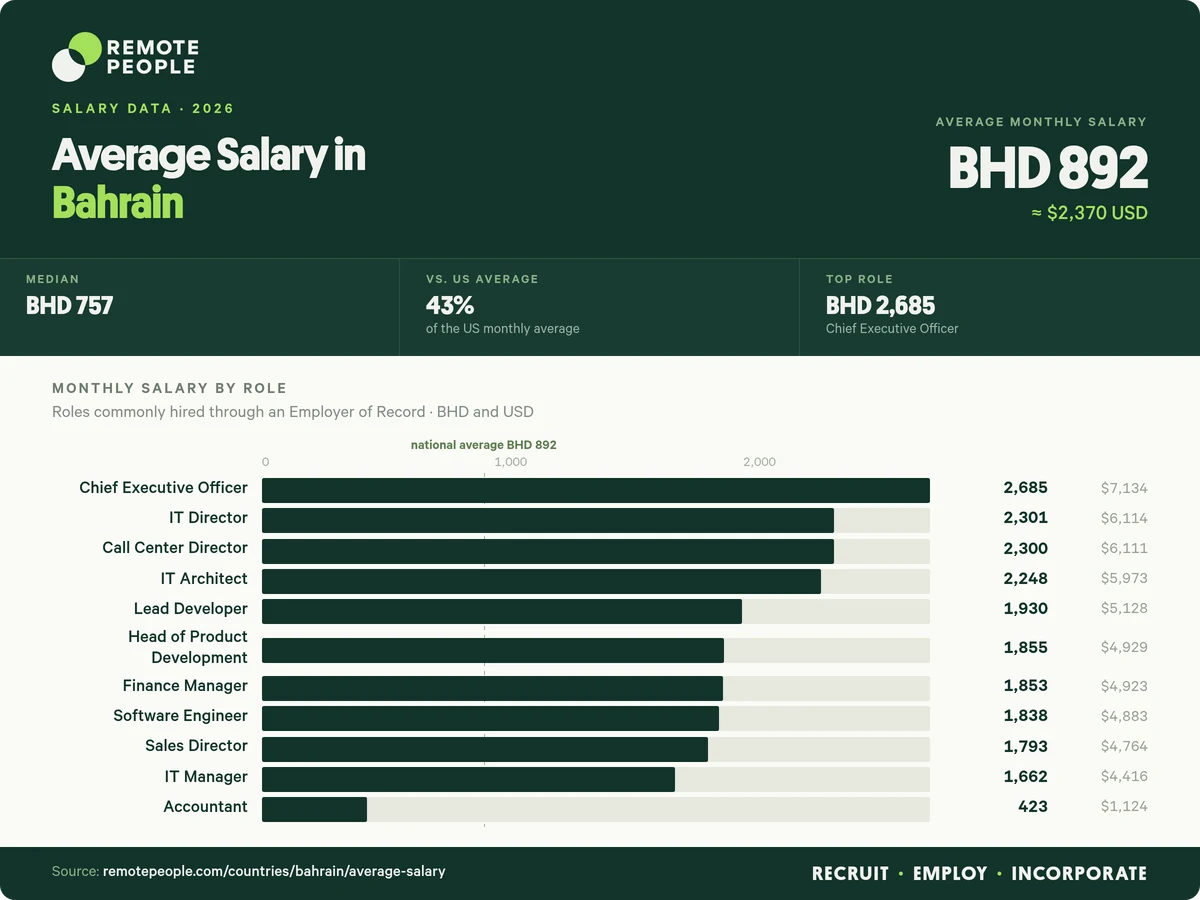
The average salary in Bahrain is 892 Bahraini dinar (BHD), about USD 2,370. However, salaries vary by experience, education, position, industry, and location. Comparing wages in the country to earnings worldwide provides additional insight.
This guide will explore all aspects of Bahraini salaries to prepare employers for international partnerships.
What is the Average Salary in Bahrain?
The average salary in Bahrain is 892 BHD, about $2,370. Wages in the country are moderate due to a diverse economy driven by lucrative industries like oil, gas, tech, and finance. However, they are limited by a lack of minimum wage for the private sector and a large expatriate workforce that creates a competitive landscape.
Median Income
The median salary in Bahrain is 757 BHD, about $2007. Half the country’s population earns higher wages; the other half earns less.
Salary Range
Salaries in Bahrain span from 433 BHD (roughly $1,148) to 1,434 BHD (about $3,803) monthly. However, wages vary significantly by industry.
Salary Comparisons in Bahrain
Average salaries provide insight, but you must consider how wages vary by experience, industry, position, education, and location. The following sections will explore how these factors impact wages.
Salary by Position
This salary comparison chart reveals how wages vary by position.
Position | Average Monthly Salary (BHD) |
|---|---|
Chief Executive Officer | 2,685 |
IT Director | 2,301 |
Call Center Director | 2,300 |
IT Architect | 2,248 |
Lead Developer | 1,930 |
Head of Product Development | 1,855 |
Finance Manager | 1,853 |
Software Engineer | 1,838 |
Sales Director | 1,793 |
IT Manager | 1,662 |
General Laborer | 462 |
Packer | 458 |
Banking Cashier | 446 |
Seamstress | 438 |
Accountant | 423 |
Porter | 423 |
Medical Records Clerk | 422 |
Tailor | 418 |
Social Counselor | 409 |
Average Wage in Bahrain Based on Education
Education plays a huge role in Bahraini wage determination and contributes heavily to income inequality. Families in rich areas have access to better education, ensuring children are skilled to qualify for high-paying jobs when they get older.
Meanwhile, families in poor areas don’t have access to education and are unable to qualify for positions with better wages, resulting in a vicious cycle.
Additionally, the minimum wage in the country varies according to educational degree.
Salary Comparison by Experience
Experience impacts salaries in Bahrain as follows:
Experience Level | Typical Monthly Salary (BHD) |
|---|---|
Entry-level | 300 – 450 |
Mid-level | 750 – 1,200 |
Senior-level | 1,333 – 2,083 |
Salary Comparison by Location
Location impacts salaries as workers in urban areas tend to earn more than rural workers due to higher living costs and proximity to large companies offering high-paying job opportunities.
For example, workers in the capital city of Manama tend to earn more than those in the country’s towns and cities. Hidd, Riffa, and Maharraq also offer decent job opportunities.
Studies on education also reveal that 18% of families in the Northern governorate have a high monthly income between 9,600 and 72,000 dinars. This compares to:
Location | Salary Difference from National Average |
|---|---|
Muharraq | +11% |
Central | +9% |
Southern | +9% |
Capital | +6% |
Compare the average salary with the minimum wage in Bahrain by checking out our guide to the minimum wage in Bahrain.
Education Level | Average Monthly Salary (BHD) |
|---|---|
High school graduates | 300 |
Diploma holders | 380 |
Bachelor’s degree holders | 450 |
Average Salary in Bahrain vs. the Rest of the World
To provide more insight, the following charts compare Bahrain salaries to wages in developed, developing, and undeveloped countries.
Bahrain vs. Developed Countries
Country | Average Salary | Comparison to Average Bahrain Salary |
|---|---|---|
Japan | 340,000 JPY (approx. $2,300) | 6% |
United Kingdom | £3,000 (approx. $4,100) | − 40% |
Norway | 50,000 NOK (approx. $4,700) | − 48% |
Germany | €4,300 (approx. $4,470) | − 45% |
Austria | €3,700 (approx. $4,050) | − 40% |
Bahrain vs. Developing Countries
Country | Average Salary | Comparison to Average Bahrain Salary |
|---|---|---|
Romania | 4,000 RON (approx. $835) | 192% |
Russia | 73,700 RUB (approx. $700) | 249% |
Albania | 83,330 ALL (approx. $860) | 184% |
Kazakhstan | 342,000 KZT (approx. $645) | 278% |
Ukraine | 18,000 Hryvnia (approx. $500) | 388% |
Bahrain vs. Undeveloped Countries
Country | Average Salary | Comparison to Average Bahrain Salary |
|---|---|---|
Afghanistan | 13,200 AFN (approx. $150) | 1,527% |
Philippines | 15,000 PHP (approx. $265) | 821% |
Cambodia | 1,150,000 Riel (approx. $280) | 771% |
Egypt | 3,900 EGP (approx. $125) | 1,852% |
Pakistan | 60,000 PKR (approx. $210) | 1,062% |
Bahrain is a developed country with a high-income economy and a High Human Development Index. It boasts a well-developed infrastructure and a diverse and stable workforce. Major sectors include oil, gas, finance, manufacturing, and tourism.
The country is emerging as an effective outsourcing destination due to its cost-effective labor, skilled workforce, and government support. It offers lower operating costs than established outsourcing markets in the MENA region, like the UAE and Saudi Arabia. Strategically situated in the Gulf Cooperation Council (GCC) center, it offers easy access to major regional markets.
What are the Most Common Outsourced Industries in Bahrain?
Employers seeking remote opportunities in the country will benefit most when focusing on the following sectors.
Finance
Bahrain is considered a central financial hub in the Middle East, attracting various foreign investors and businesses. It especially stands out for its fintech innovations and regulatory framework, which supports open banking, crowdfunding, and cryptocurrency. The Central Bank of Bahrain regulates the sector, which offers optimal stability and integrity.
Construction and Engineering
The country offers a robust and rapidly developing construction and engineering sector. Government policies like Vision 2030 and the National Renewable Energy Action Plan are driving growth in the industry. Bahrain focuses on infrastructure projects such as creating new cities, leading to more opportunities in the sector.
IT Services
Bahrain’s tech industry is growing at lightning speed due to government initiatives and digital transformation investments. Key growth areas include fintech, cybersecurity, AI, cloud computing, and IoT. It offers a business-friendly environment with 100% foreign ownership and zero taxes.
IT managers in Bahrain earn about 1,663 BHD monthly, about $4,408, while their American counterparts earn closer to $8,333, giving employers plenty of bargaining power.
Conclusion
Bahrain’s cost-effective labor, skilled workforce, and strategic location make it an excellent outsourcing destination. Its moderate average salary results in reduced expenses for employers in many countries. The exceptional products and services can help some organizations become industry leaders.