
 Recruit
Average Salary in Bangladesh
-
 Drew Donnelly
- Published
- September 21, 2026
Curious about salaries in Bangladesh? This guide breaks down the average wages, compares professions, highlights minimum wage figures, and explores how Bangladesh’s earnings measure up internationally.
- 5 ★ on G2








Let RemotePeople handle payroll, compliance, and HR admin worldwide so you can focus on building your team.
Bangladesh is an ideal outsourcing destination due to its low costs, skilled worker pool, and quality consistency. Employers looking to outsource in the region may wonder, “What is the average salary in Bangladesh?” This article will provide insightful information, allowing you to make a fair offer.
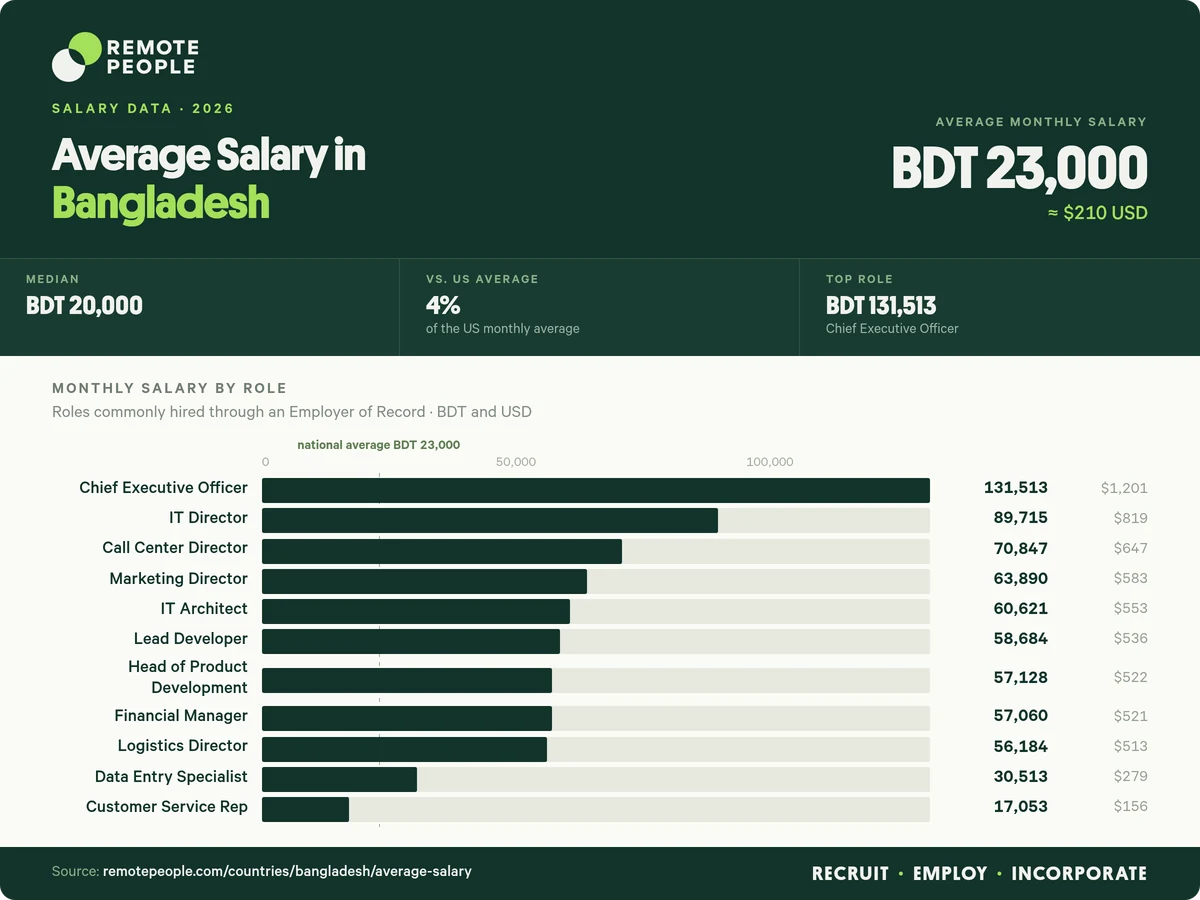
The average salary in Bangladesh is approximately 23,000 Bangladesh taka (BDT), which translates to about USD 210. However, salaries vary depending on the profession, experience, education, and location.
We will review various factors to ensure you have complete insight into Bangladesh’s average income.
What is the Average Salary in Bangladesh?
You can calculate the average salary by adding wages across the country and dividing the total by the number of workers. The average Bangladesh salary is 23,000 BDT or $210. The low wages are mainly attributed to the country’s low cost of living.
Median Income
The median salary can also be considered the middle salary. Bangladesh’s median monthly income is 20,000 BDT, which means 50% of workers make more than 20,000 BDT, and the other half make less.
Salary Range
The salary range spans the lowest to highest salaries in the country. Low-paid workers in Bangladesh can make as little as 13,000 BDT. High-paid workers make closer to 60,000 BDT.
Salary Comparison by Profession
Industry and profession are strong variables in salary determination. Skilled workers in demanding industries tend to make more than manual laborers. This salary comparison chart reveals how much workers earn across various industries.
Profession | Salary (BDT) |
|---|---|
Chief Executive Officer | 131,513 |
IT Director | 89,715 |
Call Center Director | 70,847 |
Plant Manager | 63,059 |
Marketing Director | 63,890 |
IT Architect | 60,621 |
Lead Developer | 58,684 |
Head of Product Development | 57,128 |
Financial Manager | 57,060 |
Logistics Director | 56,184 |
Data Entry Specialist | 30,513 |
Customer Service Rep | 17,053 |
Textile Technologist | 14,426 |
Cashier | 14,252 |
General Laborer | 14,203 |
Packer | 14,130 |
Medical Records Clerk | 13,816 |
Seamstress | 13,491 |
Social Counselor | 12,617 |
Average Wage in Bangladesh by Education
Education plays a factor in how much money Bangladesh workers earn. Here are some statistics to consider.
- A worker with a college degree can earn 17% more than someone with a high school diploma.
- Individuals with a Bachelor’s degree can earn 24% more than workers with associate’s degrees.
- Professionals with a Master’s degree can earn about 29% more than workers with a Bachelor’s degree.
- Those with PhDs can make 23% more than workers with Master’s degrees.
Salary Comparison by Experience
Experience also plays a role in Bangladesh salary calculations. These statistics reveal how experience can impact salaries.
- Workers with 2-5 years of experience can make 32% more than entry-level workers.
- Professionals with 5 years of experience can make about 36% more than workers with 2-5 years of experience.
- Workers with 6-9 years of experience can increase earnings by 21% in this bracket.
- Professionals with 15 years or more experience can earn 14% higher salaries than less skilled employees.
Salary Comparison by Location
Location is another factor to consider when determining salaries. Workers in urban areas tend to make more than workers in rural areas due to a higher cost of living and proximity to big companies offering more job opportunities.
Rural workers tend to make closer to minimum wage.
This chart provides average salaries in the urban areas of Bangladesh.
City | Average Monthly Salary (BDT) |
|---|---|
Dhaka | 29,700 |
Chittagong | 28,700 |
Chandpur | 24,000 |
Jamalpur | 24,600 |
Rajshahi | 28,400 |
Compare the average salary with the minimum wage in Bangladesh by checking out our guide to the minimum wage in Bangladesh.
Average Salary in Bangladesh vs. the Rest of the World
Comparing Bangladeshi salaries to those earned worldwide allows you to gain perspective on regional workers’ wages. The following charts compare Bangladeshi salaries to those earned in developed, undeveloped, and developing countries.
Bangladesh vs. Developed Countries
Country | Average Salary | Comparison to Average Bangladesh Salary |
|---|---|---|
United Kingdom | £3,000 (approx. $4,100) | − 93% |
United States | $5,220 | − 94% |
Norway | 50,000 NOK (approx. $4,700) | − 94% |
Germany | €4,300 (approx. $4,470) | − 94% |
Austria | €3,700 (approx. $4,050) | − 93% |
Bangladesh vs. Developing Countries
Country | Average Salary | Comparison to Average Bangladesh Salary |
|---|---|---|
Romania | 4,000 RON (approx. $835) | − 65% |
Russia | 73,700 RUB (approx. $700) | − 59% |
Albania | 83,330 ALL (approx. $860) | − 66% |
Kazakhstan | 342,000 KZT (approx. $645) | − 55% |
Ukraine | 18,000 UAH (approx. $500) | − 42% |
Bangladesh vs. Undeveloped Countries
Country | Average Salary | Comparison to Average Bangladesh Salary |
|---|---|---|
Afghanistan | 13,200 AFN (approx. $150) | 93% |
Philippines | 15,000 PHP (approx. $265) | 9% |
Vietnam | 7.5 million Dong (approx. $300) | − 3% |
Egypt | 3,900 EGP (approx. $125) | 132% |
Pakistan | 60,000 PKR (approx. $210) | 38% |
Although Bangladesh is considered a developing country, it is recognized as one of the most successful Least Developed Countries and is expected to graduate from this status. The country has experienced significant economic growth, making it one of the fastest-growing economies in the world. It is an excellent source for skilled workers willing to accept low wages due to the low cost of living.
The work economy is primarily based on agriculture and the garment industry. However, the tech sector is growing rapidly. Companies often hire workers from the region to handle IT, e-commerce, and digital marketing.
What are the Most Common Outsourced Industries in Bangladesh?
Garment Manufacturing
Many companies focused on garment manufacturing turn to Bangladesh for supply fulfillment. The country offers highly skilled workers and efficient systems. Manufacturers are also flexible and accommodate small and large orders.
A 2020 report revealed Bangladesh-made men’s cotton trousers sold for $7.01 per piece, 9.2% below hte global average of $7.72.
IT Services
IT Services – Bangladesh’s IT industry is growing rapidly. The country offers a large pool of tech talent in the e-commerce, fin-tech, and healthcare sectors. It is a central outsourcing hub that attracts clients from around the world.
IT workers in the country typically make between 40,000 BDT (approx. $365) and 50,000 BDT (approx. $456) per month. Meanwhile, workers in America make between $4,113 and $5,057 per month, giving American employers plenty of bargaining power.
Pharmaceutical Research and Development
Bangladesh’s pharmaceutical industry has grown rapidly since the country declared independence from Pakistan. It accounts for 97% of domestic demand and exports to the U.S., Australia, and Europe. The industry remains competitive by saving 70% on imported raw materials.
Many countries turn to Bangladesh for research and development. The country offers expert scientists, researchers, and pharmaceutical experts who can launch research initiatives at a fraction of the cost.
Conclusion
Bangladesh offers highly skilled workers willing to earn competitive salaries. Companies that use the country’s resources can save considerable amounts on human resource expenses, which benefits all parties involved.